The National Transitional Council (NTC) must get a grip on armed anti-Gaddafi groups to stop reprisal attacks and arbitrary arrests, Amnesty International warned as it released a major report into human rights violations during the Libyan conflict.
The 107-page report The Battle for Libya: Killings, Disappearances and Torture reveals that while al-Gaddafi forces committed widespread crimes under international law during the conflict, forces loyal to the NTC have also committed abuses that in some cases amounted to war crimes.
“The new authorities must make a complete break with the abuses of the past four decades and set new standards by putting human rights at the centre of their agenda” said Claudio Cordone, Senior Director at Amnesty International.
“The onus now is on the NTC to do things differently, end abuses and initiate the human rights reforms that are urgently needed.”
Bob Turner, the Republican candidate campaigning to replace disgraced Democratic Rep. Anthony Weiner, picked up a crucial endorsement last week when Democratic Assemblyman Dov Hikind threw his support to him. Hikind is the former leader of the the Jewish Defense League (JDL), which the FBI lists as a terror organization. He was also a confidant of the fanatical Israeli settler leader Meir Kahane, who called for the “slaughter” of Palestinians. Under Kahane’s direction, Hikind operated a front group with the JDL cadre Victor Vancier (aka Chaim Ben Pesach), who served 10 years in prison for carrying out numerous firebomb attacks on innocent people, and openly contemplated killing the renowned Palestinian professor Edward Said. According to journalists Michael Karpin and Ina Friedman, “Hikind had been suspected [by the FBI] of similar activities” including a string of six bombings against Arab-American targets across the United States.
Hikind once told the journalist Robert I. Friedman that he supported a Jewish terrorist underground that assassinates Nazis. “If it is a group that is made up of people who are intelligent professionals and their goal is to execute those clearly responsible for killing tens of thousands, then I would have no trouble with that,” Hikind said. Hikind added that he also favored the assassination of Arab-American supporters of the PLO. The JDL was widely suspected of killing Arab-American Anti-Discrimination committee western regional director Alex Odeh in 1985, though the FBI was never able to apprehend the likely perpetrators. In 2001, JDL leaders Irv Rubin and Earl Krugel were arrested for conspiring to blow up a Los Angeles-area mosque and assassinate Republican Rep. Darrell Issa, who is of Lebanese descent.
Hikind’s terrorist links were never raised by Bob Turner’s Democratic opponent, David Weprin. Instead, Weprin joined Turner in the pro-Israel competition that has become a hallmark of American political campaigns, attacking President Barack Obama’s policy towards Israel as “outrageous.”
We are all going to be invited to the funeral of the two-state solution if and when the UN General Assembly announces the acceptance of Palestine as a member state.
The support of the vast majority of the organization’s members would complete a cycle that began in 1967 and which granted the ill-advised two-state solution the backing of every powerful and less powerful actor on the international and regional stages.
Even inside Israel, the support engulfed eventually the right as well as the left and center of Zionist politics. And yet despite the previous and future support, everybody inside and outside Palestine seems to concede that the occupation will continue and that even in the best of all scenarios, there will be a greater and racist Israel next to a fragmented and useless bantustan.
The charade will end in September or October — when the Palestinian Authority plans to submit its request for UN membership as a full member — in one of two ways.
It could be either painful and violent, if Israel continues to enjoy international immunity and is allowed to finalize by sheer brutal force its mapping of post-Oslo Palestine. Or it could end in a revolutionary and much more peaceful way with the gradual replacement of the old fabrications with solid new truths about peace and reconciliation for Palestine. Or perhaps the first scenario is an unfortunate precondition for the second. Time will tell.
Prime Minister Benjamin Netanyahu’s cabinet on Sunday approved a plan to relocate tens of thousands of Bedouin from their unrecognized villages into settlements with official state status.
The plan emerges from the Prawer Report, drafted to find a solution to the problem of unrecognized villages in the Negev.
As part of the plan, some 20,000 to 30,000 Bedouon will be relocated to recognized settlements including Rahat, Khura and Ksayfe. The plan also includes financial compensation for those relocated, as well as alternate plots of land. The program is estimated to cost the state NIS 6.8 billion.
Opponents of the plan have accusing the government of evacuating people from their homes for no justified reason and against their will.
Bedouin representative called the decision “a declaration of war,” and some 150 members of the community gathered outside the prime minister’s office in Jerusalem on Sunday to protest the decision.
“This stupid government will be responsible for a Bedouin Intifada in the Negev,” said Arab MK Taleb al-Sana, who took part in the protest.
Adalah, the Legal Center for Arab Minority Rights in Israel, slammed the government’s approval of the plan as a major violation of basic rights, pointing out that it would result in the uprooting of tens of thousands of people and the demolition of many Bedouin villages.
The Association for Civil Rights in Israel in June submitted its objections to the Prawer Report and argued that the conditions it sets for recognizing Bedouin villages are prejudicial.
These include meeting minimal levels of population density, contiguity and economic sustainability. The criteria established, the organization maintains, flout principles of equality and justice in the distribution of resources. “If the same criteria were applied to the Jewish population, whole settlements – including community settlements, observatories, kibbutzim and moshavim – would be doomed,” the association notes.
Moreover, according to its claims, Bedouin villages are planned without considering the needs of the population, which is largely agrarian and rural, not urban. The association also opposes making any planning for the Bedouin conditional on settling disputes over land ownership.
Jordanian King Abdullah II said Monday that Israel’s position in the Middle East has deteriorated in the wake of the recent wave of Arab uprisings, telling a group of intellectuals that the Palestinians now have a “more secure future” than Israel.
Israel’s position is “more problematic than it has been in the past”, Abdullah told the group of authors and academics gathered at the royal palace in Amman, according to Army Radio.
The Jordanian king told the group that he had expressed these views on a recent visit to the United States. An Israeli intellectual told the king that he believed that the Arab Spring would serve Israeli interests, whereupon Abdullah answered he felt that the opposite would be true.
King Abdallah also related to proposals advocated by some Israeli rightists that his country fulfill the national aspirations of the Palestinian people. Abdallah called this so-called “Jordanian option” an unacceptable fantasy plan. He said that Jordan can never take the place of a substitute Palestinian homeland.
The king added that no American or European official has ever pressured him to support a solution to the Palestinian refugee problem that would come at the expense of the kingdom, according to Israel Radio.
Turkish Prime Minister Tayyip Erdogan saw “cause for war” with Israel last year after a deadly raid on a Turkish ship headed for Gaza, according to a transcript of a recent interview.
State news agency Anatolia released late on Sunday what it said was an original Turkish-language transcript of an interview Erdogan gave to Al Jazeera television last week. It included elements not broadcast as well as original wording for sensitive comments that had been transmitted only in Arabic translation.
Among previously unpublished elements, Erdogan said Israel’s deadly raid last year on the Gaza-bound flotilla would have justified going to war: “The attack that took place in international waters did not comply with any international law. In fact, it was cause for war. However, befitting Turkey’s greatness, we decided to act with patience,” he said.
The transcript in Turkish from Anatolian, apparently provided by Erdogan’s office, also gave the following account of the prime minister’s response to a question on what Turkey would do to ensure free passage for its ships in the Mediterranean.
“Right now, without a doubt, the primary duty of Turkish navy ships is to protect its own ships,” Erdogan said.
“This is the first step. And we have humanitarian aid that we want to carry there. This humanitarian aid will not be attacked any more, as it was the case with Mavi Marmara.”
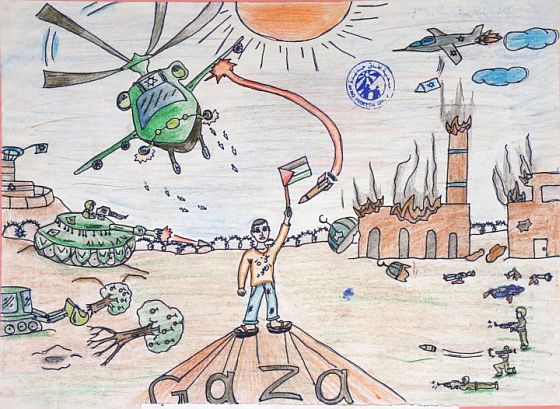
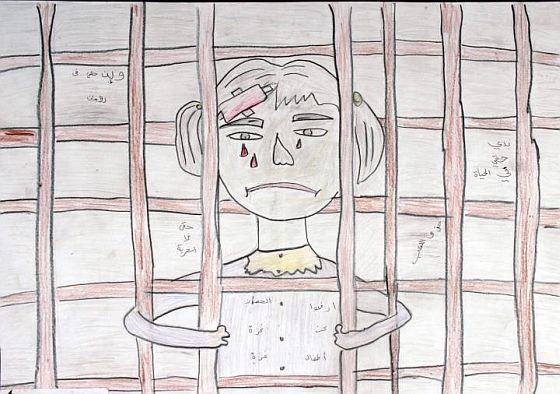
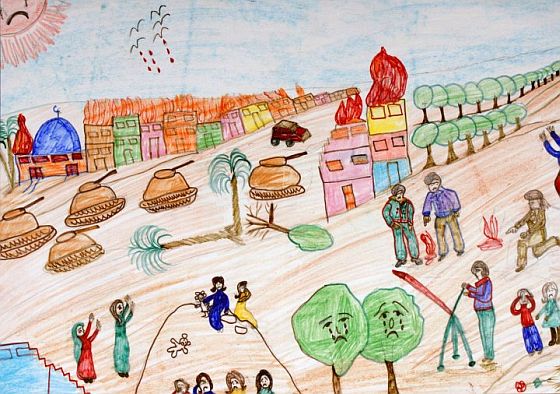
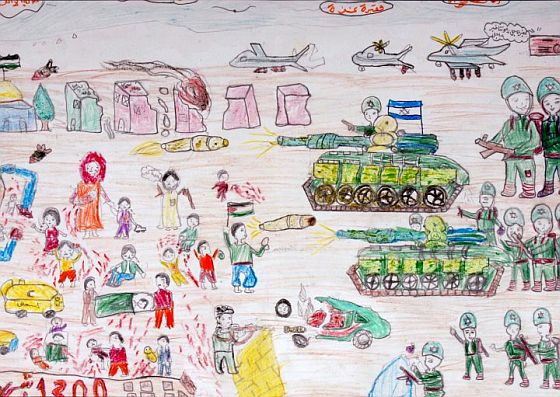
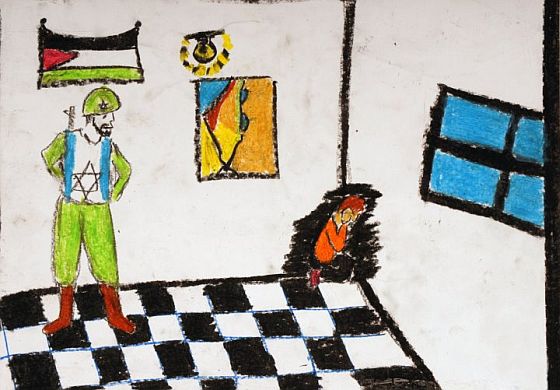
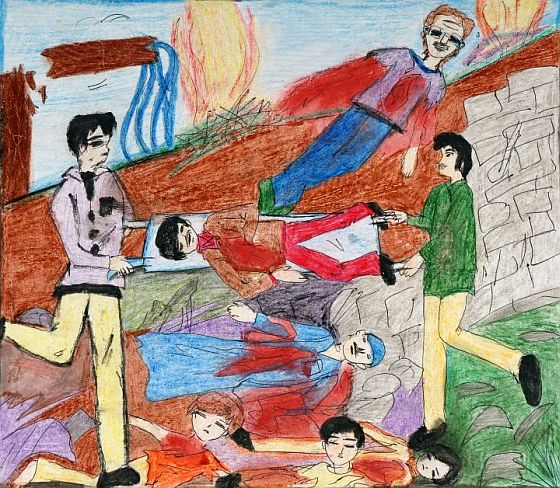
Berkeley, CA’s Middle East Children’s Alliance broke the news yesterday that the exhibit of children’s artwork from Gaza that they had worked on for months with Oakland’s Children’s Museum of Art was suddenly canceled by the board before the planned September 24 opening reception. The show featured drawings by children about Israel’s infamous Operation Cast Lead, the military assault of December 2008-January 2009 that led to the deaths of some 1,400 Palestinians, over 300 of them children.
(Check regularly at mecaforpeace.org for updates and planned actions- they won’t be taking this lying down.)
The Museum of Children’s Art in Oakland (MOCHA) has decided to cancel an exhibit of art by Palestinian children in the Gaza Strip. The Middle East Children’s Alliance (MECA), which was partnering with MOCHA to present the exhibit, was informed of the decision by the Museum’s board president on Thursday, September 8, 2011. For several months, MECA and the museum had been working together on the exhibit, which is titled “A Child’s View From Gaza.”
MECA has learned that there was a concerted effort by pro-Israel organizations in the San Francisco Bay Area to pressure the museum to reverse its decision to display Palestinian children’s art.
Barbara Lubin, the Executive Director of MECA, expressed her dismay that the museum decided to censor this exhibit in contradiction of its mission “to ensure that the arts are a fundamental part of the lives of all children.”
“We understand all too well the enormous pressure that the museum came under. But who wins? The museum doesn’t win. MECA doesn’t win. The people of the Bay Area don’t win. Our basic constitutional freedom of speech loses. The children in Gaza lose,” she said.
“The only winners here are those who spend millions of dollars censoring any criticism of Israel and silencing the voices of children who live every day under military siege and occupation.”
Egyptian activists and politicians accused the ruling military leaders of breaking a promise to end emergency law, after authorities said they would reintroduce special security courts following an attack on the Israeli embassy.
Eight months after protesters toppled President Hosni Mubarak and the military took power on an interim basis, many supporters of the protest movement say they are concerned that the military rulers are backsliding on reform pledges.
Ending emergency law, seen as a tool of Mubarak’s repression, has long been a key demand.
Israel pulled its ambassador out of Egypt after protesters stormed the building housing Israel’s embassy on Friday night.
Egypt’s military rulers said they would try suspects in emergency state security courts. Emergency law would now apply in cases such as blocking of roads, publishing false information and weapons possession, they said.
The measures add to a list of developments that activists say worry them, including the banning of cameras from important trials including that of Mubarak himself, and the army’s failure so far to set a firm date for a parliamentary election.
“The new procedure violate the constitutional decree that the military council issued after Mubarak, in which it pledged to end the state of emergency within six months and said a public referendum had to take place for it to be extended,” Mohamed Adel, leader of the April 6 youth group, told Reuters.
“Egyptian law has many rules against thugs and terrorism, so I still don’t see a reason to extend emergency law,” he added.
Presidential candidate Mohamed ElBaradei said: “It is the normal right of every Egyptian to be tried in front of an ordinary judge, but it is unfortunately not what we see as we are relying more on military and extraordinary courts.”
Emergency law was widely applied under Mubarak’s rule to stifle opposition. The law, in place for decades, gives the state ultimate powers to question or detain citizens.
It was due to be lifted before the parliamentary election which is expected anytime starting November. No poll date has yet been set, although the army has said procedures for a vote, such as voter registration, will start in September.
The Muslim Brotherhood, one of Egypt’s most organised political groups, condemned the use of emergency courts in one of its strongest statements against the military to date. The group, expected to benefit from an early vote, has tended to take a softer line than other activists in the past.
“We confirm our rejection of any attempt to abuse the events to issue martial laws or decrease the margin of freedoms,” the group’s political wing, the Freedom and Justice party, said.
The Islamist group condemned violence by protesters targeting the embassy and other police sites, but also blamed the army for not taking a tough enough stance against Israel.
Presidential hopeful and former Brotherhood leader Abdel Moneim Abul Futuh said he feared the new security measures were “part of a pre-prepared scenario to take over the revolution.”
“I warn the governing power in Egypt against moving forward in this path. And I hope everyone knows the Egyptian people will not allow such scenarios and will not allow their revolution to be aborted.”
Egyptians marched on the Israeli embassy in Cairo on Friday, demolished a wall built around the embassy building to protect it and stormed the Nile tower block that houses the mission.
Egyptian security forces raided the offices of an Egyptian affiliate of the Al Jazeera news network known for attentive coverage of street protests, eliciting allegations on Sunday of a crackdown on the news media as the military-led transitional government seeks to ensure law and order after allowing an angry mob to invade the Israeli Embassy over the weekend.
The raid on the television network came as both the Egyptian and Israeli governments began tentative steps to repair the diplomatic breach between the awkward allies after the embassy attack on Friday night.
The raid also came after a warning last week by Egypt’s minister of media, Osama Heikal, that the government would take legal action against stations that “endanger the stability and security” of the nation, and some analysts said they feared the raid could signal a broader effort to curtail the new freedoms of expression experienced since the uprising that ousted former President Hosni Mubarak this year.
The network, Al Jazeera Live Egypt, was founded in the aftermath of the uprising and has become known for its attentive, if not sensational, coverage of street protests, including the Israeli Embassy attack on Friday. The raid forced the network to halt its programming for a period before it resumed broadcasting from Al Jazeera’s headquarters in Doha, Qatar.
Officials of the Interior Ministry said they had raided the network because it lacked a license, and that neighbors had complained about noise. Numerous satellite channels have sprung up since the revolution, and Mr. Heikal, the media minister, said in his statement last week that the government would stop issuing new permits because of concerns about broadcasts that endangered stability.
But Islam Lotfy, a lawyer for the channel, said the channel had applied for a license in March without a response.
According to identical accounts offered by Egyptian officials and foreign diplomats in Cairo, Egypt had asked Israel before the developments of last Friday to keep the Israeli ambassador in Tel Aviv and to reduce the volume of its staff to the minimum, but Netanyahu insisted on sending the ambassador back only a few days before the latest protest.
“We are not expelling him, but we thought a long holiday for the Israeli ambassador in Egypt would be useful for all of us now; unfortunately, Israel thought otherwise and when anger erupted on Friday evening they had to solicit the intervention of the Americans who sent a plane to carry him and the rest of the staff out of Egypt,” said one official.
Today, there is a tacit agreement between Egypt and Israel that the long holiday for the ambassador is in place and there are guarantees offered by Cairo to both Washington and Tel Aviv that stepped up security measures will be in place to prevent another attack on the embassy.
In the Islamist Al-Dawa Al-Salafiya (Salafist Call) reaction statement to the protesters’ storming of the Israeli embassy in Cairo on 9 September, they slammed the attack as “not thought-out,” which will work in the favour of Israel.
The Salafist movement claims that the 9 September mobbing of the embassy “will work in favour of Israel and will transform them from perpetrators to victims and the focus will shift from our demands to amend the Camp David agreement to Israel’s calls for help to protect their embassy in Egypt.”
The movement also pointed out that the “Egyptians are united in their hate for Israel (thank God). We must fight cultural normalisation [with Israel] and we should push for the international isolation of Israel.”
The group also condemned the statement released by President Obama in which he told Egypt to “honour its international obligations to safeguard the security of the Israeli embassy,” and reminded the US president that Egypt has changed after the January 25 Revolution.
The statement also claimed that most of the calls for violence are actually from a US-backed ex-police officer, Omar Afifi, who resides in the US and uses the internet to incite divisions in Egypt.
The Israeli government must be exhilarated that it is no longer being held responsible for the chaotic events taking place in Egypt. Instead they are now being portrayed as victims of a different “foreign hand,” which sponsored the storming of their embassy in Cairo.
Friday’s incident at the Israeli Embassy, in which thousands of angry protestors – surprisingly – managed to storm the embassy, is being portrayed by Egypt’s flagship newspaper Al-Ahram as fueled by elements of the “counter-revolution” that seeks the fall of the Egyptian state.
In its main headline, the paper speaks of “the involvement of a number of neighboring countries in providing ‘huge beyond imagination’ funds to Egyptian NGOs.”
Justice Minister Abdel Aziz al-Guindi told Al-Ahram that a country from the Gulf gave LE181 million to a small Egyptian NGO.
Guindi added that he has received a report that shows that several neighboring countries have offered million of pounds to Egyptian human rights and civil society organizations, some of which are not registered.
He also said that he has submitted a report to the head of the Supreme Council of the Armed Forces (SCAF) and the prime minister to take appropriate action against the inflow of funds, adding that the cabinet will announce the report’s findings within the next few days.
Guindi added that these “foreign hands” – and local ones – have been behind other incidents of violence in Egypt, seeking to sabotage state institutions, undermine national security, and intimidate citizens.
One might cast doubt over the relationship between the demonstrations in front of the Israeli Embassy and a small NGO receiving millions of pounds, but Al-Ahram doesn’t address such logical inconsistencies.
An editorial in the same paper echoes the article’s sinister tone, with a lead blaring, “The secrets of the plot facing Egypt.”
It reads, “Today, the details of the plot facing Egypt are appearing. The plot doesn’t challenge the Egyptian revolution only; more dangerously, it aims to make Egypt reel in chaos.”
Following the events at the Israeli Embassy, the Egyptian government announced its intent to fully implement the decades-old Emergency Law.
It’s easy to forget that the repeal of the state of emergency was a top demand of protesters who took the streets against former President Hosni Mubarak in January and February. That mood has clearly changed now, although the SCAF declared last month that they had begun the process of ending the state of emergency before parliamentary elections that are expected to be held in November.
Despite this very fact, state-run Al-Gomhurriya praised the move of fully implementing the exceptional measures enshrined in the widely-reviled law. The newspaper runs a lengthy feature quoting “legal experts” defending the re-implementation of the law, saying that such a move would restore the prestige of the state and its stability.
There is unacknowledged freedom associated with whatever becomes inscribed in our individual and collective experience of transformative events. For many older Americans the events most vividly remembered are likely to be Pearl Harbour, the assassination of JFK, and the 9/11 attacks, each coming as a shock to societal expectations.
I doubt that other societies would have a comparable hierarchy of recollections about these three days that are so significant for an understanding of American political identity over the course of the last seventy years.
To make my point clearer, most Japanese would almost certainly single out Hiroshima, and possibly the more recent disaster that followed the 3/11/11 earthquake and tsunami that led to the Fukushima meltdown. Germans, and many Europeans, are likely to be inclined to remember the fall of the Berlin Wall, while most citizens of former colonies are undoubtedly moved by the day on which their national independence was finally achieved.
Because American responses to such transformative events are likely to be global in their effect, there is a greater tendency to share American preoccupations, but this is misleading because interpretations diverge depending on place and time. This diversity amid universality is probably truer for 9/11 than any other recent transformative event, not because of the drama of the attacks, but as a result of the connections with surges of violence unleashed both prior to the attacks and in their aftermath, what I would identify as the perspectives of 9/10 and 9/12.
Shifting ever so slightly the perspective of the observer radically alters our sense of the event’s significance. Just as 9/12 places emphasis on the American response – the launching of “the global war on terror”, 9/10 calls our attention to the mood of imperial complacency that preceded the attacks.
This national mood was (and remains) completely oblivious to the legitimate grievances that pervaded the Arab world.
These grievances were associated with Western appropriations of the region’s resources, Western support lent to cruel and oppressive tyrants throughout the Middle East, lethal and indiscriminate sanctions imposed for an entire decade on the people of Iraq after the first Gulf War, deployment of massive numbers of American troops close to Muslim sacred sites in Saudi Arabia, and America’s role in Israel’s oppressive dispossession of Palestinians and subsequent occupation.
From these perspectives, the crimes of 9/11 were an outgrowth of the wrongs of 9/10 and unreflectively led to the crimes and strategic mistakes made since 9/12.
In recent years, the Department of Homeland Security has provided grants for hundreds of police departments across America to buy $300,000 Lenco BearCats in the name of counter-terrorism.
In the wake of the September 11 attacks in 2001, a strange consensus quickly emerged in Washington: this was just al Qaeda’s first homeland assault. There would be further attacks and most likely what was to come would be even worse — far worse.
With a sense of foreboding and determination we ventured into the third great era for America as world leader — what was briefly dubbed a New American Century.
First came the fight against global fascism which resulted in unqualified victory at the end of World War Two.
Then came the American-led Western alliance to halt the advance of communism.
Even if the collapse of the Soviet Union didn’t bring communism to an end, the end of the Cold War supposedly marked the dawn of a New Global Order in which America reigned supreme as the sole Super Power.
And if after the Cold War, a decade of globalization lacked the ideological clarity needed to satisfy conservative America’s sense of righteousness and moral purpose, or the military focus that would satisfy the Pentagon, all of that was to end with 9/11 as once again the United States assumed its role as world savior.
A president whose own sense of purpose had until then extended no further than his desire to continue a family tradition, was now fired up with a mission as he led the world in a struggle between good and evil.
Yet behind Bush’s apparent boldness was the confidence of a man making a very safe bet.
In response to the attacks the president and the political class across America made a simple calculation: if they were to overstate the threat posed by terrorism they could do so with virtually no political risk and potentially great political rewards. Indeed, the greater the exaggeration the less the risk.
At the same time an honest assessment of the threat posed by al Qaeda would be freighted with enormous risk.
That meant that a dishonest assessment of the threat posed by terrorism would also be a safe assessment.
If there were no further major attacks then this would be taken as the measure of a successful counter-terrorism policy; not a reflection of al Qaeda’s inherent weakness.
Bush immediately understood this and quickly declared war. This, the neocons rapturously declared, was Bush’s great “insight”: we’re at war.
Since we couldn’t be sure exactly where the enemy was located, then just to be safe, we assumed he was everywhere. So this wasn’t going to be just another war — it would be a global war.
America had defeated fascism and then communism and now it was going to take on a battle soon predicted to last for the rest of our lives: a long war against global terrorism.
With the smoke still rising from the ruins of the Twin Towers, no one had the guts to state the obvious: whatever threat al Qaeda might pose, it was surely minute compared to the Soviet nuclear arsenal during the Cold War or the nation-crushing military forces of Japan and Germany during World War Two.
If 9/11 had really been another Pearl Harbor, where was the amassed power that made it clear: this is just the beginning, there is much worse to come?
Asymmetric threats notwithstanding, could a few terrorist camps in eastern Afghanistan really constitute a credible threat to the preeminent military and economic power in the world?
Even if there was evidence that al Qaeda had diabolical ambitions, the evidence of its capabilities was much less impressive. When the long-predicted follow-up attacks emerged, they weren’t exactly attacks on America. Shoe bombers and underpants bombers could put hundreds of lives at risk but they didn’t really threaten a whole nation.
The cowards’ logic dictates, however, that no risk is too small and no security strategy too expensive. America could never become too safe.
The application of this logic not only opened the door to the creation of a massive new government bureaucracy, Homeland Security — along with its attendant terrorism industry — but it also made a war against Iraq look unavoidable.
An operational link between Saddam Hussein and al Qaeda did not need to be conclusively proved; it would be sufficient to merely generate fear about such a possibility. We didn’t need to know that he had weapons of mass destruction; we merely needed to fear that he might soon possess them.
Again and again we were impressed to believe that possible threats were more important than imminent danger. Fear became the signpost to necessity.
And the political class, whether inside or outside government, bought into this idea with virtually no dissent.
By the time this strategic outlook could be seen to have bankrupted this country, everyone who had been promoting it would have already reaped their own political and material rewards.
If challenged — don’t you think you’ve spent too much? — the glib answer was bound to come back: who can set a price on the value of American life?
Well, tell that to the unemployed. Tell that to Americans who have vastly less reason to worry about al Qaeda than they do about paying their mortgage.
A decade after 9/11 how many Americans should be in any doubt that $6 trillion is too much?
“There’s going to be a terrorist strike some day,” warns former Bush administration official Richard Clarke. “And when there is, if you’ve reduced the terrorism budget, the other party — whoever the other party is at the time — is going to say that you were responsible for the terrorist strike because you cut back the budget. And so it’s a very, very risky thing to do.”
But note, very clearly: that is a political risk — much less a security risk. It endangers politicians much more than the people they represent.
“You can look, if you’re objective,” acknowledges Clarke, “at all of this money and all of this effort and say: What would have happened if we hadn’t done that? And in almost every case, nothing would have happened.
“It’s true that there hasn’t been another attack. It’s not true that all of this expenditure and all of these people have stopped it.”
Immediately after 9/11 the most frequently cited threat to America supposedly came from al Qaeda sleeper cells — an invisible enemy within, poised to strike again. Such sleeper cells either never woke up, or more likely never existed.
Instead, a different threat emerged — not one made up of a few fanatical Muslims, but instead filled with thousands of seemingly loyal Americans. Men and women who thought that they could help protect this country and get rich in the process. Like traders in a stock market for emotions, they realized that fear would never get over-priced.
As this country faces a much graver economic threat than any threat from terrorism, political boldness and courage are called for, yet none can be found. America’s political, military and commercial elites have spent the last decade betting on fear, investing in fear and consumed by fear.
In a culture of unchallenged fear, we find thus ourselves ruled by cowards.
Nael Mosallam watched the 9/11 attacks from a rooftop in Brooklyn. He was doing construction work – re-roofing a rowhouse – when another worker tapped him on the shoulder and pointed out a low-flying plane over Lower Manhattan. “Everybody was shocked, nobody moved,” he said.
He walked home in a daze, horrified, like tens of thousands of other New Yorkers.
But the personal impact of the attacks did not set in until several hours later, when he turned on the television and saw footage of the reaction in the Middle East.
“They were saying the Palestinians did this, showing video of people in Gaza celebrating, handing out sweets, laughing,” he said. “I saw that and I knew, that was it, I knew I was gone.”
It took several months, but Mosallam’s premonition was correct: Mosallam, like hundreds of other Arabs and Muslims, was swept up in an FBI raid for alleged connections to terrorism; he spent three years in prison before finally being deported to his native Gaza.
Mosallam was in the United States illegally; he crossed over the Canadian border in 1996. The US government had the right to deport him.
But he was, by all accounts, an otherwise law-abiding and productive resident. He had a job, a home, and references who could (and did) vouch for his character, according to paperwork from his immigration hearings and from human rights groups who took up his case in 2003.
Mosallam denies any connection to terrorism, and indeed the US never charged him or presented any evidence. A search of public records turned up no other criminal convictions or tax problems.
If 9/11 had never happened, Mosallam said, he would probably still be living and working in New York. Instead he is back in Gaza – “the cage”, as he called it – living with his parents, eking out a marginal living in a restaurant.
At some point, will it dawn on the Israelis that constructing walls is not the magic solution to all their security problems?
After Israel enraged many Egyptians by killing five border guards on August 18 (a sixth who was shot in the same incident died today), the Israeli government thought it would be prudent to install a 15-foot concrete barrier around its embassy in Cairo.
The construction of a wall outside the embassy was almost a provocation to people to come and bring it down. The symbolism of a wall was not lost on any one and merely angered people.
After protesters stormed the embassy on Friday night, Egyptian authorities only moved in to protect the Israeli staff after the Obama administration interceded on Israel’s behalf. Even then, it took two hours before U.S. Secretary of Defense Leon Panetta was able to speak to Supreme Military Council head Mohamed Hussein Tantawi.
“There’s no time to waste,” Panetta reportedly told Tantawi in the 1 A.M. call, warning of a tragic outcome that “would have very severe consequences.”
The U.S. source also said that Tantawi failed to answer incoming calls from U.S. officials throughout the evening, finally answering after more than two hours of attempts.
Nominally, Egypt is one of Israel’s only allies in the Middle East, but as Israelis are now acutely aware, there’s a big difference between an alliance with Hosni Mubarak and cordial relations with the Egyptian people.
Israel has now pulled out all its embassy staff and their families leaving behind just one diplomat, its deputy ambassador who has taken refuge at the US embassy.
The flight of the Israelis from Egypt comes just a few days before Turkish Prime Minister Recep Tayyep Erdogan is about to arrive in Cairo where he will address a meeting of Arab foreign ministers on Tuesday. Some reports say that he might travel from Cairo for a brief visit to Gaza.
The [Israel] Foreign Ministry has now decided to proceed with the formulation of a diplomatic and security “toolbox” to be used against the Turks. The first move would be to issue a travel warning urging all Israeli military veterans to refrain from traveling to Turkey. The advisory will be especially harsh as it will also urge Israelis to refrain from boarding connections in Turkey.
Another planned Israeli move is the facilitation of cooperation with Turkey’s historic rivals, the Armenians. During Lieberman’s visit to the United States this month, the foreign minister is expected to meet with leaders of the Armenian lobby and propose anti-Turkish cooperation in Congress.
The implication of this move could be Israeli assistance in promoting international recognition of the Armenian holocaust, a measure that would gravely harm Turkey. Israel may also back Armenia in its dispute vis-à-vis Turkey over control of Mount Ararat.
Lieberman is also planning to set meetings with the heads of Kurdish rebel group PKK in Europe in order to “cooperate with them and boost them in every possible area.” In these meetings, the Kurds may ask Israel for military aid in the form of training and arms supplies, a move that would constitute a major anti-Turkish position should it materialize.
The PKK is a “U.S. Government Designated Foreign Terrorist Organizations” in the State Department’s current list of foreign terrorist organizations. In the event that Israel starts providing the PKK with weapons, Israel itself will need to be considered for inclusion in the State Department’s list of State Sponsors of Terrorism. Were it to be listed, this would mean that it would be illegal for the United States to continue providing military aid and economic assistance to Israel.
Turkish Prime Minister Recep Tayyip Erdogan reiterated on Saturday his country’s intent to refer the legality of Israel’s Gaza blockade to The Hague, adding a criticism of U.S. President Barack Obama’s position regarding Israel’s 2010 of a Turkish Gaza-bound flotilla.
Speaking a convention of businessmen in the central Turkish city of Kayseri broadcast live on Turkey’s state news channel TRT Erdogan vowed to continue the legal struggle for justice for the nine people killed in the raid.
“We will carry this struggle to The Hague and Erdogan criticizes Obama,” the Turkish premier said, criticizing Turkish opposition leaders for what he described as “acting as advocates for Israel.”
Erdogan was also deeply critical of the United States position on the Mavi Marmara incident, pointing out that he had to point out to Obama how the attack had left nine Turks dead from wounds inflicted by 35 bullets mostly fired from close range, one of them an American passport holder.
“I asked President Obama whether the reason he showed no interest in one of his nationals being killed was because [the victim] was [ethnically] Turkish – he didn’t reply,” said Erdogan.
A warning by Turkish Prime Minister Recep Tayyip Erdoğan to Israel reiterating his country’s firmness on ensuring freedom of navigation in the eastern Mediterranean sent shockwaves throughout the region after it was interpreted as a prelude to a naval confrontation with its former ally.
But officials in Ankara made clear on Friday that Erdoğan’s remarks during an interview with Al Jazeera were quoted out of context. Some of his quotes were compiled later both by Al Jazeera and Reuters in a way that implied these quotes had followed each other, the same officials said. “Turkish warships, in the first place, are authorized to protect our ships that carry humanitarian aid to Gaza,” Erdoğan was quoted as saying by Reuters in the interview, broadcast by Al Jazeera with an Arabic translation.
“From now on, we will not let these ships be attacked by Israel, as what happened with the Freedom Flotilla,” Erdoğan was also quoted as saying by Reuters.
In the Turkish version of the text of the interview provided by the Anatolia news agency, however, Erdoğan, in response to a question on ensuring the freedom of navigation in the eastern Mediterranean, says: “At the moment, no doubt, Turkish warships are first of all liable to protect their own ships. This is the first step. And there is humanitarian aid which we will extend. Our humanitarian assistance will no longer be attacked as happened in the case of the Mavi Marmara.”
A senior government official speaking to Today’s Zaman on Friday said Erdoğan’s remarks cannot be interpreted to mean that Turkey has been preparing to send humanitarian aid ships to the region that will be escorted by Turkish warships. “We have put forth a principle by saying that we will ensure the freedom of navigation in the eastern Mediterranean and that this field is not an Israeli playground.
As long as Israel does not interfere in the freedom of navigation, we do not plan on sending any warships to escort humanitarian aid ships,” the official, who requested anonymity due to the sensitivity of the issue, told Today’s Zaman. “The misquoted remarks suggest that we have been readying to provide a warship to escort each humanitarian aid ship. This is not the case. However, Turkey will protect its citizens’ rights in the event of any interference in international waters,” the official added.
The Arab awakening is a tale of three battles rolled into one: people against regimes; people against people; and regimes against other regimes. The first involves the tug-of-war between regimes and spontaneous protesters. The demonstrators, most of them political only in the broadest sense of the term, are stirred by visceral, nebulous emotions—paramount among them the basic feeling of being fed up. Many don’t know what they want or who they support but are confident of what they refuse—daily indignities, privations, and the stifling of basic freedoms—and who they reject, which makes them formidable adversaries. Neither of the instruments used by rulers to maintain control, repression and co-optation, can easily succeed: repression because it further solidifies the image of the state as hostile; co-optation because there are no clearly empowered leaders to win over and attempts to seduce convey a message of weakness, which further emboldens the demonstrators.
The second struggle involves a focused fight among more organized political groups. Some are associated with the old order; they include the military, social and economic elites, local chieftains, as well as a coterie of ersatz traditional parties. Others are the outlawed or semitolerated opposition, including exiled personalities, parties, and, most importantly, Islamists. In Libya and Syria, armed groups with various leanings and motivations have emerged. Little of the enthusiasm or innocence of the protest movements survives here; this is the province of unsentimental dealings and raw power politics.
Relations between young protesters and more traditional opposition parties can be tenuous and it is not always clear how representative either are. In Egypt, where the street battle against the regime was quickly won and Mubarak rapidly resigned, organized opposition groups—from the Muslim Brotherhood to long-established parties—subsequently stepped in and sought to muscle the disorganized protesters out. In Yemen, street demonstrators coexist uneasily with organized opposition parties and defectors from the regime. In Libya, rivalry among strands of the opposition has led to bloodshed and could portend a chaotic future. Some of the local popular committees that spontaneously emerged in Syria warily eye and distrust the exiled opposition.
The third struggle is a regional and international competition for influence. It has become an important part of the picture and assumes an increasingly prominent role. The region’s strategic balance is at stake: whether Syria will remain in alliance with Iran; whether Bahrain will drift from Saudi Arabia’s influence; whether Turkey will emerge bolstered or battered; whether stability in Iraq will suffer. One suspects more than faithfulness to reforms and infatuation with democratic principles when Saudi Arabia and Bahrain, which both ruthlessly suppress dissent at home, urge Syria to allow peaceful protesters; when Iran, which backs the regime in Damascus, castigates the oppression in Bahrain; and when Ankara hedges its bets between the Syrian regime and its foes.
Interlopers are legion. The sense grows that what happens anywhere will have a profound impact everywhere. NATO fought in Libya and helped oust Qaddafi. Iran and Saudi Arabia play out their rivalry in Yemen, Bahrain, and Syria; Qatar hopes to elevate its standing by propelling the Libyan and Syrian opposition to power; in Syria, Turkey sees an opportunity to side with the majority Sunnis yet simultaneously fears what Damascus and Tehran might do in return: could they rekindle Kurdish separatism or jeopardize Ankara’s delicate modus vivendi in Iraq? Iran will invest more in Iraq if it feels Syria slipping away. As they become buoyed by advances in Libya and Syria, how long before Iraqi Islamists and their regional allies rekindle a struggle they fear was prematurely aborted?
The US has not been the last to get involved, but it has done so without a clear sense of purpose, wishing to side with the protesters but unsure it can live with the consequences. The least visible, curiously yet wisely, has been Israel. It knows how much its interests are in the balance but also how little it can do to protect them. Silence has been the more judicious choice.
Any number of outcomes could emerge from this complex brew. Regional equilibriums could be profoundly unsettled, with Iran losing its Syrian ally; the US, its Egyptian partner; Saudi Arabia, stability in the Gulf; Turkey, its newly acquired prestige; Iraq, its budding but fragile democracy. A wider Middle Eastern conflict could ensue. At the domestic level, some uprisings could result in a mere reshuffling of cards as new configurations of old elites keep control. There could be prolonged chaos, instability, and the targeting of minority groups.
The uprisings, partly motivated by economic hardship, ironically make those hardships still more severe. Where elections take place, they likely will prompt confusion, as groups with uncertain political experience compete. As with all upheavals, there will be a messy chapter before clarity sets in and the actual balance of power becomes evident. Increasing numbers could well question whether emerging regimes are improvements. Nostalgia for the past cannot lag far behind.
Some states might fragment because of ethnic, sectarian, or tribal divides. Civil war, a variant of which has broken out in Yemen and is deeply feared in Syria, may emerge. The region is ripe for breakdown. Sudan is partitioned; Yemen is torn between a Houthi rebellion in the north and secessionists in the south; Iraqi Kurdistan teeters on the edge of separation; in Palestine, Gaza and the West Bank each goes its own way; in Syria, Sunnis, Alawites, Kurds, Druze, and Bedouin tribes might push for greater self-rule. The upheaval could accelerate the drift. The uprisings revitalized symbols of unity—the national flag and anthem—yet simultaneously loosened the state’s hold and facilitated displays of subnational identity. Even the often ignored Berbers of North Africa have become more assertive.
For all this uncertainty, there seems little doubt—as protesters tire and as the general public tires of them—in what direction the balance will tilt. After the dictator falls, incessant political upheaval carries inordinate economic and security costs and most people long for order and safety. The young street demonstrators challenge the status quo, ignite a revolutionary spirit, and point the way for a redistribution of power. But what they possess in enthusiasm they lack in organization and political experience. What gives them strength during the uprising—their amorphous character and impulsiveness—leads to their subsequent undoing. Their domain is the more visible and publicized. The real action, much to their chagrin, takes place elsewhere.
The outcome of the Arab awakening will not be determined by those who launched it. The popular uprisings were broadly welcomed, but they do not neatly fit the social and political makeup of traditional communities often organized along tribal and kinship ties, where religion has a central part and foreign meddling is the norm. The result will be decided by other, more calculating and hard-nosed forces.
[…]
Of all the features of the initial Arab uprisings, the more notable relate to what they were not. They were not spearheaded by the military, engineered from outside, backed by a powerful organization, or equipped with a clear vision and leadership. Nor, remarkably, were they violent. The excitement generated by these early revolutionary moments owed as much to what they lacked as to what they possessed. The absence of those attributes is what allowed so many, especially in the West, to believe that the spontaneous celebrations they were witnessing would translate into open, liberal, democratic societies.
Revolutions devour their children. The spoils go to the resolute, the patient, who know what they are pursuing and how to achieve it. Revolutions almost invariably are short-lived affairs, bursts of energy that destroy much on their pathway, including the people and ideas that inspired them. So it is with the Arab uprising. It will bring about radical changes. It will empower new forces and marginalize others. But the young activists who first rush onto the streets tend to lose out in the skirmishes that follow. Members of the general public might be grateful for what they have done. They often admire them and hold them in high esteem. But they do not feel they are part of them. The usual condition of a revolutionary is to be tossed aside.
The only surprising thing about the breach of the Israeli embassy in Cairo is that it never happened any time before in the past 30 years. In a city that abounds in isolated walled desert compounds, someone decided to put the most often marched-upon facility in Egypt in a quite ordinary apartment building in the heart of the city, whose defenses basically consist of however much force the security services/army choose to deploy on the street that particular day. Throughout the 1990s, at least once a year, students from nearby Cairo University staged a half-hearted attempt to storm the place. The hardcore “Ultra” football club fans who seemed to be a major contingent of yesterday’s crowd may simply have been more persistant than your usual Cairo demonstrators — partially because the self-styled “commandos of the revolution” (whose subculture is described by Ursula below) are used to fighting with police, and partially because they claimed to have one of their own dead to avenge, supposedly killed on Tuesday night post-match battle between Ahly club fans and police on Saleh Salem Road that started when police charged the stands in response to taunting chants.
So, rather than being satisfied with a few hours of melee with the police and military, they kept up the battle until late into the night, until eventually some got inside the building and up to the reception area. Meanwhile, other protesters tried to storm the Giza security directorate, reportedly after a police car leaving the scene ran down two demonstrators. The deaths were a tragedy, but I don’t think that this quite constitutes an international crisis.
I was at the Tahrir demo earlier in the day, and although the Ultras were a heavy presence, and although small groups approached the nearby Interior Ministry from time to time, most of them responded pretty quickly to the “Peacefully! Peacefully!” chants from the crowd. In fact, part of the reason that the Ultras were there seemed to be that they wanted to be taken seriously as an aggrieved constituency — a huge banner reading “Ultras are not criminals!” hung in the square. Ultras in the crowd said that while they were used to demonstrating, today they came specifically on account of their own grievances: specifically, police brutality, and the referral of civilians to military trials. (Activists following the military trials says that military prosecutors tend to pick on working class kids who aren’t connected to one of the mainstream movement, so I’m guessing that includes a lot of Ultras.). “I used to come to Tahrir for the sake of the nation, but now for the first time I’m here as an Ultra,” one Ahli fan said.
This website or its third-party tools use cookies, which are necessary to its functioning. By closing this banner, you agree to the use of cookies.




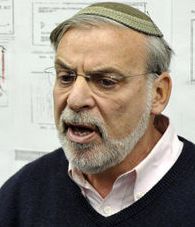 Bob Turner, the Republican candidate campaigning to replace disgraced Democratic Rep. Anthony Weiner, picked up a crucial endorsement last week when Democratic Assemblyman Dov Hikind