Category Archives: Issues

Israeli ambassador flees Egypt as protesters storm Cairo embassy

Haaretz reports:

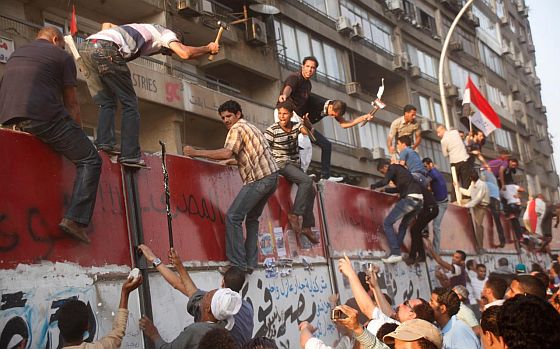
A group of about 30 protesters broke into the Israeli Embassy in Cairo Friday and dumped hundreds of documents out of the windows after a day of demonstrations outside the building in which crowds swinging sledge hammers and using their bare hands tore apart the embassy’s security wall.

Israel’s ambassador, Yitzhak Levanon, his family and other embassy staff rushed to Cairo airport and left on a military plane for Israel, said airport officials who spoke on condition of anonymity because they were not authorized to speak to the media.

Israeli officials refused to comment on the ambassador’s departure.

Hundreds of protesters converged on the embassy throughout the afternoon and into the night, tearing down large sections of the graffiti-covered security wall outside the 21-story building housing the embassy. Egyptian security forces made no attempt for hours to intervene.

Just before midnight, a group of protesters reached a room on one of the embassy’s lower floors at the top of the building and began dumping Hebrew-language documents from the windows, said an Egyptian security official who spoke on condition of anonymity because he was not authorized to speak to the media.

In Jerusalem, an Israeli official confirmed the embassy had been broken into, saying it appeared the group reached a waiting room on the lower floor. He spoke on condition of anonymity because he was not permitted to release the information.

No one answered the phone at the embassy late Friday.

Meanwhile, U.S. President Barak Obama spoke with Prime Minister Benjamin Netanyahu about the situation at the Israeli Embassy in Cairo.

The President’s office said in a statement that Obama expressed great concern about the situation at the Embassy, and the security of the Israelis serving there.

The statement said Obama “reviewed the steps that the United States is taking at all levels to help resolve the situation without further violence, and to call on the Government of Egypt to honor its international obligations to safeguard the security of the Israeli Embassy.”

Obama and Netanyahu agreed to stay in close touch until the situation is resolved.

Facebooktwittermail

Turkish warships will escort aid vessels to Gaza

Today’s Zaman reports:

Turkey said on Thursday it would escort aid ships to Gaza and would not allow a repetition of last year’s Israeli raid that killed nine Turks, setting the stage for a potential naval confrontation with its former ally.

Raising the stakes in Turkey’s row with Israel over its refusal to apologise for the killings, Prime Minister Recep Tayyip Erdoğan told Al Jazeera television that Turkey had taken steps to stop Israel from unilaterally exploiting natural resources in the Mediterranean.

“Turkish warships, in the first place, are authorised to protect our ships that carry humanitarian aid to Gaza,” Erdoğan said in the interview, broadcast by Al Jazeera with an Arabic translation.

“From now on, we will not let these ships to be attacked by Israel, as what happened with the Freedom Flotilla,” Erdoğan said.

Referring to Erdoğan’s comments, Israeli Foreign Ministry spokesman Yigal Palmor said: “This is a statement well-worth not commenting on.”

Relations between Turkey and Israel, two close US allies in the region, have soured since Israeli forces boarded the Gaza-bound Mavi Marmara aid ship in May 2010.

Facebooktwittermail

Turkish president warns European leaders over their role in extremism

Today’s Zaman reports:

Turkish President Abdullah Gül has called on European leaders to stick to values such as democracy, the rule of law and respect for human rights, which originated from the continent of Europe, as he warned that populist tendencies among European leaders towards migration triggered the radicalization of immigrant societies.

Delivering a speech at the third Global Policy Forum held in the central Russian city of Yaroslavl, Gül said the values of democracy, the rule of law and respect for human rights, although having originated in Europe, had a global impact.

“The Arab Spring that began with the demand of the people for democratic transformation is the latest manifestation of this impact. One expects a decline in discriminatory treatment as the world experiences these developments and the emergence of a common cultural understanding for mankind, but we unfortunately continue to witness the strengthening of extremist views that consider differences as a reason for conflict in various parts of the world,” Gül said at the forum, to which he had been invited as guest of honor. The forum was held under the auspices of Russian President Dmitry Medvedev. This year’s forum, titled “The Modern State in the Age of Social Diversity,” focused on issues democracies face in the present-day social diversity such as the correlation of economic efficiency and social equality, the balance between innovation and tradition, maintaining global security and personal freedoms.

“The existence of these movements on the European continent, which presented the world with the notions of democracy and the modern state, is food for thought. Racism, Islamophobia and xenophobia that fester contemporaneously with the economic crisis affecting Europe give rise to serious concern. Parties that point at migrants as the source of problems such as security, crime, poverty and other social difficulties gain more votes.

“The reaction by governments and main political parties that introduce stricter measures on migration in order to counter this fear by the people is also worrying. Rising intolerance and discrimination becomes a trigger for radicalization,” Gül said.

The July 22 terrorist attacks in which a right-wing extremist killed 77 people and rocked the foundations of Norway’s democratic society, which places high value on openness and civil rights, was one example used by Gül to better explain his point.

Facebooktwittermail

Anders Breivik’s spider web of hate

The Guardian reports:

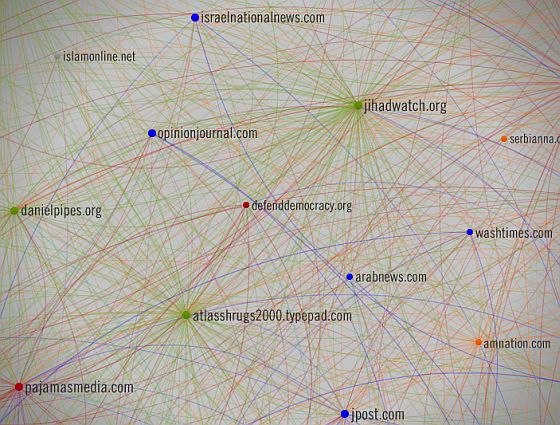
Anders Breivik’s manifesto reveals a subculture of nationalistic and Islamophobic websites that link the European and American far right in a paranoid alliance against Islam and is also rooted in some democratically elected parties.

The Guardian has analysed the webpages he links to, and the pages that these in turn link to, in order to expose a spider web of hatred based around three “counter-jihad” sites, two run by American rightwingers, and one by an eccentric Norwegian. All of these draw some of their inspiration from the Egyptian Jewish exile Gisele Littman, who writes under the name of Bat Ye’or, and who believes that the European elites have conspired against their people to hand the continent over to Muslims.

As well as his very long manifesto, Breivik also laid out some of his thoughts on the Norwegian nationalist site Document.no. In his postings there, Breivik referred to something he called “the Vienna school of thought”, which consists of the people who had worked out the ideology that inspired him to commit mass murder. He named three people in particular: Littman; the Norwegian Peder Jensen who wrote under the pseudonym of Fjordman; and the American Robert Spencer, who maintains a site called Jihad Watch, and agitates against “the Islamisation of America”.

But the name also alludes to a blog called Gates of Vienna, run by an American named Edward “Ned” May, on which Fjordman posted regularly and which claims that Europe is now as much under threat from a Muslim invasion as it was in 1683, when a Turkish army besieged Vienna.

Facebooktwittermail

Libya’s new PM Mahmoud Jibril faces growing unrest

The Guardian reports:

Libya’s interim prime minister arrived in Tripoli on Thursday for his first public appearance in the capital since Muammar Gaddafi was overthrown more than two weeks ago, to face criticism that the country is experiencing a power vacuum.

Mahmoud Jibril’s debut press conference coincided with a meeting of revolutionary activists from across Libya who called on the National Transitional Council to show leadership or face potential revolt.

Saoud Elhafi, co-founder of the February 17 Coalition – a reference to the date of the first uprising – told the Guardian that there had been frustration over Jibril’s long diplomatic missions abroad.

“There is definitely a vacuum,” he said. “He needs to fill this vacuum as soon as possible. He was assigned to form a new government but we are yet to see it. Part of stability is to provide services to the people – otherwise, they will revolt.”

Elhafi added: “In the next few weeks you will see change with Mr Jibril. There’s a lot of pressure on him now. The honeymoon period for him now is gone. People are coming together to say enough is enough.”

He said of Jibril, head of the NTC’s executive office: “We notice he is not available. He is mostly outside Libya; you can count on your hands the days he is here. It is not acceptable. He needs to be in touch with the people.”

Facebooktwittermail

Libya’s nightmare factory

Felix Kuehn reports:

The cells are barely large enough for one person to lie down in. There is no water, no toilet. Light falls through a small hole in the ceiling. Most cells don’t even have a mattress, just a strip of cloth on the floor, a cut-open plastic bottle, and the naked concrete walls, inscribed with memories of those once held here. It is dark — claustrophobic — in the narrow corridors of the cell wings. The entrance is scattered with clothes and medicine; the air thick with decay. Only days ago, the bodies were retrieved from here. After a few minutes the lingering stench grips you at the throat, gagging you.

This is Maktab al-Nasser, a dusty compound of a few buildings that stand deserted in the pale midday sun, only a few minutes away from the infamous Abu Salim prison. Many who ended up in Abu Salim would first be swallowed by this office of the internal security agency. Many never emerged. The grim cells of Maktab al-Nasser offer stark a contrast with the painted rooms at Abu Salim prison, with its kitchen facilities and bathrooms that mask the horrors that doubtlessly took place there. The pain and horror of Maktab al-Nasser seem to have penetrated its very walls and steel doors. It looks like a place one goes to die.

Abu Bashir al-Hajji, a 57-year-old laborer, spent 42 days in Maktab al-Nasser. His face strains with pain when he gets out of the chair. His ribs are broken in three places from the beatings he received. On Feb. 17, he had been out on the streets of Tripoli, demonstrating against Muammar al-Qaddafi and in support of the uprising in Benghazi. Like others, he went to what is now known as Martyrs’ Square in Tripoli. He reached out to the rebels and started to ferry information back and forth between Benghazi and the capital. On March 24, the 18th Brigade broke down his door at 2 o’clock in the morning. They came with five cars. “They knew my family,” Abu Bashir explains. “My brother, Jamal al-Hajji, was writing about Qaddafi even before the revolution started.”

They threw him in a car, beat him, and pushed him into a tiny cell. “I did not know where I was,” he says. “Only later when I was transferred to Abu Salim prison did I understand where I had been.”

At Maktab al-Nasser, half the complex is burned out and much has collapsed into itself as a result of the NATO bombing. The outer shell of what looks like an American cruise missile rests outside. Old files are scattered in the office building: Interrogation reports date back as far as the early 1990s, chronicling the activities of individuals and their families over pages and pages amid accusations of espionage and terrorism.

“Many people died in Maktab al-Nasser,” Abu Bashir says. “The guards would beat us in the lower abdomen and stomach. Something breaks inside and some people die.”

Facebooktwittermail

U.N. study savages U.S., European economic policy

Reuters reports:

The pursuit of austerity measures and deficit cuts is pushing the world economy toward disaster in a misguided attempt to please global financial markets, the annual report of the United Nations economic thinktank UNCTAD said on Tuesday.

The report, entitled “Post-crisis policy challenges in the world economy,” savaged U.S. and European economic policies and called for wage increases, stricter regulation of financial markets, including a return to a system of managed exchange rates, and a conscious break with market-led thinking.

“The message here is very pragmatic: we need to reverse our course quickly,” said UNCTAD Secretary General Supachai Panitchpakdi.

Supachai, a former head of the World Trade Organization, said the policy response to the crisis, with an emphasis on fiscal tightening, was misconceived and inept.

The report’s lead author Heiner Flassbeck said the global economic situation was extremely dangerous and, without more stimulus, a decade of stagnation was the best-case scenario.

The current policies were a disaster, said Flassbeck, head of the globalization and development strategies division at the U.N. Conference on Trade and Development, and a former deputy finance minister in Germany.

“If interests rates everywhere are zero, and if governments stick to the policy of not only keeping fiscal deficits where they are but retrenching, cutting public expenditure, then we will end up in permanent recession,” he said.

Facebooktwittermail

The terrorism industry that hijacked America

John Tirman writes:

The anniversary of the 9/11 attacks has, predictably, loosed a torrent of sentimental accounts of that terrible day ten years ago.

They recall the shock and horror at these unprecedented events, the courage of the firefighters, the sadness of the victims’ families, and the traumatic impact to the nation. All of this is understandable. What is missing in this retelling, however, are the consequences for America—the enormous cost of “homeland security”—and for the populations of Iraq and Afghanistan who have borne the brunt of America’s vengeance.

For those populations, the penalty is severe. Both countries are still buffeted by chronic warfare that was spurred by U.S. interventions. However one reckons the justifications for the invasions and occupations, the wreckage is undeniable. In Iraq, the number of people killed since the 2003 invasion is well into in the hundreds of thousands, and some four million or more Iraqis have been displaced from their homes. In Afghanistan, the violence has taken a lower toll, but is still in the tens of thousands with no end in sight. For both countries, the living conditions remain difficult—health, clean water, education, livelihoods, and social peace far from adequate.

Those grisly outcomes are occasionally acknowledged in American political discourse, although the costs of war are almost always calibrated in American lives lost and money squandered. The “blood and treasure” calculus rarely mentions the local populations, of course, but even the cost to Americans is sobering: 6,000 lives, tens of thousands maimed, and $4 trillion expended. That $4 trillion does not include vastly expanded Pentagon spending in addition to the wars, spending that has gotten a free pass in the last decade. But another cost is scarcely discussed: the enormous and expanding homeland security juggernaut.

The post-9/11 atmosphere spawned a government and societal response that uses fear and suspicion as a guiding belief system. The government has spent colossal amounts of money and has spurred the private sector to do likewise to check every person entering a skyscraper, scrutinize trillions of emails and phone messages, and expand the “security envelope” of the United States around the world. In dollars, that translates into something like $1 trillion spent by the federal government and probably a similar amount by businesses, educational institutions, and local governments. (Tellingly, there is no estimate of these non-federal costs.) Homeland security, in fact, feeds on the anxieties spawned by 9/11 and nurtured by politicians, in part because it supports pork-barrel politics in the same way that anti-communist fervor fueled excessive military spending and domestic surveillance during the long rivalry with the Soviet Union.

Facebooktwittermail

US detention post-9/11: Birth of a debacle

Lisa Hajjar writes:

Days after the terrorist attacks of September 11, 2001, the Bush administration started making decisions that led to the official authorisation of torture tactics, indefinite incommunicado detention and the denial of habeas corpus for people who would be detained at Guantánamo, Bagram, or “black sites” (secret prisons) run by the CIA; kidnappings, forced disappearances and extraordinary rendition to foreign countries to exploit their torturing services.

While some of those practices were cancelled when Barack Obama took office in January 2009, others continue to characterise US detention policy in the “war on terror”. Even the cancelled policies continue to stain the record because there has been a total failure to hold the intellectual authors of these illegal practices accountable or to provide justice for the victims of American torture and extraordinary rendition.

This five-part series traces the detention policy debacle as it has evolved over the last ten years.

Part 1: Birth of a debacle

Initially, the driving force behind the Bush administration’s post-9/11 decision-making was the legitimate need to compensate for the dearth of intelligence about al-Qaeda, which had perpetrated one of the most deadly and destructive terrorist attacks in history, and to acquire information about possible future attacks. President George W Bush decreed the attacks an act of war, and responded in kind.

On September 14, 2001, Congress passed the Authorisation to Use Military Force (AUMF), which granted the president the authority to use all “necessary and appropriate force” against those whom he determined “planned, authorised, committed or aided” the 9/11 attacks, or who harboured said persons or groups. The AUMF did not delineate any territorial specificity or geographical limits.

As is common in asymmetrical wars when states fight non-state groups, the need for information about al-Qaeda elevated the importance of gathering “actionable intelligence” through interrogation of captured enemies. But the decision to endorse the use of violent and degrading methods (even before anyone had been taken into custody) was a choice, not a necessity. [Continue reading…]

Facebooktwittermail

Turkey crisis: unconditional U.S. backing has helped Israel to isolate itself

Tony Karon writes:

Israel’s fallout with long-time ally Turkey is no isolated spat that will be repaired any time soon; it’s a dramatic illustration that no amount of U.S. backing can prevent the growing international isolation resulting from Israel’s handling of the Palestinian issue. Indeed, the unconditional nature of Washington’s backing may, in fact, have become dysfunctional to Israel’s diplomatic standing: A U.S. domestic political climate in which challenging Israel on anything is about as wise as threatening to cut medicare payments leaves Washington unable to restrain the most right-wing government in Israeli history from its most self-destructive urges, while economic changes and the radical policies adopted by the United States in the decade since 9/11 have left Washington’s influence in the Middle East at its weakest since World War II.

The trigger for Turkey expelling Israel’s ambassador, cutting defense ties and vowing to wage a diplomatic campaign against the blockade of Gaza and in support of the Palestinian move for recognition of statehood at the United Nations was the Netanyahu government’s refusal to apologize for the killing of nine Turkish citizens and a Turkish American in last year’s raid on the Gaza flotilla. The Obama Administration had tried to broker a rapprochement involving some form of Israeli apology, which Prime Minister Benjamin Netanyahu had reportedly been inclined to accept but his ultranationalist foreign minister and key coalition partner (as well as rival) Avidgor Lieberman refused to countenance it.

The breakdown, however, is about a lot more than an apology: The flotilla itself, after all, had sailed in direct challenge to the Gaza blockade, with the support of the Turkish government — an expression of the fact that Ankara was no longer willing to follow its NATO allies, under U.S. leadership, in turning a blind eye to the plight of the beleaguered Palestinians. Israeli leaders and their most enthusiastic boosters in Washington like to paint this as a sign that Turkey had “gone over” to the region’s Iranian-led “resistance” camp, but despite the ruling AK Party’s roots in moderate political Islam and its insistence on a political solution to the nuclear standoff with Iran, Turkey is in fact a regional rival for influence with Tehran. Ankara’s stance on the Palestinians, like its refusal to support or enable the Bush Administration’s invasion of Iraq and its stance on the Iran nuclear issue or its break with the Syrian regime of President Bashar al-Assad, is based on its own reading of what’s good for the region — which is quite different from Washington’s — and on Turkish public opinion. And, as if to underscore the fact that its break with Israel doesn’t threaten its commitment to NATO, Turkey announced last week that it had agreed to host radar installations for a NATO missile defense system targeting Iran.

Turkey’s actions also reflect a growing international impatience with and loss of faith in Washington’s handling of the Israeli-Palestinian conflict. Israel is worried, with good reason, that Egypt — whose foreign policy has been made more responsive to public opinion by the overthrow of the Israel-friendly U.S.-backed President Hosni Mubarak last February — may follow the Turkish example.

Meanwhile, the Associated Press reports:

Rising tensions with some of its closest and most important allies have left Israel increasingly isolated ahead of a momentous vote on Palestinian independence at the United Nations.

Troubles with Turkey, Egypt and even the U.S. are adding to Israel’s headaches ahead of the vote, which is shaping up to be a global expression of discontent against the government of Prime Minister Benjamin Netanyahu.

The Palestinians plan to ask the United Nations this month to recognize their independence in the West Bank, Gaza Strip and east Jerusalem – areas captured by Israel in the 1967 Mideast war – probably by embracing them as a “nonmember observer state.” The measure is expected to pass overwhelmingly in the U.N. General Assembly.

The assembly’s decisions are not legally binding, so the vote will be largely symbolic. But the Palestinians hope the measure will increase the already considerable pressure on Israel to withdraw from occupied territories, and add leverage should peace talks resume. The Palestinians refuse to negotiate while Israel continues to expand Jewish settlements in the West Bank and east Jerusalem.

Ghassan Khatib, a spokesman for the Palestinian government in the West Bank, said Israeli isolation is playing right into Palestinian hands. “We are seeing that result in increased support for us in the United Nations,” he said.

On Wednesday, China announced it would support the Palestinian bid. And a French Mideast envoy, Valerie Hoffenberg, said she had been fired after publicly arguing against the Palestinian initiative. France has not publicly said how it will vote, but her comments signaled that the government favors the Palestinians.

Facebooktwittermail

As ties with Turkey collapse, Israeli politicians, media and intelligence push for more conflict

Max Blumenthal writes:

The “Periphery Doctrine” has been a cornerstone of Israel’s strategic approach to the Middle East since the state’s foundation. Devised by David Ben Gurion and Eliahu Sassoon, an Israeli Middle East expert who became Israel’s first diplomatic representative in Turkey, the doctrine was based on maintaining alliances with non-Arab states and ethnic minorities in the region as a counterweight to pan-Arabism. Though three countries — Iran, Ethiopia, and Turkey — became key regional allies of Israel, Ben Gurion was keenly aware that the relationships were temporary, and could not substitute for peace with Israel’s Arab neighbors (something Ben Gurion ironically tried to manufacture through his “activist” foreign policy of unilateral military strikes and disproportionate force). From Turkey’s perspective, the relationship with Israel was never a proper strategic alliance, but rather a means of establishing leverage against nationalistic Arab governments.

This week’s events delivered the death knell to the terminally ill Periphery Doctrine. Following the Palmer/Uribe report’s factually flawed claims about the legality of Israel’s siege on the Gaza Strip and Israeli Prime Minister Benjamin Netanyahu’s refusal to apologize for Israel’s execution-style massacre of 9 activists on the deck of the Mavi Marmara — “We need not apologize!” the Prime Minister boomed three times during a recent press conference — the Turkish government significantly downgraded its relations with Israel. Turkey not only expelled Israel’s ambassador from Ankara, it suspended all military relations between the two states. Turkish Prime Minister Recep Tayyip Erdogan has suggested further sanctions will follow, exposing Netanyahu’s bravado as empty and self-destructive.

Though Netanyahu claimed today in a speech that “we sincerely want improved relations” with Turkey, he reiterated his refusal to apologize. The optics of the speech, which featured Netanyahu addressing a crowd of naval officers and hailing the bravery of the commandos who stormed the Mavi Marmara, were calculated to project an image of defiance. Meanwhile, elements in the Israeli political arena, security establishment and media are cultivating public opinion for an open conflict with Turkey, and with no apparent shortage of enthusiasm.

Facebooktwittermail

Libya, after Gaddafi

Nicolas Pelham writes:

While the foreign media focus on catching the colonel, Libyans seem to consider him to have already passed into history. Finding the deposed despot in a country of 679,358 square miles is a task that has been made all the arduous by the insouciance Libyans display toward the question of his whereabouts. For someone whose persona dominated Libya for four decades, it is striking how fast he has slipped from the public consciousness. His images have long been torn down, and his Green Book aphorisms torched. No one made an effort to stage rallies marking “Fatah September” — the forty-second anniversary of his military takeover on September 1, 1969 — or to respond to his plea for a million-man march on the capital. Threats to unleash stockpiles of mustard gas and al-tarbur al-khamis, or the fifth column, have passed without incident. Having cried wolf once too often, the colonel now sees his warnings of imminent car bombings and a guerrilla “war of bees that sting” dismissed with a complacent shrug. The ubiquitous graffiti drawings of Abu Shafshoufa, or “Fuzzy-Wuzzy,” have reduced a dictator who kept power by terrorizing his population to a joke. Of all the problems facing Libya’s new order, the specter of Qaddafi’s comeback falls far down the list.

In the wake of the colonel’s flight from the capital on August 21, cautious Tripolitanians dithered for a bit more than a week, and then decided that the wind is blowing firmly his successors’ way. Ten days later, they partied in the streets with popcorn, paper lanterns and some 30,000 new Libyan tricolors. The extent of popular participation is inspiring. Where hitherto the Great Leader was so obsessed with omnipresence that he banned soccer players from sporting their own names on their jerseys, a surfeit of new actors has stepped into the vacuum. And in a country where hitherto decision-making was routed through one man, new local coping mechanisms have emerged to address the hardships caused by an absent government, a plugged-up water supply, intermittent electricity and unpaid salaries.

The sense of local ownership of the revolution is important: No one has stripped the electricity cables from pylons for their copper, as Iraqis did after the US invaded their country and toppled Saddam Hussein. Libyans, who before the uprising depended on an army of foreign labor, farm their own allotments, run their own shops, sweep the streets and volunteer as hospital nurses. Homeowners with private wells open their doors to those with none. On their own initiative, policemen in Fashloum, a working-class district in the center of town, met in the mosque on the first Friday after the colonel’s flight and agreed to reestablish a local force. By midday the following day, a score of its hundred policemen had reported for duty.

Residents of housing estates who rarely spoke to each other under Qaddafi have created neighborhood councils, merging elders from the traditional conflict resolution mechanisms, the lijan al-sulh (reconciliation committees), with the underground leadership that planned the revolt, as well as respected men from the mosque. Within a week, their subcommittees were supplying better services than the city’s five-star hotels. The mosque in Hadaba’s Haddad quarter, a poor district of rural migrants, offered air conditioning and so much water it spilled into the streets. Ironically, in the colonel’s absence, Tripolitanians created the very social system he had taught but never realized — a jamahiriyya, a decentralized network of grassroots, non-partisan people’s committees.

Facebooktwittermail

Rarely seen victims of 9/11

The Boston Globe reports:

“Flight attendant Cameron?’’ the voice from Dallas barks. “Are you going to sign in for your trip? Are you stuck in traffic?’’

Halle Cameron squints at the clock on her nightstand: 7 a.m., Sept. 11, 2001. American Airlines Flight 11 departs in 45 minutes from Logan International Airport, nonstop to Los Angeles.

She had finally earned the seniority to pull cross-country flights like this, after 10 years of short-hop connections and layovers in Des Moines. But she came home yesterday from playing in a golf tournament feeling shaky, maybe heatstroke, maybe more.

Dragging her to dinner, a flight attendant friend had urged her not to waste a sick day on such a good route, reminding her how she loved the beds at the Westin in Los Angeles.

So she packed her bags and set the alarm for 4. But when she couldn’t sleep, she called American’s automated line to withdraw from the flight. Or so she thought.

“I called in sick last night,’’ she says.

“Oh,’’ the voice from Dallas says, hesitating. “That was you.’’

A rare glitch. Now someone is scrambling at headquarters, someone else is scrambling in Boston. On standby at Logan, 24-year-old Jean Roger gathers her belongings and hustles to Gate 32.

THIS IS WHERE it began. Two flights, one airport. Everyone knows how it ended. Nearly 3,000 dead, families devastated, a crater in the earth.

Back home, Logan reinvents itself. Around the airfield, a 10-foot-high concrete barrier, prison-camp thick, with razor wire on top. Inside, a new security force, full-body scanners, hundreds of cameras, liquids in bags, beltless travelers in socks. And unseen, scars unwilling to fade.

They are the rarely noticed casualties of the terrorist attacks: the security guard, the ticket agent, the baggage handler on the ramp. They made it home that night, but with images they couldn’t shake, a pain uncomfortable to voice. They can’t believe it has been 10 years. They can’t believe it has only been 10 years. [Continue reading…]

Facebooktwittermail

The enduring mysteries of 9/11

Justin Elliot writes:

No small part of the public discourse surrounding Sept. 11, 2001, has been polluted by Truthers — those who believe that the attacks were an “inside job,” or that World Trade Center Building 7 was destroyed in a “controlled demolition,” or that the Pentagon was hit by a cruise missile, despite no compelling evidence for any of these theories.

Perhaps the most corrosive effect of the 9/11 conspiracy theorists is that they have distracted attention from real unanswered questions about the attacks.

Here, we look at some of the most important of those questions. This is not meant to be a comprehensive list.

What’s in the famously redacted 28 pages?

A joint inquiry of the House and Senate intelligence committees produced an 800-plus page report on activity of the intelligence community in connection with the 9/11 attacks, completed in December 2002. But 28 pages were redacted in the public version, all in the section titled “Finding, Discussion and Narrative Regarding Certain Sensitive National Security Matters.” It has been widely reported that those pages — which neither the Bush nor Obama administration have declassified — deal with links between 9/11 hijackers and Saudi government officials. Newsweek, for example, reported that the section “draws apparent connections between high-level Saudi princes and associates of the hijackers.”

As long as those pages remain classified, though, it’s impossible to assess the nature of those connections.

What was the role of the Saudi government?

Short of getting a look at those redacted 28 pages, the best source of information on this crucial question is the “The Eleventh Day,” a new account of 9/11 by journalists Anthony Summers and Robbyn Swan. Bob Graham, the Florida senator who co-chaired the joint inquiry, told the authors that the investigation found evidence “that the Saudis were facilitating, assisting, some of the hijackers. And my suspicion is that they were providing some assistance to most if not all of the hijackers. … It’s my opinion that 9/11 could not have occurred but for the existence of an infrastructure of support within the United States. By ‘the Saudis, I mean the Saudi government and individual Saudis who are for some purposes dependent on the government — which includes all of the elite in the country.”

That’s from an excerpt of the book recently published in Vanity Fair.

There has been particular interest in a San Diego-based Saudi national named Omar al-Bayoumi, who in California had extensive contacts with — and gave money to — the first two hijackers to enter the United States, Khalid al-Mihdhar and Nawaf al-Hazmi. Bayoumi, along with two other Saudis of interest, was interviewed by commission staffers in Saudi Arabia in 2003-04. None was ever charged with a crime.

Facebooktwittermail

Gaddafi used torture squads in bid to preserve rule

Reuters reports:

Libya’s Muammar Gaddafi deployed special squads which held suspected opponents in shipping containers, tortured them for information about insurgent networks and disposed of their bodies in unmarked graves in a campaign to smash the revolt against his rule.

Evidence gathered by Reuters in the provincial town of Khoms shows an organised system of repression with methods including delivering electric shocks to suspects’ genitals, keeping them for weeks in baking heat with only a few sips of water a day, and whipping them with an electrical cable while their hands were bound with plastic ties.

It was all part of a deliberate strategy, said Nabil Al-Menshaz, an official in the rebel council which took over Khoms after Gaddafi’s rule there collapsed last month. “They wanted to frighten the people, so if anyone was thinking of going over to the rebels, they would change their minds,” he said.

The brutality of Gaddafi’s forces in the capital, Tripoli, in the final, chaotic days before rebels overran the city has been well documented. Dozens of bodies were left lying in the streets, and witnesses described prisoners being massacred before their gaolers fled. Thousands more were killed in battles in cities like Misrata and Zawiyah.

But accounts from Khoms paint a different, and in some ways even more sinister picture. Months before the rebel victory, and out of sight of the outside world, Gaddafi was operating a system of torture – separate from the army and police – that was so well-organised the units has their own command structures and bureaucracy.

On a wall at a construction site just outside Khoms that one of the units used for detaining suspects, pro-Gaddafi forces had scrawled in red crayon the name of their unit: “Soqur Al-Fatah” – or “Hawks of Al-Fatah,” a reference to the 1969 Al-Fatah Revolution that brought Gaddafi to power. Underneath that, in the same handwriting, someone had written the words: “Death Group.”

Al Jazeera reports:

A large convoy containing between 200 and 250 Libyan armoured vehicles has crossed into Niger.

Military sources from France and Niger told the Reuters news agency that the convoy, escorted by the Niger army, arrived in the northern desert town of Agadez on Monday.

Amid the reports about the convoy, Libyan opposition fighters have been holding talks with tribal leaders in Bani Walid to enter the town peacefully.

They are also negotiating with some tribes in Sirte, Gaddafi’s hometown, to lay down arms.

Monday’s convoy included officers from Libya’s southern army battalions and pro-Gaddafi Tuareg fighters, and likely crossed from Libya into Algeria before entering Niger, the sources said.

The French military source said he had been told Muammar Gaddafi and his son Saif al-Islam might be considering joining the convoy en route to Burkina Faso, a landlocked West African state which has offered Gaddafi and his family asylum and has a border with Niger.

Facebooktwittermail

Endless war served by endless distraction

Glenn Greenwald writes:

The Washington Post woke up a few days ago and realized that despite everything that has happened since 9/11 — no successful Terrorist attacks on the Homeland in 10 years, a country mired in debt and imposing “austerity” on ordinary Americans, and the election of a wonderfully sophisticated, urbane, progressive multinationalist from the storied anti-war Democratic Party — we are still smack in the middle of “the American era of endless war” with no end in sight.  Citing the Pentagon’s most recent assessment of global threats, the Post notes that in contrast to prior decades — when “the military and the American public viewed war as an aberration and peace as the norm” (a dubious perception) — it is now clear, pursuant to official doctrine, that “America’s wars are unending and any talk of peace is quixotic or naive,” all as part of “America’s embrace of endless war in the 10 years since Sept. 11, 2001.” 

We are now enduring a parade of wistful, contemplative, self-regarding pundit-meditations on The Meaning of 9/11 Ten Years Later or, far worse, self-righteous moralizing screeds about the nature of “evil” from war zealots with oceans of blood on their unrepentant hands (if I could impose one media rule, it would be that following every column or TV segment featuring American political commentators dramatically unloading their Where-I-Was-on-9/11-and-how-I-felt tales, there would be similar recollections offered from parents in the Muslim world talking about how their children died from the pre-9/11 acts of the U.S. and its client states or from post-9/11 American bombs, drones, checkpoint shootings and night raids:  just for the sake of “balance,” which media outlets claim to crave).  Notwithstanding this somber, collective 9/11 anniversary ritual descending upon us, the reality is that the nation’s political and media elite learned no lessons from that attack. 

The mere utterance of the word Terrorism (which now means little more than: violence or extremism by Muslims in opposition to American or Israeli actions and interests) is — at least for America’s political and media class — as potent in justifying wars, civil liberties assaults, and massive military spending as it was in the immediate aftermath of 9/11.  And worship of the American military and all that it does — and a corresponding taboo on speaking ill of it except for tactical critiques (it would be better if they purchased this other weapon system or fought this war a bit differently) — is the closest thing America has to a national religion.

But it’s not merely the existence of ongoing Endless War that is so destructive — both to the nation perpetrating it on the world and to its victims.  Far worse is what is being done to prosecute that war, the transformation of government institutions and their relationship to the citizenry to sustain it, and, most enduringly of all, the mentality that it has spawned and entrenched.

In his conclusion, Greenwald says, “Renouncing the duty of holding accountable political leaders who exercise vast power makes one directly responsible for the abuses they commit.” But what is that facilitates this form of political indifference among most Americans?

First and foremost it springs from a profound and pervasive sense of impotence. Few people believe they have any real capacity to effect political change. So why take much interest in the contours of a political landscape over which one apparently exerts no influence?

Second, we witness that those who wield great power generally do so with impunity. However great their blunders, they never seem to pay any price. It’s easy enough to say that we should hold them accountable, but how exactly is this demand to be meaningfully expressed?

Third, the experience of powerlessness and the indifference this engenders feeds the desire for sensations which even if they are meaningless restore some feeling of our own existence. We both lose and find ourselves in endless distraction.

America’s endless wars continue not because we believe in them but because they have become nothing more than white noise in the background of the well-anesthetized American way of life.

Facebooktwittermail