Category Archives: Issues

Libya conflict: Evidence emerges of executions by both sides

The Guardian reports:

Dozens of bodies have been found in Tripoli with signs of executions carried out by both sides in the civil war.

Reuters news agency reported discovering 30 bullet-riddled bodies of fighters loyal to Muammar Gaddafi, of which two had been bound with plastic handcuffs, and one was on an ambulance stretcher with an intravenous drip still in his arms. They were in the remains of a pro-Gaddafi encampment strewn with caps and pictures of the ousted leader.

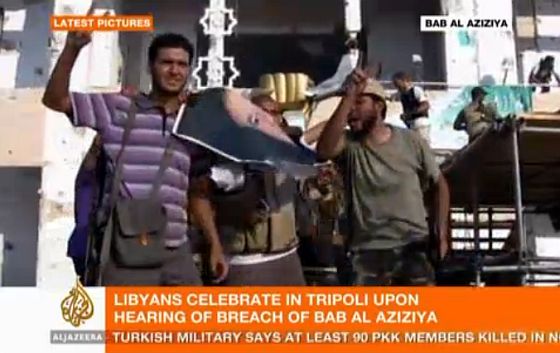
Elsewhere in the city, a medical aid worker at a Tripoli hospital said she had seen 17 bodies, believed to be civilians killed by government forces, which had been found when rebel fighters stormed the Gaddafi stronghold of Bab al-Aziziya.

“Yesterday a truck arrived at the hospital with 17 dead bodies,” Kirsty Campbell of the International Medical Corps told Reuters at Mitiga hospital. “These guys were rounded up 10 days ago. They were found in Bab al-Aziziya when the guys went in. These guys were shot in an execution there,” she said.

The wounds were not battlefield injuries, she said. She added there had been reports of more bodies.

Facebooktwittermail

173 Israeli investigations in the wake of the killing of 5,518 Palestinians

Gideon Levy writes:

Firas Qasqas was a gardener. Thirty-two years old and the father of three daughters, he came from his village with his family to visit his brother-in-law, who had moved to a new home in Ramallah. After an especially rainy, stormy night they woke up to a glorious sunny day and decided to go for a hike in the gorgeous valley of olives opposite the house. Yes, there are also Palestinians who love nature.

They were three hikers – Firas and his two brothers-in-law – when they saw a herd of deer fleeing down the slope. They knew that behind the herd there would also be people coming but it did not occur to them that on the heels of the deer would come hunters – in this case, people hunters. Very soon they saw a group of soldiers coming down to the valley. A few minutes later the soldiers started firing two or three rounds at them, from a very long range. Firas fell, bleeding to death. He managed to reassure his brothers in law and tell them everything was fine, they shouldn’t worry. But not long after that he started to gurgle and foam covered his mouth. At the hospital in Ramallah the young gardener expired.

That was in the winter of 2007, a relatively quiet winter. A few days after the killing I came to the valley of olive trees with his brother-in-law Jamil Mator, who was with Firas when he died. Hundreds of meters had separated the shooters and their victim. Far from there, at the dead man’s home in the village of Battir, I met the black-garbed young widow Majida and the three little orphaned girls. As her daughters blew soap bubbles inside the small room, Majida asked simply: “I want to know why he was killed because I don’t know.” And the bubbles (and the tears ) filled the room.

I too wanted to know why Firas was killed. The Israel Defense Forces Spokesman, as usual, said everything was in order. The soldiers discerned “suspicious behavior,” the three Palestinians were seen “doing something with the ground,” before the shooting they were “properly warned,” the incident was investigated “at all levels,” the conclusions have been “implemented” and the material has been sent “for review by the military prosecution.”

Four years have elapsed since then and Firas’ death has been forgotten. Since then I have reported on dozens more cases of killing in the West Bank, nearly all of which of course were sent for review by the military prosecution, which is usually the decisive phase on the way to burying the material of investigation of the truth in the IDF.

And now my colleague Haim Levinson published an astonishing piece of news in yesterday’s Haaretz. The military prosecution has decided to try the commander of a company in the reserves, Shahar Mor, “a well-known educator in the religious Zionist community,” who shot Firas in the back from a great distance and killed him.

It took the prosecution nearly four years to investigate such a clear case, the details of which cried out from the soil of the valley where the shooting of an unarmed person from an illegal distance occurred, without any danger to the soldiers, without any justification. Even this indictment would not have happened had not B’Tselem – The Israeli Information Center for Human Rights in the Occupied Territories intervened again and again, demanding the shooter be brought to trial. And this is such a rare occurrence. Data from Yesh Din – Volunteers for Human Rights show that only 8 percent of the investigations that were opened in the dark years of 2002-2009 culminated in an indictment. Only 14 people have been tried and there have been only 173 investigations in the wake of the killing of 5,518 individuals.

This is how the law enforcement mechanism of the IDF looks, with its army of investigators, prosecutors and judges, which is nothing but a ridiculous simulacrum of a justice system. In the four years that have elapsed dozens more Palestinians have been killed in the West Bank, not counting the Gaza Strip, some of them not guilty of anything. In Haaretz I documented the death of a paralyzed bean seller in Nablus, a 71-year-old accountant in Balata, a 19-year-old student in Tekoa, a woman demonstrator in Bil’in, a Palestinian policeman from Bethlehem, a laborer from the Far’a refugee camp, a laborer from the village of Sa’ir and a driver from Jerusalem who was going to pick up his family for a vacation in Eilat and was killed by scandalous shooting at his car. All of them were guilty of nothing and were killed for no reason. All of these cases are under investigation by the military prosecution, strenuous investigation that will be completed four years from now, or maybe in 40. During this time the educator, Company Commander Mor, went about teaching his students. No doubt he taught them “values,” love of the land and Jewish morality, as only religious Zionism can do. At the same time, one can guess, his conscience did not bother him much about the criminal killing of Qasqas the gardener.

Facebooktwittermail

Pastor Beck preaches in Jerusalem

The Guardian reports:

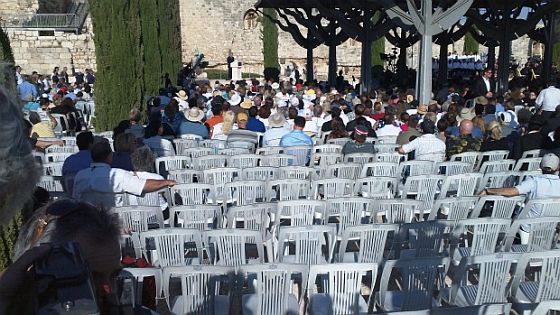
The temperature may have dropped a little in Jerusalem on Wednesday night, but it was more than compensated for by the heat produced by Glenn Beck as he brought his “Restoring Courage” rally to the Old City.

The former Fox News presenter and devout Mormon stood at a podium beneath the gunmetal grey of the dome of the al-Aqsa mosque to direct a tirade of invective at governments, human rights organisations, the United Nations, Europe and Arab states – and sometimes just “them”, whoever they are.

Despite a strangely subdued start, the rightwing polemicist finally roused his audience to whoops and cheers after a strangely subdued initial response with his trademark preacher’s inflection. But all the while, the distant noise of anti-Beck protests provided a backdrop to a 90-minute programme of declamation, music and presentations.

Dressed as though attending a funeral, Beck stood in sharp contrast to the casual attire of his overwhelmingly white American Christian audience, many of whose baseball caps and T-shirts denoted their state of origin, their church or their adherence to the US Tea Party movement.

But the surprising number of empty seats belied the organisers’ claims that demand for tickets had outstripped availability at the 2,000-capacity Davidson Centre.

Ami Kaufman writes:

After months of preparations, hours of television and radio talk all geared up for the big day, tons of merchandise manufactured, Glenn Beck could just about muster over a thousand people at his “Restoring Courage” last night in Jerusalem.

I can’t help but think that this flop might be a lethal blow for this guy. After getting kicked out of FOX and then his decision to veer even farther to the right by partnering up with the likes of Pastor John Hagee, Beck seems to have lost any chance whatsoever to get back into mainstream America like he was just months ago.

Even the event a few days earlier in Caesarea had more umph in it than this one. In fact, he barely even cried in this one. I think he might have been shedding the real tears back stage.

Facebooktwittermail

Egypt’s #Flagman is honored

Al-Masry Al-Youm reports:

The governor of Zagazig on Tuesday honored Ahmed al-Shahat, the young man who pulled down the Israeli flag from the Israel Embassy and replaced it with the Egyptian flag during anti-Israel protests on Saturday.

Protesters have been staging demonstrations before the Israeli Embassy in Giza since last week, following the death of five Egyptian soldiers at the hands of Israeli forces.

Residents of the city cheered Shahat upon his arrival and held a big celebration for him.

“I did it to please millions of Egyptians and Arabs,” Shahat said.

Facebooktwittermail

How the rebels took Tripoli

Associated Press reports:

They called it Operation Mermaid Dawn, a stealth plan coordinated by sleeper cells, Libyan rebels, and NATO to snatch the capital from the Moammar Gadhafi’s regime’s hands.

It began three months ago when groups of young men left their homes in Tripoli and traveled to train in Benghazi with ex-military soldiers.

After training in Benghazi, the men would return to Tripoli either through the sea disguised as fishermen or through the western mountains.

“They went back to Tripoli and waited; they became sleeper cells,” said military spokesman Fadlallah Haroun, who helped organize the operation.

He said that many of the trained fighters also stayed in the cities west of Tripoli, including Zintan and Zawiya, and waited for the day to come to push into the capital.

Operation Mermaid Dawn began on the night of August 21 and took the world by surprise as the rebels sped into the capital and celebrated in Green Square with almost no resistance from pro-Gadhafi forces.

Haroun said about 150 men rose up from inside Tripoli, blocking streets, engaging in armed street fights with Gadhafi brigades, and taking over their streets with check points.

He said another 200 men from Misrata.

But why did the armed Gadhafi troops melt away when the rebels drove through?

Fathi Baja, head of the rebel leadership’s political committee, said it was all thanks to a deal cut with the head of the batallion in charge of protecting Tripoli’s gates, the Mohammed Megrayef Brigade.

His name was Mohammed Eshkal and he was very close to Gadhafi and his family. Baja said Gadhafi had ordered the death of his cousin twenty years ago.

“Eshkal carried a grudge in his heart against Gadhafi for 20 years, and he made a deal with the NTC — when the zero hour approached he would hand the city over to the rebels,” said Haroun.

“Eshkal didn’t care much about the revolution,” said Haroun. “He wanted to take a personal revenge from Gadhafi and when he saw a chance that he will fall, he just let it happen.”

But Haroun said he still didn’t trust Eshkal or the men who defected so late in the game.

Haroun said that he didn’t trust any of the defectors who left Gadhafi’s side so close to August 20.

“They lived knew his days were numbered so they defected, but in their hearts they will always fear Gadhafi and give him a regard,” he said.

Haroun said NATO was in contact with the rebel leadership in Benghazi and were aware of the date of Operation Mermaid Dawn.

“Honestly, NATO played a very big role in liberating Tripoli — they bombed all the main locations that we couldn’t handle with our light weapons,” said Harouin.

Facebooktwittermail

As one group of journalists is released, another four are abducted

Reuters reports:

Four Italian journalists were abducted by gunmen near Zawiyah in western Libya as they traveled toward Tripoli on Wednesday, Italian officials said.

The four, who worked for Italian newspapers Corriere della Sera, La Stampa and Avvenire, are being held in an apartment in Tripoli, said Guido de Sanctis, the Italian consul in Benghazi, who was able to speak to one of the journalists by phone.

“They are fine, even if everything happened in a very difficult atmosphere,” de Sanctis told Reuters.

“They have been allowed to call Italy and they have been allowed to get calls from us. They were given food to eat when the Ramadan fast was broken.”

The four were seized near Zawiyah, on the coastal highway 50 km (30 miles) west of Tripoli by armed men who killed their driver, de Sanctis said. The journalists were then handed to others, presumably Muammar Gaddafi loyalists, he said.

The journalists believe the apartment they are being held in Tripoli is close to the Rixos hotel where foreign journalists who were trapped for five days left unharmed earlier on Wednesday, de Sanctis said.

The journalist at Avvenire, the Italian bishops’ newspaper, was also allowed to call the newspaper and said they were well, Italian media said.

Italy’s government said it was closely monitoring the situation.

Facebooktwittermail

Obama, Libya and triumphalism in Washington

Joe Cirincione writes:

This week, in Libya, thousands of people celebrated carrying posters of “The Fantastic Four”: Obama, Rice, French President Nicolas Sarkozy and UK Prime Minister David Cameron. All four played a leading role in supporting the people of Libya in their overthrow of a tyrant. But it was America that played the crucial role. It was America that decided at a key moment to “invest in protecting the lives of others” and to join with NATO not to overthrow a regime, but to help the people of Libya make the regime change that only they could effect.

That is leadership. That is smart. And this is what victory feels like.

Joel Rubin writes:

President Obama’s critics are on the verge of witnessing a third major Obama success in the Arab world in 2011.

First, longtime Egyptian strongman Hosni Mubarak was deposed after Obama refused to support him against the Egyptian people at the moment of truth. Second, Osama bin Laden, America’s archenemy #1, was killed by Navy SEALS on direct orders from Obama in a risky cross-border raid into Pakistan. And now, Muammar Gaddafi — a man whose presence on the international stage has mocked any reasonable definition of sanity for more than four decades — is about to be knocked out of power by an international coalition in which Obama ensured that the U.S. played a leading team role.

Fareed Zacharia, heralding a new era in U.S. foreign policy, writes:

The United States decided that it was only going to intervene in Libya if it could establish several conditions:

1) A local group that was willing to fight and die for change; in other words, “indigenous capacity”.

2) Locally recognized legitimacy in the form of the Arab League’s request for intervention.

3) International legitimacy in the form of United Nations Security Council Resolution 1973.

4) Genuine burden sharing with the British and French spelling out precisely how many sorties they would be willing to man and precisely what level of commitment they would be willing to provide.

It was only when all those conditions were fulfilled that the Obama Administration agreed to play a pivotal but supporting role in the Libya operation.

Perhaps if Obama gets re-elected (though I wouldn’t place large bets on that yet), he’ll invite a few Libyans to Washington so that they can celebrate the pivotal role they played in securing his second term.

Needless to say, I jest. Even Obama’s most loyal boosters would be forced to concede that hardly any votes in the 2012 presidential election will end up being swayed by the outcome of the Libyan revolution.

So let’s assume that Zacharia and Rubin and Cirincione are simply celebrating what they regard as a foreign policy success (and are not driven just by some idea that the outcome in Libya is good for Obama), what should we make of their analysis?

As usual it comes weighted down by the conceit that Washington is the center of the world.

Libyans who spent the last six months fighting for their country — they are just supporting actors with the honor of rolling out a red carpet along which America can now stride on its way to glory.

Has everyone forgotten? The idea that on Libya, Obama “led from behind” was a facetious way of spinning the fact that in this intervention, he really was the reluctant partner. US involvement was agreed to on the strict condition that American soldiers could maintain a comfortable distance from Libya, while their commander in chief kept his distance from Congress and the media.

America’s arm-length involvement in Libya was indeed a success, but not in the sense that success is now being paraded. It was a success in as much as it is clear to most people (at least outside Washington) that victory in Libya belongs to the people of Libya. They know they couldn’t have succeeded without Western support, but it is Libyans who died in their thousands while their allies shed not a single drop of blood.

Sarkozy, Cameron, Obama, and Rice — these were the supporting actors. NATO’s involvement was much more reluctant than it was opportunistic and it was driven by fears about the potential price of non-involvement.

Those who now want to construct out of this a model for other interventions seem to have no more imagination than those who not long ago employed the simplistic argument that what “worked” in Iraq should work in Afghanistan.

Washington was able to help out a bunch of Arabs in Libya when they got in trouble — should be able to do the same in Syria. Right?

The lesson to take away from Libya is that in the Arab Awakening no two uprisings are the same and no idea is more dangerous than that a successful intervention can be replicated.

Facebooktwittermail

Libya is no Iraq – this revolution is the real deal

Mohamed Salem writes:

Muammar Gaddafi and his sons are now on the run, fleeing from the Libyan people, yet already the doomsayers and prophets of disaster have lined up to tell the world it isn’t worth it, that Libya is destined to go down the route of chaos and fragmentation. Libya will be another Iraq and Afghanistan, we are told.

They are wrong, because the post-conflict scenario in Libya differs from those two examples of failed western intervention in several crucial aspects. Indeed if you study the indicators, Libya is poised to be the most complete and potentially most successful of any the Arab uprisings so far.

The roots of Iraq and Afghanistan’s tragedy lie in the abrupt and imposed nature of change. It’s easy to forget that Libya’s organic and intense popular uprising preceded any international intervention. UN security council resolution 1973, which authorised the use of force to protect civilians, was only passed when it became clear that a massacre in the east was imminent. This is not Nato’s revolution, not by a long way. The Libyan revolution remains very much the real deal.

The reason this matters is because it means no foreign power can now assert a moral right to meddle in Libya’s future. Libya’s destiny is now rightfully in the hands of its people, having been hijacked by Gaddafi and his cronies for almost 42 years. It also means the west must to a degree absolve itself of direct responsibility for what happens next in Libya and leave the planning to Libyans themselves.

The worst idea of all would be to send in foreign ground troops now, even under the peacekeeping banner. Not only would this be met with fierce opposition by the Libyan people, it would send the message that the west still feels that Arabs cannot be trusted to look after themselves.

Facebooktwittermail

The situation in Sinai and Egypt-Israel relations

Issandr El Amrani writes:

The events of the last week or so in Sinai have been overshadowed by the current diplomatic rift and public outrage over Israel’s shooting of at least three Egyptian border guards a few days ago. The question of security and state legitimacy in the Sinai, the attack that killed 17 Israelis in Eilat, Israel’s latest bombing campaign in Gaza (and the Palestinian rocket fire that came in response), the border incident and the future of the the Egyptian-Israel relationship has interwoven in complex ways. But there are also distinct issues worth separating to get a better understanding of the whole.

  1. The situation in Sinai: The raid on July 29 by some 100 gunmen of the al-Arish police station was a wake-up signal to the Egyptian government about how dire the situation is in North and Central Sinai. So were media reports and calls for a “Islamic Republic of Sinai” that Salafist Jihadist organizations — most notably Takfir wal Hijra, a group calling itself after the more famous group of the 1970s but that had hitherto been a low-intensity nuisance for the authorities. The security situation in Sinai is a mixture of tribal grievances and score-settling, banditry and violent ideological activity by Jihadists. Sometimes the interaction between these is uncertain.
    The military’s unleashing of Operation Eagle, aimed at breaking up violent groups, confiscating weapons and pacifying the region, is absolutely necessary. The Egyptian state has too long tolerated tribal bending of the law in Sinai, an ambiguity it used to replace legitimacy. The price it is paying is the current chaos. The question now is how to forcefully intervene (as it should, at times using force when necessary to disarm armeg groups) while repairing relations with locals. That Sami Enan, the chief of staff of the Armed Forces, is holding meetings with tribal leaders is a good first step, as is the creation of a new law for Sinai and an administrative body that will focus on its development.
    For a thorough look at this complicated situation in Sinai, including the presence of Palestinians affiliated with Muhammad Dahlan’s factions and the possibility of armed groups being manipulated by regional powers, you could do no better than to read this investigation by Lina Attalah in al-Masri al-Youm.

  2. The Eilat attack: Israel both immediately claimed that the perpetrators of the Eilat had come in from Gaza through Egypt and that Hamas were responsible for them, although Hamas denies this and Israel presented scant evidence. The Netanyahu government also used them as a diversion from protests against their economic policy, and used them to justify a new bombing campaign in Gaza that has already killed at least 15. It might very well be the case that the Eilat attackers came from Gaza into Egypt and then into Israel — but much of the coverage of the issue suggests this is a new phenomenon due to the situation in Sinai post-revolution. In fact, previous attacks in Israel’s south-west were probably also conducted via Sinai. So unlike Barry Rubin1 argues, this is not just “the bitter fruit of the U.S-backed downfall of the government of President Husni Mubarak in Egypt, opening the Egypt-Israel border as a new front in the war.”
    Of course, that it’s not the first time is little consolation to Israelis. But it means that has relatively little to do with the post-revolutionary situation. Egypt has a long border with Israel that has been porous to human and drug trafficking for a long time. It has a limited ability to deploy military personnel and helicopters. And it has a situation with smuggling and other illegal activities in Eastern Sinai that has been exarcebated by the blockade on Gaza. In other words, the core problem is not a temporary reduction in Egyptian control of Sinai. It’s the Israeli-Palestinian conflict, the pressures on neighbors created by the blockade on Gaza, and the international community’s endorsement of of it.

  3. The bombing campaign in Gaza: This brings us the point that, although it has scant evidence of who was behind the Eilat attacks, Israel bombarded Gaza, killing 15 so far, including at least five civilians, three of them children. In retaliation, Hamas fired rockets into southern Israel. But the truth is there would have probably been more rockets were it not for Israeli concern over the public mood in Egypt. This is one of the positive outcomes of the revolution: Israel will think twice about whether antagonizing Egyptian public opinion is worth it now that Mubarak is no longer around to deflect it.

Adam Shatz writes:

On Sunday night, Binyamin Netanyahu and Ehud Barak called a cabinet meeting to argue against going to war in Gaza. The meeting lasted four hours, as these unlikely doves made the case for ‘restraint’. They were, in a sense, arguing against themselves. After the attack in Eilat last Thursday, in which eight Israelis, five of them civilians, were killed, Netanyahu and Barak had immediately blamed the Popular Resistance Committee in Gaza, an armed movement of militants from different factions. If they had any evidence of PRC involvement, they didn’t share it: the best an IDF spokeswoman interviewed on the Real News could manage was that the attackers used Kalashnikovs. The PRC denied responsibility; Hamas was even more sheepish: the last thing it needed was another Operation Cast Lead.

A more likely story was that the attacks were carried out by Islamic militants in the Sinai, where relations between Bedouins and the Egyptian government have deteriorated, and where the pipeline that carries natural gas to Israel and Jordan has been blown up five times since February (as it happens, one of the charges against Mubarak is that he sold gas to Israel at below market prices). Earlier this month, more than a thousand Egyptian troops launched a ‘pacification’ campaign in the Sinai after Islamist insurgents attacked a police station, killing five people.

But Israel insisted that Gazan militants were to blame for Eilat, and carried out air strikes in Gaza that killed at least 14 people, including two children. The usual round of rocket attacks by armed groups in Gaza (though not by Hamas) followed, and the usual calls inside Israel for more blood. War looked imminent. As some left-wing Israelis noted, it looked like just what Netanyahu needed to distract attention from – and perhaps even crush – the tent protests against his economic policies. Who would dare to demonstrate against the government – or raise inconvenient questions about the recent announcement to build 1600 new homes in occupied East Jerusalem – if the nation went to war?

Yet here were Netanyahu and Barak, pleading with their cabinet for ‘restraint’ until the early hours of Monday morning. They were joined by defence officials who pointed out that Hamas hadn’t joined in the rocket attacks but had imposed a ceasefire on other militant groups. According to Haaretz, Netanyahu and Barak argued that Israel was too isolated internationally to go to war, and that its rocket interception system wasn’t fully prepared. But the decisive argument was that the price of war in Gaza could be the peace treaty with Egypt. Relations had already been jeopardised by Israel’s killing of at least three Egyptian security officers (five, according to Egypt) during its cross-border raid in search of the attackers in Eilat. The Egyptians were furious, and grew even more so when Israel chastised them for losing control of the Sinai.

Haaretz reports:

Chief of Staff Benny Gantz ordered on Wednesday that the Israel Defense Forces increase defensive measures along Israel’s border with Egypt due to intelligence that terrorist groups are planning attacks similar to the ones last Thursday in which eight Israelis were killed.

The new measures include putting in place additional means of electronic and visual intelligence gathering as well bolstering the Navy Command Center in the southern city of Eilat.

Also on Wednesday, security officials said that the Islamic Jihad operative who was killed in an IAF airstrike early Wednesday morning was responsible for transfer of funds used in last Thursday’s attacks.

The operative was identified as 34-year-old Ismael al-Asmar.

Security officials said that the decision was made to target al-Asmar due to intelligence that he was planning to initiate another attack from Sinai in the coming days.

Facebooktwittermail

Libya conflict: journalists trapped in Tripoli’s Rixos hotel

The Guardian reports:

Conditions have deteriorated sharply at the Rixos hotel in the Libyan capital, Tripoli, where more than 30 foreign journalists are trapped by fighting in the surrounding streets.

The BBC’s Matthew Price gave a graphic account of life inside the five-star hotel close to Muammar Gaddafi’s compound of Bab al-Aziziya taken by rebels on Tuesday, describing it as “the siege of the Rixos”.

“It’s a desperate situation,” Price told Radio 4’s Today programme. “The situation deteriorated massively overnight when it became clear we were unable to leave the hotel of our own free will … Gunmen were roaming around the corridors … Snipers were on the roof.”

The 35 foreigners at the hotel are mainly British and American journalists from the BBC, Sky, CNN, Fox, Reuters, Associated Press and Chinese television. Price said a US congressmen and an Indian parliamentarian were among the group.

The New York Times reports:

Rebel fighters sought to consolidate their hold on Tripoli on Wednesday and continued to hunt down an elusive and defiant Col. Muammar el-Qaddafi, a day after they crashed through the gates of his fortresslike compound, ransacking its barracks for weapons and carting off mementos of his 42-year dictatorship.

As a reminder that he remained on the loose, Colonel Qaddafi, in an address broadcast early Wednesday on a local Tripoli radio station, called his retreat from the compound “tactical,” several news reports said.

He blamed months of NATO airstrikes for bringing down his compound and vowed “martyrdom” or victory in his battle against the alliance. Urging Libyan tribes across the land to march on the capital, he said: “I call on all Tripoli residents, with all its young, old and armed brigades, to defend the city, to cleanse it, to put an end to the traitors and kick them out of our city.”

“These gangs seek to destroy Tripoli,” he said, referring to the rebels, who began taking control of Tripoli late on Sunday. “They are evil incarnate. We should fight them.”

Facebooktwittermail

The fall of Gaddafi

With the fall of the mighty comes the dispersal of the baubles of power. And just as Gaddafi was clownish in his rule, we witness another Libyan comedy as his golf cart gets unceremoniously towed away by one group of rebels while another rebel claims the trophies of Gaddafi’s hat, gold chain and fly-whisk.

At The Arabist, Steve Negus lists a few points now in Libya’s favor:

  • The combination of foreign airstrikes — which rebels realize saved them, albeit without foreign ground forces which would inevitably antagonize people — gives the West leverage without creating a backlash. Foreign interference is not a dirty word here: one katiba member I met in Ajdabiya said that the first thing he wanted to do after victory was buy a sheep, and bring it to Sarkozy to slaughter in Sarkozy’s honor. This means that proposals like bringing in the UN to help with the transitional process, as some Libyan politicians have proposed, is probably going to be broadly acceptable. Also, when NTC member Mahmoud Jibreel says that fighters should not loot or commit reprisals because the “eyes of the world are upon us”, his logic is actually appreciated by fighters on the ground.
  • Libya has no ruling party like the Baath. In Iraq, you had to join the party to rise high in your career, and to some degree the entire middle class was tainted by association with the Baath. This meant that technocrats got turfed out of their jobs by religious Shia parties, and in some cases terrorized by radical Shia militias. In Libya, the NTC has been fairly successful in keeping professionals in their posts, and only a few fairly organizations — ie, Qaddafi’s “Revolutionary Committees” — are really tainted by their relationship to the regime.
  • There seem to be few divisive differences over the identity of the country — Libya is tribally and ethnically diverse, but pretty homogenously Sunni and conservative. In order to whip up radical Islamist populism, it really helps to have some kind of Other — be they crony capitalists, nefarious secularists who want to sneakily impose atheism through supraconstitutional principles, Baathists, Shia or others who practice scandalous rituals, or other “heretics”, Tartar military dictators, etc. There aren’t any of these in Libya, yet. There also aren’t any liquor stores to smash. Maybe this will change if a militant Berber movement emerges, or if luxury hotels start going up in which an ex-NTC member has a silent partner.
Facebooktwittermail

The voice of democracy frightens Israel

The creation of a Jewish state, right from the moment of its conception, was never compatible with the development of democracy.

Democracy rests on the recognition of the political rights and power of dēmos, the people, and in as much as it allows for any kind of discrimination it does so by empowering the under-privileged. The idea that there could be such as thing as a Jewish democracy which helps preserve the Jewish character of the state at the expense of the interests of non-Jewish minorities is an insult to the idea of democracy.

Even so, since this is a contradiction that doesn’t seem to trouble most Jewish Israelis the most immediate democratic threat to Israel does not come from inside its borders — it comes from Egypt.

A year ago, if in response to an attack emanating from inside Egypt’s borders Israel had “retaliated” by launching attacks on Gaza, it would have been confident that it’s military action would have received a fairly muted response from the Mubarak regime. Demonstrations on the streets of Cairo would have done little to damage Egypt’s cordial relations with Israel.

Now everything has changed. Thus on Monday, even while rockets were still be fired at Israel from Gaza the Netanyahu cabinet voted to refrain from any action that could lead to an all-out war against Hamas. Gone is some of the hubris that fueled Israel’s 2009 war on Gaza, Operation Cast Lead.

Why? Israel can no longer be guided by its confidence that it can punish the population of Gaza with total impunity. Now its calculus must take into consideration the mood of 80 million Egyptians who can do much more than just shout on the streets — they can influence the policies of their own government. That power is still muted by military rule, but everything Israel does to alienate Egypt now has much greater potential to define and sour future Israeli-Egyptian relations.

After the Eilat attacks last week, Israel was swift to launch what Netanyahu described as retaliatory air strikes against the leaders of the Popular Resistance Committees in Gaza, even though the Israeli Defense Forces’ spokesperson later denied that the IDF believes the PRC was responsible.

One way of interpreting Israel’s strikes on Gaza is to see them as opportunistic and providing a timely distraction from Israel’s own protest movement.

At the same time, Netanyahu’s choice to hit Gaza may have had as much to do with Israel’s wariness about challenging Egypt.

One of the assumptions enshrined in the Camp David Accords was that the demilitarization of Sinai was in Israel’s security interests, but that is no longer the case. Since the fall of Mubarak, militants in the peninsula have taken advantage of the security vacuum, launching multiple rocket attacks, and now, evidence suggests, attacking Israelis outside Eilat.

Before he then pointed the finger at Gaza, Israeli minister of defense Ehud Barak last week acknowledged: “The attacks demonstrate the weakening of Egypt’s control over the Sinai peninsula and the expansion of terrorist activity there.”

Even so, Israel’s political leaders share the same fear of acts of terrorism that politicians do everywhere — that such acts risk making the state look impotent. To have responded to the attacks by saying that Israel would engage in intense diplomatic dialogue with Egypt in order to improve security would not have been enough, yet neither could Israel afford to disregard Egyptian sovereignty by pursuing militants across the border.

The only muscle-flexing alternative was to strike Gaza. But even with its show of force, Israel now feels constrained.

What emerged most clearly from Netanyahu’s and Barak’s statements to the cabinet was that Israel lacks the international legitimacy needed for a large-scale operation in Gaza. The diplomatic crisis with Egypt [following the deaths of three Egyptian policemen killed by Israelis during the Eilat attacks] further constrains Israel’s freedom of action.

“The prime minister thinks it would be wrong to race into a total war in Gaza right now,” one of Netanyahu’s advisors said. “We are preparing to respond if the fire continues, but Israel will not be dragged into places it doesn’t want to be.”

Several Netanyahu aides detailed the constraints on Israeli military action, most of which are diplomatic.

“There’s a sensitive situation in the Middle East, which is one big boiling pot; there’s the international arena; there’s the Palestinian move in the Untied Nations in September,” when the Palestinians hope to obtain UN recognition as a state, one advisor enumerated. “We have to pick our way carefully.”

For Israel, the regional expansion of democracy is clearly problematic. No longer can it take comfort in the deals it once made with a small handful of autocratic allies. Arab populations whose views could all too easily be ignored in the past, now have new power to make themselves heard and the voice of democracy frightens Israel.

Facebooktwittermail

A new hero for the Arab Street

Nicholas Noe and Walid Raad write:

The Arab Street has a new hero. Dubbed Flagman or the Egyptian Spiderman on Facebook and Twitter, young Ahmad Ash-Shahat scaled Israel‘s embassy in Cairo and replaced its flag with Egypt‘s.

This was in response to the death of three Egyptian policemen last week during clashes that followed a series of attacks by gunmen who killed eight Israelis near the Israeli resort city of Eilat. Egypt blames the Israeli military for killing the policemen in its pursuit of the gunmen, who fled into Egypt’s Sinai peninsula. Israel says the gunmen infiltrated Israel from the Sinai. Israel has expressed regret for the death of the policemen and has said it is investigating whether its forces may have been inadvertently to blame.

For most of the commentators who took up the matter in the Arabic media, Israel’s culpability is a given, the issue of whether the deaths were accidental an irrelevance. For them, Ahmad Ash-Shahat’s mounting of the Israeli embassy, during mass protests after the death of the Egyptian policemen, was an expression of triumph over a country that is a source of resentment. Wrote Abdel-Beri Atwan, the editor in chief of the Palestinian owned, London-based Al-Quds al-Arabi:

This young Egyptian man embodies the strong patriotic feelings of the Egyptians. This young man represents more than 80 million Egyptians, the Egyptian revolution at its best and even one and a half billion Arabs and Muslims spread throughout the five continents, since he conveyed the anger felt toward this violating state.

Under the rule of former Egyptian president Hosni Mubarak, a close ally of the U.S., popular criticism of Israel was muted in Egypt. But those days are over, as Makram Mohammad Ahmad noted in his column in the semi-official Egyptian daily Al-Ahram. Israelis, he wrote, have “failed to understand that Egypt has changed and that, in spite of its current keenness on preserving the peace in the region, it is now even keener on preserving the dignity of the nation.”

Facebooktwittermail

The first true Arab revolution

Inside Bab al-Aiziya, Gaddafi's Tripoli compound.

Shadi Hamid writes:

Euphoria, as it almost always is, is premature, fleeting, or both. This was the case on Feb. 11, when Egyptians celebrated after President Hosni Mubarak stepped down. They soon realized, however, that democratic transitions, even in the best of times, are messy, uncertain and occasionally bloody. As Adam Michnik memorably said: “The worst thing about Communism is what comes after.”

Unlike Egypt, Libya doesn’t have the benefit of established political parties, a largely independent judiciary, and a whole host of other weak but intermittently vibrant institutions. But, for these same reasons, Libya isn’t as weighed down by the past. The Transitional National Council does not have to contend with an old constitution or worry about hundreds of thousands of ruling party members. This, then, is the Arab world’s first true revolution; the old regime will soon find itself erased.

Libyans will go about creating a state more or less from scratch. Quite a lot is at stake. The T.N.C., a capable, impressive body, is neither cohesive nor unified. Qaddafi, as hated as he was, succeeded in uniting his own opposition. Without Qaddafi, though, the various elements within the T.N.C. will turn its attention elsewhere, and perhaps toward each other. The council includes every faction imaginable – liberals, mild-mannered technocrats, socialists, salafis and, of course, the Muslim Brotherhood. Islamists, a relatively unknown quantity in Libya but by all accounts strong and well organized, will make their real presence known for the first time. The potential for factionalization is compounded by the fact that each of these groups have guns.

Libyans will have to decide what role they want religion to play in public life. They will have to decide how much retribution to inflict on their former tormenters. Considering the thorniness of such questions, the international community’s role will be critical. This does not mean boots on the ground or a stabilization force, as some have prematurely suggested. But it can, and should, mean funding, consensus-building, technical assistance and help in organizing free elections, most likely within a year.

Unlike nearly everywhere else in the region, Libyans are grateful to the West for intervening when it did. Aug. 21 would not have happened otherwise. Accordingly, the United States and Europe can play a more constructive, less contentious role in Libya than they have in, say, Egypt, where anti-Americanism is at an all-time high. According to Steve Negus, at least one Libyan rebel is hoping to slaughter a sheep in Sarkozy’s honor. This is inconceivable anywhere else. But so many things about Libya are inconceivable anywhere else. And herein lies both the promise and peril of what is to come.

Facebooktwittermail

On the ground in Tripoli

The New York Times reports:

With rebels on the verge of ending Col. Muammar el-Qaddafi’s long reign, the character of their movement is facing its first real test: Can they build a new government of unity and reconciliation, or will their own internal rivalries mean divisions in the new Libya?

Six months after their revolt broke out, the day-to-day leadership of the anti-Qaddafi movement remains an unanswered question, with no figure emerging as the rebellion’s undisputed leader. Even the common struggle against Colonel Qaddafi never masked latent divisions between east and west, between political leaders and fractious militias, and, some say, between liberal public faces and Islamists in the rebel ranks.

The rebels from the western mountains who stormed into Tripoli on Sunday night often roll their eyes at their ostensible political leadership, the Transitional National Council, which is based in the eastern city of Benghazi. Many complained that their national leaders did not give them enough support, even after Western governments began allowing them access to the frozen assets of the Qaddafi government.

“The N.T.C. did not work so hard to bridge the gap” between what western rebels forces had and what they needed to subdue Tripoli, said Youssef Mohamed, a management consultant working as an adviser to one of the rebel units charged with securing the capital.

American and European officials said on Monday that they have been working for weeks to foster cohesion in the rebel ranks and to avoid a repeat of the sectarian strife that gripped Iraq in 2003 after the American invasion. Officials said they thought that one reason Tripoli fell as quickly as it did was that important rebel groups closed ranks and came up with a coherent strategy to invade Colonel Qaddafi’s last stronghold.

Even so, rivalries began emerging on Monday well before Tripoli was fully subdued, along with questions about the rebels’ credibility. Officials of the Transitional National Council in Benghazi said Sunday that their forces had captured Colonel Qaddafi’s son and would-be successor, Seif al-Islam el-Qaddafi. But then on Tuesday he appeared at a Tripoli hotel housing foreign journalists — moving freely around the city — and even before then some in Tripoli appeared not to trust their Benghazi leadership to handle him.

Emhemmed Ghula, a leader of the Tripoli rebel underground stationed at a newly established military headquarters on Monday, said he worried that the Benghazi leadership had wrongly agreed to turn Seif al-Islam el-Qaddafi over to the International Criminal Court in The Hague, where he is wanted on war crimes charges.

“It was not us,” Mr. Ghula said, referring to the Tripoli rebels. “If we caught him, we are not going to give him to anyone. We would just take him to trial — a fair trial — under Libyan laws.”

Pressed on his relationship with the movement’s national leadership, he acknowledged: “We belong to them, politically. They did help us with the plan for this revolution.” But he added: “The general plan, I should say. Not with the local plan.”

Tensions were also on display Monday after the rebels captured a prominent broadcaster from Libyan state television, Hala Misrati. She was spotted driving in the city and was arrested, several rebels said, in connection with her role as Qaddafi propagandist. She was taken to a local office building for questioning, and through a cracked door a heavyset man could be seen leaning over her seat as she screamed, “I am innocent!”

A mob of rebels, many armed, tried to storm the office. They were pushed back when a rebel officer emerged from the interrogation room and fired his gun through the ceiling. He fired another shot to scare off the press.

Ultimately, however, order appeared to win out: an older officer made his way through the mob counseling patience, and the crowd dissipated. Ms. Misrati was quietly whisked away.

Facebooktwittermail

Saif al-Islam not captured by rebels

The New York Times reports:

The euphoria that followed the rebels’ triumphant march in Tripoli gave way to confusion and wariness on Monday, as Col. Muammar el-Qaddafi remained at large, his son Seif al-Islam made a surprise appearance at a hotel with foreign journalists, and pockets of loyalist forces stubbornly resisted rebel efforts to take control of the capital.

While rebel leaders professed to be making progress in securing Tripoli and planning for a post-Qaddafi government, and international leaders hailed the beginnings of a new era in Libya, the immediate aftermath of the lightning invasion was a vacuum of power, with no cohesive rebel government in place and remnants of the Qaddafi government still in evidence.

Seif Qaddafi, who was brandished as a trophy capture by the rebels on Sunday and through much of Monday, presented himself to foreign journalists confined to the Qaddafi-controlled luxury Rixos Hotel in the center of Tripoli early Tuesday, boasting that his father’s government was still “in control” and had lured the rebels into a trap, the BBC and news services reported. His appearance raised significant questions about the credibility of rebel leaders.

It was not clear whether he had been in rebel custody and escaped, or was never held at all. Another Qaddafi son, Muhammed, escaped from house arrest on Monday.

Fighters hostile to the rebels still battled on the streets and rooftops of Tripoli, injuring or killing at least a dozen people. And Colonel Qaddafi’s green flag still flew in parts of Tripoli and over at least two major cities considered strongholds of his tribe, Sabha to the south and Surt on the coast roughly midway between Tripoli and Benghazi. The Pentagon reported late Monday that its warplanes had shot down a Scud missile fired from Surt.

Reuters adds:

Saif told journalists that Tripoli, which has been largely overrun in the past 24 hours by rebel forces seeking to topple his father, was in fact in government hands and that Muammar Gaddafi was safe.

Earlier, armed pro-Gaddafi security men guarding the hotel took a small group of journalists to Gaddafi’s Bab al Aziziyah compound, where they had a meeting with Saif.

They returned to the hotel accompanied by Saif, who then spoke to journalists in the lobby before taking some of them back to the compound a short distance away for a brief visit.

Facebooktwittermail

Syrians taunt Assad: ‘Gadhafi is gone, now it’s your turn’

The Associated Press reports:

Taking inspiration from the rapid unraveling of the regime in Libya, thousands of Syrians poured into the streets Monday and taunted President Bashar Assad with shouts that his family’s 40-year dynasty will be the next dictatorship to crumble.

Mr. Assad, who has tried in vain to crush the 5-month-old revolt, appears increasingly out of touch as he refuses to acknowledge the hundreds of thousands of people demanding his ouster, analysts say. Instead, he blames the unrest on Islamic extremists and thugs.

But many observers say Mr. Assad should heed the lessons of Libya.

“Gadhafi is gone; now it’s your turn, Bashar!” protesters shouted in several cities across the country hours after Assad dismissed calls to step down during an interview on state TV. Security forces opened fire in the central city of Homs, killing at least one person.

Facebooktwittermail