Here are the differences between George W. Bush’s invasion of Iraq in 2003 and the current United Nations action in Libya:
1. The action in Libya was authorized by the United Nations Security Council. That in Iraq was not. By the UN Charter, military action after 1945 should either come as self-defense or with UNSC authorization. Most countries in the world are signatories to the charter and bound by its provisions.
2. The Libyan people had risen up and thrown off the Qaddafi regime, with some 80-90 percent of the country having gone out of his hands before he started having tank commanders fire shells into peaceful crowds. It was this vast majority of the Libyan people that demanded the UN no-fly zone. In 2002-3 there was no similar popular movement against Saddam Hussein.
3. There was an ongoing massacre of civilians, and the threat of more such massacres in Benghazi, by the Qaddafi regime, which precipitated the UNSC resolution. Although the Saddam Hussein regime had massacred people in the 1980s and early 1990s, nothing was going on in 2002-2003 that would have required international intervention.
4. The Arab League urged the UNSC to take action against the Qaddafi regime, and in many ways precipitated Resolution 1973. The Arab League met in 2002 and expressed opposition to a war on Iraq. (Reports of Arab League backtracking on Sunday were incorrect, based on a remark of outgoing Secretary-General Amr Moussa that criticized the taking out of anti-aircraft batteries. The Arab League reaffirmed Sunday and Moussa agreed Monday that the No-Fly Zone is what it wants).
5. None of the United Nations allies envisages landing troops on the ground, nor does the UNSC authorize it. Iraq was invaded by land forces. [Continue reading…]
Britain, France and the United States have agreed that Nato will take over the military command of the no-fly zone over Libya in a move which represents a setback for Nicolas Sarkozy, who had hoped to diminish the role of the alliance.
Barack Obama agreed in separate phone calls with Sarkozy and David Cameron that political oversight would be handed to a separate body consisting of members of the coalition, including Arab countries such as Qatar and the United Arab Emirates that are outside Nato.
The agreement, which will have to be put be to all 28 members of Nato, indicates that the alliance has resolved one of its most serious disagreements. Countries had been splintering as they tried to comply with Obama’s demand that Washington be relieved of command of the air campaign.
Sarkozy moved to portray the agreement as a Franco-American success. In a statement the Élysée Palace said: “The two presidents have come to an agreement on the way to use the command structures of Nato to support the coalition.”
But the agreement represents a blow for Sarkozy, who had tried to persuade Britain set up an Anglo-French command for all military operations in Libya. This was strongly resisted by Britain, who said Nato was best placed to run the military operations.
With his brutal military assault on civilians, and his rantings about spiked Nescafé, Col. Muammar el-Qaddafi handed many leaders across the Arab world what had otherwise eluded them: A chance to side with the people while deflecting attention from their own citizens’ call for democracy, political analysts around the region said. And they really do not like him.
Even Arab leaders most critical of the United States’ intervention in the Middle East have reluctantly united behind the military intervention in Libya. That has given a boost to Arab leaders in places like Saudi Arabia who are at the same moment working to silence political opposition in their backyards.
“The Arab street reaction to the Western attacks on Libya has been warm,” said Hilal Khasan, chairman of the department of political studies at American University of Beirut. “This is not Iraq.”
It is another disorienting twist in this season of upheaval in the Arab world. A fierce resentment about a legacy of Western intervention, fed by historical memories of colonialism and present-day anger at the invasions of Iraq and Afghanistan, has given way to a belief that the Libyan rebels desperately needed help that only the West could fully provide. The apparent hypocrisy of repressive Arab leaders endorsing military action against a repressive Qaddafi government did not escape many Arabs.
“I see hypocrisy in everything the Arab leaders do, and I’m talking as a person of the Arab world,” said Randa Habib, a political commentator in Jordan. “I wanted them to take such a decision. There were too many people being killed in Libya. That man is cuckoo.”
This new and unpredictable tone seemed to partly explain the flip-flopping of Amr Moussa, the longtime secretary general of the Arab League who plans to run for the Egyptian presidency. Last week, the Arab League asked the United Nations to impose a no-fly zone in Libya, largely on humanitarian grounds. On Sunday, Mr. Moussa said military action there had gone too far. But he repeated his contention that the no-fly zone could not have been imposed were it not for the Arab League.
“We respect the no-fly zone, and there is no conflict with it,” he said, in a clarification that was seen in Egypt, given his political ambitions, as an overt acknowledgment of the public support for the actions in Libya. A day earlier Mr. Moussa had appeared to back away from support for the military intervention.
“In a way, the Arab League is trying to follow the sentiment of the Arab street,” said Shafeeq Ghabra, a political science professor at Kuwait University. “The street is now more in control. If we ever had an Arab street, this is the moment.”
Little is known for certain about the make-up and political outlook of the rebels’ Transitional National Council, which controls Benghazi and other parts of “liberated” Libya. Even its name is in doubt. It also goes by the title of “revolutionary council” and other variations. Eleven members of the council have been named. The identity of 20 others has been withheld, ostensibly for security reasons.
Mustafa Abdul Jalil, a former Gaddafi justice minister who chairs the council, has been condemned as a traitor by his old boss, who put a $400,000 (£240,000) bounty on his head. In an interview with the Daily Beast, Jalil asked the international community “to recognise our council as the sole representative of the Libyan people”. Among the western powers, only France has done so. But Britain, the EU and the Arab League are supportive. And Hillary Clinton met a council representative in Paris last week to discuss how the US could help.
Jalil claimed the council has grassroot support. It derived its legitimacy, he said, from local councils that were organised by revolutionaries in every village and city. “We are striving for a new, democratic, civil Libya, led by democratic and civil government [and] a multi-party system,” he said. ” Members of the council were chosen with no regard to their political views or leaning.”
‘This is not wholly true,” said Venetia Rainey, writing in the First Post online magazine. “The key players of the council, at least those we know about, all hail from the north-eastern Harabi confederation of tribes,” she said. This included Jalil and Major General Abdul Fattah Younis, a former Gaddafi interior minister who also defected to the rebels.
“Although the tribes’ influence has waned … Libya’s tribal divides linger on. Their stance [the Harabi] is not necessarily representative of the wider Libyan attitude to Gaddafi,” Rainey said.
Western tribes loyal to Gaddafi, such as the Hasoony, had flourished at the expense of the Harabi and other easterners, the Wall Street Journal reported from Benghazi. “Early in his reign, Gaddafi targeted Libya’s powerful eastern tribes, redistributing their land to others and awarding them few influential posts … The weaker tribes’ empowerment [following the revolt] helps explain why Gaddafi’s supporters appear to be clinging to power more desperately” than counterparts in Egypt or Tunisia.
“These guys know they aren’t going to fare very well if the regime goes down,” Jason Pack, a Libya scholar at Oxford university, told the journal.
Eastern Libya also has a different religious tradition from the rest of the country and this was reflected in the rebels’ transitional council, argued Andy Stone, a columnist on the Nolan Chart website. “This is no Solidarnosc movement,” he said (referring to the Polish trade union-led anti-communist movement).
“The [Libyan] revolt was started on February 15-17 by the group called the National Conference of the Libyan Opposition [an umbrella organisation founded in London in 2005]. The protests had a clear fundamentalist religious motivation and were convened to commemorate the 2006 Danish cartoons protests which had been particularly violent in Benghazi.” (The 2006 protests had turned into an anti-Gaddafi demonstration).
Stone went on to claim that much of the eastern Libyan opposition to Gaddafi was rooted in the region’s strong Islamist tradition which resulted, for example, in a large numbers of eastern Libyan jihadis taking part in the Iraq war (second in number only to Saudis) and support for the al-Qaida-affiliated, anti-Gaddafi Libyan Islamic Fighting Group, many of whose members had fought in Afghanistan.
“It is these same religiously and ideologically trained east Libyans who are now armed and arrayed against Gaddafi. Gaddafi’s claim that all his opponents are members of al-Qaida is overblown, but also not very far off in regard to their sympathies. Anyone claiming the eastern Libyans are standing for secular, liberal values needs to overcome a huge burden of proof,” Stone wrote.
A former British diplomat familiar with Libya said these and other claims that Islamists dominated the rebel movement in the east were exaggerated. Most of the population of Benghazi and other cities were political and religious moderates primarily motivated by opposition to Gaddafi, the diplomat said.
Chris McGreal witnesses the advance, retreat and panicked dispersal of young fighters on the outskirts of Ajdabiya:
The day’s events around Ajdabiya provided further evidence that the rebels stand little hope of defeating Gaddafi’s forces militarily on their own and are relying on coalition air strikes to destroy, or at least greatly weaken, the ability of the government’s army to fight.
Some of the rebels mistake the air strikes for their own victories. They dance on the burned out tanks, wave V for victory signs and declare that they are beating Gaddafi.
But the revolutionaries outside Ajdabiya only advanced because they expected to move into the town with little resistance.
The rebel leadership frankly admits that it cannot defeat the government militarily on its own and acknowledges that if it cannot take a relatively small town unaided, its forces are unlikely to be able to seize the better defended cities further west – leaving France, Britain and the US to decide if they are going to fight the insurgents’ war for them by clearing the way for the revolutionaries to advance.
Alongside the military campaign, the rebels’ political leadership says it intends to encourage fresh popular uprisings in cities still under Gaddafi’s control. But it may find it hard to persuade Libyans to take the risk unless they have the assurance that rebel forces are close enough to come to their rescue.
Members of the revolutionary council have already said they fear that the result of a limited air campaign will be military stalemate and a divided Libya. For that reason, they have called for an escalation of the air strikes to wipe out Gaddafi’s army as a fighting force.
The chaos outside Ajdabiya holds another concern for ordinary Libyans in areas now claimed as liberated territory by the revolutionary council.
There is growing alarm in Benghazi in particular at growing disorder by young men with guns who have claimed the authority for themselves to set up arbitrary road blocks, order people around and fire their weapons for the fun of it.
Even in combat situations, they do not obey orders, shooting at will and wasting ammunition. Rebels manning an anti-aircraft gun were probably responsible for shooting down the revolutionaries’ only fighter plane on Saturday.
Gen Abdul Fatteh Younis, who recently defected from Gaddafi’s military and now commands the rebel forces, was interviewed by the Irish Times:
“This man is stubborn. He will not leave the country or surrender easily . . . The situation is very complicated at the moment and I hope it will not continue for long but all the evidence suggests that Gadafy is trying to make it last even longer.” Younis talks of rumours that Gadafy has left the capital Tripoli and is now in southern Libya, and adds that there is “some evidence” that he has withdrawn money, gold and foreign currency from the central bank. He speculates that Gadafy might use this to establish himself in Chad or Niger, from where he would launch military operations in an attempt to return.
“I’m calling on the international community to realise that the sooner he is gone, the better it is for everybody, for the peace of the world,” he says.
Some opposition figures hope that the US and European coalition strikes against Gadafy’s air defences will trigger more senior defections and weaken Gadafy’s grip on power. Younis seems less certain.
“You cannot bet on something you do not have in your own hands,” he says.
“Gadafy’s strategy now is that he is effectively holding families of some of his cadre hostage in his compound so he can control their movements and make sure they will not defect or leave him. He is keeping them as human shields. He is a shrewd man in this way.”
Younis claims the rebel fighters are succeeding in pushing regime forces west, though eyewitness accounts from the front yesterday challenge this assertion.
“The no-fly zone is very helpful to allow the opposition forces come together and advance to the west . . to free those areas,” he says. He acknowledges that militarily his forces – a mix of fellow defectors and masses of untrained volunteers – are little match for the regime but argues that continuing air strikes on army installations will tip the balance in the rebels’ favour because, he insists, they are supported by the majority of Libyans.
“We are asking the international community to finish his security services because once they are gone then the rest will be done by the Libyan people.”
Younis talks of having between 15-20,000 fighters. “With that large number of revolutionaries, even with the light weapons they have, we can manage to achieve our goals, especially after air strikes help prepare the ground.”
Asked whether the rebels have been receiving foreign military assistance in the form of weapons, Younis replies: “So far we did not receive anything. A lot of countries promised to help us but they haven’t.”
Six villagers in a field on the outskirts of Benghazi were shot and injured when a US helicopter landed to rescue a crew member from the crashed jet, reports Lindsey Hilsum.
Channel 4 News International Editor, Lindsey Hilsum, says that the villagers were shot when a US helicopter picked up the pilot who had ejected from the F-15E Eagle plane after it experienced a mechanical failure.
The US aircraft crashed on Monday night and was found in a field outside Benghazi and landed in rebel-held territory.
The local Libyans who were injured in the rescue mission are currently in hospital. They are the first confirmed casualities of allied operations, almost four days after operations began. At the time of writing, no one had died as a result of the gunfire.
Babak Dehghanpisheh reports on a second American pilot who ejected from the same F-15E jet:
One of the pilots was picked up by rebel forces near the site of the crash and brought by car to the Fadeel Hotel in Benghazi around 2 a.m., according to a handful of people who said they met with the pilot. It’s unclear why the opposition forces brought the pilot to that particular hotel. Dina Omar, 30, an Egyptian cardiologist who has been volunteering at the rebel frontlines was in the Internet café at the hotel at the time. She heard from the hotel staff that a pilot had been brought in and went to see him in a large suite in the hotel. She saw a man wearing a light brown pilot suit in his early 30s lying down on a couch. “He was feeling insecure and unsafe,” she said. “He did not talk much.”
Omar and two fellow Egyptian medical volunteers offered him coffee, which he refused, they said. He did allow the doctors to check out his right leg, which had a slight contusion. Omar, who speaks fluent English, also offered him some Panadol, which he initially refused, until he saw her take a couple of pills from the same pack. He was concerned that the medical staff were Gaddafi sympathizers and Omar tried to convince him of their real work by showing a phone video she had taken of civilian victims from Saturday’s military assault on Benghazi. The doctors stayed with him until he relaxed and opened up a bit, they said. “After two hours, he started to speak and started to smile,” said Omar. The pilot reportedly confirmed he was American and said he thought the plane had gone down for technical reasons. But he refused to give much personal information or confirm whether there was another pilot with him, the sources said.
Not long after the pilot’s arrival, rebel officials brought him a bouquet of flowers, they said. “He was a very nice guy,” said Ibrahim Ismail, 42, a Libyan businessman who said he met the pilot at the hotel. “He came to free the Libyan people.” As Ismail spoke, a fellow businessman said, “I thought we agreed not talk about this,” indicating that rebel officials were trying to keep the pilot’s stay in Benghazi under wraps. Even though the pilot had a radio with a large aerial, he wanted help communicating with his family. Omar, the doctor, took him up to the hotel’s Internet café and tried to help him arrange a Skype chat which didn’t go through. Someone eventually brought the pilot a Thuraya satellite phone which he used to call his family. The witnesses at the hotel say the pilot left in a civilian car in the early morning hours.
This video allegedly shows Gaddafi forces “bombarding eastern regions of Libya” (LibyaFeb17.com)
“A city held by any organized rioters will be attacked generally in the same manner as one held by enemy troops.”
This is not a direction on how to suppress the Libyan uprising handed down from Colonel Gaddafi to his field commanders. It comes from the newly declassified 1945 US military field manual.
The manual provides instructions on how the military should handle civil disturbances in the event that local law enforcement are unable to contain the unrest. Riots and protests are anticipated to be caused by “agitators, racial strife, controversies between employees and employers concerning wages or working conditions, unemployment, lack of housing or food, or other economic or social conditions.”
According to the manual, when necessary, live rounds should be fired directly into a mob (“a crowd whose members, under the stimulus of intense excitement, have lost their sense of reason and respect for law”), aiming low to avoid injuring innocent bystanders. The manual also says: “Bayonets are effective when used against rioters who are able to retreat, but they should not be used against men who are prevented by those behind them from retreating even if they wish to do so.”
If the crises of Bosnia, Kosovo, Iraq and Afghanistan, which have consumed more than 100,000 lives, four trillion dollars and absorbed a million foreign soldiers from 60 countries, have not made us more prudent, they should at least have made us wiser. For two decades our policies in these countries have been described, explained and criticised by political philosophers, civil servants, human rights activists, journalists, development workers, film-makers and 10,000 consultants. Parliamentarians round the world refer confidently to ‘Chapter 7 resolutions’, ‘no-fly zones’, ‘the experience of the Kurds’ and ‘the responsibility to protect’. But the basic questions about intervention seem to remain as obvious as they are unhelpful. You do not need to be able to name four cities in Libya to have four arguments against or for what we are doing. You can simply deploy those which were used in 1960s Vietnam, 1920s Syria and 1860s Afghanistan.
The arguments against intervention are neatly itemised by Albert Hirschman as ‘perversity’, ‘futility’ and ‘jeopardy’: an intervention could be dangerous (for us or for Libya); it could achieve nothing; or it could achieve exactly the reverse of what it intended. This line can be bolstered by the language of medicine or commerce: ‘first do no harm’; ‘it’s none of our business’; ‘we’re broke’. Or even race. Thus Conor Cruise O’Brien in 1992: ‘There are places where a lot of men prefer war, and the looting and raping and domineering that go with it, to any sort of peacetime occupation. One such place is Afghanistan. Another is Yugoslavia after the collapse of the centralising Communist regime.’
Against these stand the four national security arguments for intervention: fear of a rogue state, fear of a failed state, fear for the neighbours and fear for ourselves. First, we called Iraq a rogue state – the weapons of mass destruction, which could be launched within 45 minutes. Second, we called Afghanistan in 2002 a failed state – the vacuum filled by drug-dealers and terrorists. Third, in 2009, we emphasised the fear for Afghanistan’s neighbour Pakistan: ‘If Afghanistan falls, Pakistan will fall and mad mullahs will get their hands on nuclear weapons in Pakistan.’ (In Vietnam, this was called ‘the domino theory’.) Fourth, we are fearful for our reputation. From Kissinger in Vietnam to the British in Afghanistan there is the eternal anxiety about being seen to be defeated, of giving confidence to enemies, of losing credibility. In Libya’s case, these arguments focus on fear of Gaddafi; fear of al-Qaida in a post-Gaddafi failed state; fear of instability in the region (civil war in Libya shaking North Africa and pushing refugees across the Mediterranean into Europe); and fear for our own credibility (what if he survives our threats and imprecations?).
Then there are the moral arguments. There are the arguments against from international law (‘it is in contravention of state sovereignty’) and arguments from guilt (‘we are the people who armed and supported Gaddafi in the first place’). There are the arguments in favour based on the scale – brought home in continual news footage – of human suffering, which make the point that inaction is leading to more deaths: that we have a right and a duty to prevent the killing, a moral obligation to the Libyan people.
Thus, three arguments against action. Four fears about inaction. And a background of guilt, law and moral obligation. Each position has its own historical analogy. If you oppose intervention, you call it ‘another Vietnam’. If you support intervention on national security grounds, you call the opponents appeasers and invoke Munich. And you could still do a ‘replace all’ and instead of Libya insert Zimbabwe, Darfur or for that matter Abyssinia, the Hejaz or ‘the Kingdom of Caubul and its dependencies’. Here more than ever what seems to matter is not detailed knowledge of the country concerned but a basic attitude of mind: a high optimism, a reactionary pessimism and very rarely anything in between.
This is not to say that the millions of pages produced over the last two decades have achieved nothing. The arguments have been given a makeover and presented in a more contemporary design, encrusted with sparkling statistics, buttressed with new analogies. If you want, you can now replace Vietnam with Iraq, Munich with Rwanda and the Second World War with Bosnia. The ‘forward policy’ is now called ‘state-building’ and ‘pacification’ is ‘counter-insurgency’.
But the basic positions remain black and white. Do it or don’t do it, but no halfway houses. And therein lies the danger.
That should not be forgotten because after 112 cruise missiles slammed into Libya’s air defense sites that day and the phrase “shock and awe” started getting tossed around once again, the implication for many observers was that Western intervention in Libya marked the beginning of another American-made war in the Arab world. It didn’t.
If I am asked, do you support the war? Or, do you support the intervention? Or, are you an interventionist? My response is: none of the above. They are all misleading questions.
By the week beginning March 13, the collapse of the Libyan revolution and the beginning of a major and very bloody assault on Benghazi were imminent. For anyone to believe in the likelihood of a massacre leading to thousands of deaths, did not depend on the political impact of dubiously sourced newspaper reports or how effectively highly questionable intelligence could be presented. Nor did it depend on ascribing to Muammar Gaddafi the intent to invade other countries or supply terrorists with weapons of mass destruction. Indeed, pretty much the only way one could avoid coming to the conclusion that Benghazi and its population of close to a million was in a position of immense danger would have been by avoiding reading the news.
Towns and cities along the Libyan coast that only days before had been liberated by a rag-tag army of protesters-turned-freedom-fighters, were being reclaimed by Gaddafi’s forces one by one as the rebels were pushed back towards Benghazi. The uprising had not been fully crushed, but it was in the process of rapid collapse.
When the members of the UN Security Council discussed the issue last week, debate did not revolve around whether the situation was urgent but on whether any consensus could be reached on how the international community could effectively respond to this emergency and prevent an assault on Benghazi. Since by that point there seemed no plausible way to protect the city other than by military force, the core issue became whether there was any validity to the claim that the fate of Benghazi had become an international responsibility.
In the end, no member of the Security Council was willing to assume a position which would effectively had said: what happens inside Libya’s borders is not our concern. Those who doubted that their concerns could be met through some form of military action, abstained.
In the wider arena of political debate, opposition to intervention in Libya has come primarily from those who are ideologically opposed to military intervention. Implicitly, their argument runs from the general to the particular.
Military intervention is always entered into with unrealistic optimism, inevitably has unintended consequences and will necessarily do more harm than good. Intervention in Libya will simply reaffirm what has universally already been shown to be true.
What about Benghazi?
The less said the better. Who knows, perhaps their plucky fighters would have been able to keep Gaddafi’s forces at bay. Perhaps Egypt would eventually have intervened.
What about the repeated appeals from the rebels?
From who? Who are these people? Is Libya really part of the wider Arab uprising or is this just a civil war in which the losing side wants our help?
“[W]e know nothing about the opposition. It ain’t Egypt,” declares Michael Ratner. As a hard-headed attorney, he says the only circumstance in which intervention in Libya could be justified would be “in response to genocide.”
It’s questionable whether a massacre of any size would cross that legal threshold, so Ratner’s message to the people there essentially amounts to this: sorry guys, you’re on your own.
And what about the impact the crushing of the Libyan uprising might have on the wider Arab revolution?
This for me is one of the most important questions. It’s clear that in Tunisia, Egypt, Yemen, Bahrain and Libya, everyone is fighting their own fight. It is also clear that there is a sense of solidarity that spans the Arab uprising — that the examples of Tunisia and then Egypt demonstrated to the region as a whole that ordinary people rising up en masse can in just a few weeks topple ruthless dictatorial regimes.
If Gaddafi stays in power he will demonstrate that popular support, enthusiasm, the use of social media, desperation and even the willingness to take up arms, will not necessarily be enough to bring down a dictator who is ruthless enough to set no limit on how much violence he is willing to use to crush his opponents.
This is a message that will disempower everyone now on the streets across the region, protesting to win their political rights. At the same time it will encourage every threatened regime and the security apparatus upon which each depends, to maintain their faith that violence can continue to sustain the status quo.
How intervention in Libya will ultimately impact the Arab democratic revolution we don’t know, but Gaddafi’s position is more vulnerable than it was a week ago. Success for Libya’s revolutionaries is far from guaranteed but they now have what is perhaps the most they can or should hope to derive from outside support — a fighting chance.
Make no mistake about it, the battle over Libya did take a turn for the worse with the international intervention to protect the Libyan people and impose no-fly zone among other measures.
The ongoing bombardment is and will remain a controversial subject that has already been criticised by the Arab league. Further escalation could lead to a backlash.
So who bears the responsibility for turning Libya into a war zone and an object of an international military intervention?
Could it be those who confronted a peaceful civil uprising for freedom with lethal force, and when it escalated into a full-fledged revolt, used aerial bombardments, heavy artillery to quell it?
Libya could have and should have gone Tunisia or Egypt’s path of change. But while their militaries conceded the need for regime change, in Libya the family-led powerful militias, financed and groomed to defend the regime’s “country estate”, sided with their pay masters.
While the Gaddafis continue to show images of pro-Gaddafi demonstrators in Tripoli to offset the images of widespread anti-Gaddafi/pro-change, in reality, Libya is not divided between two visions for their country.
Rather between a majority that seeks free and prosperous Libya, and a mostly small heavily-armed minority that runs or benefits from a corrupt rule.
As the military operation continued over Libya on Monday, there was some confusion about which country or organization is actually leading it, and for how long. France, Britain and the United States are in charge of their own operations, which each have different code names.
The participants are being “coordinated” by the United States, but not commanded by it, according to the French Defense Ministry. The Americans, with the most assets, seem to be the lead coordinator, but Washington has said it wants to step back after the initial phase and have NATO take charge of maintaining a no-fly zone and arms embargo.
Britain wants NATO to take over but France does not, and Italy is threatening to rethink its participation unless NATO takes command.
George Bush assembled coalitions of the willing, a euphemism for his failure to get the UN to back his invasion of Iraq in 2003. Barack Obama has UN cover for a no-fly zone in Libya, but he has paradoxically produced a coalition of the unwilling to enforce it. US commanders expected that Nato would announce yesterday that it was taking over. That was blocked by Turkey, whose prime minister Recep Tayyip Erdogan called for immediate talks. Neither Germany nor eastern European members are keen on Nato heading an operation that has nothing to do with the defence of Europe. That might leave Britain or France carrying the can, “using Nato machinery”.
An operation no one wants to lead reflects deeper unease about the scale of the air strikes and confusion about their strategic purpose. The Arab League is meeting in an emergency session today after its outgoing secretary general, Amr Moussa, called for an immediate halt to the military action and for talks. He clearly believes that the attacks have gone far beyond their stated purpose in protecting civilian lives. Mr Moussa’s position is important for two reasons. Not only have Qatari planes yet to become involved, but Mr Moussa himself is a participant in the democratic revolution in his native Egypt. As a possible presidential candidate of a country that will one day resume leadership of the Arab world, he has a personal interest in what he puts his name to.
In Britain, the government appeared increasingly at odds with its defence chiefs over whether Muammar Gaddafi was a legitimate military target. General Sir David Richards said the Libyan leader was “absolutely not” a target, while Downing Street appeared to side with the view of the defence secretary, Liam Fox, that the Libyan leader was a legitimate target if his forces continued to threaten civilian lives. Three days into this mission, these are not insignificant questions. While much was made of the fact that China and Russia abstained in the security council vote, the fact remains that a large part of the world – including India, Brazil and much of Africa – is against this operation. The Arab League, whose support was so essential to the argument that military action had regional backing, is plainly wavering. Mr Cameron may say until he is blue in the face that it will be up to the Libyans to choose their leader once this is all over, but history in this part of the world is against him.
The longer the bombing campaign goes on, the sooner the real issue will have to be confronted: where is it leading? The answer matters on a day-to-day basis. Yesterday, as our correspondent’s account made clear, an ad hoc motorised cavalry of scores of youth fighters on pick-up trucks charged at Ajdabiya, only to retreat in disarray when Gaddafi’s tanks, which were dug in around the town, fired back. The fighters thought that air strikes had knocked out the enemy’s tanks and rockets. And they were surely entitled to think that what was good for Benghazi was also good for Ajdabiya, or Tripoli for that matter. Some had families trapped behind Gaddafi’s tanks, and in other loyalist-held towns there were reports of civilians being used as human shields. If the rebels lack the military means to take these towns back, are coalition warplanes going to fight their battles for them? And if not, would the revolutionary council in Benghazi accept partition? As things stand, the answer to both questions is no. So even if Gaddafi’s forces accepted the ceasefire, the rebels would keep on fighting.
Members of the council have already said they fear the result of a limited air campaign will be a military stalemate and have called for an escalation of air strikes to wipe out Gaddafi’s army. This is the logic of intervention, but it is not in the remit of the UN resolution. Three days ago, air strikes launched to save innocent lives looked simple enough. Very quickly, they have become part of the war.
President Barack Obama Monday formally notified Congress the U.S. had begun military attacks on Libya, prompting complaints from lawmakers that the president waged war without congressional consent, appearing to contradict his own previous position.
In a letter to congressional leaders, the president said the U.S. had “commenced operations to assist an international effort authorized by the United Nations (U.N.) Security Council” and “to prevent a humanitarian catastrophe and address the threat posed to international peace and security by the crisis in Libya.”
Presidents over the decades have conducted military operations without prior congressional approval, including Harry Truman in Korea, George H.W. Bush in Iraq and and President Bill Clinton in Serbia. Congress in 1991 approved the Iraq military action, five months after Mr. Bush deployed forces to the region in response to Iraq’s invasion of Kuwait. The military action in Libya, which Congress wasn’t asked to approve, irked lawmakers.
More than 8,000 Libyan rebels have been killed in the revolt against Muammar Gaddafi’s rule, it has been claimed.
“Our dead and martyrs number more than 8,000 killed,” said Abdel Hafiz Ghoga, spokesman for the National Transitional Council rebel group.
He criticised Arab League Secretary General Amr Moussa over comments that appeared to be critical of military action by the United States and its allies against Libya.
The Arab League had called for the imposition of a no-fly zone over Libya to protect civilians from Gaddafi’s forces but Moussa on Sunday condemned “the bombardment of civilians”.
“What is happening in Libya differs from the aim of imposing a no-fly zone, and what we want is the protection of civilians and not the bombardment of more civilians,” Egypt’s state news agency quoted Moussa as saying.
Ghoga said: “Today, when the secretary general spoke, I was surprised.
“What is the mechanism that stops the extermination of the people in Libya, what is the mechanism, Mr Secretary General?
“If the protection of civilians is not a humanitarian obligation, what is the mechanism that you propose to us?”
After Turkish diplomats were able to secure the release of Stephen Farrell, Tyler Hicks, Lynsey Addario and Anthony Shadid, four New York Times journalists who had been captured by Gaddafi forces six days ago, they have now provided an account of their capture and captivity.
The four had been covering fighting near Ajdabiya when they decided that the battle had grown too dangerous for them to continue covering it safely. Their driver, however, inadvertently drove into a checkpoint manned by forces loyal to Colonel Qaddafi. By the time they knew they were in trouble, it was too late.
“I was yelling to the driver, ‘Keep driving! Don’t stop! Don’t stop!’ ” Mr. Hicks recalled in a telephone interview from the hotel where he and the three others were recuperating. “I knew that the consequences of being stopped would be very bad.”
The driver, Mohamed Shaglouf, is still missing. If he had tried to drive straight through, Mr. Hicks said, the vehicle certainly would have been fired on. In any event, the soldiers flung the doors to their gold four-door sedan wide open so quickly that they had little chance to get away.
As they were being pulled from the car, rebels fired on the checkpoint, sending the four running for their lives.
“You could see the bullets hitting the dirt,” Mr. Shadid said.
All four made it safely behind a small, one-room building, where they tried to take cover. But the soldiers had other plans. They told all four to empty their pockets and ordered them on the ground. And that is when they thought they were seconds from death.
“I heard in Arabic, ‘Shoot them,’ ” Mr. Shadid said. “And we all thought it was over.”
Then another soldier spoke up. “One of the others said: ‘No, they’re American. We can’t shoot them,’ ” Mr. Hicks said.
The intervention is a high-stakes gamble. If it succeeds quickly, and Qaddafi’s regime crumbles as key figures jump ship in the face of its certain demise, then it could reverse the flagging fortunes of the Arab uprisings. Like the first Security Council resolution on Libya, it could send a powerful message that the use of brutal repression makes regime survival less rather than more likely. It would put real meat on the bones of the “Responsibility to Protect” and help create a new international norm. And it could align the U.S. and the international community with al-Jazeera and the aspirations of the Arab protest movement. I have heard from many protest leaders from other Arab countries that success in Libya would galvanize their efforts, and failure might crush their hopes.
But if it does not succeed quickly, and the intervention degenerates into a long quagmire of air strikes, grinding street battles, and growing pressure for the introduction of outside ground forces, then the impact could be quite different. Despite the bracing scenes of Benghazi erupting into cheers at the news of the Resolution, Arab support for the intervention is not nearly as deep as it seems and will not likely survive an extended war. If Libyan civilians are killed in airstrikes, and especially if foreign troops enter Libyan territory, and images of Arabs killed by U.S. forces replace images of brave protestors battered by Qaddafi’s forces on al-Jazeera, the narrative could change quickly into an Iraq-like rage against Western imperialism. What began as an indigenous peaceful Arab uprising against authoritarian rule could collapse into a spectacle of war and intervention.
Buoyed by U.S. and allied airstrikes that relieved a siege of Benghazi, Libyan rebels launched an offensive early Monday aimed at retaking the strategic city of Ajdabiya, as Western warplanes continued pounding forces loyal to longtime leader Moammar Gaddafi.
Explosions and plumes of smoke marked the scene of the strikes against Gaddafi’s forces in Ajdabiya, about 100 miles south of the rebels’ de facto capital of Benghazi, and advancing rebels cheered when Western warplanes flew overhead. The rebels by Monday had regained control of Zuwaytinah, an oil terminal about 16 miles northwest of Ajdabiya that had been captured by loyalist forces last week, news agencies reported
Despite the airstrikes, however, Gaddafi’s forces were digging in outside Ajdabiya, which straddles highways that go north to Benghazi and east across the desert to Tobruk.
From a point about five miles from the northern entrance to Ajdabiya, rebels jumped into dozens of vehicles and made a massive push toward the city Monday when they heard jets in the air and the sounds of bombardment. But after about half a mile, the rebels came under fire from loyalist tank and mortar shelling and promptly turned back.
Afterward, rebel commanders said they plan to wait for more allied airstrikes against Gaddafi’s forces before pushing forward again.
In Benghazi, Libya’s second-largest city, anti-Gaddafi spokesmen said the rebels ultimately still plan to march on Tripoli, the Libyan capital where the 68-year-old strongman remains ensconced. Opposition spokesman Ahmed al-Hasi said the rebels would welcome more airstrikes but want to achieve their aims without the intervention of foreign ground troops, Reuters news agency reported.
In the next few weeks Colonel Muammar Gaddafi is likely to lose power. The forces arrayed against him are too strong. His own political and military support is too weak. The US, Britain and France are scarcely going to permit a stalemate to develop whereby he clings on to Tripoli and parts of western Libya while the rebels hold the east of the country.
Even before the air strikes Gaddafi had not been able to mobilise more than about 1,500 men to advance on Benghazi, and many of these were not trained soldiers. The reason for their advance is that the rebels in the east were unable to throw into the fighting the 6,000 soldiers whose defection touched off the original uprising.
The first days of foreign intervention mirror the experience of the US and its allies in Afghanistan in 2001 and Iraq in 2003, by going extremely well. Air attacks shattered a column of tanks and infantry south of Benghazi. Survivors have fled. The rout may soon resemble the rapid dissolutions of the Taliban and the Iraqi army.
In Iraq and Afghanistan most people were glad to get rid of their rulers, and most Libyans will be glad to see the back of Gaddafi. His regime may well fall more quickly than is currently expected. Pundits have been wagging their fingers in the last few days, saying Gaddafi may be mad but he is not stupid, but this is to underestimate the opéra bouffe quality of his regime.
It is the next stage in Libya – after the fall of Gaddafi – which has the potential to produce a disaster similar to Afghanistan and Iraq. In both cases successful war left the US as the predominant power in the country. In Iraq this rapidly turned into an old-fashioned imperial occupation. “The occupation was the mother of all mistakes,” as one Iraqi leader is fond of repeating. In Afghanistan the US always called the shots, even if Hamid Karzai headed the government.
The same problem is going to arise in Libya. There will be a lack of a credible local partner. The rebels have shown that they are politically and militarily weak. Indeed, if this had not been so, there would have been no need for a last-minute foreign intervention to save them.
The local leaders who rise to the top in these circumstances are usually those who speak the best English and get on with the US and its allies. In Baghdad and Kabul those who initially rose were those who fawned the most and who were prepared to go before Congress to express fulsome gratitude for America’s actions.
Yemeni President Ali Abdullah Saleh faced a growing internal revolt as some army leaders joined ministers and diplomats in abandoning his regime three days after it cracked down on protesters, killing dozens.
Military officers including Mohammed Ali Muhssein, commander of the eastern region, and Hamid al-Qushaibi, head of an armored brigade, have “announced their support for the revolution,” said Mohammed al-Sabri, an opposition leader. Dozens of army and internal security officials, including three generals, have joined protesters calling for an end to Saleh’s rule, Al Jazeera reported.
Tanks and military vehicles belonging to the Yemeni Republican Guard, headed by Saleh’s son Ahmed, were deployed around the presidential palace. Other army units took up positions around key government buildings and bank offices in the capital, Sana’a. Some soldiers have joined with the protesters in Taghyeer Square, the site of the March 18 killing of at least 46 people when police and pro-regime gunmen shot at a crowd of tens of thousands and snipers opened fire from rooftops.
The 32-year rule of Ali Abdullah Saleh appeared almost at an end on Monday as erstwhile stalwarts of his regime queued up to desert him and announce they were joining the opposition.
The writing had been on the wall since Friday, when 52 protesters in the capital were massacred by Saleh loyalists. Even by the violent standards of Yemeni politics, this was viewed by many as a shocking and unacceptable development.
A trickle of high-level resignations over the last few weeks turned to a flood on Monday when the president’s kinsman, General Ali Muhsin al-Ahmar, announced he was switching sides.
Ali Muhsin’s defection was the real tipping point. Because of his position in the military, it effectively means the end of the Saleh regime.
Whether that is grounds for celebration is another matter, since almost no one has a good word to say about Ali Muhsin. There were times when President Saleh used to frighten his critics by reminding them that if they didn’t like him they could always have Ali Muhsin instead.
In the past, Ali Muhsin has had questionable dealings with Yemeni jihadists, as well as the Houthi rebels in the north of the country. In 1998, for example, when the Islamic Army of Aden-Abyan (linked to al-Qaida) kidnapped a group of western tourists, one of the first phone calls made by the kidnappers’ leader was to Ali Muhsin.
Syrian troops have been deployed in the southern city of Daraa a day after an anti-government protester was killed when forces reportedly fired on a demonstration.
News agencies, citing residents, said that thousands of Syrians marched on Monday in the town following the funeral of Raed Akrad, the killed protester.
A resident told the AFP news agency that “mass of demonstrators started to march from the cemetery towards al-Omari mosque after the burial”.
“Just God, Syria and Freedom,” and “Revolution, revolution” demonstrators chanted, the resident said.
Another witness said security forces had been deployed to block protests, but people had gathered regardless.
However Rula Amin, Al Jazeera’s correspondent in Daraa, said the situation on Monday was “very tense but it is quiet”.
“There are a lot of security, the army as well as police, there are a lot of checkpoints. But we didn’t see any protests, people told us there was a funeral this morning but it ended with no clashes,” she said.
Protesters have been demonstrating in Syria since last week, calling for an end to corruption and 48 years of emergency law. They have also been protesting against the killing of five civilians in a similar demonstration three days ago.
Crowds have set fire to the courthouse and other buildings on a third straight day of demonstrations in the southern Syrian city of Daraa.
Residents said one person was killed and scores injured when security forces used live rounds against protesters. Witnesses said dozens were also taken to be treated for tear gas inhalation at the main Omari mosque.
Thousands took to the streets on Sunday, calling for an end to corruption and 48 years of emergency law and to protest the killing of five civilians in a similar demonstration two days earlier.
The headquarters of the ruling Baath party was set ablaze as well as two phone company branches. One of the firms, Syriatel, is owned by President Bashar al-Assad’s cousin Rami Makhlouf, who is under specific US sanctions for what Washington regards as public corruption.
“They burned the symbols of oppression and corruption,” an activist said. “The banks nearby were not touched.”
Commanders in Afghanistan are bracing themselves for possible riots and public fury triggered by the publication of “trophy” photographs of US soldiers posing with the dead bodies of defenceless Afghan civilians they killed.
Senior officials at Nato’s International Security Assistance Force in Kabul have compared the pictures published by the German news weekly Der Spiegel to the images of US soldiers abusing prisoners in Abu Ghraib in Iraq which sparked waves of anti-US protests around the world.
They fear that the pictures could be even more damaging as they show the aftermath of the deliberate murders of Afghan civilians by a rogue US Stryker tank unit that operated in the southern province of Kandahar last year.
Some of the activities of the self-styled “kill team” are already public, with 12 men currently on trial in Seattle for their role in the killing of three civilians.
U.S. Defense Secretary Robert Gates said Sunday that the U.S. expects to turn control of the Libya military mission over to a coalition — probably headed either by the French and British or by NATO — “in a matter of days.”
In his first public remarks since the start of the bombings, Gates said President Barack Obama felt very strongly about limiting America’s role in the operation, adding that the president is “more aware than almost anybody of the stress on the military.”
“We agreed to use our unique capabilities and the breadth of those capabilities at the front of this process, and then we expected in a matter of days to be able to turn over the primary responsibility to others,” Gates told reporters traveling with him to Russia. “We will continue to support the coalition, we will be a member of the coalition, we will have a military role in the coalition, but we will not have the preeminent role.”
The two key possibilities, he said, are a combined British-French command or the use of a NATO command. He acknowledged there is “some sensitivity on the part of the Arab League to being seen to be operating under a NATO umbrella.”
America, France and Britain – the leaders of the coalition’s air attacks on Libya – were struggling to maintain international support for their actions, as they faced stinging criticism about mission creep from the leader of the Arab League, as well as from China and Russia.
Critics claimed that the coalition of the willing may have been acting disproportionately and had come perilously close to making Gaddafi’s departure an explicit goal of UN policy.
Russia, which abstained on the UN vote last week, called for “an end to indiscriminate force”.
Despite denials from coalition forces, Alexander Lukashevich, Russia’s foreign ministry spokesman, said that the coalition had hit non-military targets.
He suggested that 48 civilians had been killed. “We believe a mandate given by the UN security council resolution – a controversial move in itself – should not be used to achieve goals outside its provisions, which only see measures necessary to protect civilian population,” he said.
The Arab League secretary general, Amr Moussa, also startled western governments when he denounced the air attacks only a week after the league had called for creation of a no-fly zone.
Moussa, who is a candidate for the Egyptian presidency, said: “What has happened in Libya differs from the goal of imposing a no-fly zone and what we want is the protection of civilians and not bombing other civilians.”
The Foreign Office later said Moussa claimed he had been misquoted, or had put his criticism more strongly in Arabic than in English. “We will continue to work with our Arab partners to enforce the resolution for the good of the Libyan people,” the FO said.
The Arab League had, though, been called to an emergency session to discuss the scale of the attacks.
The British defence secretary, Liam Fox, said the scale was in line with UN resolutions that had been “essential in terms of the Gaddafi regime’s ability to prosecute attacks on their own people”. He also said it was possible that Gaddafi himself could become a target of air attacks if the safety of civilians could be guaranteed.
Ahead of a Commons debate and vote tomorrow, leading figures in David Cameron’s cabinet were under pressure to clarify whether the explicit purpose of the attacks was to render Gaddafi’s regime so powerless that it collapses.
Speaking on the Politics Show, Fox said: “Mission accomplished would mean the Libyan people free to control their own destiny. This is very clear – the international community wants his regime to end and wants the Libyan people to control for themselves their own country.”
He then added: “Regime change is not an objective, but it may come about as a result of what is happening amongst the people of Libya.”
He said: “When the dynamic shifts and the equilibrium shifts, we will get a better idea just how much support the Gaddafi regime has and how much the people of Libya genuinely long to be able to control their own country.
“If Colonel Gaddafi went, not every eye would be wet.”
Fox said it was possible that allied forces might treat Gaddafi himself as a legitimate target for air strikes.
Around 10 p.m. Sunday, a column of white smoke rose near Colonel Qaddafi’s compound in Tripoli, accompanied by a loud explosion, suggesting that either his residence or the barracks of his personal guard had become a target for the allied barrage. The compound already contains a damaged building known as the “House of Resistance” that was preserved along with a statue as a monument to a failed American bombing attack on the compound more than 20 years ago. The sounds of sirens and sporadic gunfire followed.
Asked about the explosion, Vice Adm. William Gortney told a news conference in Washington that the United States was not on a mission to kill the Libyan leader. “At this particular point, I can guarantee that he’s not on a targeting list,” he said. But he added: “If he happens to be in a place, if he’s inspecting a surface-to-air missile site, and we don’t have any idea if he’s there or not, then —” He was interrupted by another question, and then said, “No, we’re not targeting his residence.”
The key phrase being: “at this particular point…”
Meanwhile, Chris McGreal describes the fate of some of the first victims of allied attacks on Gaddafi’s forces near Benghazi:
The dozen or so men clustered behind the last smouldering tank looked as if they had died while they slept.
Their blankets bore no burn marks so perhaps it was the force of blasts – powerful enough to rip the turrets off the Russian-made tanks and toss them 20 metres or more across the open field near Benghazi – that killed Muammar Gaddafi’s soldiers.
The air attack came at 4am , after the tanks pulled back from a day-long assault on the rebel stronghold of Benghazi. The crews chose to rest in a field about 10 miles from the de facto capital of the anti-Gaddafi revolutionaries.
It must have seemed safe to the soldiers. The rebels were far away and the tank crews would have seen any threat approaching by road. They gathered to eat and sleep behind the tank furthest into the field.
But it was no protection from the threat in the sky. The tanks and their operators were sitting ducks in the open and probably never heard the planes. The French pilots did not even have to be concerned about the risk of harming civilians.
Within moments, three of the four tanks in the field were shells.
What was not immediately incinerated was mangled, thrown into the sky and dumped in bits on the earth. Machine guns twisted into grotesque shapes, broken engine parts and flattened shells lay among the wreckage.
Four hours later, two of the tanks were still smouldering. A flatbed lorry used to haul them to the edge of Benghazi was on fire. A handful of pickup trucks, one carrying tins of food for the troops, had been burned out. Scavengers were picking over the corpses of Gaddafi’s dead soldiers.
Wreckage was strewn in similar scenes along nearly 15 miles of road beyond Benghazi, the result of air strikes on targets across the country that turned the struggle between Gaddafi and Libya’s revolutionaries on its head in a moment.
The barrage of attacks led by France, Britain and the US on Libya’s army, air bases and other military targets drew threats of a prolonged war from Gaddafi himself. But on the ground many of his forces were in disarray and fleeing in fear of further attacks from a new and unseen enemy.
The air assault halted and then reversed the advances by Gaddafi’s army on Benghazi and other rebel-held towns. But the revolutionary leadership wanted more. On Sunday it appealed for an intensification of the air assault to destroy the Libyan ruler’s forces and open the way for the rebels to drive him from power.
Issandr El Amrani has a shot at looking further down the road and poses five questions few are asking about Libya:
Not to rain on anyone’s parade, but while I’m glad that the multinational intervention is giving cover to Libyan insurgents, I’m rather shocked at the desultory coverage of what might come out of the military intervention. A tragedy has been taking place in Libya, whose people deserve help, but that doesn’t mean not thinking through consequences. Here’s a shot at it:
1. UNSC Resolution 1973 isn’t really about getting a ceasefire, is it?
Not really. Even if Qadhafi were to produce a real ceasefire, which is unlikely, the rebels would not observe it: they would keep trying to topple the regime. This resolution, under the guise of obtaining a ceasefire, seeks to carry out regime change. It would get even more complicated as the Libyan government headed by Qadhafi remains legitimate under international law, and thus can be argued to have law enforcement duties to implement against armed insurgents. This resolution is not just about preventing a massacre of civilians, it’s about taking sides. The Qadhafi regime is over as far as the international community is concerned, and mission creep will ensure that things will swiftly move from imposing a no-fly zone to more direct efforts, including ground missions. This might be good for the insurgents, might split them, and might not be so good for the countries leading the intervention. Time will tell.
2. But what if Qadhafi hangs in there, and there’s a stalemate?
Well, prolonged civil war happens. But it’s not clear whether this is a likely outcome, particularly if there are such stringent sanctions and travel restrictions on regime officials. There could a “liberated zone” and a Qadhafi-controlled zone for a while, with ongoing skirmishes. Western and Arab supplies of weapons to the insurgents would likely increase (Egypt is already supplying them). Although the insurgents have insisted on a united Libya, the fact is that historically there is strong regionalism in the country. A split could perdure, backed by both the regime’s control through force and genuine tribal support in its favor. The international community could be moved to escalate the mission to make it officially regime change, or push other actors (some would like that to be Egypt) to intervene directly. Some openly advocate for Egypt to invade Libya. I liked the idea of regional powers acting as regional policemen, but no one has asked Egypt whether it wants that role. It also has to think about thousands of Egyptians the regime might hold hostage there.
If Sarkozy, Cameron and Obama believe that Gaddafi’s demonization makes the war legitimate in the eyes of domestic audiences which might otherwise lack interest in the fate of Libya, the West will have needlessly restricted the range of acceptable outcomes to this war.
Even at this point, there should be some effort to open up as many exit methods possible both for the Libyan leader and those around him. If Gaddafi’s only options are to cling to power or be killed, he will without doubt fight to the finish. If he can be convinced he won’t win he also needs to be enticed by the credible possibility that there remains a way out — one that’s more appealing than facing trial in The Hague.
Gaddafi is too vain to be serious about martyrdom. I don’t believe he is ready to die, and if that is indeed the case then his desire to live should be seen as an advantage that his adversaries should exploit.
Simon Tisdall focuses on the implications of the expressions of personal animosity that the war’s Western leaders are directing at Muammar Gaddafi.
Now the missiles and B52s have begun their dreadful work, Gaddafi knows, if he didn’t already, that he’s in a fight to the finish – and for him, there may be no escape. His course of action in the coming days will be influenced by this realisation, and may be consequently more extreme and more aggressive than otherwise.
His defiant overnight statement, when he condemned the “crusader colonialism” afflicting his country, was clearly aimed at Arab and Muslim world opinion in particular, and the non-western world in general (major countries such as China, India, Brazil and Germany have not supported the intervention). Regime claims about mounting civilian deaths will play big there, Iraq-style. Gaddafi will press his propaganda advantage for all its worth.
The demonisation of Gaddafi has made it impossible for western leaders to countenance his continuation in power. But without the ground invasion they have pledged not to undertake, he could well survive as the overlord of western and southern Libya following a de facto partition, hostile, vengeful and highly dangerous.
This seems to be his plan. Far from giving up or drawing back, Gaddafi escalated the fighting around Benghazi at the weekend. Rather than abandon cities such as Zawiya, as Obama demanded, he is reportedly moving his troops into urban areas where they can less easily be targeted from the air. Meanwhile, his apparent willingness to use “human shields”, his threats of retaliation across the Mediterranean area, and his designation of the whole of north Africa as a “war zone” raises the spectre of possible terrorist attacks and an alarming regression to his old ways.
Gaddafi has personalised this war, too. And he is not going to go quietly. Military superiority in the air will count for nothing if pro-regime army and air force units, militia and security forces, and civilian and tribal supporters who have remained loyal refuse to turn on him or kick him out of Tripoli. By its determination to “get Gaddafi”, the west has made this a fight to the death – and death may be a long time in coming.
Benghazi woke on Saturday morning to discover that its wild celebrations over the UN security council’s declaration and Gaddafi’s calling of a ceasefire on Friday were premature. Residents had imagined the city was saved by the west’s threat of air strikes unless Gaddafi halted his attacks on Libya’s rebellious towns.
But at dawn the dictator’s army was fighting its way into the country’s second-largest city of about 700,000 people using rockets and tanks.
As the shells fell, rattling nerves and buildings, a single question emerged time and again. On occasions it was delivered as a baffled plea by middle-aged men gathered on Benghazi’s seafront as they anxiously awaited the latest word on the fighting. At other times, the question was shouted in anger by young men manning the barricades and facing the threatened onslaught with Kalashnikovs and petrol bombs.
“Where are the air strikes? Why is the west waiting until it is too late?” asked Khalid el-Samad, a 27-year-old chemical engineer, who shook his finger in fury. “Sarkozy said it. Obama said it. Gaddafi must stop. So why do they do nothing? Is it just talk while we die?”
Benghazi reeled in shock as the rebels initially fell back and then fought hard to contain the assault while artillery fire rocked parts of the city for much of the day.
Dozens of people were killed, among them the civilians the UN resolution was pledged to protect, and hospitals treated an even larger number wounded. As the fighting intensified, thousands fled east towards the Egyptian border in cars, pick-up trucks and buses crammed with people and what was most precious or essential – bedding and cooking pots.
Alongside the angry questions over the lack of air strikes was bafflement that the western powers had apparently been duped into believing Gaddafi’s false promise of a ceasefire that bought him time to launch the assault on Benghazi by delaying military action French officials had suggested was imminent.
“In 42 years we learned never to trust Gaddafi,” said Hassan Khalafa, an accountant carrying a Kalashnikov at a checkpoint near the former court that serves as the revolutionary government’s headquarters. “He always lies. The only time he told the truth is when he said he will kill all of us in Benghazi. France and America and the UN have been fooled by him.”
As dusk settled, Gaddafi’s gamble appeared to have failed. In the face of rebel resistance, his army pulled back only to be hit a few hours later by the air strikes. But by then, it was clear that the people of Benghazi will not feel safe until the man who has controlled their country for 42 years is overthrown.
Gaddafi’s prophetic declaration? “All tryants fall under the feet of the people.”
Muammar Gaddafi’s appeal for Arab solidarity in the face of foreign air strikes fell on deaf ears across the Middle East on Sunday, but support for his opponents was mixed with deep suspicion of Western motives.
Western forces have unleashed their biggest military attack in the Arab world since the 2003 U.S. invasion of Iraq, targeting Gaddafi’s air defences and armoured vehicles near the rebel stronghold of Benghazi in the east of the country.
A few hours after the first missiles struck, Gaddafi called on “citizens of the Arab and Islamic nations” and other developing countries to “stand by the heroic Libyan people to confront this aggression”.
But Arabs from North Africa to the Gulf, many demanding political rights for the first time, dismissed the appeal from a leader whose four decades of authoritarian and capricious rule have exhausted any reserves of sympathy.
“It is now clear and understandable that Arab people want to get rid of their leaders, so leaders should simply leave and not fight their people and force foreign nations to interfere,” said Mohamed Abdel Motaleb, a bank employee in Cairo, where mass protests toppled veteran president Hosni Mubarak last month.
“I am very much against foreign troops fighting in Libya, but Arab leaders should not let that happen through their stubbornness and refusal to quit power”.
A Libyan government official said 64 people died in the Western air strikes and the head of the Arab League, which supported Libyan no-fly zone, said the organisation had not endorsed attacks on ordinary Libyans.
“What is happening in Libya differs from the aim of imposing a no-fly zone, and what we want is the protection of civilians and not the bombardment of more civilians,” Amr Moussa said, announcing an emergency Arab League meeting to discuss Libya.
The overthrow of Mubarak in Egypt and Tunisia’s Zine al Abidine bin Ali — as well as mass protests against leaders in Yemen and Bahrain — have restored a dormant Arab pride which was crushed by decades of autocracy and foreign intervention.
But many people in the Arab world, while anxious to see the end of Gaddafi’s rule, felt that the resort to Western military action has tarnished Libya’s revolution.
“Who will accept that foreign countries attack an Arab country? This is something shameful,” said Yemeni rights activist Bashir Othman.
OIL OR DEMOCRACY?
Support for military action was also muted by deep-seated suspicions that the West is more concerned with securing access to Arab oil supplies than supporting Arab aspirations.
“They are hitting Libya because of the oil, not to protect the Libyans,” said Ali al-Jassem, 53, in the village of Sitra in Bahrain, where protests by the Shi’ite Muslim majority against the Sunni ruling Al-Khalifa family have triggered military reinforcement by neighbouring Gulf Arab forces.
A spokesman for Bahrain’s largest Shi’ite opposition party Wefaq questioned why the West was intervening against Gaddafi while it allowed oil-producing allies to support a crackdown on protesters in Bahrain in which 11 people have been killed.
“We think what is happening in Bahrain is no different to what was happening in Libya,” Ibrahim Mattar said. “Bahrain is very small so the deaths are significant for a country where Bahrainis are only 600,000.”
In Iraq, where U.S.-led forces invaded eight years ago to topple Saddam Hussein, opposition to Gaddafi was tempered by the years of violence which Iraq endured after Saddam’s downfall, as well as anger at perceived double standards.
“Bombing Gaddafi’s forces is a step in the right direction but turning blind eyes to the slaughter of innocent protesters in Bahrain is a step in the wrong direction,” said Amir Ahmed, owner of a home appliance shop in Baghdad’s Karrada district.
The leader of Lebanon’s Shi’ite group Hezbollah, Sayyed Hassan Nasrallah, said many people had spelt out their support for the protests in Egypt and Libya, “but when Bahrain is involved… their ink dries up”.
“What is the difference between the Al-Khalifa regime and the regimes of (Hosni) Mubarak and Gaddafi?” he said in a televised speech on Saturday night.
But criticism of the West has not translated into support for Gaddafi, who has bemused or infuriated leaders across the Arab world during his four decades in power.
After numerous statements from officials and military experts on how difficult and time consuming it would be to put a no-fly zone in state, the Pentagon now says that it’s already effectively been put in place.
Egyptians have voted overwhelmingly in favour of a package of constitutional amendments, according to official results released on Sunday evening.
Slightly more than 77 per cent of voters endorsed the amendments, the country’s supreme judicial committee has announced.
Roughly 18 million Egyptians went to the polls on Saturday, a 41 per cent turnout. It’s a better result than many past elections: The country’s fraud-plagued parliamentary ballot last year had less than 25 per cent turnout, and possibly as low as 10 per cent, according to some sources.




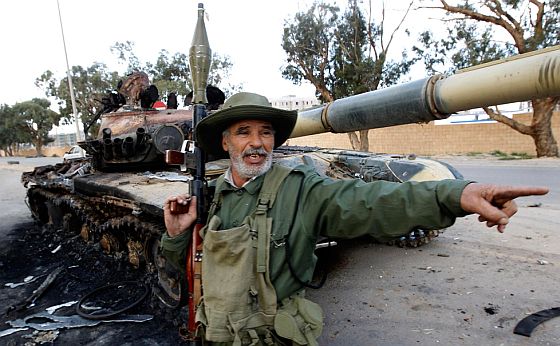

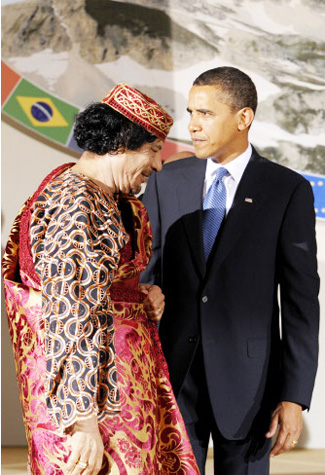 If Sarkozy, Cameron and Obama believe that Gaddafi’s demonization makes the war legitimate in the eyes of domestic audiences which might otherwise lack interest in the fate of Libya, the West will have needlessly restricted the range of acceptable outcomes to this war.