With single young men at the heart of Arab world revolt, China might seem a country ripe for uprising. But while it’s got millions of single young men, they don’t appear interested in amassing a movement for change.
China now has at least 20 million young men with no chance of ever finding a female partner, according to population experts. In short, there are too many men. Demographers predict the gender gap will grow to 35 million by 2020. The reason: China’s one-child policy and a culturally ingrained preference for male children, along with a rise in accessible ultrasound technology and sex-selective abortion, led to a staggering surplus of young men born in the 1980s and 90s.
The overall trend is beginning to change for new families, but there remains a bubble of young men that can’t be reversed or repaired. So why aren’t they rising up and causing trouble for the authoritarian regime of China? In short, they’re too busy.
Andrea den Boer, co-author of the 2005 book “Bare Branches,” an in-depth investigation of surplus males and related potential security issues in Asia, said China’s situation is different than that of Egypt, which suffers from what is know as a “youth bulge.”
China has the millions of single young men, but what it’s missing is massive unemployment and economic decline. With the world’s fastest-growing large economy, opportunity is abundant. Development has reached every corner of the country and work opportunities have begun taking tens of thousands of young Chinese men to Africa and other parts of the world.
“The bare branches in China could potentially mimic the effect of a youth bulge given the large numbers of males, but they would have to have a motivation for unrest,” said den Boer, referencing her book title, taken from a Chinese term for unmarriageable young men. “Given the relative stability of China and the continued economic growth and low unemployment in the state at present, China isn’t at risk for large scale unrest.”
Chinese officials have repeatedly stated that their country’s authoritarian but economically vibrant system has nothing to fear from the spectacle of dictatorships crumbling in distant Arab lands. Yet officials have mobilized massive resources to chase what at times seem to be little more than phantoms of unrest.
Anonymous calls on the Internet for Chinese to rally each Sunday in protest, in Beijing and other major cities, have brought out throngs of uniformed and undercover police, but few actual protesters. Foreign journalists have been harassed and, in a few cases, beaten. Human rights groups estimate that scores of dissidents and lawyers have been detained or confined to their homes.
China’s so-called “jasmine rallies” are inspired by Tunisia’s January uprising, the first in what has since become a region-wide convulsion. There is no sign that most Chinese want to follow Tunisia’s example, but the heavy-handed response of authorities has played into the hands of the mysterious organizers of China’s so-far nonexistent revolt.
Egypt and Tunisia’s unfinished revolutions
It’s been just seven weeks since President Zine el Abidine Ben Ali fled Tunisia, and just over three weeks since Hosni Mubarak was unceremoniously dumped from the presidency by the Egyptian military — but both countries have already unseated their interim prime ministers. Egypt’s Ahmed Shafiq on Wednesday followed last week’s decision by Tunisia’s Mohammed Ghannouchi to step down, heeding the will of those who had taken to the streets to oust the autocrats who had appointed them. The two countries have chosen different models for their transition to democracy: Tunisia has a civilian government supported by the military; in Egypt, a Supreme Council of the Armed Forces has taken charge and has suspended the constitution. But in both countries, the interim rulers face a crisis of legitimacy, with controversy surrounding some of the personalities now in charge and their transition plans contested by many of the same forces that took to the streets to demand political change. And at the same time, they must deal with the mountain of problems left behind by the dictators, from corruption and cronyism to collapsing state authority and anemic economic performance. (Issandr El Amrani)
Whereas 70% of Saudis are under the age of 30, and their median age is 19, the Saudi cabinet ministers average 65. Some senior princes have held their jobs as ministers or provincial governors for decades; one has governed the Northern Borders Province since 1956. Whereas 40% of Saudi youths have no jobs and nearly half of those in work take home less than 3,000 riyals ($830) a month, every prince (of whom there are probably 7,000-8,000) gets a monthly stipend ranging from a few thousand dollars up to $250,000, according to an estimate in a WikiLeaks cable.
In forums where Saudis are able to express discontent, anger is rising. Out of 1,600 asked in a recent web poll to rate the credibility of statements by Saudi officials, 90% ticked “untrustworthy”. (The Economist)
Egypt security building stormed
Egyptian protesters have stormed the headquarters of Egypt’s state security force in Alexandria, with several people suffering injuries in scuffles with riot police.
Around 1,000 people encircled the State Security Agency building late on Friday, demanding that the officers inside come out or they would storm the building.
Protesters then entered into the building and scuffled with riot police before military forces intervened and took control of the building.
Demonstrators said officers inside had been shredding and burning documents that may have proven past abuses. (Al Jazeera)
Continued disappearance of Iran opposition figures raises concerns of torture
Iranian officials should immediately end the illegal, incommunicado detention of four leading opposition figures: Mehdi Karroubi; Mir Hossein Mousavi; Fatemeh Karroubi; and Zahra Rahnavard, the International Campaign for Human Rights in Iran said today.
The Campaign warns that the incommunicado nature of their eighteen day long detention in an undisclosed location increases the likelihood that the four are facing psychological and physical torture for the purposes of extracting false confessions.
“Arbitrary and incommunicado detention in unknown locations is often associated with torture and ill treatment, and even extrajudicial execution in Iran,” said Hadi Ghaemi, the Campaign’s spokesperson.
“Time and again opposition figures in Iran are detained without contact with their families or lawyers, only to undergo abuse and appear on TV weeks later confessing to baseless charges,” he said. (International Campaign for Human Rights in Iran)
Youths ‘attack Algerian protesters’
Anti-government protesters have been attacked in the Algerian capital and an attempt made to lynch a prominent opposition politician, local media have said.
The reports said that protests organised by the National Co-ordination for Democracy and Change (CNDC) in Algiers were violently suppressed on Saturday morning.
According to the the Algerian daily newspaper El Watan, a group of youths tried to lynch Said Sadi, the president of the Rally for Culture and Democracy (RCD).
Dozens of youths wearing banners supporting Abdelaziz Bouteflicka, the Algerian president, forced Sadi to flee in his car after they threatened to kill him in the al-Madania neighbourhood of Algiers, the publication said. (Al Jazeera)
Qatari blogger detained
Amnesty International says a blogger and human rights activist has been detained incommunicado in Qatar and is at risk of torture or other ill-treatment.
The UK-based human rights group said Sultan al-Khalaifi was arrested on March 2 by around eight individuals in plain clothes, believed to be members of the security forces.
According to information received by Amnesty International, al-Khalaifi had told his wife earlier that day that state security had contacted him, asking him to report to them, but that he did not know why.
The reasons for his detentions and his whereabouts are unknown, Amnesty said in a statement on Friday, adding that it is believed he is being held in the custody of state security. (Al Jazeera)
Bahrain protesters encircle state compound
Tens of thousands of Bahraini opposition protesters encircled a sprawling government compound on Sunday, forcing the cancellation of a meeting of senior lawmakers and further escalating pressure on the ruling Al-Khalifa family to accept sweeping reforms.
Protesters began assembling before 9 a.m., taking up positions at each of the complex’s four gates and repeating opposition calls for the fall of the government. Behind the compound’s gates, hundreds of riot police stood guard, while police helicopters circled overhead.
The protest forced government ministers to abandon their weekly council meeting, where Prime Minister Sheikh Khalifa bin Salman al-Khalifa coordinates policy with the heads of Bahrain’s top ministries. Opposition groups cite the resignation of the Prime Minister, who has been in his post for 41 years, as one of their top demands.
Opposition leaders said the demonstration expanded their strategy of escalating pressure on the ruling family by marching on politically sensitive locations across the capital.
“We are attacking peacefully all the institutions of state. This is really a regime change without overthrowing the monarchy,” said Ebrahim Sharif, a Sunni Muslim and former banker who heads the National Democratic Action Society, one of the groups tasked with unifying the opposition’s message. (Wall Street Journal)
“Everybody realized that Bahrain was just too important to fail,” said an Obama administration official. And what would cause failure? For the monarchy to be overthrown and replaced with a democracy.
From Washington’s perspective, the people in Bahrain, the other Gulf states and especially in Saudi Arabia cannot be trusted with the power to determine their own futures.
Saudi Arabia is preparing to launch a ruthless crackdown on dissent and when pro-democracy demonstrators get slaughtered, as they probably will, if President Obama has anything to say we can be sure he will go no further than issue one of his usual mealy-mouthed appeals for restraint. The House of Saud has already been given the green light to do whatever it must in the name of preserving “stability.”
The stability to which the Middle East’s rulers and their American friends now cling, is a stability whose foundation is built on graves and torture cells.
Saudi Arabia was yesterday drafting up to 10,000 security personnel into its north-eastern Shia Muslim provinces, clogging the highways into Dammam and other cities with busloads of troops in fear of next week’s “day of rage” by what is now called the “Hunayn Revolution”.
Saudi Arabia’s worst nightmare – the arrival of the new Arab awakening of rebellion and insurrection in the kingdom – is now casting its long shadow over the House of Saud. Provoked by the Shia majority uprising in the neighbouring Sunni-dominated island of Bahrain, where protesters are calling for the overthrow of the ruling al-Khalifa family, King Abdullah of Saudi Arabia is widely reported to have told the Bahraini authorities that if they do not crush their Shia revolt, his own forces will.
The opposition is expecting at least 20,000 Saudis to gather in Riyadh and in the Shia Muslim provinces of the north-east of the country in six days, to demand an end to corruption and, if necessary, the overthrow of the House of Saud. Saudi security forces have deployed troops and armed police across the Qatif area – where most of Saudi Arabia’s Shia Muslims live – and yesterday would-be protesters circulated photographs of armoured vehicles and buses of the state-security police on a highway near the port city of Dammam.
Although desperate to avoid any outside news of the extent of the protests spreading, Saudi security officials have known for more than a month that the revolt of Shia Muslims in the tiny island of Bahrain was expected to spread to Saudi Arabia. Within the Saudi kingdom, thousands of emails and Facebook messages have encouraged Saudi Sunni Muslims to join the planned demonstrations across the “conservative” and highly corrupt kingdom. They suggest – and this idea is clearly co-ordinated – that during confrontations with armed police or the army next Friday, Saudi women should be placed among the front ranks of the protesters to dissuade the Saudi security forces from opening fire.
If the Saudi royal family decides to use maximum violence against demonstrators, US President Barack Obama will be confronted by one of the most sensitive Middle East decisions of his administration. In Egypt, he only supported the demonstrators after the police used unrestrained firepower against protesters. But in Saudi Arabia – supposedly a “key ally” of the US and one of the world’s principal oil producers – he will be loath to protect the innocent.
After weeks of internal debate on how to respond to uprisings in the Arab world, the Obama administration is settling on a Middle East strategy: help keep longtime allies who are willing to reform in power, even if that means the full democratic demands of their newly emboldened citizens might have to wait.
Instead of pushing for immediate regime change—as it did to varying degrees in Egypt and now Libya—the U.S. is urging protesters from Bahrain to Morocco to work with existing rulers toward what some officials and diplomats are now calling “regime alteration.”
The approach has emerged amid furious lobbying of the administration by Arab governments, who were alarmed that President Barack Obama had abandoned Egyptian President Hosni Mubarak and worried that, if the U.S. did the same to the beleaguered king of Bahrain, a chain of revolts could sweep them from power, too, and further upend the region’s stability.
The strategy also comes in the face of domestic U.S. criticism that the administration sent mixed messages at first in Egypt, tentatively backing Mr. Mubarak before deciding to throw its full support behind the protesters demanding his ouster. Likewise in Bahrain, the U.S. decision to throw a lifeline to the ruling family came after sharp criticism of its handling of protests there. On Friday, the kingdom’s opposition mounted one of its largest rallies, underlining the challenge the administration faces selling a strategy of more gradual change to the population.
Administration officials say they have been consistent throughout, urging rulers to avoid violence and make democratic reforms that address the demands of their populations. Still, a senior administration official acknowledged the past month has been a learning process for policy makers. “What we have said throughout this is that there is a need for political, economic and social reform, but the particular approach will be country by country,” the official said.
A pivotal moment came in late February, in the tense hours after Mr. Obama publicly berated King Hamad bin Isa al-Khalifa for cracking down violently on antigovernment demonstrators in Bahrain’s capital. Envoys for the king and his Arab allies shuttled from the Pentagon to the State Department and the White House with a carefully coordinated message.
If the Obama administration did not reverse course and stand squarely behind the monarchy, they warned, Bahrain’s government could fall, costing America a critical ally and potentially moving the country toward Iran’s orbit. Adding to the sense of urgency was a scenario being watched by U.S. intelligence agencies: the possibility that Saudi Arabia might invade its tiny neighbor to silence the Shiite-led protesters, threatening decades-old partnerships and creating vast political and economic upheaval.
“We need the full support of the United States,” a top Bahraini diplomat beseeched the Americans, including Joint Chiefs of Staff Chairman Adm. Michael Mullen, Assistant Secretary of State Jeffery Feltman, Deputy National Security Adviser Denis McDonough, and other top policy makers.
Arab diplomats believe the push worked. Defense Secretary Robert Gates and Secretary of State Hillary Clinton emerged as leading voices inside the administration urging greater U.S. support for the Bahraini king coupled with a reform agenda that Washington insisted would be have to be credible to street protesters. Instead of backing cries for the king’s removal, Mr. Obama asked protesters to negotiate with the ruling family, which is promising major changes.
Israel was also making its voice heard. As Mr. Mubarak’s grip on power slipped away in Egypt, Israeli officials lobbied Washington to move cautiously and reassure Mideast allies that they were not being abandoned. Israeli leaders have made clear that they fear extremist forces could try to exploit new-found freedoms and undercut Israel’s security, diplomats said.
“Starting with Bahrain, the administration has moved a few notches toward emphasizing stability over majority rule,” said a U.S. official. “Everybody realized that Bahrain was just too important to fail.”
All protests and marches are to be banned in Saudi Arabia, the interior ministry has announced on state TV.
Its statement said security forces would use all measures to prevent any attempt to disrupt public order.
The announcement follows a series of protests by the kingdom’s Shia minority in the oil-producing eastern province.
Last month, King Abdullah unveiled a series of benefits in an apparent bid to protect the kingdom from the revolts spreading throughout many Arab states.
“Regulations in the kingdom forbid categorically all sorts of demonstrations, marches and sit-ins, as they contradict Islamic Sharia law and the values and traditions of Saudi society,” the Saudi interior ministry statement said.
It added that police were “authorised by law to take all measures needed against those who try to break the law”.
To follow-up on yesterday’s observations about the prolonged forced nudity to which Bradley Manning has been subjected the last two days: brig officials now confirm to The New York Times that Manning will be forced to be nude every night from now on for the indefinite future — not only when he sleeps, but also when he stands outside his cell for morning inspection along with the other brig detainees. They claim that it is being done “as a ‘precautionary measure’ to prevent him from injuring himself.”
Has anyone before successfully committed suicide using a pair of briefs — especially when under constant video and in-person monitoring? There’s no underwear that can be issued that is useless for killing oneself? And if this is truly such a threat, why isn’t he on “suicide watch” (the NYT article confirms he’s not)? And why is this restriction confined to the night; can’t he also off himself using his briefs during the day?
Let’s review Manning’s detention over the last nine straight months: 23-hour/day solitary confinement; barred even from exercising in his cell; one hour total outside his cell per day where he’s allowed to walk around in circles in a room alone while shackled, and is returned to his cell the minute he stops walking; forced to respond to guards’ inquiries literally every 5 minutes, all day, everyday; and awakened at night each time he is curled up in the corner of his bed or otherwise outside the guards’ full view. Is there anyone who doubts that these measures — and especially this prolonged forced nudity — are punitive and designed to further erode his mental health, physical health and will?
At least 15 people have been killed and 200 more wounded in the Libyan city of Zawiya, an eyewitness told CNN.
Wounded people started arriving at the hospital Friday morning. Most of the injuries resulted from gunshots, and many of the injuries were to the head and chest.
The eyewitness said the hospital is running out of medical supplies.
“There is a river of blood here in the hospital. The situation is very bad,” he said.
Forces loyal to Libyan leader Moammar Gaddafi unleashed their fiercest counterattack yet against the opposition on Friday, assaulting rebel-held positions by ground and air and firing on demonstrators in the government stronghold of Tripoli.
The lethal force of the government offensive – including what rebels described as a “bloodbath” in the strategic western port city of Zawiyah – raised the stakes for Washington and its western allies. They have threatened military intervention should the Gaddafi government cross red lines including the systematic endangerment of defenseless civilians or if the battle for Libya evolved into a long-term, bloody stalemate.
Yet if anything, the events Friday underscored Gaddafi’s ability to press defiantly ahead with a brutal campaign to reclaim land already lost to the rebels and squelch dissent within bastions of government control. The government appeared to be attempting to secure a buffer zone around Tripoli and target areas vital to the country’s oil industry, taking aim at cities and ports that have given the rebels a foothold close to the capital.
The White House expressed renewed alarm, saying that President Obama is “appalled by the use of force against unarmed, peaceful civilians.” Obama is being briefed on Libya three times a day, and “we’re not taking any options off the table,” said Jay Carney, the White House press secretary.
With thousands of refugees stuck on the Tunisian border with Libya, the U.S. Air Force flew in humanitarian supplies for them Friday aboard two C-130 cargo planes and planned to return Saturday to pick up Egyptian refugees and fly them home.
The fiercest attack on Friday fell on the opposition-held city of Zawiyah, home to one of Libya’s largest oil refineries and situated just 27 miles west of Tripoli. Official Libyan media claimed the government had retaken the city, though the rebels there denied it. As of late Friday, however, the city remained under siege.
“We are still in the square,” said Mohamed Magid, an opposition spokesman. “Zawiyah has not fallen.”
Gaddafi loyalists armed with tanks and heavy machine guns and reportedly led by his son, Khamis Gaddafi, launched an offensive around midday, rebels said. Forces loyal to Gaddafi entered the city from several directions, using tanks, SUVs and trucks armed with heavy machine guns, witnesses said. They also laid siege to the city with mortar fire.
Though details were impossible to verify, witnesses in Zawiyah said at least 15 people were killed and 200 wounded, with a senior rebel leader reported to be among the dead. Some reports put the death toll as high as 50.
Libyan Ambassador to the United States Ali Aujali, who joined the opposition in the early days of the crisis, issued an urgent plea for the United States to take more aggressive actions against the Libyan government in an interview with Foreign Policy today.
Aujali strongly supported the implementation of a no-fly zone over Libya, calling it “a historic responsibility for the United States.” He also criticized the arguments about the risks of no-fly zone, which have been made by U.S. Defense Secretary Robert Gates and other military officials. “When we say, for example, that the no-fly zone will take a long time, that it is complicated — please don’t give this regime any time to crush the Libyan people,” he said.
The ambassador, who began his diplomatic career four decades ago, raised the flag of the Libyan opposition over the ambassador’s residence in Washington after resigning last week. He told Foreign Policy that he decided to resign following Saif al-Qaddafi’s speech on Feb. 21, in which Qaddafi’s favored son warned protesters of “rivers of blood” if they did not cease their demonstrations.
Aujali warned that further delay in organizing an international response raised the risk that Qaddafi would be able to reconstitute his strength. “Time means losing lives, time means that Qaddafi will regain control,” he said. “He has weapons, he has rockets with about 450 kilometers’ distance, and we have to protect the people. These mercenaries now are everywhere.”
Britain is to send a team of experts capable of giving military advice into eastern Libya to make contact with opposition leaders as the struggle for control of the country escalates.
The move is a clear intervention on the ground to bolster the anti-Gaddafi uprising, learn more about its leadership, and see what logistical support it needs. Whitehall sources said the diplomatic taskforce would not be providing arms to the rebels, as there is an international arms embargo.
It came as Libya’s deputy foreign minister, Khaled Kaim, said that Tripoli had accepted a peace initiative put forward by Venezuela’s president Hugo Chávez, which was heavily criticised by the White House. Kaim said it stated that a committee would be formed by African, Asian and Latin American countries “to help the international dialogue and to help the restoration of peace and stability”.
Interpol issued a global alert against Muammar Gaddafi and 15 other Libyans, including his daughter and seven sons, in an effort to enforce sanctions.
Security forces have used teargas and live ammunition to disperse hundreds of anti-government protesters who marched in Tripoli after prayers.
Several hundred demonstrators gathered in Tajura, an area east of the capital, chanting: “Gaddafi is the enemy of God.”
Protesters tore down posters of the Libyan leader and spraypainted walls with graffiti reading: “Down with Gaddafi” and “Tajura will dig your grave.”
Scores of police cars descended on the area, forcing journalists from the scene, and at least one person was detained.
Soon after the march began, officers fired teargas at the crowd. The protesters scattered, but quickly regrouped before security forces fired live ammunition, scattering the protesters again. It was not immediately clear if the shots had been fired in the air or at the marchers.
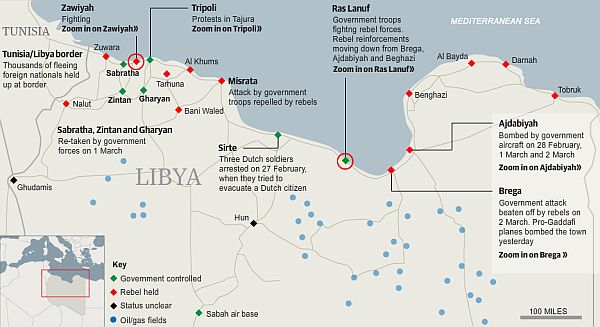
Libya unrest: the civil war begins — an interactive map in The Guardian (click image below):
On Wednesday, Libyan leader Qaddafi’s warplanes bombarded opposition-held Ajdabia, a coastal town 175 km south of Benghazi, the eastern city that has become the unofficial headquarters of anti-Qaddafi forces. That same day, Qaddafi also sent mercenaries to attack the oil-rich town of Brega, 80 km to the southwest, where fighting left 17 dead and, according to some reports, eight more dragged off by mercenaries to an unknown fate. Though fighting between the regime and the opposition has raged openly in Tripoli for the past week, these attacks brought Qaddafi’s first overt hostilities against the rebel-controlled east of the country since yellow-hatted mercenaries massacred civilian protesters in Benghazi on February 17th.
Since ousting Qaddafi’s forces and seizing control over much of eastern Libya on February 21, civilians and defectors from Qaddafi’s army have been gathering in military camps in Benghazi, receiving training from former officers, arming themselves with weapons taken from now-abandoned depots, and preparing for the inevitable counterattack, which began two days ago. That morning, the nascent rebel force mobilized., Many in Ajdabia and elsewhere had received phone calls from friends and family in Brega, which they said was under attack. Newly trained and ready to fight, thousands of these volunteers sped down to help. Ultimately, this irregular force managed to hold the town. Victorious, many returned to the military camp in Ajdabia that evening.
A 26-year-old pharmacist and volunteer in the uprising who gave his name only as Mohammed, sped down the highway toward Ajdabia on Wednesday night. Also in his car was Abdallah Kamal, an Egyptian who participated in the uprising in Cairo’s Tahrir Square, as well as myself and another foreign journalist along for the ride. The road’s checkpoints were marked with burning tires and manned by young men sporting Kalashnikovs and kaffiyehs wrapped around their heads.
The fantasy that the Arabs are passive and unsuited to democracy has evaporated in weeks. Arabs have overthrown hated authoritarian regimes in Tunisia and Egypt. In Libya, they have fought a sclerotic regime in power for 42 years that has refused to listen to their demands, facing extraordinary violence, hundreds of deaths, untold injuries, mass exodus and generalised chaos. In Algeria, Morocco, Bahrain, Yemen, Jordan, Iraqi Kurdistan, the West Bank and Oman, Arabs have taken to the streets in vast numbers. This defiance has spread even to non-Arab Iran.
And where promises of reform have been made but were then found wanting, people have simply returned to the streets. In Egypt, protesters have demanded faster and further-reaching reform. In Tunisia, renewed demonstrations on 25-27 February led to five deaths but won a change of prime minister (Mohamed Ghannouchi stepped down in favour of Beji Caid-Essebsi). In Iraq, renewed protests led to a promise to sack unsatisfactory ministers. In Algeria, the 19-year emergency law was repealed amid continuing protests. The demands are growing throughout the region, and will not be silenced.
The revolutions in Tunisia and Egypt, the uprising in Libya, and all the other popular movements that have shaken the region are not just about how people want to live and develop, but about regional politics. For the first time since the 1970s, geopolitics cannot be analysed without taking into account, at least in part, the aspirations of people who have retaken control of their destinies.
“Sultan Qaboos, Oman’s absolute ruler, is a man of culture,” writes Brian Whitaker.
“I have never encountered a place in the Arab world so well-governed as Oman, and in such a quiet and understated way,” Robert Kaplan wrote the other day in an article for Foreign Policy headed “Oman’s renaissance man”.
Last weekend, though, overshadowed by events in Libya, there were disturbances in Sohar (Oman’s second city) along with more peaceful demonstrations elsewhere in the country. Protesters’ complaints were the familiar ones heard these days in most of the Arab countries: government corruption, cronyism and youth unemployment.
Oman has an exceptionally young population – 43% are under the age of 15 – and even those who buy the line that Oman is well governed recognise that the authorities face an uphill struggle in providing jobs. “The problem is evolving faster than they can provide solutions,” one person who is familiar with the country (and asked not to be identified) told me this week.
But there’s another problem too. Even if Qaboos is a Britain-friendly, music-loving ruler with benevolent intentions he is none the less a despot. He doesn’t tolerate criticism and his citizens have very few rights. They can’t, for instance, hold a public meeting without the government’s approval. Anyone who wants to set up a non-governmental organisation of any kind needs a licence. To get it, they have to demonstrate that the organisation is “for legitimate objectives” and not “inimical to the social order”. On average, that takes two years – assuming permission is granted at all.
Egypt’s uprising, contrary to most predictions, was initiated and driven by coalitions – including political parties, associations and internet networks – which were dominated by secular and democratic forces. Islamic organisations or their individual members took part on an equal footing with groups of marginal importance before the uprising, and with groups closer to eastern European dissidents of 1989 than to the usual mass parties or revolutionary elites of social revolutions.
The discretion of Tunisia’s Islamist movement can be explained to a large extent by the harshness of its suppression under Ben Ali, impeding the ability of the Islamic Nahda party to act. However, the Muslim Brotherhood in Egypt was also discreet, but for the opposite reason: because it was a party tolerated by the military regime (although not legalised).
Anwar Sadat, when he came to power after Gamal Abdel Nasser’s death in 1970, favoured the Brotherhood’s return to the public stage and its enhanced position as a counterbalance to the Nasserist or radical left. The Brothers fully subscribed to the economic liberalisation (infitah) of Sadat when he embarked on dismantling Nasser’s legacy. This led to increased influence of members of the new Egyptian bourgeoisie within the Brotherhood. Even so, it continued to assert its piety against rampant corruption; this was a key argument for the petit bourgeois, the Brothers’ favourite constituency.
The Brotherhood built itself as a reactionary religious political movement, whose main concern was – and still is – the Islamisation of Egypt’s political and cultural institutions and the promotion of sharia as the basis for legislation. This programme is summed up by its main slogan: “Islam is the solution”. At the same time, the Brotherhood has served as a political antidote to extreme and violent fundamentalist groups.
Carried on the shoulders of protesters who claimed him as their own, Egypt’s new prime minister waded into a crowd of tens of thousands in Tahrir Square on Friday, delivering a speech bereft of regal bombast that illustrated the reach of Egypt’s nascent revolution and the breadth of demonstrators’ demands that remain unanswered.
“I am here to draw my legitimacy from you,” Prime Minister Essam Sharaf told the raucous, flag-waving assembly. “You are the ones to whom legitimacy belongs.”
Some protesters dismissed the speech as the savvy move of an ambitious politician in a time fraught with anxiety. Yet it was perhaps the symbolism itself that said the most about Friday’s moment when, just a day after his appointment, an Egyptian leader chose to make his first stop the square that helped topple his predecessor.
While millions of Americans are experiencing unemployment, wage stagnation, rising tuition, dwindling social services, and poverty at levels not seen since the Great Depression, an unjustifiably large proportion of our taxes are being used to cause death and destruction in Afghanistan. With Afghanistan being the longest war the U.S. has ever officially waged, we should carefully examine the costs of the war – financial and otherwise – and ask ourselves, is it really worth it?
The war costs taxpayers between $500,000 to $1 million per soldier in Afghanistan every year. Since President Obama deployed thousands of more troops than Bush, the escalating war has come with a bloated price tag. So far, we have spent $336 billion on the war, and if Congress approves a request for additional funding, that number will go up to $455.4 billion – nearly half a trillion dollars. According to CostofWar.com, just the $120 billion in additional funding could fund 1.6 million elementary school teachers for a year, 1.9 million firefighters for a year, or $5,550 Pell Grants for 19.3 million students. A single month’s expenses on the Afghanistan war could pay for 46.9 billion meals for the hungry each month. Six months’ worth of Afghanistan war expenses could pay for school supplies for every single child in the world.
In Benghazi, the opposition National Libyan Council said there was no room for talks, following reports that Col Gaddafi had ordered an intelligence chief to negotiate with the rebels.
The council is led by former Libyan Interior Minister Mustafa Abdel-Jalil, who defected last month.
“If there is any negotiation it will be on one single thing – how Gaddafi is going to leave the country or step down so we can save lives. There is nothing else to negotiate,” Ahmed Jabreel, a spokesman for Mr Abdel-Jalil, told Reuters news agency.
The BBC’s Kevin Connolly in Benghazi says it appears that neither side has the capacity to move large amounts of manpower or firepower over vast expanses of desert.
He says that raises the grim prospect of a military stalemate and a political vacuum after the revolt that began in the east of the country in mid-February.
Muammar Gaddafi has accepted an offer from Venezuela to mediate in Libya’s political crisis after talks with Hugo Chavez, the Venezuelan president, Al Jazeera has learnt.
Sources told our correspondent in Caracas that Nicolas Maduro, Venezuelan’s foreign minister, had discussed the offer with Amr Moussa, the head of the Arab League, and that details of the plan could be announced by the Arab League in Cairo on Thursday.
Mustafa Abdel Jalil, the head of the opposition National Libyan Council, told Al Jazeera he totally rejected the concept of talks with Gaddafi, and said that no one been in contact with him regarding the Venezuelan initiative.
The plan would involve a commission from Latin America, Europe and the Middle East trying to reach a negotiated outcome between the Libyan leader and opposition forces which have seized control of large areas of the North African oil-producing country.
After decades of financing and training rebels and liberation movements, Libya’s Moamer Gathafi is accused of using his influence to amass an army of mercenaries from across sub-Saharan Africa.
Liberia, Sierra Leone, Uganda, Chad, Mali and Zimbabwe: One only has to name a conflict, rebel group or despot in Africa to find someone the Libyan leader has offered finance, training or backing to during his 41-year reign.
He has also aided peacekeeping operations, given aid and built infrastructure.
And now, waving oil money to the south, Gathafi is said to have lured some 25,000 mercenaries to quash a popular revolt against his regime.
Gaddafi can no more quickly attack Benghazi with his armour than the rebels can advance on Tripoli in sufficient numbers to force the issue decisively. For either side to move the hundreds of kilometres to come into contact would require a huge logistical operation using tank and armour carriers which could not drive the long distances and still be ready to fight.
Why this matters is simple. Foreign policy – including the increasing threat of military intervention – is being driven by what the media is reporting from Libya, and that is being driven largely by reports from the opposition, some of which are true, some of them dubious. The Libyan government says that. But for once, in the midst of all the regime’s evasions, lies and fantastical notions, it may just have a point.
We are being drawn into a crisis where credible information about so much of what is happening is not simply at a premium, it is often impossible to mine from among all the exaggerations and misinformation.
To the rebels of eastern Libya, it was always a matter of when. On Wednesday morning, sooner than many had expected, Gaddafi’s men came for them.
A thundering burst of machine-gun fire just before 6.30am heralded the attack on the outskirts of Brega, a sand-strewn service town about 150 miles south of Benghazi. The loyalist forces had crept in during the night, patiently set up in an industrial area on the city limits, and dug in.
“They arrived in 60-70 Toyota trucks,” said Wais Werfali, 40, who works in a nearby ammonia production plant. “They have set up a perimeter and are using families from the area as human shields.”
By sunset, the battle had been joined by rebels streaming down from the city of Ajdabiya. A decisive phase in this war for control of eastern Libya had begun.
Peter Beaumont reports from the Tripoli suburb of Tajura, the target of a crackdown on rebels where ‘disappearances’ are increasing.
Tajura, with its population of about 100,000, is made up mainly of poor and middle-class Libyans who live in three-storey apartment blocks and houses built around little squares and alleys.
It is here that residents say gunmen in pickup trucks fired wildly into the crowd last week. It now feels like a ghost town, with shops shuttered and few people on the streets, which still bear the scars of the clashes.
We had been met on a dark corner by a group of youths keeping watch on the street. They were suspicious of the driver, who was sent away after being questioned briefly. There was evidence on the roadside of felled palm trees that had been used as barricades and anti-government graffiti, painted over with red paint.
“Fifteen of them came and kicked in the door,” Bilhaj says inside the house. “They turned the house upside down. In this neighbourhood, 20 have disappeared. We don’t know where they have gone.
“The people in this area feel threatened. They are scared. The government says if there are any protests in the streets here they will burn them.”
We ask what his brothers did to be arrested. “They spoke out. They were targeted because they were ones who oppose the government. Tonight they will come and take more people. Our street is almost empty. The men have been taken and the families fled elsewhere.”
Thousands of people continue to flee the violence in Libya, with most refugees attempting to enter neighbouring Tunisia or Egypt, though there are pressing concerns regarding African migrants who remain trapped in the country, unable to leave for fear of being attacked by both the government and the opposition.
Officials say that tens of thousands of people remain just inside Libya’s borders, awaiting evacuation, safe passage or the granting of asylum, while thousands more have so far not attempted to leave their homes for fear of their own safety.
International Organisation for Migration officials say that almost 200,000 people have fled Libya since violence began several weeks ago, headed towards neighbouring Egypt, Tunisia and Niger.
President Obama demanded Thursday that the embattled Libyan leader, Col. Muammar el-Qaddafi, “step down and leave” immediately, and said he would consider a full range of options to stem the bloodshed there, though he did not commit the United States to any direct military action.
In his most forceful response to the near-civil war in Libya, Mr. Obama said the United States would consider imposing a “no-fly zone” over the country — a step his defense secretary, Robert M. Gates, warned a day earlier would carry major risks, requiring the United States to destroy Libya’s air defenses.
Mr. Obama said the United States and the world were outraged by Colonel Qaddafi’s “appalling violence against the Libyan people.” Speaking after he met with President Felipe Calderón of Mexico at the White House, he declared, “Muammar Qaddafi has lost the legitimacy to lead, and must leave.”
The president’s statement, while robust, left important questions unanswered: Where would Colonel Qaddafi go, given the lack of countries that have offered him sanctuary? And what kind of intervention, beyond airlifting refugees on military planes, would the United States be willing to undertake?
The situation in Libya [has become] a test of how seriously the international community takes the idea of a responsibility to protect people from their rulers. The idea is an old one, but its modern form is rooted in the tragic failure to intervene in the Rwandan genocide in 1994. A subsequent UN inquiry concluded that as few as 2,500 properly trained military personnel could have prevented the massacre of 800,000 Tutsis.
Former US President Bill Clinton has said that the mistake he most regrets making during his presidency was his failure to push for intervention in Rwanda. Kofi Annan, who was then UN Under-Secretary-General for Peace-Keeping Operations, described the situation at the UN at the time as a “terrible and humiliating” paralysis.
When Annan became Secretary-General, he urged the development of principles that would indicate when it is justifiable for the international community to intervene to prevent gross violations of human rights. In response, Canada’s government established an International Commission on Intervention and State Sovereignty, which recommended that military intervention could be justified, as an extraordinary measure, where large-scale loss of life is occurring or imminent, owing to deliberate state action or the state’s refusal or failure to act. These principles were endorsed by the UN General Assembly at its special World Summit in 2005 and discussed again in 2009, with an overwhelming majority of states supporting them.
The principle fits the situation in Libya today. Yet the Security Council resolution contains no mention of the possibility of military intervention – not even the imposition of a no-fly zone over Libya to prevent Gaddafi from using planes to attack protesters.
One body with a special concern to transform the idea of the responsibility to protect into a cause for action is the Global Center for the Responsibility to Protect, at the City University of New York. It has called on UN members to uphold their 2005 commitments and put the responsibility to protect into action in Libya. It urges consideration of a range of measures, several of which were covered by the Security Council resolution, but also including a no-fly zone.
In addition to arguing that the responsibility to protect can justify military intervention, the International Commission on Intervention and State Sovereignty recommended a set of precautionary principles. For example, military intervention should be a last resort, and the consequences of action should not be likely to be worse than the consequences of inaction.
Whether these precautionary principles are satisfied in Libya requires expert judgment of the specifics of the situation. No one wants another drawn-out war like those in Iraq and Afghanistan. But Libya is not Iraq or Afghanistan – its population is only about one-fifth of either country’s, and there is a strong popular movement for a democratic form of government. Assuming that foreign military forces rapidly overwhelmed Gaddafi’s troops, they would soon be able to withdraw and leave the Libyan people to decide their own future.
Those calling for western military action in Libya seem brazenly untroubled by the fact that throughout the Arab world, foreign intervention, occupation and support for dictatorship is regarded as central to the problems of the region. Inextricably tied up with the demand for democratic freedoms is a profound desire for independence and self-determination.
That is clear in reaction on the ground in Libya to the threat of outside intervention. As one of the rebel military leaders in Benghazi, General Ahmad Gatroni, said this week, the US should “take care of its own people, we can look after ourselves”.
No-fly zones, backed by some other opposition figures, would involve a military attack on Libya’s air defences and, judging from the Iraqi experience, be highly unlikely to halt regime helicopter or ground operations. They would risk expanding military conflict and strengthening Gaddafi’s hand by allowing the regime to burnish its anti-imperialist credentials. Military intervention wouldn’t just be a threat to Libya and its people, but to the ownership of what has been until now an entirely organic, homegrown democratic movement across the region.
A decade ago an independent international commission that elaborated on the idea of “responsibility to protect” spelled out six criteria for deciding whether military action is justified. Essentially a modernised version of centuries-old Catholic standards for “just war”, these criteria are: right authority, just cause, right intention, last resort, proportional means, and reasonable prospects. Bitter experience, from Kosovo to Afghanistan, has taught us that “reasonable prospects” (ie of success) may be the most difficult to judge and achieve.
Applying these criteria, I remain unconvinced that a no-fly zone over Libya is justified – at the time of writing. If it turns out that Gaddafi does still have a secret stock of chemical weapons, and can drop them from the sky, this judgment could change overnight. We should prepare contingency plans. But we have not yet exhausted all other avenues, including trying to pry Gaddafi’s cronies away from him by fair means and foul. A no-fly zone would be very difficult to enforce, and might not have anything more than a marginal impact on the ground.
Above all, any form of armed intervention by the west – and the US military says a no-fly zone would require initial bombing of Libyan radar and anti-aircraft facilities – would spoil the greatest pristine glory of these events, which is that they are all about brave men and women liberating themselves.
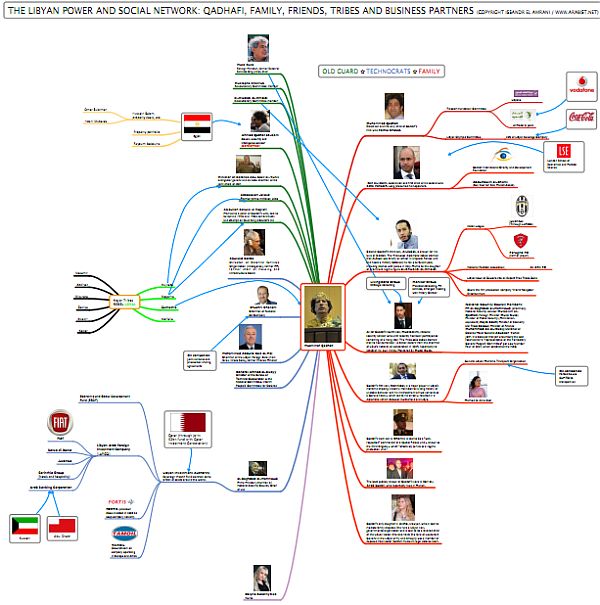
Issandr El Amrani has mapped the social and power networks around Muammar Gaddafi using existing reporting, Wikileaks cables from Tripoli, and a few academic sources.
Click on the image below to see the detailed graphic (PDF).
J Street, America’s premier liberal pro-Israel lobbying group, has just wrapped up its third annual conference in Washington. There have been sessions and panels on “building peace from the ground up,” on “expanding the tent” and even some passionate condemnations of the Occupation. Amid so much good feeling it’s almost possible to lose sight of one of J Street’s fundamental missions: to promote and guarantee America’s lavish and unconditional military aid to Israel.
This may seem like a harsh assessment of the lobbying group. After all, isn’t J Street routinely attacked by neocon ultras and praised by American liberals? But hack through J Street’s verbiage about “dialogue” and “conversation” and one finds this blandly phrased position statement: “American assistance to Israel, including maintaining Israel’s qualitative military edge, is an important anchor for a peace process based on providing Israel with the confidence and assurance to move forward on a solution based on land for peace. J Street consistently advocates for robust US foreign aid to Israel.” This last sentence is 99% of what one needs to know about J Street.
This website or its third-party tools use cookies, which are necessary to its functioning. By closing this banner, you agree to the use of cookies.