Category Archives: Issues

When democracy weakens

Bob Herbert writes:

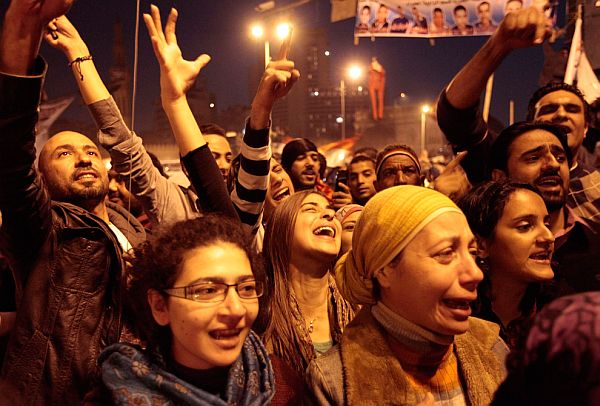
As the throngs celebrated in Cairo, I couldn’t help wondering about what is happening to democracy here in the United States. I think it’s on the ropes. We’re in serious danger of becoming a democracy in name only.

While millions of ordinary Americans are struggling with unemployment and declining standards of living, the levers of real power have been all but completely commandeered by the financial and corporate elite. It doesn’t really matter what ordinary people want. The wealthy call the tune, and the politicians dance.

So what we get in this democracy of ours are astounding and increasingly obscene tax breaks and other windfall benefits for the wealthiest, while the bought-and-paid-for politicians hack away at essential public services and the social safety net, saying we can’t afford them. One state after another is reporting that it cannot pay its bills. Public employees across the country are walking the plank by the tens of thousands. Camden, N.J., a stricken city with a serious crime problem, laid off nearly half of its police force. Medicaid, the program that provides health benefits to the poor, is under savage assault from nearly all quarters.

The poor, who are suffering from an all-out depression, are never heard from. In terms of their clout, they might as well not exist. The Obama forces reportedly want to raise a billion dollars or more for the president’s re-election bid. Politicians in search of that kind of cash won’t be talking much about the wants and needs of the poor. They’ll be genuflecting before the very rich.

Facebooktwittermail

The West can no longer claim to be an honest broker in the search for peace

Gary Younge writes:

The events of the last month in Tunisia, Egypt and elsewhere have challenged the way the west thinks of the Arab world (and how the Arab world thinks of itself). What remains to be seen is the extent to which these ongoing events confront the way in which western powers view themselves and their relationship to the Middle East.

Over the last decade in particular, the Arab world has increasingly been depicted in the west as a region in desperate need of being tamed so that it can be civilised. It has been portrayed as an area rooted in religious fervour, where freedom was a foreign concept and democracy a hostile imposition. Violence and terrorism was what they celebrated, and all they would ever understand. Liberty, our leaders insisted, would have to be forced on them through the barrel of a gun for they were not like us. The effect was to infantilise the Arab world in order to justify our active, or at least complicit, role in its brutalisation.

While this view has been intensified by the 9/11 terror attacks, the war on terror and the invasion of Iraq, it was not created by them. “There are westerners and there are Orientals,” explained the late Edward Said, as he laid out the western establishment’s prevailing attitude to the region at the turn of the last century, in his landmark work . “The former dominate, the latter must be dominated, which usually means having their land occupied, their internal affairs rigidly controlled, their blood and treasure put at the disposal of one or another western power.”

So the sight of peaceful, pluralist, secular Arabs mobilising for freedom and democracy in ever greater numbers against a western-backed dictator forces a reckoning with the “clash of civilisations” narrative that has sought to overwhelm the past decade. It turns out there is a means of supporting democracy in this part of the world that does not involve invading, occupying, bombing, torturing and humiliating. Who knew?

Facebooktwittermail

How American soldiers are falling apart

New York Magazine reports:

Even at the lowest point of the Global War on Terror—in April 2004, say, when the number of casualties was spinning out of control and it looked like there was no end in sight—morale among our troops ran fairly high. Yet today, with casualties tapering and a slightly improved prognosis for stability, our troops, by every conceivable external measure, are falling apart. Veterans of the Iraq and Afghanistan wars make up a disproportionate number of the jobless; the Army’s divorce rate, which used to be lower than the civilian population’s, has surpassed it and is higher still among those who’ve deployed. A spokesman at Fort Drum, home to the 10th Mountain Division here in New York State, tells me by e-mail that one-quarter of its 20,000 soldiers have “received some type of behavioral health evaluation and/or treatment during the past year.” Defense Department spending on Ambien, a popular sleep aid, and Seroquel, an antipsychotic, has doubled since 2007, according to the Army Times, while spending on Topamax, an anti-convulsant medication often used for migraines, quadrupled; amphetamine prescriptions have doubled, too, according to the Army’s own data. Meanwhile, a study by the Rand Corporation has found that 20 percent of the soldiers who’ve deployed in this war report symptoms of post-traumatic stress and major depression.The number climbs to almost 30 percent if the soldiers have deployed more than twice.

“I feel like people with my symptoms are becoming the majority of the Army,” says a major from the New York area who recently started taking Effexor, an antidepressant, and a variety of sleep meds after a second tour in Iraq. “Feeling anxious when you don’t have a reason to, being a little depressed, having low-grade anhedonia, not sleeping well—this is the new normal for those of us who’ve been repeatedly deployed.”

The Army’s own research confirms that drug and alcohol abuse, disciplinary infractions, and criminal activity are increasing among active-duty service members. Most ominously, a growing number of soldiers can’t handle the strains of war at all. Until three years ago, the suicide rate of the Army, the branch with by far the most men and women in this war, was actually lower than the American population’s—a testament to the hardiness of our troops, given that young men with weapons are, at least as a statistical matter, disproportionately prone to suicide. But in 2008, the Army suicide rate surpassed that of the civilian population’s, and the Marines’ surpassed it shortly thereafter. So grim is the problem that this summer, the Army released a remarkably candid suicide report. “If we include accidental death, which frequently is the result of high-risk behavior (e.g., drinking and driving, drug overdose),” it concluded, “we find that less young men and women die in combat than die by their own actions. Simply stated, we are often more dangerous to ourselves than the enemy.”

In other words, nearly as many soldiers are dying at home today as are dying abroad.

The New York Times reports:

In his last months alive, Senior Airman Anthony Mena rarely left home without a backpack filled with medications.

He returned from his second deployment to Iraq complaining of back pain, insomnia, anxiety and nightmares. Doctors diagnosed post-traumatic stress disorder and prescribed powerful cocktails of psychiatric drugs and narcotics.

Yet his pain only deepened, as did his depression. “I have almost given up hope,” he told a doctor in 2008, medical records show. “I should have died in Iraq.”

Airman Mena died instead in his Albuquerque apartment, on July 21, 2009, five months after leaving the Air Force on a medical discharge. A toxicologist found eight prescription medications in his blood, including three antidepressants, a sedative, a sleeping pill and two potent painkillers.

Yet his death was no suicide, the medical examiner concluded. What killed Airman Mena was not an overdose of any one drug, but the interaction of many. He was 23.

After a decade of treating thousands of wounded troops, the military’s medical system is awash in prescription drugs — and the results have sometimes been deadly.

Facebooktwittermail

Egypt in 2011 is not Iran in 1979

Hamid Dabashi writes:

The pro-Isreali neocons in the United States and their Zionist counterparts in Israel compare the Egyptian and Iranian revolutions because they are frightened out of their wits by a massive revolutionary uprising in a major Arab country that may no longer allow the abuse of the democratic will of a people for the cozy continuation of a colonial settlement called “Israel”.

Echoing the Israeli Prime Minister Binyamin Netanyahu, the Iranian neocon contingencies like Abbas Milani of the Hoover Institute think tank in California fear that the Muslim Brotherhood will take over the Egyptian revolution and create an Islamic Republic—habitually turning a blind eye to the fact that a fanatical “Jewish Brotherhood” has already created a Jewish Republic for more than sixty years in the same neighborhood.

Soon after Binyamin Netanyahu and Abbas Milani, and from precisely the opposite ideological direction, Ali Khamenei, the leader of the Islamic Republic and the vast petrodollar propaganda machinery at his disposal, celebrated what is happening in Egypt as a reflection of Khomeini’s will and legacy and the commencement of an “Islamic awakening”. Not so fast, interjected an almost instant announcement from the Egyptian Muslim Brotherhood. This was not an Islamic Revolution, they explained, but an Egyptian revolution that belonged to all Egyptians—Muslims, Christians, people from other ideological persuasions.

In between the frightful Zionist propaganda and Islamist wishful thinking myriads of other opinions have been aired over the last two weeks in one way or another measuring the influence of the Islamic Revolution in Iran over the revolutionary uprising in Egypt.

This is a false and falsifying presumption first and foremost because what happened in Iran during the 1977-1979 revolutionary uprising was not an “Islamic Revolution” but a violently and viciously “Islamised revolution”.

A brutal and sustained course of repression—perpetrated under the successive smoke screens of the American Hostage Crisis of 1979-1981 and the Iran-Iraq War of 1980-1988, and the Salman Rushdi Affair of 1989-1999—is the crucial difference between an “Islamic” and “Islamised” revolution.

A cruel crescendo of university purges, cultural revolutions, mass executions of oppositional forces, and forced exile, took full advantage of domestic and regional crisisis over the last three decades to turn a multifaceted, modern, and cosmopolitan revolution into a banal and vicious theocracy.

The CIA-sponsored coup of 1953, the massive arming of Saddam Hossein to wage war against Iran, and the creation of the Taliban as a bulwark against the Soviet occupation of Afghanistan, all engineered by the United States, and the continued armed robbery of Palestine by Israel have been the regional contexts in which the Islamic Republic destroyed all its ideological and political alternatives and created a malicious theocracy, consistently and systematically abusing regional crisis to keep itself in power.

That historical fact ought to be remembered today so no false analogy or anxiety of influence is allowed to mar the joyous and magnificent uprising of Tunisians and Egyptians to assert and reclaim their dignity in a free and democratic homeland.

There is no reason whatsoever to believe that Tunisians or Egyptians will allow such a treacherous kidnapping of their dreams and aspirations by one fanatical ideological absolutism or another.

What we are witnessing in Tunisia and in Egypt today, as we in fact have been over the last two years in Iran, is a people’s democratic will to retrieve their cosmopolitan political culture, wresting it from colonial (Tunisia), imperial (Egypt), or tyrannical (Iran) distortion, deception, and corruption.

Facebooktwittermail

The fear of freedom

As the train of democracy gathers steam in Egypt, there are those nearby who seem eager to throw themselves under its wheels.

No doubt an observer such as the Israeli historian, Benny Morris, is vain enough to imagine that he is not about to get run over but, on the contrary, hopes his grave warnings will encourage others to seize the train’s brakes and prevent an imminent catastrophe.

What is more likely to happen is that we will only need wait a matter of months before Morris and fellow fearmongers will be exposed as hysterical fools or intellectual rogues.

Morris believes that those of us in the West currently intoxicated by the glorious vision of democracy taking birth in Egypt, have only been able to indulge in such emotions because we don’t understand what Egyptians really want.

Alas, I fear, Westerners will see what most Egyptians actually think and want if and when the country holds free and fair general elections (perhaps in September-October). And I fear that they will be surprised—perhaps even shocked—by the results, and by what the Egyptian masses then say about what they actually think and want. I fear that at that point, “Death to Israel,” “Death to America,” and “Allahu Akbar” will drown out every democratizing and liberalizing chant.

But by then the genie will be well out of the bottle; by then, it will be too late.

Trapped inside a misanthropic Zionist mindset, Morris seems incapable of recognizing that at the core of the Egyptian and Tunisian revolutions, the driving force is not ideological. It is a universal and human demand for respect.

Sensing themselves newly visible on a world stage, ordinary Tunisians and Egyptians stood up, individually and collectively, and said: we refuse to be treated as less than human. We are reclaiming the dignity that is everyone’s birthright and will no longer tolerate the abuse of brutal rulers or the indifference of foreign powers. We demand to be heard and respected.

To the extent that the call from the dignity revolutions is being heard far beyond the Arab world, it resonates most with those who to differing degrees and for different reasons, share the same experience. That many of us live in democracies does little to diminish a sense that our governments do not represent our interests. And that so many of our fellow citizens respond to this reality with indifference only makes us envy the courage and imagination of people who do otherwise as they rise up, declare and discover: we have the power to change the world.

Facebooktwittermail

America, welcome to the era of Arab democracy

Amjad Atallah and Daniel Levy write:

The stark realization slowly dawning on Washington is that the United States cannot be on the right side of Arab democracy if it is on the wrong side of Palestinian freedom. Israel’s security and peace treaties are certainly compatible with a recalibrated American policy in the region, but not the continuation of occupation and inequality for Palestinians. This shouldn’t pose such a conundrum: the status quo has constrained the prospects for both the Arab and Jewish-Israeli publics. For all of its qualitative military edge and American backing, Israel does not feel secure, accepted or calm about its future.

Things get messy though when America fails to apply its own values to the Middle East. Some are advocating for precisely that values-free option, apparently believing that the adage of Israel being the only democracy in the Middle East is not so much a lament as an aspiration. That translates into continued support for Arab autocracies or insisting on what might be called democracy minus for Arab countries in which the balance between military and civilian rule still rests primarily with the former, and by denying democratic Islamist parties the right to participate in peaceful politics.

Representative government in the Arab world will inevitably include a role for Islamists, something seized on by democracy’s opponents as a scare tactic to plead for the continued rule of the authoritarian devil we know. Those warning of a Khomeinist takeover are either desperately ignorant of Arab reality or intentionally misleading. Iran’s system of theocratic republicanism carries no attraction for the Arab pro-democracy movements. If anything, it is Turkey’s system of parliamentary citizen-state democracy, which is held up as a model.

There is another way to look at this region in transition and to plan for the future. The best option for getting this right and being credible is in allowing American policy to reflect American political values.

Imagine that: American foreign policy that isn’t riddled with hypocrisy!

George Bush — with a less than democratic spirit — used to say, you’re either for us or against us. The same can be said about democracy: you’re either for democracy or against it.

We no longer live in an era where something called democracy can be reserved for a privileged minority. Those who now claim that democratic rights should only be selectively recognized are, quite simply, opponents of democracy.

Facebooktwittermail

In Egypt the seeds of a new world order and the end of Western supremacy

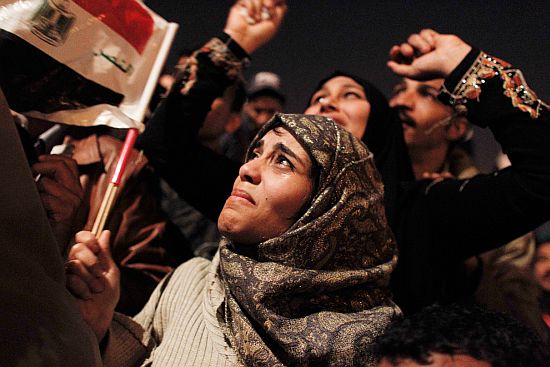
An Egyptian woman cries as she celebrates the news of the resignation of President Hosni Mubarak.

Some think the Middle East isn’t ready for democracy — in truth it’s the West that isn’t ready.

Nicholas Kristof duly notes:

Egyptians triumphed over their police state without Western help or even moral support. During rigged parliamentary elections, the West barely raised an eyebrow. And when the protests began at Tahrir Square, Secretary of State Hillary Rodham Clinton said that the Mubarak government was “stable” and “looking for ways to respond to the legitimate needs and interests of the Egyptian people.”

Commentators have repeatedly referred to the Obama administration playing catch-up during the Egyptian revolution, yet its seeming inability to track fast-changing events was merely an expression of its unwillingness to embrace the direction those events were heading.

Immediately after Hosni Mubarak resigned, Jake Tapper from ABC News tweeted that he couldn’t find anyone in the administration who thought that whatever comes next would be better for U.S. interests than Mubarak had been.

The dictator’s departure is not being celebrated in Washington. The leaders of the free world have a singular lack of enthusiasm for freedom.

The administration has not merely repeatedly stumbled, but has functioned as a dead weight, attempting to slow the pace of what may become the most significant transformation in world order since the birth of Western colonial power.

America’s friends in Israel have been equally unenthusiastic about the turn of events. After Mubarak’s defiant speech on Thursday night when he insisted he would sit out his term as president, “Israel breathed a sigh of relief,” according to Israeli commentator, Alex Fishman. The respite must have felt dreadfully brief.

But if Americans want to grasp the significance of the Egyptian revolution, they need look no further than this country’s much bloodier assertion of people power: the American revolution.

For the first time in Egypt’s history, the Egyptian people have made a declaration of sovereignty and claimed their right of self-governance. Is that not something that every person on the planet who cherishes life and liberty can joyfully celebrate?

As Western leaders now line up, having no choice but to express their support for the revolution, while sagely offering guidance and assistance in managing an “orderly transition” to a democratic system, they do so with a palpable ambivalence.

People power is in jeopardy of sweeping the Middle East and undoing the carefully constructed “stability” through which for most of the last century the West has managed the control of its most vital resource: oil.

Worse for the United States, the Egyptian revolution now undermines the US government’s ability to sustain an unswerving loyalty to the preeminence of Israel’s security interests.

A democratic Egyptian government will not have the autocratic latitude that until now enabled Mubarak’s complicity in the siege of Gaza or his willingness to participate in the charade of a peace process going nowhere.

Stepping back from the most obvious regional implications of what is now unfolding, there is a more far-reaching dimension.

When in 1990 President George HW Bush used the phrase “new world order”, his words had an ominous ring both because they implied that this would be an American-defined order but also — on the brink of the first Gulf War — a militarily-imposed order. The new order was synonymous with the dubious claim that the collapse of the Soviet Union represented an American “victory” in the Cold War.

A new world order worthy of the name, however, should represent something much more significant than the strategic reapportioning of power on a geopolitical level. It should involve the reapportioning of power through which global affairs become the people’s affairs. It should mean that international relations can no longer be conducted within the confines of intrinsically undemocratic arenas where ordinary people have no voice.

The people-power unleashed in Egypt has the potential to serve as a democratizing force that not only threatens autocratic leaders in the Middle East but also technocratic and nominally democratic leaders in the West — those whose complacent style of governance has depended on the political passivity of the populations they nominally serve while providing ready access for corporate interests to exercise their undemocratic influence.

The West, far from representing a model of democracy ripe for export has instead long been mired in a post-democratic phase where the foundational concept of demos, the people, has withered.

Individual wealth has supplanted the need for social solidarity as citizenship has been substituted by consumerism. Our material self-sufficiency has robbed us of the experience of mutual reliance and worn thin the fabric of society.

In a new world order, a new democracy might spread not just further east but also further west.

There is also a bittersweet note in this moment.

The Western exporters of democracy delivered the war in Iraq and yet as we witness events unfold in Egypt, it’s hard not to wonder what might have been possible had the people of Iraq, without Western help or hindrance, been allowed the same opportunity to claim their own freedom.

Facebooktwittermail

Why the Mubarak regime is hated, feared and loathed by the mass of ordinary Egyptians

Robert Tait describes 28 hours in the dark heart of Egypt’s torture machine:

The sickening, rapid click-click-clicking of the electric shock device sounded like an angry rattlesnake as it passed within inches of my face. Then came a scream of agony, followed by a pitiful whimpering from the handcuffed, blindfolded victim as the force of the shock propelled him across the floor.

A hail of vicious punches and kicks rained down on the prone bodies next to me, creating loud thumps. The torturers screamed abuse all around me. Only later were their chilling words translated to me by an Arabic-speaking colleague: “In this hotel, there are only two items on the menu for those who don’t behave – electrocution and rape.”

Cuffed and blindfolded, like my fellow detainees, I lay transfixed. My palms sweated and my heart raced. I felt myself shaking. Would it be my turn next? Or would my outsider status, conferred by holding a British passport, save me? I suspected – hoped – that it would be the latter and, thankfully, it was. But I could never be sure.

I had “disappeared”, along with countless Egyptians, inside the bowels of the Mukhabarat, President Hosni Mubarak’s vast security-intelligence apparatus and an organisation headed, until recently, by his vice-president and former intelligence chief, Omar Suleiman, the man trusted to negotiate an “orderly transition” to democratic rule.

Judging by what I witnessed, that seems a forlorn hope.

I had often wondered, reading accounts of political prisoners detained and tortured in places such as junta-run Argentina of the 1970s, what it would be like to be totally at the mercy of, and dependent on, your jailer for everything – food, water, the toilet. I never dreamed I would find out. Yet here I was, cooped up in a tiny room with a group of Egyptian detainees who were being mercilessly brutalised.

Facebooktwittermail

How the Egypt revolution could help Israel

The historian, Kai Bird, writes:

[T]he cold peace Israel has forged with Arab dictators is unraveling. This may, in the short term, empower Israeli Prime Minister Benjamin Netanyahu’s Likud ideologues who will argue that Arab democrats are out to “delegitimize” Israel. But in the long run, the emergence of an Arab democratic polity should convince Israeli voters that their leaders have become too complacent and too isolationist. After Tahrir, a majority of Israelis may conclude that they can’t live in the neighborhood without forging a real peace with their neighbors.

The separation wall was never a real answer to Israel’s security predicament, and it will be less so when a democratically elected government governs Egypt. The policy of separation — hafrada in Hebrew — had some short-term strategic viability when the largest Arab country was willing to police Israel’s southern border and keep Hamas penned up inside its Gaza prison. But no legitimate government in Cairo will be able to continue its complicity with the Gaza blockade — particularly not if the Muslim Brotherhood is a player in a new government.

In reality, Israel will come under renewed pressure to deal with both Hamas and the Palestinian Authority in the West Bank. Hamas’s ideology is certainly vile, but it won the last Palestinian legislative election in 2006 and has more or less observed a cease-fire with Israel since early 2009. In December 2010, the Hamas prime minister in Gaza, Ismail Haniyeh, announced that his party would abide by any peace settlement if it were to be ratified by a referendum of the Palestinian people. Furthermore, as we recently learned from Al Jazeera’s Palestine Papers — the leaked documents on the 2008 Abbas-Olmert talks — the two sides are not that far apart on a comprehensive peace settlement that would create a Palestinian state.

So here is the uplifting news: What is happening in Tahrir Square may actually propel the politicians in Washington, Jerusalem, and Ramallah to forge the Israeli-Palestinian peace deal that all of us know is there for the taking. And if that doesn’t happen? Absent a comprehensive peace settlement, Israel and the United States will find themselves increasingly isolated in the new Middle East.

Facebooktwittermail

At CIA, deadly mistakes, then promotions

Associated Press report reveals the lack of accountability in the CIA where officers responsible for botched operations end up getting promotions.

In December 2003, security forces boarded a bus in Macedonia and snatched a German citizen named Khaled el-Masri. For the next five months, el-Masri was a ghost. Only a select group of CIA officers knew he had been whisked to a secret prison for interrogation in Afghanistan.

But he was the wrong guy.

A hard-charging CIA analyst had pushed the agency into one of the biggest diplomatic embarrassments of the U.S. war on terrorism. Yet despite recommendations by an internal review, the analyst was never punished. In fact, she has risen to one of the premier jobs in the CIA’s Counterterrorism Center, helping lead President Barack Obama’s efforts to disrupt al-Qaida.

In the years since the Sept. 11, 2001, terrorist attacks, officers who committed serious mistakes that left people wrongly imprisoned or even dead have received only minor admonishments or no punishment at all, an Associated Press investigation has revealed. The botched el-Masri case is but one example of a CIA accountability process that even some within the agency say is unpredictable and inconsistent.

Though Obama has sought to put the CIA’s interrogation program behind him, the result of a decade of haphazard accountability is that many officers who made significant missteps are now the senior managers fighting the president’s spy wars.

The AP investigation of the CIA’s actions revealed a disciplinary system that takes years to make decisions, hands down reprimands inconsistently and is viewed inside the agency as prone to favoritism and manipulation. When people are disciplined, the punishment seems to roll downhill, sparing senior managers even when they were directly involved in operations that go awry.

Two officers involved in the death of a prisoner in Afghanistan, for instance, received no discipline and have advanced into Middle East leadership positions. Other officers were punished after participating in a mock execution in Poland and playing a role in the death of a prisoner in Iraq. Those officers retired, then rejoined the intelligence community as contractors.

Facebooktwittermail

The young cyberactivists behind the Egyptian revolution

Maryam Ishani writes:

Nearly three years ago, a group of youth activists with a strong sense of Internet organizing and more than a little help from abroad was preparing for a grassroots, high-tech opposition movement.

In early 2008, Ahmed Salah and Ahmed Maher, young members of the Kefaya (“Enough”) opposition group that made a strong run against Mubarak in the 2005 presidential election, branched off and formed a group they called the April 6 Youth Movement. The group took its name from the date of the first demonstration it supported — a workers’ strike planned for April 6, 2008, in el-Mahalla el-Kubra, an important town for the Egyptian textile industry. To galvanize the strike effort, April 6 activists used Facebook, Twitter, blogs, and other new-media tools to report events, alert participants about security situations, and provide legal assistance to those rounded up by state security forces.

But from the beginning, the group’s founders were anticipating a far more critical date: the Nov. 28, 2010, parliamentary elections. With memories of Iran’s post-election protests still fresh in their minds, the young activists hoped that the vote — sure to be marred by ballot stuffing, bought votes, and thuggery — would spark a mass movement that would bring Mubarak’s nearly 30-year reign to an end.

By early 2009, the group’s membership was 70,000 strong — still small numbers for a country of 82 million, yet it represented something genuinely new in Egypt’s stagnant political environment. The young activists soon took cues from Iran’s Green Movement, which was born out of the June 2009 post-election protests. They built on best practices and addressed the glaring weaknesses of the Iranian grassroots opposition movement. One of their first projects was a manual on protest methods, composed mostly of contributions from the group’s members, which were solicited online. Friends passed it to friends and added ideas on topics ranging from security to graffiti. I became aware of the group in January 2010, when a fellow reporter forwarded me the manual.

In its early experiments with organizational tactics and online safety, the group sometimes reached out to some unlikely partners. Digital media experts in the organization consulted with Italian anarchist party activists for advice on how to use “ghost servers,” which bounce Internet searches to nonexistent servers to confuse any online monitoring, allowing users to share information and continue coordinating their activities in heavily monitored digital and telecom environments, such as in Egypt, where email accounts and Facebook are watched closely.

Facebooktwittermail

Egypt’s army ‘involved in detentions and torture’ of hundreds of anti-government protesters

The Guardian reports:

The Egyptian military has secretly detained hundreds and possibly thousands of suspected government opponents since mass protests against President Hosni Mubarak began, and at least some of these detainees have been tortured, according to testimony gathered by the Guardian.

The military has claimed to be neutral, merely keeping anti-Mubarak protesters and loyalists apart. But human rights campaigners say this is clearly no longer the case, accusing the army of involvement in both disappearances and torture – abuses Egyptians have for years associated with the notorious state security intelligence (SSI) but not the army.

The Guardian has spoken to detainees who say they have suffered extensive beatings and other abuses at the hands of the military in what appears to be an organised campaign of intimidation. Human rights groups have documented the use of electric shocks on some of those held by the army.

Egyptian human rights groups say families are desperately searching for missing relatives who have disappeared into army custody. Some of the detainees have been held inside the renowned Museum of Egyptian Antiquities on the edge of Tahrir Square. Those released have given graphic accounts of physical abuse by soldiers who accused them of acting for foreign powers, including Hamas and Israel.

Facebooktwittermail

Rural Egyptians support the revolution

Reuters reports:

Beyond Tahrir Square, beyond the boundaries of the sprawling capital, beyond even the provincial cities where protesters joined the call to topple President Hosni Mubarak, rural Egypt is restless for change.

Scraping a meagre living from the land, farmers and rural workers in Egypt’s agricultural heartland have watched the largely urban uprising that has shaken the ruling system and many back the web-savvy youths who galvanised the nation.

A few have turned up in Cairo in their galabiyas, the robes worn in the fields, although most are too busy trying to feed their families. But many believe it is time for a new era, even if some think Mubarak should stay on a few months more.

“The revolution is good … It will give us stability but the protest should stop and the president should be allowed to stay until the end of his term,” said farmer Fawzi Abdel Wahab, working a field near the Nile Delta city of Tanta.

“If the president doesn’t do as he promised, Tahrir Square is still there and the youth will not die, they can go back,” he said, his wife and daughter nodding in agreement.

The protesters want Mubarak to quit now. Mubarak has said he will step down at the end of his term in September.

The protests may have begun with an educated youth and liberal, urban elite, but a tour of the Nile Delta suggests discontent is more widespread. Mubarak’s government needs to do more than meet the aspirations of the middle class.

“The ideas the youths called for in their revolution express those of all Egyptian people, including farmers and residents of rural areas who, like the rest of Egyptians in big cities, face the same needs and suffering,” said analyst Nabil Abdel Fattah.

Satellite dishes that litter roof tops of small country dwellings or village coffee shops spread the word far and wide.

“New media, mainly satellite channels, have managed to spread the message of the revolution everywhere, including rural areas,” said Abdel Fattah of the Al Ahram Centre for Political and Strategic Studies.

Facebooktwittermail

The American-Israeli led anti-democratic alliance

“Never insult the Arabs,” advised Amos Gilead, former head of Israel’s Political-Military Bureau, speaking on Monday at the influential Herzliya national security conference.

But he wasn’t appealing for an improvement in Israeli-Arab relations since he only had a few Arabs in mind — Hosni Mubarak and other leaders “that are supporting stability and are coping with terror and have proven themselves along decades.”

As for Gilead’s views about the advance of democracy in the region, such a prospect presents nothing less than a path to hell.

“If we allow,” Gilead said, then edited himself realizing that democracy should not be presented as something Israel can allow (or forbid) and thus he continued in less instrumental terms, “or if there is democrative process in the Middle East, it will bring for sure — or, let’s say, quite sure — dictatorships which will make this area like hell.”

The Obama administration — which has yet to face any form of governmental pressure it was willing to resist — is now showing itself in much deeper sympathy with those voices who present democracy as a threat than those who claim democracy as their right.

The New York Times reports:

As the Obama administration gropes for the right response to the uprising in Egypt, it has not lacked for advice from democracy advocates, academics, pundits, even members of the previous administration. But few voices have been as urgent, insistent or persuasive as those of Egypt’s neighbors.

Israel, Saudi Arabia, Jordan and the United Arab Emirates have each repeatedly pressed the United States not to cut loose Egypt’s president, Hosni Mubarak, too hastily, or to throw its weight behind the democracy movement in a way that could further destabilize the region, diplomats say. One Middle Eastern envoy said that on a single day, he spent 12 hours on the phone with American officials.

There is evidence that the pressure has paid off. On Saturday, just days after suggesting that it wanted immediate change, the administration said it would support an “orderly transition” managed by Vice President Omar Suleiman. Secretary of State Hillary Rodham Clinton said that Mr. Mubarak’s immediate resignation might complicate, rather than clear, Egypt’s path to democracy, given the requirements of Egypt’s Constitution.

“Everyone is taking a little breath,” said a diplomat from the region, who spoke on the condition of anonymity because he was discussing private conversations. “There’s a sense that we’re getting our message through.”

While each country has its own concerns, all worry that a sudden, chaotic change in Egypt would destabilize the region or, in the Arab nations, even jeopardize their own leaders, many of whom are also autocrats facing restive populations.

Like frogs that refuse to jump out of pot of hot water because its temperature is only rising slowly, those autocrats and their Western allies who now equate stability with their ability to act as a judicious brake on change, have a will to survive that is guiding them down a path of self-destruction.

Slow but sure are the watchwords of the proponents of an “orderly transition” to democracy in Egypt. Yet even as they profess a desire to see democratic change unfold and claim no interest in dictating the outcome of a democratic process, this posture of non-interference is contradicted by a clear intent to dictate the pace of change. The will of the Egyptian people will be respected — but not just yet.

What the West is telling the Arab world is this: be patient living under dictators we like because if you get rid of them you’ll end up being ruled by dictators we don’t like. Now, as ever, the West treats Arabs as being incapable of building their own democracies.

But beneath this veneer of contempt lies a much deeper fear: that a Middle East made up of truly self-governing independent nations fully in control of resources upon which the West depends will no longer bow to Western interests. That’s a prospect the West dreads to contemplate.

Facebooktwittermail

Omar Suleiman: Egypt’s torturer-in-chief threatens to unleash “dark bats of the night… to terrorize the people”

Lisa Hajjar writes:

Under the Bush administration, in the context of “the global war on terror”, US renditions became “extraordinary”, meaning the objective of kidnapping and extra-legal transfer was no longer to bring a suspect to trial – but rather for interrogation to seek actionable intelligence. The extraordinary rendition program landed some people in CIA black sites – and others were turned over for torture-by-proxy to other regimes. Egypt figured large as a torture destination of choice, as did [newly-appointed Vice President, Omar] Suleiman as Egypt’s torturer-in-chief. At least one person extraordinarily rendered by the CIA to Egypt — Egyptian-born Australian citizen Mamdouh Habib — was reportedly tortured by Suleiman himself.

In October 2001, Habib was seized from a bus by Pakistani security forces. While detained in Pakistan, at the behest of American agents, he was suspended from a hook and electrocuted repeatedly. He was then turned over to the CIA, and in the process of transporting him to Egypt he endured the usual treatment: his clothes were cut off, a suppository was stuffed in his anus, he was put into a diaper – and ‘wrapped up like a spring roll’.

In Egypt, as Habib recounts in his memoir, My Story: The Tale of a Terrorist Who Wasn’t, he was repeatedly subjected to electric shocks, immersed in water up to his nostrils and beaten. His fingers were broken and he was hung from metal hooks. At one point, his interrogator slapped him so hard that his blindfold was dislodged, revealing the identity of his tormentor: Suleiman.

Suleiman’s history should be kept in mind when considering statements he made yesterday. In a thinly veiled threat, he warned that if the protests do not end soon, there will be a coup and “dark bats of the night” will emerge “to terrorize the people.”

Egypt’s anti-government activists called on supporters Wednesday to expand their demonstrations in defiance of the vice president’s warning that protests calling for President Hosni Mubarak’s ouster would not be tolerated for much longer.

Vice President Omar Suleiman, who is managing the crisis, raised the prospect of a new crackdown on protesters Tuesday when he told Egyptian newspaper editors there could be a “coup” unless demonstrators agree to enter negotiations. The protesters insist they won’t talk before Mubarak steps down, which the president is refusing to do.

“He is threatening to impose martial law, which means everybody in the square will be smashed,” said Abdul-Rahman Samir, a spokesman for a coalition of the five main youth groups behind protests in Cairo’s Tahrir Square. “But what would he do with the rest of the 70 million Egyptians who will follow us afterward.”

Suleiman is creating “a disastrous scenario,” Samir said. “We are striking and we will protest and we will not negotiate until Mubarak steps down. Whoever wants to threaten us, then let them do so,” he added.

For the first time, protesters were calling forcefully Wednesday for labor strikes after Suleiman warned that calls by some protesters for a campaign of civil disobedience are “very dangerous for society and we can’t put up with this at all.”

The vice president’s warnings were the latest in a series of confused messages from the government to the protesters. Officials have made a series of pledges not to attack, harass or arrest the activists in recent days, followed by Suleiman’s thinly veiled threat of a new crackdown.

“We can’t bear this for a long time,” he said of the Tahrir protests. “There must be an end to this crisis as soon as possible.” He said the regime wants to resolve the crisis through dialogue, warning: “We don’t want to deal with Egyptian society with police tools.”

He also warned of chaos if the situation continued, speaking of “the dark bats of the night emerging to terrorize the people.” If dialogue is not successful, he said, the alternative is “that a coup happens, which would mean uncalculated and hasty steps, including lots of irrationalities.”

Facebooktwittermail

“Keep giving us our oil”

Venice Beach, California, might not be the best place to take the pulse of American opinion. Or is it?

Would Geena and Jenna be relieved or disappointed to learn that Egypt now consumes about as much oil as it produces and that most of the relatively small volume it exports goes to Italy?

Maybe Egypt just belongs to that long list of countries that most Americans know little about and care even less — at least so long as those countries that have it “keep giving us our oil.”

Meanwhile, our Goldilocks president (who thinks Egyptians need more democracy — as though they already have some — and who clearly doesn’t want the freedom spigot turned on too fast) will probably take comfort in the following numbers — a perfect marker of success in centrist politics: that public indifference and ignorance provide a reassuring level of support for a steady-as-she-goes approach on a course going who-knows-where.

Americans do not have a clear point of view about how the massive anti-government protests in Egypt will affect the United States. More than half (58%) say the protests will not have much of an effect (36%), or offer no response or are noncommittal (22%). Of the minority that thinks the protests will have an effect on the U.S., nearly twice as many say their impact will be negative rather than positive (28% vs. 15%).

This lack of agreement notwithstanding, a majority (57%) says the Obama administration is handling the situation in Egypt about right, while much smaller numbers say the administration has shown too much support (12%) or too little support (12%) for the protestors.

As for whether California comedian Kassem G was able to gather a representative sample of American opinion in Venice Beach, Pew’s findings would indicate he was only gathering the views of about half the country: 52% of Americans, during two weeks of media saturation coverage, said that they had heard little or nothing about what’s been happening in Egypt.

Perhaps the phrase, living under a rock, should be changed to, living in America.

Facebooktwittermail