



To assert that the United States has been poisoning the Middle East for decades might sound like too strong language to the ears of many Americans. Yet what kind of effect can we expect from the long-standing practice of supporting rulers who habitually torture their own people, other than a poisonous effect?
Much as we can celebrate the Egyptian revolution as an expression of the universal human desire for freedom, it is also the beginning of a process through which Egypt must detoxify itself.
The Obama administration still clings to the phrase orderly transition as though the process of change on which Egypt is just embarking might be as seamless as the changeless change which saw George W Bush’s departure from and Barack Obama’s arrival into the White House.
Real change is more disruptive. It can’t be stage-managed by Hosni Mubarak or his deputies.
Graham Fuller writes:
It had to come. Where, when, and how exactly one of many smoldering sparks in this agonized region might actually burst forth into the present conflagration was unknowable, but tension and anger was palpably rising over a long period.
Where all these uprisings across the region will go is still unknowable, but one thing is clear – the imperative to break the long and ugly pattern of harsh, incompetent, and corrupt rule that sucks optimism, hope, and creativity out of these societies and made them breeding grounds for radicalism.
What the people of the region demand is to be able to take control of their own lives and destinies. But that in turn depends on an end to the constant external intervention of the United States in the region.
In the near term, the prescription is stark – Washington must back off and leave these societies alone, ending the long political infantilization of Middle Eastern populations. We must end our incessant and obsessive efforts to intervene and micromanage the political life of foreign states based on a myopic vision of “American interests.”
Today the Middle East is the last redoubt in the world of regimes bought, maintained, and guided by Washington. Is it any wonder that this region is now the cauldron of numerous rebellions and anti-American expression?
And just why are we maintaining this damaging, hated quasi-imperial role in the Middle East? Is it for the oil? Yet what tin-pot dictator has ever refused us oil? Furthermore, we don’t even rely that much on Middle East oil – Saudi Arabia ranks only number three among our top five providers: Canada, Mexico, Saudi Arabia, Venezuela, and Nigeria.
Or is it perhaps all about Israel? Yet why should that state constitute the seeming touchstone of everything that we do in the region? After all, Israel is overwhelmingly the most powerful military state in the Middle East, acts at will in the Middle East under the protection of American veto, manipulates our own domestic politics in its favor, and is now run by the most inflexible and ultra-right-wing government in Israeli history, while soaking up more American foreign aid per capita than any other state. The US still backs Israel against the Palestinians in an Israeli occupation now into its fifth decade.
As the saying goes, a man is known by the company he keeps. President Obama’s choice of Frank Wisner as his special envoy to Cairo shows that corruption has become so deeply institutionalized in Washington that it cannot be exposed — it is so commonplace, so much regarded as an inherent dimension of politics that politics and corruption are indivisible. The fact that bundles of unmarked bills in brown paper bags are rarely exchanged for political services is not evidence of a clean political system. On the contrary: it is evidence that corruption has been legalized.
Robert Fisk writes:
Frank Wisner, President Barack Obama’s envoy to Cairo who infuriated the White House this weekend by urging Hosni Mubarak to remain President of Egypt, works for a New York and Washington law firm which works for the dictator’s own Egyptian government.
Mr Wisner’s astonishing remarks – “President Mubarak’s continued leadership is critical: it’s his opportunity to write his own legacy” – shocked the democratic opposition in Egypt and called into question Mr Obama’s judgement, as well as that of Secretary of State Hillary Clinton.
The US State Department and Mr Wisner himself have now both claimed that his remarks were made in a “personal capacity”. But there is nothing “personal” about Mr Wisner’s connections with the litigation firm Patton Boggs, which openly boasts that it advises “the Egyptian military, the Egyptian Economic Development Agency, and has handled arbitrations and litigation on the [Mubarak] government’s behalf in Europe and the US”. Oddly, not a single journalist raised this extraordinary connection with US government officials – nor the blatant conflict of interest it appears to represent.
Mr Wisner is a retired State Department 36-year career diplomat – he served as US ambassador to Egypt, Zambia, the Philippines and India under eight American presidents. In other words, he was not a political appointee. But it is inconceivable Hillary Clinton did not know of his employment by a company that works for the very dictator which Mr Wisner now defends in the face of a massive democratic opposition in Egypt.
So why on earth was he sent to talk to Mubarak, who is in effect a client of Mr Wisner’s current employers?
Patton Boggs states that its attorneys “represent some of the leading Egyptian commercial families and their companies” and “have been involved in oil and gas and telecommunications infrastructure projects on their behalf”. One of its partners served as chairman of the US-Egyptian Chamber of Commerce promoting foreign investment in the Egyptian economy. The company has also managed contractor disputes in military-sales agreements arising under the US Foreign Military Sales Act. Washington gives around $1.3bn (£800m) a year to the Egyptian military.
Mr Wisner joined Patton Boggs almost two years ago – more than enough time for both the White House and the State Department to learn of his company’s intimate connections with the Mubarak regime. The New York Times ran a glowing profile of Mr Wisner in its pages two weeks ago – but mysteriously did not mention his ties to Egypt.
Nicholas Noe, an American political researcher now based in Beirut, has spent weeks investigating Mr Wisner’s links to Patton Boggs. Mr Noe is also a former researcher for Hillary Clinton and questions the implications of his discoveries.
“The key problem with Wisner being sent to Cairo at the behest of Hillary,” he says, “is the conflict-of-interest aspect… More than this, the idea that the US is now subcontracting or ‘privatising’ crisis management is another problem. Do the US lack diplomats?
“Even in past examples where presidents have sent someone ‘respected’ or ‘close’ to a foreign leader in order to lubricate an exit,” Mr Noe adds, “the envoys in question were not actually paid by the leader they were supposed to squeeze out!”
While the rationalization provided by so-called political realism ascribes US support for Mubarak to the need for “stability” in an unstable region, he also belongs to the class of leaders America has always preferred to support: those unburdened by ideological affiliations whose insatiable greed makes them dependable US allies. In other words, the US government likes rulers who are so rotten they can be trusted — which is to say, trusted to serve US interests.
What does this tell us about American values and the American view of the world?
That every man can be bought — it’s just a matter of finding the right price.
It’s not a mentality one would hope to find in the cradle of modern democracy but hardly surprising to be seen prevailing in a nation built on slavery.
There is of course nothing uniquely American in this mentality — it’s the way imperial powers have always extended their reach, but as Barack Obama said on the day of his inauguration, “the world has changed and we must change with it.”
Indeed. But, if his response to the Egyptian revolution provides a reliable measure, we have yet more evidence this president lacks the will to become the agent of such change.
Salwa Ismail writes:
There is a lot more behind Hosni Mubarak digging in his heels and setting his thugs on the peaceful protests in Cairo’s Tahrir Square than pure politics. This is also about money. Mubarak and the clique surrounding him have long treated Egypt as their fiefdom and its resources as spoils to be divided among them.
Under sweeping privatisation policies, they appropriated profitable public enterprises and vast areas of state-owned lands. A small group of businessmen seized public assets and acquired monopoly positions in strategic commodity markets such as iron and steel, cement and wood. While crony capitalism flourished, local industries that were once the backbone of the economy were left to decline. At the same time, private sector industries making environmentally hazardous products like ceramics, marble and fertilisers have expanded without effective regulation at a great cost to the health of the population.
A tiny economic elite controlling consumption-geared production and imports has accumulated great wealth. This elite includes representatives of foreign companies with exclusive import rights in electronics, electric cables and automobiles. It also includes real estate developers who created a construction boom in gated communities and resorts for the super-rich. Much of this development is on public land acquired at very low prices, with no proper tendering or bidding.
Nicholas Kristof writes:
Maybe my judgment is skewed because pro-Mubarak thugs tried to hunt down journalists, leading some of us to be stabbed, beaten and arrested — and forcing me to abandon hotel rooms and sneak with heart racing around mobs carrying clubs with nails embedded in them. The place I felt safest was Tahrir Square — “free Egypt,” in the protesters’ lexicon — where I could pull out a camera and notebook and ask anybody any question.
I constantly asked women and Coptic Christians whether a democratic Egypt might end up a more oppressive country. They invariably said no — and looked so reproachfully at me for doubting democracy that I sometimes retreated in embarrassment.
“If there is a democracy, we will not allow our rights to be taken away from us,” Sherine, a university professor, told me (I’m not using full names to protect the protesters). Like many, she said that Americans were too obsessed with the possibility of the fundamentalist Muslim Brotherhood gaining power in elections.
“We do not worry about the Muslim Brotherhood,” Sherine said. “They might win 25 percent of the votes, but if they do not perform then they will not get votes the next time.”
Sherine has a point. Partly because of Western anxieties, fundamentalist Muslims have rarely run anything — so instead they lead the way in denouncing the corruption, incompetence and brutality of pro-Western autocrats like Mr. Mubarak. The upshot is that they win respect from many ordinary citizens, but my hunch is that they would lose support if they actually tried to administer anything.
For example, in 1990s Yemen, an Islamic party named Islah became part of a coalition government after doing well in elections. As a result, Islah was put in charge of the Education Ministry. Secular Yemenis and outsiders were aghast that fundamentalists might brainwash children, but the Islamists mostly proved that they were incompetent at governing. In the next election, their support tumbled.
It’s true that one of the most common protester slogans described Mr. Mubarak as a stooge of America, and many Egyptians chafe at what they see as a supine foreign policy. I saw one caricature of Mr. Mubarak with a Star of David on his forehead and, separately, a sign declaring: “Tell him in Hebrew, and then he might get the message!” Yet most people sounded pragmatic, favoring continued peace with Israel while also more outspoken support for Palestinians, especially those suffering in Gaza.
I asked an old friend here in Cairo, a woman with Western tastes that include an occasional glass of whiskey, whether the Muslim Brotherhood might be bad for peace. She thought for a moment and said: “Yes, possibly. But, from my point of view, in America the Republican Party is bad for peace as well.”
Little does she seem to know: the Democratic Party is no better.
Let the Islamists share in governance — then they’ll lose their popularity.
It’s easy to see why this argument appeals to many an American liberal. Strangely, an equally persuasive argument — let them govern, they might govern well — has yet to gain any traction, at least in the US.
But look at Turkey. Are we supposed to believe that the success of the AKP has come in spite of them being Islamists, or, is it possible that lack of corruption presents such a stark contrast with politics-as-usual that the success of the Islamists has more to do with their integrity than anything else.
If the contest is not between Sharia and democracy, but between integrity and corruption, shouldn’t we be rooting for integrity, irrespective of the banner it might carry?
Hannah Allam reports:
[T]he Brotherhood said earlier this week that it would recognize all of Egypt’s international treaties, a thinly veiled reference to the country’s longtime peace agreement with Israel.
To many observers, the reference signaled a willingness by the Brotherhood to negotiate with Western powers. Still, the Brotherhood eventually would like to put Egypt’s pact with Israel on the ballot in a national referendum, which would all but assure its rejection.
Israeli leaders have long professed the desire for peaceful relations with all their neighbors — as though the Egyptian people and the Jordanian people counted for nothing, Mubarak and King Abdullah being the sole peace contractors.
The fictitious peace that may soon be in jeopardy has merely been secured by American bribery, without the consent of the American taxpayer. Shouldn’t we be demanding a real peace and shouldn’t Israelis want such a peace — one that does not hinge on the “stability” of dictatorial rule?
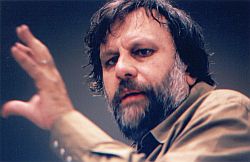 Many American academics and pundits from thinktankland should study the way Slavoj Žižek expresses himself. Passionate, emphatic, uninhibited, eccentric, and humorous — above all, a man who knows what it means to speak your mind. This is a display that shows that deep analysis does not need the protection of cover-your-ass-caveats or manicured sobriety. It can be an act of genuine self-expression.
The pre-condition though is that to speak your mind, you must know your mind and that is a dangerous enterprise.
In relation to Žižek’s central point — that the loss of the Left has come at a hefty price — it’s worth considering the pernicious influence of the sporting metaphor as it shapes American political thinking. Which is to say: the effect of the assumption that that which is defeated must by its nature be inferior; that those who lose are lesser. Guided by such thinking, we would have no reason to be concerned about the loss of species or the loss of cultures. As though the perfect condition would be one of victorious homogeneity.
And note: if democracy was by its nature something truly Western, would we now witness so much Western ambivalence about the birth of Egyptian democracy? On the contrary, the West’s ambivalence exposes the degree to which universal and socialist values have been marginalized in the West. As though we should have reason to doubt that human solidarity is a good thing.

Amy Goodman writes:
Egypt has been the second-largest recipient of U.S. foreign aid for decades, after Israel (not counting the funds expended on the wars and occupations of Iraq and Afghanistan). Mubarak’s regime has received roughly $2 billion per year since coming to power, overwhelmingly for the military.
Where has the money gone? Mostly to U.S. corporations. I asked William Hartung of the New America Foundation to explain:
“It’s a form of corporate welfare for companies like Lockheed Martin and General Dynamics, because it goes to Egypt, then it comes back for F-16 aircraft, for M-1 tanks, for aircraft engines, for all kinds of missiles, for guns, for tear-gas canisters [from] a company called Combined Systems International, which actually has its name on the side of the canisters that have been found on the streets there.”
Hartung just published a book, “Prophets of War: Lockheed Martin and the Making of the Military-Industrial Complex.” He went on: “Lockheed Martin has been the leader in deals worth $3.8 billion over that period of the last 10 years; General Dynamics, $2.5 billion for tanks; Boeing, $1.7 billion for missiles, for helicopters; Raytheon for all manner of missiles for the armed forces. So, basically, this is a key element in propping up the regime, but a lot of the money is basically recycled. Taxpayers could just as easily be giving it directly to Lockheed Martin or General Dynamics.”
Likewise, Egypt’s Internet and cell phone “kill switch” was enabled only through collaboration with corporations. U.K.-based Vodafone, a global cellular-phone giant (which owns 45 percent of Verizon Wireless in the U.S.) attempted to justify its actions in a press release: “It has been clear to us that there were no legal or practical options open to Vodafone … but to comply with the demands of the authorities.”
Narus, a U.S. subsidiary of Boeing Corp., sold Egypt equipment to allow “deep packet inspection,” according to Tim Karr of the media policy group Free Press. Karr said the Narus technology “allows the Egyptian telecommunications companies … to look at texting via cell phones, and to identify the sort of dissident voices that are out there. … It also gives them the technology to geographically locate them and track them down.”
Tariq Ali writes:
“Freedom lies behind a door closed shut,” the great Egyptian poet Ahmed Shawqi wrote in the last century. “It can only be knocked down with a bleeding fist.” More than that is bleeding in the Arab world at the moment.
The uprisings we are witnessing in Egypt have been a rude awakening for all those who imagined that the despots of the Arab world could be kept in place provided they continued to serve the needs of the West and their harsh methods weren’t aired on CNN and BBC World. But while Western establishments lull themselves to sleep with fairy tales, ordinary citizens, who are defeated and demoralized, mull their revenge.
The French government seriously considered sending its paratroopers to save former President Zine El Abidine Ben Ali in Tunisia. Israeli Prime Minister Benjamin Netanyahu is pleading with officials in Washington to delay Hosni Mubarak’s departure from Egypt so that Israel has time to prepare for the likely outcome. Former U.K. Prime Minister Tony Blair is even describing the Egyptian dictator as a “force for good.”
The almost 200 pro-democracy citizens who have been killed don’t bother him too much. That’s small beer compared with the tens of thousands dead in Iraq. And a desperate Palestine Liberation Organization is backing Mubarak and repressing solidarity demonstrations in Ramallah on the West Bank.
Noam Chomsky writes:
‘The Arab world is on fire,” al-Jazeera reported last week, while throughout the region, western allies “are quickly losing their influence”. The shock wave was set in motion by the dramatic uprising in Tunisia that drove out a western-backed dictator, with reverberations especially in Egypt, where demonstrators overwhelmed a dictator’s brutal police.
Observers compared it to the toppling of Russian domains in 1989, but there are important differences. Crucially, no Mikhail Gorbachev exists among the great powers that support the Arab dictators. Rather, Washington and its allies keep to the well-established principle that democracy is acceptable only insofar as it conforms to strategic and economic objectives: fine in enemy territory (up to a point), but not in our backyard, please, unless properly tamed.
One 1989 comparison has some validity: Romania, where Washington maintained its support for Nicolae Ceausescu, the most vicious of the east European dictators, until the allegiance became untenable. Then Washington hailed his overthrow while the past was erased. That is a standard pattern: Ferdinand Marcos, Jean-Claude Duvalier, Chun Doo-hwan, Suharto and many other useful gangsters. It may be under way in the case of Hosni Mubarak, along with routine efforts to try to ensure a successor regime will not veer far from the approved path. The current hope appears to be Mubarak loyalist General Omar Suleiman, just named Egypt’s vice-president. Suleiman, the longtime head of the intelligence services, is despised by the rebelling public almost as much as the dictator himself.
Sarah A. Topol says:
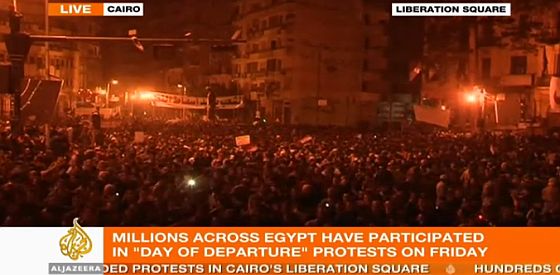
Many ask me about America, puzzling over the Obama administration’s comments about the protests. There’s a lot of frustration, but most say they want the United States to butt out.
“This revolution is an Egyptian revolution against Mubarak and his policies—we don’t want another client regime. We are capable of doing things without America. I don’t need America to teach me about democracy or human rights,” Amira Howeidy, a journalist, told me. A fluent English speaker, Amira got worked up, and then apologized. “I’m not trying to be combative,” she said as I tried to redirect the conversation.
Others just can’t figure it out. “Does Obama really want democracy in Egypt?” one woman wearing a niqab asked me.
Egyptian blogger @suzeeinthecity has tweeted what she says are the seven demands of the protesters (see the four drawn up by youth groups we detailed at (5.05pm)
1. Resignation of the president
2. End of the Emergency State
3. Dissolution of The People’s Assembly and Shora Council
4. Formation of a national transitional government
5. An elected Parliament that will ammend the Constitution to allow for presidential elections
6. Immediate prosecution for those responsible of the deaths of the revolution’s martyrs
7. Immediate prosecution of the corrupters and those who robbed the country of its wealth.
Jack Shenker has been speaking to people within the youth movement in Egypt, mainly based online, who have told him they have four very specific demands. They do not represent everyone but they do constitute an important part of the opposition:
• the removal of Hosni Mubarak and the “whole apparatus of the Mubarak regime”;
• a committee which will appoint a transitional government, the committee to be made up of 6 named senior judges, six representatives from their youth movement and two members of the military
• a council to draw up a new constitution, which would then be put to the people in a referendum
• elections at national and local level in accordance with the constitution.
One of Egypt’s youngest revolutionaries!
The Guardian reports:
The Cairo office of al-Jazeera was ransacked by pro-government “thugs” today, as the Arabic language news channel also said its news website had come under attack by hackers.
Al-Jazeera said its office had been stormed by a “gang of thugs” who burned equipment, on a day of reports of escalating violence against journalists covering the Egyptian uprising.
Brian Whitaker provides this constitutional reading on the political train of events on the horizon:
Whatever happens to Mubarak, there has to be a presidential election no later than September. The [Muslim] Brotherhood have said they will not contest that. In the absence of any inspirational leaders who can galvanise popular opinon, my feeling is that the presidency will probably be won by a compromise candidate — the one regarded as least objectionable by the largest numbner of people.
There is no requirement for parliamentary elections until 2015, since a new parliament was (fraudently) elected last year for a fixed term of five years. To dissolve the parliament legally before 2015, there would have to be a national referendum.
This means that Egypt may be lumbered for several years with a parliament that is overwhelmingly dominated by Mubarak’s NDP party. One option would be to investigate the fraud in last year’s election and disqualify some of the NDP members, presumably triggering by-elections in their constituencies.
For the Brotherhood to have any prospect of becoming the largest party over the next few years, therefore, either parliament would have to be dissolved by referendum or a very large number of NDP members would have to be disqualified and their vacant seats won by the Brotherhood.
The Economist says:
“[D]espite the ugly scenes mid-week, the developments in Egypt should be welcomed. A downtrodden region is getting a taste of freedom. In the space of a few miraculous weeks, one Middle Eastern autocrat has fallen, and another, who has kept the Arabs’ mightiest country under his thumb for 30 years, is tottering. The 350m-strong Arab world is abuzz with expectation; its ageing autocrats are suddenly looking shaky. These inspiring events recall the universal truth that no people can be held in bondage for ever.
For some in the West, which has tended to put stability above democracy in its dealings with the Middle East, these developments are disturbing. Now that the protests have sucked the life out of Mr Mubarak’s regime, they argue, the vacuum will be filled not by democrats but by chaos and strife or by the Muslim Brothers, the anti-Western, anti-Israeli opposition. They conclude that America should redouble its efforts to secure a lengthy “managed transition” by shoring up either Mr Mubarak or someone like him.
That would be wrong. The popular rejection of Mr Mubarak offers the Middle East’s best chance for reform in decades. If the West cannot back Egypt’s people in their quest to determine their own destiny, then its arguments for democracy and human rights elsewhere in the world stand for nothing. Change brings risks—how could it not after so long?—but fewer than the grim stagnation that is the alternative.
Washington Post: Israel contemplates a prospect it dreads — inserting its forces into the narrow Philadelphia corridor between Egypt and Gaza.
David Corn describes the Congressional mechanics involved in the US cutting off military aid to Egypt — a decision yet to be made.
Justin Elliot on one of Washington’s most vocal Mubarak cheerleaders, Leslie Gelb.
London-based, Master Minz — a female rapper from Casablanca, Morocco — sings BACK DOWN MUBARAK!
“Lost world we are the solution
This shit don’t smell like a flower
It’s the rise of people power”
Larry Diamond writes:
Hosni Mubarak’s exit from power under the pressure of volcanic popular protests will have wide repercussions throughout the Arab world. It will accelerate the momentum of democratic change in the region, and open the possibility of electoral democracy emerging in the Arab world’s largest and most influential country. If Mubarak can be induced to exit peacefully and soon, and the way can be paved to a free and credible presidential election in September, the authoritarian exceptionalism of the Arab world may begin drawing to an end.
Sarah Carr, whose mother is Egyptian and father British and who didn’t feel safe going out yesterday because her “mother’s genes seem to have been on strike when I was formed,” describes how state-sponsored xenophobia briefly took hold of the streets:
The worst thing about this is how very un-Egyptian it is. Much is made of the legendary Egyptian hospitality, and for good reason. Egyptians take care of their guests. Which is not to say that xenophobia or racism doesn’t exist, and doesn’t exist in its worst forms. But very generally speaking I’ve felt safer and more looked after in Egypt than anywhere else in the world.
The descent into murky hatred coincides with a concerted state media campaign against foreigners and sinister “foreign agents” who are behind the Tahir protests, a continuation of previous campaigns against foreigners which have targeted e.g. Palestinians, religious minorities, gays, Shias…etc. State media is an extension of the regime. Add this to a security vacuum and the withdrawal of the police and a desperate regime and uncertainty and you get this, another highly convenient instance of manufactured discontent.
Brian Whitaker comments on Amr Moussa’s presence in Tahrir Square today:
Moussa’s unexpected appearance in Tahrir Square is interesting, and perhaps significant.
He served Mubarak for many years as Egypt’s foreign minister before becoming head of the Arab League. There were suggestions at the time that Mubarak had kicked him sideways because the president was becoming jealous of Moussa’s popularity (he was generally regarded as adopting a fairly tough position regarding Israel).
About the time of his removal from the foreign minister, a pop song containing the line “I hate Israel and I love Amr Moussa” became a hit in Egypt.
In 2009, Moussa hinted that he might run for the Egyptian presidency in the 2011 election. In February last year, he also had a meeting with Mohamed ElBaradei which aroused a good deal of speculation.
3.15PM — Gregg Carlstrom: “Inside Tahrir Square, protesters have a ‘press officer’ helping journos. Outside, thugs ransacked AJA’s Cairo bureau. #jan25 #egypt”
2.25PM (local) — Sharif Kouddous: “On a balcony now with birds-eye view. Tahrir is an ocean of people. This is simply massive. #Egypt”

ABC News reports:
When Abdel Haleem Halim approached Hosni Mubarak at a 2002 conference to confront the Egyptian president about rampant unemployment, he says he received a familiar response. Like many of Egypt’s political dissidents, Halim says he was whisked away by the Mubarak regime’s domestic intelligence agents and tortured.
“They would bring me a paper and want me to write and sign a confession,” Halim told ABC News. “But I would refuse to write. So they would torture me because I was defiant.”
Halim claimed that the SSI agents used beatings and electroshock, and that his 2002 encounter was only the latest in a long line of detentions. A veteran political dissident, he said an earlier beating left him with temporary memory loss.
Unlike some victims of the Egyptian government’s security apparatus, however, Halim doesn’t hold the U.S. responsible. Hossam el-Hamalawy, a 33-year-old journalist who says he was tortured by the SSI in 2000, is less forgiving.
“I can’t accept that the U.S government preaches about democracy,” said el-Hamalawy, “while at the same time supporting the Mubarak regime, which has been so brutal to its own people.”
The U.S. State Department has joined international human rights groups in describing a culture of torture within Egyptian’s security agencies, issuing a 2009 report in which it itemized alleged abuses ranging from electroshock to sodomy and said “officials often operated with impunity.” Yet the U.S. government has also funded the Mubarak regime to the tune of more than a billion dollars per year, and since 1995 has used the Egyptians to interrogate terror suspects via extraordinary rendition outside the scrutiny of the U.S. legal system.
Meanwhile, Bloomberg reports:
Egypt’s Arab Center for the Independence of the Judiciary said today it may ask the International Criminal Court to look into attacks yesterday on demonstrators protesting against President Hosni Mubarak.
“There were attacks on peaceful demonstrators committed by Egyptian regime-backed groups using armed weapons, batons and Molotov cocktails in Tahrir Square,” Nasser Amin, the president of the rights group, said by telephone in Cairo.
“This means there is a possibility of considering those acts crimes against humanity under international law as they involved intentional killings and excessive harm. We are currently documenting these incidents and asking the International Criminal Court to consider them and may at some point submit an official request to the court.”
Christopher Dickey spoke with Nawal El Saadawi, an 80-year-old protester, about her refusal to go home when the protests in Cairo’s Tahrir Square turned violent. “They have a strategy to frighten us and to starve us,” she said.
Rami G. Khouri writes:
To appreciate what is taking place in the Arab world today you have to grasp the historical significance of the events that have started changing rulers and regimes in Tunisia and Egypt, with others sure to follow. What we are witnessing is the unraveling of the post-colonial order that the British and French created in the Arab world in the 1920s and 1930s and then sustained – with American and Soviet assistance – for most of the last half-century.
It is fascinating, if insular, to focus attention, as much Western media are doing, on whether Facebook drove these revolts; or to ask what will happen if the Muslim Brotherhood plays a role in any new Egyptian government. The Arabs are like a bride emerging on her wedding day to face people commenting on whether her shoes match her gloves, when the real issue is how beautiful and happy she is.
The events unfolding before our eyes in Egypt, after Tunisia, are the third most important historical development in the Arab region in the past century, and to miss that point is to perpetuate a tradition of Western Orientalist romanticism and racism that have been a large cause of our pain for all these years. This is the most important of the three major historical markers because it is the first one that marks a process of genuine self-determination by Arab citizens who can speak and act for themselves for the first time in their modern history.
Human Rights Watch reports:
Torture is an endemic problem in Egypt and ending police abuse has been a driving element behind the massive popular demonstrations that swept Egypt over the past week, Human Rights Watch said in a report released today. Prosecuting torture and ending the emergency laws that enable a culture of impunity for the security forces should be a priority for the Egyptian government, Human Rights Watch said.
The 95-page report, “‘Work on Him Until He Confesses’: Impunity for Torture in Egypt,” documents how President Hosni Mubarak’s government implicitly condones police abuse by failing to ensure that law enforcement officials accused of torture are investigated and criminally prosecuted, leaving victims without a remedy.
“Egyptians deserve a clean break from the incredibly entrenched practice of torture,” said Joe Stork, deputy director of the Middle East and North Africa Division at Human Rights Watch. “The Egyptian government’s foul record on this issue is a huge part of what is still bringing crowds onto the streets today.”The case of Khaled Said, a 28-year-old man beaten to death by two undercover police officers on an Alexandria street in June, dominated headlines and set off demonstrations across the country. The local prosecutor initially closed an investigation and ordered Said’s burial, but escalating public protests prompted the Public Prosecutor to reopen the investigation and refer it to court. “We Are All Khaled Said” is the name of the Facebook group that helped initiate the mass demonstrations on January 25, 2011.
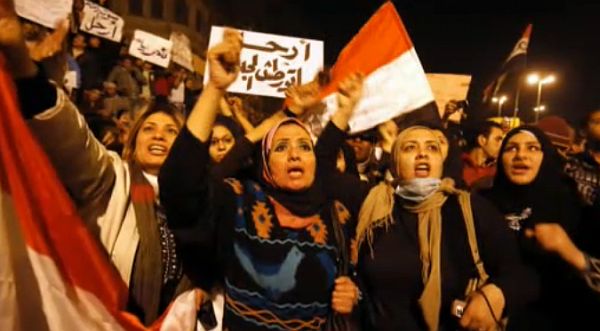
As the Million Egyptian March takes to the streets of Cairo, is President Obama finally ready to take a strong stand on the side of the people?
In The Guardian, Michael Tomasky writes “Obama is in no position to offer the moral thunder the protesters and their supporters everywhere crave.” Why? Because “the US should not be dictating outcomes any more. The modern world requires a US posture that is more fluid and subtle, and that no longer seeks to call the global shots.”
Having watched events over the last week as closely as one can from a great distance, I would say there has been no lack of moral thunder. It has come from the voices of the Egyptian people.
Having demonstrated their pride, dignity, and collective power with such force, I don’t think they crave anything from Washington or anywhere else — bar the fulfillment of their single demand: that Hosni Mubarak stand down.
To the extent that the expectations of many Egyptians and others are directed towards Washington and Obama, it is perhaps with the hope that anyone who supports democracy would celebrate the extraordinary sight of democracy being born.
Obama’s inhibitions probably say less about the fear of being perceived in the Middle East as the leader of an imperial power which still insists on calling the global shots, than in being seen by his fellow Americans supporting a revolution that they fear.
Indeed, as Benjamin Netanyahu compares the Egyptian revolution of 2011 with the Iranian revolution in 1979, Obama surely fears some form of retribution from AIPAC in 2012 if he is portrayed as having undermined Israel’s security. Above all, the 2012 incumbent presidential candidate does not want to be cast as having played a role in shaping Egypt’s future.
The most courageous thing Obama could do at this point would not be to make some grandiose expression of American support for the Egyptian people — an expression which this late in the day would carry little credibility. No, if he wants to stand up in defense of democracy, he should addressing a domestic audience — one that apparently has lost faith that democracy is a good thing.
If Americans can’t support the democratic rights of Egyptians, what does that say about how seriously we want to protect our own rights? After all, the unalienable rights upon which America was founded were not conceived as American rights but universal human rights. If we don’t stand in solidarity with Egyptians, have we not also lost faith in the principles upon which America was founded?
Obama once declared:
I do have an unyielding belief that all people yearn for certain things: the ability to speak your mind and have a say in how you are governed; confidence in the rule of law and the equal administration of justice; government that is transparent and doesn’t steal from the people; the freedom to live as you choose. These are not just American ideas; they are human rights. And that is why we will support them everywhere.
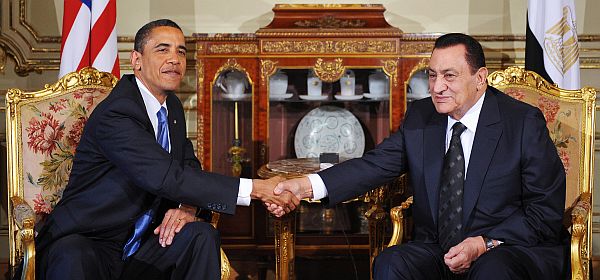
But what held the greater significance? The sentiment and meaning of Obama’s words or the fact that he delivered them as the honored guest of Hosni Mubarak?

Gideon Levy writes:
As long as the masses in Egypt and in the entire Arab world continue seeing the images of tyranny and violence from the occupied territories, Israel will not be able to be accepted, even it is acceptable to a few regimes.
The Egyptian regime became an ally of the Israeli occupation. The joint siege of Gaza is irrefutable proof of that. The Egyptian people didn’t like it. They never liked the peace agreement with Israel, in which Israel committed itself to “respect the legitimate rights of the Palestinian people” but never kept its word. Instead, the people of Egypt got the scenes of Operation Cast Lead.
It is not enough to have a handful of embassies in order to be accepted in the region. There also have to be embassies of goodwill, a just image and a state that is not an occupier. Israel has to make its way into the hearts of the Arab peoples, who will never agree to the continued repression of their brothers, even if their intelligence ministers will continue to cooperate with Israel.
If there’s one thing shared by all factions of the Egyptian opposition, it is their seething hatred of Israel. Now their representatives will rise to power, and Israel will find itself in a difficult situation. Neither will anything remain of the virtual achievement that Netanyahu often paraded – the alliance with the “moderate” Arab regimes against Iran. A real alliance with Egypt and its sister-states can only be based on the end of the occupation, as desired by the Egyptian people, and not on a common enemy, as an interest of its regime.
Zvi Bar’el writes:
So what has happened so far? A corrupt president in Tunisia flees, to cheers from around the world. Protests erupt in Egypt, and gloom descends. Protests are held in Iran, and the world cheers. A prime minister is deposed in Lebanon, to fear and dread. An Iraqi president is overthrown in a military offensive, and it’s called democracy. Raucous demonstrations take place in Yemen, and they’re called interesting but not terribly important.
Why the different reactions? This is supposedly the new Middle East the West always wanted, but something still isn’t working out. This isn’t the Middle East they dreamed of in the Bush administration, and not what nourished Prime Minister Benjamin Netanyahu’s wildest dreams. A new, unexpected player has appeared: the public.
Up to now, the world has been divided into two camps: “complicated” countries where the government represents the public and every decision is subject to public oversight, and “easy” countries where business is conducted at the top and the public is just window dressing. The dividing line between the two has always been starkly clear. Everything north of the Mediterranean belonged to the first group and everything to the south and east to the second.
The north had political parties and trade unions, a left wing and a right wing, important intellectuals, celebrities who shaped public opinion, and of course, there was public opinion itself. In the south the division was simple. It was the distinction between moderates and extremists, meaning pro-Westerners and anti-Westerners.
If you’re a Saudi king who buys billions of dollars of American weapons, you’re pro-Western and therefore entitled to continue to rule a country without a parliament, one where thieves’ hands are amputated and women aren’t allowed to drive. If you’re an Egyptian president who supports the peace process, you’re pro-Western and have permission to continue to impose emergency rule in your country, jail journalists and opposition members, and fix elections.
Amos Harel writes:
The events of the last few days in Egypt – apparently the most important regional development since the Islamic revolution in Iran and the Egyptian-Israeli peace deal of 1979 – are also an expression of the decision-makers’ nightmare, the planners and intelligence agents in Israel.
While in other countries many are watching with satisfaction at what looks to be possibly the imminent toppling of a regime that denied its citizens their basic rights, the Israeli point of view is completely different.
The collapse of the old regime in Cairo, if it takes place, will have a massive effect, mainly negative, on Israel’s position in the region. In the long run, it could put the peace treaties with Egypt and Jordan in danger, the largest strategic assets after the support of the United States.
The changes could even lead to changes in the IDF and cast a dark cloud over the economy.
Western intelligence in general and Israeli intelligence in particular did not foresee the scope of change in Egypt (the eventual descriptor “revolution” will apparently have to wait a little longer). Likewise, almost all of the media analysis and academic experts got it wrong.
In the possible scenarios that Israeli intelligence envisioned, they admittedly posited 2011 as a year of possible regime change – with a lot question marks – in Egypt and Saudi Arabia, but a popular uprising like this was completely unexpected.
More than this, in his first appearance at a meeting last Wednesday of the Foreign Affairs and Defense Committee the new head of military intelligence Major General Aviv Kochavi said to member of Knesset, “There are currently no doubts about the stability of the regime in Egypt. The Muslim Brotherhood is not organized enough to take over, they haven’t managed to consolidate their efforts in a significant direction.”
If the Mubarak regime is toppled, the quiet coordination of security between Israel and Egypt will quickly be negatively affected. It will affect relations between Cairo’s relationship with the Hamas government in the Gaza Strip, it will harm the international forces stationed in Sinai.
It will mean the refusal of Egypt to continue to allow the movement of Israeli ships carrying missiles through the Suez canal, which was permitted for the last two years, according to reports in the foreign press, in order to combat weapons smuggling from Sudan to Gaza. In the long run, Egypt’s already-cold peace treaty with Israel will get even colder.
From the perspective of the IDF, the events are going to demand a complete reorganization. For the last 20 years, the IDF has not included a serious threat from Egypt in its operational plan.
In the last several decades, peace with Cairo has allowed the gradual thinning out of forces, the lowering of maximum age for reserve duty and the diversion of massive amounts of resources to social and economic projects.
The IDF military exercises focused on conflict with Hezbollah and Hamas, at most in collusion with Syria. No one prepared with any seriousness for a scenario in which an Egyptian division would enter Sinai, for example.
If the Egyptian regime falls in the end, a possibility that seemed unbelievable only two or three days ago, the riots could easily spill over to Jordan and threaten the Hashemite regime. On Israel’s two long peaceful borders there will then prevail a completely different reality.
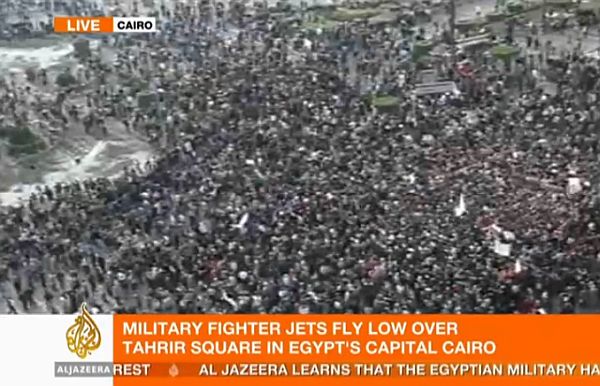
When a brutal regime is struggling to survive it turns to desperate measures.
Even as low-flying Egyptian air force Lockheed F-16s are currently attempting to shake fear into the hundreds of thousands of people gathered now in the center of Cairo, the people are showing their increasing defiance. And even now the Obama administration remains afraid of taking a strong stand in support of the Egyptian people.
We cannot honor the revolution in Egypt as impartial observers, uncertain about its outcome or its virtue. To believe in the revolution is to hold the unshakable conviction that human beings have the capacity to govern themselves and the right to live in freedom.
Egypt exposes the divide between those who fearlessly feel the thrill of freedom and those for whom freedom has become an object of fear.
As freedom spreads across the Middle East the greatest test will be faced in Israel.
Let’s be absolutely clear that the timidity with which the United States government has at this time responded to the prospect of Egyptians’ freedom, is a measure of the extent to which the freedom of 80 million people appears to pose a possible threat to the security of seven million Israelis.
Many Israelis and Americans have come to accept an unspoken and inhuman proposition: that one person’s safety can be secured at the expense of another person’s liberty. This forced exchange is an assault on human freedom.
At the same time, many others, swept up in the spirit of this moment, will be tempted to declare, “We are all Egyptians now,” but we are not.
The giddiness of freedom is the reward for those who have risen above their fears.
For those who remain the hostage of their own fears, freedom itself is another source of danger.
Under the rule of the West’s national security states we have been indoctrinated to believe that the remedy for fear is safety.
It is not. Indeed, those who cling to the fiction of high security, merely compound their own fears.
If we are to rediscover the nobility and dignity of our common humanity it will only be by defying fear with courage.

In its complacency, America views the democratic aspirations of others as the desire to possess what we already enjoy. Little do we imagine that these aspirations reveal what we have discarded or perhaps never even possessed.
President Obama packages what has driven Egyptians onto the streets within the banal phrase “the desire for a better life” — as though the world is captive to a vision of life in suburbia in which material comfort is the sum of human fulfillment.
We misinterpret the significance of the uprisings in Tunisia and Egypt if we look at these through the narrow prisms of dictatorial rule or economic hardship, because in truth they provide lessons about what it means to be human.
We are complex creatures and have advanced beyond the level of survival. Our needs go beyond material sufficiency.
Egyptians did not take to the streets today in order to fill their stomachs but in order to express their hearts. They were reclaiming their dignity by refusing to continue being the subjects of oppression.
But where is our dignity in accepting the fact that we have political representatives who do not represent our interests? Where is our dignity in having turned ourselves from citizens into consumers and having abandoned the idea of government by the people?
On the streets across Egypt today the single most important message from the people was this: we are not afraid.
Is this not a message that should shame the average American? Having spent a decade accepting the proposition that no expense should be spared to guard us against every imaginable fear, can we even imagine what it means to face danger yet not be afraid?
This perhaps more than anything else is the measure through which the bugaboo of 9/11 became the altar on which we sacrificed our dignity.
And should we pause to consider what the possible consequences are of empowering a national security state in the name of defense against terrorism, we could do no better than look at the example of the Mubarak regime.
*
One of the prevailing narratives in Washington has been that the US must tread a delicate line so that it does not undermine the flowering of democracy by providing unwelcome American support — as though the average Egyptian gives a damn about America’s position.
Egypt’s destiny is being determined by its people — not the Obama administration, which in its timidity and duplicity refuses to actually acknowledge the simple demand that is on the table: that Mubarak go.
And when from America we watch the Egyptian people assert their power, we should only imagine: what might this look like in America if we were not a nation filled with people so thoroughly convinced of our impotence?

Before publishing the Palestine Papers, Al Jazeera invited a group of experts and journalists to Doha to study the documents. The group included political and military analyst, Mark Perry, who provided analysis in this week’s special report and the following background for War in Context. He is the author of eight books, including Partners In Command and the recently released Talking To Terrorists.
We Better Get Used To It
Inside The Palestine Papers Debate
By Mark Perry
Back in 1989, I was the recipient of hundreds of State Department cables dealing with nearly every aspect of American foreign policy. The material was breathtaking: cables on CIA support for the non-communist Cambodian resistance, a DIA report on a PLO political team in Central America, the theft of U.S. monies by Thai Generals in Bangkok – accounts of changes of government in half-a-dozen developing countries. The cables were marked “Top Secret” and provided me with the opportunity to write a series of articles for a number of major dailies. Until the leaker was caught.
What surprised me the most was not the subject matter of the cables, but the rumors surrounding them. The then-head of the Senate Intelligence Committee blamed “State Department officials” for the leak, the State Department blamed the Senate. Everyone was convinced – the cables were leaked by top officials for political purposes. In truth, the leaker was an overweight late-20s State Department polymath named Bill with a habit of dribbling salad dressing on his tie. His one notable tic was an uncontrollable stutter. Worried that his discovery would lead to his arrest, I felt itmy duty to warn him that his actions would mean the end of his career. “Why are you doing this, Bill?” I asked him. He blinked for a moment, hesitated, then told me: “Shhhh . . .she . . . mmm … makes fffff . . . fun of me.” There you have it: the reason he was leaking the cables was because his supervisor at the Cable Secretariat, cruelly caricatured his stutter in front of his fellow workers – to their great amusement. “I . . I . . . I’m going to gggggee . . . get her,” he said.
I was reminded of Bill when Palestinian chief negotiator Saeb Erekat requested the U.S. and U.K governments investigate Al Jazeera reporter Clayton Swisher (a U.S. citizen) and Alastair Crooke (a former British government employee – wink, wink), for leaking over 1600 documents on the Israeli-Palestinian peace process to Al-Jazeera. This is complete eyewash. As a part of a group of experts and journalists invited to Doha two weeks ago by Al-Jazeera to study the documents, it was clear to me then that the leaker was probably an employee in the PLO’s Negotiations Department. Of course, I could be completely wrong: I have no idea who the leaker is and was given no hint of his (or her, or their) identity by anyone at the network. That hasn’t stopped me from speculating: the leaker could be a Palestinian employee who wants to embarrass the Palestinian Authority, a translator who sat in on the meetings, a janitor with access to offices and files, or Erekat himself – who wanted to embarrass George Mitchell.
Even so, Erekat’s demand that the U.S. and U.K. search for the leaker provides an interesting sidebar to the papers’ release: for having initially denounced the 1600 documents in Al-Jazeera possession as “fabrications,” Mr. Erekat is now willing to concede their authenticity. His response might be a model for all those caught out by the truth – a narrative reminisicent of that common to terminal patients: denial, anger, bargaining, depression, acceptance. In truth, while the identity of the leaker has now become a kind of cottage industry in the Arab press, the leaker’s name is not nearly as important as the leaker’s motives.
This came through clearly during my reading of the documents, for I focused initially on on a series of six meetings in September and October of 2009 between Saeb Erekat and George Mitchell. For me those documents showed Erekat as a tough, savvy, committed and stubborn nationalist, while George Mitchell appeared and talked like “Israel’s lawyer” – abandoning prior U.S. positions on the negotiation’s terms of reference and on the Road Map. I argued to my colleagues that Al-Jazeera’s “lead” should focus on Mitchell and the U.S., as Israeli supplicants. Whoever leaked these documents, I said, wanted to show us the depravity of the American position. My colleagues disagreed, though not because they had a different agenda – they had simply read different documents. For them, Erekat was a serial compromiser, having conceded traditional Palestinian positions on Jerusalem, refugees and borders.
I did not win this argument, but on reflection it’s easy to understand why. If the Palestine Papers had been leaked to CBS, NBC, ABC or CNN (for example), there’s no doubt in my mind that Mitchell (and the Obama administration) would have been the focus of subsequent reports. If the papers had been leaked to the BBC, the focus would have been on Tony Blair and MI-6. In a sense, then, my initial discomfort with Al-Jazeera’s coverage is a reflection of America’s discomfort: we say that Al-Jazeera has an “agenda” – that their journalism is not as credible as ours. And we’re right, but only to this degree: Al-Jazeera is an Arab network with an Arab viewership that covers Arab politics and leaders. Their coverage of the world isn’t less credible – it’s different. What we’re really uncomfortable with (and what I was uncomfortable with) is that Al-Jazeera doesn’t put America at the center of the world. What we have to say is less important to them than what they have to say – their focus is on what is happening outside of their door, not ours. We better get used to it.
Here’s a coda: after feting my own leaker through six months of dinners and discussions, I showed up at his apartment to find him gone. There was simply no trace of him, and all of my attempts to reach him by other means led to nothing. But one day, in 1994, I received a call from him from his mother’s home in Nevada. He confirmed that the State Department had identified him as my leaker and he’d been summarily fired. He told me he was lucky he hadn’t been prosecuted – but he seemed happy and was starting his life over again. “So,” I asked. “Did you ever get her? You know, your supervisor – the woman who made fun of you.” There was a moment’s hesitation: “Oh yeah,” he said. “I got her good. She got a bad evaluation and left her job.” It was only after I hung up that I realized: his stutter was gone.
