When Bahrain’s army opened fire on unarmed protesters yesterday there was little reason to suppose that this was anything other than a cold and calculated show of force. The lesson from Cairo for many Arab leaders was that a regime that is timid about killing its own people will quickly fall. Political dissent cannot be crushed by thugs marauding on camels and horses. The decisive message comes as a government’s marksman steadies his sight with a protester’s head fixed in the cross-hairs. There was nothing random about this act of violence:
But then comes the stunningly eloquent Crown Prince Salman bin Hamad bin Isa Al Khalifa, expressing remorse about the tragic events of recent days.
Are we to supposed that an army captain at Pearl Roundabout was responsible for yesterday’s bloodshed. Or was it that Crown Prince Salman’s consternation was not in response to recklessness in the lower ranks but because the Al Khalifa royal family was under pressure from a higher level?
Rumours burned like petrol in Bahrain yesterday and many medical staff were insisting that up to 60 corpses had been taken from Pearl Square on Thursday morning and that police were seen by crowds loading bodies into three refrigerated trucks. One man showed me a mobile phone snapshot in which the three trucks could be seen clearly, parked behind several army armoured personnel carriers. According to other demonstrators, the vehicles, which bore Saudi registration plates, were later seen on the highway to Saudi Arabia. It is easy to dismiss such ghoulish stories, but I found one man – another male nurse at the hospital who works under the umbrella of the United Nations – who told me that an American colleague, he gave his name as “Jarrod”, had videotaped the bodies being put into the trucks but was then arrested by the police and had not been seen since.
Why has the royal family of Bahrain allowed its soldiers to open fire at peaceful demonstrators? To turn on Bahraini civilians with live fire within 24 hours of the earlier killings seems like an act of lunacy.
But the heavy hand of Saudi Arabia may not be far away. The Saudis are fearful that the demonstrations in Manama and the towns of Bahrain will light equally provocative fires in the east of their kingdom, where a substantial Shia minority lives around Dhahran and other towns close to the Kuwaiti border. Their desire to see the Shia of Bahrain crushed as quickly as possible was made very clear at Thursday’s Gulf summit here, with all the sheikhs and princes agreeing that there would be no Egyptian-style revolution in a kingdom which has a Shia majority of perhaps 70 per cent and a small Sunni minority which includes the royal family.
Thousands of joyous Bahrainis retook a major square in the heart of the island nation’s capital Saturday — a dramatic turn of events two days after security forces ousted demonstrators from the spot in a deadly attack.
The sight of citizens streaming into Pearl Roundabout came as the Bahrain royal family appealed for dialogue to end a turbulent week of unrest and the crown prince ordered the removal of the military from the Pearl Roundabout, a top demand by opposition forces.
Pearl Roundabout, scene of such tragedy, now is again center of jubilation, cheering and honking. I don’t see any police/ Wow! I’m awed to watch the courage of Bahrainis. Such guts. And it worked: they have reclaimed a place stained with blood/ Delirious joy in #Bahrain “Martyrs’ Roundabout,” as it’s now called. People kissing ground. But the firecrackers make me jump/ Congrats to #Bahrain crown prince, presumably responsible for decision not to shoot protesters today. Hope he prevails/ People Power, 1; King, 0, in #Bahrain. But it’s not over yet. Lots of small children in roundabout. Let’s pray army doesn’t attack/ People still pouring into “Martyrs’ Roundabout” from every direction, say they won’t leave. Mixed views on whether attack will come.
Libyan protesters plead to Obama and the world not to be ignored
Libyans are painfully aware of the fact that their country does not attract nearly the same level of interest as Egypt or Iran, except perhaps when it comes to the eccentricities of their notoriously flamboyant dictator. This, despite the fact that the Qaddafi regime has been in power significantly longer than nearly any other autocratic system, during which time it has proved itself among the world’s most brutal and incompetent. Thus, from the moment a group of Libyans inside Libya — taking a cue from their Tunisian and Egyptian neighbors — announced plans for their own day of protest on Feb. 17, Libyan activists outside the country have been working tirelessly to get the word out, circulate audio and video, and pressure media outlets to report on Libya. If the Libyan protesters are ignored, the fear is that Qaddafi — a man who appears to care little what the rest of the world thinks of him — will be able to seal the country off from foreign observers, and ruthlessly crush any uprising before it even has a chance to begin. Eyewitness reports to this effect are already trickling in from Libya, and the death toll appears to be slowly mounting. Regrettably, international attention has thus far been minimal. (Najla Abdurrahman)
Libyan troops attempt to put down unrest in east
Soldiers sought to put down unrest in Libya’s second city on Friday and opposition forces said they were fighting troops for control of a nearby town after crackdowns which Human Rights Watch said killed 24 people.
Protests inspired by the revolts that brought down long-serving rulers of neighboring Egypt and Tunisia have led to violence unprecedented in Muammar Gaddafi’s 41 years as leader of the oil exporting country.
The New York-based rights group Human Rights Watch said that according to its sources inside Libya, security forces had killed at least 24 people over the past two days. Exile groups have given much higher tolls which could not be confirmed. (Reuters)
Government troops have withdrawn from al-Bayda, the scene of earlier confrontations, and protesters have blocked the runway to prevent military reinforcements arriving, the National Front for the Salvation of Libya maintains.
Mohamad Ali Abdalla, the deputy director of the NFSL, said:
I was told that there were 13 deaths in the city of al-Bayda alone last night and six more in Benghazi.
In al-Bayda, the city has been taken over and protesters are dismantling the runway to stop any military planes landing.
In total, there have been 30 deaths in Benghazi since demonstrations began on January 15th. Some of those who died were injured citizens who had been taken to al-Jala hospital in Benghazi.
Members of the revolutionary committee were shooting the injured who were brought in. I was told this by a nurse in al-Jala Hospital.
The government’s revolutionary committee headquarters have been captured in other places, the FNSL claimed. In Ajdabiya, in north-eastern Libya, demonstrations were in charge of the city.
There have been few demonstrations further west nearer to the capital, Tripoli. In the western mountains, nearer to Tunisia, protesters have also been out on the streets.
Several opposition sites have reported that Gaddafi’s regime has been relying on French-speaking soldiers, or “mercenaries” drawn from neighbouring Chad to crack down on the demonstrations. (The Guardian)
Yet again, Bahrain’s government has initiated a brutal crackdown on demonstrators — and this time the army is reported to be firing live rounds. A doctor has been killed and paramedics injured while trying to help injured protesters. Ambulances are being denied access to the scene of the massacre.
The United States last year provided Bahrain about $20.8 million in military assistance, a substantial amount for such a small country and almost double what it received in 2009. The vast majority of the funds went to pay for improvements to Bahrain’s F-16 fighter fleet and to its navy’s flagship frigate, supplied by the United States in 1996.
In the past, Bahrain has sent more than 100 police to Afghanistan to help build up that country’s force. Overall U.S. counterterrorism aid to Bahrain doubled last year to almost $1.1 million.
Much of that assistance likely went to police and military forces that are suppressing the current protests.
If the US is Egypt’s primary patron, in Bahrain it is among the ruling family’s biggest tenants, as the country is home to the Fifth Fleet, one of the US military’s most important naval armadas, crucial to protecting Persian Gulf shipping and projecting US power against Iran.
But while Bahrain has long been depicted as relatively moderate compared with its Salafi neighbor, Saudi Arabia, the reality is that the country is repressive and far from free, as citizens have almost no ability to transform their government, which according to the State Department “restricts civil liberties, freedoms of press, speech, assembly, association, and some religious practices.”
In the wake of Egypt, where many people harbor resentment against the Administration for its lack of early support for the democracy movement what can Obama do now? Can he in good conscience acquiesce to the brutal suppression of pro-democracy protesters so soon after his eloquent words and late coming to supporting the Egyptian revolution?
The larger question is: What is more essential to American security today, convenient bases for its ships, planes and troops across the Middle East, or a full transition to democracy throughout the region?
The answer is clearly the latter, as evidenced by the fact that America’s two primary antagonists in the Middle East, al-Qaeda and the Iranian government, have seen their standing sink in proportion to the rise of the pro-democracy movements.
In any war, cold or hot, propaganda is crucial, and here it is impossible to lose sight of the fact that al-Qaeda has had little if anything to say about the Egyptian revolution precisely because it was a massive non-violent jihad that succeeded miraculously where a decade of al-Qaeda blood and vitriol have miserably failed.
As for Iran, the government’s rhetorical support for the Egyptian revolution while it continues to suppress its own democracy movement is clearly emptying the Iranian regime of any remaining credibility as an alternative to the US-dominated order.
In this sense the success-so far-of the Egyptian revolution has presented Obama with a unique window of opportunity to forcefully advocate and press for the same kind of democratic transition across the Middle East and North Africa.
The signs on Tuesday were somewhat optimistic, as the President warned all regional leaders that they should “get ahead of the wave of protest” by moving towards democracy as quickly as possible. Yet Obama refused to mention Bahrain by name in his press conference, even as the government was cracking down on the protesters.
Instead, the US president argued that “each country is different, each country has its own traditions; America can’t dictate how they run their societies,” an utterly meaningless declaration since it contradicts the very advocacy of democracy that the President has made out of the other side of his mouth.
And now, once again, in the wake of government violence against peaceful citizens, the Obama administration stands silent, refusing to openly condemn the Bahraini government. Is the administration incapable of learning from mistakes in the immediate past?
The 14 February marked the 10th anniversary of the National Action Charter, which is considered to be the blueprint of the Bahraini reform project. In 2001, the charter was accepted almost unanimously by eligible voters, with the aim of leading to a constitutional monarchy.
This chapter in Bahrain’s history was supposed to end decades of authoritarian rule, emergency law and repression of political activists. The results are mixed – but the main outcome is superficial democracy. The state wanted to use this year’s anniversary to create a pompous spectacle to legitimise the ruling family. Organised public rallies and parties, as well as glossy newspaper ads and posters, were pervasive.
It is a twist of history that this display of regime power coincided with widespread protests and dramatic changes across the Arab world. In Bahrain, arrests of several hundred political dissidents and human rights activists have been taking place since August 2010. The state used all of its means to portray those that tried to topple the regime as dangerous elements, especially the so-called group of 25 Shia dissidents. It wanted to tell the existing opposition that you are “either with the state or against it”. In addition, the regime successfully foiled the fate of many leftist candidates in the parliamentary elections of October 2010. But to a wide spectrum of Bahraini society these widespread arrests only served as evidence of the authoritarian nature of the state.
So while the local political atmosphere was very tense and there had been many demonstrations in the past, the uprisings in Tunisia and Egypt have totally altered the Arab political sphere. Bahraini online activists saw that the time was ripe and emulated the Tunisian and Egyptian example, calling for a “revolution in Bahrain” on 14 February on social networking sites such as Facebook. This day has a symbolic value for Bahrainis as many think they were deceived by the promises of the regime and so the organisers, emboldened by Hosni Mubarak’s downfall, made the most of this moment. While many were sceptical about its success, several thousand demonstrators turned out. The leftwing al-Wa’ad party openly supported the demonstrations and the Shia alliance al-Wifaq endorsed it, but the majority of the demonstrators were young Bahrainis without political affiliations.
The army took control of this city on Thursday, except at the main hospital, where thousands of people gathered screaming, crying, collapsing in grief, just hours after the police opened fired with birdshot, rubber bullets and tear gas on pro-democracy demonstrators camped in Pearl Square.
As the army asserted control of the streets with tanks and heavily armed soldiers, the once peaceful protesters were transformed into a mob of angry mourners chanting slogans like “death to the king,” while the opposition withdrew from the Parliament and demanded that the government step down.
But for those who were in Pearl Square in the early morning hours, when the police opened fired without warning on thousands who were sleeping there, it was a day of shock and disbelief. Many of the hundreds taken to the hospital were wounded by shotgun blasts, doctors said, their bodies speckled with pellets or bruised by rubber bullets or police clubs.
In the morning, there were three bodies already stretched out on metal tables in the morgue at Salmaniya Medical Complex: Ali Mansour Ahmed Khudair, 53, dead, with 91 pellets pulled from his chest and side; Isa Abd Hassan, 55, dead, his head split in half; Mahmoud Makki Abutaki, 22, dead, 200 pellets of birdshot pulled from his chest and arms.
Doctors said that at least two others had died and that several patients were in critical condition with serious wounds. Muhammad al-Maskati, of the Bahrain Youth Society for Human Rights, said that he had received at least 20 calls from frantic parents searching for young children lost in the chaos of the attack.
The New York Times profiles Gene Sharp, whose writings on non-violent revolution have inspired dissidents around the world.
Based on studies of revolutionaries like Gandhi, nonviolent uprisings, civil rights struggles, economic boycotts and the like, he has concluded that advancing freedom takes careful strategy and meticulous planning, advice that Ms. Ziada said resonated among youth leaders in Egypt. Peaceful protest is best, he says — not for any moral reason, but because violence provokes autocrats to crack down. “If you fight with violence,” Mr. Sharp said, “you are fighting with your enemy’s best weapon, and you may be a brave but dead hero.”
Autocrats abhor Mr. Sharp. In 2007, President Hugo Chávez of Venezuela denounced him, and officials in Myanmar, according to diplomatic cables obtained by the anti-secrecy group WikiLeaks, accused him of being part of a conspiracy to set off demonstrations intended “to bring down the government.” (A year earlier, a cable from the United States Embassy in Damascus noted that Syrian dissidents had trained in nonviolence by reading Mr. Sharp’s writings.)
In 2008, Iran featured Mr. Sharp, along with Senator John McCain of Arizona and the Democratic financier George Soros, in an animated propaganda video that accused Mr. Sharp of being the C.I.A. agent “in charge of America’s infiltration into other countries,” an assertion his fellow scholars find ludicrous.
“He is generally considered the father of the whole field of the study of strategic nonviolent action,” said Stephen Zunes, an expert in that field at the University of San Francisco. “Some of these exaggerated stories of him going around the world and starting revolutions and leading mobs, what a joke. He’s much more into doing the research and the theoretical work than he is in disseminating it.”
Colonel Ian Henderson, who from 1966 until 1998 was Bahrain’s security chief, is alleged to have instituted and overseen a brutal torture regime in the Gulf state, as a result of which he came to be known as the “Butcher of Bahrain.” Numerous human rights organizations have investigated and confirmed the allegations against him, yet an investigation by British police was suspended in 2008 due to a lack of co-operation from the Bahrain government.
“Ian Henderson has played a very dirty role,” said Saeed Shehabi, Bahrain Freedom Movement, in 2002. “Ever since he came to Bahrain in 1966, he embarked upon an era of terror and thousands of people were arrested — arbitrarily arrested — and tortured under his command. Until he retired, two or three years ago, he was the strong man behind the whole repressive regime in Bahrain.”
Blind Eye to the Butcher (2002)
In a report on Bahrain’s reliance on foreign nationals in its security services, Ian Black adds:
Bahrainis often complain that the riot police and special forces do not speak the local dialect, or in the case of Baluchis from Pakistan, do not speak Arabic at all and are reviled as mercenaries. Officers are typically Bahrainis, Syrians or Jordanians. Iraqi Ba’athists who served in Saddam Hussein’s security forces were recruited after the US-led invasion in 2003. Only the police employs Bahraini Shias.
The secret police – the Bahrain national security agency, known in Arabic as the Mukhabarat – has undergone a process of “Bahrainisation” in recent years after being dominated by the British until long after independence in 1971. Ian Henderson, who retired as its director in 1998, is still remembered as the “Butcher of Bahrain” because of his alleged use of torture. A Jordanian official is currently described as the organisation’s “master torturer”.
Channel 4 report on human rights abuses in Bahrain (1999)
The pro-democracy rally at Bahrain’s Lulu Roundabout was brought to a violent end at 3am this morning when police launched a brutal assault against what at that time were mostly sleeping protesters.
Was this one of the “difficulties along the way” down “the democratic path that Bahrain is walking on” for the nation Hillary Clinton described as a “model partner” for the US less than three months ago?
When security forces launch a brutal crackdown on peaceful protesters, killing five, injuring hundreds and then the government prevents ambulances reaching the injured, there’s only one way this can be described: state terrorism.
And when the state in which this is occurring, Bahrain, is of preeminent importance to the US government because it serves as the base for the US Fifth Fleet and US naval operations in the Gulf, this becomes US-back state terrorism.
Mealy-mouthed statements from the White House on the need for “both sides” to exercise restraint and avoid violence, do nothing to disguise American complicity as yet again Washington attempts to shield one of its allies.
Here’s some of what the New York Times‘ Nicholas Kristof has reported in the last few hours:
At hospital in #Bahrain. 600 brought here w/ injuries as of 8 am, more since. Beatings, shotgun pellets, rubber bullets.
Nurse told me she saw handcuffed prisoner beaten by police, then executed with gun.
Abt 10 ambulance paramedics attacked by #Bahrain police. I interviewed them, saw their injuries.
#Bahrain govt has ordered ambulances to stop going out, hospital says.
1 #Bahrain ambulance driver told me #Saudi army officer held gun to his head, said wld kill him if helped injured.
Witnesses say #Bahrain police cursed Shia as they attacked peaceful demonstrators. I haven’t found 1 Sunni victim.
Crowd growing at main #Bahrain hospital, chanting slogans against royal family. Will govt attack them here?
In morgue, I spoke to brother of 22 year old killed by police shotgun blast. He says King Hamad must step down.
Maryam Alkhawaja from the Bahrain Centre for Human Rights tweets that “several Bahraini officers are being prosecuted for refusing to take part in violence against peaceful protesters.”
Meanwhile, Amnesty International provides the following chilling account of torture conducted by the Egyptian army, just days before Hosni Mubarak stepped down:
An 18-year-old secondary school student from Cairo told Amnesty International that he was tortured after he was arrested at about 1500hrs on 3 February 2011 by soldiers near Tahrir Square:
“I was walking with a friend towards the square when soldiers stopped us and asked for our IDs. They seemed to be suspicious of my friend, because he holds a UK residence permit. They took us to the area museum which is controlled by the army and held us there in an outdoor area. After some while we were blindfolded and handcuffed and I could not see what happened to my friend. I could only hear him screaming and believe he was severely beaten. I was only slapped in the face but not severely beaten while held at the museum.
“That night we were transferred to another location about 30 minutes away from Tahrir Square. When we got out we had to lie down on the floor and were beaten. Then I was taken for interrogation where they insulted me and my family. They said things one should not say. They took off my handcuffs, because they ordered me to take off my clothes, except my underwear, but I remained blindfolded. Then they handcuffed me again and tied my legs. They put a chain or rope to my legs and lifted me up, so that my head was hanging down. From time to time they would let me down into a barrel that was filled with water. They told me to confess that I was trained by Israel or by Iran. They also put electric shocks to my body and I fainted. This continued for several hours. After the torture finished I was so exhausted that I slept for hours.
“The next day I was taken in a group of about 30 people to another location, which – as I learned later – was Sign al-Harbi [a military prison at El Heiksteb, northeast of Cairo]. When we got out of the vehicle our blindfolds were taken off and soldiers started beating us with whips and truncheons. There are still scares on my back from the beatings. We were lead to our cells where I soon fell asleep. They kept beating us, including when we went to the bathroom. The last days of my detention I refused to eat to protest against the treatment. Finally we were released. They left us on the road to Cairo and told us to walk back.”
He was released with hundreds of other detainees from the military prison on 10 February 2011. Amnesty International delegates interviewed him several days later when scars were still visible on his back.
During an era in which Americans have been told that the threat from terrorism should be preeminent among this nation’s national security concerns, the gravest omission in public debate on this issue has been consideration of the relationship between state-sanctioned brutality and terrorism.
We have been led to believe that terrorism arising in the Middle East is spawned by extremist Islamist ideology while overlooking its much more transparent secular roots: the willingness of autocratic rulers to use violence as an instrumental and indispensable tool through which they can exercise and sustain their power.
When the word “stability” gets bandied around as though it was describing a condition of civic calmness and social order, we should remember that when someone has a gun pointed to their head they are able to sit in perfect stillness — this is stability under the threat of violence, the condition in which most people in the Middle East have lived for generations.
Where violence provides the backbone of governance, should we be surprised that similar forms of brutality would be adopted by some individuals and groups that want to challenge their rulers? And should we imagine that when these rulers are counted as America’s friends, that the US could provide its support with impunity?
What we should really marvel at is the fact that people across the region are now rising in their thousands driven, in part, by the audacious idea that non-violence can overcome violence.
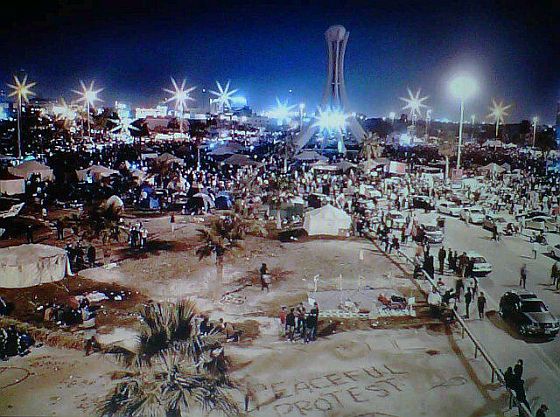
Peaceful protest at Pearl Roundabout several hours before police launched a deadly assault at 3am Thursday morning.
Al Jazeera is now reporting that at least two people have been killed and dozens injured as Bahrain police attacked sleeping demonstrators in the early hours of Thursday morning. The New York Times said:
Hundreds of riot police surrounded the nation’s symbolic center, Pearl Square, in the early morning Thursday, raining tear gas and percussion grenades on thousands of demonstrators who had poured into the square all day Wednesday to challenge the country’s absolute monarchy.
The protesters, including women and children, had been camping out and the atmosphere had been festive only hours before. But by about 3:30 a.m. Thursday, people were fleeing, screaming “We were sleeping. We were sleeping,” and ambulances, sirens blaring, were trying to make their way through the crowds.
Witnesses, some of them vomiting from the gas, said they had no warning the police were going to crack down on their peaceful protest before rows of police vehicles with blue flashing lights began to circle the area.
Shiite opposition leaders had spent the day Wednesday issuing assurances that they were not being influenced by Iran and were not interested in transforming the monarchy into a religious theocracy like the Islamic republic in Iran.
But that did not stop what appeared to be government attempts to deter the demonstrators who had laid claim to the square, the symbolic heart of the nation. Hours before the police action, the Internet was jammed to a crawl and cellphone service was intermittent. Those efforts, however, only seemed to energize the roaring crowds, which spilled out of the square, tied up roads for as far as the eye could see and united in a celebration of empowerment unparalleled for Bahrain’s Shiites, who make up about 70 percent of the country’s 600,000 citizens.
The following report from Al Jazeera was broadcast before the latest deaths. The position of the Bahrain royal family must now be even more precarious.
Where’s the next place to blow in the Arab revolution? Candidates are many, but there’s one whose geopolitical impact vastly exceeds its diminutive size — the island of Bahrain.
This is a place run by an oppressive and corrupt little regime, long coddled by Washington because the U.S. Navy’s Fifth Fleet is headquartered there. The future of the base is far from secure if the regime falls.
A few hard facts about the island that should give pause for thought:
First, Bahrain is a Shiite island. You won’t see it described that way, but it is — 70 percent of the population, more than the percentage of Shiites in Iraq. And like Iraq under Saddam Hussein, these Arab Shiites have been systematically discriminated against, repressed, and denied meaningful roles by a Sunni tribal government determined to maintain its solid grip on the country. The emergence of real democracy, as in Iraq, will push the country over into the Shiite column — sending shivers down the spines of other Gulf rulers, and especially in Riyadh.
Appearances are deceiving. Go to Bahrain and on the surface you won’t feel the same heavy hand that dominates so many other Arab authoritarian states. The island is liberal in its social freedoms. Expats feel at home — you can get a drink, go to nightclubs, go to the beach, party.
But if you look behind the Western and elite-populated high-rises you’ll encounter the Shiite ghettoes — poor and neglected, with high unemployment, walls smeared with anti-regime graffiti.
Free market? Sure, except the regime imports politically neutered laborers from passive, apolitical states that need the money: Filipinos, Bangladeshis, Sri Lankans and other South Asians who won’t make waves or they’re on the next plane out.
The regime also imports its thugs. The ranks of the police are heavily staffed with expat police who often speak no Arabic, have no attachments to the country and who will beat, jail, torture and shoot Bahraini protesters with impunity.
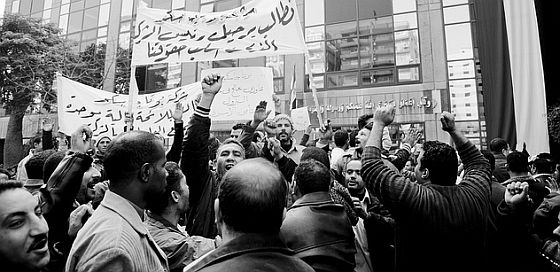
When an online petition urged Egyptians to protest on January 25, the call was not only taken up by an internet savvy minority. The demonstrators who took to the streets on that day – many of whom remained there until they forced Hosni Mubarak, the country’s autocratic ruler, to step down – transcended the divisions of class, age, religion and political affiliation. The true force behind the Egyptian people’s uprising rested in its leaderless and spontaneous nature. A widely-felt wound had been poked and festering at the centre of that wound was decades of economic exploitation and corruption made tenable by police violence against any form of public dissent.
One sign held up by protesters in Cairo’s Tahrir Square read: “Tell them to remove the plague and price increases Mubarak.” It was signed: “A citizen that loves Egypt.” That simple message conveyed the essence of the uprising, for the 18 days of protests were, in many ways, the culmination of a wave of much smaller and more localised strikes and demonstrations that had been taking place across the country since 2006.
It all began on December 7, 2006 when workers in the industrial city of El-Mahalla El-Kubra broke the country’s 20-year strike hiatus over the government’s failure to fulfill promises it had made about bonuses. For three days the strikers occupied a factory, calling for the government-backed Labor Federation to be dismantled. The government buckled under the pressure and gave in to the workers’ demands, but the event opened a Pandora’s Box of strikes and protests across the country.
The strikers were responding to the fast-track imposition of neo-liberal economic policies by a cabinet led by Ahmed Nazif, the then prime minister who relentlessly implemented the demands of the World Bank and International Monetary Fund (IMF). These measures included the privatisation of public factories, the liberalisation of markets, decreasing tariffs and import taxes and the introduction of subsidies for agri-businesses in place of those for small farmers with the aim of increasing agricultural exports.
Such economic policies, which are by no means unique to Egypt, are the fruitful soil of neo-colonialism, whereby multi-national corporations are able to capitalise on economies run by regimes that impose low standards of corporate responsibility towards their labour force, have few environmental protection laws and, in the case of Egypt, subsidise natural resources for big industry. This is coupled with the shrinking of the public sector, which is precisely where most of the labour action in Egypt has been concentrated.
These policies benefitted a small Egyptian elite and foreign corporations, while condemning the country’s working class to a new form of labour-slavery – many public sector employees held up their wage slips during protests, showing meagre monthly earnings of $50 to $90 – and the broader population to the consequences of a shrinking public sector and increased commodity prices.
Samir Amin on the Egyptian challenge to neoliberalism
The Egyptian economist, Samir Amin, President of the World Forum for Alternatives, spoke to World Social Forum TV about the situation in Egypt. The interview was recorded on February 7. A partial transcript of Samir Amin’s remarks can be found here.
If you live in Washington, DC, the question of what does the Egyptian Revolution mean for Palestine might seem like a strange question. The question du jour here is what does the Egyptian Revolution mean for Israel? The subtext to that second question is what does the Egyptian Revolution mean for Israel’s continued occupation and its denial of equality to non-Jewish citizens and residents. Of course, both questions show an Israel/Palestine-centric view of the world.
Yes, the denial of Palestinian freedom has been an iconic issue of concern not only for Arabs and the larger Muslim world, but also for the Global South and persons of conscience around the world. And once upon a time, the Palestinian struggle for their rights did symbolise the heroism of a people demanding justice for themselves.
But today that mantle lies with the Egyptian and Tunisian peoples. Today, they are the teachers and the rest of us are the pupils. Today, the Arab people of Egypt and Tunisia, and those demonstrating for the same goals throughout the Arab world are providing all of us, including Americans, with hard fought lessons that decades of useless peace-processing and support for authoritarian leaders have let us forget. Here are at least four lessons that have been thrown in our face:
First, the state and the government exist as a consequence of the will of the people, and not vice-versa. It was clear in Hosni Mubarak’s speech yesterday that he has conflated the state of Egypt with himself. His well being is that of Egypt. Attacks on his rule, in his mind, are attacks on Egypt. But Mubarak is not alone in this delusion.
Saddam Hussein saw Iraq in the same way. Listening to the Palestinian rulers in Gaza and Ramallah who administer some of the Palestinian cities under Israeli occupation, you would think that Palestine has become those administrations.
Millions of people marching throughout Egypt today and for the last two weeks have shown us what Egypt actually is – it is the self-determination exercised and demanded by those millions of individuals. Egypt is not an abstract concept tied in to a corrupt rule, it exists because the people today have resurrected themselves and in so doing have resurrected their state.
Palestinians in the first Intifada had tried something very similar but the exercise was ultimately hijacked and ended up in an agreement that actually restricted even further Palestinian space (anyone who lived in the West Bank or Gaza before the Oslo Agreement can tell you it was easier to travel throughout all of historic Palestine before “peace” than after).
Oil and gas workers on strike in Cairo, February 14, 2011. Photo: Hossam el-Hamalawy
The tearful TV appearance of Wael Ghonim, the Google executive who had been held in detention blindfolded for 12 days, had an emotional impact that reverberated across Egypt helping bring the revolution to its climax, but as Frederick Bowie notes, no less decisive — even if it garnered much less media attention — was the impact of labor support for the revolution.
Ghonim’s tears certainly played a crucial role in bringing many people, particularly middle-class Egyptians, down into the streets last week. But they cannot directly account for the massive wave of labour unrest which erupted in the days that followed, and which may have played the decisive role in transforming the emotions of the protesters into concrete gains.
Labour activists had proclaimed the creation of an independent trade union federation as early as 30 January, and the city of Suez, one of Egypt’s economic lynchpins, was at the heart of the struggle from day one. (Some believe that when all is finally known, it will be Suez too which has paid the heaviest price for its resistance in terms of dead and injured.) But the initial call for a general strike seemed at first not to find an echo outside one or two areas of the country. And it was not until as late as the middle of last week, when 24,000 workers at the Mahalla Textile Company downed tools, that labour seemed to throw its full weight behind the revolution.
Mahalla has been the epicentre of industrial action in Egypt for much of the last decade, and once the textile workers there had called a strike, it was not long before action spread to encompass armaments factories, public transport networks, universities and hospitals, oil companies, even the actors’ syndicate.
Continuing what has been the hallmark of recent Egyptian labour activism, these actions combined bread-and-butter demands about working conditions and living standards, with attacks on corruption in both management and the official trades unions, and more explicitly political calls for the end of the regime and expressions of solidarity with the protesters in Tahrir Square.
These strikes build on a recent history of labour activism that has grown since the early 2000s to be the most vibrant force for change in Egypt. Driven by the drastic deterioration in the living and working conditions of the majority of the Egyptian people that followed the regime’s compliance with IMF and World Bank demands for the privatization of state-controlled enterprises, the last decade has seen a constantly rising tide of grassroots workplace actions. And as that movement has spread and grown in confidence, its demands have become more and more explicitly political. As Mahalla strike leader Muhammad al-’Attar told a rally in September 2007, “I want the whole government to resign…. I want the Mubarak regime to come to an end. Politics and workers’ rights are inseparable. Work is politics by itself. What we are witnessing here right now, this is as democratic as it gets.”
For Egypt’s workers, the revolution is not just about an image or an emotion. It is about concrete demands, based on their concrete experience of what it is like to go without food, to be unable to pay for their children’s education, and to witness at first hand the corruption that illicitly breeds obscene levels of wealth. And it is rooted in their experience of mounting countless “illegal” actions that have united their communities, built bridges with other forces within Egyptian society, and demonstrated many times over how sheer force of numbers could overwhelm the repressive apparatus of a regime that was looking increasingly neurotic and out-of-touch.
It is too soon to know what exactly tipped the balance at the end of last week, and convinced the Supreme Council of the Armed Forces that the political and institutional superstructure of the Mubarak regime was now a liability, rather than an asset. But it is hard not to subscribe to the implications of one tweet sent by Egyptian microblogger Hossam el-Hamalawy (aka 3arabawy), which seemed to chime immediately with the hopes of many other cyber revolutionaries:
“#EgyWorkers strikes have started. The organized working class is now entering the arena. Mubarak, u r properly fucked.”
Since Hosni Mubarak fled from Cairo, and even before then, some middle-class activists have been urging Egyptians, in the name of patriotism, to suspend their protests and return to work, singing some of the most ridiculous lullabies: “Let’s build a new Egypt”, “Let’s work harder than ever before”. They clearly do not know that Egyptians are already among the hardest working people in the world.
Those activists want us to trust Mubarak’s generals with the transition to democracy – the same junta that provided the backbone of his dictatorship over the past 30 years. And while I believe the supreme council of the armed forces, which received $1.3bn from the US in 2010, will eventually engineer the transition to a “civilian” government, I have no doubt it will be a government that guarantees the continuation of a system that never touches the army’s privileges, that keeps the armed forces as the institution that has the final say in politics, that guarantees Egypt continues to follow the much hated US foreign policy.
A civilian government should not be made up of cabinet members who have simply removed their military uniforms. A civilian government means one that fully represents the Egyptian people’s demands and desires without any intervention from the top brass. I think it will be very hard to accomplish this, if the junta allows it at all. The military has been the ruling institution in this country since 1952. Its leaders are part of the establishment. And while the young officers and soldiers are our allies, we cannot for one second lend our trust and confidence to the generals.
[A] clear divergence is emerging between the demands of the young men and women who brought down the Mubarak regime and the concessions – if that is what they are – that the army appears willing to grant them. A small rally at the side of Tahrir Square yesterday held up a series of demands which included the suspension of Mubarak’s old emergency law and freedom for political prisoners. The army has promised to drop the emergency legislation “at the right opportunity”, but as long as it remains in force, it gives the military as much power to ban all protests and demonstrations as Mubarak possessed; which is one reason why those little battles broke out between the army and the people in the square yesterday.
As for the freeing of political prisoners, the military has remained suspiciously silent. Is this because there are prisoners who know too much about the army’s involvement in the previous regime? Or because escaped and newly liberated prisoners are returning to Cairo and Alexandria from desert camps with terrible stories of torture and executions by – so they say – military personnel. An Egyptian army officer known to ‘The Independent’ insisted yesterday that the desert prisons were run by military intelligence units who worked for the interior ministry – not for the ministry of defence.
As for the top echelons of the state security police who ordered their men – and their faithful ‘baltagi’ plain-clothes thugs — to attack peaceful demonstrators during the first week of the revolution, they appear to have taken the usual flight to freedom in the Arab Gulf. According to an officer in the Cairo police criminal investigation department whom I spoke to yesterday, all the officers responsible for the violence which left well over 300 Egyptians dead have fled Egypt with their families for the emirate of Abu Dhabi. The criminals who were paid by the cops to beat the protesters have gone to ground – who knows when their services might next be required? – while the middle-ranking police officers wait for justice to take its course against them. If indeed it does.
In mid-December, Sarah A. Topol described the extent to which the military controls Egypt’s economy.
The Egyptian military manufactures everything from bottled water, olive oil, pipes, electric cables, and heaters to roads through different military-controlled enterprises. It runs hotels and construction companies and owns large plots of land.
The Egyptian military has “an enormous vested interest in the way things run in Egypt, and you could, I think, be sure that they’ll try to protect those interests,” a Western diplomat in Cairo told me. “There’s a certain conventional wisdom [that] therefore the next president has to come from the military. I don’t know that that’s true. It’s the interest that they’ll be interested in protecting.”
But reporting on the military is difficult. No one wants to talk about the subject, and people who are willing to talk don’t want their names used. If civilians are worried, Egyptian journalists are petrified. “There is Law 313, [passed in] the year 1956, and it bans you from writing about the army,” Hesham Kassem, an independent publisher, told me. “It’s the taboo of journalism.”
Three days after Hosni Mubarak’s resignation, Egypt’s political opposition was bitterly divided over its next moves as the army expanded its near-total control over the country with no overt signs that it’s included anti-government protesters in its decision-making.
A major meeting of opposition leaders and protesters on Monday quickly devolved into arguments and diatribes, underscoring how difficult it will be for the diverse, leaderless revolutionary movement to coalesce around a political platform before elections that Egypt’s military caretakers have pledged to hold.
While one set of opposition figures battled itself, a group of seven young, middle-class democracy activists said that they’d met with senior members of the Supreme Council of the Armed Forces. The protesters said the generals voiced their “sincere intention to preserve the gains of the revolution.”
But the army, which Friday took power from Mubarak and since has issued only brief statements of its plans for the transition to a democratically elected government, made no mention of the meeting in its only statement of the day — a call for an end to growing labor protests.
The army has met some of the key demands of the protesters who ousted Mubarak. It’s dissolved his rubber-stamp parliament and suspended the flawed constitution. Many Egyptians consider the military the country’s most credible public institution after it remained neutral during the 18-day popular uprising and refused to fire on protesters.
But the military leadership — which includes former members of the Mubarak regime and is headed by his defense minister, Field Marshal Mohamed Hussein Tantawi — so far has emphasized stability over transparency.
The top U.S. military officer says the relationship between the American and Israeli militaries is especially relevant while Mideast nations are steeped in unrest.
Adm. Mike Mullen, the chairman of the Joint Chiefs of Staff, discussed the instability in Egypt with Israeli President Shimon Peres on Monday. He said the American-Israeli alliance is “something we both depend on.”
As the recipient of $3 billion in military aid annually, it’s clear how Israel is dependent on the United States, but much less clear how the dependence is mutual. Perhaps Mullen had personal dependence in mind, given that his principal adviser, Dr Lani Kass, grew up in Israel and was a major in the IDF.
Ilan Pappe writes on why Israelis fear the prospect of becoming surrounded democratic Arab states.
Nonviolent, democratic (be they religious or not) Arabs are bad for Israel. But maybe these Arabs were there all along, not only in Egypt, but also in Palestine. The insistence of Israeli commentators that the most important issue at stake — the Israeli peace treaty with Egypt — is a diversion, and has very little relevance to the powerful impulse that is shaking the Arab world as a whole.
The peace treaties with Israel are the symptoms of moral corruption not the disease itself — this is why Syrian President Bashar Asad, undoubtedly an anti-Israeli leader, is not immune from this wave of change. No, what is at stake here is the pretense that Israel is a stable, civilized, western island in a rough sea of Islamic barbarism and Arab fanaticism. The “danger” for Israel is that the cartography would be the same but the geography would change. It would still be an island but of barbarism and fanaticism in a sea of newly formed egalitarian and democratic states.
In the eyes of large sections of Western civil society the democratic image of Israel has long ago vanished; but it may now be dimmed and tarnished in the eyes of others who are in power and politics. How important is the old, positive image of Israel for maintaining its special relationship with the United States? Only time will tell.
But one way or another the cry rising from Cairo’s Tahrir Square is a warning that fake mythologies of the “only democracy in the Middle East,” hardcore Christian fundamentalism (far more sinister and corrupt than that of the Muslim Brotherhood), cynical military-industrial corporate profiteering, neo-conservatism and brutal lobbying will not guarantee the sustainability of the special relationship between Israel and the United States forever.
The overthrow of Egyptian President Hosni Mubarak and the transitions to new governance systems in Egypt and Tunisia – with others sure to follow – promise the birth of a more democratic, humanistic Arab world, assuming the transitions persist, which I believe is certain. Here are 10 things that may emerge from the current changes and which will determine if real democratization is underway, for these are the attributes that the Arab people have been denied throughout the past century:
First, real self-determination: Egypt and Tunisia may be the first instances of Arab countries that truly define themselves, their national values and their policies, on the basis of their people’s will and sentiments, rather than the decisions of a handful of self-imposed or foreign-installed rulers.
Second, real sovereignty: This may be the first time that modern Arab states implement domestic and foreign policies on the basis of the consent of the governed, rather than according to the desires or dictates of foreign powers.
Third, real politics: This may be the first time that modern Arab states experience the thrill and complexity of genuine politics, by which a variety of legitimate local actors negotiate the exercise of power and the routine transfer of incumbency from one group to another.
Fourth, real nationalism: This may be the first time that Arab societies forge a nationalist spirit that accurately reflects the sentiments, rights and aspiration of their own people, rather than merely the exploitative narrow goals of self-imposed rulers or hysterical crowds those autocrats callously manipulate.
Fifth, real constitutionalism: This may be the first time that modern Arab states see their own citizenry writing the rules of how power is exercised and how public authority is apportioned among the institutions of state, in the form of a constitution that actually represents a constituent population.
As protesters in Tahrir Square faced off against pro-government forces, they drew a lesson from their counterparts in Tunisia: “Advice to the youth of Egypt: Put vinegar or onion under your scarf for tear gas.”
The exchange on Facebook was part of a remarkable two-year collaboration that has given birth to a new force in the Arab world — a pan-Arab youth movement dedicated to spreading democracy in a region without it. Young Egyptian and Tunisian activists brainstormed on the use of technology to evade surveillance, commiserated about torture and traded practical tips on how to stand up to rubber bullets and organize barricades.
They fused their secular expertise in social networks with a discipline culled from religious movements and combined the energy of soccer fans with the sophistication of surgeons. Breaking free from older veterans of the Arab political opposition, they relied on tactics of nonviolent resistance channeled from an American scholar through a Serbian youth brigade — but also on marketing tactics borrowed from Silicon Valley.
As their swelling protests shook the Egyptian state, they were locked in a virtual tug of war with a leader with a very different vision — Gamal Mubarak, the son of President Hosni Mubarak, a wealthy investment banker and ruling-party power broker. Considered the heir apparent to his father until the youth revolt eliminated any thought of dynastic succession, the younger Mubarak pushed his father to hold on to power even after his top generals and the prime minister were urging an exit, according to American officials who tracked Hosni Mubarak’s final days.
The defiant tone of the president’s speech on Thursday, the officials said, was largely his son’s work.
“He was probably more strident than his father was,” said one American official, who characterized Gamal’s role as “sugarcoating what was for Mubarak a disastrous situation.” But the speech backfired, prompting Egypt’s military to force the president out and assert control of what they promise will be a transition to civilian government.
Now the young leaders are looking beyond Egypt. “Tunis is the force that pushed Egypt, but what Egypt did will be the force that will push the world,” said Walid Rachid, one of the members of the April 6 Youth Movement, which helped organize the Jan. 25 protests that set off the uprising. He spoke at a meeting on Sunday night where the members discussed sharing their experiences with similar youth movements in Libya, Algeria, Morocco and Iran.
This website or its third-party tools use cookies, which are necessary to its functioning. By closing this banner, you agree to the use of cookies.




 Colonel