Iraq today is replete with American-ordered deadlines, timetables and benchmarks that sought to create realities where realities never existed. The administration is leaving now on its own terms. Perhaps staying would make an already traumatized Iraq worse; much of its dysfunction dates to the American occupation and its earliest days. But the very nature of America’s departure — with no government formed, an unpredictable Iraqi military, and deep popular disenchantment with a hapless political elite — underscores one of the most enduring traits of American strategy in the Middle East.
Powerful but fickle, the United States has never seemed to understand time, at least not in the way it is acknowledged by Islamic activists willing to serve decades in jail, Syrian presidents assured that American policies will eventually change, and Iraq’s neighbors, who bide their turn to fill the vacuum left by an American departure.
Its policies — support for Israel and authoritarian Arab governments, the invasion of Iraq and war in Afghanistan — may shape sentiments toward it. But time, an American measure of it, often shapes the way it acts.
“It certainly is American politics and it is American culture, the sense that we are an impatient people,” said Ryan C. Crocker, a former ambassador to Iraq and veteran diplomat in the Arab world. “ ‘Tomorrow or the day after tomorrow, at the latest, and if that’s not going to happen, we’re going to move on.’ ”
The Middle East has long suffered under a peculiarly American notion that if the world’s greatest power wants something, it will somehow come to pass, on its schedule. In Lebanon, the Palestinian territories and Syria, the messy realities never quite fit. Since 2003, they rarely have in Iraq, either.
Category Archives: Issues
Goldberg willing to bet on a “better” chance that Israel will strike Iran
Israel has until the weekend to launch a military strike on Iran’s first nuclear plant before the humanitarian risk of an attack becomes too great, former U.S. Ambassador to the United Nations John Bolton said Tuesday.
A Russian company is expected to help Iran start loading nuclear fuel into its plant starting on Saturday, after which an attack on the Bushehr reactor could trigger harmful radiation, which Israel wants to avoid, Bolton said. So unless the Israelis act immediately to shut down the facility, it will be too late.
“Once it’s close to the reactor … the risk is when the reactor is attacked, there will be a release of radiation into the air,” Bolton told FoxNews.com. “It’s most unlikely that they would act militarily after fuel rods are loaded.”
The attack Iran story gets increasingly bizarre. Now we have neocon commentators like Bolton watching the clock as though this was some kind of sporting event and at the same time, presenting Israel as a thoroughly responsible player. While Israel might be willing to destabilize the whole region, it wouldn’t want to risk spreading nuclear fallout into the Gulf. But as Marsha Cohen points out, the risks from fallout would not simply be humanitarian — they would be economic:
Besides the catastrophic human and environmental toll of such an attack, the sea lanes through which much of the world’s oil supplies pass would be endangered.
Iranians know this. In 1980, Iran bombed Iraq’s Osirak nuclear power plant before it contained any radioactive material. Osirak was quickly repaired by the French contractors who built it. Eight months later Osirak was partially destroyed by Israeli jets, aided by Iranian intelligence.
Meanwhile, at The Atlantic, Jeffrey Goldberg and Robin Wright are now placing bets on the likelihood of an attack — not in the next few days, but the coming months.
“By July next year, I’ll wager that neither Israel nor the United States will have bombed Iran,” says Wright.
“I, of course, believe that there is a better than 50 percent chance Israel will strike …Iran by this time next year,” says Goldberg.
Note the phrasing chosen by the man who just a few days ago expressed “profound, paralyzing ambivalence” about whether on attack on Iran would be a good idea. He doesn’t now simply reiterate his expectation that an attack is more likely but that it looks like a “better” than 50 percent chance.
Casually chosen words? Maybe, but if Goldberg was being asked how likely another 9/11 attack might be and he thought it more likely than not to happen, I doubt that he would say there is a better than 50 percent chance of such an attack, would he?
Hamas supports the right of Muslims to pray in mosques — even in New York
Hamas has leaped into the New York mosque controversy — well, actually, not so much leaped as diffidently tiptoed when pressed to express an opinion on the issue.
In an interview on New York’s WABC radio (audio can be heard here), Mahmoud al-Zahar, a co-founder of Hamas who is in the Gaza political leadership, was asked by Aaron Klein to comment on the construction of the mosque.
Without addressing the question directly, Zahar chose to respond by pointing out that Muslims in America are like Muslims elsewhere, living in accordance with Islam, fasting (during Ramadan), praying and so forth. He then went on to say that Hamas is being misrepresented by those who would liken it to the Taliban and that it is recognized across the Islamic world as a moderate organization.
Klein, however, wanted to focus on the mosque controversy and returned to that question:
Klein: What do you think about the new initiative to build a mosque near the World Trade Center in New York, which is a major point of controversy on all sides?
Zahar: We have to build the mosque as you are allowed to build the church and the Israeli are building their holy places. We have to build everywhere — in every area we have muslims, we have to pray, and this mosque is the only site of prayer especially for the people when they are looking to be in the group — not individual.
Muslims should be allowed to worship in mosques, just like Christians going to church and Jews going to the synagogue.
Not much controversy there, right?
Well, the New York Post seems eager to pour fuel on the fire by inserting a few words in order to imply that Hamas (and Muslims in general) are engaged in territorial expansion.
A leader of the Hamas terror group yesterday jumped into the emotional debate on the plan to construct a mosque near Ground Zero — insisting Muslims “have to build” it there.
“We have to build everywhere,” said Mahmoud al-Zahar, a co-founder of Hamas and the organization’s chief on the Gaza Strip.
“In every area we have, [as] Muslim[s], we have to pray, and this mosque is the only site of prayer,” he said on “Aaron Klein Investigative Radio” on WABC.
“In every area we have Muslims, we have to pray,” which is to say, wherever Muslims live they have a religious obligation to gather for prayer and they do this in mosques.
But then we get the New York Post twist: “In every area we have, [as] Muslims[s], we have to pray,” conjures up a completely different picture. Lower Manhattan is now an area that Muslims claim as their own — at least the New York Post appears to want to promote this lie.
Let’s see whether anyone in the mainstream media is willing to correct this flagrant distortion. I’m not holding my breath.
America’s flawed Afghanistan strategy
By Dr Steven Metz
Despite the lavish time and attention that the Obama administration devoted to reviewing its Afghanistan strategy, the result was more continuity than change. The administration adjusted U.S. troops levels and shifted some operational methods but accepted the most basic — and questionable — assumptions of the Bush strategy. Unfortunately, these do not hold up under close scrutiny. The new strategy, like the old one, totters on a dangerously flawed foundation.
Both the Bush and Obama strategies assume that al-Qaeda needs state support or sanctuary. That, after all, is the fundamental rationale for continued American involvement in Afghanistan. But throughout the “war on terror,” no one has made a persuasive case that the September 11, 2001, attacks would not have happened had al-Qaeda not had bases in Afghanistan. While it may take meetings and phone calls to plot terrorism, these can be done from nearly anywhere. Al-Qaeda’s Afghanistan sanctuary was a convenience, not a necessity. Destroying the sanctuary has not stopped bin Laden and his henchmen from plotting new attacks.
Why, then, should the United States devote billions of dollars fighting the Taliban in Afghanistan if doing so has little effect on al-Qaeda’s ability to launch terrorism? The answer says more about the way Americans think than it does about how terrorists operate. The United States has expended great effort to eradicate al-Qaeda’s bases and training camps less because they were important than because we are effective at it. There is an old saying that, “when all you have is a hammer, every problem looks like a nail.” America has an amazing hammer — its military — which is very good at seizing and controlling territory. So, we reasoned, eradicating bases and training camps will cripple al-Qaeda. Yet there is no evidence to validate this idea.
The Obama strategy also assumes that without U.S. and NATO troops in Afghanistan, the Taliban will regain control. But the Taliban came to power in 1996 because the warlords opposing it had little outside support and, more importantly, because Afghans did not understand just what Taliban rule would mean and thus did little to resist it. Now they do know and will resist, at least outside Afghanistan’s Pashtun areas. Simply funding the Afghan government and providing it with training and advice can prevent an outright Taliban victory without a large U.S. military presence.
The Obama strategy then assumes that if the Taliban regains control of Afghanistan, it will again provide bases and sanctuary to al-Qaeda. The Pentagon’s newly released Quadrennial Defense Review warned of al-Qaeda “regaining sanctuary in Afghanistan.” In his December 2009 speech at West Point, President Obama stated that al-Qaeda would “operate with impunity” if the region “slides backward.” This is only true if the Taliban is remarkably stupid. Before September 11, 2001, the Taliban allowed al-Qaeda to train and plot in Afghanistan because it was profoundly ignorant of American intentions and power. The United States, Taliban leaders believed, understood enough history to not intervene in Afghanistan. Now they know better. If the Taliban somehow returned to power, it would face enemies enough without provoking another American assault or intervention by giving al-Qaeda a free hand.
Finally, the Obama strategy assumes that if the Taliban regained control of some or all of Afghanistan and did, for some reason, provide support and sanctuary to al-Qaeda, this would increase the threat to the United States and the other NATO countries. Again, this overlooks history. Al-Qaeda was able to plot terrorism from Afghanistan because the United States was unaware of the impending danger. Had America known what was coming, it certainly would have rendered al-Qaeda’s Afghanistan bases useless even without a full scale invasion. There is no reason to believe that if al-Qaeda somehow recreated its pre-September 11 Afghanistan sanctuary that the United States would not quickly destroy it.
Ultimately, then, the basic rationale of American strategy in Afghanistan is questionable. Certainly America cannot ignore that country as it did before September 11, 2001, and should continue supporting the national government and other Afghans opposed to the Taliban. But in strategy, balance is the key — the expected security benefits of any action must justify the costs and risks. Today, America’s Afghanistan strategy, with its flawed assumptions, is badly out of balance.
Dr Steven Metz is a Research Professor of National Security Affairs at the Strategic Studies Institute of the United States Army War College. The views expressed in this op-ed are those of the author and do not necessarily reflect the official policy or position of the Department of the Army, the Department of Defense, or the U.S. Government.
Reprinted with permission of the Strategic Studies Institute Newsletter, U.S. Army War College.
Harvard University cuts its losses and dumps all investments in Israel
Update: Harvard explains Israel share sales: it wasn’t divestment, it’s just that Israel is no longer an emerging market (Business Insider).
Did the Boycott, Divestment and Sanctions for Palestine movement just make a historic advance? Harvard University has sold close to $40 million of shares in Israeli companies:
In another blow to Israeli shares, the Harvard Management Company notified the US Securities and Exchange Commission (SEC) on Friday that it had sold all its holdings in Israeli companies during the second quarter of 2010. No reason for the sale was mentioned. The Harvard Management Company manages Harvard University’s endowment.
Harvard Management Company stated in its 13-F Form that it sold 483,590 shares in Teva Pharmaceutical Industries Ltd. (Nasdaq: TEVA; TASE: TEVA) for $30.5 million; 52,360 shares in NICE Systems Ltd. (Nasdaq: NICE; TASE: NICE) for $1.67 million; 102,940 shares in Check Point Software Technologies Ltd. (Nasdaq: CHKP) for $3.6 million; 32,400 shares in Cellcom Israel Ltd. (NYSE:CEL; TASE:CEL) for $1.1 million, and 80,000 Partner Communications Ltd. (Nasdaq: PTNR; TASE: PTNR) shares for $1.8 million.
Some commentators plausibly argue that Harvard’s decision was purely financial and not a political decision. Indeed, were it actually an explicit act of divestment there would surely have been a carefully crafted statement explaining their decision.
Even so, the effectiveness of the BDS movement may well depend less on persuading capital to move with principal (it never does) but on companies, institutions, artists and other players coming to the self-interested conclusion that doing business with Israel is bad for business.
Obama’s defense of religious freedom
On Friday, Glenn Greenwald wrote:
This is one of the most impressive and commendable things Obama has done since being inaugurated:
President Obama delivered a strong defense on Friday night of a proposed Muslim community center and mosque near ground zero in Manhattan, using a White House dinner celebrating Ramadan to proclaim that “as a citizen, and as president, I believe that Muslims have the same right to practice their religion as anyone else in this country” . . . .
“I understand the emotions that this issue engenders. Ground zero is, indeed, hallowed ground,” the president said in remarks prepared for the annual White House iftar, the sunset meal breaking the day’s fast.
But, he continued: “This is America, and our commitment to religious freedom must be unshakable. The principle that people of all faiths are welcome in this country, and will not be treated differently by their government, is essential to who we are” . . . .
What makes this particularly commendable is there is virtually no political gain to be had from doing it, and substantial political risk. Polls shows overwhelming opposition to the mosque nationwide (close to 70% opposed), and that’s true even in New York, where an extraordinary “50% of Democrats, 74% of Republicans, and 52% of ‘non-enrolled’ voters, don’t want to see the mosque built.” The White House originally indicated it would refrain from involving itself in the dispute, and there was little pressure or controversy over that decision. There was little anger over the President’s silence even among liberal critics. And given the standard attacks directed at Obama — everything from being “soft on Terror” to being a hidden Muslim — choosing this issue on which to take a very politically unpopular and controversial stand is commendable in the extreme.
On Saturday, Obama was questioned by CNN on the reaction provoked by his speech the night before. Obama responded:
My intention was to simply let people know what I thought. Which was that in this country, we treat everybody equally in accordance with the law. Regardless of race. Regardless of religion. I was not commenting on and will not comment on the wisdom of making a decision to put a mosque there. I was commenting very specifically on the right that people have that dates back to our founding. That’s what our country’s about and I think it’s very important that as difficult as some of these issues are, we stay focused on who we are as a people and what our values are all about.
Fair enough?
Well not if you’re a journalist who wants to construct a story about the president who “seemed to contradict himself.”
In a country that has a constitution that protects religious freedom by separating Church and State, what business does any politician have in expressing an opinion about the wisdom of building a house of worship anywhere? Just because this is a representative democracy doesn’t mean elected politicians have an obligation to reflect the bigotry of their constituents.
Obama’s secret war
The Bush administration was well known for its lack of accountability and its disregard for international law, yet if the lead proponents of outlaw governance — men such as Dick Cheney and his chief of staff David Addington — preferred to operate in the shadows, there was a political form of accountability in as much as their approach was seen as an integral feature of the neoconservative agenda — an agenda that got roundly criticized in many quarters.
This is what makes President Obama’s approach in some ways more dangerous than that of the neocons.
The New York Times reports on Obama’s secret war being conducted in Yemen and elsewhere which discredited neocons must now be applauding not only because this administration has in in so many ways adopted their approach but because this approach has now become institutionalized and legitimized by an administration that is not weighed down by the ideological baggage of its predecessor.
A convergence between the CIA — operating increasingly as a paramilitary organization — and the Pentagon — conducting more and more clandestine operations — has produced an American killing machine that operates with minimal political and legal oversight. As the Times says: “the American military campaign in Yemen began without notice in December and has never been officially confirmed.”
“Where we want to get is to much more small scale, preferably locally driven operations,” said Representative Adam Smith, Democrat of Washington, who serves on the Intelligence and Armed Services Committees.
“For the first time in our history, an entity has declared a covert war against us,” Mr. Smith said, referring to Al Qaeda. “And we are using similar elements of American power to respond to that covert war.”
Some security experts draw parallels to the cold war, when the United States drew heavily on covert operations as it fought a series of proxy battles with the Soviet Union.
And some of the central players of those days have returned to take on supporting roles in the shadow war. Michael G. Vickers, who helped run the C.I.A.’s campaign to funnel guns and money to the Afghanistan mujahedeen in the 1980s and was featured in the book and movie “Charlie Wilson’s War,” is now the top Pentagon official overseeing Special Operations troops around the globe.
A campaign for war with Iran begins
In response to Jeffrey Goldberg’s Atlantic article, “The Point of No Return,” Trita Parsi writes in Salon:
Whether characterizing it as “mainstreaming war with Iran” or “making aggression respectable,” Goldberg’s article serves to create a false narrative that claims that the two failed meetings held between the U.S. and Iran last October constitute an exhaustion of diplomacy, that deems the Obama administration’s crippling, indiscriminate sanctions on Iran a failure only weeks after they’ve been imposed, and that then leaves only one option remaining on the table: an American or Israeli military strike. And on top of that, if President Obama doesn’t green light a bombing campaign, Israel will have no choice but to bomb itself, even though it isn’t well-equipped to do so, according to Goldberg.
It is important to note that the aim of this unfolding campaign may not be to pressure Obama into military action. It could just as much serve to portray Obama as weak and indecisive on national security issues that are of grave concern to the U.S. and that are of existential nature to Israel. This portrayal will give the Republicans valuable ammunition for the November congressional elections as well as for the 2012 presidential race.
Indeed, the likely political motivation for this unfolding campaign should not be underestimated. Just as much that the building blocks of the Iraq war were put into place under the Clinton years — most importantly with the passage of the Iraq Liberation Act in 1998 — serious preparation for selling an Iran war to the American public under a Republican president (Palin?) in 2013 must be undertaken now, both to establish the narrative for that sell and to use the narrative to remove any obstacles in the White House along the way.
What would George Orwell say about the US withdrawal from Iraq?

By Hannah Gurman
As the Second World War drew to a close, George Orwell looked back on the various prognoses of war and peace that had emerged in recent years:
“All political thinking for years past has been vitiated in the same way,” he observed. “People can foresee the future only when it coincides with their own wishes, and the most grossly obvious facts can be ignored when they are unwelcome.”
Over the next several years, Orwell would elaborate a dystopian vision of the emerging Cold War, a vision in which warring superpowers would use distorted and self-serving political rhetoric to battle each other and their citizens.
In recent weeks, we have reached another historic juncture. The Iraq War, or at least the American military’s role in it, is drawing to a symbolic close. To mark this moment, the U.S. Ministry of Information has put its spin machine in high gear. Orwell would have had a field day with this one. He could not have invented a more Orwellian tale than the actual story of the U.S. withdrawal from Iraq.
Here is the official version, championed in its earlier moments by Bush, Petraeus, and other congressional hawks, and now trumpeted almost as loudly by the White House and State Department: Violence is down. Iraqis are finally (it’s about time, guys) taking responsibility for their own security. The March elections were a great step forward. Iraq, we can safely say, is on the path to a brighter future.
This story marks the last chapter in the surge narrative that took root in 2006, a narrative in which General David Petraeus is credited with turning the war around. Proponents of this story know better than to declare victory, a word that has largely fallen out of the official lexicon. But the word success, which has taken its place, is everywhere. And while it doesn’t quite afford that nationalist sense of superiority to which Americans have long been accustomed, success does provide a certain contentment and satisfaction over a job well done. It allows for that perennial optimism that never quite goes out of fashion in the American way of war.
It is telling though not surprising that Obama chose a military audience to deliver his official remarks on the nominal end of America’s seven-year occupation of Iraq. Like all American, and especially all Democratic presidents, Obama rarely misses a moment to pay tribute to the troops — perhaps the only thing that no loyal American can question regardless of how unjust the wars America fights may be. “As we mark the end of America’s combat mission in Iraq,” President Obama declared, “a grateful America must pay tribute to all who served there.”
There is nothing fundamentally new in this story. It is just the latest version of a longstanding nationalist narrative in which, no matter how the story begins, the U.S. always ends up on the right side of history. For the most loyal devotees of this narrative, even Vietnam is not an exception. Were it not for that cheap congress, those pesky journalists, and those traitorous anti-war activists, they insist, we would’ve won that war too. Never mind that we had allied ourselves with a corrupt government that cared little about the people of Vietnam. Never mind that the enemy saw this as just the latest in a decades-long war against foreign occupiers. Never mind that, as Daniel Ellsberg has said, we were not just “on the wrong side” of this war. “We were the wrong side.”
As with the hawk’s version of Vietnam’s ignominious conclusion, the tale of America’s withdrawal from Iraq is characterized by contradictions, half-truths, and huge blind spots. It is a story told by officials with jobs and reputations to protect. It is a myth bought and sold by Americans who want to believe in a benevolent image of their country in the world. And most important of all, it is a fairy tale that systematically elevates the good news about Iraq and avoids any talk of the long-term devastation this war has wreaked on the people there.
In recent months, as the deadline for troop withdrawal has neared, Ambassador Christopher Hill has become a more visible prop in the administration’s official spin machine, deflecting any arrows aimed at the armor that is the official success narrative. When NPR’s Steve Inskeep asked him whether Iraq might still collapse, Hill said that he looked at the situation “in pretty optimistic terms.” That’s easy for Hill to say. He is leaving Iraq this month to become the dean of the international relations program at Denver University.
The success story is a bit harder to feed to the Iraqis who actually experience the realities on the ground in Iraq, and who, unlike Hill, will continue to face these realities on a daily basis. In an interview on Al Jazeera’s “Inside Iraq” television show in April, Jassim Al-Assawi challenged the ambassador’s rosy assessment of the March parliamentary elections, pointing out that a number of elected ex- Baathist officials had been denied seats in parliament. When questioned about the legality of this measure, as well as other serious problems of Iraqi governance, Hill tried to convince his interviewer that he was not the Iraqi government. “I’m just the US ambassador,” he said. “I’m not the prime minister” of Iraq. “I’m not a judge in Baghdad.”
Good thing. Because, according to the most recent Brookings index of Iraq, 135 of 869 judges in Iraq have been removed on charges of corruption. Overall, when it comes to corruption, Iraq ranks 176 out of 180 countries. Thus, it should come as no surprise that nine billion dollars of oil revenue intended for reconstruction has gone missing.
Of course, the state of Iraq’s political and judicial institutions has never been the strongest thread in the success narrative. The security story, on the other hand, is ostensibly on firmer ground, and has therefore figured prominently in the official version of the story. Here’s Obama on the progress of security in Iraq:
Today – even as terrorists try to derail Iraq’s progress – because of the sacrifices of our troops and their Iraqi partners, violence in Iraq continues to be near the lowest it’s been in years. And next month, we will change our military mission from combat to supporting and training Iraqi security forces. In fact, in many parts of the country, Iraqis have already taken the lead for security.
In this effort to play up the security achievements of Iraq, Obama bracketed the spikes in violence in recent months and used the word terrorist to avoid the deeper and more complex political history of both the Sadrist and Sunni insurgencies.
There is no denying that violence is down from its highest levels, and that is a good thing. But the Ministry of Information distorts all reality when it suggests that the Iraqi army and police are ready to “take the lead” in maintaining this security. As of December 2009, there were 664,000 Iraqi security forces. This reflects only the number of authorized personnel, however, and is not an indicator of operational readiness.
In September 2009, the Iraqi Army had close to 250 battalions. But only about 50 of them were deemed capable of planning, executing, and sustaining counterinsurgency operations on their own. The rest were either completely incapable or required assistance from coalition forces. This isn’t news to Iraqi military leaders. Lieutenant General Babker Zerbari, Iraq’s most senior military officer, has said that his security forces won’t be able to take the lead until 2020 and has asked the US to delay its planned withdrawal.
While the weavers of the success story have distorted the security situation in Iraq, they have hardly said a peep about the disaster that is Iraq’s infrastructure and essential services. As of February 2009, 80 percent of the population still lacked access to sanitation services, 55 percent lacked access to potable water, and 50 percent still had serious electricity shortages. As late as May 2010, Brookings estimated that 30,000-50,000 private generators were making up for shortages in the national grid.
Healthcare is also in dire straits. New studies reveal soaring cancer rates in Fallujah and other cities that were heavily targeted by U.S. forces. This news comes against the backdrop of a mass exodus of doctors from the country. Twenty thousand of Iraq’s thirty-four thousand registered physicians left Iraq after the US invasion. As of April 2009, fewer than 2,000 returned, the same as the number who were killed during the course of the war.
The shortage of doctors in Iraq is just one facet of the much bigger population displacement as a result of the war. As of January 2009, there were still 2 million Iraqi refugees living outside of the country, and as of April 2010, there were 2,764,000 internally displaced people living in Iraq.
- “War against a foreign country only happens when the moneyed classes think they are going to profit from it.” –George Orwell, New Statesmen (1937)
In 2002, the State Department’s “Future of Iraq” group predicted that the toppling of the Saddam regime would usher in a period of great economic boom. That turned out not to be the case, at least not initially. Iraq’s instability kept multinational corporations out of Iraq for awhile, but in recent years, that’s been changing. In 2008 and 2009, Foreign Direct Investment went up tenfold in Iraq. Not surprisingly, officials have been framing this as great news for the country. In 2009, the website of Operation Iraqi Freedom proudly advertised that the governor of Anbar was named FDI magazine’s “Global Personality of the Year.” What the website does not advertise is that the huge oil and natural gas companies competing for Anbar’s natural resource wealth have little interest in helping the people of Anbar, but are instead focused on their bottom lines. That entails plans for using cheap foreign labor from China and other countries. It is unlikely that anything more than a small portion of their earnings will actually trickle down to ordinary Iraqis.
The oil and gas companies are not the only ones who will profit from the postwar order in Iraq. The United States military and defense industry will make out well too. Despite claims to the contrary, this is not the end of the US military presence in Iraq. In addition to the several bases that will remain active, housing the soldiers and private contractors whose titles will change to advisors, there will be an indefinite state of dependency on US-manufactured weapons and technology. Defense companies, such as ARINC will continue to make hundreds of millions providing Mi-17 helicopters and other military hardware and logistics to Iraq.
While the Ministry of Information does not advertise the reality of America’s enduring military presence in Iraq, it is quick to announce a civilian “surge” in the country. Along these lines, officials have been boasting about the massive US embassy in Baghdad. “Along with the Great Wall of China,” said Ambassador Hill, “its one of those things you can see with the naked eye from outer space. I mean it’s huge.” Indeed. At 104 acres, it is the largest U.S. embassy in the world. In addition to six apartment buildings, it has a luxury pool, as well as a water and sewage treatment plan. Stop for a second and reflect on these last two amenities. They give you some measure of what American officials really know but aren’t saying about the state of drinking water and sanitation in Iraq. The State Department has requested a mini-army to protect this Fortress America — including 24 Black Hawk helicopters and 50 bomb-resistant vehicles. Again, stop for a minute and ask yourself what this says about security in Iraq. This shadow army says a lot about what American officials really think about the state of security in Iraq.
- “Who Controls the Past Controls the Future. Who Controls the Present Controls the Past” –George Orwell, 1984 (1949)
Given all the damage that remains in Iraq, it is no wonder that some Iraqis are confused and angry at the rosy pronouncements about Iraq’s path to progress. Without masking his hostility and frustration, Jassim Al-Assawi pressed ambassador Hill to explain why, despite all the problems Iraq is currently experiencing, he remains so optimistic. After waxing poetic about the heroism and drive of the Iraqi people, Hill simply insisted, “There’s no going back, only forward.”
This last statement encapsulates what is perhaps the most important function of the success narrative. All this talk about moving forward is also an insistence on not looking back, especially not to 2003. The U.S. has sought to control the past of the Iraq War by rejecting and effectively erasing it, willfully marginalizing the very act that got this whole story going in the first place. The Bush administration needed to scratch 2003 out in order to minimize its own role in the destruction of Iraq and the suffering of its people. Now, the Obama administration has picked up the eraser in order to convince everyone that this is a “responsible” withdrawal.
No matter how much the U.S government erases the past or predicts the future of Iraq, ordinary Iraqis will continue to face the more messy and complicated realities of the present. I dare Obama and everyone else in the spin machine to go to Iraq and look a child in the eyes. A child who, seven years after the US invasion, still lacks adequate housing, drinking water, sanitation, electricity, and education. Now, tell that child that the war in Iraq was a success.
Hannah Gurman is an Assistant Professor at New York University’s Gallatin School.

Fears of al Qaida return in Iraq as US-backed fighters defect
Al-Qaida is attempting to make a comeback in Iraq by enticing scores of former Sunni allies to rejoin the terrorist group by paying them more than the monthly salary they currently receive from the government, two key US-backed militia leaders have told the Guardian.
They said al-Qaida leaders were exploiting the imminent departure of US fighting troops to ramp up a membership drive, in an attempt to show that they are still a powerful force in the country after seven years of war.
Al-Qaida is also thought to be moving to take advantage of a power vacuum created by continuing political instability in Iraq, which remains without a functional government more than five months after a general election.
Sheikh Sabah al-Janabi, a leader of the Awakening Council – also known as the Sons of Iraq – based in Hila, 60 miles south of Baghdad, told the Guardian that 100 out of 1,800 rank-and-file members had not collected their salaries for the last two months: a clear sign, he believes, that they are now taking money from their former enemies.
“Al-Qaida has made a big comeback here,” he said. “This is my neighbourhood and I know every single person living here. And I know where their allegiances lie now.”
You must do what we can’t, because if you don’t, we will
There are those who would have us believe that:
[O]ne day next spring, the Israeli national-security adviser, Uzi Arad, and the Israeli defense minister, Ehud Barak, will simultaneously telephone their counterparts at the White House and the Pentagon, to inform them that their prime minister, Benjamin Netanyahu, has just ordered roughly one hundred F-15Es, F-16Is, F-16Cs, and other aircraft of the Israeli air force to fly east toward Iran — possibly by crossing Saudi Arabia, possibly by threading the border between Syria and Turkey, and possibly by traveling directly through Iraq’s airspace, though it is crowded with American aircraft.
Worried about an Israeli attack on Iran? That’s the idea.
You must do what we can’t, because if you don’t, we will.
This is how some Israelis are trying to twist Washington’s arm to get the US to attack Iran.
A more honest way of making the argument would be to say this: If the US won’t attack Iran, then Israel will — even though it won’t accomplish its military objectives and it will open Pandora’s box. Desperate nations sometimes do desperate things. You have been warned.
Another name for this: blackmail.
It’s hard to counter an irrational argument when the irrationality is intentional. Such are the means by which someone like erstwhile Israeli army corporal and current Atlantic commentator, Jeffrey Goldberg, attempts to persuade his readers — not through cogent reasoning based on clear evidence, but by an insidious form of argument that has the clarity of slime.
Consider the way he tries to close his case for an attack on Iran — even while avoiding saying straight out that he supports such a course of action.
The United States must not take the risk of letting Israel attack Iran because if President Obama orders US forces to attack instead, this would be the most patriotic thing to do. Obama would not be serving Israel’s interests; he would be defending Western civilization.
Based on months of interviews, I have come to believe that the administration knows it is a near-certainty that Israel will act against Iran soon if nothing or no one else stops the nuclear program; and Obama knows — as his aides, and others in the State and Defense departments made clear to me — that a nuclear-armed Iran is a serious threat to the interests of the United States, which include his dream of a world without nuclear weapons. Earlier this year, I agreed with those, including many Israelis, Arabs — and Iranians — who believe there is no chance that Obama would ever resort to force to stop Iran; I still don’t believe there is a great chance he will take military action in the near future — for one thing, the Pentagon is notably unenthusiastic about the idea. But Obama is clearly seized by the issue. And understanding that perhaps the best way to obviate a military strike on Iran is to make the threat of a strike by the Americans seem real, the Obama administration seems to be purposefully raising the stakes. A few weeks ago, Denis McDonough, the chief of staff of the National Security Council, told me, “What you see in Iran is the intersection of a number of leading priorities of the president, who sees a serious threat to the global nonproliferation regime, a threat of cascading nuclear activities in a volatile region, and a threat to a close friend of the United States, Israel. I think you see the several streams coming together, which accounts for why it is so important to us.”
When I asked Peres what he thought of Netanyahu’s effort to make Israel’s case to the Obama administration, he responded, characteristically, with a parable, one that suggested his country should know its place, and that it was up to the American president, and only the American president, to decide in the end how best to safeguard the future of the West. The story was about his mentor, David Ben-Gurion.
“Shortly after John F. Kennedy was elected president, Ben-Gurion met him at the Waldorf-Astoria” in New York, Peres told me. “After the meeting, Kennedy accompanied Ben-Gurion to the elevator and said, ‘Mr. Prime Minister, I want to tell you, I was elected because of your people, so what can I do for you in return?’ Ben-Gurion was insulted by the question. He said, ‘What you can do is be a great president of the United States. You must understand that to have a great president of the United States is a great event.’”
Peres went on to explain what he saw as Israel’s true interest. “We don’t want to win over the president,” he said. “We want the president to win.”
Israel only wants what’s good for America — and we’re supposed to believe that, even while few if any Israelis could be persuaded that America only wants what’s good for Israel.
The truth is that everyone gets to define their own interests so let’s ignore the obsequious crap from Peres and consider Goldberg’s core claim: that Israel is gearing up to strike Iran.
Even if Goldberg is participating in a neocon game of bluff, the only kind of bluff worth engaging in is one that has credibility. To make a credible argument that Israel has the intention of going it alone, Goldberg would have to present the outline of a credible plan of attack. He doesn’t even try.
Israeli planes would fly low over Saudi Arabia, bomb their targets in Iran, and return to Israel by flying again over Saudi territory, possibly even landing in the Saudi desert for refueling—perhaps, if speculation rife in intelligence circles is to be believed, with secret Saudi cooperation.
And he prefaces this “plan” by saying Israel only gets one try. That’s not even a back-of-an-envelope war plan. It’s more like a Twitter war plan.
Five years ago Kenneth Pollack dismissed the idea that Israel could attack Iran on its own. I don’t see any reason to doubt that his analysis on the military logistics of an attack still remains sound. Indeed, there seem to be plenty of Israeli analysts who concede that Israel simply does not have the option of going it alone. Even Goldberg quotes an unnamed Israeli general who says: “This is too big for us.”
In The Persian Puzzle: The Conflict Between Iran and America, Pollack wrote:
[T]he United States … should not count on Israel to conduct a counterproliferation strike for us. It is almost certainly the case that Israel would be willing to absorb the diplomatic costs of a strike, would be prepared to deal with Iran’s retaliation in the form of either terrorist attacks or missile strikes on Israel, and probably is not overly concerned about Iranian behavior in Iraq. The problem for Israel is much simpler: Iran is too far away. Most of the known Iranian nuclear facilities are around 1,000 miles away from Israel. Its Jericho II ballistic missiles could reach these targets, but they lack the payload, accuracy, and numbers to be able to significantly damage (let alone destroy) more than one or two of the large Iranian nuclear facilities, which leaves the matter to the Israeli Air Force. Even assuming that Israeli aircraft were to fly directly to Iran, overflying Jordan and Iraq, the only aircraft in its inventory that could reach Iran’s known nuclear sites are its 25 F-151 strike fighters. (Israel would need to set up aerial refueling stations at three to five locations between Israel and the Iranian targets for its roughly 350 F-16s to be able to participate, which would be practically impossible.) Because the F-151s would have to carry a considerable amount of fuel, they could not carry a great deal of ordinance. Given the size of the various Iranian nuclear facilities, it would not be possible for Israel to destroy all of them in a single raid as it did Osiraq. Nor would it be politically, militarily, or logistically possible for Israel to sustain multiple such strikes over the many days, if not weeks, it would take for all its F-151s to accomplish the job. [My emphasis.]
The neocon game of bluff will only box in the Obama administration if the Israeli “threats” are treated seriously. A more appropriate response would seem to be to focus on the limits of Israeli military action — unless that is one imagines that Israel would launch a nuclear attack on Iran, which to my mind is wildly implausible. (If Israel wants to permanently seal its global pariah status, the first offensive use of nuclear weapons since Nagasaki is a sure way.)
Goldberg reports, but apparently didn’t take seriously, the observations of some Israelis who given their positions of military command seem to merit close attention:
Gabi Ashkenazi, the Israeli army chief of staff, is said by numerous sources to doubt the usefulness of an attack, and other generals I spoke with worry that talk of an “existential threat” is itself a kind of existential threat to the Zionist project, which was meant to preclude such threats against the Jewish people. “We don’t want politicians to put us in a bad position because of the word Shoah [Holocaust],” one general said. “We don’t want our neighbors to think that we are helpless against an Iran with a nuclear bomb, because Iran might have the bomb one day. There is no guarantee that Israel will do this, or that America will do this.”
The message Netanyahu, Goldberg and other panic-stricken Zionists are unintentionally sending out is that come the day Iran acquires a nuclear weapon, Israelis may as well back their bags and abandon the Jewish state.
That probably won’t happen because in such an event Israel will “discover” what many Israelis no doubt already think: that retired General John Abizaid was right when he said that the United States and its allies can “live with” a nuclear-armed Iran. “Let’s face it — we lived with a nuclear Soviet Union, we’ve lived with a nuclear China, and we’re living with nuclear powers as well,” Abizaid told an audience at the Center for Strategic and International Studies.
That was true in 2007 and it’s true now. It’s also true that spineless politicians remain the playthings of fear-mongers who are addicted to war.
The Israeli bastion of fear
The prefix anti- has become tarnished — no longer the signal of vital dissent. To be anti-war is to be dismissed as belonging to an ineffectual movement that paraded its political impotence until the marching lost all conviction and withered away. To be anti-American or anti-Israel is to be condemned as an enemy of civilization. To be an anti-Zionist is to be cast as someone with no regard for the rights of the Jewish people. And meanwhile, behind all these variants of opposition lurks the most dangerous negation of all: anti-Semitism.
You say no and we say yes. Who can escape seeing the appeal of being on the side of yes — even when it’s far from clear what this yes is supposed to affirm?
In a speech Chris Hedges delivered in New York City last Thursday at a fundraiser for sponsoring a U.S. boat to break the blockade of Gaza, he made a point worth heavily underlining when it comes to defining the oppositional antonyms that we use to define the issue of Palestine. This is not a struggle between yes and no.
Addressing secret informants in the room who were undoubtedly there gathering intelligence for the Israeli government, Hedges said:
You may have the bulldozers, planes and helicopters that smash houses to rubble, the commandos who descend from ropes on ships and kill unarmed civilians on the high seas as well as in Gaza, the vast power of the state behind you. We have only our hands and our hearts and our voices. But note this. Note this well. It is you who are afraid of us. We are not afraid of you.
This indeed is the most telling marker — not one that distinguishes those who are for or against but one that separates the fearful and the fearless.
To stand up in the name of justice is to align oneself with something bigger than ones own interests. The fearful cling to the things they are in jeopardy of losing. They defend an inequity that is inherently unstable. Their resistance is against balance and against a natural order. It is they who are most loudly saying “no” — even while calling it “peace.” Their resistance is through opposition to inevitable change.
The challenge to the fearful is this: you say you want to protect yourself from danger, yet you have allowed fear to become your closest companion. Do you not see that fear itself poses a greater threat to life than all the perils you name? Think less about how you can feel safe and you might discover how you can become less afraid.
* * *
Chris Hedges:
When I lived in Jerusalem I had a friend who confided in me that as a college student in the United States she attended events like these, wrote up reports and submitted them to the Israel consulate for money. It would be naive to assume this Israeli practice has ended. So, I want first tonight to address that person, or those persons, who may have come to this event for the purpose of reporting on it to the Israeli government.
I would like to remind them that it is they who hide in darkness. It is we who stand in the light. It is they who deceive. It is we who openly proclaim our compassion and demand justice for those who suffer in Gaza. We are not afraid to name our names. We are not afraid to name our beliefs. And we know something you perhaps sense with a kind of dread. As Martin Luther King said, the arc of the moral universe is long but it bends toward justice, and that arc is descending with a righteous fury that is thundering down upon the Israeli government.
You may have the bulldozers, planes and helicopters that smash houses to rubble, the commandos who descend from ropes on ships and kill unarmed civilians on the high seas as well as in Gaza, the vast power of the state behind you. We have only our hands and our hearts and our voices. But note this. Note this well. It is you who are afraid of us. We are not afraid of you. We will keep working and praying, keep protesting and denouncing, keep pushing up against your navy and your army, with nothing but our bodies, until we prove that the force of morality and justice is greater than hate and violence. And then, when there is freedom in Gaza, we will forgive … you. We will ask you to break bread with us. We will bless your children even if you did not find it in your heart to bless the children of those you occupied. And maybe it is this forgiveness, maybe it is the final, insurmountable power of love, which unsettles you the most.
And so tonight, a night when some seek to name names and others seek to hide names, let me do some naming. Let me call things by their proper names. Let me cut through the jargon, the euphemisms we use to mask human suffering and war crimes. “Closures” mean heavily armed soldiers who ring Palestinian ghettos, deny those trapped inside food or basic amenities—including toys, razors, chocolate, fishing rods and musical instruments—and carry out a brutal policy of collective punishment, which is a crime under international law. “Disputed land” means land stolen from the Palestinians. “Clashes” mean, almost always, the killing or wounding of unarmed Palestinians, including children. “Jewish neighborhoods in the West Bank” mean fortress-like compounds that serve as military outposts in the campaign of ethnic cleansing of the Palestinians. “Targeted assassinations” mean extrajudicial murder. “Air strikes on militant bomb-making posts” mean the dropping of huge iron fragmentation bombs from fighter jets on densely crowded neighborhoods that always leaves scores of dead and wounded, whose only contact with a bomb was the one manufactured in the United States and given to the Israeli Air Force as part of our complicity in the occupation. “The peace process” means the cynical, one-way route to the crushing of the Palestinians as a people.
Remembering Tony Judt: 1948-2010
“The problem with Israel, in short, is not — as is sometimes suggested — that it is a European ‘enclave’ in the Arab world; but rather that it arrived too late. It has imported a characteristically late-nineteenth-century separatist project into a world that has moved on, a world of individual rights, open frontiers, and international law. The very idea of a ‘Jewish state’ — a state in which Jews and the Jewish religion have exclusive privileges from which non-Jewish citizens are forever excluded — is rooted in another time and place. Israel, in short, is an anachronism.”
Israel: The Alternative by Tony Judt, New York Review of Books, September, 2003
A tribute on Democracy Now!
Still Life: A short film about Tony Judt
Clips from “The Israel Lobby” (Marije Meerman, VPRO Backlight 2007)
America’s wars of indifference
Something is rotten in our democracy. Like a family where everything goes wrong and nobody says a word, we suffer a load of unasked questions that have under them still more questions. Do Americans always need a war? That is a first question. It did not seem so before 2001. And the attacks that America endured then, attacks whose misery we have returned a hundredfold against actual and imagined enemies — did those events and the interpretation put on them by Cheney and Bush (and ratified, with an agreeable change of tone, by Barack Obama ) trigger a mutation in the American character? In relation to the Constitution and our place in the world of nations, 2001 in that case must have assumed the status of the Big Bang in the universe of politics. Useless even to think of anything that came before.
To say we now act as if we need a war may underrate the syndrome. We seem to require three wars at a given time: a war to be getting out of, a war we’re in the middle of, and a war we aim to step into. The three at present are Iraq, Afghanistan, and Iran. And the three to follow? Pakistan, Sudan, and Yemen, perhaps: we are already well along in all three — well along in missile strikes, black ops, alienated people whom we say we support.
The commitment to war as a general need was not less wrong but it seemed more comprehensible when the president was George W. Bush. “All wars are boyish, and are fought by boys,” wrote Melville; and it was evident to anyone with nerve-endings that Bush was an unsatisfied boy. The pursuit of multiple wars seems more exposed under Barack Obama because he fits a common idea of a grown-up. So we look more dryly now for the principle backing wars that once seemed driven by crude passions and a cruel simplicity of heart.
America’s wars are sustained less by public support than by the absence of public opposition. These are wars of indifference that endure because tolerably few Americans get killed.
A society which likes to declare: we support our troops, is comfortable with the idea that a few thousand won’t come home. Tens of thousands Americans maimed is also tolerable — not because the number is tolerable but because it’s a number rarely mentioned. And hundreds of thousands of non-Americans killed or disfigured, with millions losing their homes while seeing their countries ripped apart — these are the tears in a global fabric, whose weave, texture, design are of little concern to a nation that perpetually sees the world as other.
When and how did this indifference emerge? I don’t believe that 9/11 was a turning point as much as a clarifying moment: it revealed that as far as most Americans are concerned, the US government is free to do as it pleases overseas so long as its military adventures do not intrude too much within the insulated American way of life.
And what is the nature of that way of life? It was anticipated 150 years ago by Alexis de Tocqueville when he described how democracy would fall apart:
I seek to trace the novel features under which despotism may appear in the world. The first thing that strikes the observation is an innumerable multitude of men, all equal and alike, incessantly endeavoring to procure the petty and paltry pleasures with which they glut their lives. Each of them, living apart, is as a stranger to the fate of all the rest; his children and his private friends constitute to him the whole of mankind. As for the rest of his fellow citizens, he is close to them, but he does not see them; he touches them, but he does not feel them; he exists only in himself and for himself alone; and if his kindred still remain to him, he may be said at any rate to have lost his country.
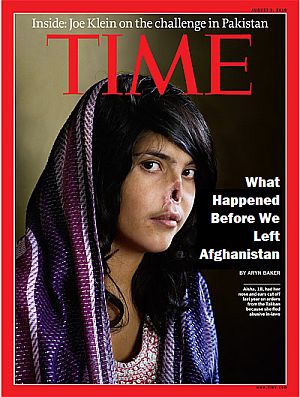
What happened before we left Afghanistan
“What Happens if We Leave Afghanistan” predicts the latest Time magazine cover, yet Time has not mastered a new art — taking photographs of the future. The image reflects what has happened under our watch and rather than representing the dreadful fate for Afghan women should the US and its allies prematurely relinquish control, it underlines the fact that we have never had anything more than a tenuous grip on Afghanistan.
The idea that we went there to make it a better country merely pandered to our world-saving vanity. A war billed as a necessity — the linchpin of American national security — was itself a face-saving exercise. It wasn’t about saving the faces of Afghan women, but saving the reputation of America’s military might after its weakness had been exposed by a small band of men armed with nothing more than box cutters.
The means through which the US will eventually extricate itself from this ill-conceived war will likewise be another face-saving exercise through which failure can be dressed up as success.
Meanwhile, as fewer Americans are acquiring college degrees, more are taking to the streets to protest against the construction of mosques — even while a recent study indicates mosques deter the spread of Islamic militancy.
9/11 might have caused a national wound, but the means through which we treated it turned out to be more harmful than the injury itself. Nine years later should mean nine years wiser. Instead, we find ourselves living in a nation that gets harder to parody, as reality itself becomes increasingly absurd.
Consider for instance the Pentagon’s ways of responding to Wikileaks — demanding leaked documents be “returned” (as though they had been spirited away to a secret location where a stash of Xerox sheets are now hidden) while telling DoD employees they mustn’t look at the documents (as though they’re now going to pretend they forgot how to use the internet).
As Noah Shachtman writes:
Any citizen, any foreign spy, any member of the Taliban, and any terrorist can go to the WikiLeaks website, and download detailed information about how the U.S. military waged war in Afghanistan from 2004 to 2009. Members of that same military, however, are now banned from looking at those internal military documents. “Doing so would introduce potentially classified information on unclassified networks,” according to one directive issued by the armed forces.
That cry you hear? It’s common sense, writhing in pain.
There was a time, just a few months ago, when the Pentagon appeared to be growing comfortable with the emerging digital media landscape. Troops were free to blog and tweet, as long as they used their heads and didn’t disclose secrets. Thumb drives and DVDs could be employed, as long as they didn’t carry viruses or classified information. But the WikiLeaks disclosures — tens of thousands of classified documents — seem to have reversed that trajectory.
And in a commentary on this country’s perversely misconceived national priorities, Glenn Greenwald writes:
As we enter our ninth year of the War in Afghanistan with an escalated force, and continue to occupy Iraq indefinitely, and feed an endlessly growing Surveillance State, reports are emerging of the Deficit Commission hard at work planning how to cut Social Security, Medicare, and now even to freeze military pay. But a new New York Times article today illustrates as vividly as anything else what a collapsing empire looks like, as it profiles just a few of the budget cuts which cities around the country are being forced to make. This is a sampling of what one finds:
Plenty of businesses and governments furloughed workers this year, but Hawaii went further — it furloughed its schoolchildren. Public schools across the state closed on 17 Fridays during the past school year to save money, giving students the shortest academic year in the nation.
Many transit systems have cut service to make ends meet, but Clayton County, Ga., a suburb of Atlanta, decided to cut all the way, and shut down its entire public bus system. Its last buses ran on March 31, stranding 8,400 daily riders.
Even public safety has not been immune to the budget ax. In Colorado Springs, the downturn will be remembered, quite literally, as a dark age: the city switched off a third of its 24,512 streetlights to save money on electricity, while trimming its police force and auctioning off its police helicopters.
There are some lovely photos accompanying the article, including one showing what a darkened street in Colorado looks like as a result of not being able to afford street lights. Read the article to revel in the details of this widespread misery. Meanwhile, the tiniest sliver of the wealthiest — the ones who caused these problems in the first place — continues to thrive.
And let’s be clear about what it means to thrive while others suffer. This isn’t simply callous indifference or unrestrained greed; it is parasitic behavior.
New York City Mayor Bloomberg’s remarks on the proposed mosque and community center in Lower Manhattan

On Tuesday August 3 2010, Mayor Michael Bloomberg joined NYC City Council Speaker Christine Quinn and religious leaders from across New York City at an event on Governor’s Island. He spoke about the importance of religious freedom and the great tradition of tolerance and diversity that has characterized New York City since its founding.
“We have come here to Governors Island to stand where the earliest settlers first set foot in New Amsterdam, and where the seeds of religious tolerance were first planted. We’ve come here to see the inspiring symbol of liberty that, more than 250 years later, would greet millions of immigrants in the harbor, and we come here to state as strongly as ever – this is the freest City in the world. That’s what makes New York special and different and strong.
“Our doors are open to everyone – everyone with a dream and a willingness to work hard and play by the rules. New York City was built by immigrants, and it is sustained by immigrants – by people from more than a hundred different countries speaking more than two hundred different languages and professing every faith. And whether your parents were born here, or you came yesterday, you are a New Yorker.
“We may not always agree with every one of our neighbors. That’s life and it’s part of living in such a diverse and dense city. But we also recognize that part of being a New Yorker is living with your neighbors in mutual respect and tolerance. It was exactly that spirit of openness and acceptance that was attacked on 9/11.
“On that day, 3,000 people were killed because some murderous fanatics didn’t want us to enjoy the freedom to profess our own faiths, to speak our own minds, to follow our own dreams and to live our own lives.
“Of all our precious freedoms, the most important may be the freedom to worship as we wish. And it is a freedom that, even here in a City that is rooted in Dutch tolerance, was hard-won over many years. In the mid-1650s, the small Jewish community living in Lower Manhattan petitioned Dutch Governor Peter Stuyvesant for the right to build a synagogue – and they were turned down.
“In 1657, when Stuyvesant also prohibited Quakers from holding meetings, a group of non-Quakers in Queens signed the Flushing Remonstrance, a petition in defense of the right of Quakers and others to freely practice their religion. It was perhaps the first formal, political petition for religious freedom in the American colonies – and the organizer was thrown in jail and then banished from New Amsterdam.
“In the 1700s, even as religious freedom took hold in America, Catholics in New York were effectively prohibited from practicing their religion – and priests could be arrested. Largely as a result, the first Catholic parish in New York City was not established until the 1780’s – St. Peter’s on Barclay Street, which still stands just one block north of the World Trade Center site and one block south of the proposed mosque and community center.
“This morning, the City’s Landmark Preservation Commission unanimously voted not to extend landmark status to the building on Park Place where the mosque and community center are planned. The decision was based solely on the fact that there was little architectural significance to the building. But with or without landmark designation, there is nothing in the law that would prevent the owners from opening a mosque within the existing building. The simple fact is this building is private property, and the owners have a right to use the building as a house of worship.
“The government has no right whatsoever to deny that right – and if it were tried, the courts would almost certainly strike it down as a violation of the U.S. Constitution. Whatever you may think of the proposed mosque and community center, lost in the heat of the debate has been a basic question – should government attempt to deny private citizens the right to build a house of worship on private property based on their particular religion? That may happen in other countries, but we should never allow it to happen here. This nation was founded on the principle that the government must never choose between religions, or favor one over another.
“The World Trade Center Site will forever hold a special place in our City, in our hearts. But we would be untrue to the best part of ourselves – and who we are as New Yorkers and Americans – if we said ‘no’ to a mosque in Lower Manhattan.
“Let us not forget that Muslims were among those murdered on 9/11 and that our Muslim neighbors grieved with us as New Yorkers and as Americans. We would betray our values – and play into our enemies’ hands – if we were to treat Muslims differently than anyone else. In fact, to cave to popular sentiment would be to hand a victory to the terrorists – and we should not stand for that.
“For that reason, I believe that this is an important test of the separation of church and state as we may see in our lifetime – as important a test – and it is critically important that we get it right.
“On September 11, 2001, thousands of first responders heroically rushed to the scene and saved tens of thousands of lives. More than 400 of those first responders did not make it out alive. In rushing into those burning buildings, not one of them asked ‘What God do you pray to?’ ‘What beliefs do you hold?’
“The attack was an act of war – and our first responders defended not only our City but also our country and our Constitution. We do not honor their lives by denying the very Constitutional rights they died protecting. We honor their lives by defending those rights – and the freedoms that the terrorists attacked.
“Of course, it is fair to ask the organizers of the mosque to show some special sensitivity to the situation – and in fact, their plan envisions reaching beyond their walls and building an interfaith community. By doing so, it is my hope that the mosque will help to bring our City even closer together and help repudiate the false and repugnant idea that the attacks of 9/11 were in any way consistent with Islam. Muslims are as much a part of our City and our country as the people of any faith and they are as welcome to worship in Lower Manhattan as any other group. In fact, they have been worshipping at the site for the better part of a year, as is their right.
“The local community board in Lower Manhattan voted overwhelming to support the proposal and if it moves forward, I expect the community center and mosque will add to the life and vitality of the neighborhood and the entire City.
“Political controversies come and go, but our values and our traditions endure – and there is no neighborhood in this City that is off limits to God’s love and mercy, as the religious leaders here with us today can attest.”
Shimon Peres — king of bombast

“You write history — I have to make history,” Shimon Peres says at the end of an interview with the Israeli historian Benny Morris.
At times in the interview the Israeli president almost sounds deranged.
The main reason for war was that people earned their livelihood from land. People wanted either to defend their land or conquer more land. From the moment people live from science, force can’t do [anything]. An army can’t overcome science. All these borders will be blurred. The main reason for classic wars has disappeared. What will remain are fanatical religious groups, irrational groups, dangerous to the whole world. They will be destroyed in the end, out of self-defense. There won’t be wars. There will be great rivalry. Football will be more important than war, and science more important than football. There will be a contest to develop nature’s riches. What importance is there today to land?
So I guess Israel, with its fuzzy borders and expanding settlements, is not as it appears to many of us on the outside, a state engaged in old-fashioned colonization, but rather it heralds a future in which land is no longer of any importance.
And what’s Peres’ transcendental perspective on the most contested piece of territory, Jerusalem?
Original Jerusalem, the Sacred Basin, is all told one square kilometer — the Old City, the Temple Mount, that’s the whole story. It’s small, but it’s not territory; it’s a flame, and it is difficult to divide fire, to fence in flames. What can be done? Let’s set aside [the idea of] national sovereignty and let’s look at religious sovereignty. Give each religion responsibility for its own holy sites.
So Israel’s ready to relinquish its claim of national sovereignty with an undivided Jerusalem as its capital and return to the UN’s original proposal for the holy city, internationalization?
All that will do is perpetuate the conflict, but with the involvement of more parties.
Leaving Jerusalem aflame, let’s turn to what for me was the most entertaining part of the interview — where Peres vents some good old Anglophobia (at least there’s one thing Israelis and Iranians see eye-to-eye on) and then reveals that he only watches TV broadcast from Mars.
How do you explain the rise in the delegitimization of Israel in the world in recent years? Do you agree that this is happening?
Let me give you a contrary picture: Israel is the most popular country in the world. [Peres’s media aide giggles. “Benny, you won’t leave here depressed,” she says.] For 2,000 years there was friction between the Vatican and the Jews. There are, what is it, 1.3 billion Christians? Now we have excellent relations with the Vatican. This is no small thing. And we have good relations with India, also hit by Muslim terrorists. And that’s together 3 billion. And [we now have] excellent relations with China.
Right. But why the delegitimization, especially in the West?
Firstly, there is a problem in the Scandinavian countries. They always want to appear like yefei nefesh [the Hebraism roughly translates as “bleeding hearts,” with an undertone of hypocrisy]. And I don’t expect them to understand us. Sweden doesn’t understand why we are at war. For 150 years they have not had a war. There were even Hitler and Stalin, but they kept out of the picture. As did Switzerland. So, they don’t understand why we are “for war,” as if we really like wars. It’s like Marie Antoinette didn’t understand why the people didn’t bake cakes. The same logic.
But it goes a bit beyond [Sweden and Switzerland]?
Our next big problem is England. There are several million Muslim voters. And for many members of parliament, that’s the difference between getting elected and not getting elected. And in England there has always been something deeply pro-Arab, of course, not among all Englishmen, and anti-Israeli, in the establishment. They abstained in the [pro-Zionist] 1947 U.N. Partition Resolution, despite [issuing the pro-Zionist] Balfour Declaration [in 1917]. They maintained an arms embargo against us [in the 1950s]; they had a defense treaty with Jordan; they always worked against us.
But England changed after the 1940s and 1950s. They supported us in 1967, there was Harold Brown [sic — presumably Harold Wilson or Harold Macmillan, both of whom secretly and illegally assisted Israel’s nuclear program] and Mrs. Thatcher [who were pro-Israeli].
There is also support for Israel today [on the British right].
But in Labor there was always a deep pro-Israeli current.
But [the late 1940s prime minister and Labor leader Clement] Attlee was [anti-Israel].
Anyway, this [pro-Israeli current] vanished because they think the Palestinians are the underdog. In their eyes the Arabs are the underdog. Even though this is irrational. Take the Gaza Strip. We unilaterally evacuated the Gaza Strip [in 2005]. We evacuated 8,000 settlers and it was very difficult, after mobilizing 47,000 policemen [and soldiers]. It cost us $2.5 billion in compensation. We left the Gaza Strip completely. Why did they fire rockets at us, for years they fired rockets at us. Why?
Maybe because they don’t like us?
You fire rockets at everyone you don’t like? For eight years they fired and we refrained from retaliating. When they fired at us, the British didn’t say a word.
Maybe it is anti-Semitism?
Yes, there is also anti-Semitism. There is in England a saying that an anti-Semite is someone who hates the Jews more than is necessary. But with Germany relations are pretty good, as with Italy and France.
But there is erosion of public pro-Israel sentiment — at the universities, in the press. I’m not talking about the governments.
I’ll tell you why. On television there is an asymmetry that can’t be corrected. What the terrorists do is never broadcast.
So there you have it, from the man who believes Israel is the most popular country in the world and claims that acts of terrorism directed at Israel never appear on TV. What can one say?
As an Englishman, I naturally take an interest in expressions of suspicion or hostility directed towards the British, but there is one point Peres makes that cannot pass without comment: his reference to Muslim voters in Britain. This is where Peres’ racism seeps out since he cannot bring himself to refer to this political constituency as British Muslims. They are for Peres, Muslims with the power to vote — not Britons who practice Islam.
As for the general tone of the interview as it deals with the British current, I’m reminded of similar, if somewhat more forcefully expressed sentiments coming from an American writer who sees Peter Beinart as a victim of the malevolent British influence.
After Beinart wrote his widely acclaimed piece in the New York Review of Books, “The Failure of the American Jewish Establishment,” Jim Sleeper was sure he knew how Beinart’s mind had been corrupted:
Political decay, impotence and bitterness slither out of people in peculiar ways, and, for too many Brits, who have so much more to regret and apologize for and so much bottomless hypocrisy to plumb than Israel ever will, the anguish of decline slithers out against the Jews in eerily disembodied, oddly passionless ways:
“How odd of God to Choose the Jews,” runs a characteristically disdainful verse by the 20th Century British journalist William Norman Ewer. (To which my own riposte is, “Moses, Jesus, Spinoza; Marx, Einstein, and Freud; no wonder the gentiles are annoyed.”)
Well, there are lots of annoying people and things in the world, but British Jews who swallowed Ewer’s hook on some playground or classroom in their early years seem condemned to writhe with it, much as American blacks who’ve internalized a standard of idealized whiteness turn it against blacks who are darker-skinned than themselves, and much as German Jews who’d internalized an idealized German kultur loathed the embarrassing Ostjuden from… Russia and Eastern Europe. Here — and let us not mince words — we are talking about self-hatred, a cold, fine-spun, exacting usurper of sound judgment.
Beinart’s ancestors came from Lithuania, but before World War I they migrated, with a sizable contingent of other Litvaks, to South Africa. In the interwar years of Wilsonian nationalist awakening In Lithuania and all over Europe, many more Lithuanian Jews saw what was rising around them in their home of 500 years and opted for Zionism, transforming their ancestral, liturgical Hebrew into an old/new language and migrating to Palestine in the 1920s and 30s. Still others opted for the more universal promise of Communism in Europe and Russia, and others for capitalist opportunity in America. Those who stayed put were slaughtered — more than 135,000 of them in the woods and fields around their towns and were buried in mass trenches by the Nazi Einsatzgruppen and their Lithuanian recruits in the summer of 1941.
Some Lithuanian-Jewish Communists had fled not to the USSR but to South Africa as well as to America, among them Joseph Slovo, a founder of the African National Congress. A few of the next generation of South African Jews were ANC sympathizers, like the young Ian Shapiro, now a political scientist at Yale. And some of these leftists later became neo-conservatives or bureaucratic apparatchiks in the manner I’ve mentioned, grafting an old mental morphology onto Established Power rather than onto a revolutionary pursuit of Power.
Beinart’s family and most other South African Jews weren’t leftists. They came seeking freedom from persecution and bourgeois. But in South Africa they internalized the idealized British standards I’ve mentioned, and few were immune to internalizing the “odd” but unrelenting British discomfort and pretended bemusement about Jews.
All this prompts many a British Jew’s own efforts at expiation and projection. Even young Beinart, although he grew up in Cambridge, Massachusetts and attended the Buckingham Brown and Nichols School and then Yale, where he was influenced by the Jewish nationalist political theorist Steven Smith, eventually spent a year at Oxford reckoning with whatever aspirations and insecurities the Brits of South Africa had implanted in his parents and, through them, in him.
This is a recipe for the unsavory mix of aspirations and fears we encountered in his writings and his trajectory as I sketch them briefly in bookforum. Although I don’t share their positions, Chait and Goldberg have a point: Beinart, like the estimable Tony Judt, himself a British Jew, is right in principle about Israel’s worst apologists, but he overstates his case for reasons having more to do with swift, dark currents in history and himself than with the complicated realities in Israel and Palestine.
Maybe I need to place a prominent warning on this site, alerting readers about the dangerous influence of the evil country where I grew up.
Looking back at torture
President Obama has so far refused to look back at the previous administration’s use of torture, but David Cole says: “on this issue, we cannot move forward without looking back. Unless we acknowledge that what the United States did was not just a bad idea, but illegal, we risk treating torture as simply another policy option.”
Cole presents some of the reasons the administration is unwilling to grasp the issue and argues that Britain’s new prime minister, David Cameron, has taken a lead worth following.
The Justice Department is investigating allegations of torture at the CIA’s secret prisons — but is considering only the actions of interrogators who are reported to have exceeded the brutality authorized by the Justice Department and Bush’s Cabinet. Why are the underlings being investigated, but not those who set the illegal scheme in motion?
The answer is politics. A torture investigation that could implicate the former president and vice president would be too divisive, some say. It would consume the nation’s attention and divert us from addressing other urgent problems, such as health care, the economy, global warming and immigration.
But there is an even larger political obstacle: fear. The Democratic administration is afraid of appearing more concerned about the rights of terrorism suspects than about the security of the nation. Cheney and his supporters have already accused the administration of not being tough enough on terrorists; Democrats fear that a torture inquiry might play into critics’ hands.
There is another element at work here which is the moral relativism that underpins American views on violence.
Why would a society that widely supports the death penalty regard torture as unacceptable? From the American perspective, it’s OK to poison someone, electrocute them, hang them, shoot them (though not decapitate them), with the sole condition that a reasonably sound legal process is followed.
Torture might be illegal, but it’s not clear that it conflicts with the values that Americans live by, especially those applied to people who, in the popular imagination, deserve to suffer.