Category Archives: Issues

No country would accept Netanyahu’s conditions for peace

Akiva Eldar writes:

The decision to add the Tomb of the Patriarchs and Rachel’s Tomb to the list of historical heritage sites up for renovation was not made with the intention of inflaming tempers and sabotaging efforts to revive final-status talks with the Palestinians. It was merely a routine move by a rightist government, further proof that Prime Minister Benjamin Netanyahu’s “two states” speech at Bar-Ilan University was a milestone on the road to nowhere. The only difference between “the rock of our existence” that launched the Western Wall tunnel violence in 1996 and the 2010 model is that this time Netanyahu is wearing a mask, trying to pass himself off as peace activist Uri Avnery, with the generous help of Defense Minister Ehud Barak.

The prime minister, as we all know, simply can’t wait for renewed final-status talks to get underway, but Palestinian Authority President Mahmoud Abbas refuses to back down and is setting “conditions that predetermine the outcome of the negotiations,” as Netanyahu told Haaretz a week ago. Indeed, the Palestinians have made their participation in indirect talks conditional on, in part, a construction freeze during the talks in West Bank settlements and East Jerusalem. They have the audacity to claim that it is Netanyahu’s demand to expand settlements during negotiations along with the assertion of Jewish ownership over sensitive sites which are the conditions that predetermine the outcome of the talks.

The Palestinian demand for a total freeze on settlement construction, including that required for natural population growth, is not, in Netanyahu’s words “a condition that no country would accept.” Israel accepted that condition in the road map seven years ago. In an article in the journal of the Israel Council on Foreign Relations in December 2009, Prof. Ruth Lapidoth, recipient of the 2006 Israel Prize for Legal Studies, and Dr. Ofra Friesel wrote that the Netanyahu government is obligated by the road map, which was ratified by the Sharon government. A former legal adviser to the Foreign Ministry, Lapidoth stresses that the 14 remarks (not reservations, as they are usually termed) that Israel appended have no legal validity. And since the U.S. government promised no more than to relate “fully and seriously” to these remarks, they don’t have any diplomatic validity, either.


Facebooktwittermail

In Marja, a communication gap

The New York Times reports:

In the battle-scarred district of Marja, where the open fighting stopped just a few days ago, feelings about the war and the previous period of Taliban control are deeply personal, and the message from local people to the Afghan government on Monday was simple: words are not enough; if you expect us to be loyal, we need to see deeds.

As Second Vice President Karim Khalili stood before a gathering of about 200 tribal elders here under a bright sun, he saw row upon row of stony-faced, bearded men; their traditional shalwar kameez trousers and tunics soiled from having had little chance to wash them during more than a week of fighting.

For most of the hour of speeches from Mr. Khalili and local government leaders, the men were silent, offering only brief applause. Mostly their expressions were guarded, even closed, and there was little sign of welcome or warmth.

The vice president plunged ahead. “The priority for us is to bring peace for all the people,” he said.

“Please talk to your friends, tell them to come to the government,” he implored. “The government of Afghanistan is beside you. We will make a good administration here for you in Marja.”

As an ethnic Hazara, whose people had been persecuted by the Taliban, who are mostly Pashtuns and had been sheltered here, Mr. Khalili’s journey here was longer than could be measured in miles. The speech could not have been easy for him to give.

It may not have been easy to receive, either; he spoke in Dari without an interpreter, a language that few in his Pashtun audience fully understand.

Facebooktwittermail

Before Iraq election, Arab and Kurd tensions soar in the north

Christian Science Monitor reports:

In a sign of heightened Arab-Kurd tension along a disputed boundary just days from Iraq elections, the president of Iraqi Kurdistan says the governor of the adjoining Arab-majority province will be arrested if he enters Kurdish-controlled areas.

In an interview with The Christian Science Monitor at his mountaintop headquarters in northern Iraq, Kurdish President Massoud Barzani described Ninevah governor Atheel al-Nujaifi as a “criminal” and said a warrant would be issued for his arrest in connection with an incident this month involving US forces.

He also said Nujaifi had failed to secure the provincial capital of Mosul. Mr. Barzani offered to bring up to 2,000 Christian university students from the troubled city to Kurdistan to continue their studies. At least eight Christians have been killed in the last two weeks in Mosul in the latest wave of attacks on minorities.

Facebooktwittermail

Genuine American exceptionalism on due process

Glenn Greenwald on America’s disregard for due process:

If there’s any country which can legitimately claim that Islamic radicalism poses an existential threat to its system of government, it’s Pakistan. Yet what happens when they want to imprison foreign Terrorism suspects? They indict them and charge them with crimes, put them in their real court system, guarantee them access to lawyers, and can punish them only upon a finding of guilt. Pakistan is hardly the Beacon of Western Justice — its intelligence service has a long, clear and brutal record of torturing detainees (and these particular suspects claim they were jointly tortured by Pakistani agents and American FBI agents, which both governments deny). But just as is true for virtually every Western nation other than the U.S., Pakistan charges and tries Terrorism suspects in its real court system.

The U.S. — first under the Bush administration and now, increasingly, under Obama — is more and more alone in its cowardly insistence that special, new tribunals must be invented, or denied entirely, for those whom it wishes to imprison as Terrorists (along those same lines, my favorite story of the last year continues to be that the U.S. compiled a “hit list” of Afghan citizens it suspected of drug smuggling and thus wanted to assassinate [just as we do for our own citizens suspected of Terrorism], only for Afghan officials — whom we’re there to generously teach about Democracy — to object on the grounds that the policy would violate their conceptions of due process and the rule of law). Most remarkably, none of this will even slightly deter our self-loving political and media elites from continuing to demand that the Obama administration act as self-anointed International Arbiter of Justice and lecture the rest of the world about their violations of human rights.

Facebooktwittermail

Obama wants to expand America’s military reach

As President Obama prepares to present his first Nuclear Posture Review, the news is that he’s about to announce plans to eliminate thousands of nuclear weapons from the United States arsenal. So good so far — but it gets worse from here on in.

If a smaller arsenal might look like a step towards the elimination of nuclear weapons, the fact that this president wants to retain a first strike option is not a step in the right direction. Worst of all are the designs for a non-nuclear future in the shape of what is called “Prompt Global Strike” — the ultimate form of remote warfare through which the US could strike any target on the planet in less than an hour.

This is how the New York Times describes the new class of non-nuclear weapons:

The idea, officials say, would be to give the president a non-nuclear option for, say, a large strike on the leadership of Al Qaeda in the mountains of Pakistan, or a pre-emptive attack on an impending missile launch from North Korea. But under Mr. Obama’s strategy, the missiles would be based at new sites around the United States that might even be open to inspection, so that Russia and China would know that a missile launched from those sites was not nuclear — to avoid having them place their own nuclear forces on high alert.

Better than firing nuclear weapons, isn’t it? Of course. But the one virtue of strategic nuclear weapons is that their use has seemed unthinkable to a point where we’ve gone 65 years without their use — apart from in testing.

To call Prompt Global Strike a “non-nuclear option” is to imply that it is some kind of relatively benign alternative to nuclear force. On the contrary, what we’re looking at here are two classes of weapons of mass destruction: one whose primary function is that they be held in reserve as a diabolical threat; the other system is very much designed for use. Indeed, one can imagine that at some point in his or her term of office, every American president will make a point of showcasing American power with a prompt global strike.

Noah Shachtman describes how this would work:

A tip sets the plan in motion — a whispered warning of a North Korean nuclear launch, or of a shipment of biotoxins bound for a Hezbollah stronghold in Lebanon. Word races through the American intelligence network until it reaches U.S. Strategic Command headquarters, the Pentagon and, eventually, the White House. In the Pacific, a nuclear-powered Ohio class submarine surfaces, ready for the president’s command to launch.
When the order comes, the sub shoots a 65-ton Trident II ballistic missile into the sky. Within 2 minutes, the missile is traveling at more than 20,000 ft. per second. Up and over the oceans and out of the atmosphere it soars for thousands of miles. At the top of its parabola, hanging in space, the Trident’s four warheads separate and begin their screaming descent down toward the planet. Traveling as fast as 13,000 mph, the warheads are filled with scored tungsten rods with twice the strength of steel. Just above the target, the warheads detonate, showering the area with thousands of rods-each one up to 12 times as destructive as a .50-caliber bullet. Anything within 3000 sq. ft. of this whirling, metallic storm is obliterated.

If Pentagon strategists get their way, there will be no place on the planet to hide from such an assault.

What Prompt Global Strike is really about is turning inter-continental ballistic missiles (minus nuclear warheads) into usable weapons.

Facebooktwittermail

The war on terror is anti-American

Philip Giraldi writes:

The expression war on terror is meaningless. Terror is a tactic, it is not a foreign government or political movement. To use the expression a “terrorist group” is equally misleading as the groups which come in all shapes sizes and colors are essentially political and have frequently clearly defined political objectives even if they use terrorism to advance their agenda. In most cases, the groups we call terrorists seek to take over the government of the countries where they operate, replacing groups not dissimilar to themselves who are currently in charge.

Why is what we call something important, whether we use the expression “terrorist” or not? It is important because how you name and define something shapes how you think about it and how you respond to it. It frames the narrative. Instead of bumper sticker definitions, we should instead be asking whether international groups that use terror genuinely threaten either the United States or any vital national interest. If we were to undertake such an analysis, we would quickly learn that frequently the terrorist label is misleading.

The exploitation of fear of terrorism by those in government has led to wars that did not have to be fought. Fear has been the key to the door for expansion of government and government powers and the people in charge in Washington have seized the opportunity. It has also eroded the liberties that have defined us as a nation.

Facebooktwittermail

Greek mess, global mess

Immanuel Wallerstein writes:

Everyone is discussing what Fortune magazine is calling the “Greek maelstrom” and everyone is pointing the finger at someone else.

The Greek government is accused of cheating and allowing Greeks to live beyond their means. The European Union is accused of having created an impossible structure for the euro. Goldman Sachs is accused of having enabled the Greek government to falsify its accounts when it sought to join the euro monetary system. Chancellor Angela Merkel of Germany calls Goldman Sachs’ actions in 2002 “scandalous” and Christine Lagarde, France’s finance minister, calls for greater regulation of credit-default swaps.

Niall Ferguson says “a Greek crisis is coming to America” and calls this “a fiscal crisis of the Western world.” Paul Krugman says calls it a “Euromess” because Europe should not have adopted a single currency before it was ready for political union. But now the euro can’t be allowed to break up since it would trigger a worldwide financial collapse.

Facebooktwittermail

39 army raids, 28 arrests: Just another day in the West Bank

Amira Hass reports:

“The year 2009 was the quietest for Israelis from the security point of view and the most violent for the Palestinians from the point of view of attacks by settlers in the West Bank.” Just as he was saying this – as an example of one of the absurdities that characterize the political situation – Palestinian Agriculture Minister Ismail Daiq received a phone call from the Jenin district to inform him that five artesian wells in the village of Daan had been destroyed that morning. One person was shot and wounded in the abdomen when he tried to lift the pump to save it from damage. This was not an attack by settlers but a raid by the army.

And that wasn’t the only routine event on Wednesday, February 24. The negotiations affairs department of the Palestine Liberation Organization collects information daily from all the districts of the occupied territories (Gaza and the West Bank, as well as Jerusalem) and publishes it in a daily situation report by the Palestinian Monitoring Group. For the sake of convenience, the report categorizes the events and then provides details for each district.

That Wednesday, a total of 212 occupation-related incidents were recorded. Examples include: four physical assaults (which took place in the West Bank, and included civilians being beaten in Nablus and Jerusalem); one injury (a civilian hurt in a clash in Daan); eight military shooting attacks (two of which took place in Gaza, two were in the midst of raids, and one came from a military outpost; 39 army raids (one in Gaza); 28 arrests; and 12 detentions at checkpoints and in residential areas. The items on the checklist include home demolition (none that day), the leveling of agricultural land (one, in Gaza), and construction of the separation wall (at 22 locations).

Facebooktwittermail

At what point will the West dump Israel?

For those of us who view the Israeli-Palestinian conflict as being an issue of injustice, there’s plenty of reason to believe no resolution is in sight simply because justice is one of the weakest among the principles governing world affairs. To this extent, Israeli leaders can feel confident in their sense of impunity.

But there is another line Israel crosses at its peril: where its actions conflict with the commercial interests of its allies. Israel can be a moral liability but it cannot be a financial liability.

US taxpayers have every reason to feel that Israel, as the largest single recipient of US foreign aid, is already a massive financial liability. Even so, since most of those tax dollars get plowed straight back into the US defense industry, Washington is unlikely to become more attentive to the concerns of ordinary American citizens than it is to the interests of its corporate sponsors.

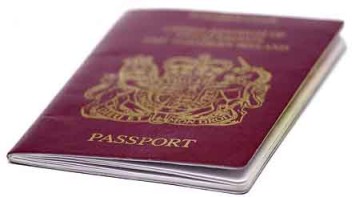
Nevertheless, there is now reason to think that with the murder of Mahmoud al Mabhouh in Dubai, Israel crossed a line that strains the limits of Western tolerance. Western governments would have paid scant attention to this event were it not for one egregious error by Mossad: its flagrant disregard for the integrity of foreign passports.

For many international travelers from Western countries, a passport might seem like nothing more than an obligatory document of no extraordinary value, yet in many ways these carefully bound and embossed permits are the lubricants of globalization. Swift passage through immigration control is one of the things that keeps the wheels of business turning smoothly.

But anyone traveling to the Middle East on an EU or Australian passport will now face a new level of scrutiny from immigration officers intent on blocking the passage of Israeli assassins.

Dubai’s police chief Lt Gen Dahi Khalfan Tamim announced on Monday that any travelers suspected of being Israeli, even if they hold passports from another country, will now be barred from entry into the UAE.

Asharq Al-Awsat reports that any foreign traveler visiting Lebanon who has a Jewish name will now be placed under surveillance.

Major General Wafiq Jizzini, director general of the Lebanese Public Security, said: “When someone comes to Lebanon on a foreign passport and the name of his family indicates that he is of Jewish origin, the border center sends the information to the central information office at the General Directorate of the Public Security. Afterward, the directorate observes this person who would have already registered his address in Lebanon. Both the visiting person and the one who receives him at the airport are observed.”

Israeli leaders such as Israel’s minister of industry, trade and labor, Binyamin Ben-Eliezer, who still regard the Dubai murder as a victory for Israel, have further reason to question that conclusion as fallout from the operation has now reached the United Nations General Assembly.

On Friday, the only countries willing to side with Israel in opposing a resolution that makes a renewed call for the investigation of war crimes committed during Israel’s war on Gaza, were the United States, Canada, Micronesia, Nauru, Panama, and Macedonia.

Australian government sources informed the Sydney Morning Herald that there was a direct connection between the UN vote and the Dubai affair:

Britain, France and Germany have all recently expressed anger at Israel after their passports were caught up in the Dubai plot.

One Department of Foreign Affairs source told the Herald there was no doubt the decision to abstain was intended as a sign to Israel not to take Australian support for granted.

“A number of things made it easier for us to switch our vote,” the source said.

“Firstly, the Americans helped the Palestinians to soften the wording of this resolution compared to the last one. Secondly, a number of other countries had indicated that they were toughening their own positions on Goldstone. But there is no question that the debacle surrounding our passports being used in Dubai helped to make up the government’s mind to abstain. The final decision was taken late on Friday, Australian time, just a few hours before the vote.

“Our pattern in the past has been to vote with the US when it comes to Israel, to show as much support for Israel as possible.

“We were also aware that the UK’s decision to vote in favour of the resolution was influenced by the fact that so many of their citizens had been caught up in the Dubai assassination.”

Israelis would do well to remember that even among their most effusive supporters, an allegiance to business invariably trumps all others.

Facebooktwittermail

Is Israel really prepared to go it alone?

Reuters reports:

Israel’s perspective on Iran’s nuclear program differs from that of the United States, and the two may part ways on what action to take, Israeli Defense Minister Ehud Barak said on Friday.

Washington’s clout over its Middle East ally is under scrutiny after Israel’s veiled threats to attack Iran preemptively if international diplomacy fails to rein in Tehran’s uranium enrichment, a process with bomb-making potential.

The United States this week said it did not want to hurt the Iranian people with “crippling” sanctions against Iran’s energy sector, measures Israeli Prime Minister Benjamin Netanyahu has described as the only viable diplomatic solution.

“There is of course a certain difference in perspective and a difference in judgment and a difference in the internal clock, a difference in capabilities,” Barak told the Washington Institute for Near East Policy think-tank, when asked about Israeli-U.S. discussions about Iran.

“I don’t think that there is a need to coordinate in this regard. There should be understanding on the exchange of views, but we do not need to coordinate everything,” said Barak, who was in Washington for strategic talks.

Yet again, we are supposed to believe that Israel is prepared to go it alone and take on Iran.

Israel can destroy a nuclear reactor in Iraq; it can destroy one under construction in Syria; it wipe out a weapons convoy in Sudan; it can kill a Hezbollah commander with a bomb in Damascus; it can smother a Hamas commander with a pillow in Dubai; and it can flatten Southern Lebanon and Gaza.

Therefore, Israel’s ready to go to war with Iran… or, it loves to show off its power when it perceives the risk of doing so is minimal. If that was the case with Iran, we wouldn’t be weighing the chances of an Israeli attack — we’d be looking at the results of such an action.

Facebooktwittermail

The attrition of bravery

In Shakespeare’s Henry V, as the Battle of Agincourt is about to commence, the king addresses his men — “We few, we happy few, we band of brothers” — heavily outnumbered by the French and facing the risk of imminent slaughter.

Henry — a king who fights with his men and doesn’t simply issue commands — declares:
… he which hath no stomach to this fight,
Let him depart; his passport shall be made,
And crowns for convoy put into his purse;
We would not die in that man’s company
That fears his fellowship to die with us.

To the extent that there is a noble dimension to warfare it is this: that those willing to kill are also willing to die. Those taking the lives of others do so knowing that just as easily they could lose their own.

The technological advance of war has broken this equation and broken it so thoroughly that not only do a new class of killers face no risk of being killed; they may not even lose any sleep.

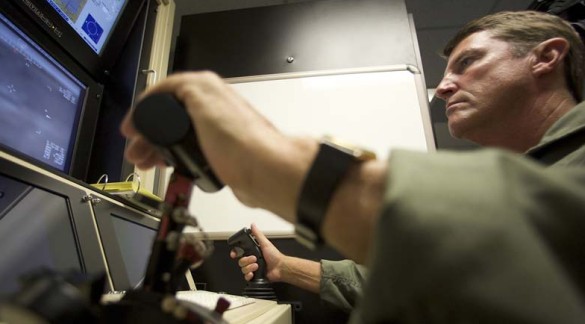
A drone pilot can fire on an insurgent dug into the Afghan hills and be home in time for a backyard barbecue. In just an hour or two, the pilot can go from a heated argument with a spouse to a tense radio conversation with an amped-up soldier pinned down by weapons fire.

“On the drive out here, you get yourself ready to enter the compartment of your life that is flying combat,” said retired Col. Chris Chambliss, who until last summer commanded drone operations at Creech Air Force Base, the command center for seven Air Force bases in the continental U.S. where crews fly drones over Iraq and Afghanistan. “And on the drive home, you get ready for that part of your life that’s going to be the soccer game.”

Drone crews don’t put their lives at risk. Instead, they juggle vast streams of video and data. With briefings both before and after their missions, their workdays typically stretch to 10 or 11 hours. Many of the pilots are experienced military fliers, but the camera operators tend to be much younger — often only 19 or 20, and new to the stresses of combat.

Mirroring the remote warfare of the drone operator is an unspoken compact between civilians and soldiers: The threshold at which this nation offers its tacit consent to war now corresponds not with the degree to which we embrace its gravity but the degree to which it can be ignored.

Ours have become wars of indifference whose advance is commensurate with the attrition of bravery.

Facebooktwittermail

The rise of militainment

At Foreign Policy, P W Singer writes:

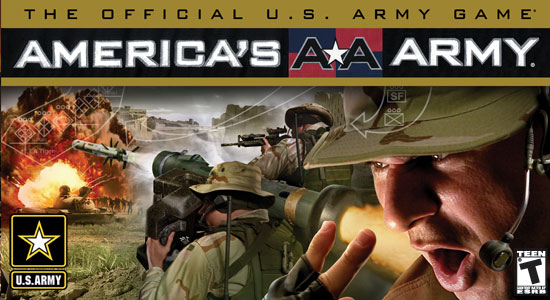
The country of Ghanzia is embroiled in a civil war. As a soldier in America’s Army, your job is to do everything from protect U.S. military convoys against AK-47-wielding attackers to sneak up on a mountain observatory where arms dealers are hiding out. It is a tough and dangerous tour of duty that requires dedication, focus, and a bit of luck. Fortunately, if you get hit by a bullet and bleed to death, you can reboot your computer and sign on under a new name.

America’s Army is a video game — a “tactical multiplayer first-person shooter” in gaming lingo — that was originally developed by the U.S. military to aid in its recruiting and training, but is now available for anyone to play. Among the most downloaded Internet games of all time, it is perhaps the best known of a vast array of video game-based military training programs and combat simulations whose scope and importance are rapidly changing not just the video-game marketplace, but also the way the U.S. military finds and trains its future warriors and even how the American public interfaces with the wars carried out in its name. For all the attention to the strategic debates of the post-9/11 era, a different sort of transformation has taken place over the last decade — largely escaping public scrutiny, at modest cost relative to the enormous sums spent elsewhere in the Pentagon budget, and with little planning but enormous consequences.

Facebooktwittermail

Marjah: Success for the military, hell for the residents

At GlobalPost, Jean MacKenzie and Mohammad Ilyas Dayee write:

The dusty squares of Marjah are empty; there is no life, the soul of the place seems to have disappeared. Those residents who are left cower in their homes, afraid of bullets or mines if they venture out, even for food.

“It is a small picture of Doomsday,” said Alishah Mazlumyar, the head of Helmand’s Department of Information and Culture, and a member of the Marjah shura, or council. “Dozens of civilians have been killed. Their families cannot bury the bodies, and for days they have been lying in their houses, beginning to decompose. There is a smell of death here.”

Twelve days into Operation Moshtarak — pitting 15,000 U.S., British and Afghan troops against a few hundred Taliban — the message from the military and diplomatic communities is resolutely upbeat.

Western diplomats term the operation a success, and the media office of the International Security Assistance Force (ISAF) points to a bright future.

“Signs of steady progress in development and governance are being seen in central Helmand province. Bridges, roads and culverts are being repaired, bazaars are re-opening and attracting customers, and a variety of initiatives are being planned or implemented,” read the IJC press release of Feb. 22.

But those in Marjah are telling a very different story.

Reporting for Christian Science Monitor, Anand Gopal says:

Pakistan has arrested nearly half of the Afghanistan Taliban’s leadership in recent days, Pakistani officials told the Monitor Wednesday, dealing what could be a crucial blow to the insurgent movement.

In total, seven of the insurgent group’s 15-member leadership council, thought to be based in Quetta, Pakistan, including the head of military operations, have been apprehended in the past week, according to Pakistani intelligence officials.

Western and Pakistani media had previously reported the arrest of three of the 15, but this is the first confirmation of the wider scale of the Pakistan crackdown on the Taliban leadership, something the US has sought.

“This really hurts the Taliban in the short run,” says Wahid Muzjda, a former Taliban official turned political analyst, based in Kabul. Whether it will have an effect in the long run will depend on what kind of new leaders take the reins, he says.

The New York Times reports:

Inside a secret detention center in an industrial pocket of the Pakistani capital called I/9, teams of Pakistani and American spies have kept a watchful eye on a senior Taliban leader captured last month. With the other eye, they watch each other.

The C.I.A. and its Pakistani counterpart, the Directorate of Inter-Services Intelligence, have a long and often tormented relationship. And even now, they are moving warily toward conflicting goals, with each maneuvering to protect its influence after the shooting stops in Afghanistan.

Yet interviews in recent days show how they are working together on tactical operations, and how far the C.I.A. has extended its extraordinary secret war beyond the mountainous tribal belt and deep into Pakistan’s sprawling cities.

Beyond the capture of Mullah Abdul Ghani Baradar, C.I.A. operatives working with the ISI have carried out dozens of raids throughout Pakistan over the past year, working from bases in the cities of Quetta, Peshawar and elsewhere, according to Pakistani security officials.

The Washington Post says:

A blizzard of bank notes is flying out of Afghanistan — often in full view of customs officers at the Kabul airport — as part of a cash exodus that is confounding U.S. officials and raising concerns about the money’s origin.

The cash, estimated to total well over $1 billion a year, flows mostly to the Persian Gulf emirate of Dubai, where many wealthy Afghans now park their families and funds, according to U.S. and Afghan officials. So long as departing cash is declared at the airport here, its transfer is legal.

But at a time when the United States and its allies are spending billions of dollars to prop up the fragile government of President Hamid Karzai, the volume of the outflow has stirred concerns that funds have been diverted from aid. The U.S. Drug Enforcement Administration, for its part, is trying to figure out whether some of the money comes from Afghanistan’s thriving opium trade. And officials in neighboring Pakistan think that at least some of the cash leaving Kabul has been smuggled overland from Pakistan.

Finally, in Mother Jones, Daniel Schulman reports:

Blackwater improperly obtained hundreds of weapons intended for use by Afghanistan’s already underequipped police force—and then falsely claimed to a Senate committee that the firearms had been returned when many remained unaccounted for.

According to a months-long investigation by the Senate Armed Services Committee that unearthed a range of misconduct by the company’s personnel, contractors working for a Blackwater subsidiary named Paravant operated recklessly and routinely violated military regulations. The inquiry also identified a series of major vetting lapses by the company, which employed at least one contractor it had previously fired for improper behavior in Iraq and others who abused alcohol and drugs, including steroids. The investigation paints a grim picture of the state of contracting oversight in Afghanistan, where, according to committee staffers, military officials missed multiple red flags calling Paravant’s conduct into question—and were even confused about who was ultimately responsible for overseeing the company’s work in the first place.

Facebooktwittermail

The attack on climate-change science

At TomDispatch, Bill McKibben writes:

Twenty-one years ago, in 1989, I wrote what many have called the first book for a general audience on global warming. One of the more interesting reviews came from the Wall Street Journal. It was a mixed and judicious appraisal. “The subject,” the reviewer said, “is important, the notion is arresting, and Mr. McKibben argues convincingly.” And that was not an outlier: around the same time, the first president Bush announced that he planned to “fight the greenhouse effect with the White House effect.”

I doubt that’s what the Journal will say about my next book when it comes out in a few weeks, and I know that no GOP presidential contender would now dream of acknowledging that human beings are warming the planet. Sarah Palin is currently calling climate science “snake oil” and last week, the Utah legislature, in a move straight out of the King Canute playbook, passed a resolution condemning “a well organized and ongoing effort to manipulate global temperature data in order to produce a global warming outcome” on a nearly party-line vote.

And here’s what’s odd. In 1989, I could fit just about every scientific study on climate change on top of my desk. The science was still thin. If my reporting made me think it was nonetheless convincing, many scientists were not yet prepared to agree.

Now, you could fill the Superdome with climate-change research data. (You might not want to, though, since Hurricane Katrina demonstrated just how easy it was to rip holes in its roof.) Every major scientific body in the world has produced reports confirming the peril. All 15 of the warmest years on record have come in the two decades that have passed since 1989. In the meantime, the Earth’s major natural systems have all shown undeniable signs of rapid flux: melting Arctic and glacial ice, rapidly acidifying seawater, and so on.

Somehow, though, the onslaught against the science of climate change has never been stronger, and its effects, at least in the U.S., never more obvious: fewer Americans believe humans are warming the planet. At least partly as a result, Congress feels little need to consider global-warming legislation, no less pass it; and as a result of that failure, progress towards any kind of international agreement on climate change has essentially ground to a halt.

Facebooktwittermail

Do you have to be Jewish to report on Israel for the New York Times?

Jonathan Cook, writing at Mondoweiss, provides some fascinating insights into the reasons for the entrenched bias in Western reporting on Israel-Palestine conflict. He explains why the case of Eitan (“Ethan”) Bronner — the New York Times Jerusalem bureau chief whose son’s enrollment in the Israeli army recently provoked a brief debate inside the newspaper about conflicts of interest — is far from unusual. Cook spoke to a Jerusalem-based bureau chief who anonymously shared these observations:

He calls Bronner’s situation “the rule, not the exception”, adding: “I can think of a dozen foreign bureau chiefs, responsible for covering both Israel and the Palestinians, who have served in the Israeli army, and another dozen who like Bronner have kids in the Israeli army.”

He added that it is very common to hear Western reporters boasting to one another about their “Zionist” credentials, their service in the Israeli army or the loyal service of their children. “Comments like that are very common at Foreign Press Association gatherings [in Israel] among the senior, agenda-setting, elite journalists.”

My informant is highly critical of what is going on among the Jerusalem press corps, even though he admits the same charges could be levelled against him. “I’m Jewish, married to an Israeli and like almost all Western journalists live in Jewish West Jerusalem. In my free time I hang out in cafes and bars with Jewish Israelis chatting in Hebrew. For the Jewish sabbath and Jewish holidays I often get together with a bunch of Western journalists. While it would be convenient to think otherwise, there is no question that this deep personal integration into Israeli society informs our overall understanding and coverage of the place in a way quite different from a journalist who lived in Ramallah or Gaza and whose personal life was more embedded in Palestinian society.”

And now he gets to the crunch: “The degree to which Bronner’s personal life, like that of most lead journalists here, is integrated into Israeli society, makes him an excellent candidate to cover Israeli political life, cultural shifts and intellectual life. The problem is that Bronner is also expected to be his paper’s lead voice on Palestinian political life, cultural shifts and intellectual life, all in a society he has almost no connection to, deep knowledge of or even the ability to directly communicate with … The presumption that this is possible is neither fair to Bronner nor to his readers, and it’s really a shame that Western media executives don’t see the value in an Arabic-speaking bureau chief living in Ramallah and setting the agenda for the news coming out of the Palestinian territories.”

All true. But I think there is a deeper lesson from the Bronner affair. Editors who prefer to appoint Jews and Israelis to cover the Israeli-Palestinian conflict are probably making a rational choice in news terms — even if they would never dare admit their reasoning. The media assign someone to the Jerusalem bureau because they want as much access as possible to the inner sanctums of power in a self-declared Jewish state. They believe – and they are right – that doors open if their reporter is a Jew, or better still an Israeli Jew, who has proved his or her commitment to Israel by marrying an Israeli, by serving in the army or having a child in the army, and by speaking fluent Hebrew, a language all but useless outside this small state.

Yes, Ethan Bronner is “the rule”, as my informant notes, because any other kind of journalist — the goyim, as many Israelis dismiss non-Jews — will only ever be able to scratch at the surface of Israel’s military-political-industrial edifice. The Bronners have access to power, they can talk to the officials who matter, because those same officials trust that high-powered Jewish and Israeli reporters belong in the Israeli consensus. They may be critical of the occupation, but they can be trusted to pull their punches. If they ever failed to do so, they would be ejected from the inner sanctum and a paper like the NYT would be forced to replace them with someone more cooperative.

Read the whole piece.

Facebooktwittermail

The Dubai-Payoneer connection

As I noted below, the New York-based company Payoneer is linked to Israel in a number of ways, not least through it’s Israeli CEO, Yuval Tal, a former member of an elite combat unit of the Israel Defense Forces and former Vice President of Business Development for the Tel Aviv-based technology company, Radware. Tal describes how Payoneer operates in this video.

As Clayton Swisher notes:

Mr Tal did not exactly conceal his prior affiliations when he appeared on Fox News during the 2006 Lebanon war. He opined then that “this is a war that Israel cannot afford to lose”.

If Tal or his Payoneer firm are in any way involved in the conspiracy to help a foreign intelligence service (like, say providing Mossad operatives with credit cards), he may soon find himself in his own battle with little prospects of winning – in a US courtroom.

The Federal Bureau of Investigation (FBI) is the lead agency with statutory authority and responsibilities for investigating foreign espionage activities on US soil. It’s a job they take seriously and with a proven record of not shying away from the numerous instances when America’s special ally played foul.

As an initial inquiry, I imagine case agents will subpoena all financial records associated with the fraudulently issued credit cards. This would include the original credit card applications, which requires such things as a delivery address (to mail the card to), social security numbers, dates of birth, and employment information.

If the applications were made on paper, then the documents may contain all manner of evidence, from handwriting samples to fingerprints. There will be a similar trail to pore over if the applications were made over the phone or electronically via computer.

I also smell money laundering, as the money was supposedly dumped into prepaid accounts to conceal its purpose and origination. So US investigators may even want to tap in on the US treasury department’s crack financial investigator, Financial Crimes Enforcement Network (FINCEN).

Beneath an article about Payoneer appearing at TechCrunch, a commenter suggests: “payoneer is definitely in the legal gray area when it comes to the patriot’s act, anti-money laundering, and a host of other laws around ‘know your customer'”
Tal answers:

Payoneer is meticulously compliant with all federal, state and MasterCard regulations, including AML, BSA, Patriot act, KYC etc. There is nothing grey about it. As a certified MasterCard Member Service Provider we undergo rigorous ongoing diligence related, among others, to our regulatory compliance level.

If Payoneer comes under investigation, the FBI and US government regulatory agencies will not simply take Tal at his word. They will want to know exactly how Payoneer cards could be used by individuals with false identification.

Facebooktwittermail

Pakistani reports capture of a Taliban leader

The New York Times reports:

In another blow to the Taliban senior leadership, Pakistani authorities have captured Mullah Abdul Kabir, a member of the group’s inner circle and a leading military commander against American forces in eastern Afghanistan, according to a Pakistani intelligence official.

American officials in the region and in Washington said they had received some indications of Mullah Kabir’s detention but that they could not confirm it.

Mullah Kabir was detained several days ago in Nawshera, in Pakistan’s North-West Frontier Province, the Pakistani official said, speaking on condition of anonymity.

Mullah Kabir is a member of the Quetta Shura, the small group of leaders who direct the Taliban’s operations and who report to Mullah Muhammad Omar, the group’s founder. The group is named for the Pakistani city where many of the Taliban’s leaders are thought to be hiding.

Mullah Kabir is the second member of the Quetta Shura to be captured in Pakistan in recent weeks. Last month, American and Pakistani intelligence agents captured Abdul Ghani Baradar, the Taliban’s top military commander and the head of the Quetta Shura.

Facebooktwittermail

Can speech constitute terrorism?

Shayana Kadidal, a senior managing attorney at the Center for Constitutional Rights, lays out the issues in fron of the Supreme Court today in a case that asks whether political speech – writing an op-ed for, or teaching nonviolent conflict resolution to a group on the government’s blacklists – can constitute a crime of terrorism carrying a fifteen year prison sentence.

The law at issue is the “material support” statute. Created in 1996 and modified several times by Congress (including in the Patriot Act) after parts of it were struck down by earlier rounds of this lawsuit, the statute allows the State Department to create a blacklist of “foreign terrorist organizations” – defined very broadly to include groups that engage in violence against property that hurts U.S. economic interests. Once a group is on the blacklist, virtually any form of association with the group becomes a crime.

Once obscure, the law is becoming more familiar as it is invoked in almost every terrorism prosecution brought since 9/11. People hear the term “material support” and, because the word “material” connotes “tangible,” assume it must mean things akin to weapons or money. But in fact the statute specifically says that various intangibles – “training,” “expert advice or assistance,” “personnel” or “services” – all are included within the ban.

Our plaintiffs are a variety of U.S.-based humanitarian activists. Humanitarian Law Project and its founder Ralph Fertig seek to work with members of one of the blacklisted groups, the Kurdistan Workers Party (PKK), teaching them how to monitor human rights abuses against the Kurds, bring human rights complaints to the UN, and encourage the PKK – which like many separatist groups has engaged in both peaceful advocacy and violence – to solve their disputes through nonviolent conflict resolution. The other plaintiffs are Tamil-American groups that sought to send humanitarian aid – money, relief supplies, and their own members (doctors, lawyers and engineers) – to do medical relief and help rebuild the parts of Sri Lanka devastated by the civil war between the government and a rebel group on the list, the Tamil Tigers (LTTE). Because the LTTE served as the functioning government in the area prior to 2009, any aid workers there would have to have dealt with the group in the course of carrying out their humanitarian missions. After the December 26, 2004 Indian Ocean Tsunami, those same LTTE controlled-parts of Sri Lanka already devastated by the civil war were further ravaged. Yet the prohibitions prevented Tamil-Americans from traveling there to help deal with one of the ten greatest natural disasters in recorded history.

Facebooktwittermail