Category Archives: Issues

NEWS: Africa doesn’t want AFRICOM

Skepticism, distrust greet America’s new military command in Africa

Just a few years ago, the U.S. military was all but absent from the oil-rich waters of West Africa’s Gulf of Guinea.

This year, it plans to be there every day.

Africa’s strategic importance is on the rise, as the U.S. acknowledged last month with the creation of a new unified U.S. military command for the continent called Africom. Monday brings the first military mission to Africa since Africom’s founding, a U.S. Navy cruiser on a half-year training exercise through the Gulf of Guinea that stops first in Senegal’s capital, Dakar.

For American commanders, Africom means consolidating responsibility for a continent previously split among three other regional commands, each of which saw Africa as a secondary interest.

However, Africom’s creation has provoked so much skepticism on the continent that one of the most basic questions — where it will be located — remains unresolved. [complete article]

Facebooktwittermail

ANALYSIS & EDITOR’S COMMENT: The blowback has yet to come

Crisis in Pakistan: Administration officials see few options for U.S.

For more than five months the United States has been trying to orchestrate a political transition in Pakistan that would manage to somehow keep Gen. Pervez Musharraf in power without making a mockery of President Bush’s promotion of democracy in the Muslim world.

On Saturday, those carefully laid plans fell apart spectacularly. Now the White House is stuck in wait-and-see mode, with limited options and a lack of clarity about the way forward.

General Musharraf’s move to seize emergency powers and abandon the Constitution left Bush administration officials close to their nightmare: an American-backed military dictator who is risking civil instability in a country with nuclear weapons and an increasingly alienated public. [complete article]

Editor’s Comment — While the neoconservatives are waging a hysterical campaign targeting unrealized nuclear risks in Iran, the fearmongers have had little to say about the nuclear actualities in Pakistan. Indeed, we now know that for decades American administrations and Congress looked the other way while Pakistan both developed its own weapons program and created the most extensive clandestine proliferation network ever known – a network that is believed to remain in tact and in operation even though in February 2004 its chief of operations, AQ Khan, was forced into what could best be described as early retirement. Paradoxically, while the drumbeat for bombing Iran grows increasingly loud, there is a stunning silence in response to the preeminent risk for nuclear terrorism. Washington’s Faustian pact with General Musharraf is now unraveling, yet we are blithely assured that Pakistan’s weapons and nuclear materials will remain safe, whoever rises to power. We have seemingly entered a Through-the-Looking-Glass world where nuclear weapons that do exist are less dangerous than those that can be imagined.

For more revelations on Washington and Islamabad’s twisted relations, read this:

‘Bush winked at Pakistan’s nuclear proliferation’
Chidanand Rajghatta, Times of India, September 5, 2007

Successive US administrations winked at Pakistan’s clandestine nuclearisation and its rampant proliferation activities, and Washington continues the charade of normalcy although proliferation activities continue to this day, an explosive new book on the subject has revealed.

The disclosures in the book Deception: Pakistan, the United States and the Secret Trade in Nuclear Weapons by Adrian Levy and Catherine Scott-Clark, which is to be released next week, are nothing short of stunning.

It charges US President Bush of perpetuating deceit in an elaborate American charade that forgave Pakistan for its nuclear transgressions as a price for keeping it from becoming an even more dangerous proposition – in other words, succumbing to Pakistani blackmail.

Describing the episode in which US officials confronted Pakistan’s military ruler Pervez Musharraf with evidence of its nuclear proliferation, the authors say “American officials knew that Musharraf had known about the nuclear trade all along. And Washington had itself not only turned a blind eye to Pakistan’s nuclear bomb project for decades but had covered it up for imperative geopolitical reasons, even when Islamabad began trading its secret technology.”

The authors credit then Deputy Secretary of State Richard Armitage of conceiving the drama in which Musharraf would promise to shut down Pakistan’s nuclear black market in return for winning continued US support for his unelected regime.

It was agreed that A Q Khan and his aides would be arrested and blamed for “privately” engaging in proliferation. “The country’s military elite – who had sponsored Khan’s work and encouraged sales of technology to reduce their reliance on American aid – were left in the clear,” the authors say, adding that “Bush subscribed to the deceit.”

However, in a worrying new claim for Washington’s non-proliferation pundits, who have spent the last two decades chasing WMD phantoms in all the wrong places, Pakistan’s proliferation has not stopped even now.

They say new intelligence reports show that Pakistan is procuring a range of materials and components that “clearly exceeds” what Islamabad needed for its domestic nuclear program.

KRL labs, A.Q.Khan’s old facility, had continued to coordinate the Pakistani sales programme and now runs a network of front companies in Europe, the Gulf and southeast Asia which deployed all the old tricks: disguising end-user certificates by shielding the ultimate destinations from sellers, and lying on customs manifests.

Most alarming, say the authors, was the finding that hundreds of thousands of components amassed by Khan, including canisters with radioactive material, had vanished since he had been put out of operation.

In other words, they write, Pakistan has continued to sell nuclear weapons technology (to clients known and unknown) even as Musharraf denies it – “which means either that the sales are being carried out with his secret blessing or that he is no more in control of Pakistan’s nuclear program than he is of the bands of jihadis in his country.”

The book then quotes Robert Gallucci, a former US diplomat who tracked Islamabad’s nuclear program from inception in 1972, as describing Pakistan as “the number one threat to the world at this moment.”

“If it all goes off, a nuclear bomb in a US or European city, I’m sure we will find ourselves looking in Pakistan’s direction,” says Gallucci.

Such observations, and other disclosures in the book, hasn’t made the slightest impression on Washington, which continues a decades-long wink-wink policy that has made Pakistan’s into what experts are increasingly
describing as the world’s most dangerous country.

The Bush administration continues to back Musharraf and is trying to engineer a coalition between the military ruler and former PM Benazir Bhutto. The latest experiment does not address the nuclear proliferation issue, where Washington is yet to even question A.Q.Khan even as Pakistan spirals out of control.

“The tragedy is that America’s gamble on Musharraf has not paid off…Musharraf presides over a country that is not only still a nuclear proliferator but the real source of the Islamist terrorism menacing the West,” say Levy and Clark-Scott.

http://timesofindia.indiatimes.com/articleshow/msid-2338421,prtpage-1.cms

Facebooktwittermail

NEWS & EDITOR’S COMMENT: Ho hum… first use of nukes since 1945?

Al-Jazeera: Strike on Syria was made by U.S. Air Force with tactical nukes

The September 6 raid over Syria was in fact carried out by the US Air Force, Al-Jazeera’s Web site reported in Arabic Friday, quoting unnamed Israeli and Arab sources as saying that two strategic US jets armed with tactical nuclear weapons executed the attack on a nuclear site under construction.

The sources were quoted as saying that Israeli F-15 and F-16 jets only provided cover for the US fighter-bombers, which carried one tactical nuclear weapon apiece. The site was hit by one bomb and totally destroyed. The use of nukes might account for the fact that the suspected plant was effectively erased from the earth, with few if any traces remaining, according to satellite photos. [complete article]

New satellite surveillance system was key Israeli tool in Syria raid

In addition to the military objective of destroying the target, the raid on Syria also had important international and domestic political overtones, notes one Israeli official. The goal was to send a strategic signal to the region about Israel’s willingness to act. Moreover, for the IAF, the mission was an important step. The armed forces are grappling with lessons learned from last year’s Lebanon war and a potential budget shift to the ground forces. As a result, the air arm wanted to signal its continued importance to national defense. [complete article]

Editor’s Comment — Former CIA officer Philip Giraldi, recently asserted that the Box-on-the-Euphrates story bears all the marks of a “classic disinformation” campaign. I beg to differ. I think the script here comes straight out of The Onion. How else can we account for such a wildly meandering narrative that spans every quarter from historic event — the first offensive use of nuclear weapons since “Fat Man” obliterated Nagasaki on August 9, 1945 — to the prosaic — a theatrical piece of budgetary infighting as the Israeli Air Force competes against the Israeli Army for a larger slice of the IDF sheqel pie — to the absurd — a Syrian super secret, so secret it couldn’t be revealed to Syria’s own military?

What next? It was Osama bin Laden’s hide out and he got killed in the attack?

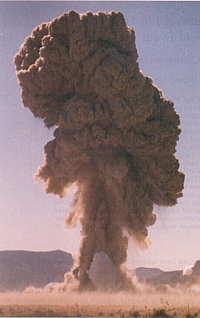
And just in case anyone wants to think seriously about the idea that a tactical nuclear weapon was used to destroy the Box on the Euphrates (or “tall building shaped like a square” to use the IAEA’s more technically precise nomenclature), this is what an explosion equivalent to a low-yield (5kt) nuclear explosion looks like:
misersgold.jpg
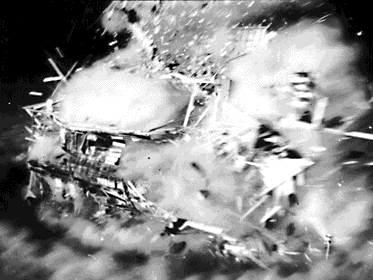
This is what happens to a house located 1,100 meters away a somewhat larger (16kt) explosion:
blast8.gif
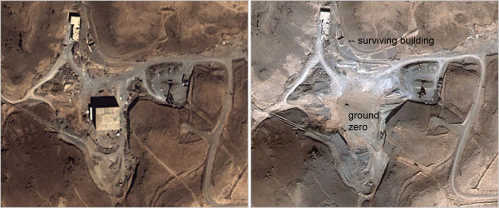
And this is a picture of the Syrian site after the attack:
noboxontheeuphrates.jpg
Note, a small building just 300 meters directly up from “ground zero” was still standing after the attack. That’s a clue — there was no nuclear shockwave that ripped through this gully.

Facebooktwittermail

NEWS: The torture test

Bush administration blocked waterboarding critic

A senior Justice Department official, charged with reworking the administration’s legal position on torture in 2004 became so concerned about the controversial interrogation technique of waterboarding that he decided to experience it firsthand, sources told ABC News.

Daniel Levin, then acting assistant attorney general, went to a military base near Washington and underwent the procedure to inform his analysis of different interrogation techniques.

After the experience, Levin told White House officials that even though he knew he wouldn’t die, he found the experience terrifying and thought that it clearly simulated drowning. [complete article]

Editor’s Comment — Does Cheney have as much guts as an acting assistant attorney general? Or does he think waterboarding guidelines should include a clause that exempts anyone with a pacemaker?

Mukasey all but a shoo-in for approval

Michael B. Mukasey appeared on Friday to be all but assured of becoming the nation’s 81st attorney general when two Senate Democrats broke ranks and said they would support the retired federal judge to head the Justice Department.

While acknowledging serious concerns about his views on interrogation techniques, Sens. Dianne Feinstein of California and Charles E. Schumer of New York said they would vote to confirm Mukasey when the Senate Judiciary Committee takes up his nomination to succeed Alberto R. Gonzales on Tuesday. [complete article]

See also, John Dean on Mukasey (TPM) and The torture litmus test (Scott Horton).

Facebooktwittermail

NEWS: U.S. approves Gaza invasion; Abbas talks to Hamas

‘U.S. okays IDF wide-scale Gaza op’

The United States has given a “green light” to an IDF operation in the Gaza Strip, the Lebanese newspaper, Al-Akhbar reported Saturday morning.

The report cites “credible diplomatic sources” as saying that American approval came after Israeli intelligence impressed on US officials the importance of a wide-scale operation as an answer to the unprecedented arms smuggling within Gaza.

According to the newspaper report, the intelligence was shared during Defense Minister Ehud Barak’s last visit to Washington. Sources told Al-Akhbar that the intelligence depicted a worrying picture of an “arms race” between Hamas and the Islamic Jihad. In addition, Israel presented details of money transfers between the Islamic Jihad and the Al-Aksa’s Martyrs Brigades. [complete article]

Abbas meets West Bank Hamas leaders

The Palestinian president, Mahmoud Abbas, met Friday with a group of Hamas leaders in the West Bank, the first time he has done so since Hamas routed Fatah forces in Gaza in June.

Mr. Abbas, of the Fatah faction, said the meeting in his Ramallah office was not the beginning of a formal dialogue with Hamas. Instead, it seemed to be an effort to split more moderate Hamas officials in the West Bank from their more militant brethren in Gaza. [complete article]

Facebooktwittermail

FEATURE: What’s good for others is good for us

Is (his) biography (our) destiny?

The United States has had only one foreign policy and one national-security strategy since the transforming events of 9/11 — and this set of doctrines has been shaped by the very distinctive worldview of George W. Bush and Dick Cheney and the men and women around them. The great project of the foreign-policy world in the last few years has been to think through a “post-post-9/11 strategy,” in the words of the Princeton Project on National Security, a study that brought together many of the foreign-policy thinkers of both parties. Such a strategy, the experts concluded, must, like “a Swiss Army knife,” offer different tools for different situations, rather than only the sharp edge of a blade; must pay close attention to “how others may perceive us differently than we perceive ourselves, no matter how good our intentions”; must recognize that other nations may legitimately care more about their neighbors or their access to resources than about terrorism; and must be “grounded in hope, not fear.” A post-post-9/11 strategy must harness the forces of globalization while honestly addressing the growing “perception of unfairness” around the world; must actively promote, not just democracy, but “a world of liberty under law”; and must renew multilateral instruments like the United Nations.

In mainstream foreign-policy circles, Barack Obama is seen as the true bearer of this vision. “There are maybe 200 people on the Democratic side who think about foreign policy for a living,” as one such figure, himself unaffiliated with a campaign, estimates. “The vast majority have thrown in their lot with Obama.” Hillary Clinton’s inner circle consists of the senior-most figures from her husband’s second term in office — the former secretary of state Madeleine Albright, the former national security adviser Sandy Berger and the former United Nations ambassador Richard Holbrooke. But drill down into one of Washington’s foreign-policy hives, whether the Carnegie Endowment or the Brookings Institution or Georgetown University, and you’re bound to hit Obama supporters. Most of them served in the Clinton administration, too, and thus might be expected to support Hillary Clinton. But many of these younger and generally more liberal figures have decamped to Obama. And they are ardent. As Ivo Daalder, a former National Security Council official under President Clinton who now heads up a team advising Obama on nonproliferation issues, puts it, “There’s a feeling that this is a guy who’s going to help us transform the way America deals with the world.” Ex-Clintonites in Obama’s inner circle also include the president’s former lawyer, Greg Craig, and Richard Danzig, his Navy secretary. [complete article]

Facebooktwittermail

ANALYSIS & EDITOR’S COMMENT: Drafting diplomatic cannon fodder

Why diplomats won’t go to Iraq

At a State department “town hall” meeting on Wednesday, one participant, veteran diplomat Jack Croddy, pointed out the risks of injury and death faced by American diplomats [in Iraq]. But he hit closer to the heart of the matter when he told the director general of the Foreign Service, who was leading the meeting, “It’s one thing if someone believes in what’s going on over there and volunteers, but it’s another thing to send someone over there on a forced assignment.” On Friday, Secretary of State Condoleezza Rice, who was traveling, issued a statement saying, “We must go forward with the identification of officers to serve, should it prove necessary to direct assignments. Should others step forward, as some already have, we will fill these new jobs as we have before —with volunteers. However, regardless of how the jobs may be filled, they must be filled.” [complete article]

Editor’s Comment — The core issue here is that there is an inherent tension between loyalty and intelligence. The willingness to follow orders requires, in part, a willingness to suspend the use of ones own powers of discrimination, analysis, and judgment. Diplomats who are good are doing what they are told and probably not as good at conducting diplomacy.

Facebooktwittermail

NEWS & ANALYSIS: Action on Kurdish violence; after the surge

Turkey urges U.S. to take action on Kurdish violence

Turkish Foreign Minister Ali Babacan said Friday that Turkey wants the United States to stop talking and start taking action to help end cross-border attacks by Kurdish guerrillas in Iraq.

“We need to work on actually making things happen,” Babacan said at a news conference with Secretary of State Condoleezza Rice in Ankara. “This is where the words end and action needs to start.”

Rice stopped in the Turkish capital for emergency meetings with senior Turkish officials, including Babacan, Prime Minister Recip Tayyip Erdogan and President Abdullah Gul, ahead of an Iraq conference with regional foreign ministers Saturday in Istanbul. [complete article]

The dark side of Iraq’s good news

When Mark Twain lumped statistics together with lies and damned lies, he could have had Mesopotamia in mind. A new set of data from Iraq shows Iraqi civilian deaths on the decline, from 2,800 in January 2007 to about 800 last month. Other reports reveal that tens of thousands of Iraqis have joined local auxiliary forces to secure their neighborhoods and that U.S. forces continue to kill or capture many of the insurgency’s top leaders. Violence is down sharply in most areas. In Baghdad, troops report weeks without a roadside bomb in neighborhoods that used to be hit every day; and in Anbar, things are so good the Marines held a 5K race on the streets of Ramadi two weeks ago.

Still, the truth behind these numbers is elusive. It’s near impossible to discern whether they reflect the success of our military operations or some larger, deeper trends in Iraqi society, such as the success of the Shiite campaign to rid Baghdad of its Sunni residents. The situation does present a paradox, however. If the surge is the reason, as the generals claim, we’re in trouble, because the surge is about to end. If Iraqi reconciliation and ethnic cleansing get primary credit, and the surge is mostly acting as a catalyst, our inevitable drawdown over the next six months to pre-surge levels may not be catastrophic, because the positive trends result more from Iraqi societal shifts and less from American soldiers brokering the peace. As commanders plan for the 2008 reduction in troops, they must try to reconcile these competing explanations and find a way to sustain the success when there are fewer—or no—American soldiers on the streets. [complete article]

Facebooktwittermail

NEWS: Testifying on AIPAC’s cozy relationship with the U.S. government

Defense may seek Rice and Hadley’s testimony in AIPAC case

A federal judge on Friday ordered Secretary of State Condoleezza Rice and Stephen J. Hadley, the national security adviser, to be ready to testify as defense witnesses at the trial of two former pro-Israel lobbyists accused of receiving secret national security information.

The judge, T. S. Ellis III of Federal District Court in Alexandria, Va., agreed with defense lawyers that Ms. Rice, Mr. Hadley and several other government officials could be subpoenaed because they might help the defendants demonstrate that they were engaged in traditional “back channel” lobbying — not in espionage — in their contacts with the government over Middle East policy.

Justice Department officials who are overseeing the prosecution had no immediate comment on the judge’s ruling or on whether they might appeal the decision. The State Department also declined to comment. The trial in the case is scheduled to begin in January, although a delay is considered likely. [complete article]

Facebooktwittermail

NEWS & REFLECTIONS: On dying in Iraq

Requiem for the last American soldier to die in Iraq

At some point in the future, soldiers will pack up their rucks, equipment will be loaded into huge shipping containers, C-130s will rise wheels-up off the tarmac, and Navy transport ships will cross the high seas to return home once again. At some point — the timing of which I don’t have the slightest guess at — the war in Iraq will end. And I’ve been thinking about this a lot lately — I’ve been thinking about the last American soldier to die in Iraq.

huntersmoon.jpgTonight, at 3 a.m., a hunter’s moon shines down into the misty ravines of Vermont’s Green Mountains. I’m standing out on the back deck of a friend’s house, listening to the quiet of the woods. At the Fairbank’s Museum in nearby St. Johnsbury, the lights have been turned off for hours and all is dark inside the glass display cases, filled with Civil War memorabilia. The checkerboard of Jefferson Davis. Smoothbore rifles. Canteens. Reading glasses. Letters written home.

Four or five miles outside of town, past a long stretch of water where the moon is crossing over, a blue and white house sits in a small clearing not far from where I stand now. Chimney smoke rises from a fire burned down to embers. A couple spoon each other in sleep, exhausted from lovemaking. One of them is beginning to snore. I want them to wake up and make love again, even if they need the sleep and tomorrow’s workday holds more work than they might imagine.

Who can say where that last soldier is now, at this very moment? Kettlemen City. Turlock. Wichita. Fredricksburg. Omaha. Duluth. She may be in the truck idling beside us in traffic as we wait for the light to turn green. He may be ordering a slice of key lime pie at Denny’s, sitting at a booth with his friends after bowling all night. What name waits to be etched on a stone not yet erected in America? Somewhere out in the vast stretches of our country, somewhere out in Whitman’s America, out among the wide expanse of grasses, somewhere here among us the last soldier may lie dreaming in bed before the dawn as the sun sets over Iraq. [complete article]

Note about the author: Brian Turner is a poet who has served seven years in the Army, most recently in 2004 as an infantry team leader in Mosul with the Third Stryker Brigade Combat Team, Second Infantry Division. His book of poems, “Here, Bullet,” won the 2005 Beatrice Hawley Award and was a New York Times Editor’s Choice selection. He lives in Fresno, Calif, where he teaches poetry at Fresno State.

Envoys resist forced Iraq duty

Uneasy U.S. diplomats yesterday challenged senior State Department officials in unusually blunt terms over a decision to order some of them to serve at the U.S. Embassy in Baghdad or risk losing their jobs.

At a town hall meeting in the department’s main auditorium attended by hundreds of Foreign Service officers, some of them criticized fundamental aspects of State’s personnel policies in Iraq. They took issue with the size of the embassy — the biggest in U.S. history — and the inadequate training they received before being sent to serve in a war zone. One woman said she returned from a tour in Basra with post-traumatic stress disorder only to find that the State Department would not authorize medical treatment.

Yesterday’s internal dissension came amid rising public doubts about diplomatic progress in Iraq and congressional inquiries into the department’s spending on the embassy and its management of private security contractors. Some participants asked how diplomacy could be practiced when the embassy itself, inside the fortified Green Zone, is under frequent fire and officials can travel outside only under heavy guard.

Service in Iraq is “a potential death sentence,” said one man who identified himself as a 46-year Foreign Service veteran. “Any other embassy in the world would be closed by now,” he said to sustained applause. [complete article]

Facebooktwittermail

NEWS: Syria’s “tall building shaped like a square”

Syria nuclear probe may be inconclusive

The IAEA has been studying before-and-after commercial aerial photos of the site and has asked Syria for explanations. But Syria has not replied and the pictures alone are unlikely to yield conclusions, the diplomat told Reuters.

“IAEA experts are looking back at the evolution of this facility. But with these pictures alone they feel they may be unable to draw conclusions,” the diplomat, familiar with IAEA affairs but not authorised to speak on the record, told Reuters.

“If the IAEA got credible indications from anyone of nuclear procurement or activity, that would be different. But imagery of a tall building shaped like a square, that’s not enough (to tell whether or not the site may have been a nuclear site).” [complete article]

Facebooktwittermail

OPINION: Time to talk to Iran

Sen. Hagel’s message to Bush

Now is the time for the United States to active consider when and how to offer direct, unconditional, and comprehensive talks with Iran. The offer should be made even as we continue to work with our allies on financial pressure, in the UN Security Council on a third sanctions resolution, and in the region to support those Middle East countries who share our concerns with Iran. The November report by IAEA Director General ElBaradei to the IAEA Board of Governors could provide an opportunity to advance the offer of bilateral talks.

An approach such as this would strengthen our ability across the board to deal with Iran. Our friends and allies would be more confident to stand with us if we seek to increase pressure, including tougher sanctions on Iran. It could create a historic new dynamic in US-Iran relations, in part forcing the Iranians to react to the possibility of better relations with the West. We should be prepared that any dialogue process with Iran will take time, and we should continue all efforts, as you have, to engage Iran from a position of strength.

We should not wait to consider the option of bilateral talks until all other diplomatic options are exhausted. At that point, it could well be too late. [complete article]

Facebooktwittermail

NEWS & ANALYSIS: The Kurdish dilemma

Iraq asks for Iran’s help in calming Kurdish crisis

Iran has been sympathetic to Turkey’s position, because Kurdish guerrillas have also been attacking Iran, but it has loyalties to Iraq which, like Iran, has a Shiite-majority government. Iran has also worked closely with the Kurdish leadership in Iraq.

In comments at a news conference on Wednesday, the Iraqi foreign minister, Hoshyar Zebari, said that he had discussed the situation with Mr. Mottaki and that he had warned of “serious consequences” if Turkey were to invade Iraq.

“It will have consequences for the entire region,” he said he told Mr. Mottaki.

However, Mr. Zebari also said Iraq needed help from its neighbors on many other issues, such as border security, refugees and economic investment. “The Istanbul meeting should not be hijacked by the P.K.K. terrorist activities in Turkey,” he said. [complete article]

Double-crossing in Kurdistan

The George W Bush administration would not flinch to betray its allies in Iraqi Kurdistan if that entailed a US “win” in the Iraq quagmire. And it would not flinch to leave its Turkish North Atlantic Treaty Organization allies in the wilderness as well – if that entailed further destabilization of Iran. Way beyond the Kurdistan Workers’ Party (PKK) vs Turkey skirmish, one of these two double-crossing scenarios will inevitably take place. Washington simply cannot have its kebab and eat it too.

The Bush administration’s double standards are as glaring as meteor impacts. When, in the summer of 2006, Israel used the capture of two of its soldiers by Hezbollah to unleash a pre-programmed devastating war on Lebanon, destroying great swathes of the country, the Bush administration immediately gave the Israelis the green light. When 12 Turkish soldiers are killed and eight captured by PKK guerrillas based in Iraqi Kurdistan, the Bush administration urges Ankara to take it easy.

The “war on terror” is definitely not an equal-opportunity business. That has prompted Slovenian philosopher Slavoj Zizek to mischievously remark, regarding Turkey, “It’s as if an intruder has gatecrashed the closed circle of ‘we’, the domain of those who hold the de facto monopoly on military humanitarianism.” [complete article]

Facebooktwittermail

NEWS & ANALYSIS: Arab nuclear solutions

Gulf Arabs offer to provide uranium to Iran: report

U.S.-allied Gulf Arab states are willing to set up a body to provide enriched uranium to Iran to defuse Tehran’s stand-off with the West over its nuclear plan, Saudi Arabia’s foreign minister told a magazine on Thursday.

Saudi Arabia and other Gulf countries — Kuwait, Oman, Qatar, Bahrain and the United Arab Emirates — share Western concerns that Iran’s nuclear energy program will lead to it acquiring atomic bombs, a claim Tehran denies.

“We have proposed a solution, which is to create a consortium for all users of enriched uranium in the Middle East,” Foreign Minister Prince Saud al-Faisal told the Middle East Economic Digest (MEED). [complete article]

Middle East racing to nuclear power

This week Egypt became the 13th Middle Eastern country in the past year to say it wants nuclear power, intensifying an atomic race spurred largely by Iran’s nuclear agenda, which many in the region and the West claim is cover for a weapons program.

Experts say the nuclear ambitions of majority Sunni Muslim states such as Libya, Jordan, Yemen, and Saudi Arabia are reactions to Shiite Iran’s high-profile nuclear bid, seen as linked with Tehran’s campaign for greater influence and prestige throughout the Middle East.

“To have 13 states in the region say they’re interested in nuclear power over the course of a year certainly catches the eye,” says Mark Fitzpatrick, a former senior nonproliferation official in the US State Department who is now a fellow at the International Institute for Strategic Studies in London. “The Iranian angle is the reason.” [complete article]

Facebooktwittermail

OPINION: U.S. shouldn’t exclude academics critical of its policies

The U.S. blacklisted me. Let’s talk

For years, I worked tirelessly in academic and public circles to dismantle the barriers erected by those who see Islam and the West as mutually exclusive, to build bridges of mutual understanding and respect. Since 2001, I have also intensified my work to remind my fellow Western citizens of the fragility of our societies and the precariousness of our civil liberties as we are thrust into this so-called war on terrorism. Since the end of 2004, I have done this primarily in Europe through my academic work, debates, and public lectures and by working closely with European politicians, governmental agencies, and civic institutions. But I have been prevented from doing this work on American soil. [complete article]

Facebooktwittermail

OPINION: The rise of racist liberalism

How liberals lost their anti-racism

A new sentiment has gripped the mainstream of liberal thinking in Britain over the last few years. It is an attitude that regards Muslims as uniquely problematic and in need of forceful integration into what it views as the inherently superior values of the West. For this new breed of liberal, previously cherished norms of multiculturalism should be discarded and the fight for racial and religious equality is irrelevant. The publication this year of Nick Cohen’s What’s Left? how liberals lost their way and Andrew Anthony’s more sharply argued The Fall-Out: how a guilty liberal lost his innocence provide the clearest statements yet of what this new liberalism stands for. Their core argument can be stated straightforwardly: the major problem facing the West is a failure to stand up for its Enlightenment values. Liberalism has been infected by guilt – which prevents it from defending itself against external threats, chief among them ‘Islamism’, which is held responsible not only for terrorist violence but also for Muslim separatism in our cities. What precisely an Islamist is is left unclear; after all, a realistic definition of Islamism – as a wide range of political movements, some violent and some constitutional, generally with social conservatism at their core – would require the reader to pause for a moment before the ritual denunciation of all Islamists as irrational, nihilist and totalitarian.

But Cohen’s and Anthony’s main target is not so much Islamism as the appeasing attitudes they detect among liberals. Anthony writes that, since the 1970s, liberalism has been corrupted by White guilt which leads liberals to think that everything will be OK as long as they don’t interfere in other people’s lives, especially the lives of other ethnic groups. But this is fantasy: in practice, White liberals have not usually shied away from using the power of the state to intervene in the lives of non-Whites, either in Britain or in the neocolonialism of the ‘war on terror’. Moreover, at the conceptual level, liberalism has always lacked the means to generate the kind of social solidarity which Anthony wants to see. Individualist indifference has been a feature of liberal democracy since its inception. The slave-owning liberal democracy of early nineteenth-century America could not be said to be a society suffering from what Anthony calls a ‘guilt-warped vision of the world’, yet Tocqueville wrote of its citizens that ‘each of them, living apart, is as a stranger to the fate of the rest’. [complete article]

Facebooktwittermail

OPINION: Engaging Hamas and Hezbollah

Engaging Hamas and Hezbollah

Nothing could be easier in the present atmosphere than to accuse anyone who calls for recognition of and dialogue with Hamas, Hezbollah and other Islamist movements of being closet supporters of reactionary “extremism” or naive fellow travelers of “terrorists.” This tactic is not surprising coming from neoconservatives and Zionists. What is novel is to see it expressed in supposedly progressive quarters.

Arun Kundnani has written about a “new breed of liberal” whose outlook “regards Muslims as uniquely problematic and in need of forceful integration into what it views as the inherently superior values of the West.” The target of these former leftists, Kundnani argues, “is not so much Islamism as the appeasing attitudes they detect among [other] liberals.”

Such views are now creeping into the Palestinian solidarity movement. MADRE, an “international women’s human rights organization,” presents one example. In the wake of the Hamas election victory and takeover of Gaza from US- and Israeli-backed Fatah warlords, MADRE declared that the challenge for Palestine solidarity activists is “how do we support the people of Palestine without endorsing the Hamas leadership?” Calling for what it terms “strategic solidarity” as opposed to “reflexive solidarity,” MADRE defines Hamas as a “repressive” movement “driven by militarism and nationalism,” which “aims to institutionalize reactionary ideas about gender and sexuality,” while using “religion as a smokescreen to pursue its agenda.” Similarly strident and dismissive claims have been made by a Washington-based pro-Palestinian advocacy group. [complete article]

Facebooktwittermail

OPINION: Report treats torture-based confessions as news

NPR gives torture credibility

Good journalists don’t base their stories on highly dubious “facts.” And they try to avoid reports that will encourage violence. Unfortunately, a recent segment on NPR’s Morning Edition (10/26/07) violated both rules.

NPR Iraq correspondent Anne Garrels’ report was based around the accounts of three men who were being held prisoner by Shiite cleric Moqtada al-Sadr’s militia. The captives were supposedly “renegade” members of Sadr’s militia who said “they were trained in roadside bombs and car bombings in Iran…to attack Americans and sow suspicion and violence between Shiites and Sunnis.” The details of the prisoners’ accounts made up much of Garrels’ report, despite her noting that “the three detainees had clearly been tortured.”

“There was blood all over their clothes,” Garrels reported. “They were in such bad shape they couldn’t walk. They had to be dragged onto the chairs, and one of them was just sobbing.”

Given the brutal treatment of the three men, there is no reason to put any stock whatsoever in the claims they made in the presence of their captors. [complete article]

Facebooktwittermail