Category Archives: Israel

Liberal Jews and Israel – a case of split personality disorder

Liberal Jews and Israel – a case of split personality disorder

Last Saturday I met an Israeli-American friend who came for a short visit from his studies in Europe. We talked some politics, and finally came to an issue which always puzzles me: the fact that American Jews are unwilling – almost unable – to criticize Israel, both in public and in private, and even when Israeli policies contradict their own believes. My friend noted that if some of the articles on the Israeli media – and not even the most radical ones – were to be printed in the US and signed by none-Jews, they would be considered by most Jewish readers like an example of dangerous Israel-bashing, sometimes even anti-Semitism.

I’ve became more aware of this issue myself since I started writing this blog. Things I say or write which are well within the public debate in Israel are sometimes viewed as outrageous by American Jewish readers; at the same time, events which would make the same readers furious if they happened in the US – for example, the Israeli municipality which tried to prevent Arabs from dating Jewish girls – are met with indifference.

Naturally, I’m generalizing here. Between millions of Jews you can obviously find all kinds of voices – and this is part of the reason I hesitated before writing this post – but I think one can recognize some sort of mainstream opinion within the Jewish community, which both echoes the official Israeli policies, regardless of the identity of the government in Jerusalem, and at the same time, turns a blind eye on events which might distort the image of Israel which this community holds. And this is something which is hard to understand. [continued…]

Stealing Gaza

It’s a tragedy that the Israelis – a people who must understand better than almost anybody the horrors of oppression – are now acting as oppressors. As the great Jewish writer Primo Levi once remarked “Everybody has their Jews, and for the Israelis it’s the Palestinians”. By creating a middle Eastern version of the Warsaw ghetto they are recapitulating their own history as though they’ve forgotten it. And by trying to paint an equivalence between the Palestinians – with their homemade rockets and stone-throwing teenagers – and themselves – with one of the most sophisticated military machines in the world – they sacrifice all credibility.

The Israelis are a gifted and resourceful people who fully deserve the right to live in peace, but who seem intent on squandering every chance to allow that to happen. It’s difficult to avoid the conclusion that this conflict serves the political and economic purposes of Israel so well that they have every interest in maintaining it. While there is fighting they can continue to build illegal settlements. While there is fighting they continue to receive huge quantities of military aid from the United States. And while there is fighting they can avoid looking candidly at themselves and the ruthlessness into which they are descending. [continued…]

Israeli army officers fear arrest in UK

A group of Israeli army officers has cancelled a visit to Britain because London was unable to guarantee they would not be arrested for alleged war crimes under universal jurisdiction provisions, Israeli officials said yesterday.

Four officers, including a major, a lieutenant colonel and a colonel had been due to visit last week at the invitation of the British Army.

An Israeli official declined to specify the purpose of the visit but said that Israeli officers are invited to Britain “to assist in defensive technology in the military arena”.

The incident has fuelled Israeli anger at the British Government for not yet following through on promised changes to the law so that Israeli officers and officials do not run the risk of arrest on UK soil. There have been several incidents in which visiting Israelis have been vulnerable to arrest. [continued…]


Facebooktwittermail

Viva Palestina convoy entering Gaza

Viva Palestina convoy entering Gaza

Although it’s very slow moving, vehicles in the Viva Palestina aid convoy have finally started entering Gaza:

The Viva Palestina aid convoy entered Gaza Wednesday, after it received the approval of Egyptian authorities to bring into the besieged, impoverished coastal sliver several tons of humanitarian supplies.

The activists entered Gaza through Rafah border crossing. More than 500 international activists accompany the convoy organized by the British-based group Viva Palestina, a Press TV correspondent reported. — Press TV

V slowly we r moving out 2 Rafah. Many still at port, but first vehicles 2 leave r already in #Gaza. It’s finally happening! #vivapalestina — joti2gaza

An Egyptian soldier has been killed and at least eight Palestinians hurt in clashes at the Egypt-Gaza border. — BBC News

Facebooktwittermail

Viva Palestina convoy heading to Rafah

Viva Palestina convoy heading to Rafah

After a battle between Egyptian riot police and convoy members in Al-Arish last night, the convoy finally started out on the last leg of its journey a couple of hours ago:

“Vehicles very slowly exiting port gates now, heading to Rafah, insyaAllah.” – juanajaafar

An Egyptian border guard was shot dead Wednesday and about 55 people were injured late Tuesday in clashes between Egyptian police and pro-Palestinian activists trying to get a relief convoy into the Gaza Strip, militants, medics and officials said.

Some 520 activists belonging to the convoy – led by charismatic and outspoken British MP George Galloway – broke down the gate at El-Arish to protest an Egyptian decision to ship some of the goods through Israel.

They blocked the two entrances to the Sinai port with vehicles, and clashed with police. Forty militants were injured, a source close to them said, while medical sources said 15 policemen were also hurt.

An Egyptian official said Wednesday that the border guard was shot dead by a Palestinian sniper while Gazan youths hurled stones across the border at the Egyptian security forces.

The protests were sparked by an Egyptian decision to allow 139 vehicles to enter Gaza through the Rafah bordering crossing, about 45 kilometers from El-Arish, but requiring a remaining 59 vehicles to pass via Israel. Talks in which Galloway and a delegation of Turkish MPs sought to change the Egyptian’s minds proved unsuccessful. — Hurriyet Daily News

At the beginning, it was a peaceful protest, singing and making noise. The Egyptians were there to be provoked, no doubt, but they needed a reason. This went on for about 1 hour 30 mins, and then all hell broke loose. I don’t know who threw the first stone but the Egyptians seemed to have prepared stones to be thrown. A running battle went on for about 30 minutes, mainly the Egyptians hurtling stones at us. Some people fought back with stones and sticks against the riot police with batons. Five seasoned Derry men stood at the back. Ole hands at these riots.

The end result was up to 20 people injured, head injuries and even worse it appears. There was news that the Turks had captured 3 Egyptians police as hostages but they were later released. There was a deadly atmosphere amongst the compound. This wasn’t the way it was suppose to work out, we should of been heading for Gaza. At this point, it’s too early to see where the blame lies.

Galloway made his way onto the stage, looking very shaken and holding prayer beads, he recalled the progression of events that I have just told, and once again, encouraged people to protest throughout the world against the Egyptians. He said we wouldn’t be going anywhere soon’. We went to bed after that.

So another massive change of events, and I think the whole thing has had a negative rather than positive effect on proceedings. A lot of people think this way and I could see a lot of people going home. — Derry to Gaza

“Galloway challenged in open convoy mtg to resign leadership!” — zhat

Jordan’s Islamic Action Front (IAF) on Wednesday condemned Egypt’s alleged assault on members of the Viva Palestina humanitarian convoy in the Egyptian port of El Arish.

“The attack by the Egyptian authorities on the Viva Palestina convoy late Tuesday is heinous and cruel. We condemn the assault on the convoy members who seek to break the siege imposed on Gaza and such behaviors do not reflect the history of Egypt,” the IAF, the political arm of Jordan’s Muslim Brotherhood, said in a statement posted on its website. — Xinhua

In Istanbul, thousands of protesters staged a demonstration to condemn the Egyptian police crackdown on the Gaza-bound aid convoy. The protestors marched towards the Egyptian Consulate in the Turkish capital and held a picture of assassinated Hezbollah commander Imad Mugniyah and a picture titled “the picture of betrayal”, showing Egyptian President Hosni Muabark shaking hands with former Israeli Foreign Minister Tzipi Livni.

Tuesday’s demonstration joined a wave of protests against Mubarak across the Arab world. The Hamas organization in Gaza called on Palestinians on Wednesday morning to stage protests calling on the Egyptian authorities to allow the entry of the foreign activists. — Ynet

An Egyptian soldier was killed and four Palestinians were wounded in a gunbattle on Wednesday during a protest against an anti-smuggling wall Cairo is building on the Gaza border. — Reuters

Facebooktwittermail

Turkey helps Viva Palestina deliver aid to Gaza

Turkish MPs to enter Gaza with Viva Palestina convoy in Egypt

Five Turkish MPs will on Monday join an international aid convoy that has reached Egyptian port one-week later after the date that they initially hoped to reach Gaza Strip on the first anniversary of Israel’s 22-day offensive.

Viva Palestina Convoy is now at the Egyptian port of El-Arish with Turkish ship ULUSOY-6, which carried the convoy from the Syrian port of Lattakia to Egypt.

The aid volunteers who stay at Lattakia will fly in the day in 3 separate flights to Al-Arish to join the convoy. After everyone arrives at the Al- Arish port, the convoy will make an hour-drive to the Rafah border.

It is expected that the convoy will enter Gaza on Tuesday evening. It will be able to stay in Gaza for 24 hours only. During this time, all aid, drugs and medical tools will be delivered to the Gazan authorities. After 24 hours, all volunteers who travel with the convoy will go to Egypt and then fly back to their own countries. [continued…]

Facebooktwittermail

Settlers, tell us, what do you think will happen?

Settlers, tell us, what do you think will happen?

What constitutes the life of a settler? A house on the cheap; a standard of living above the national average; a job usually subsidized by the government; a fierce religious, nationalist, uncompromising conviction on the justness of his cause; a supportive, heavy-handed social environment; a highway system; transportation arrangements; socially enriching activities; and, at times, a life that comes with the risk of danger.

The settler goes to and from his home without seeing anything. He does not see his neighbors, he does not see the danger he exposes his children to, he does not see the moral baggage he carries on his back. He does not want to see all this, and an entire system surrounds him that makes life easy for him despite his blindness.

Some of the highways on which he drives are cleansed of Palestinians; he has never visited the neighboring villages, not one of whose names he would know were it not for traffic signs pointing in their direction. His teachers, functionaries and rabbis sketch out the scenery that is his world, leaving him no shred of doubt: the Arabs are terrorists, all of them are suspicious packages, and the Jews are allowed to do as they wish, for they are the lords of the land, and there is no other but they. [continued…]


Just before Christmas, the US President, Barack Obama, signed into law one of his country’s biggest aid pledges of the year. It was bound not for Africa or any of the many struggling countries on the World Bank’s list.

It was a deal for $US2.77 billion ($3 billion) to go to Israel in 2010 and a total of $US30 billion over the next decade.

Israel is bound by the agreement to use 75 per cent of the aid to buy military hardware made in the US: in the crisis-racked US economy, those military factories are critical to many towns. [continued…]

Facebooktwittermail

‘Israel resembles a failed state’

‘Israel resembles a failed state’

One year has passed since the savage Israeli attack on the Gaza Strip, but for the people there time might as well have stood still.

Since Palestinians in Gaza buried their loved ones – more than 1,400 people, almost 400 of them children – there has been little healing and virtually no reconstruction.

According to international aid agencies, only 41 trucks of building supplies have been allowed into Gaza during the year.

Promises of billions made at a donors’ conference in Egypt last March attended by luminaries of the so-called “international community” and the Middle East peace process industry are unfulfilled, and the Israeli siege, supported by the US, the European Union, Arab states, and tacitly by the Palestinian Authority (PA) in Ramallah, continues. [continued…]

Editor’s Comment — Ali Abunimah, who has just left Cairo after attending the thwarted Gaza Freedom March, adds on his blog:

To talk about the siege of Gaza in the abstract is one thing, but to actually come to Egypt and find that Gaza is harder to visit than a prison is like a bucket of cold water. The Egyptian government may be efficient at few things, but it is highly efficient at maintaining the siege. Buses hired to take all the marchers to Gaza were prevented from showing up. Those who tried to get to Gaza under their own steam were turned back or detained at their hotel in Al Arish. It was very very frustrating. But whatever frustration we felt is one millionth of the frustration of the besieged Palestinian people in Gaza. So perhaps in some way it is better then that we did not get in, because Egypt gave us a small taste of what it serves every day to people in Gaza — and a small taste of what Egyptians face when they challenge their government’s policies.

Report from Gaza: One student’s question to the world – ‘Why the Palestinians? Why are we the only ones suffering?’

The question was like an electric shock to the six or so Palestine solidarity activists, including myself, as we were standing inside a classroom at a school in Gaza City.
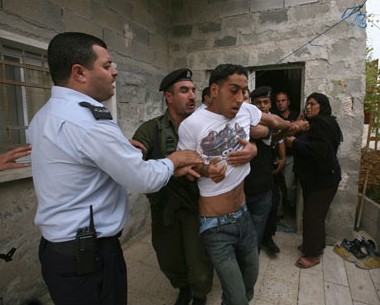
“Why the Palestinians? Why are we the only ones suffering?” asked a Palestinian girl who was probably about nine or ten-years-old. And then the enormity of what the people of Gaza go through every day hit me.

Most of us were Americans and one was Canadian, and we were delivering some of the $17,000 in school supplies that Jessica Campbell and Julia Hurley, two members of the Gaza Freedom March student delegation, had brought and raised on their own. [continued…]

Israel’s 10 worst errors of the decade

…there is perhaps no better time than this to review Israel’s 10 Worst Mistakes of the Last 10 Years:

1. The Siege of Gaza – The stated goal of the siege was to undermine Hamas and to goad Gazans into rejecting Hamas rule. The effect of the siege has been to focus and intensify Palestinian anger against Israel, increase Gazans’ dependency on Hamas social welfare arms, enrich Hamas coffers through tunnel taxation and foreign donations, and sap Palestinian support for Fatah, which, through its back-channel encouragement for the siege, is seen as a betrayer and a boot-licker in the eyes of many Palestinians.

2. The Siege of Gaza – The blockade was ostensibly a means to stem the influx of weaponry into Gaza. In practice, with shipments the size of automobiles flowing through the tunnels, the Hamas arsenal has grown ever more sophisticated, now believed to include Iranian-manufactured rockets capable of striking Tel Aviv and Ben-Gurion Airport from the Strip.

3. The Siege of Gaza – In the eyes of the world community, the overwhelming collective punishment – and the relative silence of Israelis in response – has gutted Israeli claims to the moral high ground. It has undercut sympathy for Israelis living within Qassam range. It has kept open the moral wounds of the Gaza War, cramping rebuilding efforts, enshrining universal unemployment, and ensuring agonizing homelessness as the coastal winter gathers full force. Israeli officials have quietly take steps of astounding insensitivity, arbitrarily barring such goods as school supplies.

4. The Siege of Gaza – The siege has been presented in the past as a means of pressing Hamas to release Gilad Shalit. Not only does he remain captive, the terms of a prospective deal appear not to include lifting the siege. The siege has been presented in the past as a means of pressuring Gazans to end rocket fire. But rocket fire only increased after the siege was put in place. Finally, Cast Lead, the Gaza war a year ago, might have been prevented altogether, had Israel adhered more closely to the Egyptian-brokered Hamas-Israel truce agreement of June, 2008, and lifted the siege more completely in response to a drop in rocket fire.

5. The Siege of Gaza – The siege works to the detriment of U.S. support for Israel. In February, Secretary of State Hillary Clinton signaled anger at Israel over obstacles to humanitarian aid entering the strip. The message came soon after Senate Foreign Relations Committee Chairman John Kerry, visiting Gaza, learned that Israel had blocked shipments of pasta, ruling it off the list of permitted humanitarian aid items.

6. The Siege of Gaza – The fact that the siege has failed so completely in achieving its stated aims, reinforces the impression that its real purpose is punitive.

7. The Siege of Gaza – The siege places Israeli officials in jeopardy of being charged with violating the Fourth Geneva Convention and other international codes, as outlined in detail in the Goldstone Report. Referring to the siege, paragraph 1335 of the report states that: “From the facts available to it, the Mission is of the view that some of the actions of the Government of Israel might justify a competent court finding that crimes against humanity have been committed.”

8. The Siege of Gaza – With the siege under the direct aegis of Defense Minister Ehud Barak and his deputy, Matan Vilnai, the moral failings of the siege could prove the coup de grace to an already foundering Labor Party.

9. The Siege of Gaza – The siege threatens to destabilize the rule of Hosni Mubarak in Egypt, posing a potential threat to Israeli-Egyptian peace and Israeli security.

10. The Siege of Gaza – The siege corrupts the moral values of all Israelis, who, whether or not they are aware of what is being done to the people of Gaza, bear ultimate responsibility for all acts being carried out in their name. [continued…]

A year ago: Yonatan Schapira, a former Captain in the Israeli Air Force, speaks out on Israel’s war crimes

Facebooktwittermail

Mousavi defiant after new threats

Iran’s opposition leader defiant after new threats

Iran’s opposition leader on Friday pledged to remain defiant in the face of new threats — including calls by hard-liners for his execution — and said he was ready to sacrifice his life in defense of the people’s right to protest peacefully against the government.

Mir Hossein Mousavi’s remarks come after the worst unrest since the immediate aftermath of the disputed June presidential election. At least eight people died during anti-government protests on Sunday, including Mousavi’s nephew.

In one of his strongest statements to date, Mousavi said he was “ready for martyrdom” — the sacrifice of one’s life for a higher cause — and lashed out at the bloody crackdown the authorities are waging against the opposition. [continued…]

Israel seeks ‘crippling’ Iran sanctions

As the deadline for Iran to respond to the international community’s offer regarding its nuclear program passed Thursday, the US has toughened its rhetoric and is looking increasingly to sanctions rather than diplomacy.

That has pleased Israel, which wants strong action against the Islamic Republic as it continues to enrich uranium in defiance of international demands and has rejected US President Barack Obama’s outstretched hand.

The next step, according to Ambassador to the US Michael Oren, should be “imposing crippling sanctions” on the Teheran regime, which is in keeping with the pledge Oren said Obama made to Prime Minister Binyamin Netanyahu in May that the US would end the engagement phase toward Iran if it were unsuccessful by year’s end.

Oren told The Jerusalem Post that “there isn’t an Israeli view and an American view” on the Iranian question, but rather “one view.” [continued…]

Editor’s Comment — Israel is desperate to sustain the myth that Israeli and American interests are indistinguishable from one another, yet Israel’s insistence on pushing for crippling sanctions at this moment exposes the ugly truth: Israel regards the Iranian opposition movement as a threat.

If the Islamic Republic’s regime collapses, Israel will lose its indispensable enemy. An Israel that can no longer drum up support on the basis that it faces a so-called existential threat will find it much harder to cloak its own brutality.

The advance of democracy in Iran means the advance of Israel’s international status as a pariah state. If they could now secretly send advisers to coach Ayatollah Khamenei on how to most effectively suppress the uprising, I have little doubt the Israelis would gladly do so.

Facebooktwittermail

Report: US pressing Israel not to free Barghouti

Report: US pressing Israel not to free Barghouti

s the US trying to prevent the release of two senior prisoners whose freedom Hamas is demanding in return for Shalit? Palestinian sources have told the London-based Arabic-language al-Hayat newspaper that the United States has pressured Israel not to release Secretary-General of the Popular Front for the Liberation of Palestine Ahmed Saadat and former Fatah leader in the West Bank Marwan Barghouti.

There was also pressure not to release prisoners from east Jerusalem and Arab citizens of Israel, the report said.

The sources told the newspaper that Israel has gone back on agreements reached earlier regarding the deal aimed at securing the release of kidnapped IDF soldier Gilad Shalit. [continued…]

Facebooktwittermail

Hamas using English law to demand arrest of Israeli leaders for war crimes

Hamas using English law to demand arrest of Israeli leaders for war crimes

The Islamist group Hamas is masterminding efforts to have senior Israeli leaders arrested for alleged war crimes when they visit European countries including Britain, a top Hamas official involved in the effort has told The Times.

The claim comes amid continuing diplomatic fallout after a British arrest warrant was issued last week against Tzipi Livni, who served as Foreign Minister during Israel’s Gaza offensive last winter. The warrant was withdrawn when it became clear that Ms Livni, now leader of the opposition, was not in the country. Its existence apparently prompted her to cancel a trip to attend a meeting in London.

President Peres described the incident as “one of the greatest political mistakes” that Britain could have made and calling for the law to be changed. “Everything is based on … a hostile majority public opinion,” he said last week. “The British promised they would fix this and it is time that they do so.” [continued…]

The democratic value of universal accountability

In important global dynamic today bridges the worlds of politics, morality and violence. Societies are grappling with the challenge of how to hold accountable the political leaders who are accused of various degrees of criminal behavior, including war crimes, torture — even genocide or crimes against humanity. The most outrageous cases are tried in special international tribunals or at the International Criminal Court. Other cases reflect more contested situations and raise critical issues of the universality of ethics and law.

Two cases last week in the United States and Israel are interesting in this respect, because these two countries remind us twice a week — and more often in war time and on patriotic national holidays — that they are democracies whose values should be spread around the world. Well, the world at the receiving end of their moral munificence frequently asks an important question to which it has yet to receive a clear answer:

Are the United States and Israel subject to the same standards of accountability for their behavior as everyone else in the world, or do they operate at a higher plane of impunity when it comes to using violence to kill, torture, and invade or occupy other peoples? [continued…]

Facebooktwittermail

U.S.-Israeli arms cooperation quietly growing

U.S.-Israeli arms cooperation quietly growing

Leaders in Washington and Jerusalem have publicly locked horns over the issue of West Bank settlements. And Israeli public opinion has largely viewed America’s new administration as unfriendly. But behind the scenes, strategic security relations between the two countries are flourishing.

Israeli officials have been singing the praises of President Obama for his willingness to address their defense concerns and for actions taken by his administration to bolster Israel’s qualitative military edge — an edge eroded, according to Israel, during the final year of the George W. Bush presidency.

Among the new initiatives taken by the administration, the Forward has learned, are adjustments in a massive arms deal the Bush administration made with Arab Gulf states in response to Israeli concerns. There have also been upgrades in U.S.-Israeli military cooperation on missile defense. And a deal is expected next year that will see one of the United States’ most advanced fighter jets go to Israel with some of America’s most sensitive new technology.

Amid the cacophony of U.S.-Israel clashes on the diplomatic front, public attention given to this intensified strategic cooperation has been scant. But in a rare public comment in October, Israeli Ambassador Michael Oren praised the Obama administration’s response to complaints about lost ground during the close of the Bush years as “warm and immediate.” [continued…]

CIA working with Palestinian security agents

Palestinian security agents who have been detaining and allegedly torturing supporters of the Islamist organisation Hamas in the West Bank have been working closely with the CIA, the Guardian has learned.

Less than a year after Barack Obama signed an executive order that prohibited torture and provided for the lawful interrogation of detainees in US custody, evidence is emerging the CIA is co-operating with security agents whose continuing use of torture has been widely documented by human rights groups.

The relationship between the CIA and the two Palestinian agencies involved – Preventive Security Organisation (PSO) and General Intelligence Service (GI) – is said by some western diplomats and other officials in the region to be so close that the American agency appears to be supervising the Palestinians’ work.

One senior western official said: “The [Central Intelligence] Agency consider them as their property, those two Palestinian services.” A diplomatic source added that US influence over the agencies was so great they could be considered “an advanced arm of the war on terror”. [continued…]

Obama told China: I can’t stop Israel strike on Iran indefinitely

President Barack Obama has warned his Chinese counterpart that the United States would not be able to keep Israel from attacking Iranian nuclear installations for much longer, senior officials in Jerusalem told Haaretz.

They said Obama warned President Hu Jintao during the American’s visit to Beijing a month ago as part of the U.S. attempt to convince the Chinese to support strict sanctions on Tehran if it does not accept Western proposals for its nuclear program.

The Israeli officials, who asked to remain anonymous due to the sensitivity of the matter, said the United States had informed Israel on Obama’s meetings in Beijing on Iran. They said Obama made it clear to Hu that at some point the United States would no longer be able to prevent Israel from acting as it saw fit in response to the perceived Iranian threat. Continue reading

Facebooktwittermail

Israeli women’s group tells Livni to turn herself in

Israeli women’s group tells Livni to turn herself in

The Women’s Coalition for Peace sent a letter on Wednesday to Israel’s former Foreign Minister, Tzipi Livni, calling on her to cooperate with international investigations into her role in the assault on Gaza last winter, after a British court issued an warrant for her arrest on Monday.

The Israeli organization wrote in the letter, which was attached to a translated copy of the Goldstone report on alleged war crimes in Gaza, “We are convinced that if you refer to the report you will understand why British citizens and organizations have turned to the courts with a request to issue a warrant for your arrest.”

The letter added that the Goldstone report directly refers to remarks by senior political figures in Israel which encouraged indiscriminate attacks on civilians, in contradiction of international law.

It is in this context that Livni was quoted as saying, on 13 January 2009, “We have proven to Hamas that the equation has been altered. Israel is a state that, when its citizens are shot at, will respond insanely. And that’s a good thing.” [continued…]

Most Israeli ministers would face arrest in UK

Kadima Party leader Tzipi Livni is not the only one, or even one of a select few, who face the near-certainty of arrest should they make the mistake of visiting England.

According to former Foreign Ministry legal adviser
Allan Baker, two of every three ministers in the cabinet would also likely be arrested and detained in a British jail if they did the same.

Britain is one of several west European countries that have passed laws granting it international jurisdiction – that is, the right to try anyone suspected of violating various provisions of international law, no matter where the alleged crimes were committed or the citizenship of the suspect.

Israel first tasted the sting of international jurisdiction in 2001, when a warrant was issued in Belgium for the arrest of former Prime Minister Ariel Sharon, former army Chief-of-Staff Raphael Eitan and former head of IDF Northern Command, Amos Yaron, for their alleged roles in the 1982 Sabra and Shatila massacres in Beirut by Christian militiamen. The charges were eventually dropped, and Belgium changed its law to make it more difficult to apply universal jurisdiction.

But the threat remains in other countries. In 2005, former head of IDF Southern Command Doron Almog narrowly escaped arrest when he was advised to remain on board the plane that had brought him to London and immediately return to Israel. [continued…]

Israeli officials at risk for civil lawsuits in US

Four American Jewish groups are urging the US Supreme Court to reverse a lower court decision that could lead to Israeli officials being slammed with civil lawsuits in the United States.

Coinciding with a British judge’s decision to sign an arrest warrant for Kadima leader Tzipi Livni for alleged “war crimes” during Operation Cast Lead, the brief seeks to overturn a Fourth Circuit decision to strip foreign government officials from immunity in American civil lawsuits.

Written by Washington attorney Nathan Lewin on behalf of the Zionist Organization of America, the American Association of Jewish Lawyers and Jurists, Agudath Israel of America and the Union of Orthodox Jewish Congregations of America, the “friend of court” brief warns against a “torrent of unfounded lawsuits against Israeli government officials” in the absence of absolute immunity. [continued…]

Livni has no right to claim immunity from prosecution

It is not at all surprising that the Israeli government is outraged at the attempt – initially successful – to obtain an arrest warrant in Britain against their former foreign minister Tzipi Livni. But their characterisation of it as a “diplomatic offence” is wide of the mark. Those who come to Britain are subject to its laws.

It is necessary to step back from the particular case and look at the broader picture. War crimes and crimes against humanity are international crimes transcending national boundaries. Universal jurisdiction to put those accused of them on trial is a logical development of that recognition. Such crimes are unlikely to be redressed in the country where the perpetrators hold political power. If they are not, they can only be adjudicated in courts of another state, or in an international court or tribunal.

Since the Second World War there has been a steady expansion of legal mechanisms designed to ensure that there is no hiding place for the perpetrators of international crimes. Complying with UN treaties such as the Geneva Conventions, many countries, including the UK, give their courts jurisdiction to try specific crimes committed outside their own territory. [continued…]

Facebooktwittermail

British court issued Gaza arrest warrant for former Israeli minister Tzipi Livni

British court issued Gaza arrest warrant for former Israeli minister Tzipi Livni

A British court issued an arrest warrant for Israel’s former foreign minister over war crimes allegedly committed in Gaza this year – only to withdraw it when it was discovered that she was not in the UK, it emerged today.

Tzipi Livni, a member of the war cabinet during Operation Cast Lead, had been due to address a meeting in London on Sunday but cancelled her attendance in advance. The Guardian has established that Westminster magistrates’ court issued the warrant at the request of lawyers acting for some of the Palestinian victims of the fighting but it was later dropped.

The warrant marks the first time an Israeli minister or former minister has faced arrest in the UK and is evidence of a growing effort to pursue war crimes allegations under “universal jurisidiction”. Israel rejects these efforts as politically motivated, saying it acted in self-defence against Hamas rocket attacks from Gaza. [continued…]

U.S. tax dollars fund rabbi who excused killing gentile babies

The White House condemns the torching of a mosque, yet respectable Americans contribute to a yeshiva whose rabbi said it’s okay to kill gentile babies. It is no surprise that the American administration tacitly, if unenthusiastically, accepted the excuse that the map of national priority zones the cabinet approved on Sunday does not violate the decision to freeze construction in the settlements.

How can President Barack Obama object to furthering education in a settlement like Yitzhar, located in the heart of the West Bank? After all, his own tax revenues contribute to the flourishing of the Od Yosef Chai Shechem yeshiva, the settlement’s crowning glory.

This is the same yeshiva whose rabbi said it is permissible to kill gentile babies because of “the future danger that will arise if they are allowed to grow into evil people like their parents.” In his latest book, the head of the yeshiva, Yitzhak Shapira, who bears the honorable title of rabbi, even permits killing anyone “who, through his remarks and so forth, weakens our kingdom” (Obama, beware!). [continued…]

How Israel’s system of Jewish apartheid operates in Jerusalem

Green Zone from Nimrod Zin on Vimeo.

Green Zone – is a 20 minute long documentary, exploring Israel’s discriminatory policies in occupied East Jerusalem. Since 1967 urban planning has been used by the Israeli establishment as a tool to contain the growth of the Palestinian population in the mixed city. The impact of these policies has been catastrophic for many Palestinian residents, resulting in an average of 100 house demolitions every year. The film incorporates interviews with Israeli and Palestinian residents, architects, journalists and politicians, in an attempt to present this complex situation, which has significant ramifications to the whole peace process.

Lawless settlers are an inseparable part of Israel

The dogs of Shiloh run about, excited. Barking loudly, they try to chase after the long convoy of security vehicles passing the doghouses. But they aren’t going anywhere: They’re collared to long iron chains.

No sight could better illustrate the futile journey of the inspectors and police officers through the West Bank this week.

They’re here to deliver the building freeze orders, to people who rip them up in front of the cameras. This week, they traveled from one settlement to the next, and we followed, an odd convoy of armored vehicles from the Civil Administration, the Yasam special police forces and the Border Police, two cars full of journalists and one car driven by a settler activist reporting to his friends from the field and giving advance notice.

Some settlements the convoy passed quickly, without stopping, which raised even more speculation about the objective of this shadowy trip. At other settlements, its way was blocked. When the convoy parked at one West Bank junction, a few Palestinian passersby from a nearby village stared. They had no idea where it was headed; it seemed like the members of the secured convoy weren’t so sure either. [continued…]

Far-right yeshiva head: My duty is to tell troops to refuse orders

The head rabbi of a far-right West Bank yeshiva declared Monday after his school was ousted from the Israel Defense Forces hesder program that he encouraged his students to refuse settlement evacuation orders because he had an obligation to “speak his inner truth.”

Rabbi Eliezer Melamed, whose Har Bracha Yeshiva’s status was revoked late Sunday, wrote in an article published on Arutz 7 that he had skipped a critical hearing on the matter with Defense Minister Ehud Barak because he would not give in to “governmental pressure.”

“Although I knew by the Defense Minister’s rudeness that this could cause the end of the arrangement with Yeshiva Har Bracha,” wrote Melamed. “And despite all of the harsh significance that it entailed, I was obligated to stick to my independent principles and not give in.” [continued…]

Israel votes new funding for settlements

Israeli Prime Minister Benjamin Netanyahu’s cabinet voted more funding for Jewish settlements on Sunday as violence over a temporary settlement building freeze in enclaves in the occupied West Bank increased.

Defense Minister Ehud Barak voted against the plan, saying it would reward settlers living in parts of the West Bank where Palestinians have lately come under attack, such as a village where parts of a mosque was torched at the weekend.

Netanyahu condemned the burning of carpets and copies of the Koran at Yasuf village near Nablus, where graffiti scrawled in Hebrew called the act “a price tag.” It was similar to a slogan left by suspected settlers after other acts of vandalism. [continued…]

Life behind The Wall

Facebooktwittermail

Evidence of Iran’s nuclear arms expertise mounts

Evidence of Iran’s nuclear arms expertise mounts

Long denied access to foreign technology because of sanctions, Iran has nevertheless learned how to make virtually every bolt and switch in a nuclear weapon, according to assessments by U.N. nuclear officials in internal documents, as well as Western and Middle Eastern intelligence analysts and weapons experts.

Iran’s growing technical prowess has been highlighted by a secret memo, leaked to a British newspaper over the weekend, that purportedly shows Iranian scientists conducting tests on a neutron initiator, one of the final technical hurdles in making a nuclear warhead, weapons analysts said Monday.

There was no way to establish the authenticity or original source of the document, which is being assessed by officials at Western intelligence agencies and the U.N. nuclear watchdog. Even so, former intelligence officials and arms-control experts said that if it is a genuine Iranian government document, it is a worrisome indication of an ongoing, clandestine effort to acquire nuclear weapons capability. Iran has steadfastly denied seeking nuclear arms. [continued…]

Israeli MI chief: Iran has enough nuclear material for bomb

Military Intelligence Chief Amos Yadlin said Tuesday that Iran has over the last year accumulated enough materials to create a nuclear bomb and warned: “The technological clock has almost finished winding.”

Speaking at The Institute for National Security Studies, Yadlin said that Iran had embarked on a “measured and sophisticated strategy for a solid nuclear infrastructure, by spreading out in facilities both overt and covert, while simultaneously developing a military capability that would allow a breakthrough when it so decides.”

According to Yadlin, there are three clocks now ticking with regard to Iran’s contentious nuclear program — those of technology, diplomacy, and of the stability of the Islamic regime. [continued…]

Iran intends to go forward with espionage trial of 3 Americans

Three Americans who were accused of espionage after entering Iran illegally during a hiking trip will be put on trial, Iran’s foreign minister said Monday, raising the stakes in a case likely to exacerbate tensions with the United States.

The announcement comes after Iran last week demanded the release of 11 Iranians who it says are being held by the United States — a possible signal that Tehran wants to use the Americans as bargaining chips. The development also coincides with an international stalemate over Tehran’s nuclear program. The Obama administration has warned Iran that it faces tougher sanctions over its uranium-enrichment activities unless it accepts a proposed deal by Dec. 31.

Foreign Minister Manouchehr Mottaki did not say when the trial would begin or specify the charges, saying only that the Americans had “entered Iran illegally, with suspicious objectives.” [continued…]

Ayatollah Rafsanjani? Not anymore, it appears

“Fararu,” an Iranian news website, has posted a directive that is said to be from the deputy news director of Iran’s official news agency IRNA.

The directive reportedly calls on the agency’s news sections to refer to Iran’s former President Akbar Hashemi Rafsanjani, an ayatollah and a rival of Iran’s current president, Mahmud Ahmadinejad, as hojatoleslam, which is a lower religious title.

The directive also notes that Rafsanjani’s job title is the head of Iran’s Expediency Council and says the move is aimed at unifying the reporting of Rafsanjani’s titles by the new agency. (Rafsanjani also heads the Assembly of Experts, which is in charge of selecting and dismissing Iran’s supreme leader.)

But some analysts believe the IRNA directive is part of a government campaign against Rafsanjani. Rafsanjani has backed the opposition, criticized the crackdown against opposition members, and said publicly that the Islamic republic is facing a crisis. [continued…]

Facebooktwittermail

Iran’s worst enemy

Iran’s worst enemy

Even among Israel’s tough security chiefs, Meir Dagan has always been known for his raw nerve. As a military trainee he would wander around the base during his off hours flinging a knife at trees and telephone poles like a circus entertainer, one fellow soldier recalls. He earned one of his first decorations as a young commando in Gaza, for snatching a live grenade from the hands of an enemy fighter. Long-haired and confident, Dagan would sometimes bring his pet Doberman, Paco, along on raids. His propensity for solving problems by force continued even after he retired from the military. He was leading a task force on terrorist financing in 2001 when his men told him they had discovered a European bank being used to channel money from Iran to Hamas. “We have the address, no?” Dagan asked his intel officers, according to a participant in the meeting, who asked not to be named for fear of angering Dagan. “Burn it down!” The horrified intelligence officers stalked out of the room in protest. (Dagan declined any comment for this story.)

Soon afterward Dagan was brought in to rejuvenate the Mossad, Israel’s storied foreign intelligence serv-ice. Eight years later, after a string of covert successes attributed to the agency, he has become the country’s longest-serving and most influential spy chief. His men revere him (an affection that does not extend to all their bosses, according to a recent internal survey cited by Mossad sources); even Israel’s civilian leaders heed his strategic advice. But critics say his influence has been achieved at a cost: Dagan, 64, has systematically reoriented the Mossad to focus almost exclusively on what he (and most Israelis) see as the dominant threat to the country—Iran. He views almost all of Israel’s national-security challenges through that prism. [continued…]

Facebooktwittermail

Let’s face the facts, Israel is a semi-theocracy

Let’s face the facts, Israel is a semi-theocracy

The storm over remarks made by Justice Minister Yaakov Neeman is in many respects a tempest in a teapot, which has for a long time taken on holier aspects than it seems. Neeman wants Torah law, or in other words, he wants Israel to be a country governed by Jewish religious law, halakha. In any event, Israel is already a semi-theocracy. The Israelis who were frightened by the minister’s remarks and who love viewing their country as liberal, Western and secular are forgetting that our life here is more religious, traditional and halakhic than we are prepared to admit.

Between Stockholm and Tehran, Israel of 2009 is much closer to Tehran. From birth to death, from circumcision to funeral, from the establishment of the state to the establishment of the last of the illegal outposts in the West Bank – we are operating in the shadow of the commandments of religion. We should be honest with ourselves and admit it already: The country is too religious. Neeman just wanted to take this one step further, something one can and must come out against; but the religious-nationalist campaign began a long time ago, and it is still going strong.

It begins, of course, with the fact of our presence here. Among other things, it is based on theological reasoning. Abraham the Patriarch was here, so we are, too. He bought the Cave of the Patriarchs in Hebron, so we, too, are in Palestinian Hebron. People who are entirely secular also cite religious and biblical explanations for the connection between the Jewish people and the Land of Israel. We can’t even say whether Judaism is a religion or a nationality – and in any event, there is no other country in the Western world where religion has its holy iron grip on the state as it does in Israel. Continue reading

Facebooktwittermail

Israel must unpick its ethnic myth

Israel must unpick its ethnic myth

What exactly is “Zionism”? Its core claim was always that Jews represent a common and single people; that their millennia-long dispersion and suffering has done nothing to diminish their distinctive, collective attributes; and that the only way they can live freely as Jews – in the same way that, say, Swedes live freely as Swedes – is to dwell in a Jewish state.

Thus religion ceased in Zionist eyes to be the primary measure of Jewish identity. In the course of the late-19th century, as more and more young Jews were legally or culturally emancipated from the world of the ghetto or the shtetl, Zionism began to look to an influential minority like the only alternative to persecution, assimilation or cultural dilution. Paradoxically then, as religious separatism and practice began to retreat, a secular version of it was actively promoted.

I can certainly confirm, from personal experience, that anti-religious sentiment – often of an intensity that I found discomforting – was widespread in left-leaning Israeli circles of the 1960s. Religion, I was informed, was for the haredim and the “crazies” of Jerusalem’s Mea Sharim quarter. “We” are modern and rational and “western”, it was explained to me by my Zionist teachers. But what they did not say was that the Israel they wished me to join was therefore grounded, and could only be grounded, in an ethnically rigid view of Jews and Jewishness.

The story went like this. Jews, until the destruction of the Second Temple (in the First century), had been farmers in what is now Israel/Palestine. They had then been forced yet again into exile by the Romans and wandered the earth: homeless, rootless and outcast. Now at last “they” were “returning” and would once again farm the soil of their ancestors. [continued…]

Is Israel a democracy?

After the war, the 156,000 Arabs remaining in Israel were about 15 percent of the population. They became Israeli citizens, with the right to vote and be elected. But most Arab towns and villages remained under restrictive military government. “The Israeli authorities viewed the Arab population as hostile and potentially seditious,” as Hillel Cohen writes in Good Arabs: The Israeli Security Agencies and the Israeli Arabs, 1948-1967, an Israeli best seller that has just come out in English. Cohen’s title is ironic. It refers to the web of collaborators and informers that security agencies built among the Arab minority. The network’s purpose, Cohen writes, was not only to uncover hostile groups and agents of enemy countries. It was also to control political life down to the village level and to “reshape Arab consciousness and identity,” divorcing Arab citizens from Palestinian nationalism.

Using previously classified documents, Cohen charts in fascinating and disturbing detail how collaboration shaped life among Israeli Arabs. Pro-regime Arabs tried to keep wedding singers from performing communist and Arab nationalist songs. Teachers in Arab-language schools were hired or fired based on political loyalties. “Naturally, this affected the quality of teaching,” especially since educated Arabs were more likely to have Arab nationalist leanings, Cohen writes. The military government over Israeli Arabs was dissolved in 1966. The Arab parties set up as satellites of Jewish ones have vanished. Arab citizens now vote mainly for parties that outspokenly demand their rights. “State supervision of political speech has lessened” but not disappeared, Cohen writes. Yet alongside (frustratingly slow) progress within Israel, a far more blatantly ethnocratic regime has developed in the territories that Israel conquered in 1967. Israel’s democratically elected governments rise and crumble based on their position on the occupation. [continued…]

Editor’s Comment — As a liberal Zionist, Gorenberg is unwilling to judge Israel as a democratic failure, but if instead of asking whether Israel can realize a democratic possibility he was merely to coldly judge whether Israel can be seen moving along a democratic trajectory, he could spare himself any further hand-wringing.

Still, don’t just read the snippet above — read the whole article.

Facebooktwittermail

What the U.S. elite really thinks about Israel

What the U.S. elite really thinks about Israel

The Council on Foreign Relations is always near the top of the Left’s list of bogeymen that stand accused of pulling the strings of US foreign policy. It is right up there with the Bilderberg Group and the Trilateral Commission, right? Wrong. If that was the case, those arguing that US support for Israel is based on it being a “strategic asset” will have a hard time explaining a Pew Research Center survey on America’s Place in the World, taken of 642 CFR members between October 2 and November 16. The Pew poll not only reveals that the overwhelming majority, two-thirds of the members of this elite foreign policy institution, believes that the United States has gone overboard in favoring Israel, it doesn’t consider Israel to have have much importance to the US in the first place.

What can be concluded from the answers to questions that dealt with the Israel-Palestine conflict is that the general public forms its opinions from what it hears and reads in the mainstream media which are largely biased towards Israel while CFR members have greater access to as well as interest in obtaining more accurate information and are less susceptible to pro-Israel propaganda. That apparently not a single US newspaper saw fit to report on the opinions of CFR members, under those circumstances, is not surprising. [continued…]

Facebooktwittermail

The Invention of the Jewish People

Shlomo Sand interviewed on Al Jazeera, speaking about The Invention of the Jewish People

Book review: Shlomo Sand’s The Invention of the Jewish People

Sand traces how Zionist ideology drove the project of Jewish nationalism by turning Judaism “into something hermetic, like the German Volk …” (255). He argues that history and biology were enlisted “to bind together the frangible secular Jewish identity.” Together, these engendered an “ethnonationalist historiography” which was typified by the mid-19th century German Jewish historian Heinricht Graetz and his friend Moses Hess, who “needed a good deal of racial theory to dream up the Jewish people” (256).

According to Sand, the destruction by the Romans of the Second Temple in 70 AD left the indigenous Jewish population of Judea and Samaria in place. “[T]he Romans never deported entire peoples. It did not pay to uproot the people of the land, the cultivators of produce, the taxpayers” (130). Furthermore, at that time there were already Jewish communities numbering up to four million persons in Persia, Egypt, Asia Minor and elsewhere (145). Palestine’s status as the unique “ancestral homeland” of the Jews collapses together with the myth of David and Solomon’s imposing kingdom.

Against the ethno-biological concept of a Jewish people — a “race” — whose linear descendants returned from exile to (re)found today’s Israel, Sand posits a religious community proliferating throughout and beyond the Mediterranean region by means of proselytism and conversion. He offers a detailed rebuttal of the conventional wisdom whereby “Judaism was never a proselytizing religion,” a view disseminated by historian Martin Goodman and others (150, note 42).

Most importantly, he concentrates attention on Khazaria, that “Strange Empire” that flourished in the Caspian region between the seventh and tenth centuries AD. By the eighth century the Khazars had adopted Hebrew as their sacred and written tongue, and “[a]t some stage between the mid-eighth and mid-ninth centuries, the[y] … adopted Jewish monotheism” (221). Sand speculates that this conversion was calculated to save them from absorption into either the Roman or the Islamic empires. The Khazars, he contends, engendered those Askhenazi Jews of central and eastern Europe who would later invent the myths of Zionism to justify their colonization of Palestine, a land to which they had no “ethnic” connection and where they remain the dominant elite. [continued…]

Facebooktwittermail