Category Archives: Israel

Washington can give an Israeli attack on Iran the red light

Washington can give an Israeli attack on Iran the red light

On August 2, 1990, almost a year after the fall of the Berlin Wall and the end of the Iron Curtain divide, Iraq invaded Kuwait. Within months, the George H. W. Bush administration carefully assembled a coalition of states under the UN flag and defeated the Iraqi army and restored Kuwait’s ruling family, the House of Sabah. The Bush senior administration saw particular value in ensuring that the international coalition contained numerous Arab states. But to get the Arab’s to join a war alongside the US and against another Arab power, Israel needed to be kept out of the coalition.

This turned out to be a tricky issue, particularly when Saddam Hussein hurled thirty-four Scud missiles at Tel Aviv and other Israeli cities, in an obvious attempt to lure Israel into the war. Then-National Security Advisor, General Brent Scowcroft, told me in an interview that the United States told Israel “in the strongest possible words” that it needed to keep itself out of the Iraq operation because Israeli retaliation would cause the collapse of Washington’s alliance against Iraq.

For the government of Prime Minister Yitzhak Shamir, this was a very tough decision. Saddam’s missile attacks damaged Israel’s public morale; the country’s otherwise lively and noisy capital quickly turned into a ghost town. Bush sent Undersecretary of State Lawrence Eagleburger to Israel to assure Israeli leaders that the United States was doing all it could to destroy the Iraqi missile launchers.

But neither the Israel Defense Forces nor the Ministry of Defense was convinced. Instead, a feeling prevailed among Israel’s leaders that Washington was untrustworthy and that it could not be relied upon when it came to Israel’s existence. Bad blood was created between Israel and the United States, according to Efraim Halevi, the former head of the Mossad. Washington’s protection of Israel was ineffective, and the image that Israel was relying on the United States for protection was hard to stomach for ordinary Israelis. Shamir’s decision to accommodate the Americans was extremely unpopular, because it was believed that it “would cause irreparable damage to Israel’s deterrent capabilities,” Halevi told me. To make matters worse, people around Shamir felt that the United States did not reward Israel for, in their view, effectively enabling the coalition to remain intact by refusing to retaliate against Iraq.

Just as Israeli retaliation against Iraq in 1991 would have been devastating for the US, an Israeli preventive attack against Iran today would spell disaster for US national security. [continued…]

A defiant Iran vows to build nuclear plants

Iran angrily refused Sunday to comply with a demand by the United Nations nuclear agency to cease work on a once-secret nuclear fuel enrichment plant, and escalated the confrontation by declaring it would construct 10 more such plants.

The response to the demand came as Iran’s president, Mahmoud Ahmadinejad, said his cabinet would also order a study of what it would take for Iran to further enrich its existing stockpile of nuclear fuel for use in a medical reactor — rather than rely on Russia or another nation, as agreed to in an earlier tentative deal.

On Monday, Russia, a sponsor of the nuclear agency’s resolution, said it was “seriously concerned by the latest statements from the Iranian leadership,” according to news reports. France, which also supported the resolution by the United Nations International Atomic Energy Agency in Vienna last week, said Iran should be given a “last chance” to discuss the future of its nuclear program, Reuters reported. But, referring to the agency by its initials, Foreign Minister Bernard Kouchner said Monday, “The fact that Iran persists in ignoring the demands of a big independent agency like the I.A.E.A., that’s very dangerous.”

The agency’s move also drew criticism from a former Iranian president and still influential politician, Ali Akbar Hashemi Rafsanjani, who said the demand had been made “out of sheer spite,” the state-run broadcaster, Press TV, said Monday. “This resolution targets the entire panoply of Iran’s feats and accomplishments in nuclear research and technology,” he said, urging that Iran respond with “active diplomacy on the international scale.” [continued…]

Iran seizes five British sailors to raise stakes in stand-off with West

Diplomatic tension between Britain and Iran deepened yesterday with the news that Tehran is holding five British sailors after their yacht apparently strayed into Iranian waters.

The Foreign and Commonwealth Office said that the crew members were taken from their yacht Kingdom of Bahrain on November 25 after she was stopped by Iranian naval vessels while sailing from Bahrain to Dubai.

Sources named the five Britons as Oliver Smith, 31, an experienced sailor from Southampton, as well as Sam Usher, Oliver Young, 21, from Saltash in Cornwall, Luke Porter, 21, from Weston-super-Mare and Dave Bloomer, a presenter on Radio Bahrain. Mr Porter is reported to have spoken to his father Charles yesterday. [continued…]

Senior cleric denounces Iranian militia for crackdown

Iran’s most senior cleric denounced the role of the volunteer militia force known as the Basij in the crackdown against protesters, saying the force’s actions were against religion and “in the path of Satan.”

The cleric, Grand Ayatollah Hossein Ali Montazeri, condemned the force in a statement posted on an opposition Web site, mowjcamp.com, decreeing that “the assailants have acted against religion and must pay blood money” to those who were wounded or to their families.

It was the harshest criticism of the militia to date by the ayatollah, who has sided with the opposition leaders. The Basij militia has played an instrumental role in the crackdown; the opposition has said that at least 73 people have been killed since the post-election protests began in June. [continued…]


Facebooktwittermail

Omar Barghouti and George Fletcher debate BDS

Omar Barghouti and George Fletcher debate BDS

At the beginning of November Omar Barghouti and George Fletcher debated BDS at Columbia University. The event was moderated by Laura Flanders from GRITtv, who posted this great video of the event. Check it out. [continued…]

The battle for Israel’s soul

Unreported World travels to Israel to reveal how the rapid growth of Jewish ‘fundamentalists’ is creating tension within Israeli society and endangering any negotiations on a peace deal with the Palestinians.

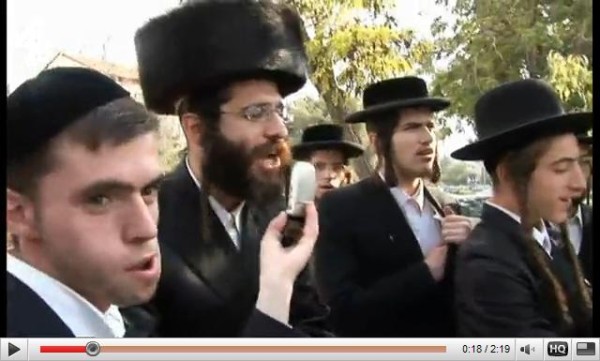
Reporter Evan Williams and director Alex Nott begin their journey in the Mea Sharim district of Jerusalem. It’s the heartland of ultra-Orthodox Jews known as the Haredi, or ‘those who fear God’. They find a poor, overcrowded part of the city where everyone is wearing clothes in the style of 18th-century Europe, from where most of their ancestors came. ‘We are the real Jews,’ says one community leader, ‘everyone else in Israel just happens to be born Jewish.’

Many of the Haredi sects were almost wiped out in the Holocaust. But their numbers are growing fast. Haredi are the fastest growing segment of Israeli society, with many families having as many as eight children. ‘Every 20 years we have a community that is growing at eight or nine times,’ says one of the Haredi men to Williams. ‘It means we are growing in size and influence.’

Many Haredi men in Israel don’t work as they receive government subsidies to spend their entire lives studying the Torah and religious texts. One Rabbi from the Reform wing of Judaism tells Williams that, because Haredis are exempt from military service and heavily subsidised, they are creating huge tensions within the country. [continued…]

Facebooktwittermail

Israel is lying to itself about ‘united Jerusalem’

Israel is lying to itself about ‘united Jerusalem’

Those types have always been seen on big-city streets, talking to themselves, asking and answering, shouting, speaking in a low voice, deliberating and pontificating. As children, we were afraid of them. They were “crazy.” That’s exactly what Israeli public discourse is like. We are talking to ourselves, inventing bogus axioms and sticking with them as if they were decreed from on high, convinced that the whole world accepts them. But we are only talking to ourselves. No one else accepts them. The Israeli collective is not only talking to itself, it’s deceiving itself completely.

Jerusalem is a perfect example of this. It’s a neglected city, filthy and in parts frightfully ugly, stricken by poverty and ignorance. Nationalist, religious and social tensions are tearing it asunder, and part of the city is under the burden of occupation with all its most violent characteristics. The purported education, culture, openness and prosperity – far from the actual situation – are the locus of our national aspirations.

It’s a capital city which not a single country in the world recognizes, but it’s “our eternal capital,” in the words of the prime minister. It’s a relatively marginal city, certainly when compared to Tel Aviv. From many standpoints it’s a city on the margins which secular Israelis don’t exactly flock to for a good time. It’s a city even the prime minister preaches about. But he doesn’t practice what he preaces when he flees the city for the weekend, whenever he can. It’s the “heart of the nation,” but a city that has gradually become the city of the ultra-Orthodox and the Arabs, society’s two poorest minorities. Continue reading

Facebooktwittermail

Jerusalem’s Jewish bigots

Mouths filled with hatred

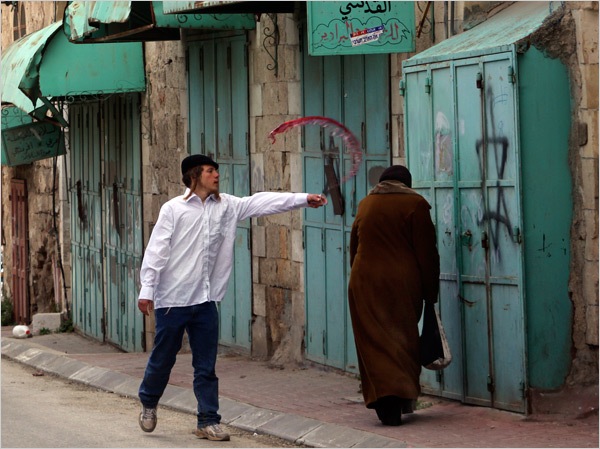
Father Samuel Aghoyan, a senior Armenian Orthodox cleric in Jerusalem’s Old City, says he’s been spat at by young haredi and national Orthodox Jews “about 15 to 20 times” in the past decade. The last time it happened, he said, was earlier this month. “I was walking back from the Church of the Holy Sepulchre and I saw this boy in a yarmulke and ritual fringes coming back from the Western Wall, and he spat at me two or three times.”

Wearing a dark-blue robe, sitting in St. James’s Church, the main Armenian church in the Old City, Aghoyan said, “Every single priest in this church has been spat on. It happens day and night.”

Father Athanasius, a Texas-born Franciscan monk who heads the Christian Information Center inside the Jaffa Gate, said he’s been spat at by haredi and national Orthodox Jews “about 15 times in the last six months” – not only in the Old City, but also on Rehov Agron near the Franciscan friary. “One time a bunch of kids spat at me, another time a little girl spat at me,” said the brown-robed monk near the Jaffa Gate.

“All 15 monks at our friary have been spat at,” he said. “Every [Christian cleric in the Old City] who’s been here for awhile, who dresses in robes in public, has a story to tell about being spat at. The more you get around, the more it happens.” [continued…]

Editor’s Comment — Larry Derfner underlines: “Every Christian cleric interviewed for this article stressed that they weren’t blaming Israeli Jewry as a whole for the spitting attacks; on the contrary, they said their general reception by Israeli Jews, both secular and religious, was one of welcome.”

Even so, the historical resonances of these particular expressions of Jewish bigotry, with their anti-Semitic European, segregated American and Apartheid South African counterparts, are inescapable:

A nun in her 60s who’s lived in an east Jerusalem convent for decades says she was spat at for the first time by a haredi man on Rehov Agron about 25 years ago. “As I was walking past, he spat on the ground right next to my shoes and he gave me a look of contempt,” said the black-robed nun, sitting inside the convent. “It took me a moment, but then I understood.”

Since then, the nun, who didn’t want to be identified, recalls being spat at three different times by young national Orthodox Jews on Jaffa Road, three different times by haredi youth near Mea She’arim and once by a young Jewish woman from her second-story window in the Old City’s Jewish Quarter.

But the spitting incidents weren’t the worst, she said – the worst was the time she was walking down Jaffa Road and a group of middle-aged haredi men coming her way pointed wordlessly to the curb, motioning her to move off the sidewalk to let them pass, which she did.

Derfner adds: “Christians in Israel are a small, weak community known for ‘turning the other cheek,’ so these Jewish xenophobes feel free to spit on them; they don’t spit on Muslims in the Old City because they’re afraid to, the clerics noted.”

The targets of such expressions of contempt are however not confined to members of the Christian clergy.

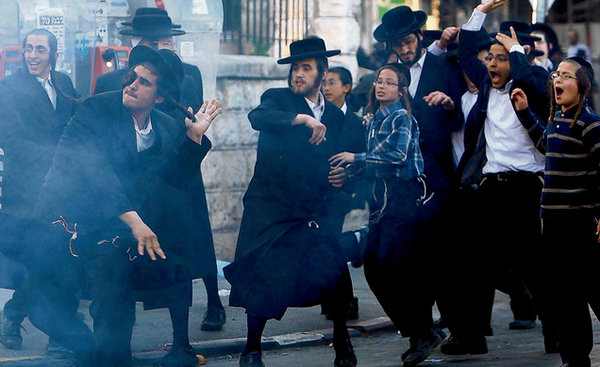
Anne Barker, a reporter for Australia’s ABC News, described an incident this summer in which she became a victim of ultra-Orthodox Jewish hatred while she covered what have become frequent demonstrations in Jerusalem by Jews intent on preserving the sanctity of the Shabbat which they see threatened by secularism.

I was mindful I would need to dress conservatively and keep out of harm’s way. But I made my mistake when I parked the car and started walking towards the protest, not fully sure which street was which.

By the time I realised I’d come up the wrong street it was too late.

I suddenly found myself in the thick of the protest – in the midst of hundreds of ultra-Orthodox Jews in their long coats and sable-fur hats.

They might be supremely religious, but their behaviour – to me – was far from charitable or benevolent.

As the protest became noisier and the crowd began yelling, I took my recorder and microphone out of my bag to record the sound.

Suddenly the crowd turned on me, screaming in my face. Dozens of angry men began spitting on me.

I found myself herded against a brick wall as they kept on spitting – on my face, my hair, my clothes, my arms.

It was like rain, coming at me from all directions – hitting my recorder, my bag, my shoes, even my glasses.

Big gobs of spit landed on me like heavy raindrops. I could even smell it as it fell on my face.

Somewhere behind me – I didn’t see him – a man on a stairway either kicked me in the head or knocked something heavy against me.

I wasn’t even sure why the mob was angry with me. Was it because I was a journalist? Or a woman? Because I wasn’t Jewish in an Orthodox area? Was I not dressed conservatively enough?

In fact, I was later told, it was because using a tape-recorder is itself a desecration of the Shabbat even though I’m not Jewish and don’t observe the Sabbath.

It was lucky that I don’t speak Yiddish. At least I was spared the knowledge of whatever filth they were screaming at me.

Facebooktwittermail

Intel Inside? Prove it.

Intel Inside? Prove it.

Here is a thought experiment. It is Sunday, and various employees of Intel’s R&D and consulting facility in Chantilly, VA, just outside of Washington, are working through the week-end. The facility is suddenly surrounded by several thousand evangelical Christians–mainly educated at Regent University, and led by the aged Pat Robertson–who demand that the company shut down the facility, so as not to violate the holy Sabbath. Windows are shattered by rock throwers. State police move in, but do not disband the mobs.

So Intel’s senior management go into a huddle. They authorize the local management team to meet with Robertson’s representatives, along with representatives from the Virginia governor’s office, now in the hands of rightist Republicans. At first Intel threatens to pull out of Virginia. But finally they approve a compromise agreement. The facility can stay open, the agreement states, but the shifts will be reduced. Also, on Sundays, only non-Christians can work there.

Imagine, in this fantasy, what the Intel board would face at the next shareholders’ meeting. Or imagine the employee emails the corporation’s global “Director of Diversity,” Rosalind Hudnell, would be fielding the next morning.

Well, if haven’t already heard, something quite like this just happened in Jerusalem.

A week ago Saturday, Intel’s facility on Har Ha’Hotzvim–a technology park in a belt of land near (but not at all in) the burgeoning ultraOrthodox neighborhood of Sanhedria–was surrounded and vandalized by acolytes of various Haredi rabbis, most notably, the leader of Eda, Rabbi Yitzhak Tuvia Weiss. Intel met with representatives of the Haredi groups, facilitated by Jerusalem Mayor Nir Barkat and Knesset Speaker Ruby Rivlin–both rightists tied to Haredi voters. The Sabbath shift, so the “compromise” stipulates, will be cut from 120 employees to 20. None of them will be Jews. (By the way, this absurd agreement may have satisfied most, but not Rabbi Weiss. His mobs were back yesterday demanding a complete shut down.) [continued…]

Editor’s Comment — The more exposed the conflict becomes between the forces of secularism and religious fundamentalism inside Israel, the more it would seem that Israel depends on durable external enemies as the indispensable means for forging national unity.

Bring an end to the Israeli-Arab conflict and Israel might well then rip itself apart.

Facebooktwittermail

The real demographic threat facing the Jewish state

At the edge of the abyss

The chapter on Israel in the U.S. State Department’s 2009 Report on International Religious Freedom, issued in October, presents Israel in an embarrassing light – as one of the 30 countries “where violations of religious freedom have been noteworthy.” According to the Americans, Israel is more similar to Russia or Turkey than it is to Saudi Arabia or Iran, but that’s small comfort.

The report addresses at length the fact that one-quarter of students in the Jewish school system in Israel do not study general subjects such as English, mathematics and the sciences, and will thus find it difficult to enter the labor market. Like most Israelis, the Americans do not draw the correct conclusions: The difficult situation of today is just a promo – if the current trend continues things will get much worse here.

According to studies carried out by economist Eli Berman of the University of California, San Diego, Israel’s ultra-Orthodox population doubles every 16 years. Thirteen percent of Israelis who are eligible for the draft each year “enlist” in yeshivas. The Israel Defense Forces predicts that in 10 years one in every four 18-year-olds will evade service by studying in a yeshiva. For a long time now the problem has gone beyond discrimination; we are on the brink of a problem of national security.

According to researchers of the Israel 2028 project, headed by Eli Hurvitz and David Brodet, barring a significant change to the fertility rate in the Haredi community, the ultra-Orthodox will represent more than one-fifth of Israel’s Jewish population in 2028. Continue reading

Facebooktwittermail

Gideon Levy on Israel’s addiction

Gideon Levy on Israel’s addiction

Gaza militant groups agree to stop firing rockets into Israel

Hamas has won an agreement from other militant groups in Gaza to halt rocket fire into Israel for the first time in almost a year, asboth sides indicated progress on a deal to release a captured Israeli soldier.

The agreement, announced , appears to be an attempt by the Palestinian Islamist movement to prevent another descent into fighting at a time when reconstruction has barely begun almost 12 months after the devastating conflict with Israel.

It also reflected more progress in secretly mediated talks to release Gilad Shalit, the soldier captured more than three years ago, in exchange for the return of hundreds of Palestinian prisoners. [continued…]

Gaza water unfit for human consumption: Palestinians

Water in the Gaza Strip is so salty that it is unfit for human consumption, a Palestinian official in charge of water supplies inside the besieged coastal territory said on Saturday.

“The water is no longer fit for human consumption, with analysis and international studies showing that just 10 percent of water in the Gaza Strip is usable… threatening the lives of Palestinians,” Munzir Shiblak warned.

He called in a statement for “the necessary measures to be taken to end the problem of salinity in Gaza water supplies, a problem that is getting worse.” [continued…]

Obama must deal with important questions of the Mideast conflict

For 41 years, Washington turned a blind eye. It protested a bit, scolded a bit, and mostly made do with periodically stating that its policy has not changed – it still opposes settlements in the territories and does not recognize the annexation of East Jerusalem or the Golan Heights. Suddenly, it gave us a resounding slap, but one of the frustrating kind that misses the cheek and flies through empty air. Because the American demand that we freeze construction in the settlements, that “strong message” containing a threat, has become a personal duel between Prime Minister Benjamin Netanyahu and U.S. President Barack Obama, in place of a clear policy presented by the latter.

Obama will win, of course. He can set a meeting with Netanyahu late at night, not answer the prime minister’s phone calls, warn him from the Great Wall of China and even order his officials to give Israel’s requests the cold shoulder. Obama already has managed to garner international support for his demand that Israel freeze settlement construction, even in Jerusalem, and American public opinion is on his side. If Obama wants to undermine Israel’s trust in the United States, or to prove to Netanyahu who is stronger, he does not have to work hard.

The American demand is proper, even if it is very late and unusually aggressive. However, its lack of context is infuriating. Freezing settlements is not a policy. Its entire purpose is to give Mahmoud Abbas, the resigning Palestinian Authority president, a reason to get back to negotiations. But negotiations cannot be a final goal, just as freezing settlements cannot be considered the ultimate achievement. What then? Is Abbas doomed to be a constant negotiator in endless negotiations? Does Washington have a plan for continuing negotiations? Continue reading

Facebooktwittermail

Kahane tribute may damage peace talks

Kahane tribute may damage peace talks

A plan by right-wing legislators in Israel to commemorate the anniversary this month of the death of Meir Kahane, whose banned anti-Arab movement is classified as a terrorist organisation, risks further damaging the prospects for talks between Israel and the Palestinians, US officials have warned.
A move to stage the commemoration in Israel’s parliament, the Knesset, is being led by Michael Ben-Ari, who was elected this year and is the first self-declared former member of Kahane’s party, Kach, to become a legislator since the movement was banned 15 years ago.

The US Embassy, in Tel Aviv, has sent a series of e-mails to Reuven Rivlin, the parliamentary speaker, asking that he intervene to block the event.

According to US officials, pressure is being exerted on behalf of George Mitchell, the US president Barack Obama’s envoy to the region, who is concerned that it will add to his troubles as Israeli and Palestinian leaders clash over a possible move by the Palestinians to issue a unilateral declaration of statehood.

Some Israeli legislators have warned that Mr Ben-Ari and his supporters are gaining a stronger foothold in parliament, in an indication of the country’s increasing lurch rightwards.

“Ben-Ari and the advisers he has brought with him are unabashed representatives for Kach and Kahane’s ideas,” said Ahmed Tibi, an Arab legislator and the deputy speaker. “What we have is in effect a terrorist cell in the parliament.” [continued…]

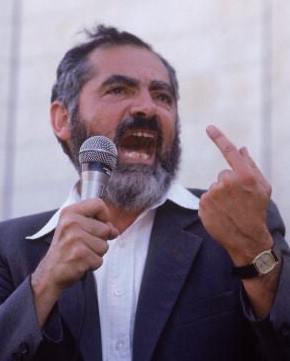
Editor’s Comment — Beyond the fact that Rabbi Meir Kahane was bad for Israel’s international image and that he fomented hostility between Jews and Palestinians, Kahane no doubt antagonized moderate Zionists by unmasking the contradictions implicit in the notion of a Jewish democratic state.

The following videos contain a CBS 60 Minutes report on Kahane from 1984. (The second part of the report is followed by a song eulogizing Kahane. Whoever put this on YouTube is clearly a shameless Kahanist.)

Kahane was describing the “demographic threat” facing Israel well before that phrase and that concept was lent a veneer of political respectability by becoming the fact that, for Zionists, makes the realization of a two-state solution an imperative.

Interestingly, back in 1984, an American journalist — Mike Wallace — had no problem asserting on national television that Israel’s claim to be democratic would require accepting the possibility that Palestinians might at some point become the majority.

Wallace, in the setup for the interview clip says: “Kahane asks his Jewish opponents how they would react to an Arab majority in Israel?”

Rabbi Meir Kahane: In theory, do they [the Palestinians] have a right to be the majority? Yes or no? They [Kahane’s opponents] can’t answer that. They cannot answer that question.

Wallace: If Israel is a democratic state, then obviously they [the Palestinians] obviously do [have a right to be in the majority].

Kahane: Right. But if it’s a Zionist state then obviously they don’t.

Wallace: But you’re the one who finds it impossible to accept both Zionism and democracy in the same state.

Kahane: Anyone does, because Zionism — the very definition of it is: the creation of a Jewish state — and in fact, Israel is defined in its declaration of independence as the “Jewish” state. You think that that makes Arabs feel happy. You think that Arabs rush into the streets on Independence Day in Israel to celebrate their defeat.

I think that only liberals have such contempt for Arabs that they believe you can buy an Arab’s national pride by raising his living standards. Not by bread alone does an Arab live.

Because I respect the Arab, I want to throw him out.

Later in the 60 Minutes report, Kahane is shown outside city of Umm al-Fahm, the second largest Palestinian city within Israel, saying in reference to some of its residents who are protesting his presence: “I want to make it clear to those dogs that are standing there, there is no such thing as an Arab village in the state of Israel.”

Facebooktwittermail

Israel: Apartheid and beyond

Beyond compare

While South Africa was explicit about the goal of apartheid policies, Israel engages in discursive subterfuge so that the intent and effects of their policies must be seen on the ground to be fully comprehended. Shulamit Aloni, the former Israeli minister of education, relates an episode at a bypass road built for settlers in the West Bank:

On one occasion I witnessed such an encounter between a driver and a soldier who was taking down the details before confiscating the vehicle and sending its owner away. ‘Why?’ I asked the soldier. ‘It’s an order—this is a Jews-only road,’ he replied. I inquired as to where was the sign indicating this fact and instructing [other] drivers not to use it. His answer was nothing short of amazing. ‘It is his responsibility to know it, and besides, what do you want us to do, put up a sign here and let some anti-Semitic reporter or journalist take a photo so that can show the world apartheid exists here?’

Part of the appeal of the apartheid comparison is that apartheid is a recognized name for an ideology and practice of separation. There is no similar name for what Israel has done. Neither the pre-state Zionist movement nor the state of Israel has ever spelled out an official policy of discrimination against the Palestinians, and Israel did not institute discriminatory practices in one fell swoop. Instead, it has worked in a piecemeal fashion to constrain Palestinian rights and access to resources. In other words, separation in the Occupied Territories has been a process whose legal contours are harder to discern and whose name has yet to circulate abroad.

A corollary assumption underlying the comparison is that Israeli practices cannot be condemned as discriminatory in and of themselves. They cannot stand on their own, partly because they are difficult to understand unless they are seen up close. Most people understand that Zionism, as an ideology and a project, calls for Jewish communal security, and due to centuries of pogroms and the Holocaust, this project commands considerable sympathy. But many people do not understand that Zionism, as put into practice, calls for an exclusivist state that leads to policies characteristic of apartheid, as defined by the UN.

Zionism retains a significant body of supporters in the West, particularly among Jews and evangelical Christians, but also the public at large. For numerous historical, cultural and political reasons, the American public in particular “stands with Israel,” a fact demonstrated by poll after poll and not lost on successive US administrations. Israel and its backers work constantly to cement this support, in part by equating criticism of Israel, the “Jewish state,” with anti-Semitism. Thus, drawing attention to the parallels between Israel’s occupation and apartheid has been one way to turn the tables, framing the occupation (and not criticism of Israel) as inherently racist. But the introduction of race into the conversation heats it up to the boiling point: As the Jews of Europe suffered from persecution and genocidal racism, and Jews comprised a large percentage of the white Americans who put their bodies on the line for civil rights, equating the practices of Zionism with racism is, for many, inconceivable. Rational debate shuts down.

It may be time to develop a new language. “Apartheid” cannot thoroughly explain Zionist ideology or Israeli practices. It can simply offer broad points of comparison, a framing in an already powerful concept. Yet the Afrikaans term does have a Hebrew counterpart in the term hafrada, meaning separation from and putting distance between oneself and others, in this case, the Palestinians. In Hebrew, the wall is often referred to as the “hafrada barrier.” [continued…]

Editor’s Comment — I seriously doubt whether any effort to develop new language can ever work. We don’t need new terms — we need to bring about a shift in the way existing terms are used.

Apartheid was a system that Africaners believed in and legally institutionalized. The campaign against apartheid was an effort to delegitimize an idea that held legitimacy in the minds of its proponents. And that seems to be the key: people give names to the things they believe in. Efforts in “discursive subterfuge” are efforts to avoid naming that which needs to be denied.

The concept of hafrada has arisen (from what I understand) in an effort to legitimize a policy of separation, yet that policy carries with it the notion that this separation comes out of a security imperative rather than an ideological conviction. It amounts to saying: We don’t want separation but the Palestinians made us do it.

The implication is that Israelis are good Western pluralists who are not racists and who would happily co-exist with their neighbors if only their neighbors could forsake their violent tendencies.

Julie Peteet says: “Perhaps the Hebrew hafrada can one day become a rallying cry as powerful as “apartheid” was in its day.”

To my mind the much more likely candidate is Zionism.

Although this is a word that is a long way from completely losing mainstream legitimacy, it has over the decades acquired increasingly negative connotations. It is a word that seems to have entered a netherworld. Self-described Zionists tend to be right-wing. Liberal Zionists either refrain from unabashedly calling themselves Zionists or they strongly emphasize the “liberal” qualification. Yet Zionism, of whatever political stripe, has at its core the notion of Jewish sovereignty in a Jewish homeland.

What does that mean? The clearest expression that I have recently heard comes from Rabi Toba Spitzer, an American Jew who in a promotional video for J Street underlined this as one of Israel’s core attributes: “[Israel is] the one place in the world where Jews are in charge.”

Whatever Israel’s future — whether its international boundaries can be agreed upon and whether a Palestinian state can be created — the continuation of Israel’s existence as a Jewish state depends on this: that it remains a state where Jews are in charge.

This, it seems to me, reveals the unvarnished nature of Zionism and exposes Israel’s hollow claim to be democratic.

Democracy is government by the demos — the people — and it allows no distinction between the multitude of groups whose amalgamation constitutes “the people”.

Jewish democracy, built on the fantasy of “a land with no people for a people with no land”, has in its practice used “democracy” as a salve to its liberal conscience, yet in the conflict between its Jewish identity and its democratic identity, democracy has consistently lost.

Israel’s enemy within: A rising militancy from the Jewish settlements

The terrorist walked up the quiet alleyway, police say, and went down nine steps and found himself hidden from view in the stone vestibule outside the famous Holocaust survivor’s apartment.

More than a half century ago the Nazis hadn’t been able to kill Ze’ev Sternhell, who would live to become Israel’s foremost expert on fascism and a long-time peace activist. But the terrorist who was now on his door step, whom police allege was a fellow Israeli from the militant settlement movement, was determined to succeed in just that. He attached the bomb, hidden inside a plant, to the doorknob and left.

Sternhell was inside the apartment in West Jerusalem. It was Sept. 25, 2008 and he and his wife had returned from a vacation in Paris the previous day. The hallway leading to the front door was still clogged up with their bags. It was late, a few minutes after midnight, and just like he does every night, Sternhell went to close the metal gate at the entrance of the vestibule that is meant to keep unwelcome guests from breaking and entering. The obstruction in his hallway forced Sternhell to turn sideways, the right side of his body facing outside, as he opened the door to the apartment.

There was a huge noise and something pushed him back. He saw the flash of an explosive. His right leg and thigh stung with pain and began to bleed. He was rushed to hospital in an ambulance. Doctors told him later that if he had not been sideways to the blast, his abdomen would likely have been pierced by the bomb’s shrapnel. He could have died.

Police who came to the scene found leaflets scattered nearby. The fliers offered a reward of $300,000 to anyone who killed a member of Peace Now, Israel’s best known peace movement. “The State of Israel has become our enemy,” the fliers said. Police officers immediately went to guard the home of Peace Now’s most-prominent figure, general secretary Yariv Oppenheimer.

I interviewed Sternhell in his home this January. The police had made no arrests back then, but Sternhell was convinced that fellow Jews had tried to kill him. “This,” said the 73-year-old, whose mother and sister were killed by the Nazis when he was 7 years old, “was an act of pure Jewish terror.” [continued…]

Rights groups: Israeli ambulance rules discriminate

Human rights groups are calling on the Israeli government to cancel instructions preventing ambulances from entering Palestinian neighborhoods in East Jerusalem without a police escort.

According Adalah, The Legal Center for Arab Minority Rights in Israel, Magen David Adom (MDA) ambulances “must wait in a Jewish neighborhood adjacent to the Palestinian neighborhood and may not enter it to transfer the injured or the sick person to the hospital until a police escort arrives, even in life threatening situations.”

In many cases, patients face long delays in receiving treatment, and must be transferred by their own family’s cars, risking complications or increased severity of illness, the rights advocates say.

In a news release on Thursday, Adalah said the procedures “violate the first rule in the work of emergency crews, which is to provide medical aid as soon as possible, and the state’s obligation to ensure the life and physical well-being of each person under its authority.” [continued…]

Facebooktwittermail

Why has the left in Israel vanished?

Why has the left in Israel vanished?

he threats uttered against a possible Palestinian declaration of independence by our leaders Benjamin Netanyahu, Avigdor Lieberman and Ehud Barak let the Israeli sanctimony (usually tedious and belabored) drop to the floor for a moment, like a woman’s slip. It exposed the ugly skeleton of force that gives only us freedom of speech – we’re permitted, you’re forbidden. We are allowed to reiterate Israel’s Declaration of Independence over and over. You are not allowed to do so with yours.

The simplest explanation for our privileges, and one that is becoming increasingly significant, is the religious one – the land is ours, from God, not theirs, so we’re allowed to declare independence or harm civilians. The simplest explanation offered by secular people of those privileges is force – we’re strong. These two explanations are the axis of consensus. In the name of this consensus, the military rabbis and officers in the Israel Defense Forces, equipped with equal amounts of hysteria, set out to incite the units on their way to kill in Gaza. Continue reading

Facebooktwittermail

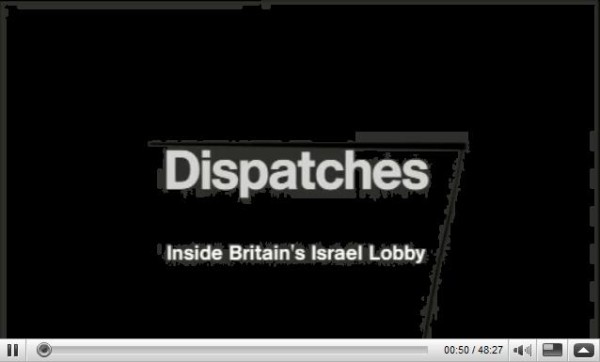
Dispatches: Inside Britain’s Israel Lobby

Dispatches: Inside Britain’s Israel Lobby


(Click on the image above to watch this 48-minute documentary — it’s essential viewing.)

Dispatches investigates one of the most powerful and influential political lobbies in Britain, which is working in support of the interests of the State of Israel.

Despite wielding great influence among the highest realms of British politics and media, little is known about the individuals and groups which collectively are known as the pro-Israel lobby.

Political commentator Peter Oborne sets out to establish who they are, how they are funded, how they work and what influence they have, from the key groups to the wealthy individuals who help bankroll the lobbying.

He investigates how accountable, transparent and open to scrutiny the lobby is, particularly in regard to its funding and financial support of MPs.

The pro-Israel lobby aims to shape the debate about Britain’s relationship with Israel and future foreign policies relating to it.

Oborne examines how the lobby operates from within parliament and the tactics it employs behind the scenes when engaging with print and broadcast media.

Editor’s Comment — It’s hard to predict when the day might come when a broadcast of this nature appears on American television, but if such a day comes, the Lobby here will suffer an irreparable damage in its foundations.

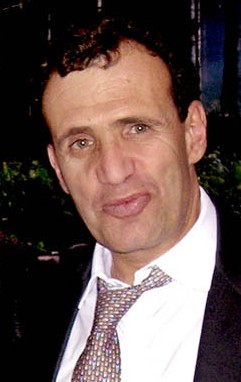
To learn more about a man who figures prominently in the Channel 4 documentary — Chaim “Poju” Zabludowicz, who sounds and looks like a Jewish mafia boss — see the article below.

How the pro-Israel lobby in Britain benefits from a generous London tycoon

Britain’s most active pro-Israeli lobbying organisation – which flies journalists to Israel on fact-finding trips and organises access to senior government figures – has received nearly £1.4m in two years from a billionaire donor whose father made a fortune manufacturing arms in Israel.
The British Israel Communication and Research Centre, known as Bicom, has been one of the most active organisations behind the scenes in the UK during the present Gaza offensive, organising briefings and interview opportunities with senior Israeli spokesmen.

Its biggest funder is Poju Zabludowicz, a London-based tycoon, who has underwritten its campaigning since 2007. The disclosure comes amid an intense struggle in Britain between lobbying organisations working for both sides in the conflict. Foreign affairs specialists say that the injection of funds has ensured that Bicom has become one of the most persistent and slickest media operations in the battle for influence over opinion formers. [continued…]

Facebooktwittermail

Who’s in charge of the language here?

“… who is in charge of the language here?”

After Israeli officials flatly refused a US request to block the approval for the construction of 900 new housing units in occupied East Jerusalem, the Obama administration “lashed out” (CBS) with “anger” (New York Times) and “sharply criticized” (Wall Street Journal) Israel’s decision.

The White House unleashed a shocking display of… “dismay.”

We are dismayed at the Jerusalem Planning Committee’s decision to move forward on the approval process for the expansion of Gilo in Jerusalem.

Thankfully, AP’s Matt Lee wasn’t as obliging as some of his colleagues in their efforts to pump vigor into a pathetic statement.

Challenging State Department spokesman Ian Kelly, Lee asked:

You can’t come up with anything stronger than “dismaying”? I mean, this flies in the face of everything you’ve been talking about for months and months and months.

Kelly: It’s dismaying.

Lee: Yeah, you can’t offer a condemnation of it or anything like that? (Laughter.) I mean, who is in charge of the language here?

On the other side of the Atlantic, Britain’s Foreign Office was a tad more forthright if not quite fiery: “this decision is wrong and we oppose it.”

That kind of language is apparently too strong for this White House. In fact, having originally put out a statement referring to planned “Settlement Expansion in Jerusalem”, the mamby pamdys in charge of language in the most powerful executive office in the world decided to retract “settlement expansion” and simply titled it a statement “on Jerusalem”.

So, the Obama administration is “dismayed” by Israel’s behavior.

It may well be that the word was chosen with exquisite care. It’s etymology is all too appropriate:

Middle English dismaien, from Anglo-Norman *desmaiier : probably de-, intensive pref.; see de- + Old French esmaier, to frighten (from Vulgar Latin *exmagāre, to deprive of power : Latin ex-, ex- + Germanic *magan, to be able to).

The White House could have said:

Prime Minister Netanyahu. You have exposed our impotence. Alas, we have no power.

Should anyone be dismayed at the White House’s language?

Only if you’ve been ignoring the news for the last few months and still imagine that Obama’s speech in Cairo was genuinely a highlight of his presidency.

Bibi goes nuclear on Jerusalem settlements

The plan, if implemented, will allow the construction of 844 units, and these units won’t be inside the existing footprint of the settlement. Rather, they will be on the settlement’s southwestern flank, expanding Gilo in the direction of the Palestinian village of Wallajeh (a village in which a large number of the homes are fighting Israeli demolition orders). This new Gilo plan clearly dovetails with another plan to build a new settlement, called Givat Yael, which would straddle the Jerusalem border and significantly extend Israeli Jerusalem to the south, further sealing the city off from the Bethlehem area and the West Bank (and connecting it to the Etzion settlement bloc). That plan, it was reported yesterday, also appears to be suddenly gaining steam. (for a map showing both the Gilo plan and Givat Yael, click here.)

The Gilo plan is thus extremely provocative on several levels. It represents a clear and public statement from the Netanyahu government that it is neither “freezing” nor acting with “restraint” in East Jerusalem. It compels the Palestinians to respond, just as it compels other regional actors to respond. Finally, it has important strategic implications, since the plan, implemented, would impact on border options for Jerusalem under a future peace agreement.

Today’s crisis was by no means inevitable. Nobody (except for those of us who obsessively follow Jerusalem at its most minute level) had any idea this Gilo plan was on the agenda for today. This means that Bibi could easily have responded positively to US concerns and quietly quashed or delayed the project, without any political cost. Alternatively, he could have offered another (deceptively) constructive course, like allowing it to be deposited for public review but promising to find other ways to hold it up later. Or he could simply have refused to intervene, but kept quiet about it – letting today’s technical approval process run it course and only react publicly, after the fact.

Bibi had a number of conventional options; he chose to go nuclear.

If this feels familiar, it should. This is basically what happened earlier this year with the Shepherds Hotel settlement in Sheikh Jarrah. The plan was on the agenda, Washington weighed in firmly but quietly, hoping for firm but quiet action by Netanyahu – and instead they got a story leaked to the Israeli media (in fact, to the same journalist who broke today’s Gilo story), turning it into an opportunity for Netanyahu to burnish his Jerusalem credentials, at the expense of the prospects for peace. [continued…]

Facebooktwittermail

Goldstone to Haaretz: U.S. does not have to protect Israel blindly

Goldstone to Haaretz: U.S. does not have to protect Israel blindly

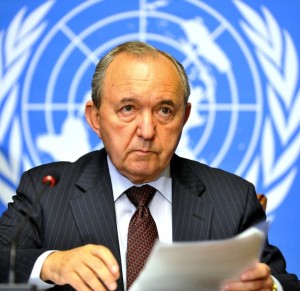
The Goldstone report is expected to be raised for discussion in the United Nations Security Council in the near future, and Goldstone Thursday discussed the possibility that the United States would veto any resolution that would hurt Israel when it comes to the implementation of the report’s findings. “I do not believe that any nation should protect another nation blindly. I would prefer to see the United States furnish reasons for criticizing the report. The United States has supported our call for credible investigations by Israel and by the Gaza authorities, whether the PA or Hamas,” he said.

Goldstone reiterated statements he has made, as well as those made by a number of Israeli human rights groups, inviting an open, public investigation and categorically rejecting a probe by the Israel Defense Forces of the Gaza campaign. “It does not suffice for the military to investigate itself. That will satisfy very few people and certainly not the victims.”

However Goldstone stressed that “in any public inquiry, it would be open to the Israeli government and the IDF to have sensitive security information protected from public disclosure.”

When asked how far up the chain of command he felt such a criminal investigation should go, and whether decision-makers in government be its subject, he replied: “A criminal investigation should go as high up the chain of command, both military and civilian, as the evidence justifies.” [continued…]

Facebooktwittermail

Israeli Jews and the one-state solution

Israeli Jews and the one-state solution

Ultimately, as we now know, the combination of internal resistance and international isolation did force whites to abandon political apartheid and accept majority rule. However, it is important to note that the combined strength of the anti-apartheid movement never seriously threatened the physical integrity of the white regime.

Even after the massive township uprisings of 1985-86, the South African regime was secure. “So far there is no real physical threat to white power,” The Economist noted, “so far there is little threat to white lives. … The white state is mighty, and well-equipped. It has the capacity to repress the township revolts far more bloodily. The blacks have virtually no urban or rural guerrilla capacity, practically no guns, few safe havens within South Africa or without.”

This balance never changed, and a similar equation could be written today about the relative power of a massively-armed — and much more ruthless — Israeli state, and lightly armed Palestinian resistance factions.

What did change for South Africa, and what all the weapons in the world were not able to prevent, was the complete loss of legitimacy of the apartheid regime and its practices. Once this legitimacy was gone, whites lost the will to maintain a system that relied on repression and violence and rendered them international pariahs; they negotiated a way out and lived to tell the tale. It all happened much more quickly and with considerably less violence than even the most optimistic predictions of the time. But this outcome could not have been predicted based on what whites said they were willing to accept, and it would not have occurred had the ANC been guided by opinion polls rather than the democratic principles of the Freedom Charter.

Zionism — as many Israelis openly worry — is suffering a similar, terminal loss of legitimacy as Israel is ever more isolated as a result of its actions. Israel’s self-image as a liberal “Jewish and democratic state” is proving impossible to maintain against the reality of a militarized, ultra-nationalist Jewish sectarian settler-colony that must carry out frequent and escalating massacres of “enemy” civilians (Lebanon and Gaza 2006, Gaza 2009) in a losing effort to check the resistance of the region’s indigenous people. Zionism cannot bomb, kidnap, assassinate, expel, demolish, settle and lie its way to legitimacy and acceptance. [continued…]

Facebooktwittermail

What Goldstone says about the US

What Goldstone says about the US

… if Israel is guilty of committing systematic war crimes across Gaza and the West Bank, then the US, which supported, funded and armed Israel during the war, is an accessory to those crimes.

Goldstone explains in no uncertain terms that Gaza was not an aberration in terms of Israel’s treatment of Palestinians.

Rather, it marked not only a continuation of Israel’s behaviour during the 2006 invasion of Lebanon, but “highlights a common thread of the interaction between Israeli soldiers and Palestinian civilians which emerged clearly also in many cases discussed in other parts of the report.

It referenced continuous and systematic abuse, outrages on personal dignity, humiliating and degrading treatment contrary to fundamental principles of international humanitarian law and human rights law”.

“The Mission concludes that the treatment of these civilians constitutes the infliction of a collective penalty on those persons and amounts to measures of intimidation and terror. Such acts are grave breaches of the Geneva Conventions and constitute a war crime,” the report says.

Put simply, if there is blood on Israel’s hands, than it is has dripped all over America’s shirt.

Israel could not and would not have engaged in the level of wholesale destruction of Gaza painstakingly catalogued in the report without the support of the outgoing Bush administration, and acquiescence of the incoming Obama administration. [continued…]

Facebooktwittermail

Why the US will not cut aid to Israel

Department of meaningless gestures

Two eminent mainstream journalists — Tom Friedman and Joe Klein — recently called for United States to disengage from the Israeli-Palestinian peace process, on the grounds that Palestinians were too divided to make a deal and the Israelis were not interested in one. Friedman couldn’t bring himself to draw the logical conclusion — if the United States [is] truly going to “disengage,” that also means cutting off its economic and military assistance — but Klein did.

I have a certain sympathy for this position (and even wrote similar things myself before I wised up), but there are two problems with this specific idea. The first is that it is a meaningless prescription: There’s no way to cut the aid package (or even put a hold on it, which is what Klein recommends) so long as Congress is in hock to AIPAC and the other groups in the status quo lobby. And unless I’ve missed something, I doubt groups like J Street would support it either.

Friedman and Klein’s statements do convey how discourse in the United States is changing, but the specific recommendation they offer here is a non-starter. Remember: we are dealing with a Congress that just voted to condemn the Goldstone Report by a vote of 344-24. The aid package may be indirectly subsidizing the settlements and threatening Israel’s future as a Jewish majority state, but a supine House and Senate will still sign the annual check. [continued…]

Editor’s Comment — The perennial debate on whether the US will ever find the will to cut off aid to Israel invariably misses what is ultimately probably the most important sticking point: a lion’s share of the money that Congress allocates as foreign military aid ends up going back into the US economy. Members of Congress face pressure not only from the Israel lobby but also the defense industry lobby and in many cases their own constituents to keep on doling out the cash.

The Israeli government is currently in the process of negotiating its largest military purchase ever: 25 F-35 fighters at a cost of $3.25 billion, paid to Lockheed-Martin who will start delivery in 2014. Interestingly, Israel has the ability to allocate funds coming from US taxpayers that will appear in US budgets that have yet to be passed or even drafted by Congress!

So, if the White House is not about to call on Congress to cut back on aid to Israel, the one lever over which it retains absolute control is the way the US casts votes in the UN Security Council. I’m not holding my breath waiting for any surprises there.

Perhaps more significant than anything happening (or not happening) in Washington, is the process unfolding around the globe through which Israel is inexorably losing its legitimacy.

When Michael Oren, the Israeli ambassador to the US, warns about the delegitimization of Israel he is giving voice to a real fear among Israelis. That fear is given form when people such as the French Foreign Minister Bernard Kouchner says Israel does not want peace:

“What really hurts me, and this shocks us, is that before there used to be a great peace movement in Israel. There was a left that made itself heard and a real desire for peace,” Kouchner said on France Inter radio.

“It seems to me, and I hope that I am completely wrong, that this desire has completely vanished, as though people no longer believe in it,” he added.

Israel clings to a tenuous claim to being a peace-loving nation. Once the world completely loses faith in that notion, the path to pariah status will be hard to avoid.

Facebooktwittermail

Israeli rabbi approves murder of non-Jews

Israeli rabbi approves murder of non-Jews

A book published this week by a radical Jewish rabbi from the Israeli-occupied West Bank and endorsed by prominent religious right-wing figures suggests killing any non-Jew, including children and babies, who pose a threat to Israel.

The book’s publication, just days after the arrest of Jewish settler Jack Teitel, who is charged with a string of killings, including two Palestinians, reflects a growing antipathy towards Palestinians among Jews living in the occupied territory.

Michael Warschawski, the founder of the Jerusalem-based Alternative Information Centre, said the book went public with a concept that was already being promoted in a quieter way by dozens of settler rabbis in internal community newspapers and speeches. [continued…]

Facebooktwittermail