Category Archives: Israel

The attacks on Goldstone

In Haaretz, Hagai El-Ad writes:

What will they come up with next? The campaign to discredit Judge Richard Goldstone, his fact-finding commission and the report that now bears his name seems to reach new heights every week. The latest installment in this high-drama farce has been the revelations about Goldstone’s record during apartheid-era South Africa, and the implication that his report can therefore be disregarded. The mind reels at the intensity of attempts by Israeli officials and others to do everything to dodge the real questions of accountability, policy and justice that have been lingering inconveniently since Operation Cast Lead. But inconvenient questions do tend to linger, and the attempts to deploy an ever-thicker smokescreen usually only draw more attention to what may be hidden behind it.

And yet, the recent attacks on Goldstone have been helpful in re-introducing into public discourse what is perhaps the most important question of all: moral responsibility. How must individuals behave when faced with injustice? What do we expect from our judges, public servants and elected officials? And what do we expect from ourselves? The focus on Goldstone’s past, far from enabling us to escape the lingering questions of Cast Lead – and other questions that must trouble anyone seeking justice – actually serves to throw them into sharp relief.

So here are some complementary questions about justice and those involved in its disservice. And mind you, these questions were not drawn from a far-away past, but from the here-and-now. It is the present that will determine our future – and to what extent justice will be a part of it.

Consider this: What is the reader’s moral judgment of a law that allows some people to reclaim past ownership rights but denies the same rights to others? This is the question today in Sheikh Jarrah.

How just do we deem the conduct of legal advisers who approve the evacuation of longtime indigenous residents from the center of a thriving city, enforcing almost complete separation between the hundreds who have moved in and the thousands who were displaced? This is the question today in Hebron.

What do we think of military commanders who collectively punish more than a million human beings, systematically answering their nutritional needs with provisions that keep them just above a state-secret “red line”? This is the question today in Gaza.

Facebooktwittermail

Obama wants US taxpayers to pay for an Israeli defense ‘scam’

Israel’s newly developed “Iron Dome” missile defense shield will supposedly provide vital protection from rocket attacks from Gaza or Lebanon.

The system’s manufacturer, Rafael Advanced Defense Systems, says:

The Iron dome is a cost effective system that can handle multiple threats simultaneously and efficiently [and] has been selected by the Israeli Defense Ministry as the best system offering the most comprehensive defense solution against a wide range of threats in a relatively short development cycle and at low cost.

Israel receives $3 billion annually in military aid from US taxpayers, so you’d imagine that the Israeli government would allocate some of that generous aid to pay for Iron Dome. No, instead President Obama just agreed that we should chip in an extra $205 million because Iron Dome “addresses an immediately existing threat to each Israeli citizen,” a senior administration official said.

But while Israel isn’t willing to cover the cost of deploying this system, it is already looking at opportunities to sell it to NATO.

As for the “low cost” the manufacturers tout, perhaps what they mean is that it will be a low cost for Israelis so long as its paid for by Americans. Whether the system would have any real value — that’s a completely different question.

Some of the harshest criticism of the system comes from inside Israel where Tel Aviv University professor and noted military analyst Reuven Pedatzur charged that despite the well-known ineffectiveness of Iron Dome and other missile defense systems, “for the aeronautics and defense industries, it’s a matter of money; and for politicians, supporting such projects allows them to tell the public that they’re doing something, they’re trying to find answers to the threats we face.”

“The Iron Dome is all a scam,” he said. “The flight-time of a Kassam rocket to Sderot is 14 seconds, while the time the Iron Dome needs to identify a target and fire is something like 15 seconds. This means it can’t defend against anything fired from fewer than five kilometers; but it probably couldn’t defend against anything fired from 15 km., either.”

Added Pedatzur: “Considering the fact that each Iron Dome missile costs about $100,000 and each Kassam $5, all the Palestinians would need to do is build and launch a ton of rockets and hit our pocketbook.

The David’s Sling is even worse, he said. “Each one of its missiles costs $1 million, and Hizbullah has well over 40,000 rockets. This issue has no logic to it whatsoever.”

Facebooktwittermail

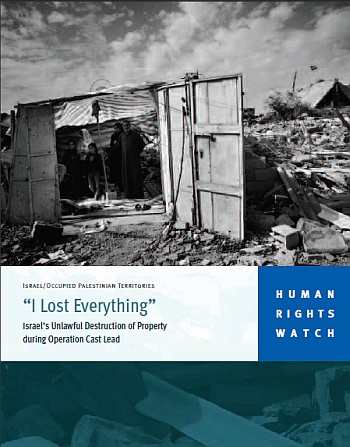
Israel’s unlawful destruction of property during Operation Cast Lead

In a press release, Human Rights Watch said today:

Israel should investigate the unlawful destruction of civilian property during the 2009 Gaza hostilities and lift the blockade that hinders residents from rebuilding their homes, Human Rights Watch said in a new report released today.

The 116-page report, “‘I Lost Everything’: Israel’s Unlawful Destruction of Property in the Gaza Conflict” documents 12 separate cases during Operation Cast Lead in which Israeli forces extensively destroyed civilian property, including homes, factories, farms, and greenhouses, in areas under their control, without any lawful military purpose. Human Rights Watch’s investigations, which relied upon physical evidence, satellite imagery, and multiple witness accounts at each site, found no indication of nearby fighting when the destruction occurred.

Israel has claimed that its forces destroyed civilian property only when Palestinian armed groups were fighting from it, or were using it to store weapons, hide tunnels, or advance other military purposes. Israel also claims that many Gazan homes were destroyed by Hamas booby-traps. The evidence in the incidents that Human Rights Watch investigated does not support such claims.

“Almost 16 months after the war, Israel has not held accountable troops who unlawfully destroyed swaths of civilian property in areas under their control,” said Sarah Leah Whitson, Middle East director at Human Rights Watch. “Israel’s blockade continues to keep Gazans from rebuilding their homes, meaning that Israel is still punishing Gaza’s civilians long after the fighting is over.”

Human Rights Watch found evidence in the 12 cases indicating that Israeli forces carried out the destruction for either punitive or other unlawful reasons, violating the prohibition under international humanitarian law – the laws of war – against deliberately destroying civilian property except when necessary for lawful military reasons. In seven of the cases, satellite imagery corroborated eyewitness accounts that Israeli forces destroyed many structures after establishing control over an area and shortly before Israel announced a ceasefire and withdrew its forces from Gaza on January 18, 2009.

Israel’s comprehensive blockade of the Gaza Strip, a form of collective punishment against civilians imposed in response to Hamas’s takeover of Gaza in June 2007, has prevented significant reconstruction, including in areas where Human Rights Watch has documented destruction. Israel has allowed imports of cement for several repair projects, but United Nations Secretary-General Ban Ki-moon noted in late March that these were “a drop in a bucket” compared to housing needs.

Israeli officials insist that the blockade – which had already degraded humanitarian conditions in Gaza before Operation Cast Lead – will remain in place until Hamas releases Staff Sergeant Gilad Shalit, the Israeli soldier captured in 2006, rejects violence, and fulfills other political conditions. Hamas’s prolonged incommunicado detention of Shalit violates the prohibition of cruel and inhuman treatment and may amount to torture.

Many goods are being smuggled into Gaza through tunnels beneath the southern border with Egypt, and many damaged buildings have been repaired at least partially with bricks made from smuggled cement and recycled concrete rubble. However, these improvised building materials are reportedly of poor quality and cannot be used for large reconstruction projects. In the areas of Gaza where Human Rights Watch found that Israeli forces had destroyed homes in areas under their control, there has been virtually no reconstruction of destroyed buildings, indicating that the inadequate supply of reconstruction materials still leaves these materials prohibitively expensive for most of Gaza’s residents, more than three-quarters of whom are impoverished.

Egypt shares responsibility for the collective punishment of Gaza’s civilian population due to its own closure of Gaza’s southern border. Except in limited circumstances, Egypt refuses to allow the passage of goods or people through the border crossing it controls at Rafah.

The laws of war prohibit attacks on civilian objects, including residential homes and civilian factories, unless they become a legitimate military objective, meaning that they are providing enemy forces a definite military advantage in the circumstances prevailing at the time. The report examines incidents of destruction that suggest violation of the laws-of-war prohibition of wanton destruction – the term used to describe extensive destruction of civilian property not lawfully justified by military necessity. Such destruction would be a grave breach of the Fourth Geneva Conventions of 1949, which is applicable in Gaza. Individuals responsible for committing or ordering such destruction should be prosecuted for war crimes.

Human Rights Watch did not include in its report cases in which the destruction was not extensive, or the evidence suggested any possibility that Israel’s destruction of the property in question could have been militarily justified or based on mistaken information.

Human Rights Watch documented the complete destruction of 189 buildings, including 11 factories, 8 warehouses and 170 residential buildings – roughly 5 percent of the total property destroyed in Gaza – leaving at least 971 people homeless. In the cases investigated in the neighborhoods of Izbt Abd Rabbo, Zeitoun, and Khoza’a, Israeli forces had destroyed virtually every home, factory, and orchard within certain areas, indicating an apparent plan of systematic destruction in these locations. The destroyed industrial establishments include juice and biscuit plants, a flour mill, and seven concrete factories. Human Rights Watch did not determine whether these incidents represent a broader pattern, but Israel should thoroughly investigate these cases – including the lawfulness of any relevant policy decisions – and appropriately punish persons found to have acted unlawfully.

“The evidence shows that, in these cases, Israeli forces gratuitously destroyed people’s homes and livelihoods,” said Whitson. “If the Israeli government doesn’t investigate and punish those responsible, it would be effectively endorsing the suffering that these civilians have endured.”

Israel Defense Forces (IDF) lawyers told Human Rights Watch that the IDF is probing many of the cases of property destruction documented in this report. However, these are not criminal investigations by military police, but so-called operational debriefings that do not involve contacting Palestinian witnesses. Of the 150 investigations opened to date into Operation Cast Lead, 36 are criminal investigations and the rest are operational debriefings. Two of these criminal cases include allegations of damage to individual buildings.

The only reported penalty imposed for unlawful property destruction during Operation Cast Lead was an unspecified disciplinary measure taken immediately by the commander in the field against one soldier for an incident involving “uprooting vegetation” in Gaza. The IDF has provided no further details regarding the incident or the disciplinary measure. Overall, to date Israel has criminally sentenced only one soldier and has disciplined four other soldiers and commanders for violations during the Gaza operation.

Notably, Israel has not conducted thorough and impartial investigations into whether policy decisions taken by senior political and military decision-makers, including pre-operation decisions, led to violations of the laws of war, such as the unlawful destruction of civilian infrastructure.

Israel has published the results of a military probe into one case documented in this report, which found an attack on a flour mill to be lawful. The probe’s conclusions, however, are contradicted by available video and other evidence. (In late March 2010, Israel announced that it had approved cement imports to repair the flour mill.) The IDF has not provided explanations for the other 11 incidents that Human Rights Watch documented and previously raised with the IDF.

Hamas authorities are not known to have taken any meaningful steps to investigate or hold accountable members of Hamas or other Palestinian armed groups responsible for serious laws-of-war violations either before, during, or since Operation Case Lead, primarily rocket attacks at populated areas in Israel. However, under the laws of war, unlawfulness by one party to a conflict does not justify unlawful acts by another.

Under the laws of war, not all destruction of civilian property is unlawful. At times, Hamas and other Palestinian armed groups used civilian structures to engage Israeli forces and to store arms; they also booby-trapped civilian structures and dug tunnels underneath them.

In addition, Human Rights Watch criticized Hamas and other Palestinian groups for firing rockets from populated areas. In such cases, property damage caused by Israeli counter-strikes against armed groups may have been lawful “collateral damage.” Palestinian armed groups also may have been responsible for damage to civilian property in cases in which IDF attacks triggered secondary explosions of weapons or explosives stored by armed groups, which damaged nearby structures. The destruction of civilian property during immediate fighting or in order to permit the movement of Israeli forces because adjoining roads were mined and impassable may be lawful as well, depending on the circumstances.

Human Rights Watch’s investigations considered these possibilities and focused on 12 cases where the evidence indicates that there was no lawful justification for the destruction of civilian property. In these incidents, the IDF was not engaging Palestinian forces at the time they destroyed the property – in all cases fighting in the area had stopped – and in most cases the property destruction occurred after Israeli forces had eliminated or dispersed Palestinian fighters in the area and consolidated their control, such as by occupying houses, stationing tanks in streets or on nearby hills, and undertaking continuous surveillance from manned and unmanned aircraft.

The mere possibility of future military use by armed groups of some civilian structures in these areas – such as to set booby-traps, store weapons, or build tunnels – cannot under the laws of war justify the wide-scale and at times systematic destruction of whole neighborhoods, as well as of factories and greenhouses that provided food and other items intended for the civilian population.

Public statements by some Israeli political leaders suggest a willingness to destroy civilian infrastructure in Gaza to deter rocket attacks by armed groups against Israel. Human Rights Watch documented numerous cases in which Palestinian armed groups in Gaza launched rocket attacks against Israeli population centers during and before Operation Cast Lead in violation of the laws of war. During the fighting, approximately 800,000 Israelis were within range of hundreds of rocket attacks, which killed three Israeli civilians and seriously injured several dozen others. Individuals who willfully conducted or ordered deliberate or indiscriminate rocket attacks on civilians are responsible for war crimes. However, as noted, laws of war violations by one party to a conflict do not justify violations by another party.

Israel controls the Gaza Strip’s land, air, and sea access with the exception of a 15-kilometer border with Egypt. Since the end of the conflict, Israel has approved limited shipments of food, fuel, and material into Gaza, but these fall far short of the humanitarian needs of the population. It has allowed construction materials designated for specific projects, but continues to deny entry to cement, iron bars, and other basic construction materials. While there are valid Israeli security concerns that Hamas could use cement to build or strengthen military bunkers and tunnels, humanitarian aid organizations report that Israel has refused to consider a mechanism to ensure the independent monitoring of the end-use of construction materials. Israel should urgently seek to create such a mechanism.

“The United States, the European Union, and other states should urgently call upon Israel and Egypt to open Gaza’s borders to reconstruction materials and other supplies essential for the civilian population,” Whitson said.

Facebooktwittermail

Russia’s Middle East moves

While Israel, Iraq and Afghanistan are like lead weights that limit the flexibility of the United States in the Middle East, other powers are now taking advantage of Washington’s inability to function as an agent of change.

After Russian President Dmitry Medvedev visited Turkey this week, commentator Semih Idiz wrote:

[I]f U.S. President Barack Obama’s visit to Turkey was the highlight of 2009, Medvedev’s visit to Turkey is the highlight of 2010. In fact, one can even go further and suggest that the latter visit has produced much more in terms of concrete results than the former.

There is no doubt, for example, that Washington is looking on with a certain chagrin as Turkey awards a $20 billion nuclear power plant contract to Russia and signs documents that propose a $100 billion volume of trade as well as billions of dollars worth of investments, all suggesting a rapidly growing strategic partnership.

Meanwhile, Al Jazeera reports that Russia has rejected criticism from Israel after Medvedev met the leader of Hamas in Damascus.

Israel’s foreign ministry said it was “deeply disappointed” that Medvedev had met Khaled Meshaal, the group’s exiled leader, during a visit to Syria this week.

“Hamas is not an artificial structure,” Andrei Nesterenko, the Russian foreign ministry spokesman, said in a statement on Thursday.

“It is a movement that draws on the trust and sympathy of a large number of Palestinians. We have regular contacts with this movement.

“It is known that all other participants of the Middle East quartet are also in some sort of contact with Hamas leadership, although for some unknown reason they are shy to publicly admit it,” Nesterenko said.

Joshua Landis says:

Russia will fish in the troubled waters of the Middle East. American isolation can only redound to its advantage. The Arabs and Iran will look to Russia for arms. Russia can also be gratified by the deterioration of Turkey’s relations with both Israel and the United Stats. It will continue to look for ways to frustrate U.S. efforts to add teeth to its sanctions regime against Iran.

So long as America’s No. 1 foreign-policy goal in the region is to hurt Iran and help Israel, Russia will be drawn back into the region and a new Cold War will take shape. Washington’s failure to realign relations with Iran and Syria dooms it to repeat its past. But this time Israel will be more of a millstone around its neck as it thumbs it’s nose at international law and human rights.

Facebooktwittermail

IAEA set to focus on Israel

The Associated Press reports:

Israel’s secretive nuclear activities may undergo unprecedented scrutiny next month, with a key meeting of the International Atomic Energy Agency tentatively set to focus on the topic for the first time, according to documents shared Friday with The Associated Press.

A copy of the restricted provisional agenda of the IAEA’s June 7 board meeting lists “Israeli nuclear capabilities” as the eighth item — the first time that that the agency’s decision-making body is being asked to deal with the issue in its 52 years of existence.

The agenda can still undergo changes in the month before the start of the meeting and a senior diplomat from a board member nation said the item, included on Arab request, could be struck if the U.S. and other Israeli allies mount strong opposition. He asked for anonymity for discussing a confidential matter.

Even if dropped from the final agenda, however, its inclusion in the May 7 draft made available to The AP is significant, reflecting the success of Islamic nations in giving concerns about Israel’s unacknowledged nuclear arsenal increased prominence.

Facebooktwittermail

Israel still might not dodge a human rights threat from Britain

“Sighs of relief will have been heard in Israel’s London embassy on Friday morning as it emerged that Britain’s Liberal Democrat party had failed to capitalize on a surge in pre-election opinion polls,” Haaretz reported.

Cleggmania might have proven to be short-lived — or at least not translated well in a parliamentary system that disregards the size of the vote. Still, I’d says those breaths released in relief should probably have been held in. An Israeli nightmare might still come to pass: Foreign Secretary Nick Clegg in a coalition government. As of Friday afternoon, that outcome is still in the cards.

But why should Israel be so afraid of Britain’s newest political star?

Clegg is bad news for Israel,” one official here said. “His party is running on a human rights platform, and the atmosphere is hostile to Israel. We remind the Liberal Democrats of South Africa during apartheid. Even if Clegg decides not to take the foreign portfolio, the very fact that Liberal Democrats sit in the cabinet is likely to mean trouble for us.”

Israel’s Lieberman-run ministry of foreign affairs might make a mockery of diplomacy, but it should never be faulted for its bluntness: Good for human rights; bad for Israel. There’s a slogan to remember!

Facebooktwittermail

The Israeli exception

At Foreign Policy in Focus, John Feffer draws attention to the contradiction between Israel’s behavior as a rogue state and the fact that it is about to be granted the privileged status of membership in the Organization for Economic Cooperation and Development — unless, that is, a country such as Turkey steps up and exercises its right to cast a veto.

North Korea and Israel have a lot in common.

Neither is a signatory to the Nuclear Non-Proliferation Treaty (NPT), and both employ their nuclear weapons in elaborate games of peek-a-boo with the international community. Israel and North Korea are equally paranoid about outsiders conspiring to destroy their states, and this paranoia isn’t without some justification. Partly as a result of these suspicions, both countries engage in reckless and destabilizing foreign policies. In recent years, Israel has launched preemptive strikes and invaded other countries, while North Korea has abducted foreign citizens and blown up South Korean targets (including, possibly, a South Korean ship in late March in the Yellow Sea).

And they’re both exceptions in their regions: Israel is a Jewish state in an Arab region; North Korea is an old-style feudal dictatorship in an Asian region marked by relative prosperity and political openness. But the two countries often behave as if they are exceptions to all other rules as well. For instance, they both share an antipathy toward human rights organizations that attempt to hold them to international standards. Witness the recent attacks by Israel (and its hard-right supporters) of Human Rights Watch because of reports critical of Israel’s human rights record. North Korea also routinely rejects human rights inquiries as a challenge to its sovereignty. (For a proposal on a better strategy to engage North Korea on human rights issues, check out my latest piece Starting Where North Korea Is.)

Despite these similarities, these two roguish powers haven’t had a great deal of interaction. Between 1992 and 1994, Israel secretly negotiated a billion dollar buy-out of North Korea’s missile export program to the Middle East, and the United States intervened to nix the deal (only to explore a similar option with North Korea at the end of the Clinton administration). In 2007, Israel bombed a suspected nuclear facility in Syria that may or may not have been built with North Korean assistance. Otherwise, the two countries maintain their innocence and distance.

And yet one country is an official rogue and the other country only plays one on Arab TV. The difference in designation owes much to U.S. policy. One of the perks of world domination is the chance to make like Adam in Genesis and name all the animals. North Korea, according to Washington, is beyond the pale. Israel, however, is “one of us”: firmly ensconced in the Judeo-Christian tradition, accorded honorary European status, and even considered worthy of membership in the Organization for Economic Cooperation and Development (OECD).

Meanwhile, The Guardian reports:

Britain has refused to allow Israel’s Mossad secret service to send a representative back to the country’s London embassy following the row over the killing of a Hamas operative by agents using forged UK passports.

Israel’s Yediot Aharonot newspaper reported yesterday that the Foreign Office is digging in its heels because Israel is refusing to commit itself not to misuse British passports in future clandestine operations.

Facebooktwittermail

The sadistic logic behind Israel’s siege of Gaza

The Israeli human rights group, Gisha, has taken the Israeli government to court in an effort to force Israel to reveal information on the import controls through which Gaza is being held under siege.

Rules that allow the importation of cinnamon but not coriander might seem arbitrary and it’s unlikely that further documentation from the Israelis will show otherwise. But there does appear to be a sadistic logic at work here. Nothing more effectively reinforces a sense of powerlessness in a population than for the minutiae of everyday life to be under the constant, arbitrary and callous control of an invisible and inaccessible power. This is the logic and practice of subjugation. It is an exercise in the crushing of human will.

Gisha’s director, Sari Bashi, says she is no security expert, “but preventing children from receiving toys, preventing manufacturers from getting raw materials – I don’t see how that’s responsive to Israeli security needs.”

And she says that some of the prohibitions appear to be absurdly arbitrary: “I certainly don’t understand why cinnamon is permitted, but coriander is forbidden. Is there something more dangerous about coriander? Is coriander more critical to Gaza’s economy than cinnamon? This is a policy that appears to make no sense.”
She argues that if there is a logic behind such decisions, the military should reveal what it is.

Now, after several months’ waiting, the state has given its response to the court, in a written submission, seen by the BBC.

It throws a small pool of light on the process behind the blockade.

The overall rationale is set out, in bold type: “The limitation on the transfer of goods is a central pillar in the means at the disposal of the State of Israel in the armed conflict between it and Hamas.”

The Israeli authorities also confirm the existence of four documents related to how the blockade works: how they process requests for imports into Gaza, how they monitor the shortages within Gaza, their approved list of what is allowed in, and a document entitled “Food Consumption in the Gaza Strip – Red Lines” which sets out the minimum calorie intake needed by Gaza’s million and a half inhabitants, according to their age and sex.

This paper was however, the state insists, just a draft power-point presentation, used for “internal planning work”, which “never served as a basis for the policy of the authority”.

But while the first three documents promise a great deal of detail, that detail is not delivered.

In each case, the state argues that disclosure of what is allowed in and why would, in their words, “damage national security and harm foreign relations”.

Facebooktwittermail

A view of life in Gaza

In a bloggingheads.tv interview, Robert Wright speaks to Bassam Nasser, who works for the Catholic Relief Services in Gaza. Though Wright’s questions tend to be somewhat uninformed and predictable, Nasser’s responses provide a much richer and more nuanced view of life under siege and Israeli occupation than can be gleaned for standard news reports.

Facebooktwittermail

Is J Street, AIPAC’s Trojan horse for disarming the American Jewish left?

After meeting last week with J Street‘s executive director, Jeremy Ben-Ami, the Jerusalem Post‘s Shmuel Rosner mused that J Street may have a complimentary role to the one performed by AIPAC.

Maybe as a separate organization with more credibility on the left J Street can help Israel more by way of helping curb the wacky initiatives of the far left (like divestment in Berkeley).

Richard Silverstein responds to that suggestion by saying:

I’d never quite thought of the fact that J Street either intentionally or unintentionally may serve to co-opt the political energy of the American Jewish peace movement. Progressives funnel their energy into the organization which transmutes it in turn into faintly liberal pro-Israel substance that bears only a slight resemblance to the actual political values of many of those progressives. In this way, J Street contributes to the dumbing down of progressive Jewish politics.

“Dumbing down” might be a charitable way of characterizing what J Street is doing. What J Street itself might claim to be a moderating influence in its efforts to occupy the supposedly all-powerful political center, can also be seen as classic Israeli divide-and-rule politics.

Where does Israel face some of its most serious political challenges coming from? The Goldstone Report, the embryonic but significant BDS movement, and the broad political trend that with increasing vigor and fearlessness is questioning Israel’s legitimacy. On all counts, J Street stands resolutely on Israel’s side. Yet even as it does so, it attempts to appeal to American Jews who already have a critical view of the Jewish state. It says, we hear you, we embrace you, and now you can quiet down.

To call J Street, AIPAC’s Trojan horse does not have to imply some kind of nefarious conspiracy behind the scenes but simply suggests that J Street by design or accident is on the way to becoming an integral part of the Israel lobby.

Facebooktwittermail

US lifting the veil on Israel’s nuclear status

The Wall Street Journal reports:

The U.S. is negotiating with Egypt a proposal to make the Middle East a region free of nuclear weapons, as the U.S. seeks to prevent Iran from derailing a monthlong U.N. conference on nuclear nonproliferation that begins Monday.

U.S. officials familiar with the move call it an important step in assuring countries that Washington—criticized by some for its silence about Israel’s undeclared nuclear arsenal—will equitably address weapons proliferation across the region, as Iran seeks to shift focus away from its own nuclear program.

But here’s the catch: before Washington applies any pressure on Israel, there must be significant progress in the peace process.

Still, there is one element here that should have been worthy of a headline of its own but doesn’t even get a mention in the article: the Obama administration seems to effectively be ending US complicity in Israel’s policy of nuclear ambiguity.

Another important part of this story that the WSJ article glides over without clarification is the reason the US is negotiating specifically with Egypt.

Washington is pushing for revisions to the Non-Proliferation Treaty to close some of its loopholes but for these to pass in the 189-nation conference, the US needs the support of the 118-non-aligned states led by Egypt. That support will not be forthcoming without some kind of agreement on a nuclear-free Middle East.

Facebooktwittermail

The future of Palestine: righteous Jews vs. the new Afrikaners

Professor John Mearsheimer, in a speech delivered at The Palestine Center in Washington DC on Thursday said:

As anyone who has spent time in the Occupied Territories knows, it is already an incipient apartheid state with separate laws, separate roads, and separate housing for Israelis and Palestinians, who are essentially confined to impoverished enclaves that they can leave and enter only with great difficulty.

Israelis and their American supporters invariably bristle at the comparison to white rule in South Africa, but that is their future if they create a Greater Israel while denying full political rights to an Arab population that will soon outnumber the Jewish population in the entirety of the land. Indeed, two former Israeli prime ministers have made this very point. Ehud Olmert, who was Netanyahu’s predecessor, said in late November 2007 that if “the two-state solution collapses,” Israel will “face a South-African-style struggle.” He went so far as to argue that, “as soon as that happens, the state of Israel is finished.” Former Prime Minister Ehud Barak, who is now Israel’s defense minister, said in early February of this year that, “As long as in this territory west of the Jordan River there is only one political entity called Israel it is going to be either non-Jewish, or non-democratic. If this bloc of millions of Palestinians cannot vote, that will be an apartheid state.”

Other Israelis, as well as Jimmy Carter and Bishop Desmond Tutu, have warned that if Israel does not pull out of the Occupied Territories it will become an apartheid state like white-ruled South Africa. But if I am right, the occupation is not going to end and there will not be a two-state solution. That means Israel will complete its transformation into a full-blown apartheid state over the next decade.

In the long run, however, Israel will not be able to maintain itself as an apartheid state. Like racist South Africa, it will eventually evolve into a democratic bi-national state whose politics will be dominated by the more numerous Palestinians. Of course, this means that Israel faces a bleak future as a Jewish state. Let me explain why.

For starters, the discrimination and repression that is the essence of apartheid will be increasingly visible to people all around the world. Israel and its supporters have been able to do a good job of keeping the mainstream media in the United States from telling the truth about what Israel is doing to the Palestinians in the Occupied Territories. But the Internet is a game changer. It not only makes it easy for the opponents of apartheid to get the real story out to the world, but it also allows Americans to learn the story that the New York Times and the Washington Post have been hiding from them. Over time, this situation may even force these two media institutions to cover the story more accurately themselves.

The growing visibility of this issue is not just a function of the Internet. It is also due to the fact that the plight of the Palestinians matters greatly to people all across the Arab and Islamic world, and they constantly raise the issue with Westerners. It also matters very much to the influential human rights community, which is naturally going to be critical of Israel’s harsh treatment of the Palestinians. It is not surprising that hardline Israelis and their American supporters are now waging a vicious smear campaign against those human rights organizations that criticize Israel.

The main problem that Israel’s defenders face, however, is that it is impossible to defend apartheid, because it is antithetical to core Western values. How does one make a moral case for apartheid, especially in the United States, where democracy is venerated and segregation and racism are routinely condemned? It is hard to imagine the United States having a special relationship with an apartheid state. Indeed, it is hard to imagine the United States having much sympathy for one.

Facebooktwittermail

Palestinian roads: cementing statehood, or Israeli annexation?

At The Nation, Nadia Hijab and Jesse Rosenfeld write:

Palestinian Authority Prime Minister Salam Fayyad has staked his political credibility on securing a Palestinian state by 2011 in the entire West Bank, Gaza and East Jerusalem, a program enthusiastically embraced by the international community. Ambitious PA plans include roads and other infrastructure across the West Bank, with funds provided by the United States, Europe and other donors.

Fayyad has argued that development will make the reality of a Palestinian state impossible to ignore. However, many of the new roads facilitate Israeli settlement expansion and pave the way for the seizure of main West Bank highways for exclusive Israeli use.

For decades Israel has carried out its own infrastructure projects in the occupied West Bank and East Jerusalem. These include a segregated road network that, together with the separation wall Israel began building in 2002, divides Palestinian areas from each other while bringing the settlements–all of which are illegal under international law–closer to Israel.

Now, armed with information from United Nations sources and their own research, Palestinian nongovernmental organizations are raising the alarm. Their evidence spotlights the extent to which PA road-building is facilitating the Israeli goal of annexing vast areas of the West Bank–making a viable Palestinian state impossible.

Facebooktwittermail

What Israel means to me

By David Shasha*, April 30, 2010

Over the years there has been a constant spate of books containing the testimonials of American Jews proclaiming their teary-eyed and deeply emotional love of the state of Israel. These books are part of the larger program of Israeli Hasbarah, the form of advocacy that seeks to assert the total primacy of Zionism as the centerpiece of Jewish life the world over.

In order to establish what Israel means to me as a Jew, the first thing I need to do is figure out what it means to other Jews and how that relates to the reality of the Jewish past.

American Jews have been conducting a romantic affair with an Israel whose contours are outlined in two recent movies: In Adam Sandler’s comedy You Don’t Mess with the Zohan and Quentin Tarantino’s Inglourious Basterds, we find that the American Jewish love affair with Israel is based on an almost erotic identification with the perception of Zionism and Israel as a form of revenge fantasy. Sandler’s Zohan is a figure whose sexual potency rests in his skill as a Jewish superhero, a man who kills Arabs to defend the Jewish people. Similarly, Tarantino’s Nazi-era fantasy is a phantasmagoria of violence in the name of Jewish self-doubt and an inferiority complex.

These fantasies bring to mind the idealist aspects of the original Zionist program and its rejection of traditional Jewish identity. The Israeli scholar Oz Almog has examined this rejectionism in his book The Sabra: The Creation of the New Jew:

The Zionists greatly admired the physical beauty of the native, the “Jewish Gentile” who had been anointed king of the new Israel, and they contrasted him with the ostensible ugliness of the Diaspora Jew […]. Writers of this era […] described the native as a robust youth with “gentile” characteristics, a kind of Jewish muzhik, or Russian peasant — strapping, self-confident, and strong-spirited, as opposed to the stereotypical Diaspora Jew, who was pale, servile, and cowardly.

Especially prominent in descriptions of the native are his masculine vitality and health and his alienation from Judaism. The criteria are European-Christian ones, which have their source in ancient Greece and Rome […].

The paradox inherent in Zionism is the way in which it creates the “New Jew” by rejecting what it perceives to be the “Old Jew.” In both cases, the understanding of what it means to be Jewish is based on a completely Eurocentric model; the decrepit Diaspora Jew is seen in terms of the Shtetl Jew who is isolated from the general world, while the ideal Israeli Jew — typified by the Zohan and by the vengeful Jews of the Tarantino fantasy world — is seen as an uber-Gentile.

From a Sephardic perspective this transformation of Jewish identity has very real consequences. As Almog argues later in the book:

The Oriental immigrants, like all other immigrants, were perceived by the Israeli establishment as in need of a cure for the Diaspora disease from which they suffered, a cure that would turn them into Sabras. But in the case of the Oriental immigrants, the usual differences between the natives and the immigrants were supplemented by the cultural differences between East and West. The Yishuv leadership, and the Sabras after them, treated the Oriental immigrants with a mixture of affection, compassion, condescension, and arrogance — the products of the combined ethoses of ingathering the exiles and rejecting the Diaspora. The common wisdom regarding the acclimatizing of Oriental Jewish youth to their new country was that they should discard the Oriental culture, which the establishment considered backward, and ascend to a higher cultural level by adopting the characteristics of the Sabra and the more advanced Western culture.

For the traditional Jew, not just for Sephardim, the state of Israel represents a profound rejection of a millennia-old Jewish identity. The psychological impact of all this is formulated in the irrational American Jewish identification with Israel as the existential center of all Jewish life. Having rejected the traditions of the past, based on the religious values of Torah and Halakhah, contemporary Jews have recreated a religious culture based on the rituals and demands of the Jewish state and Zionism.

In typical Ashkenazi fashion, this new Zionist religion is authoritarian and draconian in its demand for conformity.

Two current examples — just in time for last week’s commemoration of Israeli Independence Day — are the Anat Kamm affair and the ongoing demonization of South African judge Richard Goldstone. Kamm has been charged with leaking confidential military documents to the press, while Goldstone continues to be vilified for the report that he prepared for the United Nations on the 2009 Gaza incursion. Kamm is currently under house arrest in Israel while Goldstone has found himself pressured from attending his own grandson’s Bar Mitzvah.

These two stories speak to the demands of the new Judaism which has replaced the Torah of Moses with the new Torah of Zionism. Had Kamm and Goldstone eaten a ham sandwich on Yom Kippur, they would not find themselves in the trouble they are now in. Rather than judging Jewish behavior in traditional religious terms, the new Zionist imperative seeks to control human behavior and speech by setting out a series of protocols regarding the way in which we see and speak about Israel. This regime is controlled internally by the Jewish community, which determines who is “one of us” and who is not.

The actions of Jews like Anat Kamm and Richard Goldstone speak to the Jewish tradition of self-examination and the idea of justice in a wider sense. The Talmudic tradition teaches that Jews must not allow other Jews to act in ways that violate standards of morality. This tradition extends to the Jewish court as well. Far from exonerating the court as infallible, the Talmudic tradition discussed the ways in which justice could be violated due to judicial error or malice.

But today Israel represents a reversal of the old moral codes. In its ethos is found a cruelty and meanness that is reflected in the way Jews conduct their discourse. Destroying individual Jews who are critical of Israel is seen as a positive commandment of the new Judaism. At the epicenter of this ideology is a pathological paranoia regarding anti-Semitism which often marks the Arab as the primordial enemy of the Jew.

Castigating Arab Jews for their native culture has led to a profound crisis in Sephardic civilization. Sephardim have been transformed by Ashkenazi Zionism into Arab-haters and as witnesses to the barbarity of Arabs and their culture. This has led the Sephardim to reject their traditional past and the wisdom of their Sages, many of whom were immersed in the Arab culture.

Gradually, Zionism has eroded the traditional Jewish past and replaced it with a new identity construct that mimics the authoritarian aspects of rabbinic culture even as it rejects its valuational content. Ironically, the secularization of Jewish tradition has led to a renewal of fundamentalist Orthodoxy in both Zionist and non-Zionist variations.

The Zionist religious Orthodoxy is well-described by Karen Armstrong in her classic book The Battle for God:

The extreme religious Zionists and members of Gush Emunim were also ready for a fight. They were rebels, mounting what they saw as a revolution against secular nationalism on the one hand, and Orthodoxy on the other. Life had changed drastically for the Jews. They felt there was no need for Jews to be constricted by traditions belonging to the Diaspora, because the messianic age had begun.

The irony here is that the standard articulations of Jewish tradition in its liturgy and religious calendar remain in force. A new messianic age has yet to be formally articulated in the liturgy. Anti-traditionalism is a paradox that lies behind the Settlement movement and allows it to become a part of the larger project of an anti-Jewish Zionism.

In the end, those who are on the receiving end of the Israeli whip understand all too well the pressures that have been placed on Jews to conform: Israel is the new God, the new revelation from on High, and all those who reject its commandments are to be excommunicated from the community, marked as Jewish heretics who deny the new order.

For Sephardim, what Israel means at present is not only the ongoing destruction of their culture and heritage and the near-complete triumph of Ashkenazi Judaism, but the requirement that Sephardim bear witness to their own cultural impotence and corruption.

What Israel means to me at the moment is the fact of Jews persecuting other Jews for speaking out and affirming the traditions of the past, of being “Old Jews” rather than “New Jews.”

* David Shasha is the director of the Center for Sephardic Heritage in Brooklyn, New York. This article previously appeared at The Huffington Post and is republished here with the author’s permission.

Facebooktwittermail

Israel’s fascist mood

Responding to the results of a poll I highlighted yesterday, Gideon Levy writes:

Israel is ready for a monster. Nothing will stop it. Every kind of violent and dangerous leader and every war crime will be welcomed here, welcomed by the stupid and ignorant.

Our immune systems have long weakened. The press will be silent, and the Supreme Court will forgive. Meanwhile, protest slumbers and civil society, a concept on the rise in world politics, doesn’t exist. Go explain to the Israel of 2010 that the media’s role is to expose wrongdoing, the non-governmental organizations’ role is to warn us, and the Supreme Court’s role is to be a gatekeeper. Instead, all of them are to be punished. Go explain that the tyranny of the majority is no less dangerous than control by the minority. Go explain that democracy means unlimited, free criticism.

All this is gone and forgotten. We have no one to instill these values. We have survived Pharaoh, and we will survive Iran, but not this problem. It filters down from within, threatening to bring everything down on the people. The current public atmosphere is the classic breeding ground, as if it were taken from the history books for cultivating savage regimes. There is no need for a military coup in Israel. The defense establishment has excessive control over most aspects of life. There is no need for a dictator, either. The tyranny of the majority is dangerous enough.

Facebooktwittermail

How Israel operates as an apartheid state

In a talk delivered to the Fifth Bilin International Conference for Palestinian Popular Resistance, held in the West Bank village of Bilin on April 21, Jonathan Cook described some of the aspects of Israeli apartheid — the systematic discrimination between Jews and non-Jews inside the state of Israel.

A few weeks ago I met Uzi Ornan, an 86-year-old professor from the Technion University in Haifa, who has one of the few ID cards in Israel stating a nationality of “Hebrew.” For most other Israelis, their cards and personal records state their nationality as “Jewish” or “Arab.” For immigrants whose Jewishness is accepted by the state but questioned by the rabbinical authorities, some 130 other classifications of nationality have been approved, mostly relating to a person’s religion or country of origin. The only nationality you will not find on the list is “Israeli.” That is precisely why Professor Ornan and two dozen others are fighting through the courts: they want to be registered as “Israelis.” It is a hugely important fight – and for that reason alone they are certain to lose. Why?

Far more is at stake than an ethnic or national label. Israel excludes a nationality of “Israeli” to ensure that, in fulfillment of its self-definition as a “Jewish state,” it is able to assign superior rights of citizenship to the collective “nation” of Jews around the globe than to the body of actual citizens in its territory, which includes many Palestinians. In practice it does this by creating two main classes of citizenship: a Jewish citizenship for “Jewish nationals” and an Arab citizenship for “Arab nationals.” Both nationalities were effectively invented by Israel and have no meaning outside Israel.

This differentiation in citizenship is recognized in Israeli law: the Law of Return, for Jews, makes immigration all but automatic for any Jew around the world who wishes it; and the Citizenship Law, for non-Jews, determines on any entirely separate basis the rights of the country’s Palestinian minority to citizenship. Even more importantly, the latter law abolishes the rights of the Palestinian citizens’ relatives, who were expelled by force in 1948, to return to their homes and land. There are, in other words, two legal systems of citizenship in Israel, differentiating between the rights of citizens based on whether they are Jews or Palestinians.

That, in itself, meets the definition of apartheid, as set out by the United Nations in 1973: “Any legislative measures or other measures calculated to prevent a racial group or groups from participation in the political, social, economic, and cultural life of the country and the deliberate creation of conditions preventing the full development of such a group or groups.” The clause includes the following rights: “the right to leave and to return to their country, the right to a nationality, the right to freedom of movement and residence, the right to freedom of opinion and expression.”

Such separation of citizenship is absolutely essential to the maintenance of Israel as a Jewish state. Were all citizens to be defined uniformly as Israelis, were there to be only one law regarding citizenship, then very dramatic consequences would follow. The most significant would be that the Law of Return would either cease to apply to Jews or apply equally to Palestinian citizens, allowing them to bring their exiled relatives to Israel – the much-feared Right of Return. In either a longer or shorter period, Israel’s Jewish majority would be eroded and Israel would become a binational state, probably with a Palestinian majority.

Facebooktwittermail

Israelis have an un-American view of democracy

Imagine reading this report in an American newspaper:

More than half of white Americans think human rights organizations that expose immoral behavior by the United States should not be allowed to operate freely, and think there is too much freedom of expression here, a recent survey found.

The pollsters surveyed 500 white Americans who can be considered a representative sample of the adult white population.

They found that 57.6 percent of the respondents agreed that human rights organizations that expose immoral conduct by the United States should not be allowed to operate freely.

Slightly more than half agreed that “there is too much freedom of expression” in the US.

The poll also found that most of the respondents favor punishing journalists who report news that reflects badly on the actions of the US military.

Another 82 percent of respondents said they back stiff penalties for people who leak illegally obtained information exposing immoral conduct by the military.

In reality, the views related in the fictitious article above are not those of white Americans but come from Jewish Israelis and pertain to their own state, military, and press. The results of the poll commissioned by the Tami Steinmetz Center for Peace Research at Tel Aviv University, are reported by Haaretz.

During his recent visit to Israel, Vice President Joe Biden spoke about the “unbreakable bond borne of common values” shared by America and the Jewish state.

What the Israeli poll makes clear is that Jewish Israelis and Americans, far from having an unbreakable bond of common values, actually have significantly different views about how democracy works. As Daniel Bar-Tal, a professor at Tel Aviv university said: “The public recognizes the importance of democratic values, but when they need to be applied, it turns out most people are almost anti-democratic.”

Of course, even my attempt to contrive some kind of ethnic symmetry by juxtaposing the dominant ethnic group in the United States with that in Israel, is itself a tenuous parallel. We now have a non-white president but for as long as Israel remains a Jewish state it will surely never have a non-Jewish prime minister.

Most Americans understand that the separation of Church and State protects both democracy and religious freedom. In this era, we know that if any single ethnic or religious group were to assert a “right” to control this country, the United States would cease to be a democracy. The principle of equal rights does not come in different ethnic flavors.

Facebooktwittermail

Preparations for a military strike on Iran

Ten days ago, the New York Times published a story about a memo on Iran from Defense Secretary Robert Gates to National Security Adviser Gen James Jones.

David E Sanger and Thom Shanker reported on the contents of this memo, yet neither of them possesses a copy of the memo, nor have they read it, nor did they even report directly on its contents. In fact, it was not until after their story appeared that they received official confirmation of the memo’s existence.

In an interview on National Public Radio, when asked what the memo said, Sanger neglected to mention that he had never set eyes on the document. Were he to have made that clear, he could not have presumed to say anything about what the memo said — merely what he had been told about what it said. To position his source as the gatekeeper and shaper of the report would make it rather obvious that Sanger was a willing tool of a senior administration official, but no self-respecting journalist wants to be seen prostituting his services.

Sanger’s NPR interviewer, Warren Olney, also appeared willing to collude in this charade by skirting around the fact that the reporter had not set eyes on the memo, but nevertheless Olney pressed Sanger on the issue of his source’s agenda:

Olney: Can you say anything at all about the motivations of the people that revealed this memo to you?

Sanger: Um, no, the only thing I would say is that I would caution people against — I would do this in many kinds of story — the assumption that somebody just dropped off word of this memo in front of us.

A classified memo in an unmarked manila envelope could be dropped off, but how exactly would word of such a memo be “dropped off”?

Sanger wants to dispel an image of his being a passive recipient of information he is being fed, yet given that he has no means to independently interpret the contents of the memo and contrast that interpretation with the one being provided by his primary source, what he recounts is merely his source’s angle.

As I wrote when the article came out, the identity of Sanger’s source may be more significant than the existence of the memo. If it turns out that it was Dennis Ross, then the New York Times may yet again be serving a role in preparations for military action.

Flynt Leverett and Hillary Mann Leverett write:

We do not know who leaked the Gates memo. But the “senior officials” who did so were clearly seeking to use their selective description to catalyze more robust planning for potential military strikes against Iranian nuclear targets — the very option that Gates has consistently opposed.

This explains Gates’s public claim that his memo had been “mischaracterized” by the leaker. It also explains [Defense Undersecretary Michele] Fluornoy’s later statement that an attack against Iran is “off the table in the near term.” (Though, after White House intervention, Gates’s spokesman walked back Flournoy’s comment.)

The reality is that a cadre of senior National Security Council officials — including Deputy National Security Adviser Tom Donilon and Dennis Ross, senior director for the central region (including Iran) — is resisting the adoption of containment as the administration’s Iran strategy.

For some, containment is problematic because it would be interpreted in Israel and pro-Israeli circles here as giving up on preventing Iran from becoming a nuclear threshold state. Republicans could use this to label Obama as weak on national security.

Others in this camp may actually believe that Washington should be preparing for military action against Iran.

As Ross told us before he returned to government service in the Obama administration, President George W. Bush’s successor would probably need to order military strikes against Iranian nuclear targets.

Pursuing diplomatic initiatives early in Obama’s tenure, Ross said, would be necessary to justify potential military action to domestic and international constituencies.

That is precisely what the administration has done — first, by pursuing halfhearted diplomatic initiatives toward Tehran, then, when Iran did not embrace them, blaming Iran for the impasse.

Adopting containment as the administration’s posture toward Iran might undermine some White House officials’ efforts to prepare the political ground for an eventual presidential decision approving military strikes.

We have also heard former Bush administration officials close to Vice President Dick Cheney take note of the recent rise in U.S. public support for military action against Iran, as measured by some opinion polls.

Against that backdrop, these Republicans say, Obama — “a Chicago pol”— could ultimately see his way clear to ordering military strikes.

Facebooktwittermail