Rémi Brulin writes: Appearing on CNN a few days into the current offensive in Gaza, Israeli Prime Minister Benjamin Netanyahu described Hamas as “the worst terrorists, genocidal terrorists.” He said they want to “pile up as many civilian dead as they can,” and, he added, to “use telegenically dead Palestinians for their cause.”
By contrast, Israeli strikes are said to be aimed at the “terrorists,” who are by definition legitimate targets. Any civilian casualties that may result from such uses of force are unintentional, and in fact should be blamed squarely on Hamas. Indeed, Netanyahu explained, not only do they target civilians but they also “hide behind civilians,” thus committing “a double war crime.”
According to this narrative, often embraced in toto by elected officials and political commentators in the United States, “terrorism” is a very clear, non-controversial concept. “Terrorism” is the use of violence against civilians for political purposes.
This discourse on “terrorism” is a deeply moral discourse, one that makes important normative claims about a given conflict and the parties to it.
It draws its power from a simple claim: what separates “us” from “them” is a fundamental conception of the value of innocent life. “We” respect innocent lives, demonstrated by our refusal to target civilians. In stark contrast, not only are “the terrorists” more than willing to hurt our civilians, but they also hope that we will kill theirs too.
The discourse on “terrorism” is thus an essentialist discourse: it claims to say something about the very essence of “the enemy” (cue recurring references to “barbarism”) and, consequently, about us (and our “civilized” values.)
On closer inspection however, this discourse fails precisely where it claims to be strongest. Israel’s actual practices, informed by its combat doctrine, are fundamentally at odds with how international law defines the concept of “civilian.” In actual fact, the discourse on “terrorism” and the practices it informs and justifies drastically erode the distinction between civilian and combatants as commonly understood in International Humanitarian Law. [Continue reading…]
Category Archives: Lands
Palestinians in #Gaza don’t want #Hamas to give up the fight
David Kenner writes: Why can’t the two sides reach a compromise? Why wouldn’t Hamas agree to an extension of the cease-fire, when its civilians and infrastructure are bearing the lion’s share of the damage?
And then you come to Gaza. The horror stories seek you out: The man living in a crowded United Nations Relief and Works Agency (UNRWA) refugee camp who hasn’t had the money to repair his house since it was damaged in the 2012 war; the 7-year-old girl who interrupts an interview to interject that her father has been killed; the exhausted general manager of Shifa Hospital, who spoke mournfully about how his staff was performing surgeries in waiting rooms because all of the operating rooms were full.
These people all said that this war was easily the worst of the three conflicts with Israel since Hamas took over the Gaza Strip in 2007. And all of them maintained that Hamas should continue striking Israel until its demands are met.
For these Gazans, the roots of their support for Hamas lie in the fact that they simply have so little left to lose. Sitting in his office in Gaza City, Raji Sourani, the director of the Palestinian Center for Human Rights, ticks off the statistics showing how impoverished this tiny territory was even before the war: 50 percent unemployment, 80 percent of households below the poverty line, and 90 percent dependence on international organizations that provide food and aid.
“We have become a nation of beggars. That’s not us — we are a people with dignity and with pride,” he said. “If you want to have isolation from the outside world, bombing, [and] destruction … that means you want to create extremism. Chapeau [respect] for Hamas that we don’t have either [the Islamic State] or al Qaeda. It’s a miracle.” [Continue reading…]
Hollywood studios blacklist Penelope Cruz over #Gaza letter accusing #Israel of ‘genocide’
International Business Times: Actress Penelope Cruz and her husband Javier Bardem have roused the fury of Hollywood producers, with pledges made to snub the Spanish couple.
Oscar-winner Bardem and Cruz signed an open letter speaking against “the genocide perpetrated by the Israeli occupation army”.
The letter accused Israel of “advancing on Palestinian territories instead of withdrawing to the 1967 borders.
“Gaza is living through horror… while the international community does nothing.”
The Spanish letter was signed by 100 leading figures in the film industry, including director Pedro Almodovar.
One top producer who has worked with Cruz says he privately has vowed not to hire her again, according to the Hollywood Reporter.
Another top Hollywood executive also privately expressed his disapproval, saying he’s “furious at Javier and Penelope” and wasn’t sure about working with the Spanish couple again.
Global protests in solidarity with Palestinians — #GazaDayofRage
Biggest demo in South Africa since apartheid era. 200K marched in Cape Town for #Gaza pic.twitter.com/2rQV5t4qzk pic.twitter.com/iUzUbkZHhC
— لينة (@LinahAlsaafin) August 9, 2014
Aman Jordan #GazaDayofRage pic.twitter.com/0Ukqe80xF2
— #GazaDayofRage (@nosh15) August 9, 2014
Oxford Circus, London, right now #Gaza via @GettyImages pic.twitter.com/oKLYh7ppHV
— Mohamed Madi (@m_madi) August 9, 2014
From the roof of BBC in London #GazA9 #GazaDayofRage #Gaza #March4Gaza #GazaUnderAttack pic.twitter.com/Dl6XkF5Rrj
— Ibrhim`dediki (@IbrhimDediki) August 9, 2014
#ManifGaza #GazaManif #Protest #Paris
#Gaza #GazaUnderAttack #GazaDayOfRage pic.twitter.com/3XIQ68ha2k
— #GazaDayOfRage (@opFethi) August 9, 2014
Israelis won’t negotiate a ceasefire unless there’s a ceasefire
Middle East Eye: As violence resumes in Gaza, the Israelis have withdrawn their delegates from the Cairo ceasefire talks saying they won’t negotiate “under fire.”
Though these are not the first time ceasefire talks have been held in Cairo, the circumstances are very different from previous occasions.
Ramzy Baroud, managing editor of Middle East Eye, discusses the ceasefire talks between Palestinian and Israeli delegates in Cairo, the political influence of Egypt and how the circumstances have changed for Hamas.
The Jerusalem Post reports: Egyptian and Palestinian delegates have reportedly reached a new agreement on a draft cease-fire proposal that will be submitted to Israel on Saturday, a Palestinian official told AFP.
According to the official speaking on condition of anonymity, the deal would see the Palestinian Authority and the government in Cairo render control of the Rafah border between Gaza and Egypt.
Under the reported terms, Hamas would in effect enact a unity deal signed in April with the PA, entrusting the group’s demands for a port in Gaza to the Ramallah-based government for negotiations at a later point with Israel.
Egyptian sources who are intimately familiar with the discussions are quoted by Arab media sources as saying that the sides have reached verbal agreements on a truce that would go into effect Saturday evening, even as Hamas threatens to renew rocket fire against Israel’s most populous areas in the center of the country in response to what it says is Jerusalem’s “obstinacy” in cease-fire talks.
“The launching of rockets from the Gaza Strip toward Israel and the Israeli air force strikes in response to those rockets will cease completely [Saturday evening] in parallel with the arrival of the Israeli delegation to the talks in Cairo and the continuation of negotiations toward a permanent cease-fire,” sources told the Palestinian daily Al-Quds.
Would half Israelis like to see Obama dead?
In a press conference last Saturday, Israeli Prime Minister Benjamin Netanyahu expressed his gratitude for the Obama administration’s resolute support throughout the latest war on Gaza: “I think the United States has been terrific.” He also thanked President Obama for his “unequivocal stand with Israel on our right to defend ourselves.”
While atrocities committed by Israel have been condemned by UN Secretary General Ban Ki-moon, people around the world have marched in solidarity with the Palestinians and there are repeated calls for Israel to be charged with war crimes and be taken to the International Criminal Court, the Obama administration has replenished Israel’s munition supplies and increased funding for Israel’s Iron Dome missile defense system.
With so few friends in the world, one might imagine that most Israelis would be glad they have a friend in the White House.
In an online poll conducted on August 3 by Israel’s most popular TV channel, Channel 2, respondents were asked what they thought the best birthday gift for Barack Obama would be?
The most popular response, coming from 48%, was to give him the Ebola virus.
Return of the blacklist? Cowardice and censorship at the University of Illinois
David Palumbo-Liu writes: A few weeks ago Steven Salaita had reason to be pleased. After a full review by the University of Illinois at Urbana-Champaign, he had received a generous offer of a tenured, associate professor position there — the normal contract was offered, signed by the school, he had received confirmation of his salary, a teaching schedule, everything except the final approval of the UIUC chancellor.
In academia this is not at all unusual; departments and schools are told to go ahead with the offer, so as to be competitive with both the candidate’s current school and others that might be bidding for their talent. Salaita is a world-renowned scholar of indigenous studies (and also a frequent Salon contributor). At that point, as required by academic protocols, upon accepting the position he resigned the one he held at Virginia Tech.
But final approval never came. The Chronicle of Higher Education reports today that “Phyllis M. Wise, the campus’s chancellor, and Christophe Pierre, the University of Illinois system’s vice president for academic affairs, informed the job candidate, Steven G. Salaita, on Friday that they were effectively revoking a written offer of a tenured professorship made to him last year by refusing to submit it to the system’s Board of Trustees next month for confirmation.”
According to Inside Higher Education: “Sources familiar with the university’s decision say that concern grew over the tone of his comments on Twitter about Israel’s policies in Gaza. While many academics at Illinois and elsewhere are deeply critical of Israel, Salaita’s tweets have struck some as crossing a line into uncivil behavior.” Nevertheless, IHE goes on to report: “But as recently as July 22 (before the job offer was revoked), a university spokeswoman defended Salaita’s comments on Twitter and elsewhere. A spokeswoman told the News-Gazette for an article about Salaita that “faculty have a wide range of scholarly and political views, and we recognize the freedom-of-speech rights of all of our employees.”
With both the university and Salaita keeping quiet on the details of the firing at the moment, it’s hard to tell what exactly changed the university’s mind. But it would seem that Salaita would be doubly protected from summary firing. First of all, no matter how “uncivil,” “disagreeable” or even repugnant some of his tweets might appear to some people, they are nonetheless protected under the First Amendment. This holds true for all individuals. But Salaita is also protected by academic freedom, a concept enshrined in American institutions of higher education.
Not only that, Salaita would be protected as a tenured professor, had it not been for his being caught between resigning from Virginia Tech and being formally hired by UIUC. The concepts of academic freedom and tenure go hand in hand — both are aimed at guaranteeing professors the freedom to found new knowledge, which is often only possible by critically examining old knowledge and continually retesting norms and assumptions, without fear of reprisals from entrenched interests, or from those who might be threatened or offended. Besides the lofty ideals of the pursuit of knowledge, academic freedom and tenure have practical goals as well — they assure that no professor will lose their livelihood for taking unpopular stances. In sum, then, Salaita was on firm ground according to all the norms and protocols for both free speech and academic freedom.
But his tweets had indeed offended not a few, including the Simon Wiesenthal Center, which wrote to UI president Robert Easter accusing Salaita of being anti-Semitic and declaring that “such outrageous statements present a real danger to the entire campus community, especially to its Jewish students.” Here is where things start to blur, and to blur in ways that make this issue much more than simply a matter for the ivory tower. We see a deliberate confusion of a private individual’s thoughts and beliefs and their professional life. Despite the fears of the Wiesenthal Center, there has been no proof whatsoever that Salaita’s tweets would be required reading in the classroom. Or that his political views would be force-fed to the students. Furthermore, the “danger” mentioned here is extremely vague. What is deeply troubling in this case is the influence of outside agencies and organizations on a university decision, and the absolute lack of transparency on the part of the university. [Continue reading…]
Send them parasols?
CODEPINK asks: “Why does our President want to take sides and get involved in a civil war? The US is not the target of ISIS, but if we become involved, we will be.”
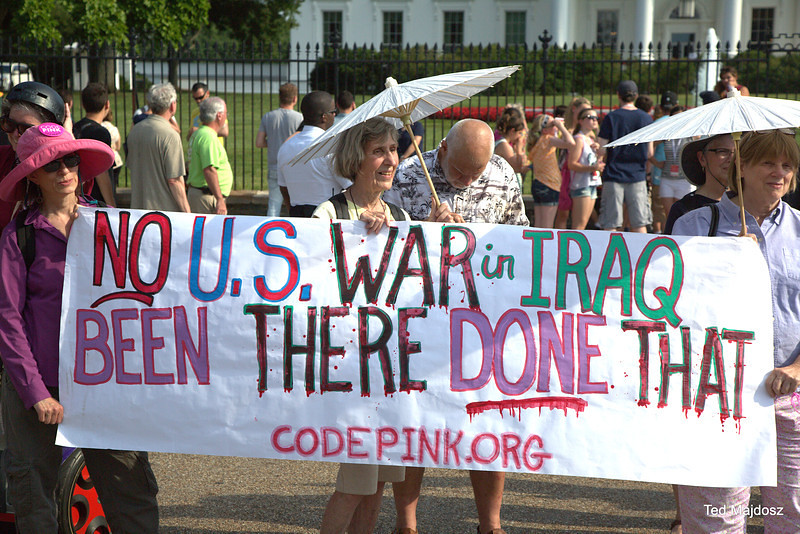
A lot of Americans these days, some of whom regard themselves as impeccable humanitarians, have formed the conviction that when it comes to the Middle East (or pretty much anywhere else in the world), intervention by the United States — especially military intervention — can do nothing but harm.
President Obama’s concerns about the Iraqi humanitarian crisis and the safety of US personnel can be solved without dropping bombs. Helping the besieged civilians in Iraq should be an orchestrated international effort, not carried out just by the US — the country that unleashed the sectarian turmoil in the first place. (CODEPINK)
Tens of thousands of Iraqis fled from ISIS, taking refuge on a mountain top where they have no food, water, or shelter. How long could anyone survive in these conditions when daytime temperatures often exceed 100F?

By the time CODEPINK’s wished for international effort could be orchestrated, thousands of those in need of help would be dead.
Channel 4 News spoke to a Yazidi refugee, Barakat al-Issa, who is trapped in the Sinjar mountains: “the situation is very tragic, more than 100 thousand people are trapped in the mountains here, in need of water and food.”The Americans and Turkish have carried out air drops of aid, but the effort was not sufficient said Mr al-Issa: “They are saying that planes are dropping aid, but this aid is only getting to some 5 per cent of the people who are trapped here, because of the mountainous terrain.”
“People are waiting here for international forces to intervene, in the hope that this will become a safe haven for aid to be delivered.”
“Most of the people here are civilians and they hope a peacekeeping force will come from Iraq or Nato.”
He accused the Islamic State militants of kidnapping at least 500 Yazidi women, whose fate remains unknown, and said that dozens of families had been murdered in the south of the Sinjar mountains as they tried to flee. He also repeated allegations that militants had been seen executing women and children.
To advocate neutrality in this conflict seems indicative of either being willfully deluded about the nature of ISIS or the result of simply not paying attention to what has been happening in Syria and Iraq over the last two years.
ISIS, or the Islamic State as it now prefers to be known, is utterly uncompromising. These men have chosen to fight a war that they will either win or lose — don’t expect them to ever send a delegation of negotiators to Geneva or start talking about how they want to live peacefully side by side with anyone. Coexistence is not part of their vocabulary.
Anyone in CODEPINK who is averse to taking sides should watch the video below — or at least as much of it as they can stomach — to witness how these jihadists whose passion for killing has no limit choose to portray themselves.
Some of the latest military action in Iraq appears to already by paying off but the situation remains dire, as Rudaw reports:
Local officials said today that 10,000 Yezidis who were stranded on Mount Shingal for one week were rescued and settled in the town of Zakho.
Medical teams and aid organizations in Zakho have rushed in to assist the rescued families, said Rudaw reporter.
Ashti Kocher, Zakho’s security chief said that Kurdish armed forces have opened a safe corridor for the Yezidis at Mount Shingal.
“We have also cleared about 30 kilometers of the ISIL forces in order to open a road for those families,” said Kocher, who currently leads a Peshmerga unit at Sinune village near Shingal.
Kocher said that the rescued civilians were transported to the Kurdistan Region through Rojava (Syrian Kurdistan) which is under the control of Kurdish forces known as the Peoples Protection Units (YPG).
Barakat Issa, Rudaw reporter on Mount Shingal said that the number of Yezidis stranded on the mountain is higher than initially reported. He said that nearly 100,000 people are hiding on the mountain.
Issa said that in the past few days 60 children and elderly have [died] … of hunger and thirst while there is fear that Islamic militants controlling the town of Shingal and other villages have massacred hundreds of others.
Stephen Walt proposes a course of inaction for the U.S. in the Middle East on the grounds that U.S. intervention never has its desired effects, but he adds this caveat:
[T]his argument would not preclude limited U.S. action for purely humanitarian purposes — such as humanitarian airdrops for the beleaguered religious minorities now threatened with starvation in Iraq. That’s not “deep engagement”; that’s merely trying to help people threatened with imminent death. But I would not send U.S. forces — including drones or aircraft — out to win a battle that the Iraqi government or the Kurds cannot win for themselves.
So the anti-interventionist “humanitarian” perspective is this — if I understand it correctly: we should try to make sure the Yazidi do not starve to death on the mountaintop. If, however, they manage to come back down only later to be slaughtered by ISIS, that’s their problem.

U.S. expands airstrikes against Islamic State militants in northern Iraq
No criticism in #iranian websites of US military intervention in Northern #iraq,not even websites close t hardliners #IS
— Omid (@okhazani) August 8, 2014
The Washington Post reports: The U.S. military ramped up its campaign against Islamist militants in northern Iraq on Friday, with fighter jets and drones conducting additional airstrikes outside the Kurdish regional capital of Irbil, officials said.
The Pentagon said the strikes “successfully eliminated” militant targets and destroyed artillery being used by the Islamic State extremist group to shell Kurdish forces.
The first strikes took place at dawn, Washington time, with two F/A-18 combat jets flying from the aircraft carrier USS George H.W. Bush in the Persian Gulf. The aircraft dropped 500-pound laser-guided bombs on a “mobile artillery piece” near Irbil, said Rear Adm. John F. Kirby, the Pentagon press secretary.
Islamic State fighters were “using this artillery to shell Kurdish forces defending Irbil where U.S. personnel are located,” he said in a statement. “As the president made clear, the United States military will continue to take direct action against [Islamic State militants] when they threaten our personnel and facilities.”
Hours later, an MQ-1 Predator drone armed with Hellfire missiles struck an Islamic State mortar position. When “fighters returned to the site moments later, the terrorists were attacked again and successfully eliminated,” Kirby said. [Continue reading…]
Grooming children for jihad: The Islamic State (part 2)
Why has Iran had so little to say about Gaza?
Trita Parsi writes: Nothing in the Middle East seems normal right now. Israel locks the United States out of cease-fire talks with Egypt over Gaza. U.S.-Saudi relations look increasingly like a marriage that both sides regret getting into in the first place. Egypt’s state media publicly cheers Israeli Prime Minister Benjamin Netanyahu as he bombs Gaza. Saudi Arabia pretends to be unaware of the ongoing fighting between Israel and Hamas. Protests against Israel’s bombing campaign are larger in Europe than in the Arab Middle East.
The surprises don’t stop there. Iran’s relative silence on the Gaza war has been deafening: Spanish actors Penelope Cruz and Javier Bardem have been more forceful in their criticism of Israel’s Gaza attacks than many Iranian officials.
Iran is usually known for jumping on every possible opportunity to blast Israel for its treatment of Palestinians. The Iranian game plan in the past few decades has been to boost its bid for regional leadership by portraying the Arab states as impotent “servants of American interests” in the Middle East, while portraying Tehran as the true champion of the Palestinian cause — and therefore the leader of the Islamic world.
Fighting between Hamas and Israel in Gaza is usually a political cash cow for Iran’s leaders. But by their own standards, Iranian leaders have remained curiously quiet on the ongoing, month-long fight. Why? Shifting dynamics across the Middle East and a new president in Tehran have changed Iran’s political calculus on Palestine.
Iran has a widespread reputation as Hamas’s main patron, providing the group with rockets and weapons over the past decade. But the relationship between the Palestinian Islamists and the government in Tehran has never been friction free. The Hamas leadership has long complained that Tehran talked a good game, but in practice did little to help the Palestinian Islamist group. Ideologically, there has always been a gulf between the Muslim Brotherhood-inspired Sunni group and the Shiite thinkers of Qom. But full-on tensions between these disparate Islamists only broke out with the Syrian Civil War, when Hamas sided early on with the Syrian opposition and Tehran backed President Bashar al-Assad. Tehran viewed Hamas Leader Khaled Meshaal’s break with the Syrian dictator in 2012 as a betrayal after years of providing the group with both financial support and a base in Damascus.
Earlier this year, Hamas and Tehran officially reconciled. “Relations between Iran and Hamas have returned to be as they were before and we have no problem with Hamas,” the speaker of Iran’s parliament, Ali Larijani, told a Lebanese television channel. But mistrust remained amid the conciliatory rhetoric, as Iranian officials have told me. Leaders of the Islamic Republic do not have a reputation of forgetting quickly or forgiving genuinely. [Continue reading…]
How Sisi’s hatred of Hamas made him become Israel’s closest ally
The Wall Street Journal reports: Israel and Egypt quietly agreed to work in concert to squeeze Hamas after Egypt’s military coup in 2013, a strategy that proved effective but which some Israeli and U.S. officials now believe stoked tensions that helped spur open warfare in Gaza.
When former military chief Abdel Fattah Al Sisi rose to power in Egypt after leading the overthrow of Islamist President Mohammed Morsi, Israel found the two countries had a common interest in suppressing the Islamist group that ruled Gaza. They worked to bring pressure on their shared enemy.
But a reconstruction of events leading up to the conflict over the past month found that in their determination to hem in Hamas, Israeli and Egyptian officials ignored warning signs of an impending explosion, U.S., Israeli and U.N. officials said.
The U.S. encouraged Israel and Egypt to forge a close security partnership. What Washington never anticipated was that the two countries would come to trust each other more than the Americans, who would watch events in Gaza unfold largely from the sidelines as the Israelis and the Egyptians planned out their next steps.
The seeds of the latest Israel-Hamas conflict were sown in 2012, when Hamas broke ranks with longtime allies Syria, Iran and Lebanon’s Hezbollah and threw its support behind the rebels fighting to unseat President Bashar al-Assad in Syria’s civil war.
Hamas, which ruled Gaza for the past seven years, came to rely on cash supplied by Qatar transferred through Egypt, with the assent of Mr. Morsi, and on revenue from smuggling goods through tunnels reaching into Egypt. As long as Hamas controlled cross-border attacks, Israel tolerated the Islamist movement at its southern doorstep, Israeli officials said.
That pressure got dialed up when Mr. Morsi was deposed and Mr. Sisi rose to power. Israeli officials knew Egypt was as committed as they were to reining in Hamas when Mr. Sisi sent word earlier this year that his forces had completely destroyed 95% of the tunnels under Egypt’s border with Gaza.
At first, Israeli intelligence officials said they didn’t know what to make of Mr. Sisi, a devout Muslim who in previous posts treated his Israeli counterparts coldly, a senior Israeli official said. As Mr. Sisi moved to take control of the government, Israeli intelligence analysts pored over his public statements, writings and private musings, Israeli and U.S. officials said.
The Israeli intelligence community’s conclusion: Mr. Sisi genuinely believed that he was on a “mission from God” to save the Egyptian state, the senior Israeli official said.
Moreover, as an Egyptian nationalist, he saw Mr. Morsi’s Islamist group, the Muslim Brotherhood, and its Palestinian offshoot, Hamas, as threats to the state that needed to be suppressed with a heavy hand, the Israeli official said.
Israeli intelligence analysts interpreted Mr. Sisi’s comments about keeping the peace with Israel and ridding Egypt of Islamists as a “personal realization that we — Israel — were on his side,” the Israeli official said. [Continue reading…]
Uri Avnery on Gaza crisis, his time in a Zionist terrorist group & becoming a peace activist
U.S. warplanes strike #ISIS artillery to protect Kurds
Reuters reports: U.S. warplanes struck Iraq on Friday for the first time since American troops pulled out in 2011, attacking Islamist fighters advancing towards the Kurdish region after President Barack Obama said Washington must act to prevent “genocide.”
The fighters had advanced to within a half hour’s drive of Arbil, capital of Iraq’s Kurdish region and a hub for U.S. oil companies. A Pentagon spokesman said two F/A-18 aircraft dropped laser-guided bombs on a mobile artillery piece used by Islamic State fighters to shell Kurdish forces defending Arbil. [Continue reading…]
UN must act to prevent #ISIS committing genocide in Iraq
Hamas far from disabled after weeks of fighting
The Guardian reports: As war returned to Gaza on Friday, many outside observers were asking why Hamas and the other smaller Islamist groups active in Gaza had let the ceasefire lapse and fired dozens of rockets into Israel. One answer lies in the resilience of a movement that has been carefully built over decades and is deeply embedded in the community.
A key question is the level of casualties sustained by Hamas, an acronym for the Harakat al Muqawamma Islamiya (Islamic Resistance Movement) so far in this most recent war. Israeli military officials have said that up to 900 fighters from Hamas and other smaller factions in Gaza, such as Palestinian Islamic Jihad, have been killed. These figures are largely based on reports from Israeli units fighting in Gaza.
“They were reporting a lot of success: five guys, 10 guys, 20 guys killed. These were big engagements,” said Daniel Nisman, an Israeli security analyst and commentator.Last week, Yossi Kuperwasser, the Israeli minister for strategic affairs, told reporters: “Hamas has lost more and more during the war – the tunnels, thousands of rockets and hundreds of operatives. Every day that went by, they lost more.”
It does appear that dozens of sophisticated tunnels leading from Gaza into Israel, which could enable cross-border raids to kill or kidnap civilians and soldiers, have been destroyed. More than 3,000 rockets have been fired on Israel from Gaza – killing three people – which Israeli officials insist is at least half of Hamas’s total stocks of the weapons.
However, few senior Hamas military commanders appear to have died.
“Most of the casualties were from anti-tank missile cells or lost on motorbikes. These were low-level guys bouncing between missile positions, particularly in border areas,” said Daniel Nisman, an Israeli security analyst.
When last week a missile struck a street metres from the gates of a UN school in Rafah, killing nine people, Israeli military spokesmen said they had been targeting “terrorists on a motorbike” nearby.
Khaleel Habeel, an Islamic Jihad official in Gaza, admitted casualties, saying that “if you take on the fourth most powerful army in the world then of course you lose people”. Ziad Abu Oda of the Mujahideen Faction splinter group told the Guardian that his organisation had lost 50 men, including fighters and political officials.
But even top-end estimates of casualties would be a fraction of the strength of Hamas’s military brigades and other groups, which are believed to have 10,000 fighters permanently under arms, with another 10,000 in reserve. [Continue reading…]
To end violence, end the occupation
Charlie Rose in conversation with Nadia Bilbassy-Charters, Khaled Elgindy, Rula Jebreal and Yousef Munayyer. Starts at 15 minutes 40 seconds.
Why #Israel is its own worst enemy
Gideon Levy writes: The streets of Ashkelon were half empty when I arrived on a Monday afternoon. The latest war was under way, and Haaretz had just published a critical article I’d written about Israel’s air force pilots and the grave consequences of their bombardment of Gaza.
I came to this southern Israeli town, not far from Gaza, to chronicle the fear spreading throughout Israeli communities near the border. As a columnist for the country’s leading liberal newspaper, I am quite used to people being hostile towards my views, but this was something new.
As I arrived in the town center for a live interview with Channel 2, a crowd of people immediately swarmed around me, cursing me with an aggression that I’ve never seen before. The bullies encircled me, jumping in front of the camera in an attempt to prevent the interview from going on. The show’s host cut the broadcast off. The mob hurled insults at me, calling me “garbage” and a “traitor” and accused me of claiming that Israeli pilots were murderers — something I never said.
As the crowd’s anger grew, I rushed to my car and drove out of the town center, the men’s screams trailing off as I steered my way out of Ashkelon. But it wasn’t just the street mobs. Leading figures in Israel have publically called me a traitor. Yariv Levin, a senior member of Prime Minister Benjamin Netanyahu’s party, called on TV for me to be charged with treason during war time. Haaretz has hired a bodyguard to ensure my safety, and my life has been turned upside down by the incident.
They haven’t succeeded in silencing me. I will continue to write about the brutality of this war, about the atrocities, the mass killing of civilians and the horrifying destruction in Gaza.
But I am not the story. The real tale to be told is of the unprecedented cracks in Israeli democracy that have been revealed in just one month of conflict. Years of nationalistic incitement by the Israeli government, of expressions of racism, of anti-democratic legislation, of price-tag actions against Palestinians in the West Bank, without anyone being brought to justice — all of that intolerance has suddenly exploded in our faces. [Continue reading…]
