



Bloomberg reports: Islamic State militants who last week captured the Mosul Dam, Iraq’s largest, had one demand for workers: Keep it going.
Arriving in their Toyota pickup trucks, armed with Kalashnikov assault rifles and wearing a patchwork of military uniforms, robes and turbans, jubilant militants from the al-Qaeda breakaway group told workers hiding in management offices they would get their salaries as long as the dam continued to produce electricity for the region under their control, according to a technician who was at the dam when nearly 500 militants drove off Kurdish troops.
Islamic State’s rampage through northern Iraq has inspired terror as stories spread of beheadings and crucifixions. At the same time, its fighters are capturing the strategic assets needed to fund the Islamic caliphate it announced in June and strengthen its grip on the territory already captured.
“These extremists are not just mad,” said Salman Shaikh, director of the Brookings Institution’s Doha Center in Qatar. “There’s a method to their madness, because they’ve managed to amass cash and natural resources, both oil and water, the two most important things. And of course they are going to use those as a way of continuing to grow and strengthen.”
The dam is the most important asset the group captured since taking Nineveh province in June. The group controls several oil and gas fields in western Iraq and eastern Syria, generating millions of dollars in daily revenue. [Continue reading…]
Hassan Hassan reports: The group, which became known as the Islamic State of Iraq and Syria (Isis) after it broke away from the al-Qaida-affiliated Jabhat al-Nusra in April last year, had been driven out of most of Syria, and rebel factions and al-Qaida affiliates threatened to chase it out of Iraq. But the group has made a remarkable comeback, seizing stretches of at least seven provinces in the two countries, and marching steadily into other areas.
In the last two weeks alone, Isis has fought on five fronts: against the Iraqi army, the Kurdish peshmerga, the Syrian regime, the Syrian opposition and the Lebanese army. In Syria the group has all but consolidated control of the eastern provinces of Raqqa and Deir Ezzor, as it made advances against government forces in Raqqa and subdued most of the rebel forces in Deir Ezzor. It is also advancing into Aleppo, reaching the city’s eastern outskirts, and in Hasaka, and is battling the Kurdish militias in the north-east. In Iraq it has advanced to a point only half an hour’s drive from Irbil, the Kurdish capital.
Yet these advances appear to be only the tip of the iceberg. Away from the publicised gains, Isis is quietly making progress on other fronts. Perhaps the most worrying is the fact that armed groups backed by the US have been co-opted by Isis.
After its sweeping military success in Iraq in June, Isis moved to take over the strategic province in Deir Ezzor, where the rebels controlled lucrative oil and gas resources. To the surprise of many, the group quickly controlled towns and villages that were home to some of the group’s most powerful adversaries, including Jabhat al-Nusra and locally rooted tribal militias. [Continue reading…]
BuzzFeed reports: “We’re not planning on stopping our actions, because the siege of Gaza still goes on,” Clare Essex, a spokeswoman for London Palestine Action (LPA), said. “People can’t have medicine. The one power plant in the city has been destroyed. More than ever, we need to keep pushing that into people’s consciousness.”
In the last few weeks, hundreds of thousands of people have been protesting in the streets of London, Manchester, and Edinburgh against the government’s stance on the conflict in Gaza. Alongside larger actions, there have been protests inside supermarkets such as Sainsbury’s, and shopkeepers have claimed to have faced intimidation on the high streets of Manchester.
But despite a short-term end to hostilities in Gaza, the campaign shows no signs of winding down. The Palestine Solidarity Campaign’s (PSC) chair, Hugh Lanning, said the organisation plans to build on the momentum it has gained. There will be another national day of action next Saturday, when activists will target high street stores that sell the products of SodaStream, a manufacturer of DIY carbonated-drink machines that has its headquarters in an Israeli settlement. [Continue reading…]
#Maliki in #Iraq: 'The al-Abadi candidacy is a clear violation of the constitution. The US refrained from condemning this violation'
— Middle East Eye (@MiddleEastEye) August 11, 2014
The Guardian reports: Iraq’s embattled prime minister, Nouri al-Maliki, appeared to have lost his job on Monday, after the country’s president appointed a rival Shia candidate to form a new government.
In a major defeat for Maliki, Iraq’s largest coalition of Shia political parties nominated Haider al-Abadi, a member of Maliki’s Shia Islamist Dawa party, to take over as prime minister.
Iraq’s Kurdish president, Fouad Massoum, formally announced Abadi’s appointment soon afterwards. The move is likely to deepen Iraq’s political turmoil and comes just hours after Maliki deployed his elite security troops on the streets of Baghdad.
The international community has repeatedly put pressure on Maliki to step down. It says that his divisive sectarian politics have enabled the rise of Islamic State (Isis) militants, who have captured large swaths of the country over the past three months.
But a defiant Maliki has insisted that he has the right to carry on as prime minister following elections in April because he commands the largest bloc in the Iraqi parliament.
In a TV address on Sunday he accused Massoum of violating the consitution by failing to name a prime minister within 15 days. Pointedly, he also sent Iraq government forces on Sunday evening to the green zone, the home of Iraq’s government, and to the president’s residence.
It was unclear whether Maliki will now accept the president’s decision or resist attempts to replace him. Abadi, the first deputy speaker of Iraq’s parliament, is a member of Maliki’s party, which in recent weeks has turned against the prime minister.
#BreakingNews: Influential Shiite cleric Moqtada al-Sadr says the nomination of PM Abadi is a precursor to an end of Iraq's poltical crisis
— Al Arabiya English (@AlArabiya_Eng) August 11, 2014
The Washington Post reports: Even before its assault on Kurdish territories in northern Iraq this month, analysts said the Islamic State had shown an almost impulsive character in its pursuit of territory and recruits, with little patience for the elaborate and often time-consuming terror plots favored by al-Qaeda.
Counterterrorism analysts at the CIA and other agencies have so far seen no indication that an entire al-Qaeda node or any of its senior leaders are prepared to switch sides. But officials said they have begun watching for signs of such a development.
The launching of U.S. airstrikes has raised new questions, including whether the bombings will hurt the Islamic State’s ability to draw recruits or elevate its status among jihadists. “Does that increase the spigot or close it?” said a senior U.S. counterterrorism official, who, like others, spoke on the condition of anonymity and noted that U.S. military operations in Afghanistan and elsewhere have crippled al-Qaeda but also served as rallying cries against the United States.
Longer-term, U.S. officials expressed concern that the Islamic State, which so far has been focused predominantly on its goal of reestablishing an Islamic caliphate, may now place greater emphasis on carrying out attacks against the United States and its allies. [Continue reading…]
“One of the reasons why I worry about what’s happening in the Middle East right now is because of the breakout capacity of jihadist groups that can affect Europe, can affect the United States,” she said. “Jihadist groups are governing territory. They will never stay there, though. They are driven to expand. Their raison d’etre is to be against the West, against the Crusaders, against the fill-in-the-blank—and we all fit into one of these categories. How do we try to contain that? I’m thinking a lot about containment, deterrence, and defeat.”
The breakout capacity of jihadist groups? I strongly suspect that phrase was a gift from GOP strategist Frank Luntz. It offers a subliminal connection between terrorism and Iran’s nuclear program without having to make any substantive assertion to that effect. Instead, it conjures up jihadist groups as metaphorical weapons of mass destruction. Is this how a President Clinton would frame her iteration of the War on Terrorism?
More importantly, Clinton is echoing the U.S.-centric narcissistic view of terrorism that still prevails in this country: that extremists of every description have no greater desire than to find ways of killing Americans.
No doubt, ISIS has issued blood-curdling warnings, saying that the U.S. will be severely punished if it tries to obstruct the growth of the Islamic State, but the very fact that it has made these warnings is an indication that the group has vastly more interest in its caliphate project than it has in waging war with the U.S..
ISIS is not at war with America — it’s enemy is the Shia.
That’s not to imply that the rest of the world has any justification for being complacent about the level of mayhem ISIS can and already has created. It’s simply a suggestion that “American lives are at stake” should not be the only rationale guiding U.S. foreign affairs.
Haaretz reports: “Battle-tested” is the best marketing slogan for defense industries the world over, so for Israeli military manufactures Operation Protective Edge has yielded a major competitive edge.
“For the defense industries this campaign is like drinking a very strong energy drink — it simply gives them tremendous forward momentum,” says Barbara Opall-Rome, Israel bureau chief for the U.S. magazine Defense News. “Combat is like the highest seal of approval when it comes to the international markets. What has proven itself in battle is much easier to sell. Immediately after the operation, and perhaps even during, all kinds of delegations arrive here from countries that appreciate Israel’s technological capabilities and are interested in testing the new products.”
That was also the opinion of veteran military correspondent Amir Rapaport, editor of Israel Defense, which covers the local defense industry. “From a business point of view, the operation was an outstanding thing for the defense industries,” he says. “There are two main reasons for that. First, the cloud of budget cuts and project cancellations has been lifted. I believe that after the operation, Israel’s defense budget will be increased and projects that were frozen will be revived. Second, during the weeks of the war, new products were introduced for the army’s use. The war is an opportunity to cut red tape. Weapons systems that have long been under development suddenly became operational during the course of the fighting. [Continue reading…]
Ronen Bergman writes: Israel’s leaders are determined to represent Defensive Edge as a victory, and it is therefore unlikely that public inquiry panels will be set up as they were after the Lebanon war in 2006 or that heads will roll.
However, the I.D.F. will have to reinvent the way it counters guerrilla warfare. It will once again have to try to recruit agents in Gaza, now that it has become clear that electronic spying is insufficient because Hamas has become more careful.
Israel’s foreign intelligence agency, the Mossad, will now have to pay more attention to Hamas operatives in Qatar and Turkey and intercept Hamas’s communications from weapons suppliers, like North Korea.
Israel may also decide to focus on striking Hamas personnel outside Gaza, without taking responsibility. When the Mossad assassinated a top Hamas official in 2010 in Dubai, the large amount of negative publicity led to a cessation of such acts, but they may now be judged more effective than massive military action. Likewise, special operations will get more attention. Hamas surprised Israel, but Israel has carried out almost no imaginative or daring targeted operations in this latest war. Ehud Barak, the most prominent commando fighter in Israel’s history, proposed some such schemes when he was defense minister in 2010, but they were not adopted.
Finally, the defense ministry will be given unlimited funding to devise an underground electronic “fence” based on oil and gas prospecting technology, that will be laid all along the border between Israel and Gaza to detect tunnels as they are built.
For Israel, this round of fighting will probably end politically more or less at the point where it began but with significant damage to Israel’s deterrence.
And the feeble efforts at negotiation efforts between Mahmoud Abbas’s Palestinian Authority and Israel now seem completely irrelevant, as military commanders on both sides go back to their drawing boards to plan the inevitable next round.
The Guardian reports: In the space of just one week last month, according to Crif, the umbrella group for France’s Jewish organisations, eight synagogues were attacked. One, in the Paris suburb of Sarcelles, was firebombed by a 400-strong mob. A kosher supermarket and pharmacy were smashed and looted; the crowd’s chants and banners included “Death to Jews” and “Slit Jews’ throats”. That same weekend, in the Barbes neighbourhood of the capital, stone-throwing protesters burned Israeli flags: “Israhell”, read one banner.
In Germany last month, molotov cocktails were lobbed into the Bergische synagogue in Wuppertal – previously destroyed on Kristallnacht – and a Berlin imam, Abu Bilal Ismail, called on Allah to “destroy the Zionist Jews … Count them and kill them, to the very last one.” Bottles were thrown through the window of an antisemitism campaigner in Frankfurt; an elderly Jewish man was beaten up at a pro-Israel rally in Hamburg; an Orthodox Jewish teenager punched in the face in Berlin. In several cities, chants at pro-Palestinian protests compared Israel’s actions to the Holocaust; other notable slogans included: “Jew, coward pig, come out and fight alone,” and “Hamas, Hamas, Jews to the gas.”
Across Europe, the conflict in Gaza is breathing new life into some very old, and very ugly, demons. This is not unusual; police and Jewish civil rights organisations have long observed a noticeable spike in antisemitic incidents each time the Israeli-Palestinian conflict flares. During the three weeks of Israel’s Operation Cast Lead in late 2008 and early 2009, France recorded 66 antisemitic incidents, including attacks on Jewish-owned restaurants and synagogues and a sharp increase in anti-Jewish graffiti.But according to academics and Jewish leaders, this time it is different. More than simply a reaction to the conflict, they say, the threats, hate speech and violent attacks feel like the expression of a much deeper and more widespread antisemitism, fuelled by a wide range of factors, that has been growing now for more than a decade. [Continue reading…]
Eli Clifton reports: On the same evening last November that world powers announced an interim deal with Iran, halting its nuclear progress in exchange for a modest easing of sanctions, United Against Nuclear Iran (UANI) put out a statement complaining that the agreement was a “disappointment” and “provides disproportionate sanctions relief to Iran.” The group’s executive director, former U.S. diplomat Mark Wallace, suggested that no sanctions relief was appropriate as part of an interim deal: “By rolling back sanctions now, the international community is significantly lessening the pressure on Iran’s economy.”
That same group, at the end of July, turned up in a bit of intrigue: the New York Times revealed that the Justice Department had stepped in to a defamation suit against UANI to prevent the disclosure of documents revealing the group’s donors, among other information. UANI serves as a key pressure group for the enforcement of sanctions, frequently issuing reports and press releases about companies doing illicit business with Iran.
The Times reported that lawyers representing Greek shipping magnate Victor Restis, the plaintiff in the suit, accused UANI of receiving foreign funding and shaking down companies for donations. UANI had earlier accused Restis and his company of being “front men for the illicit activities of the Iranian regime.”
But it remains unclear what potential revelations the Justice Department is concerned about.
Among the pieces of heretofore undisclosed information the Justice Department’s shield might prevent from coming to light is the connection between UANI and one of the biggest investors in precious metals, Thomas S. Kaplan. Kaplan has emerged as one of the business world’s most outspoken proponents of investing in gold and other precious metals, investments he says will retain or appreciate in value during periods of political and economic unrest. [Continue reading…]
Tweet from U.S. Deputy Assistant Secretary of State for Near Eastern Affairs (Iraq and Iran):
Fully support President of #Iraq Fuad Masum as guarantor of the Constitution and a PM nominee who can build a national consensus.
— Brett McGurk (@brett_mcgurk) August 10, 2014
Vox: Iraqi Prime Minister Nouri al-Maliki threw the country’s political system into crisis on Sunday, when he announced that he would be staying on as Prime Minister after a deadline to form a new government expired without an agreement at 12 am Baghdad time. Maliki announced a plan to sue Iraq’s President, Fuad Masum, for violating the country’s constitution, and it’s now totally unclear when, if ever, Iraq will return to normal democratic procedures.
All of this underscores why, on his Saturday press conference about the US intervention on Iraq, President Obama emphasized the need for Iraqi political reform to solve the ISIS crisis. “Ultimately, there’s not going to be an American military solution to this problem,” President Obama told reporters. “There’s going to have to be an Iraqi solution.” This is the key line to understand if you want to grasp the administration’s approach to Iraq — and why the goals of the US military campaign are more narrow than you might think.
The American objectives for Obama’s airstrikes in Iraq are very clear, and very limited. American airpower will protect Iraqi Kurdistan from the advance of militants from Islamic State (ISIS), and will attempt to break the ISIS siege that’s starving up to 40,000 members of the Yazidi minority on an isolated mountain.
So why is the US stopping there? ISIS controls a huge swath of land about the size of Belgium in Iraq and Syria. The group poses a serious threat to the Iraqi government and possibly even the stability of the entire region. If the United States can beat ISIS back in Kurdistan, why not elsewhere?
That line about an Iraqi solution is the administration’s answer. In fact, the Obama administration has been consistent on this question since June, when ISIS first took control of big chunks of Iraq. They see ISIS as, at its heart, a political problem — one that can’t be solved solely with force. But the march on Kurdistan and the siege on Sinjar are narrow military problems, and thus merit military solutions. This distinction between military and political problems is at the heart of the Obama administration’s thinking on Iraq. [Continue reading…]
The Washington Post reports: Burned by the sun, blistered with thirst and weak from exhaustion, thousands of Yazidis fled the mountain on which they had been trapped for a week on Sunday, streaming into Iraq’s northern Kurdistan region after a harrowing escape from extremist fighters that some said was aided by U.S. airstrikes.
Hungry, thirsty and tired, they limped across a narrow bridge spanning the Tigris on the Iraqi-Syrian border hauling their few belongings, some of them barefoot, others in sleeping clothes because they ran for their lives at night.
It was the last leg of a nightmarish journey that some have not survived — and many more may not.
Thousands are still stranded on the mountain, either because they are surrounded in their villages by militants with the Islamic State or are simply too weak to walk, according to those arriving in the remote Iraqi border post of Fishkhabour. Others have died trying to reach safety, falling by the wayside on the barren, rocky mountain for lack of food and water. [Continue reading…]
David Hearst reports: Hamas has decided to demand that President Mahmoud Abbas sign the Rome Statute which will allow Palestine to join the International Criminal Court as a full member, even though the militant movement itself could be subject to prosecution, sources told the Middle East Eye.
Hamas’s deputy chairman and chief negotiator in Cairo, Moussa Abu Marzouk has been instructed to sign the document supporting the State of Palestine as a member of the ICC in The Hague, the MEE has learned. The decision comes after a top level meeting between the Palestinian chief negotiator Saeb Erekat and Khaled Meshaal, the leader of Hamas.
The document already contains the signatures of the PLO executive committee, Fatah Central Committee and other PLO organisations such as the Popular Front and the Democratic Front. But Abbas himself is resisting, as a result of the forceful opposition of the United States and the European Union.
A tape in which Erekat criticised Abbas’s refusal to join the ICC was leaked recently. In it, Erekat is alleged to have criticised Abbas for stalling on the question of the ICC. Since then, Erekat has been at the forefront of a campaign to force Abbas’ hand. The PLO held a meeting recently in which all Palestinian factions put their name to joining the ICC. [Continue reading…]
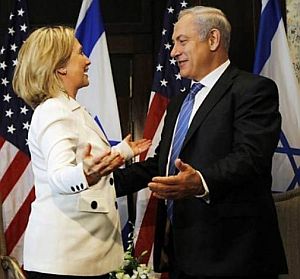 In case anyone has the slightest doubt whether Hillary Clinton is running for president in 2016, read her interview with Jeffrey Goldberg in the Atlantic.
She dutifully supports every position the Israel lobby demands and even deftly conjures up a rhetorical connection between jihadists and the nuclear threat from Iran, introducing a piece of non-proliferation jargon into counterterrorism when she refers to the breakout capacity “of jihadist groups that can affect Europe, can affect the United States.”
For a few neocons in Washington who are indulging in fantasies about their political rehabilitation, much of what Clinton says, must be music to their ears. She shares the view frequently expressed by Israel apologists during its assault on Gaza, that Israel is getting more criticism than it deserves.
When it comes to killing Palestinian civilians, Israel still suffers from its “old PR problem.” Indeed, hundreds of dead children always cause a PR problem.
Hillary Clinton: [W]e do see this enormous international reaction against Israel, and Israel’s right to defend itself, and the way Israel has to defend itself. This reaction is uncalled for and unfair.
Jeffrey Goldberg: What do you think causes this reaction?
HRC: There are a number of factors going into it. You can’t ever discount anti-Semitism, especially with what’s going on in Europe today. There are more demonstrations against Israel by an exponential amount than there are against Russia seizing part of Ukraine and shooting down a civilian airliner. So there’s something else at work here than what you see on TV.
And what you see on TV is so effectively stage-managed by Hamas, and always has been. What you see is largely what Hamas invites and permits Western journalists to report on from Gaza. It’s the old PR problem that Israel has. Yes, there are substantive, deep levels of antagonism or anti-Semitism towards Israel, because it’s a powerful state, a really effective military. And Hamas paints itself as the defender of the rights of the Palestinians to have their own state. So the PR battle is one that is historically tilted against Israel.
JG: Nevertheless there are hundreds of children —
HRC: Absolutely, and it’s dreadful.
JG: Who do you hold responsible for those deaths? How do you parcel out blame?
HRC: I’m not sure it’s possible to parcel out blame because it’s impossible to know what happens in the fog of war. Some reports say, maybe it wasn’t the exact UN school that was bombed, but it was the annex to the school next door where they were firing the rockets. And I do think oftentimes that the anguish you are privy to because of the coverage, and the women and the children and all the rest of that, makes it very difficult to sort through to get to the truth.
There’s no doubt in my mind that Hamas initiated this conflict and wanted to do so in order to leverage its position, having been shut out by the Egyptians post-Morsi, having been shunned by the Gulf, having been pulled into a technocratic government with Fatah and the Palestinian Authority that might have caused better governance and a greater willingness on the part of the people of Gaza to move away from tolerating Hamas in their midst. So the ultimate responsibility has to rest on Hamas and the decisions it made.
That doesn’t mean that, just as we try to do in the United States and be as careful as possible in going after targets to avoid civilians, that there aren’t mistakes that are made. We’ve made them. I don’t know a nation, no matter what its values are– and I think that democratic nations have demonstrably better values in a conflict position — that hasn’t made errors, but ultimately the responsibility rests with Hamas.

The Washington Post reports: Aided by U.S. airstrikes, embattled Kurdish forces began to reverse a string of losses on Sunday, expelling Islamic State extremists from two northern Iraqi towns.
Makhmour and Gweir, the first areas targeted in the U.S. air campaign that began Friday night, were cleared of the al-Qaeda-inspired militants on Sunday, Kurdish officials said.
“It’s thanks to the strikes that we have been able to move forward,” said Mahmood Haji, an official in the Kurdish Interior Ministry. The Kurdish television channel Rudaw showed live footage of security forces advancing in Makhmour, and later crowding around a government building in the town, where the Kurdish flag had been raised once more.
President Obama said Saturday that the American air campaign would not expand beyond the limited objectives he has outlined. He tied more extensive assistance to the formation of an inclusive Iraqi government in Baghdad. [Continue reading…]
BasNews reports: Most Arab tribes that border the Kurdistan Region geographically are helping Islamic State (IS) insurgents as well as helping them to get close or enter Kurdish villages and cities in northern Iraq.
Chris Doyle writes: “The lamps are going out all over the Middle East”, to update Sir Edward Grey’s doom-laden warning to Europe a hundred years ago. The areas of calm and stability seem like small oases in a multitude of firestorms. Many areas are literally without lights. Gaza has around two hours electricity a day. The power cuts in Yemen are worse and worse, leading to major protests. But, more worryingly, the lights of the democratic, liberal, pluralistic forces that for many months in 2011 lit up the region are also dimming, overshadowed by the twin forces of brutal dictatorship and brutal religious sectarian extremism.
Syria and Iraq are divided and near ungovernable, in the waiting room for failed-state status. The so-called Islamic caliphate or Isis, which in reality bears no resemblance to any caliphates of the past, covers an ever-expanding area, larger than the United Kingdom, including 35 per cent of Syria. Libya is being terrorised by rival militias. Palestinians in Gaza, for the fourth time since 2006, are at the wrong end of an Israeli military aggression that pits one of the world’s most sophisticated militaries against a captive population inside the world’s largest prison. The collective pile of rubble from these conflicts would grace a mountain range.
Those states and areas that enjoy calm become refugee camps. Lebanon and Jordan host almost two million Syrian refugees between them, as well as 2.5 million Palestinians. Tunisia is confronted with a mass Libyan exodus; while Iraqi Kurdistan is home to more than 300,000 Iraqis displaced only since June, as well as 220,000 Syrian refugees. In each case, the numbers are rocketing up – with the number of Syrian refugees alone expected to reach four million by the end of the year. Each humanitarian appeal is underfunded.
Will it get worse? The signs are worrying. The fighting in Lebanon last week, in Arsal in the north Bekaa valley, is yet another example of why the Syrian crisis threatens to move from spilling over, to swamping, its smaller neighbour. The instability could spread to Jordan. Saudi Arabia and the Gulf states will not be immune to the regional changes.
Given the epidemic of crises in an area of the world vital to our trade, energy and security interests, the minimal expectation would be an energetic and engaged response. Yet, when asked about Western policy towards the region, my instinctive response is, “There is one?”
The failure is first and foremost one of leadership, at an international and regional level. Who are great international statesmen in the West or in the Middle East? Who do young Arabs, who make up most of the population, look to for inspiration? President Obama has been blasted for his indecisiveness but he is not alone. George W Bush and Tony Blair were decisive over Iraq and destroyed the country. There is no strategy, and often the debate is reduced to a question of to bomb or not to bomb. [Continue reading…]