Daniel Levy writes: Israel’s governing coalition has been much seized of late by the issue of potential boycotts and sanctions in response to its policies in the occupied Palestinian territories. The centrist and rightist wings of Netanyahu’s coalition have been trading accusations over how severe the threat is, and who is to blame – is it the Livni-Lapid camp for acknowledging that boycotts are a problem, thereby encouraging the phenomenon?
Or is the Bennett-Miri Regev camp to blame for shouting from the rooftops about annexing the territories rather than quietly building on Palestinian hilltops as all Israeli governments have done for four decades? Israel’s cabinet even considered convening to officially respond to this threat. Public ministerial statements have followed familiar lines around whether to play nice with the peace process and deflect criticism (the centrist position) or to conduct a more effective PR and hasbara push-back campaign (the rightist position).
In the short term the right is correct in downplaying any sense of imminent economic disaster due to a boycott tsunami. In the longer term, the centrists get it in asserting that the globally connected Israeli economy and lifestyle will prove unsustainable as sanctions slowly but inevitably advance. But both sides are promoting an ill-informed and misleading discussion, perhaps intentionally. Much of that misinformation revolves around Europe’s role, unsurprising given Europe’s position as Israel’s leading trade partner and as the likely source of most sanctions momentum.
Israelis need to know five things about this so-called boycott debate that are too often obscured. [Continue reading…]
Category Archives: Lands
Egypt’s military coup empowers jihadists who reject democracy
The New York Times reports: The military overthrow of a freely elected Islamist fulfilled the predictions of jihadist ideologies that power could never be won through democracy, and they have pounced on the opportunity to proclaim their vindication.
International terrorist groups like Al Qaeda and the Islamic State of Iraq and Syria, or ISIS, began calling for Muslims inside and outside of Egypt to take up arms against the government. Now a growing number of experienced Egyptian jihadists are heeding that call, often under the banner of Sinai-based militant groups such as Ansar Beit al-Maqdis, according to United States and Egyptian officials involved in counterterrorism. At least two Egyptians who returned from fighting in Syria have already killed themselves as suicide bombers, according to biographies released by the group.
Egyptian military officials say they have also captured Palestinians, Syrians and other foreigners among the terrorists in Sinai. But an American counterterrorism official said Washington believed Ansar Beit al-Maqdis “is largely Egyptian, including some who fought in other conflict zones before returning home,” along with “a relatively small contingent of battle-hardened foreigners.”
The jihadist homecoming appears to have provided the resources and expertise behind a quickening series of attacks that have far exceeded the abilities previously displayed in Egypt. Ansar Beit al-Maqdis has shown it can build and remotely detonate large bombs in strategic locations, gather intelligence about the precise timing of movements by their targets, record their own attacks and manage the complicated maintenance of an advanced portable surface-to-air missile — all suggesting combat experience.
“The number of attacks has gone up certainly over the past six weeks,” John O. Brennan, the director of the C.I.A., told a House hearing this week. “And some senior-level Egyptian officials have been killed at the hands of these terrorists.”
Egyptian military officials say they are determined to defeat this new wave of terrorists just as they defeated the insurgency that flared in the 1990s.
Back then, militants who insisted on armed struggle — including Ayman al-Zawahri, the Egyptian-born Al Qaeda leader — eventually gave up on the utility of armed struggle at home, refocusing on attacking Egypt’s Western sponsors.
But the ouster of Mr. Morsi appears to have changed that calculus.
“Zawahri and others have been saying from the beginning that they believed the military would come back, that the military and the West are not going to allow an Islamist government to stay in power,” said Aaron Zelin, a researcher at the Washington Institute for Near East Policy who tracks jihadist messages.
The Brotherhood, which has publicly denounced violence for decades, once helped combat militancy by channeling Islamist opposition into the political process. But the new government has now outlawed the Brotherhood. [Continue reading…]
Egypt’s war on journalists
Sharif Abdul Quddus writes: In Egypt, journalism can now be a form of terrorism. At least that’s what prosecutors are alleging in a case targeting Al Jazeera, with 20 defendants referred to trial on charges of joining or aiding a terrorist group and endangering national security.
Among the principal accusations, the prosecutor’s statement accuses the defendants of manipulating video footage “to produce unreal scenes to suggest abroad that the country is undergoing a civil war that portends the downfall of the state.” The statement goes on to say prosecutors assigned a team of “media experts” from the Egyptian Union for Television and Radio to inspect equipment seized from the hotel where Al Jazeera English was operating. The technical reports show that “the footage was altered and video scenes were modified using software and high-caliber editing equipment.”
So they used Final Cut Pro. They edited. They probably even selected the fiercest footage of clashes for their reports. The nature of the charges would be comical if they weren’t so serious.
The journalists accused in the case are being treated as terrorists – that is to say, inhumanely. Two of the detained Al Jazeera English staff, Mohamed Fahmy and Baher Mohamed, are being held in Al-Akrab, the maximum security wing of Tora prison, alongside jihadis and militants. They have been kept in solitary confinement 24-hours a day in insect-infested cells with no beds, books or sunlight for over four weeks. Following the series of bombings in Cairo on January 24, guards even took away their blankets and food their relatives had provided. After a recent visit with him, Fahmy’s family said his spirit appeared to have been broken. Peter Greste is being held in only slightly better conditions.
Meanwhile, two other Al Jazeera journalists, Abdallah al-Shami and Mohamed Badr, have been imprisoned for over five months, their lives irrevocably damaged for having reported from the site of clashes and swept up in the mass arrests of protesters. Shami has been on a hunger strike since January 21 to protest his detention.
Egypt has become one of the most dangerous places on earth to be a journalist. The Committee to Protect Journalists ranked it the third deadliest country for journalists in 2013 and among the world’s top ten worst jailers of journalists. Aside from being killed, wounded, or arrested by security forces, reporters in Egypt are increasingly being attacked by civilians. [Continue reading…]
The Iraqi re-awakening
Mark Perry writes: Gen. Raad al-Hamdani holds a unique place among Iraqi military commanders: He openly confronted Saddam Hussein — and lived.
The incident occurred during a high-level briefing in the summer of 2002. A war with the U.S. was looming, but Saddam told Hamdani not to worry. There won’t be a war, he said confidently, because the American people “have no taste for blood.”
Hamdani, who commanded six divisions in Saddam’s elite Republican Guard Corps and was viewed as one of his country’s toughest fighters, disagreed. The Americans would not only invade, he responded — their plan was to occupy Baghdad after a lightning campaign. The only way to fight them, he argued, was to “bleed them slowly” in a series of delaying actions.
Saddam might easily have lost his temper, but he smiled and dismissed his general’s prediction. After all, there was good reason to value Hamdani’s knowledge: He not only owned a library filled with books on America’s World War II campaigns, he was known for his obsessive study of U.S. military tactics. Saddam regularly taunted him about his obsession, calling him “my American General.”
After his conference with Saddam, Hamdani returned to his command. Less than a year later, his divisions fought the U.S. Marines in Nasiriyeh, but failed to hold the southern Iraqi city’s bridges. Without air power, Hamdani’s army didn’t stand a chance; most of his units were destroyed. After Saddam was toppled, Hamdani returned to his home in Baghdad where, one night, American soldiers burst through his door, wrestled him to the ground, and questioned him. Hamdani was enraged.
The experience didn’t rob Hamdani of his courage. After his questioning — and after receiving death threats from Iraq’s new Shiite-dominated government — he moved to Amman. From there, he worked with Anbar tribal leader Talal al-Gaood to kick-start a political opening with the U.S. military that led to the Anbar Awakening. Hamdani’s idea, proposed in a quiet meeting with U.S. Marine Corps officers in an Amman hotel in July 2004, was to arm Anbar’s Sunni militias to face off against Islamic extremists flooding into the province from Syria. Anbar’s insurgents, he told his U.S. military interlocutors, had at least one thing in common with their American occupiers — they both hated al Qaeda.
Gaood established a think tank called the Iraq Futures Foundation in Amman in the summer of 2005, and signed Hamdani on as the organization’s military advisor. The think tank’s goal was to unite Anbar’s tribes against the al Qaeda threat. While it took many months for this vision to be realized, their pioneering work — alongside officers of the U.S. 1st Armored Division — resulted in the formation of the Anbar Awakening Council. The council fought off al Qaeda, empowered Anbar’s Sunnis, and returned the province to political and economic stability.
Hamdani, who is still living in Amman, is now increasingly concerned that his achievements in Anbar are unraveling. Over the last few months, he’s watched with growing alarm as Prime Minister Nouri al-Maliki cracked down on an anti-government protest movement in the province, laying the groundwork for the resurgence of al Qaeda.
His worries are shared by current and former U.S. military officials, who believe that Iraq will need to build another Awakening to defeat al Qaeda, but are convinced the obstacles to doing so will be even more daunting this time around.
Maliki appears to be preparing the Iraqi Army for a renewed assault on Anbar province. His forces shelled the outskirts of the cities of Fallujah and Ramadi on Monday, Feb. 3, and the Iraqi Defense Ministry claimed that the attacks killed 57 militants.
The violence has returned Anbar to the dark days of 2004 and 2005, when hundreds of U.S. soldiers lost their lives battling a jihadist insurgency there.
“People who know Iraq and Anbar best saw this coming as early as this last summer,” a former senior advisor to both Donald Rumsfeld and Robert Gates told me. “Maliki kept poking at Anbar, inflaming the tribes. It was an absolutely cynical power play. He figured the angrier Anbar got, the more he could pose as Iraq’s strongman. He thought he’d be viewed as the defender of the Shias and win himself another term as prime minister.”
But by cracking down on Anbar’s Sunnis, the Iraqi premier set the stage for a full-blown uprising. [Continue reading…]
Iraq: Execution of SWAT forces furthers crimes against humanity
Human Rights Watch: The execution-style killing of four members of Iraq’s SWAT forces, apparently by the ISIS armed group, is the latest atrocity in a campaign of widespread and systematic murder that amounts to crimes against humanity, Human Rights Watch said today.
Men presenting themselves as members of the Islamic State of Iraq and the Sham (ISIS) claimed responsibility for the killings, which took place near Ramadi on January 20, 2014. A video posted online showed ISIS members firing on and disabling the last truck of a SWAT convoy.The ISIS members then take four SWAT members into custody, interviewing them in front of an ISIS flag, and shooting them in the back of their heads.
“These abhorrent killings are the latest in a long list of ISIS atrocities, at a time when civilians in Anbar province are stuck in the fighting and getting abused by all sides,” said Joe Stork, deputy Middle East director at Human Rights Watch. “Together with the ISIS car bombs and suicide attacks targeting civilians, they are further evidence of crimes against humanity.” [Continue reading…]
The effort to isolate ISIS, Syria’s renegade jihadists
If the Assad regime had wanted to plant a Trojan Horse inside the Syrian revolution, the Islamic State in Iraq and Syria (ISIS or ISIL) would have provided the perfect vehicle. Whether ISIS is actually doing the regime’s bidding is almost besides the point since by design or not, the group is undoubtedly serving Assad’s interests. For all the other rebel groups in Syria, ISIS now represents the enemy within.
The conflict within the opposition — conflict which the press conveniently describes as “infighting” — predictably presents an image of a movement that is imploding; a movement whose lack of legitimacy is rising to the surface. Again, in this narrative the interests of the Syrian government and its supporters are being served.
Yesterday’s statement issued by al Qaeda’s central leadership is significant and should probably be taken at face value. It says:
Qae’dat al-Jihad (AQ) declares that it has no links to the ISIS group. We were not informed about it’s creation, nor counseled. Nor were we satisfied with it rather we ordered it to stop. ISIS is not a branch of AQ & we have no organizational relationship with it. Nor is al-Qaeda responsible for its actions and behaviors.
Aron Lund provides some background to this announcement:
In April 2013, Abu Bakr al-Baghdadi announced that the ISI would become the ISIL by extending its activity into Syria and taking full possession of the Syria-based jihadi faction known as the Nusra Front, which Baghdadi had helped create in August 2011.
All this happened without Zawahiri being informed, to his great dismay. When he complained and attempted to assert authority over the ISI(L), ordering Baghdadi to dissolve the new cross-border entity and head back to Iraq, Baghdadi simply refused to comply. From his hideout, which is probably in Pakistan, there was little Zawahiri could do about it.
But the al-Qaeda leader didn’t leave the Syrian dispute empty-handed: he gained or regained the allegiance of the Nusra Front, whose leader, Abu Mohammad al-Golani, publicly declared his allegiance to Zawahiri in an attempt to avoid being gobbled up by the ISIL. Since then, the Nusra Front has functioned as a de facto al-Qaeda branch, even though it isn’t yet publicly declared as such.
This split between the ISIL and the Nusra Front, which took place in April 2013, set in motion the process that now, after almost a year, has resulted in brutal infighting in northern Syria, with the ISIL and the Nusra Front on different sides. But it also forced al-Qaeda to finally come clean about what may have been the reality for quite a while: it no longer seems to have an Iraqi wing.
Over the last few weeks, @wikibaghdady, who presents himself as an inside source, has revealed many details about the inner workings of ISIS and Al Qaeda in Iraq (AQI/ISI).
Although Abu Bakr al-Baghdadi is most often referred to as the leader, according to @wikibaghdady (see an English translation of his tweets) the core leadership is a three-man military council of former officers who served Saddam Hussein and were members of the Ba’ath Party. Brigadier General Haji Bakr led the council until his death near Aleppo in January.
General Haji Bakr first met Abu Omar Al-Baghdadi when he offered his services to him due to having experience in Saddam’s Ba’athist army. He demonstrated his dedication to him and he is now considered to be one of the closest to him. However, Haji Bakr didn’t have any previous jihadi experience before that. He was accepted to the Military Council on the one condition of providing the State [AQI / ISI] with important information about the Iraqi army. When he did that and proved his loyalty, he was then appointed as the military adviser to Abu Omar al-Baghdadi and Abu Hafs al-Muhajir and continuously provided them with information about previous military leaders, plans and successfully linking them with previous members of the Ba’ath Party.
Although ISIS has become infamous for its outward brutality, the account of Haji Bakr’s leadership makes it clear that he imposed his own internal reign of terror.
When Haji Bakr became a leader, a new era started that was important to Iraq as well where the amount of fear between citizens increased. A lot of people considered Haji Bakr to be arrogant next to Abu Bakr al Baghdadi, who many considered to be a quiet personality. In addition, Haji Bakr completely changed the way he looked where he shaved his beard off and even changed the way he speaks in the first few weeks. The main issue here is that no one in the State dared to question anything taking place because questioning was considered not trusting the other person. This issue was serious to a point where it was allowed to kill another member who considered being suspicious of another.
Haji Bakr then started holding private meetings with Abu Bakr Al Baghdadi to reshape the State. The first agreement was protecting the State from the inside and out. This involved creating a security outlet that would be able to respond to any type of danger. An important step that took place was that Haji Bakr prevented Abu Bakr Al Baghdadi from meeting with leaders from other groups so they didn’t impact or advise him in any way. The orders came from the Shura council that Abu Bakr created to ensure that all decisions made were fair. After this, the two became very close and were always with each other where many considered him to be Al Baghdadi’s private minister.
Among their plans were various assassinations that in fact took place. This first started with twenty people and within a month, the number increased to one hundred people. It is essential to understand that no one in the State AQI/ISI would dare to take any orders from anyone else but Haji Bakr or Abu Bakr Al Baghdadi during that time. Every member in the Shura was carefully chosen by Haji Bakr and most of them were in the previous Baath party. One of the members’ main responsibilities was assassinating everyone who disobeys or betrays the State.
The most recent tweets reveal:
There were about twenty to thirty fighters who split from the ISIS on a daily basis. They found that fighters from Saudi Arabia were the most likely to split and that Tunisians were the least. This is when he [Al Baghdadi?] ordered that the suicide bombers should be Saudi as much as possible, and that Tunisians shouldn’t be involved since they’re the most loyal.
If a jihadist group turns out to be run primarily by former Ba’athists — a thoroughly secular political movement — this begs the question: is ISIS being viewed through the right ideological prism?
No doubt ISIS recruits jihadists, but if it is led by men who drew their power from the security apparatus of a Ba’athist state, then their overriding interests may have less to do with the creation of a Caliphate and more to do with surviving in a harbor provided by the last remaining Ba’athist government in the Middle East.

‘Not our problem’

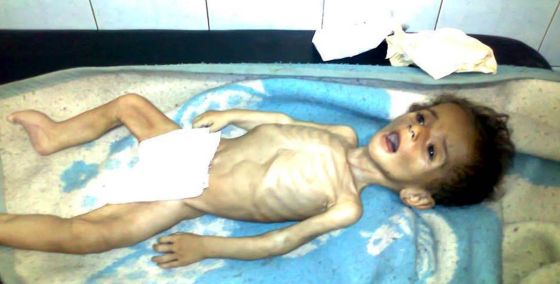
Abed Al Jalil Khamis, just under a year old, is seen in Yarmouk camp. He later starved to death on Jan. 28, 2014.
NBC News reports on starvation and malnutrition in Yarmouk Camp, a Palestinian refugee camp just south of Damascus, whose population has been trapped under siege for months and where at least 89 people have died of starvation. In Yarmouk, “people are eating cats, grass and cactus they are so hungry.”
A comment beneath the report comes from “Pessimist”:
Not our problem. If Syrians can’t solve their own problems – too bad. Cats, rats, dogs – let them eat what they want.
Psychopaths, when shown images of people in distress, exhibit low affective empathy, which is to say they have an inability to respond emotionally appropriately to the suffering of others.
If the comment I cited was unusual, it might sound like “Pessimist” is a psychopath. Yet the sentiment — this isn’t our problem — pervades this thread of hundreds of comments.
“Let those folks climb out of their own cesspool, if they’re willing.”
“pics of starving children? really? since when did syria care about its children?”
The phrase, not our problem, appears thirty times just on the first of nine pages of comments.
There’s nothing new and nothing uniquely American about indifference. But the response to Syria goes far beyond indifference and has become a kind of angry callousness — tied to a legitimate rejection of another American war in the Middle East.
Yet even in this — wars in Iraq and Afghanistan that most Americans now see as having been futile — what appears to be the most regretted feature of these military adventures is their cost in “blood and treasure” to America.
The populations in those countries seem to be viewed by many as being just as undeserving of American sympathy as people starving in Syria.
What do all these people — the people whose suffering can be ignored — have in common?
They are Muslims and over the last decade while Muslims have been the primary target of American aggression overseas, the demonization of Muslims in American society has inexorably grown.
In an era where political correctness has had the broad effect (of questionable benefit) of tempering blunt expressions of bigotry, Islamophobia is not only prevalent but those who harbor such feelings appear to regard them as perfectly legitimate. Americans who have negative views of Muslims recognize that there are relatively few societal penalties for expressing these views.
“ohio state buckeyes fan” responds to “Hope-295312” — a commenter who appeals for an expression of empathy.
HOPE: These same folks you have such compassion for were the very same folks that were dancing in the street of Damascus after 9/11, these are the same folks that have cheered on every terrorist attack committed against the west. Frankly not our war, not our concern and if your truly had any desire for a safer world and for a peaceful Syria than you should be rooting for a war of extermination between the sides waging the civil war.
Hatred directed at a foreign other provides glue that can hold weak societies together. But the indifference many Americans express towards the suffering of children starving in Syria is not merely a reflection of a pervasive xenophobia; it also mirrors the extent to which a society that elevates the value of self-interest will also be a society in which we have a little willingness to care for each other.
Alberta oil sands pollution two to three times higher than thought
AFP reports: The amount of harmful pollutants released in the process of recovering oil from tar sands in western Canada is likely far higher than corporate interests say, university researchers said Monday.
Actual levels of polycyclic aromatic hydrocarbon (PAH) emissions into the air may be two to three times higher than estimated, said the findings in the Proceedings of the National Academy of Sciences, a peer-reviewed US journal.
The study raises new questions about the accuracy of environmental impact assessments on the tar sands, just days after a US State Department report said the controversial Keystone pipeline project to bring oil from Canada to Texas would have little impact on climate change or the environment.
Current government-accepted estimates do not account for the evaporation of PAHs from wastewater pools known as tailing ponds, which are believed to be a major source of pollution, said researchers at the University of Toronto.
According to corporate interests which are responsible for projecting their environmental impact, the Athabasca oil sands beneath Alberta, Canada — which hold the third largest reserve of crude oil known in the world — are only spewing as much pollution into the air as sparsely populated Greenland, where no big industry exists.
Lead study author Frank Wania, a professor in the department of physical and environmental sciences, described the corporate estimates as “inadequate and incomplete.”
“If you use these officially reported emissions for the oil sands area you get an emissions density that is lower than just about anywhere else in the world,” he told AFP. [Continue reading…]
The latest threat to Jewish continuity
The Times of Israel reported in late January: Yair Netanyahu is “spitting on the grave of his grandfather and grandmother,” Dr. Hagai Ben-Artzi, brother of Sara Netanyahu, said Monday of his nephew’s relationship with a non-Jewish Norwegian woman.
News that the prime minister’s son, who is 23, is dating Sandra Leikanger, 25, was first reported by the Norwegian daily Dagen. The tall, svelte blonde met the younger Netanyahu at the Interdisciplinary Center in Herzliya, where the two study.
Prime Minister Benjamin Netanyahu reportedly told Norwegian Prime Minister Erna Solberg at the World Economic Forum in Davos last week that his son traveled with Leikanger in Norway over the summer, and that the two had been dating for months.
In an interview with ultra-Orthodox website Kikar HaShabbat, Ben-Artzi urged his nephew to cut ties with his new girlfriend, and warned him that should he choose to pursue the relationship, Ben-Artzi would personally see to it that he would not be allowed near his grandparents’ graves.
“It’s terrible,” Ben-Artzi said. “Just terrible, and the son of the prime minister no less. It is the worst thing that is threatening and was a threat throughout the history of the Jews.”
Should his nephew marry Leikanger, Ben-Artzi said he “would bury myself, I don’t know what I would do with myself, I’d take to the streets and rip the hair out of my head — and here it’s coming true.”
If his father was alive, Ben-Artzi added, that is precisely how he would respond too.
Ben-Artzi and Sara Netanyahu have not been in touch for years for undisclosed reasons.
Earlier on Monday, ultra-Orthodox Shas MK Arye Deri responded to news of the relationship by saying, “If God forbid it’s true, then woe to us, woe to us.”
Deri told the Kol Barama radio station the relationship was no mere personal matter because Netanyahu is a “symbol of the Jewish people.”
“I know friends of mine who invest tens of millions and more, hundreds of millions to fight assimilation in the world,” Deri said. [Continue reading…]
Elianna Yolkut, a Conservative Rabbi in New York City, writes: Though it might sound fatalistic, if our Jewish leadership and institutions do not stop obsessing over demographics and statistics, we will lose the true fight. Judaism will lose its wisdom, its value and its meaning. We must, as a community, dedicate our resources, time, money, leadership and energy to being the voice for the powerful messages Judaism can bring to the world, and to Jewish community; message of love and responsibility, of hope and possibility, of compassion and commitment.
Video: Children inside the Syrian revolution
The following documentary has been shown on television in the UK and Canada. It focuses on the experiences of children who are growing up in the shattered remains of Aleppo. Watch it while you can — it may not remain on YouTube for long.
“The law of war in Syria is that the closer you are to your enemy, the safer you are from air attacks, missiles and tanks.”
*
He said to me, “Mum, don’t be sad if I become a martyr.” … I said, “We’ll all be martyrs one day but you’re still too young my son.”
*
What happened to this town?
A child was martyred.
What did he do wrong?Keep away soldiers!
Don’t obey this tyrant!
Free… free… freedom.*
“I will protest here and I will die here.”
“We were raised in Syria. We were born here. We stayed here. The regime killed us here. We lost people here. We lost dear ones here. It is us who defend our town.”
Al Qaeda breaks link with Syrian militant group ISIS
Reuters reports: Al Qaeda’s general command said on Monday it had no links with the Islamic State in Iraq and the Levant (ISIL aka ISIS), in an apparent attempt to reassert its authority over fragmented Islamist fighters in Syria’s civil war.
After a month of rebel infighting, al Qaeda disavowed the increasingly independent ISIL in a move likely to bolster a rival Islamist group, the Nusra Front, as al Qaeda’s official proxy in Syria.
The switch is seen as an attempt to redirect the Islamist effort towards unseating President Bashar al-Assad rather than waste resources in fighting other rebels, and could be intended to shift the strategic balance at a time when government forces are increasingly active on the battlefield. It could also embolden Nusra in its dispute with ISIL.
Meanwhile, Jeffrey Goldberg writes: Two prominent Republican senators say that U.S. Secretary of State John Kerry told them — along with 13 other members of a bipartisan congressional delegation — that President Barack Obama’s administration is in need of a new, more assertive, Syria policy; that al-Qaeda-affiliated groups in Syria pose a direct terrorist threat to the U.S. homeland; that Russia is arming the regime of Syrian president Bashar al-Assad, and is generally subverting chances for a peaceful settlement; that Assad is violating his promise to expeditiously part with his massive stores of chemical weapons; and that, in Kerry’s view, it may be time to consider, once again, supporting the arming of more moderate Syrian rebel factions.
At a time that al Qaeda, the organization led by Ayman Zawahri, is disavowing ISIS, it’s time that Washington and the press stop using al Qaeda and al Qaeda affiliates as the preferred catch-all terms for branding America’s enemies.
Know Your Enemy 101: Al Qaeda, Jabhat al-Nusra, and the Islamic State of Iraq and the Levant/Syria (ISIL or ISIS) are not interchangeable terms. The idea that all these groups pose a threat to the U.S. homeland is either an expression of the ignorance of those making the claim or a cynical attempt to exploit the ignorance of their audience.
ISIS fighters kill Syrian rebel leaders
Al Jazeera reports: Fighters linked to al-Qaeda have killed two rebel leaders in bombings in Syria, in an apparent shift of tactics to target the command structures of their rivals.
The UK-based Syrian Observatory for Human Rights reported that Adnan Bakour, the leader of Liwa al-Tawhid, was among 26 people killed in a double suicide bombing late on Saturday in Aleppo.
The Islamic State of Iraq and the Levant, which has links with al-Qaeda, said it carried out the attack on Tawhid, a brigade aligned to the Islamic Front coalition, a group fighting the ISIL [aka ISIS] in Aleppo and beyond.
In another attack late on Saturday in Hama, the leader of the powerful Suqour al-Sham group, Abu Hussein al-Dik, was killed by the ISIL, according to sources spoken to by Al Jazeera.
Charles Lister, of the Brookings Doha Centre, told Al Jazeera that the ISIL was clearly targeting key headquarters, “strategic checkpoints and senior influential commanders” of their rival rebel groups.
The attacks are the latest in weeks of rebel infighting that has pitted a loose alliance of Syrian fighters against al-Qaida linked groups such as the ISIL. [Continue reading…]
Video: America as a horror show
How the U.S. continues to flood the world with weapons
The Express Tribune reports: While the biggest arms companies recorded a slump in sales during 2012, Russian companies posted sharp increases, noted the Stockholm International Peace Research Institute (SIPRI) in its latest data on international arms production released on Friday.
Despite the slump, seven US companies remained amongst the world’s top ten entities in terms of 2012 arms sales, with Lockheed Martin emerging at top.
The list excluded China, about which SIPRI says:
“Although several Chinese arms-producing enterprises are large enough to rank among the SIPRI Top 100, it has not been possible to include them because of lack of comparable and sufficiently accurate data.”
The global top 100 list had 42 companies from the US and six from Russia. The total sales of arms and military services by these hundred companies in 2012 amounted to no less than $395 billion.
“Sales by the 42 US-based arms producers amounted to 58 per cent of the total arms sales of the Top 100, with 30 companies based in Western Europe making up another 28 per cent of the total,” SIPRI says.
The US-based Lockheed Martin was followed by Boeing (also US-based) and United Kingdom’s BAE Systems on number three. [Continue reading…]
Iran’s top clergy back Rouhani’s nuclear approach
Reuters reports: President Hassan Rouhani has secured the backing of senior conservative clerics against hardliners opposed to a nuclear deal reached with major powers, Iran’s official news agency IRNA said on Saturday.
His first vice president, Eshaq Jahangiri, visited clerics in the Shi’ite Muslim holy city of Qom to explain the deal and seek their blessing over “complex foreign policy issues” ahead of talks next month on a long-term accord, IRNA said.
Why Israel fears the boycott
Omar Barghouti writes: If Secretary of State John Kerry’s attempts to revive talks between Israel and the Palestinian Authority fail because of Israel’s continuing construction of illegal settlements, the Israeli government is likely to face an international boycott “on steroids,” as Mr. Kerry warned last August.
These days, Israel seems as terrified by the “exponential” growth of the Palestinian-led Boycott, Divestment and Sanctions (or B.D.S.) movement as it is by Iran’s rising clout in the region. Last June, Prime Minister Benjamin Netanyahu effectively declared B.D.S. a strategic threat. Calling it the “delegitimization” movement, he assigned the overall responsibility for fighting it to his Strategic Affairs Ministry. But B.D.S. doesn’t pose an existential threat to Israel; it poses a serious challenge to Israel’s system of oppression of the Palestinian people, which is the root cause of its growing worldwide isolation.
The Israeli government’s view of B.D.S. as a strategic threat reveals its heightened anxiety at the movement’s recent spread into the mainstream. It also reflects the failure of the Foreign Affairs Ministry’s well-endowed “Brand Israel” campaign, which reduces B.D.S. to an image problem and employs culture as a propaganda tool, sending well-known Israeli figures around the world to show Israel’s prettier face. [Continue reading…]
Tzipi Livni: Naftali Bennett’s Israel would look worse than apartheid South Africa
Earlier this week, Ron Kampeas wrote: On Facebook today, Tzipi Livni, the Israeli justice minister and the top negotiator in talks with the Palestinians, posted an attack aimed at her coalition partner Naftali Bennett.
Bennett, Israel’s economy minister and leader of the pro-settler Jewish Home party, had the night before delivered a speech in which he apparently argued that Israel’s problem was one of hasbara, or PR. This is not a new argument from him — it’s not a new argument at all — but something set Livni off this time.
So in a Facebook post that was dripping with sarcasm, she proposes a PR campaign for Bennett’s vision of an Israel that has rejected of Palestinian statehood, and wonders if it could be even worse than apartheid South Africa.
Livni is not the first Israeli politician to warn that a failure to arrive at a two-state solution could lead to apartheid; she is not even the first scion of the “fighting family” of right-wing Revisionists who once stood for a Greater Israel to do so — that would be Ehud Olmert, the former prime minister.
But I’ve never seen any Israeli leader so senior describe so brutally an erosion of democracy in the country, nor have I seen anyone use real-time examples to posit an apartheid analogy. Olmert and Ehud Barak before him said that demographic realities could lead to Apartheid; Livni sees it looming before her in the radical Hilltop Youth settler movement and the “price tag” attacks on Palestinians. [Continue reading…]
Is Syria becoming this generation’s equivalent of the Spanish Civil War?
In the 1930s, the war against fascism attracted the support of 35,000 foreign fighters who traveled to Spain from as many as 53 nations to join the International Brigades.
In the U.S. media, the foreigners drawn to Syria are generally branded as jihadists or terrorists and their motives assumed to be extreme or fanatical. That for many of them their motives might be comprehensible to others who are not Muslim, seems to require a leap of imagination outside the reach of Washington, the press or most news consumers on this side of the Atlantic.
Channel 4 News in the UK, however, has the editorial gumption to frame the following report in a way that none of their American counterparts would dare: