Category Archives: Russia

Putin’s effort to hide the deaths of Russian troops in Ukraine

The Moscow Times reports: Legal amendments introduced Thursday that classify as state secrets any losses sustained during peacetime special operations are further confirmation of Russia’s direct involvement in the Ukraine conflict, legal and military experts told The Moscow Times.

The amendments, signed by President Vladimir Putin, make “information disclosing the loss of personnel … during special operations in peacetime” a classified state secret.

Putin has repeatedly denied any involvement of Russian troops in the armed conflict in eastern Ukraine. Asked to explain Putin’s move Thursday, his spokesman Dmitry Peskov had no immediate comment, Reuters reported.

Military servicemen who are killed, injured or go missing can be considered military losses, meaning their relatives will be forced to keep information about their deaths a secret, lawyers said Thursday.

“Even a death notification sent to parents or other relatives [of a soldier] can be considered a secret under this decree,” Ivan Pavlov, a leading lawyer in the field of government transparency who has successfully defended treason suspects, told The Moscow Times. [Continue reading…]

Reuters reports: From his hospital bed in the Ukrainian capital, Russian fighter Alexander Alexandrov feels abandoned by his country, its leaders and even the local Russian consul.

Alexandrov, 28, says he’s a Russian soldier who was captured in east Ukraine after being sent there on active duty with Russian special forces to help separatists fighting Kiev. He said he was serving on a three-year contract. “I never tore it up, I wrote no resignation request,” he said. “I was carrying out my orders.”

Yet Russian President Vladimir Putin, in the face of widespread evidence to the contrary, has repeatedly said there are no Russian soldiers in Ukraine – only volunteers who have gone to help the separatists of their own accord.

So Alexandrov and Yevgeny Yerofeyev, another Russian who was captured with him, find themselves pawns in the deepest confrontation between Moscow and the West since the Cold War.

They believe they should be treated as captured servicemen. But Moscow will not admit they are any such thing, or that it has sent any soldiers into Ukraine to help wrest swathes of east away from Kiev’s control. To do so would undermine Moscow’s claims that the separatist uprising there is a spontaneous reaction by Russian-speaking communities against Kiev.

The Kremlin has described the two men as Russian citizens, and Russia’s defense ministry has said they are former soldiers who left the military before they were captured.

Disowned at home, the two men stand accused by Ukrainian authorities of being terrorists.

In an interview from his bed, Alexandrov, wearing a hospital-issue green T-shirt and with several days stubble on his face, told Reuters he felt alone and trapped between these vast forces. He said the Russian consul in Kiev had visited him and Yerofeyev, but had been a let-down. The two captives had hoped Moscow would get them home in a prisoner exchange, but they said the consul had been non-committal. [Continue reading…]


Facebooktwittermail

Russia steps up propaganda push with online ‘Kremlin trolls’

The Washington Post reports: Deep inside a four-story marble building in St. Petersburg, hundreds of workers tap away at computers on the front lines of an information war, say those who have been inside. Known as “Kremlin trolls,” the men and women work 12-hour shifts around the clock, flooding the Internet with propaganda aimed at stamping President Vladimir Putin’s world vision on Russia, and the world.

The Kremlin has always dabbled in propaganda, but in the past year its troll campaign has gone into overdrive, adding hundreds of online operatives to help counter Western pressure over its role in the pro-Russian insurgency in eastern Ukraine. The program is drawing Serbia away from its proclaimed EU membership path and closer to the Russian orbit, and is targeting Germany, the United States and other Western powers. The operation has worried the European Union enough to prompt it to draw up a blueprint for fighting Russia’s disinformation campaign, although details have not yet been released.

Lyuda Savchuk, a single mother with two children, worked in the St. Petersburg “troll factory” until mid-March. The 34-year-old journalist said she had some idea of the Orwellian universe she was entering when she took the job, but underestimated its intensity and scope. [Continue reading…]

Facebooktwittermail

Hacked emails reveal Russian plans to obtain sensitive Western tech

The Intercept reports: In April 2014, Viktor Tarasov wrote to the head of Ruselectronics, a Russian state-owned holding company, about a critical shortage of military equipment. The Russian military lacked thermal imaging systems — devices commonly used to detect people and vehicles — and Tarasov believed that technology might be needed soon because of the “increasingly complex situation in the southeast of Ukraine and the possible participation of Russian forces” to stabilize the region.

Tarasov, in charge of Ruselectronics’ optical tech subsidiary, was hoping that the head of Ruselectronics would write to the minister of defense for armaments to advance his company 150 million rubles, then about $4 million, to buy 500 microbolometer arrays, a critical component of thermal imaging devices. The money, Tarasov wrote, would allow the company to buy the equipment under a current contract from a French company without the need for signing a new “end-use certificate,” which requires the buyer to disclose the final recipient.

Time was of the essence, he warned, because the West was preparing another round of sanctions against Russia that would slow the purchases and increase costs. Tarasov also claimed that the United States was already providing similar equipment to Ukrainian forces. (Pentagon spokesperson Eileen Lainez confirmed that the Department of Defense had provided thermal imaging devices and night-vision goggles to Ukraine in 2014, along with a variety of other military equipment). [Continue reading…]

Facebooktwittermail

Russia bans ‘undesirable’ international organisations ahead of 2016 elections

The Guardian reports: Russia’s parliament has passed a law banning “undesirable” international organisations, raising fears of a further crackdown on voices critical of the Kremlin.

According to the legislation, the prosecutor general and foreign ministry can register as undesirable any “foreign or international organisation that presents a threat to the defensive capabilities or security of the state, to the public order, or to the health of the population”.

Blacklisted groups will be forbidden from operating branches or distributing information in Russia and banks will have to notify the prosecutor general and justice ministry of any financial transfers involving them. Although the language of the threat posed was vague, the bill’s authors suggested that international NGOs often work in the interests of foreign intelligence agencies. [Continue reading…]

Facebooktwittermail

New Putin invasion coming this summer

Michael Weiss James Miller write: The war in Ukraine may have faded largely from international headlines, but Vladimir Putin’s drip-drip invasion continues. In the last two weeks, forensic evidence, some of which has been reported by monitor organizations and senior Western diplomats, the rest corroborated by eyewitness photography and video, only confirms what the U.S. fears most: A summer offensive is inevitable.

On May 5, the Ukrainian government released new data which says that they have lost 28 towns to Russian-backed separatists since February 18. That was the day the strategic town of Debaltsevo, which guarded a key highway to separatist-controlled regions, slipped from Ukraine’s control. The map of separatist territory is as alarming as it is illustrative, especially when it is combined with the daily reports of ceasefire violations and fighting coming out of both the Organization for Security and Co-operation in Europe (OSCE) and Kiev.

On May 6, Ukrainian President Petro Poroshenko addressed the National Security and Defense Council and warned that Russia has 50,000 troops on the border and its proxies have more than 40,000 fighters inside the country. That’s not only a combined 50% increase in possible invaders over July of last year, the month which proceeded the “Russian invasion” on the Ukrainian mainland. It’s more than enough soldiers to invade and gobble up a significant amount of Ukrainian territory. [Continue reading…]

Facebooktwittermail

Is Marine Le Pen in bed with Putin?

The Daily Beast reports: On May 11, delegates from Europe’s political fringes travelled to Donetsk, the occupied ‘capital’ of the self-proclaimed Donetsk People’s Republic (DNR), for a forum to mark the first anniversary of the proclamation of the Russian-backed separatist entities in Ukraine. This in itself is unsurprising since far-right politicians have been used on several occasions to lend a veneer of legitimacy to Russia’s puppet statelets and sham votes since the invasion of Crimea last year.

The attendance roster for this confab included some familiar pro-Putin faces such as French far-right Member of European Parliament Jean-Luc Schaffhauser, Italian nationalist Alessandro Musolino and German neo-Nazi journalist Manuel Ochsenreiter, who moonlights as Kremlin propaganda channel RT’s German “expert” on the Middle East. But this time there was one surprising name in the bunch: Emmanuel Leroy.

Leroy was billed as representing the French charity, Urgence d’Enfants Ukraine (UEU), led by Alain Fragny, a former member of the extreme-right Bloc Identitaire. UEU is a suspicious organization that promotes pro-Russian and pro-separatist propaganda on its websites and is rather opaque with regards to its structure and operations. Leroy was also named by the official site of the DNR leadership as one of the initiators of the forum back in March this year.

But this infamously reclusive figure on France’s far-right is a far more interesting and important figure than any of the other political outliers to have participated in pro-separatist events.

Leroy is a former member of GRECE (Groupement de recherche et d’études pour la civilisation européenne, or the Research and Study Group for European Civilization), an extreme, ethno-nationalist think tank, formed in 1968 and headed by Alain de Benoist, whose name appeared in a leaked list of potentially sympathetic contacts purportedly drafted by the Russian ultra-nationalist, Aleksandr Dugin. GRECE promotes ethnic nationalism as a bulwark against race-mixing, placing great emphasis on pre-Christian Nordic culture, which left the group at odds with the Catholic mainstream of the Front National, France’s increasingly popular far-right party, which last year won two seats in the French senate. [Continue reading…]

Facebooktwittermail

Russian soldiers quit over Ukraine

Reuters reports: Some Russian soldiers are quitting the army because of the conflict in Ukraine, several soldiers and human rights activists have told Reuters. Their accounts call into question the Kremlin’s continued assertions that no Russian soldiers have been sent to Ukraine, and that any Russians fighting alongside rebels there are volunteers.

Evidence for Russians fighting in Ukraine – Russian army equipment found in the country, testimony from soldiers’ families and from Ukrainians who say they were captured by Russian paratroopers – is abundant. Associates of Boris Nemtsov, a prominent Kremlin critic killed in February, will soon publish a report which they say will contain new evidence of the Russian military presence in Ukraine.

Until now, however, it has been extremely rare to find Russian soldiers who have fought there and are willing to talk. It is even rarer to find soldiers who have quit the army. Five soldiers who recently quit, including two who said they left rather than serve in Ukraine, have told Reuters of their experiences.

One of the five, from Moscow, said he was sent on exercises in southern Russia last year but ended up going into Ukraine in an armored convoy.

“After we crossed the border, a lieutenant colonel said we could be sent to jail if we didn’t fulfil orders. Some soldiers refused to stay there,” said the soldier, who served with the elite Russian Kantemirovskaya tank division. He gave Reuters his full name but spoke on condition of anonymity, saying he feared reprisals. [Continue reading…]

Facebooktwittermail

Putin needs neither war nor peace in Ukraine

Leonid Bershidsky writes: Russia’s toxicity for investors is suddenly so 2014. Western money is returning to Moscow’s equity and bond markets, and private Russian companies are again able to borrow, albeit at a premium to Western peers.

The main cause for this reversal of fortunes is the cease-fire in Ukraine, even though it isn’t really holding militarily or moving forward politically. That’s a paradox that may shed light on how events in eastern Ukraine will develop.

The Wall Street Journal reported Wednesday that “investors have taken Russia out of the penalty box.” According to the global fund tracker EPFR, the influx of cash into mutual and exchange-traded funds targeting Russian securities so far this year has almost wiped out last year’s outflow. Indeed, the rebound in the Russian stock and bond markets since December’s panic over a free-falling ruble has been spectacular: [Continue reading…]

Facebooktwittermail

U.S. now sees Russia directing Ukraine’s rebels

The Associated Press: The United States now sees the Ukrainian rebels as a Russian force.

American officials briefed on intelligence from the region say Russia has significantly deepened its command and control of the militants in eastern Ukraine in recent months, leading the U.S. to quietly introduce a new term: “combined Russian-separatist forces.” The State Department used the expression three times in a single statement last week, lambasting Moscow and the insurgents for a series of cease-fire violations in Ukraine.

The shift in U.S. perceptions could have wide-ranging ramifications, even if the Obama administration has cited close linkages between the pro-Russian separatists and President Vladimir Putin’s government in Moscow since violence flared up in Ukraine a year ago.

Facebooktwittermail

Why Russia and China may fear the nuclear deal with Iran

Melik Kaylan writes: Today’s news that Iran’s navy impounded a Western ship illustrates the severe impediments to a nuke deal. With so much going against it, the most powerful argument for completing the agreement still hasn’t been uttered by anyone. Astonishing, you might think. Not really. The central figure on whose shoulders falls the task of selling it to Americans — President Obama — will not tell you. Arguably, he cannot. Meanwhile, his initiative has to survive incessant media barracking about centrifuge numbers, breakout thresholds, regional proliferation, threats to Israel, plausible monitoring and much else.

Even George W. Bush came out of obscurity this weekend to lend his threadbare authority to the naysaying chorus. He added, for good measure, that withdrawing from Iraq was a strategic mistake. It didn’t take long for the Twitterverse to respond that invading in the first place was the greater mistake. We won’t get into that here. Suffice to say that on George W.’s watch, Putin invaded Georgia, China became a global superpower, and Venezuela’s Chavez got a guarantee of security from the US in exchange for uninterrupted oil supplies. Obama’s soft approach to world affairs hasn’t righted things. But the proposed nuclear framework agreement with Iran may be his first big venture to do just that.

The clue — overwhelmingly conspicuous yet everyone ignores it — comes in the form of Russia and China’s reaction. I know something about this having published a book in September entitled “The Russia-China Axis.” When the preliminary stage of talks concluded positively, Moscow immediately announced an agreement to build 50 more nuclear power stations for Iran. This time around, they announced the sale of S-300 missiles.

As for China, here’s a statement by Iran’s official news agency about Beijing ramping up massive investments in Iranian oilfield development and the like. Subtract the propaganda and hyperbole and you still get a clear enough picture. China never abided by the sanctions, becoming Teheran’s main trading partner in recent years. In essence, the sanctions gave China exclusive access to cheap Iranian oil. Iran was among the first nations to join the Beijing-led Asian Infrastructure Investment Bank. And now as a possible lifting of sanctions looms, the Chinese are piling it on. [Continue reading…]

Facebooktwittermail

Russian hackers read Obama’s unclassified emails, officials say

The New York Times reports: Some of President Obama’s email correspondence was swept up by Russian hackers last year in a breach of the White House’s unclassified computer system that was far more intrusive and worrisome than has been publicly acknowledged, according to senior American officials briefed on the investigation.

The hackers, who also got deeply into the State Department’s unclassified system, do not appear to have penetrated closely guarded servers that control the message traffic from Mr. Obama’s BlackBerry, which he or an aide carries constantly.

But they obtained access to the email archives of people inside the White House, and perhaps some outside, with whom Mr. Obama regularly communicated. From those accounts, they reached emails that the president had sent and received, according to officials briefed on the investigation. [Continue reading…]

Facebooktwittermail

Russian prime minister spells out cost of supporting the break up of Ukraine

CNN: Russia is paying a hefty price for supporting the break up of Ukraine — $106 billion, to be precise.

Russian Prime Minister Dmitry Medvedev gave the first official estimate of the cost in a speech Tuesday. He said the decision to annex Crimea had sparked a crisis that turned out to be “more difficult” than even the most pessimistic expectations.

Western sanctions imposed over Crimea and Moscow’s support for separatist rebels in eastern Ukraine had cost Russia $26.7 billion in 2014. This year, the costs could balloon to $80 billion, he said.

“There should be no illusions. Today we are faced not only with a short term crisis,” Medvedev said.

Facebooktwittermail

How the media became one of Putin’s most powerful weapons

Jill Dougherty writes: From his first days as president, Putin moved quickly to dominate the media landscape in Russia, putting not only state media but privately owned broadcast media under the Kremlin’s influence.

“The limitations on the media have existed for the 15 years that Vladimir Vladimirovich has been in power,” Alexey Venediktov, editor in chief of Echo of Moscow, Russia’s only remaining independent radio station, told me during a December visit to the Russian capital. The war in Ukraine, he added, has solidified Putin’s view of the media: “It’s not an institution of civil society, it’s propaganda. [The Russian broadcasters] First Channel, Second Channel, NTV, Russia Today internationally — these are all instruments for reaching a goal inside the country, and abroad.”

Early in his presidency, Venediktov said, Putin told him how he thinks the press works: “Here’s an owner, they have their own politics, and for them it’s an instrument. The government also is an owner and the media that belong to the government must carry out our instructions. And media that belong to private businessmen, they follow their orders. Look at [Rupert] Murdoch. Whatever he says, will be.”

Putin pursues a two-pronged media strategy. At home, his government clamps down on internal communications—primarily TV, which is watched by at least 90 percent of the population, but also newspapers, radio stations, and, increasingly, the Internet. State-aligned news outlets are flooded with the Kremlin’s messages and independent outlets are pushed — subtly but decisively — just to the edge of insignificance and extinction. At the same time, Putin positions himself as a renegade abroad, deploying the hyper-modern, reflexively contrarian RT — an international news agency formerly known as Russia Today — to shatter the West’s monopoly on “truth.” The Kremlin appears to be betting that information is the premier weapon of the 21st century, and that it can wield that weapon more effectively than its rivals.

When Western news outlets report on a “takeover” of the press by the Russian government, it usually evokes images of Putin, a puppet master behind Kremlin walls, ordering armed men to break down doors and haul away journalists. But in Russia, there are other ways to control the media — less dramatic, less obvious, but just as potent [Continue reading…]

Facebooktwittermail

Getting inside Putin’s head

Mark Galeotti writes: The current crisis in relations between Russia and the West and the attempt to respond to it through economic sanctions illustrates how hard it is to answer a fundamental question: what does Putin really want? That, after all, is the key to predicting the Russian president’s next move, giving us the best chance of formulating a policy able to make the right concessions. Moreover, it’s the only way to hit the pressure points that will produce movement.

Karen Dawisha’s Putin’s Kleptocracy (Simon & Schuster, 2014), a meticulous exploration of the myriad economic crimes associated with Putin and his friends, allies and cronies, brings this challenge to the fore and illustrates both what can be divined from the evidence at our disposal — and what we may just be assuming.

How do we know what we think we know? Putin rarely gives interviews, and when he does, they are artfully choreographed to present him in the best or most appropriate light and to convey the message of the day. The people closest to him — and we do not even have a definitive list of those who might truly be called the inner circle — rarely speak openly about what they tell him, much less what he says to them. Two things Russia does well are message control and counter-intelligence, so both the aboveboard and underhand methods of knowing what really goes on inside the black box are severely limited in utility. And so, like Soviet-era Kremlinologists reborn, we tend to pore through what statements, gossip, visual clues and other snippets of information we can find, to piece together our best working assessment. [Continue reading…]

Facebooktwittermail

Russia’s leading environmentalist flees to Estonia

The Associated Press: Russia’s leading environmentalist whose fierce campaigning once threatened the interests of some of the country’s richest men has moved to Estonia to ensure she is not separated from her children.

Yevgenia Chirikova, 38, is best known for a 2010 campaign opposing the construction of an $8bn road linking Moscow and St Petersburg. Chirikova’s investigations shed light on some of the murkier aspects of a project that is partly owned by president Vladimir Putin’s childhood friend.

As her allies and environmentalists from other Russian regions face increasing government pressure, Chirikova has opted to leave her homeland.

“It is difficult to work in Russia because they can come for you at any moment like they blackmailed me once with my children,” she told The Associated Press on the phone from the Estonian capital of Tallinn. “Now I’ve eliminated my biggest vulnerability by leaving for Estonia.”

Facebooktwittermail

Congress can’t stop Iran sanctions unraveling

Barbara Slavin writes: For months now, Russia has been a constructive member of the international consortium negotiating with Iran, often proposing creative fixes to technical hurdles.

But this week, just as the Senate Foreign Relations Committee was taking up sensitive Iran-related legislation, Russia announced that it was going forward with an old contract to sell Iran an air defense missile system that could make it less vulnerable to foreign attack.

The deal to supply the S-300 is not illegal under UN sanctions, which prohibit selling offensive heavy weaponry to Iran. The message the Kremlin is sending is that Russia is not willing to wait for the conclusion of negotiations on Iran’s nuclear program to lock in the benefits of resumed trade with the Islamic Republic.

It is unfortunate that the government of Vladimir Putin didn’t wait a few months longer. Critics of the Iran deal have been quick to pounce on the announcement as proof that the Barack Obama administration was somehow duped by Moscow and that the Iran framework so laboriously negotiated over the past 13 months is a “sucker’s deal.”

A more insightful way to read Russia’s act is to see it as a recognition of reality that the elaborate web of multilateral sanctions imposed on Iran over the past five years is unraveling and only an egregious Iranian effort to break out and build a nuclear weapon could arrest that momentum. [Continue reading…]

Facebooktwittermail

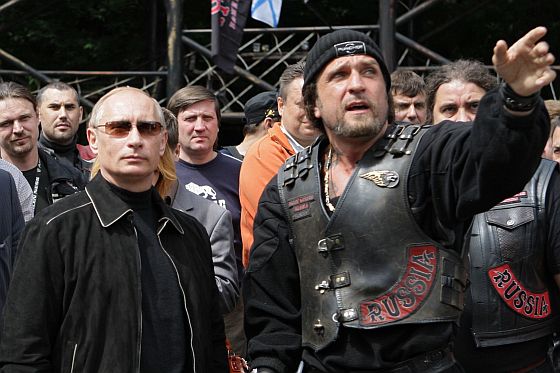
The Night Wolves — Putin’s biker friends — plan to descend on Berlin

night-wolves

The New York Times reports: Several hundred leather-clad motorcyclists from the Night Wolves, a club closely allied with President Vladimir V. Putin of Russia, plan to roar from Moscow to Berlin this month for the 70th anniversary of the Soviets’ victory over Nazi Germany.

Like the Red Army before them, the Night Wolves will have several countries to cross on the way, including Poland. And given the current tensions over Ukraine and widespread worries that Mr. Putin may have other aggressive designs on his neighbors, the prospect of hundreds of Russian bikers’ roaring across the Polish countryside — not to mention Slovakia, the Czech Republic, Austria or Germany — is not being greeted with joy in all quarters.

“I wish they would never come here,” said Monika Trzcinska, the mayor of Braniewo, a small Polish town a stone’s throw from the Russian border, which will be the first stop in Poland for some of the riders on April 25.

A Facebook page opposing the event had 11,000 likes by Wednesday afternoon with a logo featuring a Polish eagle with a lit match chasing a flaming wolf. Meanwhile, a petition calling for the motorcycle rally to be banned had attracted 4,000 signatures, and some Polish lawmakers were calling on their government to find some way to block the event.

Prime Minister Ewa Kopacz called the rally a “provocation” in an interview Tuesday on Polish radio, and said it would be up to Polish border guards to decide whether Russian bikers would be allowed into the country.

Some Polish biker groups said they intended to take to the highways to block the Russians, but others were more welcoming. [Continue reading…]

Facebooktwittermail

Why has Russia lifted its ban on delivery of S-300 surface-to-air missile system to Iran?

The Wall Street Journal reports: The Kremlin lifted its self-imposed ban on the delivery of a powerful missile air-defense system to Iran on Monday, stoking sharp criticism from the White House and Israel and casting fresh doubt on the international effort to curb Tehran’s nuclear program.

U.S. lawmakers seized on Moscow’s announcement Monday to warn Russia was among a host of foreign countries using the prospect of a nuclear deal to begin seeking out lucrative business deals that could bolster Iran’s military and economy.

Any delivery of an air-defense system would complicate airstrikes on Iranian nuclear facilities by Israel or the U.S. should the diplomatic track fail.

Iran thinks that Russia will deliver the missile system this year, Ali Shamkhani, secretary of Iran’s Supreme National Security Council, told the Interfax news agency in Moscow on Tuesday.

The U.S. Senate is set to vote this week on legislation that would provide Congress with the power to approve, amend or kill any agreement that seeks to curb Iran’s nuclear program in exchange for a lifting of international sanctions.

Supporters of the bill, Republican and Democrat, said Russia’s lifting of its ban on the S-300 surface-to-air missile system could be just the beginning of countries testing the sanctions regime and a United Nations arms embargo on Iran.

“Before a final nuclear deal is even reached, [Russian President] Vladimir Putin has started to demolish international sanctions and ignore the U.N. arms embargo,” said Sen. Mark Kirk (R., Ill.), who sponsored legislation that seeks to impose new sanctions on Iran if a final deal isn’t reached by June 30.

Russian Foreign Minister Sergei Lavrov said the defensive systems didn’t come under the U.N. arms embargo, and that Russia implemented the S-300 ban voluntarily. “This was done in the spirit of good will to stimulate progress in the negotiations,” he said, adding that it was no longer necessary.

The State Department also said that the embargo imposed on Iran in 2010 didn’t prevent the delivery of S-300s. But the White House warned that the missile system, while defensive, could enhance Iran’s ability to challenge key U.S. allies in the Middle East, such as Israel and Saudi Arabia.

It said that Secretary of State John Kerry raised the issue with Mr. Lavrov on Monday.

Still, the Obama administration was measured in its criticism, noting that it didn’t believe the proposed missile sale would jeopardize the nuclear negotiations. [Continue reading…]

Some analysts may interpret Putin’s move as an effort to undermine the nuclear deal with Iran, but one can argue that on the contrary, the planned delivery of S-300 missiles may make the conclusion of the deal a fait accompli.

With an elastic clock, Benjamin Netanyahu has long favored a breathless time is running out narrative when it comes to closing the door on Iran’s nuclear capabilities.

If no deal is signed and within a few months Iran’s newly-reinforced defense systems make its nuclear sites extremely difficult to attack, 2015 is probably the last year that Israel could launch or instigate air strikes on Iran. It has never been plausible that it could conduct such attacks on its own, but the timing for it to enlist the support of others has probably never been worse.

The U.S. and Iran are effectively on the same side in a war against ISIS. American forces currently in Iraq would definitely become very vulnerable if the U.S. soon started bombing Iran.

Moreover, as Yemen becomes a quagmire for Saudi Arabia, an attack on Iran would likely become the tipping point for the current matrix of regional conflicts to start hopelessly spinning out of control.

Putin’ intention in approving the delivery of S-300 missiles at this juncture might simply be to push Russia first out of the gate in the race to cash in on the rewards from the inevitable ending the economic embargo on Iran.

Those who currently argue that the framework agreement is not good enough are rapidly being confronted with the reality that either the deal gets struck by the end of June or within a fairly short period Iran will see dwindling incentives for making any deal. Time is on Iran’s side.

Facebooktwittermail