Category Archives: Russia

West must confront Russia over Aleppo, British MPs to be told

The Guardian reports: Western air forces must be willing to confront Russian military jets over the skies of Syria to enforce a no-fly zone and protect the citizens of eastern Aleppo from a bombardment akin to the attack on Guernica during the Spanish civil war, UK MPs will be told by a former cabinet minister in an emergency three-hour Commons debate on Tuesday.

The intervention by Andrew Mitchell, the former international development secretary, and the granting of the debate itself, will force the UK’s Foreign Office to set out how it intends to respond after Russia’s veto of a UN resolution calling for a ceasefire in eastern Aleppo. The west has been criticised for lacking any leverage over Russia in Syria.

Britain has criticised Russia but set out no clear plan on how to respond to the growing threat posed by Moscow not just in the Middle East, but across eastern Europe. Mitchell argues the whole post-cold war international diplomatic architecture is being torn down by Russian actions. [Continue reading…]

Facebooktwittermail

Warming relations between Russia and Turkey as Putin and Erdogan revive pipeline deal

The New York Times reports: Amid increasingly tense relations with the United States over Syria, President Vladimir V. Putin of Russia took advantage of a routine meeting in Istanbul on Monday to advance the Kremlin’s reconciliation with Turkey, including an agreement to revive a suspended natural-gas pipeline project.

The new pipeline, known as the Turkish Stream, would run under the Black Sea to Turkey and then the Greek border, allowing Russian gas to reach Western markets without using Russia’s existing export pipelines through Eastern Europe.

The pipeline would make it much easier for Russia to cut off gas supplies to neighboring countries like Ukraine without disrupting sales to countries farther west like Italy or Austria. Russia has been trying for years to establish such an export route.

Mr. Putin’s appearance at an international energy conference was his first visit to Turkey since a crisis in relations between the countries after Turkey’s downing of a Russian fighter jet along the border with Syria in November 2015, in which a Russian pilot was killed. President Recep Tayyip Erdogan of Turkey, nominally an ally of the United States in Syria, patched things up with a letter of apology and a trip to St. Petersburg in August.

The two have sought to use their warming relationship both at home and abroad to indicate that they are not politically isolated and remain central players in any Syria solution. They sat next to each other in the front row of the World Energy Congress in Istanbul, laughing together, and later met for bilateral talks. [Continue reading…]

Facebooktwittermail

Everything Donald Trump says about Syria is crazy, wrong, or both

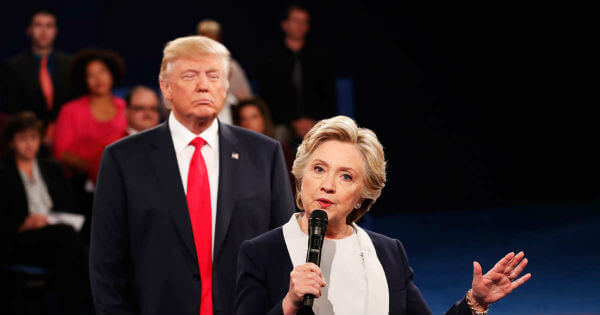
hovering-trump

Michael Weiss writes: Well, now I prefer the guy who didn’t know what Aleppo is.

In the second presidential debate, during which Hillary Clinton looked as if she could profit from her own no-fly zone against her menacingly hovering opponent, Donald Trump made a series of assertions about the five-year-old humanitarian catastrophe in Syria that no one with access to Google, much less classified intelligence, ever ought to make. That he managed to do this while both deferring to a theocratic—excuse me, Islamic terrorist—regime he claims to reprehend and also humiliating his own running-mate in the process was a masterstroke of Trumpist illogic and megalomania.

By way of reaffirming his faith in a better working relationship with the Kremlin (whose hacking of the Democratic National Committee he again doubted), Trump stated that “Assad is killing ISIS. Russia is killing ISIS. And Iran is killing ISIS.” He sees this as proof of absent American leadership, and is quite comfortable being on their side in a civilizational struggle, even though he hates the fact that Iran is richer and only able to war against the Sunni extremists thanks to Obama’s nuclear deal.

In point of fact, none of the parties Trump rattled off has demonstrated much of a keenness or willingness to fight ISIS in Syria, as a bevy of U.S. officials and independent monitors have repeatedly pointed out. [Continue reading…]

Facebooktwittermail

Russia to build permanent Syrian naval base, eyes other outposts

Reuters reports: Russia will create a permanent naval base in Syria to expand its military footprint in its closest Middle East ally, a government official said on Monday, a week after Moscow said it was considering reopening Soviet-era bases in Vietnam and Cuba.

The move, announced by Russian Deputy Defence Minister Nikolai Pankov, is further evidence Russia is building up its capabilities in Syria despite a partial drawdown in March and another sign it is digging in for the long haul to help prop up President Bashar al-Assad.

“By doing this Russia is not only increasing its military potential in Syria but in the entire Middle East,” Senator Igor Morozov, a member of the upper house of parliament’s International Affairs Committee, told the RIA news agency. [Continue reading…]

Facebooktwittermail

Russian parliament authorizes air force to remain in Syria forever

RT reports: The lower house of the Russian parliament (the State Duma) has ratified an agreement allowing the country’s Air Force to stay in Syria on an unlimited basis. Combatting terrorism is cited as one of the key goals.

The ballot took place on Friday with all 446 legislators voting in favor of the agreement, which will be applied “for an unlimited period and is timely applied from the date of its signing.” [Continue reading…]

Facebooktwittermail

Russia vetoes UN demand for end to bombing of Syria’s Aleppo

Reuters reports: Russia vetoed a French-drafted U.N. Security Council resolution on Saturday that would have demanded an end to air strikes and military flights over Syria’s city of Aleppo, while a rival Russian draft text failed to get a minimum nine votes in favor.

Moscow’s text was effectively the French draft with Russian amendments. It removed the demand for an end to air strikes on Aleppo and put the focus back on a failed Sept. 9 U.S./Russia ceasefire deal, which was annexed to the draft.

British U.N. Ambassador Matthew Rycroft told Russian U.N. Ambassador Vitaly Churkin: “Thanks to your actions today, Syrians will continue to lose their lives in Aleppo and beyond to Russian and Syrian bombing. Please stop now.”

Syrian President Bashar al-Assad’s forces, backed by Russian war planes and Iranian support, have been battling to capture eastern Aleppo, the rebel-held half of Syria’s largest city, where more than 250,000 civilians are trapped.

“Russia has become one of the chief purveyors of terror in Aleppo, using tactics more commonly associated with thugs than governments,” U.S. Deputy Ambassador to the United Nations David Pressman told the council. [Continue reading…]

Facebooktwittermail

Seven reasons the new Russian hack announcement is a big deal

Julia Ioffe writes: It’s been buried under news of Donald Trump bragging about his ability to grab women by their genitals, but Friday afternoon’s news dump included a stunning declaration by the Department of Homeland Security: the first direct accusation from the Obama administration that Russia is trying to interfere with our elections.

“The U.S. Intelligence Community is confident that the Russian Government directed the recent compromises of e-mails from US persons and institutions, including from US political organizations,” the statement said, concluding that “these thefts and disclosures are intended to interfere with the US election process.” After the Democratic National Committee hack and the scattered hacks of voting machines, and months of talk in the press and on Capitol Hill, the Obama administration has openly called out the Kremlin for meddling in the election.

This was immediately followed by a new dump of documents from WikiLeaks, this time of Clinton campaign chair John Podesta’s emails, and news that the Russian ambassador to the United Nations lodged a formal complaint with the organization when another official criticized Trump. And all of this comes against the backdrop of Trump’s constant and effusive praise for Vladimir Putin, as well as a steady stream of revelations about his campaign’s shady ties to Russia.

As head-spinning as it might be and as distracted as we might be by #TrumpTapes, this is arguably the more important story. What’s really going on? The hacking war is a genuinely new development in the long and often fraught U.S. relationship with Russia, and carries profound implications. Here’s what’s behind Friday’s statement — and why it matters so much. [Continue reading…]

Facebooktwittermail

Is Russia pulling Turkey away from the West?

Mustafa Akyol writes: A binational meeting was held in Moscow Oct. 2, bringing together Ahmet Tunc — an adviser of Melih Gokcek, the mayor of Ankara and a strong supporter of President Recep Tayyip Erdogan — and Aleksandr Dugin, a “special representative” of President Vladimir Putin. In the meeting, Dugin made the sensational claim that he himself helped save Turkey from the military coup by informing Turkish authorities about some “unusual activity” in the military July 14, a day before the coup attempt. He also claimed that the coup plot took place “because Erdogan had begun to turn toward Russia.”

Dugin also urged his Turkish guests to reconsider the orientation of their country. “You know, they are not welcoming Turks to Europe,” he said, in reference to Turkey’s unpromising bid to join the European Union. “Yet while Europe’s doors are closed to you, Russian ones are open.”

If Dugin were an ordinary Russian political scientist, these words would not mean much. But he is widely acknowledged as a major ideologue of the Putin regime. Western media outlets have dubbed him “Putin’s brain” and the “prophet of the new Russian Empire.” He is known for promoting “Eurasianism,” which seems to be “a scheme for uniting all the global enemies of liberalism under Russian leadership.” [Continue reading…]

Facebooktwittermail

The United States and Russia are prepping for doomsday

Jeffrey Lewis writes: The other day, a little present arrived in the mail. It was book, or rather a pair of doorstops. Titled Doomed to Cooperate, the massive two-volume set is about 1,000 pages of essays, interviews, and vignettes from more than 100 participants in the remarkable period of cooperation between the nuclear weapons complexes of the United States and Russia in the immediate post-Cold War period. Siegfried Hecker, who edited the volumes, titled them after the remark of a Soviet scientist, who said of the shared danger that nuclear weapons pose, “Therefore, you know, we were doomed to work together, to cooperate.” Not everyone got the message, certainly not Vladimir Putin. Set against relations between Washington and Moscow today, the incredible stories in Hecker’s two volumes seem to be from another era entirely. On Monday, Putin issued a decree suspending a plutonium disposition agreement with the United States due to its “unfriendly actions.” (An unofficial translation is available from the Center for Energy and Security Studies in Moscow, as is a draft law submitted by the Kremlin.) Putin’s decree ends one of the last remaining forms of cooperation from that remarkable era.

“Plutonium disposition” is a fancy sort of phrase, the kind of term of art that, when I drop it at a cocktail party, sends people off to refill their drinks. But plutonium is the stuff of which bombs are made. After the Cold War, the United States and Russia agreed to dispose of tons of plutonium to make sure it could never be put back into bombs. So believe you me, when the Russians decide that maybe they should just hang on to that material for a while longer, it’s not so boring.

And we’re talking about a lot of plutonium here. If you recall the dark days of the Cold War, or maybe just read about them in a book, the United States and Soviet Union each had tens of thousands of nuclear weapons. That’s sort of insane if you think about what just one nuclear bomb did to Hiroshima and another to Nagasaki. But the United States and the Soviet Union each built stockpiles in excess of 30,000 nuclear weapons at their peak, massive arsenals of nuclear weapons that vast exceeded any conceivable purpose. And at the beating heart of the vast majority of those bombs were tiny little pits of plutonium.

Washington and Moscow have made great strides in reducing their vast nuclear arsenals, although we still have more than enough nuclear weapons to kill each other and then make the rubble bounce. The United States, for example, has reduced its stockpile from a peak of 31,255 nuclear weapons in 1967 to 4,571 in 2015. Let’s just say Russia’s stockpile is comparable, though perhaps not quite as modest.

Of course, retiring a nuclear weapon requires it to be dismantled. In the United States, a backlog of thousands of weapons awaits dismantlement. That queue stretches to 2022, and few experts think the United States will meet that target. And even once a weapon is dismantled, that still leaves the plutonium. As long as the plutonium exists, it can be turned back into a nuclear bomb.

The United States and Russia have lots and lots of plutonium left over from the Cold War. Neither country makes new plutonium anymore, or at least no weapons-grade plutonium, but don’t worry — there’s still more than enough to keep you up at night. The International Panel on Fissile Materials, at Princeton University, estimates the stockpiles of weapons-grade plutonium at 88 metric tons for the United States and 128 metric tons for Russia. To give you a sense of how much plutonium that is, it is an unclassified fact that a nuclear weapon can be made with as little as 4 kilograms of plutonium. It’s a slightly touchier subject that this is the average in the U.S. stockpile — one can make do with less. But let’s do the math: Even at 4 kilograms per nuclear weapon, 88 metric tons represents enough material for 22,000 nuclear weapons. [Continue reading…]

Facebooktwittermail

U.S. government officially accuses Russia of hacking campaign to interfere with elections

The Washington Post reports: The Obama administration on Friday officially accused Russia of attempting to interfere in the 2016 elections, including by hacking the computers of the Democratic National Committee and other political organizations.

The denunciation, made by the Office of the Director of National Intelligence and the Department of Homeland Security, came as pressure was growing from within the administration and some lawmakers to publicly name Moscow and hold it accountable for actions apparently aimed at sowing discord around the election.

“The U.S. Intelligence Community is confident that the Russian Government directed the recent compromises of e-mails from U.S. persons and institutions, including from U.S. political organizations,” said a joint statement from the two agencies. “. . . These thefts and disclosures are intended to interfere with the U.S. election process.”

The public finger-pointing was welcomed by senior Democratic and Republican lawmakers, who also said they now expect the administration to move to punish the Kremlin as part of an effort to deter further acts by its hackers. [Continue reading…]

Facebooktwittermail

UN Syria envoy offers to escort Nusra fighters out of eastern Aleppo

The New York Times reports: The top United Nations diplomat for the Syria conflict proposed a new truce on Thursday, in hopes of averting what he called the destruction of rebel-held eastern Aleppo by Russian and Syrian forces. He offered to personally escort the jihadist fighters in the area to safety if the bombing is halted.

The proposal by the diplomat, Staffan de Mistura, reflected his despair over the relentless bombardment by the Syrian military and its Russian allies in the past few weeks, following the collapse of a cease-fire negotiated by Russia and the United States.

But Mr. de Mistura’s proposal also was seen as part of a possible new diplomatic effort to press the Russians over their role in the humanitarian disaster unfolding in Aleppo, the divided Syrian city that was once the country’s commercial capital and is now a sprawling urban kill zone.

Roughly 275,000 people in the rebel-held eastern half of Aleppo have been subjected to indiscriminate aerial bombing that has killed hundreds, including many children. Outside access to that part of the city has been cut off.

Russia, which has been supporting the forces of President Bashar al-Assad for the past year with airstrikes and other military assistance, has said it is not responsible for the killing of civilians.

In Aleppo, the Russians have said, their targets are the radical jihadist fighters of the Nusra Front, an affiliate of Al Qaeda that is also known as the Levant Victory Front. Those fighters are regarded as enemies by the United States and its allies as well as by the Syrian government and Russia.

Speaking to reporters at the United Nations offices in Geneva, Mr. de Mistura said opposition groups had a total of no more than 8,000 fighters in eastern Aleppo, including roughly 900 to 1,000 Nusra members. Their departure from the city, Mr. de Mistura said, would remove any justification by Russia and Syria for the ferocious bombardments. [Continue reading…]

Facebooktwittermail

In fight for Aleppo, Assad’s side is just as fragmented as his opponents

The New York Times reports: The Syrian civil war, and the intense new ground battle in the divided city of Aleppo, is often seen as a contest between a chaotic array of rebel groups and the Russian-backed government of President Bashar al-Assad. But the reality is that Mr. Assad’s side is increasingly just as fragmented as its opponents, a panoply of forces aligned partly along sectarian lines but with often-competing approaches and interests.

There are Iraqi Shiite militiamen cheering for clerics who liken the enemy to foes from seventh-century battles. There are Iranian Revolutionary Guards fighting on behalf of a Shiite theocracy. There are Afghan refugees hoping to gain citizenship in Iran, and Hezbollah militants whose leaders have long vowed to fight “wherever needed.”

The Syrians themselves are in a few elite units from an army steeped in a nominally socialist, Arab nationalist ideology, exhausted after five years of war, as well as pro-government militias that pay better salaries. And, yes, overhead there are the Russian pilots who have relentlessly bombed the rebel-held eastern side of Aleppo — trained to see the battle as supporting a secular government against Islamist extremist terrorists.

“The government’s fighting force today consists of a dizzying array of hyper-local militias aligned with various factions, domestic and foreign sponsors, and local warlords,” said one analyst, Tobias Schneider, in recently summing up the situation.

The battle for eastern Aleppo, where the United Nations says some 275,000 people are besieged, has raised tensions between the United States and Russia to their highest levels in years, but the Cold War rivals do not wield clear control over their nominal proxies. The competing interests on both sides and lack of clear leadership on either one is part of why the fighting has proved so hard to stop: Mr. Assad is desperate to retain power, Moscow is seeking to increase its clout at the global geopolitical table, and Iran is exercising its regional muscle.

While Washington and Moscow say preservation of Syrian state institutions is a priority, a look at the fight for Aleppo, Syria’s largest city, shows that those structures are already atrophying.

At least one elite Syrian Army unit has been filmed seizing positions in Aleppo, but the bulk of the pro-government force is made up militiamen trained and financed by Iran, the Shiite theocracy that is the Syrian government’s closest ally, according to experts, diplomats, regional officials and fighters battling for and against the government.

“Aleppo is Shiite, and she wants her people,” goes a song overlaid onto a video posted online of an Iraqi cleric visiting Iraqi Shiite militia fighters on the front lines south of Aleppo. The message ignores the fact that the mainstream Shiite sect that accounts for the bulk of the Iraqi militias makes up less than 1 percent of Syria’s population. [Continue reading…]

Facebooktwittermail

Who are Syria’s White Helmets, and why are they so controversial?

By Scott Lucas, University of Birmingham

A young man, wearing a white helmet and a distinctive yellow-and-blue badge on his arm, digs for four hours in the rubble of a building destroyed by a Russian-regime airstrike in Idlib Province in northwest Syria.

Finally, he sees what he’s looking for: an infant, only weeks old. He gently lifts her, still breathing, from the wreckage and takes her to an ambulance. Crying uncontrollably, he cradles her as she is treated, wounded but alert. He says, “I feel like she is my own daughter.”

Warned that Russian warplanes are overhead, volunteers in a civil defence centre get out of their beds and dress, preparing to help victims at the next bombed site. As they arrive, the warplanes target them in a “double tap” attack, dropping one bomb and then another minutes later. One rescuer is seriously wounded. His colleagues wait anxiously, and suddenly he revives, insisting on lighting a cigarette. A sigh of relief as the pack is taken from him: “No smoking for you now.

These all-too-numerous episodes often don’t end so well. Generally it’s bodies rather than survivors that get pulled out of the rubble, and the volunteers are vulnerable: 141 have been killed and many more wounded.

As Syria’s nearly six-year conflict rumbles on with no end in sight, the country’s so-called “White Helmets” continue to offer a desperately needed humanitarian response. More than 62,000 people have been rescued since the volunteer humanitarian force was formed in 2013.

Continue reading

Facebooktwittermail

Lobbyist advised Trump campaign while promoting Russian pipeline

Politico reports: A Republican lobbyist was earning hundreds of thousands of dollars to promote one of Vladimir Putin’s top geopolitical priorities at the same time he was helping to shape Donald Trump’s first major foreign policy speech.

In the first two quarters of 2016, the firm of former Reagan administration official Richard Burt received $365,000 for work he and a colleague did to lobby for a proposed natural-gas pipeline owned by a firm controlled by the Russian government, according to congressional lobbying disclosures reviewed by POLITICO. The pipeline, opposed by the Polish government and the Obama administration, would allow Russian gas to reach central and western European markets while bypassing Ukraine and Belarus, extending Putin’s leverage over Europe.

Burt’s lobbying work for New European Pipeline AG, the company behind the pipeline known as Nord Stream II, began in February. At the time, the Russian state-owned oil giant Gazprom owned a 50 percent stake in New European Pipeline AG. In August, five European partners pulled out and Gazprom now owns 100 percent. [Continue reading…]

Facebooktwittermail

Eastern Aleppo faces ‘total destruction’ in two months

BBC News reports: Rebel-held eastern parts of the Syrian city of Aleppo may face “total destruction” in two months, with thousands killed, the UN’s envoy says.

Staffan de Mistura told reporters that he was prepared to personally accompany al-Qaeda-linked jihadists out of the city if it would stop the fighting.

He also appealed to Russia and Syria’s government not to destroy the city for the sake of eliminating militants.

Troops have been besieging the east, where 275,000 people live, for a month.

“The bottom line is, in a maximum of two months… the city of eastern Aleppo at this rate may be totally destroyed,” Mr de Mistura told a news conference in Geneva.

“Thousands of Syrian civilians, not terrorists, will be killed and many of them wounded.” [Continue reading…]

Facebooktwittermail

Obama has no plan to save Aleppo from Putin and Assad

The Daily Beast reports: U.S. officials are scrambling to find ways to blunt Russian and regime aggression in Syria. But none of the limited set of options currently being crafted would stop the eastern part of the country’s largest city, Aleppo, from falling into the hands of the Bashar al-Assad regime and its Russian allies, two U.S. officials told the Daily Beast.

Rather, lower level American officials are proposing to arm U.S.-backed rebels with more powerful, longer range weapons and surface-to-air weapons to potentially thwart Russian and regime airstrikes. The hope is that such weaponry would be enough for opposition groups to retain their control in other parts of Syria, like the suburbs of Damascus.

The surface-to-air missiles would not include shoulder-fired anti-aircraft missiles — so-called “MANPADS,” short for “Man Portable Air Defense Systems,” — but rather less mobile systems that would be less likely to end up in the wrong hands, the officials said.

“Those kind of plans are on the table,” one of the U.S. officials explained to The Daily Beast.

But even those plans would be an ambitious sell to the White House, the officials concede, given that the administration has so far rejected direct military intervention in eastern Aleppo. None of those potential proposed responses would be carried out in time to stop the fall of eastern Aleppo into regime hands, which officials have told The Daily Beast is imminent. [Continue reading…]

Facebooktwittermail

How did the world remain silent during the Holocaust? Exactly the way it’s doing in Aleppo

Nitzan Horowitz writes: For as long as I can remember, when I was told about the Holocaust they always said that the world was silent. “The Jews were sent to the gas chambers and the world did nothing,” the teacher leading Holocaust Remembrance Day ceremonies would say, and her voice would crack with tears. So did my grandmother, whose huge ultra-Orthodox family was shot, burned, poisoned and starved in the Nazi killing fields. The few who managed to flee for their lives, shivering refugees, faced a hostile reception in neutral countries like Switzerland. American visas were not even the remotest possibility.

That same grandmother, who was already in this country, went as far as the British high commissioner to beg for an entrance permit for her mother, who remained behind in Poland. In vain. “There’s not even room for a cat in Palestine,” the senior British official told her. Her mother was murdered, and that cruel response burned in her until her dying day.

How could the world have remained silent? Why didn’t they stop the destruction, or at least bomb the death camps, the trains and the tracks? Toward the end of the war, when the military balance in Europe had changed, they could have done this. Some of the Jews of Hungary, for example, could have been saved from Eichmann’s clutches. Hundreds of thousands of people. How did they not open the gates?

How? Look at Aleppo and you’ll see. No comparisons allowed? I’m comparing. To Guernica for example, the symbol of fascist violence in the Spanish Civil War. The mass murderer Bashar Assad, assisted by the brutal Vladimir Putin, dropping barrels of burning oil on residential buildings, carpet-bombing entire neighborhoods, exterminating children, the elderly, farmers and merchants. It’s been going on for five years. Half a million people have been killed. More than four million have fled the country. Double that number have become refugees in their own country. Right now hundreds of thousands of people are under siege in Aleppo, about to be annihilated.

War crimes? Certainly. A crime against humanity? No doubt. And the world is silent. There is an international coalition in Syria, led by the United States. It is even working energetically, and apparently also efficiently, against the Islamic State and the rest of the murder organizations of its ilk. A worthy goal indeed, but ISIS is responsible for only a small part of the massacre, the destruction and the waves of refugees generated by the regime in Damascus and their patrons in Moscow.

The Nobel Peace Prize laureate, President Barack Obama, did not bring peace. Syria was a major lost opportunity, a stain on his presidency. True, he inherited a terrible legacy from the Republicans: a bleeding swamp in Afghanistan and the fraudulent war in Iraq. The last thing he wanted was another entanglement in the Middle East. It’s hard to blame him, but one should: It was his duty. Had he responded firmly to the horrors perpetrated by Assad and Putin at the outset, perhaps this nightmare of a war would not have reached its current proportions. It would have been possible – and these things were proposed and discussed in real time – to declare a no-fly zone in the regions of the civil war, just as was done in Iraqi Kurdistan against Saddam Hussein. But it wasn’t done, and Putin pulled the rope tighter and tighter until he broke it completely. Millions of people are paying the unimaginable price. [Continue reading…]

Facebooktwittermail

Whoever saves a life

In June 2014, Matthieu Aikins visited Aleppo and rode with Civil Defense volunteers (the “White Helmets”) in their donated truck in the neighborhood of Hanano. He wrote: The members of Civil Defense were attendants to the city’s trauma, one of the few first responders left to care for the civilians caught on the front lines in a war between Syrian President Bashar al Assad and rebel fighters. The team evacuated the injured, cleaned up the bodies, and fought fires. But what they were best known for  — what they had become famous for in Syria and abroad  — were the dramatic rescues, the lives they pulled from under the rubble.

When they spotted a blast, they’d cram into the cabin, ten or more on its two bench seats, and set off in search of the impact site. The truck had a loose, shaky suspension and the cab would smash up and down off the craters and potholes, jangling the men like change inside of a tin cup. The siren atop was an old-school wailer, deafening and sonorous. Sometimes they’d catch sight of an ambulance and give chase; often they’d be the first to the scene. As they rushed along, they’d lean out and ask pedestrians where the bomb had fallen. They could tell by the reaction if they were getting closer. At first it was just a pointed arm or a shrug, but as they neared, the onlookers would get increasingly agitated, until they saw in their eyes the wildness of a close brush with death or the panic for a trapped neighbor. The missions were all the more dangerous because of the regime’s tactic of “double-tap” strikes, where they would return to bomb the same site and hit the rescuers and whatever crowd had gathered. In March, three members of the Hanano team had been killed that way, along with an Egyptian-Canadian photographer who had come to document their work.

Khaled flicked the cigarette into the parking lot. Thirty years old, he looked more like a graduate student than someone who had spent the last year immersed in blood and rubble: shaggy hair, a straight, full-bridged nose and a pointed jaw softened by full lips and cheeks. In a city dominated increasingly by anti-Western Islamist groups, he had until recently worn a pony tail. He was growing a slight paunch from all the nights spent sitting up snacking on fruit and nuts, listening to the sound of the city’s bombardment and waiting for a call. When he smiled, a net of crow’s feet crinkled into the corners of his eyes, but mostly his face maintained an unshakable placidity, even in the presence of death. It was this stillness, more than anything else, that accounted for his unruly team’s respect and obedience. “It’s the quiet ones you should fear,” was how Surkhai, the group’s joker, had put it.

After washing his face in the rickety outbuilding that served as their bathroom, Khaled returned to his office, which was furnished with a scuffed desk, a shelf that held the station’s paperwork, and a couple of love seats. On the wall hung a certificate of appreciation from the city council. Two bare bulbs dangled from the ceiling.

Khaled could hear the rest of the team stirring. Present that day were some of his most reliable veterans  —  though of course they were really still boys. At 28, the twins, Surkhai and Shahoud, heavyset with thick hair covering everywhere but the top of their heads, were among the eldest. The rest were mostly 20 or 21. Scrawny Ali, with his mullet, was only 19. Only Ahmed, a lanky, goateed kid who had been a firefighter like his father, had any experience as a first responder before the war. In all, there were 30 of them, but they worked in shifts, so that only a dozen or so were typically in the station at any one time. Except for the leader, Khaled. He had not taken a single day off. He loved the team  —  loved the physical closeness, the emotional bond. These guys had become his life. His old self, the former law student who taught at a trade school, seemed as remote to him as his family’s home, now behind regime lines. [Continue reading…]

Facebooktwittermail