Category Archives: Syria

Will the gas fields of the Levant Basin become Israel’s next warzone?

a13-iconChristopher Dickey reports: When Israel looks at the greatest threat to its long-term hopes for the future, these days it’s looking out to sea. The old issues are on the table, of course: Iran’s nukes, the Palestinians, the Syrian slaughterhouse next door and growing regional instability. But if there’s a place where a sudden, out-of-control war is likely to erupt, it’s probably not going to be called the Sinai, the Golan, the West Bank (or Judea and Samaria). It’s going to be called Leviathan, Dalit or Karish — the vast fields of natural gas and oil discovered in the deep waters between Israel and Cyprus over the last five years.

Who controls that wealth is likely to dominate the economic future of the region for generations to come. The Israelis know it. So do their allies, their rivals and their enemies. And tensions are mounting by the day.

“All the elements of danger are there,” says Pierre Terzian, editor of the oil industry weekly Petrostrategies: there is competition for huge resources, there are disputed borders, and, not to put too fine a point on it, “this is a region where resorting to violent action is not something unusual.”

The United States government is watching warily, trying to broker diplomatic settlements and, so far, failing. No longer inclined to be the region’s policeman on land or in the air, much less at sea, Washington is scaling back its presence in the Middle East while just about everyone else is increasing theirs.

Israel is rushing to create “the most technologically advanced fleet in the Eastern Mediterranean,” according to a report in Tablet Magazine. Turkey is flexing its maritime muscles with plans to spend as much as a billion dollars on a multi-purpose amphibious assault ship that will give its fleet blue water capabilities like never before. The Iranian-backed Hezbollah militia in Lebanon, meanwhile, is known to have naval missiles, and has used them in the past, sinking a cargo vessel and holing an Israeli warship during the Lebanon war of 2006. Russia is expanding both its naval and commercial presence in Syrian waters, despite the Syrian civil war. It inked a $90 million, 25-year exploration deal with Damascus last Christmas Day. [Continue reading…]

Facebooktwittermail

Syria: Barrel bombs on Aleppo

o13-iconEach and every day that the barrel-bombing of Aleppo continues, the Asad regime reminds the world of its true colors. It is the latest barbaric act of a regime that has committed organized, wholesale torture, used chemical weapons, and is starving whole communities by blocking delivery of food to Syrian civilians in urgent need.

Now, with air raids killing dozens more civilians in just the past few days, destroying apartment buildings, and barrel bombs striking a mosque today, the staggering civilian toll dramatically climbs. Each and every barrel bomb filled with metal shrapnel and fuel launched against innocent Syrians underscores the barbarity of a regime that has turned its country into a super magnet for terror. Given this horrific legacy, the Syrian people would never accept as legitimate a government including Asad.

While the opposition and the international community are focused on ending the war, as outlined in the Geneva communiqué, the regime is single-mindedly focused on inflicting further destruction to strengthen its hand on the battlefield and undermining hopes for the success of the Geneva II process. Statement of Secretary of State John Kerry, February 4, 2014

Frederic C. Hof writes: Secretary Kerry’s statement on the Assad regime’s latest affront to civilization combines, in equal measure, eloquence and emptiness. One reads the words and likes each of them. One applauds the style and appreciates the substance. Yet in the end two words come to mind: what next?

What does the United States intend to do about this outrage? Condemn it in the strongest possible terms? Call on Bashar al-Assad to step aside? Point out that Assad has lost all legitimacy? Draw a red-line? Urge the parties to negotiate in good faith at Geneva?

Barrel bombs have been pushed out of helicopters onto schools, clinics, bakeries, and mosques for months. Is the administration taking notice now because it has discovered that a regime acting with triumphant impunity, thanks to Iranian and Russian support, is not playing by the rules at Geneva? Is the administration surprised? Shocked?

Historians will note that the only reason why the Assad regime had helicopters in 2014 with which to drop these hideous steel packets of encased fuel and shrapnel is because the United States did not destroy them all in the summer of 2013, along with fixed-wing aircraft, airfields, artillery, rockets, and missiles. A straightforward military mission of destroying or significantly degrading the regime’s ability to bring concentrated fires to bear on populated areas would, by now, have saved thousands of lives. This mission could have been completed in days: no slippery slope, no boots on the ground, no open-ended commitment to win what President Obama has characterized as someone else’s civil war, no Iraq part deux. [Continue reading…]

Facebooktwittermail

The effort to isolate ISIS, Syria’s renegade jihadists

e13-iconIf the Assad regime had wanted to plant a Trojan Horse inside the Syrian revolution, the Islamic State in Iraq and Syria (ISIS or ISIL) would have provided the perfect vehicle. Whether ISIS is actually doing the regime’s bidding is almost besides the point since by design or not, the group is undoubtedly serving Assad’s interests. For all the other rebel groups in Syria, ISIS now represents the enemy within.

The conflict within the opposition — conflict which the press conveniently describes as “infighting” — predictably presents an image of a movement that is imploding; a movement whose lack of legitimacy is rising to the surface. Again, in this narrative the interests of the Syrian government and its supporters are being served.

Yesterday’s statement issued by al Qaeda’s central leadership is significant and should probably be taken at face value. It says:

Qae’dat al-­Jihad (AQ) declares that it has no links to the ISIS group. We were not informed about it’s creation, nor counseled. Nor were we satisfied with it rather we ordered it to stop. ISIS is not a branch of AQ & we have no organizational relationship with it. Nor is al-­Qaeda responsible for its actions and behaviors.

Aron Lund provides some background to this announcement:

In April 2013, Abu Bakr al-Baghdadi announced that the ISI would become the ISIL by extending its activity into Syria and taking full possession of the Syria-based jihadi faction known as the Nusra Front, which Baghdadi had helped create in August 2011.

All this happened without Zawahiri being informed, to his great dismay. When he complained and attempted to assert authority over the ISI(L), ordering Baghdadi to dissolve the new cross-border entity and head back to Iraq, Baghdadi simply refused to comply. From his hideout, which is probably in Pakistan, there was little Zawahiri could do about it.

But the al-Qaeda leader didn’t leave the Syrian dispute empty-handed: he gained or regained the allegiance of the Nusra Front, whose leader, Abu Mohammad al-Golani, publicly declared his allegiance to Zawahiri in an attempt to avoid being gobbled up by the ISIL. Since then, the Nusra Front has functioned as a de facto al-Qaeda branch, even though it isn’t yet publicly declared as such.

This split between the ISIL and the Nusra Front, which took place in April 2013, set in motion the process that now, after almost a year, has resulted in brutal infighting in northern Syria, with the ISIL and the Nusra Front on different sides. But it also forced al-Qaeda to finally come clean about what may have been the reality for quite a while: it no longer seems to have an Iraqi wing.

Over the last few weeks, @wikibaghdady, who presents himself as an inside source, has revealed many details about the inner workings of ISIS and Al Qaeda in Iraq (AQI/ISI).

Although Abu Bakr al-Baghdadi is most often referred to as the leader, according to @wikibaghdady (see an English translation of his tweets) the core leadership is a three-man military council of former officers who served Saddam Hussein and were members of the Ba’ath Party. Brigadier General Haji Bakr led the council until his death near Aleppo in January.

General Haji Bakr first met Abu Omar Al-Baghdadi when he offered his services to him due to having experience in Saddam’s Ba’athist army. He demonstrated his dedication to him and he is now considered to be one of the closest to him. However, Haji Bakr didn’t have any previous jihadi experience before that. He was accepted to the Military Council on the one condition of providing the State [AQI / ISI] with important information about the Iraqi army. When he did that and proved his loyalty, he was then appointed as the military adviser to Abu Omar al-Baghdadi and Abu Hafs al-Muhajir and continuously provided them with information about previous military leaders, plans and successfully linking them with previous members of the Ba’ath Party.

Although ISIS has become infamous for its outward brutality, the account of Haji Bakr’s leadership makes it clear that he imposed his own internal reign of terror.

When Haji Bakr became a leader, a new era started that was important to Iraq as well where the amount of fear between citizens increased. A lot of people considered Haji Bakr to be arrogant next to Abu Bakr al Baghdadi, who many considered to be a quiet personality. In addition, Haji Bakr completely changed the way he looked where he shaved his beard off and even changed the way he speaks in the first few weeks. The main issue here is that no one in the State dared to question anything taking place because questioning was considered not trusting the other person. This issue was serious to a point where it was allowed to kill another member who considered being suspicious of another.

Haji Bakr then started holding private meetings with Abu Bakr Al Baghdadi to reshape the State. The first agreement was protecting the State from the inside and out. This involved creating a security outlet that would be able to respond to any type of danger. An important step that took place was that Haji Bakr prevented Abu Bakr Al Baghdadi from meeting with leaders from other groups so they didn’t impact or advise him in any way. The orders came from the Shura council that Abu Bakr created to ensure that all decisions made were fair. After this, the two became very close and were always with each other where many considered him to be Al Baghdadi’s private minister.

Among their plans were various assassinations that in fact took place. This first started with twenty people and within a month, the number increased to one hundred people. It is essential to understand that no one in the State AQI/ISI would dare to take any orders from anyone else but Haji Bakr or Abu Bakr Al Baghdadi during that time. Every member in the Shura was carefully chosen by Haji Bakr and most of them were in the previous Baath party. One of the members’ main responsibilities was assassinating everyone who disobeys or betrays the State.

The most recent tweets reveal:

There were about twenty to thirty fighters who split from the ISIS on a daily basis. They found that fighters from Saudi Arabia were the most likely to split and that Tunisians were the least. This is when he [Al Baghdadi?] ordered that the suicide bombers should be Saudi as much as possible, and that Tunisians shouldn’t be involved since they’re the most loyal.

If a jihadist group turns out to be run primarily by former Ba’athists — a thoroughly secular political movement — this begs the question: is ISIS being viewed through the right ideological prism?

No doubt ISIS recruits jihadists, but if it is led by men who drew their power from the security apparatus of a Ba’athist state, then their overriding interests may have less to do with the creation of a Caliphate and more to do with surviving in a harbor provided by the last remaining Ba’athist government in the Middle East.

Facebooktwittermail

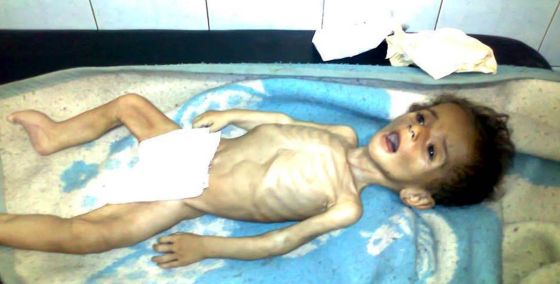
‘Not our problem’

Abed Al Jalil Khamis, just under a year old, is seen in Yarmouk camp. He later starved to death on Jan. 28, 2014.

Abed Al Jalil Khamis, just under a year old, is seen in Yarmouk camp. He later starved to death on Jan. 28, 2014.

NBC News reports on starvation and malnutrition in Yarmouk Camp, a Palestinian refugee camp just south of Damascus, whose population has been trapped under siege for months and where at least 89 people have died of starvation. In Yarmouk, “people are eating cats, grass and cactus they are so hungry.”

A comment beneath the report comes from “Pessimist”:

Not our problem. If Syrians can’t solve their own problems – too bad. Cats, rats, dogs – let them eat what they want.

Psychopaths, when shown images of people in distress, exhibit low affective empathy, which is to say they have an inability to respond emotionally appropriately to the suffering of others.

If the comment I cited was unusual, it might sound like “Pessimist” is a psychopath. Yet the sentiment — this isn’t our problem — pervades this thread of hundreds of comments.

Let those folks climb out of their own cesspool, if they’re willing.

pics of starving children? really? since when did syria care about its children?

The phrase, not our problem, appears thirty times just on the first of nine pages of comments.

There’s nothing new and nothing uniquely American about indifference. But the response to Syria goes far beyond indifference and has become a kind of angry callousness — tied to a legitimate rejection of another American war in the Middle East.

Yet even in this — wars in Iraq and Afghanistan that most Americans now see as having been futile — what appears to be the most regretted feature of these military adventures is their cost in “blood and treasure” to America.

The populations in those countries seem to be viewed by many as being just as undeserving of American sympathy as people starving in Syria.

What do all these people — the people whose suffering can be ignored — have in common?

They are Muslims and over the last decade while Muslims have been the primary target of American aggression overseas, the demonization of Muslims in American society has inexorably grown.

In an era where political correctness has had the broad effect (of questionable benefit) of tempering blunt expressions of bigotry, Islamophobia is not only prevalent but those who harbor such feelings appear to regard them as perfectly legitimate. Americans who have negative views of Muslims recognize that there are relatively few societal penalties for expressing these views.

“ohio state buckeyes fan” responds to “Hope-295312” — a commenter who appeals for an expression of empathy.

HOPE: These same folks you have such compassion for were the very same folks that were dancing in the street of Damascus after 9/11, these are the same folks that have cheered on every terrorist attack committed against the west. Frankly not our war, not our concern and if your truly had any desire for a safer world and for a peaceful Syria than you should be rooting for a war of extermination between the sides waging the civil war.

Hatred directed at a foreign other provides glue that can hold weak societies together. But the indifference many Americans express towards the suffering of children starving in Syria is not merely a reflection of a pervasive xenophobia; it also mirrors the extent to which a society that elevates the value of self-interest will also be a society in which we have a little willingness to care for each other.

Facebooktwittermail

Video: Children inside the Syrian revolution

f13-iconThe following documentary has been shown on television in the UK and Canada. It focuses on the experiences of children who are growing up in the shattered remains of Aleppo. Watch it while you can — it may not remain on YouTube for long.

“The law of war in Syria is that the closer you are to your enemy, the safer you are from air attacks, missiles and tanks.”

*

He said to me, “Mum, don’t be sad if I become a martyr.” … I said, “We’ll all be martyrs one day but you’re still too young my son.”

*

What happened to this town?
A child was martyred.
What did he do wrong?

Keep away soldiers!
Don’t obey this tyrant!
Free… free… freedom.

*

“I will protest here and I will die here.”

“We were raised in Syria. We were born here. We stayed here. The regime killed us here. We lost people here. We lost dear ones here. It is us who defend our town.”

Facebooktwittermail

Al Qaeda breaks link with Syrian militant group ISIS

n13-iconReuters reports: Al Qaeda’s general command said on Monday it had no links with the Islamic State in Iraq and the Levant (ISIL aka ISIS), in an apparent attempt to reassert its authority over fragmented Islamist fighters in Syria’s civil war.

After a month of rebel infighting, al Qaeda disavowed the increasingly independent ISIL in a move likely to bolster a rival Islamist group, the Nusra Front, as al Qaeda’s official proxy in Syria.

The switch is seen as an attempt to redirect the Islamist effort towards unseating President Bashar al-Assad rather than waste resources in fighting other rebels, and could be intended to shift the strategic balance at a time when government forces are increasingly active on the battlefield. It could also embolden Nusra in its dispute with ISIL.

Meanwhile, Jeffrey Goldberg writes: Two prominent Republican senators say that U.S. Secretary of State John Kerry told them — along with 13 other members of a bipartisan congressional delegation — that President Barack Obama’s administration is in need of a new, more assertive, Syria policy; that al-Qaeda-affiliated groups in Syria pose a direct terrorist threat to the U.S. homeland; that Russia is arming the regime of Syrian president Bashar al-Assad, and is generally subverting chances for a peaceful settlement; that Assad is violating his promise to expeditiously part with his massive stores of chemical weapons; and that, in Kerry’s view, it may be time to consider, once again, supporting the arming of more moderate Syrian rebel factions.

At a time that al Qaeda, the organization led by Ayman Zawahri, is disavowing ISIS, it’s time that Washington and the press stop using al Qaeda and al Qaeda affiliates as the preferred catch-all terms for branding America’s enemies.

Know Your Enemy 101: Al Qaeda, Jabhat al-Nusra, and the Islamic State of Iraq and the Levant/Syria (ISIL or ISIS) are not interchangeable terms. The idea that all these groups pose a threat to the U.S. homeland is either an expression of the ignorance of those making the claim or a cynical attempt to exploit the ignorance of their audience.

Facebooktwittermail

ISIS fighters kill Syrian rebel leaders

n13-iconAl Jazeera reports: Fighters linked to al-Qaeda have killed two rebel leaders in bombings in Syria, in an apparent shift of tactics to target the command structures of their rivals.

The UK-based Syrian Observatory for Human Rights reported that Adnan Bakour, the leader of Liwa al-Tawhid, was among 26 people killed in a double suicide bombing late on Saturday in Aleppo.

The Islamic State of Iraq and the Levant, which has links with al-Qaeda, said it carried out the attack on Tawhid, a brigade aligned to the Islamic Front coalition, a group fighting the ISIL [aka ISIS] in Aleppo and beyond.

In another attack late on Saturday in Hama, the leader of the powerful Suqour al-Sham group, Abu Hussein al-Dik, was killed by the ISIL, according to sources spoken to by Al Jazeera.

Charles Lister, of the Brookings Doha Centre, told Al Jazeera that the ISIL was clearly targeting key headquarters, “strategic checkpoints and senior influential commanders” of their rival rebel groups.

The attacks are the latest in weeks of rebel infighting that has pitted a loose alliance of Syrian fighters against al-Qaida linked groups such as the ISIL. [Continue reading…]

Facebooktwittermail

Is Syria becoming this generation’s equivalent of the Spanish Civil War?

NewsIn the 1930s, the war against fascism attracted the support of 35,000 foreign fighters who traveled to Spain from as many as 53 nations to join the International Brigades.

In the U.S. media, the foreigners drawn to Syria are generally branded as jihadists or terrorists and their motives assumed to be extreme or fanatical. That for many of them their motives might be comprehensible to others who are not Muslim, seems to require a leap of imagination outside the reach of Washington, the press or most news consumers on this side of the Atlantic.

Channel 4 News in the UK, however, has the editorial gumption to frame the following report in a way that none of their American counterparts would dare:

Facebooktwittermail

Nearly 1,900 killed in Syria since Geneva talks began

NewsThe Guardian reports: Nearly 1,900 people have been killed in Syria since the Geneva talks between the government and the opposition began just over a week ago, it was reported on Friday, as the UN mediator admitted there had been “no progress to speak of” so far.

The casualty figures were published by the Syrian Observatory for Human Rights, a UK-based pro-opposition group. It said at least 498 of the dead were civilians, 850 were fighters from mainstream or extremist rebel groups and 515 were on the government side. An estimated 130,000 people have died since the conflict erupted nearly three years ago. [Continue reading…]

Facebooktwittermail

Syria promised to deliver 700 tons of CW by Feb 5; only 32 tons have arrived

NewsThe Los Angeles Times reports: The Obama administration on Thursday slammed Syria for failing to fulfill its pledges to surrender its most dangerous chemical weapons for destruction and voiced concern that the entire project could now be in jeopardy.

In a statement to the Organization for the Prohibition of Chemical Weapons in the Netherlands, U.S. Ambassador Robert P. Mikulak accused Syria of “open-ended delaying” of the disarmament process in an attempt to renegotiate the deal it agreed to last fall.

The effort “has seriously languished and stalled,” Mikulak told the executive council of the group, which is overseeing the initiative with the United Nations. Syria’s “open-ended delaying of the removal operation could ultimately jeopardize the carefully timed and coordinated multistate removal and destruction effort.”

U.S. Defense Secretary Chuck Hagel, at an appearance in Warsaw, also expressed concern.

“They need to fix this,” he said.

Syrian President Bashar Assad agreed to surrender his chemical arsenal, one of the biggest in the world, to deflect President Obama’s threat to launch punitive missile strikes last summer in response to Syria’s alleged use of deadly nerve agents against civilians in suburbs of the capital, Damascus.

Syria initially appeared to comply with its promises to give up its poison gases, and the White House hailed the deal as a major foreign-policy accomplishment. But veteran arms experts have predicted since the deal was signed in September that Assad would seek to test the world community’s resolve and might try to keep some parts of a huge stockpile.

Under a disarmament plan proposed by the Syrians, Damascus was to deliver 700 tons of its most dangerous chemicals by next Wednesday to the port of Latakia, where the material would be loaded onto ships and destroyed at sea. But officials say it has delivered only about 32 tons, in two shipments on Jan. 7 and Jan. 27. [Continue reading…]

Facebooktwittermail

Syrian government demolishing whole neighbourhoods to punish residents

NewsThe Guardian reports: The Syrian government has demolished thousands of buildings, in some cases entire neighbourhoods, in parts of Damascus and Hama, as part of a collective punishment against residents of rebel-held areas, Human Rights Watch has found.

Satellite imagery taken over both cities has revealed seven areas where neighbourhoods have either been largely destroyed or totally demolished. None of the destruction was caused during combat. Rather, the buildings have been systemically destroyed using bulldozers and explosives placed by troops who first ordered residents to leave, then supervised the demolitions.

A report released on Thursday morning says the Syrian regime claims that the demolitions were part of an urban planning programme that aimed to remove illegally constructed buildings. [Continue reading…]

Meanwhile, Vice reports: Last September, an 18-month-old girl named Rana starved to death in the Damascus suburb of Mouadamiya. Her mother, Um Bilal, had watched helplessly for months as her child grew thinner and thinner, unable to do anything to ease her suffering. She holds the international community and the Syrian regime equally responsible for her child’s death. “The whole world watches the crimes of this regime that murdered my child and does nothing,” she said.

Under siege by the regime of Syrian President Bashar al Assad since November of 2012, Mouadamiya is subject to regular and completely indiscriminate bombardment with heavy artillery, mortars, and massive barrel bombs dropped by regime aircraft. After more than a year of this, the town boasts almost no intact buildings and is getting extremely short on places to bury its dead. Despite all that has been thrown at it though, the people of Mouadamiya have, so far, refused to surrender their town.

Of all those who’ve suffered in Syria’s bloody civil war, Mouadamiya has experienced some of the most calamitous bad luck. Much of this is down to geography; it’s situated between Mezzeh Military air base to the east, the regime’s Republican Guard to the west and the elite fourth armored division (which is run by Assad’s brother and chief enforcer, Maher) to the south. This makes the town exceedingly easy to surround and choke off. Consequently, when the regime got bored of trying to retake the town from the various rebel battalions controlling it by direct assault and instead resorted to siege, the result was starvation.

The Syrian regime is employing similar tactics against other rebel-held Damascus suburbs and has been for close to a year now. Having tried and failed to take back these strategically vital areas for 15 months and having used everything in their arsenal—from tanks to fighter jets to a massive sarin gas attack on the 21st of August of last year—they are now resorting to simply starving their opponents to surrender or death. [Continue reading…]

Facebooktwittermail

With Assad regime in stronger position, chemical weapons disarmament stalls

AnalysisThe Institute for the Study of War has released a new report: The Assad regime’s military position is stronger in January 2014 than it was a year ago and remains committed to fighting for Damascus, Homs, and Aleppo. Nonetheless, the conflict remains at a military and political deadlock.

In the spring of 2013 the regime lacked the necessary manpower to conduct simultaneous operations on multiple fronts against rebel groups that were quickly making gains throughout the north, south, and Damascus countryside. The Syrian Arab Army (SAA) had sustained more losses than it could replenish. It relied on air assets to resupply besieged troops in its Aleppo and Idlib outposts because it lacked overland logistical lines connecting those outposts. The regime had contracted its military footprint to Damascus and Homs in order to its secure supply lines while rebels contested Homs, the lynchpin of the regime’s logistics system that connected Damascus to Aleppo and to the coast.

The Syrian regime has since been resuscitated by infusions of men and materiel from Iran, Hezbollah, and Russia and from the formalization of pro-regime militias under the National Defense Forces. This report will lay out the changes in the regime’s strategy and conduct of the campaign that allowed it to regain some of its strength. It will also lay out how opposition movements have attempted to conduct multiple, sometimes competing campaigns of their own against the regime. [See the complete report.]

Reuters reports: Syria has given up less than 5 percent of its chemical weapons arsenal and will miss next week’s deadline to send all toxic agents abroad for destruction, sources familiar with the matter said on Wednesday.

The deliveries, in two shipments this month to the northern Syrian port of Latakia, totaled 4.1 percent of the roughly 1,300 tonnes of toxic agents reported by Damascus to the Organisation for the Prohibition of Chemical Weapons (OPCW), said the sources, who spoke on condition of anonymity.

“It’s not enough and there is no sign of more,” one source briefed on the situation said.

Meanwhile, the Washington Post reports: In his battle against an al-Qaeda-led insurgency in western Iraq, Prime Minister Nouri al-Maliki’s is providing arms and funds to unnatural bedfellows – Sunni tribesmen who complain of being neglected by his Shiite-dominated government.

The government has trucked weapons and approved millions of dollars in payments to tribesmen in Anbar province in a bid to win their help ousting al-Qaeda-linked fighters who took over the cities of Fallujah and Ramadi earlier this month. The United States is also speeding up its supply of small arms to Iraq, urging them to pass them on to tribesmen.

Facebooktwittermail

ISIS selling Syrian oil to Assad regime

EditorialWith the Islamic State of Iraq and Syria, or ISIS, and Jabhat al-Nusra fighting each other, the latter fighting against the regime and the former increasingly appearing to have at least some kind of tactical alliance with the government, to continue branding them both as al Qaeda affiliates is accurate and confusing. What’s the value of giving two entities the same name if the differences between them appear more significant than the similarities?

This isn’t just a semantic issue. It’s merely one example of the ways in which Western governments with the support of the media persist in their effort to treat terrorism as a cohesive phenomenon. If disparate groups with separate and sometimes conflicting aims can all be lumped together and treated as some kind of shape-changing global entity, the primary effect is to legitimize representations of terrorism as a global threat.

Imagine if the World Health Organization had successfully argued for a massive increase in its funding in order to fight a pandemic but the pandemic turned out to be no such thing. Instead, small outbreaks of different diseases none of which were particularly contagious were occurring in various regions and yet with each new occurrence there would be alarming headlines about the spreading “pandemic” along with solemn statements from government officials promising that no effort would be spared in trying to halt the widespread threat and protect humanity.

That’s what the global terrorist threat amounts to: a fictitious pandemic.

The New York Times reports: Islamist rebels and extremist groups have seized control of most of Syria’s oil and gas resources, a rare generator of cash in the country’s war-battered economy, and are now using the proceeds to underwrite their fights against one another as well as President Bashar al-Assad, American officials say.

While the oil and gas fields are in serious decline, control of them has bolstered the fortunes of the Islamic State of Iraq and Syria, or ISIS, and the Nusra Front, both of which are offshoots of Al Qaeda. The Islamic State of Iraq and Syria is even selling fuel to the Assad government, lending weight to allegations by opposition leaders that it is secretly working with Damascus to weaken the other rebel groups and discourage international support for their cause.

Although there is no clear evidence of direct tactical coordination between the group and Mr. Assad, American officials say that his government has facilitated the group’s rise not only by purchasing its oil but by exempting some of its headquarters from the airstrikes that have tormented other rebel groups.

Facebooktwittermail

Palestinian refugees starve in Syria

The Wall Street Journal reports: Dozens of emergency-aid workers waited hours this weekend for government permission to evacuate hundreds of children, elderly and the sick from among tens of thousands of residents trapped with little food and medicine in a rebel-held neighborhood here sealed off by regime forces.

A clutch of women, some on stretchers, finally emerged from behind battle-scarred buildings. “Let everyone out. We are eating cat and donkey meat, have mercy on us,” said 45-year-old Qamar Azeema, who collapsed in tears. She and 26 others were allowed to leave the Yarmouk Camp district on Sunday.

Both sides in the conflict have used access to food and medicine as a weapon, but it has been mostly the Syrian government, according to human-rights groups and interviews with more than a dozen aid officials and workers. [Continue reading…]

Facebooktwittermail

The battle for Damascus and the future of the war in Syria

The Institute for the Study of War has produced a 57-page report, “Assad Strikes Damascus.” This is the executive summary:

Damascus is the Syrian regime’s center of gravity. The capital of Syria has long been viewed by the rebel forces as the key to winning the war in Syria, and its loss is unthinkable for Bashar al-Assad. Thus the struggle for Damascus is existential for the regime as well as the opposition. An operational understanding of the battle for Damascus is critical to understanding the imminent trajectory of the war. This report details the course of the conflict as it engulfed Damascus in 2013; laying out the regime’s strategy and describing the political and military factors that shaped its decisions on the battlefield.

As the seat of power for the Assad regime, Damascus has always been heavily militarized and has hosted a high proportion of the Syrian armed forces throughout the war. It became a battleground relatively late in the conflict. In July 2012, rebels advanced into areas of the capital previously thought to be impenetrable. In response, the regime escalated operations in the capital in late 2012 and consolidated forces from other parts of the country. Meanwhile, rebels in Damascus worked to improve their organizational structure, and implemented a shift towards targeted attacks on infrastructure and strategic assets. In addition to redistributing forces, the regime in late 2012 began augmenting its forces with foreign fighters, namely Hezbollah and Iraqi Shi‘a militias, and professionalizing pro-regime militias. This influx of manpower, in addition to increased levels of support from Iran and Russia, has been critical to the regime’s military strategy in 2013.

In early 2013, the Syrian regime set conditions for future operations in Damascus by seizing key terrain to open its own supply lines, cut opposition supply lines, and isolate rebel support zones. In April, the regime also escalated sieges of key neighborhoods. The regime’s use of blockades to restrict the flow of food, medicine, and people into and out of neighborhoods with a rebel presence was an increasingly important component of its military operations throughout 2013. Continue reading

Facebooktwittermail

The kidnapping of journalists — further evidence of collusion between Assad and al Qaeda?

It would appear that whoever is behind the kidnapping of journalists in Syria doesn’t welcome the press coverage they’ve been getting during the conflict. It’s reasonable to assume that there is some kind of underlying rationale. So given that ISIS is generally believed to be the prime culprit, one has to ask: how does this benefit the al Qaeda group?

After all, for members of al Qaeda in Syria or anywhere else there’s little if any friendly press coverage. Likewise, most of the coverage ISIS gets tends to inflate perceptions of the group’s power, so in a sense all coverage, however grizzly, can be seen to serve the group’s interests.

The overall impact of the spate of kidnappings has been to greatly diminish the number of foreign journalists willing to enter Syria and to amplify the international perception of rebel-controlled Syria as a lawless and hostile environment. Who benefits from both of these factors? The Assad regime. Yet if the regime was believed to have a direct role in the kidnappings, this would seriously undermine the PR campaign that it has been waging with increasing success on the international stage. Much better to outsource the task to a group that has no image to protect.

Press Freedom Now: Syria is currently the most dangerous country for journalists. In fact, all of us at Press Freedom Now have never seen anything like it and have never had so many colleagues go missing before.

For those of us who have worked in Syria, this conflict zone makes previous experiences covering conflict look a bit like walks in the park. At least 30 journalists have been kidnapped in Syria or disappeared since the start of the conflict in 2011.

Early in the Syrian Civil War it appeared that the Syrian government of Bashar al-Assad was responsible for the kidnappings of journalists. In recent months however, as the Islamic State of Iraq and the Levant (ISIL or ISIS) has risen in prominence in Syria, it has become clear that ISIS is responsible for most kidnappings of journalists.[Continue reading…]

Facebooktwittermail

Syria’s Assad accused of boosting al-Qaeda with secret oil deals

The Telegraph reports: The Syrian regime of President Bashar al-Assad has funded and co-operated with al-Qaeda in a complex double game even as the terrorists fight Damascus, according to new allegations by Western intelligence agencies, rebels and al-Qaeda defectors.

Jabhat al-Nusra, and the even more extreme Islamic State of Iraq and al-Shams (ISIS), the two al-Qaeda affiliates operating in Syria, have both been financed by selling oil and gas from wells under their control to and through the regime, intelligence sources have told The Daily Telegraph.

Rebels and defectors say the regime also deliberately released militant prisoners to strengthen jihadist ranks at the expense of moderate rebel forces. The aim was to persuade the West that the uprising was sponsored by Islamist militants including al-Qaeda as a way of stopping Western support for it.

The allegations by Western intelligence sources, who spoke on condition of anonymity, are in part a public response to demands by Assad that the focus of peace talks due to begin in Switzerland tomorrow be switched from replacing his government to co-operating against al-Qaeda in the “war on terrorism”.

“Assad’s vow to strike terrorism with an iron fist is nothing more than bare-faced hypocrisy,” an intelligence source said. “At the same time as peddling a triumphant narrative about the fight against terrorism, his regime has made deals to serve its own interests and ensure its survival.”

Intelligence gathered by Western secret services suggested the regime began collaborating actively with these groups again in the spring of 2013. When Jabhat al-Nusra seized control of Syria’s most lucrative oil fields in the eastern province of Deir al-Zour, it began funding its operations in Syria by selling crude oil, with sums raised in the millions of dollars.

“The regime is paying al-Nusra to protect oil and gas pipelines under al-Nusra’s control in the north and east of the country, and is also allowing the transport of oil to regime-held areas,” the source said. “We are also now starting to see evidence of oil and gas facilities under ISIS control.”

The source accepted that the regime and the al-Qaeda affiliates were still hostile to each other and the relationship was opportunistic, but added that the deals confirmed that “despite Assad’s finger-pointing” his regime was to blame for the rise of al-Qaeda in Syria. [Continue reading…]

Facebooktwittermail

Syria peace talks near collapse before they begin

Reuters reports: Syria’s first peace talks came close to collapsing before they began on Friday, with the opposition refusing to meet President Bashar al-Assad’s delegation and the government threatening to bring its team home.

Still, figures on both sides later seemed to moderate their positions, expressing a willingness to meet their enemies.

The opposition said early on Friday that it would not meet Assad’s delegation unless it first agreed to sign up to a protocol calling for a transitional administration. The government rejected the demand outright and said its negotiators would return home unless serious talks began within a day.

“If no serious work sessions are held by (Saturday), the official Syrian delegation will leave Geneva due to the other side’s lack of seriousness or preparedness,” Syrian state television quoted Foreign Minister Walid al-Moualem as saying.

Friday was meant to be the first time in three years of war that Assad’s government and foes would negotiate face to face.

But plans were ditched at the last minute after the opposition said the government delegation must first sign up to a 2012 protocol, known as Geneva 1, that calls for an interim government to oversee a transition to a new political order.

“We have explicitly demanded a written commitment from the regime delegation to accept Geneva 1. Otherwise there will be no direct negotiations,” opposition delegate Haitham al-Maleh told Reuters. [Continue reading…]

Facebooktwittermail