Category Archives: United States

Wesley Clark: Libya isn’t worth helping — they don’t have enough oil

Retired US Army general and NATO’s former supreme allied commander in Europe, Wesley Clark, says Libya doesn’t provide the US with enough oil for the fate of the country to be regarded as a vital interest. Not only that, the US is busy helping democracy movements in Iraq and Afghanistan!

In 2001, when the United States went into Afghanistan, it was clear that we had to strike back after the attacks of Sept. 11. And we’re still there, despite all the ambiguities and difficulties, because we have a vital interest in combating al-Qaeda and similar terrorist groups there and across the border in Pakistan.

How do we apply this test to Libya? Protecting access to oil supplies has become a vital interest, but Libya doesn’t sell much oil to the United States, and what has been cut off is apparently being replaced by Saudi production. Other national interests are more complex. Of course, we want to support democratic movements in the region, but we have two such operations already underway – in Iraq and Afghanistan. Then there are the humanitarian concerns. It is hard to stand by as innocent people are caught up in violence, but that’s what we did when civil wars in Africa killed several million and when fighting in Darfur killed hundreds of thousands. So far, the violence in Libya is not significant in comparison. Maybe we could earn a cheap “victory,” but, on whatever basis we intervene, it would become the United States vs. Gaddafi, and we would be committed to fight to his finish. That could entail a substantial ground operation, some casualties and an extended post-conflict peacekeeping presence.

Facebooktwittermail

Americans on Islam and violence

Reflecting on the results of a survey on American attitudes towards Islam, Jonathan Wright writes:

Maybe it’s time that educational curricula made a deliberate effort to explain the diversity of opinion within such communities, emphasizing the way that believers, as individuals and as groups, emphasize the doctrines that suit their worldly interests and political dispositions. Any religion that has existed for so many centuries across such a vast geographical expanse offers a wide range of alternative doctines, many of them incompatible or contradictory. ‘Islam’ as a stable unitary construct hardly exists, except in the most banal sense, however much both Muslims and their enemies might claim that it does. Only individual Muslims can endow the label with meaning, and each Muslim does so in a way that is never identical to the way other individual Muslims do so. This is widely accepted among theoreticians (Aziz al-Azmeh comes to mind – “There are as many Islams as there are situations which contain it”), but it’s clearly taking quite a while for this to sink in among the general public. One day, the Pew Research Center might offer people who respond to such surveys an option reflecting this insight.

Facebooktwittermail

Why the Egyptian revolution is more significant than the American revolution

Sam Haselby writes:

How does the revolution in Egypt compare with the American Revolution? There is no comparison. It is more impressive and more important. So far.

In the United States, the American Revolution is sacred history. As a result, Americans tend to associate its slogans and symbols with the whole concept of revolution. If the peculiarities of this habit help prevent Americans from recognising the significance of events in Egypt, both countries will pay a price.

For the leaders of the American Revolution, colonial North America had been a place of social mobility and prosperity. In a European context, the American patriots belonged to the minor gentry class.

No European society allowed members of the minor gentry the prominent roles in political life that the British colonies had offered Americans. When they rebelled against Great Britain, over taxes and in the name of freedom, they were the freest and least taxed people in the western world.

As to the much-noted hypocrisy of slaveholders rebelling in the name of freedom, the English writer Samuel Johnson gave the line for the ages, when he asked, “How is it that we hear the loudest yelps for liberty among the drivers of negroes?”

In contrast, the people of Egypt for decades lived under a cruel military dictatorship. The Mubarak regime almost destroyed a once vibrant Egyptian middle class. The Mubarak family, according to recent reports, accumulated as much as $70bn worth of assets, held mostly in foreign banks and real estate. In contrast to the free and prosperous American revolutionaries, Egyptian resistance broke out from an impoverished and oppressed people.

Facebooktwittermail

Meet the white supremacist leading the GOP’s anti-Sharia crusade

Mother Jones reports:

Last week, legislators in Tennessee introduced a radical bill that would make “material support” for Islamic law punishable by 15 years in prison. The proposal marks a dramatic new step in the conservative campaign against Muslim-Americans. If passed, critics say even seemingly benign activities like re-painting the exterior of a mosque or bringing food to a potluck could be classified as a felony.

The Tennessee bill, SB 1028, didn’t come out of nowhere. Though it’s the first of its kind, the bill is part of a wave of related measures that would ban state courts from enforcing Sharia law. (A court might refer to Sharia law in child custody or prisoner rights cases.) Since early 2010, such legislation has been considered in at least 15 states. And while fears of an impending caliphate are myriad on the far-right, the surge of legislation across the country is largely due to the work of one man: David Yerushalmi, an Arizona-based white supremacist who has previously called for a “war against Islam” and tried to criminalize adherence to the Muslim faith.

Yerushalmi, a lawyer, is the founder of the Society of Americans for National Existence (SANE), which has been called a “hate group” by the Council on American-Islamic Relations (CAIR). His draft legislation served as the foundation for the Tennessee bill, and at least half a dozen other anti-Islam measures—including two bills that were signed into law last year in Louisiana and Tennessee.

Facebooktwittermail

Why isn’t Wall Street in jail?

Matt Taibbi writes:

Over drinks at a bar on a dreary, snowy night in Washington this past month, a former Senate investigator laughed as he polished off his beer.

“Everything’s fucked up, and nobody goes to jail,” he said. “That’s your whole story right there. Hell, you don’t even have to write the rest of it. Just write that.”

I put down my notebook. “Just that?”

“That’s right,” he said, signaling to the waitress for the check. “Everything’s fucked up, and nobody goes to jail. You can end the piece right there.”

Nobody goes to jail. This is the mantra of the financial-crisis era, one that saw virtually every major bank and financial company on Wall Street embroiled in obscene criminal scandals that impoverished millions and collectively destroyed hundreds of billions, in fact, trillions of dollars of the world’s wealth — and nobody went to jail. Nobody, that is, except Bernie Madoff, a flamboyant and pathological celebrity con artist, whose victims happened to be other rich and famous people.

The rest of them, all of them, got off. Not a single executive who ran the companies that cooked up and cashed in on the phony financial boom — an industrywide scam that involved the mass sale of mismarked, fraudulent mortgage-backed securities — has ever been convicted. Their names by now are familiar to even the most casual Middle American news consumer: companies like AIG, Goldman Sachs, Lehman Brothers, JP Morgan Chase, Bank of America and Morgan Stanley. Most of these firms were directly involved in elaborate fraud and theft. Lehman Brothers hid billions in loans from its investors. Bank of America lied about billions in bonuses. Goldman Sachs failed to tell clients how it put together the born-to-lose toxic mortgage deals it was selling. What’s more, many of these companies had corporate chieftains whose actions cost investors billions — from AIG derivatives chief Joe Cassano, who assured investors they would not lose even “one dollar” just months before his unit imploded, to the $263 million in compensation that former Lehman chief Dick “The Gorilla” Fuld conveniently failed to disclose. Yet not one of them has faced time behind bars.

Facebooktwittermail

Arming democracy’s opponents

The Daily Telegraph reports:

Facing budget cuts at home, western arms firms are desperate for a share of the lucrative Middle East market. “The post-financial crisis reality,” said Herve Guillou, president of Cassidian Systems, a subsidiary of European aviation defence group EADS, “is that today it is clearly the Middle East that is seeing the biggest growth.” Iran’s growing military power has pushed Gulf states into their largest-ever military build up, making purchases worth £76 billion from the US alone in 2010. The largest acquisitions were made by Saudi Arabia, which is spending £41 billion on F-15 fighter jets and upgrades for its naval fleet.

The six Gulf Cooperation Council countries – Saudi Arabia, Bahrain, UAE, Oman, Qatar, Kuwait – along with Jordan will spend another £41 billion on defence in 2011, according to Frost and Sullivan, a research firm.

Libya and Egypt are among the states which have representatives at IDEX [the International Defence Exhibition and Conference in Abu Dhabi]. Global Industrial and Defence Solutions, a Pakistani exhibitor, lists Libya as being among the “key customers of our products.” Renault also issued a press release before the exhibition, saying it had contracted to supply military trucks to Egypt. Libya’s al-Musallah magazine, which covers arms-trade related issues in the country, is also among the exhibitors.

Simon Jenkins writes:

I must be missing something. The present British government, like its predecessor, claims to pursue a policy of “liberal interventionism”, seeking the downfall of undemocratic regimes round the globe, notably in the Muslim world. The same British government, again like its predecessor, sends these undemocratic regimes copious weapons to suppress the only plausible means of the said downfall, popular insurrection. The contradiction is glaring.

Downing Street is clearly embarrassed by Egypt, Bahrain and Libya having had the impertinence to rebel just as David Cameron was embarking on an important arms-sales trip to the Gulf, not an area much addicted to democracy. Fifty British arms makers were present at last year’s sickening Libyan arms fair, while the resulting weapons are reportedly prominent in gunning down this week’s rioters. Cameron reads from the Foreign Office script, claiming that all guns, tanks, armoured vehicles, stun grenades, tear gas and riot-control equipment are “covered by assurances that they would not be used in human rights repression”. He must know this is absurd.

What did the FO think Colonel Gaddafi meant to do with sniper rifles and tear-gas grenades – go mole hunting? Britain has tried to cover its publicity flank by “revoking 52 export licences” to Bahrain and Libya for weapons used against demonstrators, in effect admitting its guilt. This merely locks the moral stable after the horse has fled, while also being a poor advertisement for British after-sales service. What is the point of selling someone a gun and telling him not to use it?

Gaddafi turns US and British guns on his own people

Facebooktwittermail

The democratic threat to the Jewish state

Ilan Pappe writes on why Israelis fear the prospect of becoming surrounded democratic Arab states.

Nonviolent, democratic (be they religious or not) Arabs are bad for Israel. But maybe these Arabs were there all along, not only in Egypt, but also in Palestine. The insistence of Israeli commentators that the most important issue at stake — the Israeli peace treaty with Egypt — is a diversion, and has very little relevance to the powerful impulse that is shaking the Arab world as a whole.

The peace treaties with Israel are the symptoms of moral corruption not the disease itself — this is why Syrian President Bashar Asad, undoubtedly an anti-Israeli leader, is not immune from this wave of change. No, what is at stake here is the pretense that Israel is a stable, civilized, western island in a rough sea of Islamic barbarism and Arab fanaticism. The “danger” for Israel is that the cartography would be the same but the geography would change. It would still be an island but of barbarism and fanaticism in a sea of newly formed egalitarian and democratic states.

In the eyes of large sections of Western civil society the democratic image of Israel has long ago vanished; but it may now be dimmed and tarnished in the eyes of others who are in power and politics. How important is the old, positive image of Israel for maintaining its special relationship with the United States? Only time will tell.

But one way or another the cry rising from Cairo’s Tahrir Square is a warning that fake mythologies of the “only democracy in the Middle East,” hardcore Christian fundamentalism (far more sinister and corrupt than that of the Muslim Brotherhood), cynical military-industrial corporate profiteering, neo-conservatism and brutal lobbying will not guarantee the sustainability of the special relationship between Israel and the United States forever.

Facebooktwittermail

When democracy weakens

Bob Herbert writes:

As the throngs celebrated in Cairo, I couldn’t help wondering about what is happening to democracy here in the United States. I think it’s on the ropes. We’re in serious danger of becoming a democracy in name only.

While millions of ordinary Americans are struggling with unemployment and declining standards of living, the levers of real power have been all but completely commandeered by the financial and corporate elite. It doesn’t really matter what ordinary people want. The wealthy call the tune, and the politicians dance.

So what we get in this democracy of ours are astounding and increasingly obscene tax breaks and other windfall benefits for the wealthiest, while the bought-and-paid-for politicians hack away at essential public services and the social safety net, saying we can’t afford them. One state after another is reporting that it cannot pay its bills. Public employees across the country are walking the plank by the tens of thousands. Camden, N.J., a stricken city with a serious crime problem, laid off nearly half of its police force. Medicaid, the program that provides health benefits to the poor, is under savage assault from nearly all quarters.

The poor, who are suffering from an all-out depression, are never heard from. In terms of their clout, they might as well not exist. The Obama forces reportedly want to raise a billion dollars or more for the president’s re-election bid. Politicians in search of that kind of cash won’t be talking much about the wants and needs of the poor. They’ll be genuflecting before the very rich.

Facebooktwittermail

In Egypt the seeds of a new world order and the end of Western supremacy

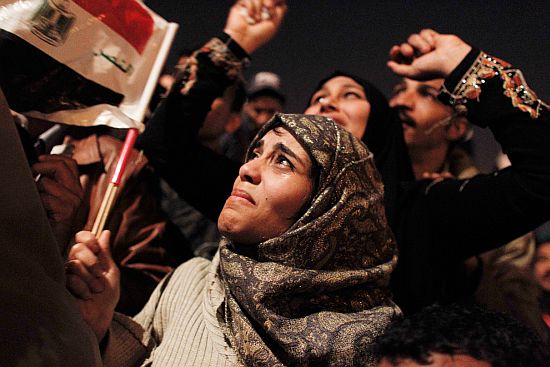
An Egyptian woman cries as she celebrates the news of the resignation of President Hosni Mubarak.

Some think the Middle East isn’t ready for democracy — in truth it’s the West that isn’t ready.

Nicholas Kristof duly notes:

Egyptians triumphed over their police state without Western help or even moral support. During rigged parliamentary elections, the West barely raised an eyebrow. And when the protests began at Tahrir Square, Secretary of State Hillary Rodham Clinton said that the Mubarak government was “stable” and “looking for ways to respond to the legitimate needs and interests of the Egyptian people.”

Commentators have repeatedly referred to the Obama administration playing catch-up during the Egyptian revolution, yet its seeming inability to track fast-changing events was merely an expression of its unwillingness to embrace the direction those events were heading.

Immediately after Hosni Mubarak resigned, Jake Tapper from ABC News tweeted that he couldn’t find anyone in the administration who thought that whatever comes next would be better for U.S. interests than Mubarak had been.

The dictator’s departure is not being celebrated in Washington. The leaders of the free world have a singular lack of enthusiasm for freedom.

The administration has not merely repeatedly stumbled, but has functioned as a dead weight, attempting to slow the pace of what may become the most significant transformation in world order since the birth of Western colonial power.

America’s friends in Israel have been equally unenthusiastic about the turn of events. After Mubarak’s defiant speech on Thursday night when he insisted he would sit out his term as president, “Israel breathed a sigh of relief,” according to Israeli commentator, Alex Fishman. The respite must have felt dreadfully brief.

But if Americans want to grasp the significance of the Egyptian revolution, they need look no further than this country’s much bloodier assertion of people power: the American revolution.

For the first time in Egypt’s history, the Egyptian people have made a declaration of sovereignty and claimed their right of self-governance. Is that not something that every person on the planet who cherishes life and liberty can joyfully celebrate?

As Western leaders now line up, having no choice but to express their support for the revolution, while sagely offering guidance and assistance in managing an “orderly transition” to a democratic system, they do so with a palpable ambivalence.

People power is in jeopardy of sweeping the Middle East and undoing the carefully constructed “stability” through which for most of the last century the West has managed the control of its most vital resource: oil.

Worse for the United States, the Egyptian revolution now undermines the US government’s ability to sustain an unswerving loyalty to the preeminence of Israel’s security interests.

A democratic Egyptian government will not have the autocratic latitude that until now enabled Mubarak’s complicity in the siege of Gaza or his willingness to participate in the charade of a peace process going nowhere.

Stepping back from the most obvious regional implications of what is now unfolding, there is a more far-reaching dimension.

When in 1990 President George HW Bush used the phrase “new world order”, his words had an ominous ring both because they implied that this would be an American-defined order but also — on the brink of the first Gulf War — a militarily-imposed order. The new order was synonymous with the dubious claim that the collapse of the Soviet Union represented an American “victory” in the Cold War.

A new world order worthy of the name, however, should represent something much more significant than the strategic reapportioning of power on a geopolitical level. It should involve the reapportioning of power through which global affairs become the people’s affairs. It should mean that international relations can no longer be conducted within the confines of intrinsically undemocratic arenas where ordinary people have no voice.

The people-power unleashed in Egypt has the potential to serve as a democratizing force that not only threatens autocratic leaders in the Middle East but also technocratic and nominally democratic leaders in the West — those whose complacent style of governance has depended on the political passivity of the populations they nominally serve while providing ready access for corporate interests to exercise their undemocratic influence.

The West, far from representing a model of democracy ripe for export has instead long been mired in a post-democratic phase where the foundational concept of demos, the people, has withered.

Individual wealth has supplanted the need for social solidarity as citizenship has been substituted by consumerism. Our material self-sufficiency has robbed us of the experience of mutual reliance and worn thin the fabric of society.

In a new world order, a new democracy might spread not just further east but also further west.

There is also a bittersweet note in this moment.

The Western exporters of democracy delivered the war in Iraq and yet as we witness events unfold in Egypt, it’s hard not to wonder what might have been possible had the people of Iraq, without Western help or hindrance, been allowed the same opportunity to claim their own freedom.

Facebooktwittermail

How the Egypt revolution could help Israel

The historian, Kai Bird, writes:

[T]he cold peace Israel has forged with Arab dictators is unraveling. This may, in the short term, empower Israeli Prime Minister Benjamin Netanyahu’s Likud ideologues who will argue that Arab democrats are out to “delegitimize” Israel. But in the long run, the emergence of an Arab democratic polity should convince Israeli voters that their leaders have become too complacent and too isolationist. After Tahrir, a majority of Israelis may conclude that they can’t live in the neighborhood without forging a real peace with their neighbors.

The separation wall was never a real answer to Israel’s security predicament, and it will be less so when a democratically elected government governs Egypt. The policy of separation — hafrada in Hebrew — had some short-term strategic viability when the largest Arab country was willing to police Israel’s southern border and keep Hamas penned up inside its Gaza prison. But no legitimate government in Cairo will be able to continue its complicity with the Gaza blockade — particularly not if the Muslim Brotherhood is a player in a new government.

In reality, Israel will come under renewed pressure to deal with both Hamas and the Palestinian Authority in the West Bank. Hamas’s ideology is certainly vile, but it won the last Palestinian legislative election in 2006 and has more or less observed a cease-fire with Israel since early 2009. In December 2010, the Hamas prime minister in Gaza, Ismail Haniyeh, announced that his party would abide by any peace settlement if it were to be ratified by a referendum of the Palestinian people. Furthermore, as we recently learned from Al Jazeera’s Palestine Papers — the leaked documents on the 2008 Abbas-Olmert talks — the two sides are not that far apart on a comprehensive peace settlement that would create a Palestinian state.

So here is the uplifting news: What is happening in Tahrir Square may actually propel the politicians in Washington, Jerusalem, and Ramallah to forge the Israeli-Palestinian peace deal that all of us know is there for the taking. And if that doesn’t happen? Absent a comprehensive peace settlement, Israel and the United States will find themselves increasingly isolated in the new Middle East.

Facebooktwittermail

“Keep giving us our oil”

Venice Beach, California, might not be the best place to take the pulse of American opinion. Or is it?

Would Geena and Jenna be relieved or disappointed to learn that Egypt now consumes about as much oil as it produces and that most of the relatively small volume it exports goes to Italy?

Maybe Egypt just belongs to that long list of countries that most Americans know little about and care even less — at least so long as those countries that have it “keep giving us our oil.”

Meanwhile, our Goldilocks president (who thinks Egyptians need more democracy — as though they already have some — and who clearly doesn’t want the freedom spigot turned on too fast) will probably take comfort in the following numbers — a perfect marker of success in centrist politics: that public indifference and ignorance provide a reassuring level of support for a steady-as-she-goes approach on a course going who-knows-where.

Americans do not have a clear point of view about how the massive anti-government protests in Egypt will affect the United States. More than half (58%) say the protests will not have much of an effect (36%), or offer no response or are noncommittal (22%). Of the minority that thinks the protests will have an effect on the U.S., nearly twice as many say their impact will be negative rather than positive (28% vs. 15%).

This lack of agreement notwithstanding, a majority (57%) says the Obama administration is handling the situation in Egypt about right, while much smaller numbers say the administration has shown too much support (12%) or too little support (12%) for the protestors.

As for whether California comedian Kassem G was able to gather a representative sample of American opinion in Venice Beach, Pew’s findings would indicate he was only gathering the views of about half the country: 52% of Americans, during two weeks of media saturation coverage, said that they had heard little or nothing about what’s been happening in Egypt.

Perhaps the phrase, living under a rock, should be changed to, living in America.

Facebooktwittermail

Lessons from Egypt

In its complacency, America views the democratic aspirations of others as the desire to possess what we already enjoy. Little do we imagine that these aspirations reveal what we have discarded or perhaps never even possessed.

President Obama packages what has driven Egyptians onto the streets within the banal phrase “the desire for a better life” — as though the world is captive to a vision of life in suburbia in which material comfort is the sum of human fulfillment.

We misinterpret the significance of the uprisings in Tunisia and Egypt if we look at these through the narrow prisms of dictatorial rule or economic hardship, because in truth they provide lessons about what it means to be human.

We are complex creatures and have advanced beyond the level of survival. Our needs go beyond material sufficiency.

Egyptians did not take to the streets today in order to fill their stomachs but in order to express their hearts. They were reclaiming their dignity by refusing to continue being the subjects of oppression.

But where is our dignity in accepting the fact that we have political representatives who do not represent our interests? Where is our dignity in having turned ourselves from citizens into consumers and having abandoned the idea of government by the people?

On the streets across Egypt today the single most important message from the people was this: we are not afraid.

Is this not a message that should shame the average American? Having spent a decade accepting the proposition that no expense should be spared to guard us against every imaginable fear, can we even imagine what it means to face danger yet not be afraid?

This perhaps more than anything else is the measure through which the bugaboo of 9/11 became the altar on which we sacrificed our dignity.

And should we pause to consider what the possible consequences are of empowering a national security state in the name of defense against terrorism, we could do no better than look at the example of the Mubarak regime.

*

One of the prevailing narratives in Washington has been that the US must tread a delicate line so that it does not undermine the flowering of democracy by providing unwelcome American support — as though the average Egyptian gives a damn about America’s position.

Egypt’s destiny is being determined by its people — not the Obama administration, which in its timidity and duplicity refuses to actually acknowledge the simple demand that is on the table: that Mubarak go.

And when from America we watch the Egyptian people assert their power, we should only imagine: what might this look like in America if we were not a nation filled with people so thoroughly convinced of our impotence?

Facebooktwittermail

Turkey’s rise points to the post-American Middle East

In the New York Times, Anthony Shadid writes:

In a series of stalemates — from the Arab-Israeli conflict to Lebanon — Turkey has proved the most dynamic, projecting an increasingly assertive and independent foreign policy in an Arab world bereft of any country that matches its stature. Its success is a subtle critique of America’s longstanding policy in the Middle East of trying to isolate and ostracize its enemies. From Hezbollah here to the followers of a populist, anti-American cleric in Iraq, Turkey has managed to forge dialogue with America’s enemies and allies alike.

“Turkey has become, I think, until the contrary is proven, an indispensable state in the reorganizing of this region,” said Sarkis Naoum, an analyst and prominent columnist in Beirut.

So far, the interventions of Turkey and others in the Lebanese crisis are mostly symbolic, ventures into a maddeningly complex political landscape that hews to a formula of “no victor, no vanquished.” But in contrast to past crises, when Turkey was virtually irrelevant, the new effort signals the country’s ascent as a regional superpower.

Facebooktwittermail
