Technology without borders

The Washington Post reports: Measured in millimeters, the tiny device was designed to allow drones, missiles and rockets to hit targets without satellite guidance. An advanced version was being developed secretly for the U.S. military by a small company and L-3 Communications, a major defense contractor.

On Monday, Sixing Liu, a Chinese citizen who worked at L-3’s space and navigation division, was sentenced in federal court here to five years and 10 months for taking thousands of files about the device, called a disk resonator gyroscope, and other defense systems to China in violation of a U.S. arms embargo.

The case illustrates what the FBI calls a growing “insider threat” that hasn’t drawn as much attention as Chinese cyber operations. But U.S. authorities warned that this type of espionage can be just as damaging to national security and American business.

“The reason this technology is on the State Department munitions list, and controlled . . . is it can navigate, control and position missiles, aircraft, drones, bombs, lasers and targets very accurately,” said David Smukowski, president of Sensors in Motion, the small company in Bellvue, Wash., developing the technology with L-3. “While it saves lives, it can also be very strategic. It is rocket science.”

Smukowski estimated that the loss of this tiny piece of technology alone could ultimately cost the U.S. military hundreds of millions of dollars. [Continue reading…]

Facebooktwittermail

Spies and big business fight cyberattacks

International Herald Tribune: Britain’s intelligence services, working alongside security experts from private companies, are setting up a secret control center in London to combat what the head of the country’s domestic spy agency has described as “astonishing” levels of cyberattacks.

The existence of the so-called Fusion Cell was due to be confirmed on Wednesday in a statement on the government’s strategy to boost information sharing in an expanding cyberwar against online attackers.

A team of security analysts at an undisclosed location will monitor attacks on large screens and provide details in real-time of who is being targeted, according to the BBC.

The British initiative, which also includes the creation of a social network-style web portal to facilitate information exchange, is the latest in a series of international measures to combat what is seen as the growing threat of cyberattacks to both business and government networks.

President Obama last month signed an executive order to increase information sharing about cyberthreats between the government and private companies.

“We have seen a steady ramping up of cybersecurity threats,” Mr. Obama said in a recent interview. “Some are state sponsored, some are just sponsored by criminals.”

Jonathan Evans, the outgoing head of MI5, Britain’s domestic intelligence agency, made a similar point ahead of last year’s London Olympic Games.

“Vulnerabilities in the internet are being exploited aggressively not just by criminals but also by states,” he said in a rare interview. “The extent of what is going on is astonishing.”

The victims are said to include big companies. The BBC said one major London listed company had lost the equivalent of $1.2 billion as a result of a cyberattack from a hostile state. [Continue reading…]

Facebooktwittermail

Sanctions may be speeding Iran’s nuclear advancement

Christian Science Monitor reports: Even Iranian officials now admit that the US-led sanctions regime against Iran is damaging its economy.

But the pressure has failed in its primary aim: to slow Iran’s nuclear progress. That has become obvious to the US and European officials imposing crippling sanctions, as has the fact that sanctions may have even sped up Iran’s nuclear advancement.

A report released today – based on 30 in-depth interviews with Iranian officials, analysts, and businessmen – explains that dilemma and Iran’s determined defiance to Western policymakers, who will conduct a fifth round of nuclear negotiations with Iran in Kazakhstan next week.

The report’s conclusions provide a rare glimpse from high levels in Iran of how sanctions have and have not worked, which could directly affect decisions by Western nuclear negotiators, and a US Congress keen on adding more sanctions, but reluctant to offer enough sanctions relief to convince Iran to stop its most sensitive nuclear work. [Continue reading…]

Facebooktwittermail

Anthony Lewis saw how Israelis destroyed Palestine’s ‘Biblical appearance’

Raja Shehadeh writes: In 1991 I went for a hike in the hills north of Ramallah with the journalist Anthony Lewis, who passed away on Monday. He was in his early 60s at the time and was not in the best of shape, but he was game, as always.

We scrambled down unmarked stony paths toward Wadi Matar, a valley that meanders between undulating hills. Tony looked around with wonder at the surrounding slopes, the drapes of grapevines and the dots of olive trees. When we got to the wadi we heard a pack of wild dogs barking. They were coming toward us. I pulled out a “dog stop,” one of those small tubes that, when pressed, emits a sound humans cannot hear but that is designed to scatter dogs. Or so I was told by that shopkeeper in London who had sold it to me. I hadn’t tried the gadget before, and when I heard the dogs coming our way, I pressed down on the tube as hard as I could. It let out an unearthly screech, and Tony fell to the ground. The dogs were never seen.

Two years later he was back in Ramallah, and ever the good sport, he agreed to walk through that valley with me again. The Oslo Accords had been signed in the meantime, and I showed him the illegal road that some Jewish settlers had built through the valley to connect two of their settlements, Dolev and Beit El. His face assumed a pained expression. He wrote about that valley and its transformation in his 2002 introduction to my memoir “Strangers in the House”: “It has been destroyed by Jewish settlements and the bypass roads that connect them to Israel. The story is the same in much of the West Bank. The occupiers’ bulldozers have carved up the hills that gave the West Bank what visitors thought of as its Biblical appearance.” Tony could wield a pen to poignant effect, especially in the service of justice and the rule of law. [Continue reading…]

Facebooktwittermail

Hamas reacts to Israeli apology to Turkey

Al Monitor: Following US mediation, personally led by President Barack Obama during his visit to the region, Israel and Turkey have finally renormalized their diplomatic relations.

This new Israeli-Turkish agreement brought to mind the Israeli attack on the Freedom Flotilla, where nine Turkish activists on board were killed on May 31, 2010. This attack was what pushed Israel to ease its blockade of the Hamas-controlled Gaza Strip. Hamas welcomed Israel’s apology, in the hope that Turkey would continue with its pressure to further ease the blockade.

The head of Hamas’ foreign relations department, Bassem Naim, said in an interview with Al-Monitor, that “this apology represents a major milestone in the history of the Israeli-Arab conflict in the region, since it is the first time Israel has offered an apology of this kind.

“Israel’s crimes against humanity can no longer be overlooked in light of the emergence of a powerful and respectable state such as Turkey, whose new diplomacy is based on solid ground,” he added.

Turkey had imposed three conditions on Israel as a prerequisite to exchanging ambassadors and normalizing relations between the countries. First, Israel must offer an apology, compensate the victims’ families and lift the blockade on the Gaza Strip.

It should be noted that Israel has maintained economic constraints on the Gaza Strip by shutting the commercial crossing of Karam Abu Salem (Kerem Shalom), after militants in Gaza recently fired rockets at Israeli towns. Israel has also restricted fishing areas in the Mediterranean, violating the stipulations of the Oslo Accords in this regard. Additionally, movement through the Erez crossing has been limited.

According to Naim, Israel will try to evade Turkey’s condition of lifting the blockade on Gaza by misleading the public and Turkey, claiming that it has [already] been allowing goods to enter the area freely.

Facebooktwittermail

Why Erdogan wants peace with the PKK

F. Stephen Larrabee writes: Last week, Abdullah Ocalan, the leader of the Kurdistan Workers’ Party (PKK), declared a cease-fire in his party’s nearly three-decade-long struggle with the Turkish state. Before then, the insurgency — which had claimed some 40,000 lives — had seemed intractable. Ankara’s attempts to put it down had only inflamed Kurdish nationalism and made the PKK stronger. But with Ocalan now apparently ready to try to resolve differences peacefully, the prospects that the uprising will come to an end have improved.

Ocalan’s announcement came at an opportune time. Several factors had already made the moment ripe for peace. First, the ruling Justice and Development Party (AKP) and the broader Turkish public had come to recognize that trying to end the insurgency with force was a dead end and that the government would have to make a more determined effort to find a political solution to the Kurdish conflict.

Second, the Kurdish issue is closely linked to Prime Minister Recep Tayyip Erdogan’s political ambitions. Under AKP bylaws, Erdogan cannot run for another term as prime minister when his second term ends next year. Instead, he is widely expected to try to run for president. If he wins, he will be the first popularly elected president in Turkish history, capping his political career and giving him the chance to shape Turkish politics until 2023, the hundredth anniversary of the founding of the Turkish Republic. [Continue reading…]

Facebooktwittermail

The strangeness of other creatures

In a survey of the expanding understanding of non-human consciousness, John Jeremiah Sullivan concludes: If we put aside the self-awareness standard — and really, how arbitrary and arrogant is that, to take the attribute of consciousness we happen to possess over all creatures and set it atop the hierarchy, proclaiming it the very definition of consciousness (Georg Christoph Lichtenberg wrote something wise in his notebooks, to the effect of: only a man can draw a self-portrait, but only a man wants to) — it becomes possible to say at least the following: the overwhelming tendency of all this scientific work, of its results, has been toward more consciousness. More species having it, and species having more of it than assumed. This was made boldly clear when the “Cambridge Declaration on Consciousness” pointed out that those “neurological substrates” necessary for consciousness (whatever “consciousness” is) belong to “all mammals and birds, and many other creatures, including octopuses.” The animal kingdom is symphonic with mental activity, and of its millions of wavelengths, we’re born able to understand the minutest sliver. The least we can do is have a proper respect for our ignorance.

The philosopher Thomas Nagel wrote an essay in 1974 titled, “What Is It Like To Be a Bat?”, in which he put forward perhaps the least overweening, most useful definition of “animal consciousness” ever written, one that channels Spinoza’s phrase about “that nature belonging to him wherein he has his being.” Animal consciousness occurs, Nagel wrote, when “there is something that it is to be that organism — something it is like for the organism.” The strangeness of his syntax carries the genuine texture of the problem. We’ll probably never be able to step far enough outside of our species-reality to say much about what is going on with them, beyond saying how like or unlike us they are. Many things are conscious on the earth, and we are one, and our consciousness feels like this; one of the things it causes us to do is doubt the existence of the consciousness of the other millions of species. But it also allows us to imagine a time when we might stop doing that.

In Michel de Montaigne’s excellent passage on animal minds in the “Apology for Raymond Sebond”, in which he writes about playing with his cat and wonders who is playing with whom, there is a funny and deceptively profound final sentence: “We divert each other with monkey tricks,” he writes. Meaning he and the cat. Both human being and cat are compared with a third animal. They are monkeys to each other, strange animals to each other. (The man is all but literally a monkey to the cat.) All three creatures involved in Montaigne’s metaphor are revealed as points on a continuum, and none of them understands the others very well. This is what the study of animal consciousness can teach us, finally — that we possess an animal consciousness.

To ask whether animals have consciousness is often turned into a question about if and how they think.

That creatures as small as a fruit fly do indeed exhibit evidence of sophisticated cognitive processes is intriguing, but the question that engages philosophers and scientists less than what the brains of other creatures compute is the seemingly imponderable question of what they feel.

The experience of feeling — whether it is ones own feelings or the feelings of others — is the preeminent concern of humans in general when it comes to the question of consciousness.

Consider this imaginary scenario: You are about to undergo surgery and the anesthesiologist tells you that with newly approved drugs it is no longer necessary to be fully anesthetized and you have a choice of drugs.

One drug blocks feelings. Your body will become numb. You will feel neither pain nor fear but you will be able to talk to the surgeon and understand what she is telling you as the procedure progresses.

An alternative drug paralyses the body and blocks discursive thought but you will feel everything. You will feel pain and most likely terror but none of these feelings will provoke thoughts and neither within your mind nor through speech will you be able to articulate anything. Because your cognitive processes have been shut down in this way, once the drug has worn off you will have no decipherable memory of what occurred.

Basically, with one drug you will feel nothing but remember everything and with the other you will feel everything but remember nothing.

That’s not much of a choice since the preeminent concern of just about anyone receiving surgery is that during the procedure they will feel nothing.

I’m calling this an imaginary scenario, but the chances are that a lot of people who have faced surgery will have entertained this very idea: what if the effect of the anesthetic is merely that it causes paralysis and that you end up feeling everything?

That possibility isn’t just the product of fearful imagination; it’s a reality and it has a name: “anesthesia awareness” — something that an estimated one or two per thousand patients experience every year in the United States. And while it’s an issue that understandably concerns patients and doctors, it points to an underlying fact about the nature of consciousness.

What matters is what we feel. Our ability to reflect on our feelings, to have memories, engage in analysis, and even the experience of self-identity — all of this is secondary to the primary experience of feeling.

Needless to say, life demands that we cultivate the ability to marginalize our own feelings, to recognize their transience, understand they can be misleading, and to cultivate the ability to endure unpleasant feelings. Yet none of this negates the fact that life as it is felt, almost always trumps thought — the stuff which in many ways and much of the time is little more than the effervescence of consciousness.

What do non-human animals feel?

Neuroscientists have no doubt accumulated useful data that will lead towards scientific answers to that question, but a non-scientific answer is readily available.

Our capacity to experience empathy is not the ability to engage in emotional conjecture. We do not posit the feelings of others and on that basis draw logical conclusions about their nature. To have empathy is to recognize the feelings of others directly. It is a kind of sixth sense. Moreover, as every pet owner can attest, this feeling-attunement is a faculty not limited to humans. Indeed, it seems possible that human beings with their cognitively cluttered consciousness, may have a tendency to often become empathically impaired. Ideation crowds out sensation.

If they had the thoughts to articulate what they daily observe, the question might be reversed as animals asked of us: are you really conscious? Could a creature that causes so much harm to its fellows and to the environment on which all life depends truly be more conscious than all others, or is it, as all the evidence suggests, mired in a collective and highly destructive state of unconsciousness?

Facebooktwittermail

Subscribe by email

Stay up to date with War in Context: subscribe by email.

Once a day you will receive an email summary including links to all the posts from the previous 24 hours. I will never share or sell your email address. Give it a try!

After signing up, look out for a confirmation email with the subject line: “War in Context – please activate your email subscription” — it could show up in your spam folder. Your subscription will not start until you have responded to this confirmation.

Facebooktwittermail

The scope and the scale of animal intelligence

Ayumu

As everyone knows (or should know), you don’t have to be smart to get rich. The aggregation of power is not coterminous with the concentration of talent — that is, other than the talent for accumulating power.

In spite of this, there is a human prejudice which, observing our species’ dominion across the world, assumes that given that human beings exert so much power — enough to have set in train the Anthropocene, a new epoch in the planet’s history — it goes without saying that our intelligence exceeds that of every other creature.

Even so, given that we seem to be intent on setting our own home on fire, that’s reason enough to question our intelligence. It also turns out that based on our own metrics, we can be outwitted by animals that we otherwise regard as having lesser intelligence.

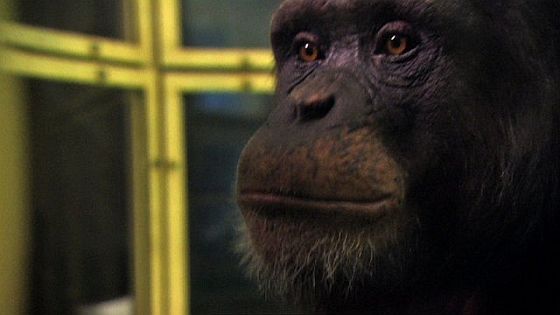
Frans de Waal writes: Who is smarter: a person or an ape? Well, it depends on the task. Consider Ayumu, a young male chimpanzee at Kyoto University who, in a 2007 study, put human memory to shame. Trained on a touch screen, Ayumu could recall a random series of nine numbers, from 1 to 9, and tap them in the right order, even though the numbers had been displayed for just a fraction of a second and then replaced with white squares. [See video below.]

I tried the task myself and could not keep track of more than five numbers—and I was given much more time than the brainy ape. In the study, Ayumu outperformed a group of university students by a wide margin. The next year, he took on the British memory champion Ben Pridmore and emerged the “chimpion.”

How do you give a chimp — or an elephant or an octopus or a horse — an IQ test? It may sound like the setup to a joke, but it is actually one of the thorniest questions facing science today. Over the past decade, researchers on animal cognition have come up with some ingenious solutions to the testing problem. Their findings have started to upend a view of humankind’s unique place in the universe that dates back at least to ancient Greece.

Aristotle’s idea of the scala naturae, the ladder of nature, put all life-forms in rank order, from low to high, with humans closest to the angels. During the Enlightenment, the French philosopher René Descartes, a founder of modern science, declared that animals were soulless automatons. In the 20th century, the American psychologist B.F. Skinner and his followers took up the same theme, painting animals as little more than stimulus-response machines. Animals might be capable of learning, they argued, but surely not of thinking and feeling. The term “animal cognition” remained an oxymoron.

A growing body of evidence shows, however, that we have grossly underestimated both the scope and the scale of animal intelligence. Can an octopus use tools? Do chimpanzees have a sense of fairness? Can birds guess what others know? Do rats feel empathy for their friends? Just a few decades ago we would have answered “no” to all such questions. Now we’re not so sure. [Continue reading…]

Facebooktwittermail

No human being is illegal

Rebel Diaz Arts Collective, South Bronx

As others have said: judge a state’s respect for human rights by the way it treats its prisoners.

In what kind of country would people, convicted of no crime, be put into solitary confinement because they are mentally ill, or gay, or Muslim?

The United States — a country that dehumanizes many foreigners by branding them illegal aliens.

How pervasive and bipartisan is xenophobia in America?

Consider the response to drone warfare. Thousands of people have been killed in Pakistan provoking nothing more than a very marginal outcry over here. Why? Because none of the dead have been Americans.

Only after three U.S. citizens were killed in drone strikes in Yemen did the legality of Obama’s assassination program start to receive wider scrutiny and for most of those Americans troubled by the issue, concern about a disregard for the constitutional rights of Americans, seemed to be uppermost in their minds.

This is a nation that bathes in a sense of its own innocence. Its innocents can take for granted that all are presumed innocent until proven guilty — unless they happen to be foreigners.

When it comes to foreigners suspected of being terrorists, suspicion is as good as conviction. “Suspected terrorist” and “terrorist” are not exactly exchangeable terms since the exchange only goes in one direction — by dropping the qualification “suspected.”

Add to the xenophobia the racism that pervades what remains a white-ruled society and it should come as no surprise that the worst treatment for some of the least fortunate among us is often dished out to those whose double offense is that they are both foreign and have darker skins.

The New York Times reports: On any given day, about 300 immigrants are held in solitary confinement at the 50 largest detention facilities that make up the sprawling patchwork of holding centers nationwide overseen by Immigration and Customs Enforcement officials, according to new federal data.

Nearly half are isolated for 15 days or more, the point at which psychiatric experts say they are at risk for severe mental harm, with about 35 detainees kept for more than 75 days.

While the records do not indicate why immigrants were put in solitary, an adviser who helped the immigration agency review the numbers estimated that two-thirds of the cases involved disciplinary infractions like breaking rules, talking back to guards or getting into fights. Immigrants were also regularly isolated because they were viewed as a threat to other detainees or personnel or for protective purposes when the immigrant was gay or mentally ill.

The United States has come under sharp criticism at home and abroad for relying on solitary confinement in its prisons more than any other democratic nation in the world. While Immigration and Customs Enforcement places only about 1 percent of its jailed immigrants in solitary, this practice is nonetheless startling because those detainees are being held on civil, not criminal, charges. As such, they are not supposed to be punished; they are simply confined to ensure that they appear for administrative hearings.

After federal immigration authorities caught up with him, Rashed BinRashed, an illegal arrival from Yemen, was sent to a detention center in Juneau, Wis. He was put in solitary confinement, he says, after declining to go to the jail’s eating area and refusing meals because he wanted to fast during Ramadan.

Federal officials confined Delfino Quiroz, a gay immigrant from Mexico, in solitary for four months in 2010, saying it was for his own protection, he recalls. He sank into a deep depression as he overheard three inmates attempt suicide. “Please, God,” he remembers praying, “don’t let me be the same.” [Continue reading…]

Facebooktwittermail

For the media, soda matters more than civil rights in New York City

Blake Zeff writes: In New York City, Mayor Michael Bloomberg’s NYPD is stopping large numbers of innocent people walking down the street each day — questioning them as to their whereabouts and invasively frisking their bodies in a hunt for weapons and drugs. The stops are almost entirely (nearly nine in ten) targeting young black and Latino men. The overwhelming majority of those stopped are doing nothing wrong (just 6 percent of stops lead to arrests, and a small fraction of those are ever prosecuted). And it’s having a deleterious effect on the psyche of the targets (as well as community relations with police).

How disconcerting is the program’s execution — which currently allows officers to stop anyone committing a “furtive” movement (whatever that is)? This past week, a federal judge in Manhattan, Shira Scheindlin, heard arguments as to whether the stops — whose numbers have soared to roughly 700,000 per year, according to the force’s own estimates — are actually even constitutional. During the course of the proceedings, it was revealed that NYPD engaged in an illegal quota system and that officers were intentionally targeting young black men.

Of course, if you watched any number of interviews with Mayor Bloomberg on national TV this past week or two, you’d have no idea of any of this. [Continue reading…]

Facebooktwittermail

Sweden: More than ever, the land of internet freedom

Nouvel Observateur/Worldcrunch: “This is happening right now in Homs, Syria…” Hans Eriksson shows a shaky video of column of smoke just after a bombing from Bashar al-Assad’s troops.

Bambuser is the name of the service launched by this 44-year-old Swede, which allows any smartphone user to broadcast live what’s happening in front of him – without any censorship. The service is a precious resource for Arab Spring protesters.

“In these countries where information is – or was – under heavy surveillance, it is crucial to be able to show the details of the repression. The world needs to know,” says Eriksson. His service is used by CNN, the BBC and Al-Jazeera.

From 5,000 to 10,000 raw, unedited videos are uploaded every day by this 12-person start-up. Bambuser is the latest symbol of Sweden’s fight for freedom of speech on the Internet.

Three years ago, the country decided to take a stand for the promotion of freedom on the Internet. Minister for Foreign Affairs Carl Bildt launched a dialogue with companies on Internet freedom. He was soon followed by Hillary Clinton, who made an acclaimed speech on Internet freedom in 2010.

“Freedom of expression has always been a cornerstone of the Swedish government, we just extended it to the Internet,” says Ministry of Foreign Affairs Special Adviser Johan Hallenborg. “The freedom to say what we want on the Internet or anywhere else is a human right.” [Continue reading…]

Facebooktwittermail

Aleppo: a city abandoned by the world

Channel 4 News: Twelve-year-old Mohamed Asaf’s days are filled treating Aleppo’s war wounded. He starts work at 8am and usually gets to bed by 11pm.

When filmmaker Marcel Mettelsiefen meets him in the city’s Dar al-Shifa clinic, Mohamed is battling to save a young girl’s life.

After months bearing witness to the human tragedy of Syria’s civil war, he has become desensitised to the horrors: “With time it has become easy: blood has become like water to me,” he says.

In an interview, Mettelsiefen describes the logic of the Assad regime which targets civilians while avoiding striking the al-Nusra Front’s command in Aleppo. The desired effect is to radicalize the population, swell al-Nusra’s ranks and thereby heighten Western fears about the fall of the regime. In effect, al-Nusra has become Assad’s insurance against intervention.

Facebooktwittermail

Drone war: Out of sight, out of mind

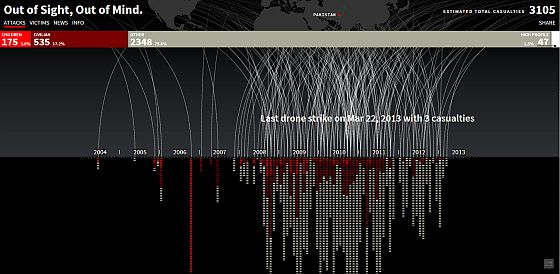
Click on the image above to view the “Out of Sight, Out of Mind” interactive graphic on the drone war in which an estimated 3,105 people have been killed in Pakistan of whom only 47 were so-called “high value” suspected terrorists.

A note on the producer of this interactive graphic: It comes from Pitch Interactive, an information visualization studio based in Berkeley, California. Their clients range from AT&T to Google to Fortune Magazine.

“The primary data used in this visualization comes from a dataset maintained by the Bureau of Investigative Journalism (BIJ)” — which is good because BIJ has compiled more information than anyone else has on the results of America’s drone war.

“This project helps to bring light on the topic of drones. Not to speak for or against, but to inform and to allow you to see for yourself whether you can support drone usage or not.”

Wes Grubbs, the studio’s founder, tweets: “We made this because it had to be made”.

Facebooktwittermail

Subscribe by email

Stay up to date with War in Context: subscribe by email.

Once a day you will receive an email summary including links to all the posts from the previous 24 hours. I will never share or sell your email address. Give it a try!

After signing up, look out for a confirmation email with the subject line: “War in Context – please activate your email subscription” — it could show up in your spam folder. Your subscription will not start until you have responded to this confirmation.

Facebooktwittermail

McChrystal: America’s drone war risks provoking another attack on New York City

Retired General Stanley McChrystal: Anywhere you have undergoverned or ungoverned areas, organizations like al Qaeda have a tremendous opportunity to get a foothold. And when they can get a foothold, they can start to operate and spread from there.

Foreign Affairs: So what do you do with places like Mali and Yemen?

Well, you can’t solve all of them. You certainly don’t want to put Western forces in all of these countries. The initial reaction that says, “We will simply operate by drone strikes” is also problematic, because the inhabitants of that area and the world have significant problems watching Western forces, particularly Americans, conduct drone strikes inside the terrain of another country. So that’s got to be done very carefully, on occasion. It’s not a strategy in itself; it’s a short-term tactic.

It seems like the methods you pioneered in Iraq have been embraced by the U.S. government and the American public as a general approach to managing small-scale irregular warfare, and doing so in a way short of putting lots of boots on the ground or walking away entirely. Some would argue that this is the true legacy of Stan McChrystal — the creation of an approach to counterterrorism that is halfway between war and peace, at such a low cost and with such a light footprint that it’s politically viable for the long term in a way that war and disengagement are not. Do you disagree?

I question its universal validity. If you go back to the British tactics on the North-West Frontier, the “butcher and bolt” tactics, where they would burn an area and punish the people and say, “Don’t do that anymore,” and simultaneously offer a stipend to the leader while saying, “If you will remain friendly for a period of time, we’ll pay you” — that approach worked for a fair amount of time. It managed problems on their periphery. But it certainly didn’t solve the problems.

The tactics that we developed do work, but they don’t produce decisive effects absent other, complementary activities. We did an awful lot of capturing and killing in Iraq for several years before it started to have a real effect, and that came only when we were partnered with an effective counterinsurgency approach. Just the strike part of it can never do more than keep an enemy at bay. And although to the United States, a drone strike seems to have very little risk and very little pain, at the receiving end, it feels like war.

Americans have got to understand that. If we were to use our technological capabilities carelessly — I don’t think we do, but there’s always the danger that you will — then we should not be upset when someone responds with their equivalent, which is a suicide bomb in Central Park, because that’s what they can respond with.

Facebooktwittermail

Most Americans think ‘innocent until proven guilty’ only applies to Americans

Gallup poll: Nearly two-thirds of Americans (65%) think the U.S. government should use drones to launch airstrikes in other countries against suspected terrorists. Americans are, however, much less likely to say the U.S. should use drones to launch airstrikes in other countries against U.S. citizens living abroad who are suspected terrorists (41%); to launch airstrikes in the U.S. against suspected terrorists living here (25%); and to launch airstrikes in the U.S. against U.S. citizens living here who are suspected terrorists (13%).

Facebooktwittermail