Obama’s effort to prolong the war in Syria

“I am very concerned about Syria becoming an enclave for extremism because extremists thrive in chaos, they thrive in failed states, they thrive in power vacuums,” President Obama said at a news conference in Amman, Jordan, this week.

Given that this administration has designated the al Nusra Front as a terrorist organization, is now linking it to al Qaeda’s leadership in Pakistan, and that the widely accepted consensus is that among the opponents of the Assad regime, this ranks as the most powerful group, isn’t the eventuality that Obama fears, the state of affairs that already exists?

Maybe not. Maybe in Obama’s mind the current conditions in Syria represent what amounts to a tolerable balance of power. The rebels don’t have the strength to topple Assad and Assad retains control over his chemical weapons. For the U.S., Syria’s river of blood has not reached flood stage.

Even when it would be possible to make an argument that since the U.S. has such limited influence over the outcome it should not be involved in Syria militarily in any way whatsoever, Obama opts for limited involvement for what would appear to be political reasons: he can thereby deflect criticism from those who say the U.S. must do something — even if in the end all the U.S. is doing is prolonging the war.

The Wall Street Journal reports: The Central Intelligence Agency is expanding its role in the campaign against the Syrian regime by feeding intelligence to select rebel fighters to use against government forces, current and former U.S. officials said.

The move is part of a U.S. effort to stem the rise of Islamist extremists in Syria by aiding secular forces, U.S. officials said, amid fears that the fall of President Bashar al-Assad would enable al Qaeda to flourish in Syria.

The expanded CIA role bolsters an effort by Western intelligence agencies to support the Syrian opposition with training in areas including weapons use, urban combat and countering spying by the regime.

The move comes as the al Nusra Front, the main al Qaeda-linked group operating in Syria, is deepening its ties to the terrorist organization’s central leadership in Pakistan, according to U.S. counterterrorism officials.

The provision of actionable intelligence to small rebel units which have been vetted by the CIA represents an increase in U.S. involvement in the two-year-old conflict, the officials said. The CIA would neither confirm nor deny any role in providing training or intelligence to the Syrian rebels.

The new aid to rebels doesn’t change the U.S. decision to not take direct military action. President Barack Obama last year rejected a CIA-backed proposal to provide arms to secular units fighting Mr. Assad, and on Friday he reiterated his argument that doing so could worsen the bloodshed.

He also warned that Mr. Assad’s fall could empower extremists. “I am very concerned about Syria becoming an enclave for extremism because extremists thrive in chaos, they thrive in failed states, they thrive in power vacuums,” Mr. Obama said at a news conference in Amman, Jordan.

The new CIA effort reflects a change in the administration’s approach that aims to strengthen secular rebel fighters in hope of influencing which groups dominate in post-Assad Syria, U.S., European and Arab officials said.

The CIA has sent officers to Turkey to help vet rebels that receive arms shipments from Gulf allies, but administration officials say the results have been mixed, citing concerns about weapons going to Islamists. In Iraq, the CIA has been directed by the White House to work with elite counterterrorism units to help the Iraqis counter the flow of al Qaeda-linked fighters across the border with Syria.

The West favors fighters aligned with the Free Syrian Army, which supports the Syrian Opposition Coalition political group.

Syrian opposition commanders said the CIA has been working with British, French and Jordanian intelligence services to train rebels on the use of various kinds of weapons. A senior Western official said the intelligence agencies are providing the rebels with urban combat training as well as teaching them how to properly use antitank weapons against Syrian bunkers.

The agencies are also teaching counterintelligence tactics to help prevent pro-Assad agents from infiltrating the opposition, the official said.

Among other U.S. activities on the margins of the conflict, the Pentagon is helping train Jordanian forces to counter the threat posed by Syria’s chemical weapons, but isn’t working directly with rebels, defense officials say.

The extent of the CIA effort to provide intelligence to Syrian rebels remains cloaked in secrecy. The U.S. has an array of intelligence capabilities in the region, mainly on the periphery of the conflict.

The U.S. uses satellites and other surveillance systems to collect intelligence on Syrian troop and aircraft movements as well as weapons depots. Officials say powerful radar arrays in Turkey are likewise used to track Syrian ballistic missiles and can pinpoint launch sites.

The U.S. also relies on Israeli and Jordanian spy agencies, which have extensive spy networks inside Syria, U.S. and European officials said.

The current level of intelligence sharing is limited in scope because the CIA doesn’t know whether it can fully trust fighters with the most sensitive types of information, several U.S. and European officials said. The CIA, for example, isn’t sharing information on where U.S. and Israeli intelligence agencies believe the Syrian government keeps its chemical weapons, officials said.

Rebel leaders and some U.S. lawmakers say more robust U.S. support is needed to turn the tide in the civil war. These officials say the CIA’s current role comes as too little, too late to make a decisive difference in the war.


Facebooktwittermail

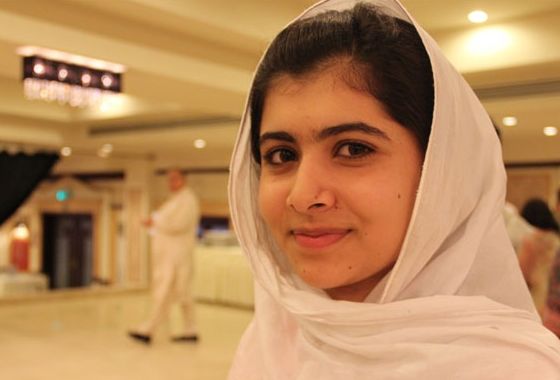
Malala Yousafzai: The fifteen-year-old Pakistani girl who wanted more from her country

Malala Yousafzai

Marie Brenner writes: One day in November 2007, on an editing console in the Dawn television news bureau in Peshawar, Pakistan, the bright brown eyes of a young girl popped from the computer screen. Just three hours to the northeast, in the Swat Valley, the mountain town of Mingora was under siege. Walking by the desk of the bureau chief, a reporter named Syed Irfan Ashraf stopped to take a look at the edit, which was being translated into English for that night’s news, and heard the girl’s voice. “I’m very frightened,” she said crisply. “Earlier, the situation was quite peaceful in Swat, but now it has worsened. Nowadays explosions are increasing We can’t sleep. Our siblings are terrified, and we cannot come to school.” She spoke an Urdu of startling refinement for a rural child. “Who is that girl?,” Ashraf asked the bureau chief. The answer came in Pashto, the local language: “Takra jenai,” which means “a shining young lady.” He added, “I think her name is Malala.”

The bureau chief had driven to Mingora to interview a local activist, the owner of the Khushal Girls High School & College. On the roads, Taliban soldiers in black turbans pulled drivers out of cars at checkpoints, searching for DVDs, alcohol, and anything else in violation of Shari’a, or strict Islamic law. In a lane near the market, a low wall protected the two-story private school. Inside, the bureau chief visited a fourth-grade class, where several girls shot up their hands when asked if they wanted to be interviewed. Seeing girls speak out in public was very unusual, even in the Swat Valley, a cultivated, 3,500-square-mile Shangri-la with 1.5 million inhabitants. That night, the brown-eyed girl’s sound bite led the news.

Later that evening the bureau chief ran into the school’s owner, Ziauddin Yousafzai, who said, “The girl who spoke on your broadcast. That Malala is my daughter.” The highly educated Yousafzai clearly understood that in the rigid class system of Pakistan he was an invisible member of the rural underclass, unseen by the elite of Lahore and Karachi. For his family, a moment on national news was huge. Like his daughter, Ziauddin spoke excellent English. Ashraf, who had been a professor at the University of Peshawar, could not get the image of Malala’s piercing gaze out of his mind. “She was an ordinary girl, but on-camera extraordinary,” he said. His beat at Dawn television included covering the bombings that were devastating remote villages all through Swat, and he determined to meet Malala and her father the next time he was on assignment in Mingora.

Last autumn, I contacted Ashraf at a computer lab in Carbondale, Illinois, where he is studying for a doctorate in media studies at Southern Illinois University. On October 9, he had seen in a news flash the horrifying image of Malala Yousafzai lying bandaged on a stretcher, after having been shot by an unknown extremist on her school bus. For the next three days, Ashraf did not leave his cubicle as the world grieved for this teenager who had stood up to the Taliban. Then he wrote an anguished column in Dawn, Pakistan’s most widely read English-language newspaper, which seemed like a profound mea culpa. Ashraf was savage regarding his role in Malala’s tragedy. “Hype is created with the help of the media while the people wait for the dénouement,” he wrote. He decried “the media’s role in dragging bright young people into dirty wars with horrible consequences for the innocent.” On the telephone he told me, “I was in shock. I could not call anyone.” He described his mute agony watching the TV coverage. “It is criminal what I did,” he said in an apoplectic tone. “I lured in a child of 11.” [Continue reading…]

Facebooktwittermail

U.S. cyber plan calls for private-sector scans of Net

Reuters reports: The U.S. government is expanding a cybersecurity program that scans Internet traffic headed into and out of defense contractors to include far more of the country’s private, civilian-run infrastructure.

As a result, more private sector employees than ever before, including those at big banks, utilities and key transportation companies, will have their emails and Web surfing scanned as a precaution against cyber attacks.

Under last month’s White House executive order on cybersecurity, the scans will be driven by classified information provided by U.S. intelligence agencies – including data from the National Security Agency (NSA) – on new or especially serious espionage threats and other hacking attempts. U.S. spy chiefs said on March 12 that cyber attacks have supplanted terrorism as the top threat to the country.

The Department of Homeland Security will gather the secret data and pass it to a small group of telecommunication companies and cybersecurity providers that have employees holding security clearances, government and industry officials said. Those companies will then offer to process email and other Internet transmissions for critical infrastructure customers that choose to participate in the program.

Facebooktwittermail

The systematic obliteration of Islam’s cultural heritage

The Independent reports: The authorities in Saudi Arabia have begun dismantling some of the oldest sections of Islam’s most important mosque as part of a highly controversial multi-billion pound expansion.

Photographs obtained by The Independent reveal how workers with drills and mechanical diggers have started demolishing some Ottoman and Abbasid sections on the eastern side of the Masjid al-Haram in Mecca.

The building, which is also known as the Grand Mosque, is the holiest site in Islam because it contains the Kaaba – the point to which all Muslims face when praying. The columns are the last remaining sections of the mosque which date back more than a few hundred years and form the inner perimeter on the outskirts of the white marble floor surrounding the Kaaba.

The new photos, taken over the last few weeks, have caused alarm among archaeologists and come as Prince Charles – a long-term supporter of preserving architectural heritage – flew into Saudi Arabia yesterday for a visit with the Duchess of Cornwall. The timing of his tour has been criticised by human rights campaigners after the Saudis shot seven men in public earlier this week despite major concerns about their trial and the fact that some of the men were juveniles at the time of their alleged crimes.

Many of the Ottoman and Abbasid columns in Mecca were inscribed with intricate Arabic calligraphy marking the names of the Prophet Muhammad’s companions and key moments in his life. One column which is believed to have been ripped down is supposed to mark the spot where Muslims believe Muhammad began his heavenly journey on a winged horse, which took him to Jerusalem and heaven in a single night.

Ghaffar Hussain writes: The holy cities of Mecca and Medina are increasingly beginning to resemble Chicago and Las Vegas rather than quaint Arab towns in which one can envisage what life was like in the times of the Prophet of Islam. Cultural heritage sites are being bulldozed in order to make way for glitzy shopping centres, 5 star hotels, trendy apartment blocks and bland sky scrapers. In fact, when I was last in Medina, the place was starting to resemble Milton Keynes

The Saudi regime benefits enormously from the millions of Muslim pilgrims that descend upon the holy cities each year. Visitor numbers are increasing year on year and expected to rise to 20 million a year in 2020. From a business point of view this is a dream come true. Increasingly wealthy visitors from neighbouring Gulf States have the potential to transform the holy cities into a gold mine, but that is only half the good news.

The business community has found allies in the conservative Wahabi religious establishment that is keen to obliterate historical sites and cultural artefacts and, thus, pave the way for unfettered development. In Wahabi theology, cultural heritage is not only deemed valueless, it is also deemed dangerous. Wahabis are strictly against forms of Islam in which holy relics or buildings are given reverence; they are also determined to enforce this view on others, stamping out more tolerant strands of Islam in the process.

Facebooktwittermail

Dying Iraq war veteran Tomas Young explains decision to end his life

A Message to George W. Bush and Dick Cheney From a Dying Veteran

To: George W. Bush and Dick Cheney
From: Tomas Young

I write this letter on the 10th anniversary of the Iraq War on behalf of my fellow Iraq War veterans. I write this letter on behalf of the 4,488 soldiers and Marines who died in Iraq. I write this letter on behalf of the hundreds of thousands of veterans who have been wounded and on behalf of those whose wounds, physical and psychological, have destroyed their lives. I am one of those gravely wounded. I was paralyzed in an insurgent ambush in 2004 in Sadr City. My life is coming to an end. I am living under hospice care.

I write this letter on behalf of husbands and wives who have lost spouses, on behalf of children who have lost a parent, on behalf of the fathers and mothers who have lost sons and daughters and on behalf of those who care for the many thousands of my fellow veterans who have brain injuries. I write this letter on behalf of those veterans whose trauma and self-revulsion for what they have witnessed, endured and done in Iraq have led to suicide and on behalf of the active-duty soldiers and Marines who commit, on average, a suicide a day. I write this letter on behalf of the some 1 million Iraqi dead and on behalf of the countless Iraqi wounded. I write this letter on behalf of us all—the human detritus your war has left behind, those who will spend their lives in unending pain and grief.

I write this letter, my last letter, to you, Mr. Bush and Mr. Cheney. I write not because I think you grasp the terrible human and moral consequences of your lies, manipulation and thirst for wealth and power. I write this letter because, before my own death, I want to make it clear that I, and hundreds of thousands of my fellow veterans, along with millions of my fellow citizens, along with hundreds of millions more in Iraq and the Middle East, know fully who you are and what you have done. You may evade justice but in our eyes you are each guilty of egregious war crimes, of plunder and, finally, of murder, including the murder of thousands of young Americans—my fellow veterans—whose future you stole. [Continue reading…]

Facebooktwittermail

Pentagon wants $49 million to build new prison at Guantánamo

The New York Times reports: The United States Southern Command has requested $49 million to build a new prison building at Guantánamo Bay, Cuba, for “special” detainees on top of other renovations it says are necessary since Congress has decided to keep it open indefinitely. That brings the potential taxpayer bill for upgrading the deteriorating facilities to an estimated $195.7 million, the military said on Thursday.

That overall price tag is significantly higher than the estimate of $150 million to $170 million that General John F. Kelly, the Southcom commander, gave in Congressional testimony on Wednesday. The special detainee facility was not included on the list of requested construction projects released by Southcom on Wednesday when reporters asked for details.

The project appears to be a proposed replacement for Camp 7, where so-called high-value detainees who were formerly held by the Central Intelligence Agency – like Khalid Shaikh Mohammed, the self-described architect of the terrorist attacks of Sept. 11, 2001 – are housed. While the existence of Camp 7 is widely known, the military generally refuses to discuss it. [Continue reading…]

Facebooktwittermail

Defensive jihad in Syria

Aymenn Jawad Al-Tamimi asks: How do the jihadist rebels generally conceive of jihad in the Syrian civil war?

One useful way to look into this question is to examine the Qur’anic verses pertaining to warfare cited in propaganda statements. In this context, one recurring verse is 22:39, which runs as follows: ‘Permission [to fight] has been granted to those who are being fought, because they have been wronged. And verily is God able to grant them victory.’

For example, at the start of the final rebel offensive on Raqqah at the beginning of this month that successfully took the city out of the hands of Assad’s forces, a video emerged on Youtube entitled ‘Statement from Jabhat al-Nusrah [JAN] on the beginning of the battle to liberate Raqqah.’ In this video, one can see three fighters from JAN – the al-Qa’ida-aligned jihadist group. The speaker begins the statement with citation of 22:39.

In a similar vein, at the end of last year, a battalion calling itself ‘The Free Men of the Euphrates Battalion’ invoked 22:39 at the opening of the announcement of its formation. In January of this year, a claimed police defector in Hama highlighted 22:39 in announcing his defection to Ahrar al-Sham, which has since merged with numerous other battalions to form a broad jihadist umbrella group that played a key role in the capture of Raqqah.

To be sure, 22:39 is also cited beyond jihadist circles, for it was notably invoked by the prominent Islamic scholar Mohammed Ali al-Sabouni — head of the Association of Syrian Scholars and a member of the Syrian National Coalition (opposition coalition-in-exile) — as a justification for taking up arms against the Assad regime.

Coming back to JAN (on whom I focus since it is considered the most hardline jihadist group), another Qur’anic quotation cited in their propaganda is 9:39, which states: ‘Fight the polytheists altogether just as they fight you altogether.’ This verse appeared at the beginning of a video released through the group’s official channel, called ‘The White Minaret.’

JAN’s channel also released a video that begins with quotation from 4:75, which speaks of the need to fight in the cause of God for the oppressed who cry out for aid: a theme emphasized in the same video.

One could go on, but the point is that by citing all these verses, even JAN places an emphasis on what might be termed ‘defensive jihad’: that is, fighting in self-defense and in defense of one’s fellow Muslim brethren in the face of a regime seen as waging war on Islam.

Indeed, the doctrine contrasts with ‘offensive jihad’, which is a concept that normally relies on a verse of the Qur’an quite different from the ones cited above: namely, 9:29. Modern al-Qa’ida theorists use this verse to argue that Muslims must conquer the world for Islam. Osama bin Laden himself made this aggressive approach clear in an essay stating that non-Muslims had three choices: conversion, subjugation, or death. [Continue reading…]

Facebooktwittermail

Zionism has become an obstacle to Jewish welfare and security

Ian S. Lustick asks: How close is Israel to pariah status? Quite close. Americans know that ratings for Congress are now in the single digits: below traffic jams, colonoscopies and cockroaches, though still above North Korea and telemarketers. If Israel were included in that survey it would of course do better than Congress — among Americans. But not in the world at large.

In a 2003 European Union-sponsored poll, Israel was seen as more dangerous to world peace than any other country. In 2006, an Israeli government poll conducted in 35 countries found Israel had the worst public image in every category it tested. In 2012, the BBC reported that 50% of 24,090 people polled worldwide thought Israel had a “mostly negative” impact on the world, tied with North Korea and exceeded only by Pakistan and Iran.

Worried about “delegitimization” as an “existential threat,” the Israeli government and its U.S. friends have funded a host of rebranding PR efforts. But Israel’s image has suffered more from repeated outrages to the world’s sense of fairness than from bad public relations.

Israeli leaders have repeatedly threatened to attack Iran, a signatory to the nuclear nonproliferation treaty, for developing nuclear technology with weapons potential, even as they refuse to join the NPT or acknowledge Israel’s own immense nuclear force. Israeli governments have launched several onslaughts against the Gaza Strip and Lebanon, inflicting collateral damage to innocents that has hugely exceeded Israeli casualties. In response to the United Nation’s decision to recognize Palestine as an observer state, the Israeli government announced radical expansion of Jewish settlement in sensitive areas of Jerusalem and the West Bank. Jews living in Palestine thousands of years ago are cited to justify a right of 21st century Jews to “return,” while Palestinian demands to return after 65 years of exile are deemed absurd.

Such policies and actions have shaped the international image of the Jewish state as defiant rather than courageous, belligerent rather than reasonable, dangerous rather than reliable.

Netanyahu and his allies can be blamed for many of Israel’s current excesses. But there are much deeper forces at work. One of them is the still-unrecognized reality of post-Zionism. Israel’s founding ideology has not adapted gradually to a changing world, and the American colossus has protected it from the consequences. When adaptation cannot occur gradually, it occurs suddenly. It is wrenching and disorienting. This is the sort of change in store for Israel. [Continue reading…]

Facebooktwittermail

Turkey, Israel make U.S.-brokered peace after Mavi Marmara apology

Today’s Zaman reports: Israeli Prime Minister Benjamin Netanyahu offered an apology to Turkey for a 2010 raid on an aid flotilla that resulted in the deaths of eight Turks and a Turkish American, ending a deep crisis in ties between the two former allies.

In a statement carried by Reuters, Netanyahu said he “expressed apology” to the Turkish people for any error that could have led to loss of life in the flotilla incident. He also said Israel has agreed to pay compensation to the families of the victims and that Israel and Turkey agree to work together to improve the humanitarian situation in the Palestinian territories.

A Turkish official in Ankara confirmed the apology, telling Today’s Zaman that Netanyahu called Erdoğan to offer an apology and that Erdoğan accepted it.

Facebooktwittermail

Obama’s expanding empire of drone bases advances across Africa

The Washington Post reports: The newest outpost in the U.S. government’s empire of drone bases sits behind a razor-wire-topped wall outside this West African capital, blasted by 110-degree heat and the occasional sandstorm blowing from the Sahara.

The U.S. Air Force began flying a handful of unarmed Predator drones from here last month. The gray, mosquito-shaped aircraft emerge sporadically from a borrowed hangar and soar north in search of al-Qaeda fighters and guerrillas from other groups hiding in the region’s untamed deserts and hills.

The harsh terrain of North and West Africa is rapidly emerging as yet another front in the United States’ long-running war against terrorist networks, a conflict that has fueled a revolution in drone warfare.

Since taking office in 2009, President Obama has relied heavily on drones for operations, both declared and covert, in Afghanistan, Iraq, Pakistan, Yemen, Libya and Somalia. U.S. drones also fly from allied bases in Turkey, Italy, Saudi Arabia, Qatar, the United Arab Emirates and the Philippines.

Now, they are becoming a fixture in Africa. The U.S. military has built a major drone hub in Djibouti, on the Horn of Africa, and flies unarmed Reaper drones from Ethiopia. Until recently, it conducted reconnaissance flights over East Africa from the island nation of the Seychelles. [Continue reading…]

Facebooktwittermail

Kirkuk: the time-bomb that didn’t explode

Der Spiegel reports: Kirkuk is a multiethnic city thousands of years old and claimed by Kurds, Arabs and Turkmen alike. American occupiers already viewed it as the predetermined breaking point of the new Iraq. They predicted that the various groups in the “Mesopotamian Jerusalem” would begin attacking each other after US troops had withdrawn.

The first oil in Iraq was discovered in Kirkuk in 1927. Since the 1930s, gas flares have been burning day and night on the city’s outskirts, serving as a reminder of the riches that whoever controls the region has access to. An American colonel once said that this city could plunge the entire country into ruin.

It’s looking that way at the moment, but not, as was once predicted, because of the city’s residents. In Kirkuk, where the local television station broadcasts in four languages, Muslims and Christians, Kurds, Arabs and Turkmen coexist more peacefully than they did years ago.

Although the parties are still at odds over voter registration problems, residents are increasingly indifferent to the issue. “We just want to live normally,” says Murah Salah, a Turkmen mechanic. “We want to have jobs, electricity, security, a functioning garbage-collection service and,” he adds with a smile, “to be able to drive out to barbecues on the weekend!”

He is referring to the sort of outing that’s taking place on a large meadow outside the city today. Mohammed Hilmi and his family are picnicking directly next to the Salah family. Yes, things have improved, he says. “In the past, people sat on their blankets, far apart from each other, and no one spoke with anyone else. Those days are now gone.”

Delwar Abdul Aziz, a Kurdish pharmacist, says: “After Saddam, we just needed time to become normal again. There was deep-seated fear and mistrust. Now people trust each other again. The attacks are certainly a problem, but the terrorists are definitely not from here.”

Defusing Kirkuk ‘s Conflict

Neither Kurds nor Arabs nor Turkmen alone control Kirkuk and its population of 900,000. But that circumstance has probably kept things relatively stable in the city, which has put coexistence to the test for centuries, and which, in addition to the three main ethnic groups, is home to religious groups like the Yazidis, Kakai and Assyrian Christians. Jews are the only religious group to have left Kirkuk, in the 1950s.

When competing groups are forced to hammer out compromises, the result is checks and balances. Perhaps another reason for the city’s stability is that the Kirkukis got rid of their corrupt governor two years ago and elected a new one, whose nickname is the “Bulldozer.”

Najmuddin Karim, a Kurdish neurosurgeon who lived in the United States for 35 years, has fired corrupt officials, built roads, bridges and a new market, and created a few thousand temporary administrative jobs. Now that Karim is in office, electricity is available for 20 instead of four hours a day, and there are even streetlights, in Kurdish, Arab and Turkmen neighborhoods alike.

Although Karim hasn’t managed to end the conflict over Kirkuk, he has defused it. “We must treat everyone as a citizen, something we failed to do in the past,” says Karim, who is in his mid-60s. “Of course I would like to see Kirkuk become part of the Kurdish region. But it won’t work if the Sunnis and Turkmen don’t agree!” [Continue reading…]

Facebooktwittermail

Subscribe by email

Stay up to date with War in Context: subscribe by email.

Once a day you will receive an email summary including links to all the posts from the previous 24 hours. I will never share or sell your email address. Give it a try!

After signing up, look out for a confirmation email with the subject line: “War in Context – please activate your email subscription” — it could show up in your spam folder. Your subscription will not start until you have responded to this confirmation.

Facebooktwittermail

A new view of the universe

Slate: The Universe is a wee bit older than we thought. Not only that, but turns out the ingredients are a little bit different, too. And not only that, but the way they’re mixed isn’t quite what we expected, either. And not only that, but there are hints and whispers of something much grander going on as well.

So what’s going on?

The European Space Agency’s Planck mission is what’s going on. Planck has been scanning the entire sky, over and over, peering at the radio and microwaves pouring out of the Universe. Some of this light comes from stars, some from cold clumps of dust, some from exploding stars and galaxies. But a portion of it comes from farther away… much farther away. Billions of light years, in fact, all the way from the edge of the observable Universe.

This light was first emitted when the Universe was very young, about 380,000 years old. It was blindingly bright, but in its eons-long travel to us has dimmed and reddened. Fighting the expansion of the Universe itself, the light has had its wavelength stretched out until it gets to us in the form of microwaves. Planck gathered that light for over 15 months, using instruments far more sensitive than ever before.

The light from the early Universe shows it’s not smooth. If you crank the contrast way up you see slightly brighter and slightly dimmer spots. These correspond to changes in temperature of the Universe on a scale of 1 part in 100,000. That’s incredibly small, but has profound implications. We think those fluctuations were imprinted on the Universe when it was only a trillionth of a trillionth of a second old, and they grew with the Universe as it expanded. They were also the seeds of the galaxies and the clusters and galaxies we see today.

What started out as quantum fluctuations when the Universe was smaller than a proton have now grown to be the largest structures in the cosmos, hundreds of millions of light years across. Let that settle in your brain a moment. [Continue reading…]

Facebooktwittermail

The neuroscience of finding your lost keys

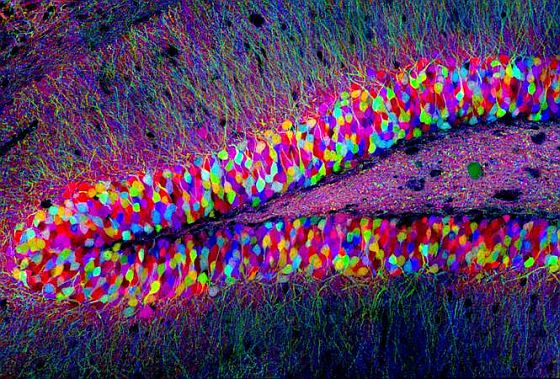
Individual neurons of the dentate gyrus in a 'Brainbow' mouse.

Salk Institute: Ever find yourself racking your brain on a Monday morning to remember where you put your car keys?

When you do find those keys, you can thank the hippocampus, a brain region responsible for storing and retrieving memories of different environments-such as that room where your keys were hiding in an unusual spot.

Now, scientists have helped explain how the brain keeps track of the incredibly rich and complex environments people navigate on a daily basis. They discovered how the dentate gyrus, a subregion of the hippocampus, helps keep memories of similar events and environments separate, a finding they reported March 20 in eLife. The findings, which clarify how the brain stores and distinguishes between memories, may also help identify how neurodegenerative diseases, such as Alzheimer’s disease, rob people of these abilities.

“Everyday, we have to remember subtle differences between how things are today, versus how they were yesterday – from where we parked our car to where we left our cellphone,” says Fred H. Gage, senior author on the paper and the Vi and John Adler Chair for Research on Age-Related Neurodegenerative Disease at Salk. “We found how the brain makes these distinctions, by storing separate ‘recordings’ of each environment in the dentate gyrus.”

The process of taking complex memories and converting them into representations that are less easily confused is known as pattern separation. Computational models of brain function suggest that the dentate gyrus helps us perform pattern separation of memories by activating different groups of neurons when an animal is in different environments.

However, previous laboratory studies found that in fact the same populations of neurons in the dentate gyrus are active in different environments, and that the way the cells distinguished new surroundings was by changing the rate at which they sent electrical impulses. This discrepancy between theoretical predictions and laboratory findings has perplexed neuroscientists and obscured our understanding of memory formation and retrieval. [Continue reading…]

Facebooktwittermail

Rethinking Israel-Palestine: Beyond bantustans, beyond reservations

Noura Erakat writes: Due to the insistence upon maintaining a Jewish demographic majority, Israel’s establishment and maintenance has necessitated the ongoing forced displacement of Muslim and Christian Palestinians. Well before Israel’s establishment, David Ben-Gurion, Israel’s chief architect and two-time prime minister, said that in order to be successful, Jews must comprise 80 percent of the population, hardly a plausible ratio in light of a vibrant Palestinian society in 1948. As put by the Israeli historian Benny Morris during an interview discussing his book, The Birth of the Palestinian Refugee Problem Revisited,

Ben Gurion…understood that there could be no Jewish state with a large and hostile Arab minority in its midst…that has to be clear, it’s impossible to evade it. Without the uprooting of the Palestinians, a Jewish state would not have arisen there.

And so based on that vision, Zionists demolished 531 Arab villages and expelled some 700,000 Palestinians from what is today Israel proper. The “problem,” so to speak, is that Zionist forces did not expel all Palestinians. Instead, the 100,000 Palestinians remaining within Israel at the conclusion of the 1948 war today constitute a 1.2 million-person population, approximately 20 percent of Israel’s total population.

Had Israel declared its borders along the 1949 armistice line, maintaining an 80 percent demographic balance may have been possible. Israel, however, has never declared any borders and, in accordance with a plan first elaborated by Deputy Prime Minister Yigal Allon immediately after the 1967 war, it has steadily expanded into the rest of Mandate Palestine, home now to 4 million Palestinians.

As of October 2012, the balance of Jews to non-Jews throughout Israel and the OPT was approximately 5.9 million Jewish Israelis, including the settler population, and 6.1 million Palestinians.

At this juncture, Israel could abandon its commitment to a Jewish demographic majority and establish a state for all its citizens without distinction to religion. Its leaders and supporters reject this pluralistic, democratic option outright and equate it with the destruction of Israel. [Continue reading…]

Facebooktwittermail

Homes found and homes lost

As President Obama correctly noted in his speech in Jerusalem, Zionism and America’s founding myth spring from a common quest: the yearning for a homeland.

But this human search is not universal — even if modernity has produced an ever expanding sense of rootlessness in populations made up of individuals for whom home is an abstraction buried in lost memories or unrealized hopes, not an intimately known place of birth.

People who know exactly where they were born and know this as the point on the planet from which they crawled, walked, climbed and by whatever other means slowly ventured out into the world, form a picture of the world resting on a very granular and specific foundation. Home known this way is not a disputed territory or a divine gift — it’s simply the place one knows better than any other.

From such a home a world is constructed that begins with definite articles: the hill, the river, the house, the field. Out of these utterly unique details a wider world of less distinct generalities only later emerges.

Homes yearned for, on the other hand, are homes to be discovered, created, invoked, declared, and claimed and for Americans and Israelis such homes could only be found by denying the existence of the homes of others.

This act of denial required that each nation fabricate or reinvent a founding mythology in which God gave a land with no people to a people with no land. An earthly paradise could only be created and believed in by destroying the past, dispossessing the native population and driving people out of their homeland.

This is our bond — but it’s not one to celebrate.

Facebooktwittermail