Al Ahram reports: A joint Saudi committee composed of representatives of the ministries of interior, justice and health is mulling the replacement of beheading with firing squads for capital sentences due to shortages in government swordsmen, Saudi daily Al-Youm reported on Sunday.
The committee argued that such a step, if adopted, would not violate Islamic law, allowing heads – or emirs – of the country’s 13 local administrative regions to begin using the new method when needed.
“This solution seems practical, especially in light of shortages in official swordsmen or their belated arrival to execution yards in some incidents; the aim is to avoid interruption of the regularly-taken security arrangements,” the committee said in a statement.
The ultra-conservative Gulf kingdom beheaded 76 people in 2012, according to an AFP tally based on official figures. Human Rights Watch (HRW) put the number at 69.
Rape, murder, apostasy, armed robbery and drug trafficking are all punishable by death under Saudi Arabia’s strict version of Sharia, or Islamic Law.
The Muslim Brotherhood’s fight against women’s rights
The New York Times reports: During its decades as an underground Islamist movement, the Muslim Brotherhood has long preached that Islam required women to obey their husbands in all matters.
“A woman needs to be confined within a framework that is controlled by the man of the house,” Osama Yehia Abu Salama, a Brotherhood family expert, said of the group’s general approach, speaking in a recent seminar for women training to become marriage counselors. Even if a wife were beaten by her husband, he advised, “Show her how she had a role in what happened to her.”
“If he is to blame,” Mr. Abu Salama added, “she shares 30 percent or 40 percent of the fault.”
Now, with a leader of the Brotherhood’s political arm in Egypt’s presidential palace and its members dominating Parliament, some deeply patriarchal views the organization has long taught its members are spilling into public view. The Brotherhood’s strident statements are reinforcing fears among many Egyptian liberals about the potential consequences of the group’s rise to power and creating new awkwardness for President Mohamed Morsi as he presents himself as a new kind of moderate, Western-friendly Islamist.
In a statement Wednesday on a proposed United Nations declaration to condemn violence against women, the Brotherhood issued a list of objections, which formally laid out its views on women for the first time since it came to power.
In its statement, the Brotherhood said that wives should not have the right to file legal complaints against their husbands for rape, and husbands should not be subject to the punishments meted out for the rape of a stranger.
A husband must have “guardianship” over his wife, not an equal “partnership” with her, the group declared. Daughters should not have the same inheritance rights as sons. Nor should the law cancel “the need for a husband’s consent in matters like travel, work or use of contraception” — a reform in traditional Islamic family law that was enacted under former President Hosni Mubarak and credited to his wife, Suzanne.
Egypt’s Daily News adds: The National Council for Women (NCW) denied in a statement released on Thursday that a declaration regarding violence against women currently being drafted in the 57th United Nations’ Commission on the Status of Women breaches Islamic Shari’a.
The Muslim Brotherhood released a statement on Wednesday denouncing the declaration for “contradicting principles of Islam and destroying family life and the entire society”.
“The Brotherhood’s statement is completely unfounded,” the NCW said in its statement. The council added that the final draft of the declaration is yet to be released and voted on.
The council denied that the declaration goes against the principles of Islam, eliminates Islamic manner or destroys families. “This misleading allegation abuses religion to taint the UN and stall women’s rights,” the statement read. It added that the “accusations” referred to in the Brotherhood’s statement are all non-existent in the draft declaration.
“The points mentioned in the Brotherhood’s statement cannot be found in the declaration; neither literally nor metaphorically,” said Abeer Abul Ella, head of the NCW’s media office.
In its statement, the Muslim Brotherhood listed ten points allegedly present within the declaration which represent “the final step in the intellectual and cultural invasion of Muslim countries”.
How can we stlil raed words wehn teh lettres are jmbuled up?
The Economic and Social Research Council: Researchers in the UK have taken an important step towards understanding how the human brain ‘decodes’ letters on a page to read a word. The work, funded by the Economic and Social Research Council (ESRC), will help psychologists unravel the subtle thinking mechanisms involved in reading, and could provide solutions for helping people who find it difficult to read, for example in conditions such as dyslexia.
In order to read successfully, readers need not only to identify the letters in words, but also to accurately code the positions of those letters, so that they can distinguish words like CAT and ACT. At the same time, however, it’s clear that raeders can dael wtih wodrs in wihch not all teh leettrs aer in thier corerct psotiions.
“How the brain can make sense of some jumbled sequences of letters but not others is a key question that psychologists need to answer to understand the code that the brain uses when reading,” says Professor Colin Davis of Royal Holloway, University of London, who led the research.
For many years researchers have used a standard psychological test to try to work out which sequences of letters in a word are important cues that the brain uses, where jumbled words are flashed momentarily on a screen to see if they help the brain to recognise the properly spelt word.
But, this technique had limitations that made it impossible to probe more extreme rearrangements of sequences of letters. Professor Davis’s team used computer simulations to work out that a simple modification to the test would allow it to question these more complex changes to words. This increases the test’s sensitivity significantly and makes it far more valuable for comparing different coding theories.
“For example, if we take the word VACATION and change it to AVACITNO, previously the test would not tell us if the brain recognises it as VACATION because other words such as AVOCADO or AVIATION might start popping into the person’s head,” says Professor Davis. “With our modification we can show that indeed the brain does relate AVACITNO to VACATION, and this starts to give us much more of an insight into the nature of the code that the brain is using – something that was not possible with the existing test.”
The modified test should allow researchers not only to crack the code that the brain uses to make sense of strings of letters, but also to examine differences between individuals – how a ‘good’ reader decodes letter sequences compared with someone who finds reading difficult.
“These kinds of methods can be very sensitive to individual differences in reading ability and we are starting to get a better idea of some of the issues that underpin people’s difficulty in reading,” says Professor Davis. Ultimately, this could lead to new approaches to helping people to overcome reading problems.
Music: Esbjörn Svensson Trio — ‘The Goldhearted Miner’
Pope Francis’s book reveals a radical progressive in the making
The Guardian reports: The In his own words, Pope Francis comes over as a clever, thoughtful and skilful mixture of social conservative and radical progressive who preaches zero tolerance of pederast priests but whose own behaviour during the terror of Argentina’s military juntas remains decidedly blurred.
In his latest book, On Earth and Heaven, the man then known as Jorge Bergoglio, discusses the divine and the mundane with the prominent Jewish rabbi Abraham Skorka in a series of conversations published in 2010.
Bergoglio appears as a man with a profound social conscience, expressing admiration of some atheist socialists and professing a genuine belief in interfaith dialogue – to the extent that some radical Catholics accuse him of heresy.
He is critical of those who covered up the paedophile scandal that has done so much damage to the church he now leads.
“The idea that celibacy produces paedophiles can be forgotten,” he says. “If a priest is a paedophile, he is so before he becomes a priest. But when this happens you must never look away. You cannot be in a position of power and use it to destroy the life of another person.”
Bergoglio says he has never had to deal with such a case, but when a bishop asked what he should do, he told him the priest should be sacked and tried, that putting the church’s reputation first was a mistake.
“I think that is the solution that was once proposed in the United States; of switching them to other parishes,” he says. “That is stupid, because the priest continues to carry the problem in his backpack.” The only answer to the problem, he adds, is zero tolerance. [Continue reading…]
The ontological deflection
When it comes to allegations about his complicity in Argentina’s dirty wars, Pope Francis may not be served well by his own staff.
The New York Times reports:
The Rev. Federico Lombardi, the Vatican spokesman, said there had “never been a credible accusation against him” relating to the period in the 1970s when he was the superior of the Jesuit order in Argentina.
Indeed, “there have been many declarations of how much he did for many people to protect them from the military dictatorship,” Father Lombardi said in a statement at a news conference.
“The accusations belong to the use of a historical-social analysis of facts for many years by the anticlerical left to attack the church and must be rejected decisively.”
This is a standard public relations deflection: don’t directly address the content of the criticism, but instead treat it as an expression of the identity of a critic who is supposedly hostile to the identity of those being attacked.
We are being attacked because of who we are — not because of how we act.
As soon as any criticism gets framed in this way, it is transformed from criticism into hatred. People who criticize Israel do so because they hate Jews. Critics of Pope Francis hate clerics — and so the ontological deflection turns. The critic gets smeared; the target is turned into an innocent victim.
The fact that this particular story about Cardinal Bergoglio’s alleged complicity in the imprisonment and torture of two Jesuits priests, Franz Jalics and Orlando Yorio, has continued to churn for so many years, suggests that it has yet to be fully told.
The facts may not be clear cut because differences in accounts may hinge on differences of opinion about how to deal with the junta. Still, the new pope might do better by putting aside the shield created by the often self-serving defenders of the papacy and instead telling his own story.
Argentina’s dirty war casts a shadow over Pope Francis
Christopher Dickey reports: The new pope won over the crowd in St. Peter’s Square on Wednesday night with his kindly voice and humble words. But whispers about his past hover like a threatening storm over his papacy. When Jorge Mario Bergoglio, now Pope Francis, was the head of the Jesuit order in Argentina, did he do too little to protect his priests from a savage military dictatorship? Or, worse, did he denounce some of them as guerrilla sympathizers, virtually sentencing them to death?Franz Jalics SJ
The allegations are not new, but they are persistent.
“It was the time of the civil war between the extreme right-wing and left-wing groups in Argentine society,” wrote Franz Jalics, an Argentine priest [correction: he’s Hungarian], looking back decades later. It was 1976, and after years of growing violence by various guerrilla groups, a military junta had seized power in Buenos Aires. The secretive campaign waged by the generals, known as the “dirty war,” was ferocious. Thousands of people were “disappeared” at the hands of a special Navy unit that took some prisoners to concentration camps and threw others into the sea from helicopters.
One Sunday morning the unit came for Jalics and another Jesuit priest, Orlando Yorio. Rumor had it that the two were sympathetic to the guerilla groups. An influential member of the local Catholic hierarchy had apparently confirmed that information to the junta.
Their tormentors used drugs and torture to try to make them talk. For five months, blindfolded and chained the whole time, the priests lived in terror, convinced that at any second they’d be killed. “My fears don’t seem exaggerated to me even today,” Jalics wrote, nearly 20 years later. When the dictatorship ended and several commanders were put on trial, he wrote, “there were no surviving witnesses from the 6,000 people whom this particular group had abducted. Only we two survived. All the others had been killed.”
In Jalics’s book, first published in 1994, he writes about the intense rage he felt against the man (unnamed) he believed had betrayed him in meetings with the military. More recently Argentine muckraker Horacio Verbitsky reported in a series of detailed articles and in his own book that the betrayer was Bergoglio, head of the Jesuit order in Argentina at the time. Verbitsky bases that allegation on interviews with Yorio, who died of natural causes in 2000, and on several documents.
Jalics does not name the object of his rage himself, and appears never to have confirmed Verbitsky’s reports publicly. Why? Perhaps because, as Jalics writes, he forgave his enemy as Christians are supposed to do.
Bergoglio’s fellow cardinals certainly knew about the allegations, but chose not to believe them when they voted for him to be pope. Australia’s Cardinal George Pell told a television interviewer on Thursday: “Those stories were dismissed years ago. They were a smear and a lie. They were laid to rest years ago.”
Not really. As recently as October 2012, Argentina’s bishops under Bergoglio’s leadership issued a collective apology for failing to protect their flock adequately during the dictatorship, blaming both the right-wing generals and the left-wing guerrillas for the years of bloodshed. The Daily Beast’s Mac Margolis reports from Rio de Janeiro that Bergoglio’s biographer, Sergio Rubín, has been defending the new pope in the press by claiming that his “nonconfrontational” attitude toward the junta was pragmatism at a time when many people were being persecuted, tortured, and killed.
As Rubín tells the story, Bergoglio persuaded the chaplain of the junta’s leader to call in sick so Bergoglio could go to the general’s home to say Mass and raise the question of the abducted priests personally. Rubín argues that Bergoglio’s later reluctance to talk about his role during the dirty war is a sign of “humility.”
“What is a well-established point is that the leadership of the Catholic Church in Argentina during the dictatorship was pretty much silent,” says José Miguel Vivanco, director of the Americas division at Human Rights Watch in New York. He won’t comment on the allegations against the new pope, but acknowledges that “some bishops were openly sympathetic to the military junta.”
Jalics’s humble little book is not an exposé like Verbitsky’s, it is not a smear, and it does not read like a lie. I bought it on Thursday morning in the “spirituality” section of a store run by nuns a couple of blocks from St. Peter’s Square. Its title is Contemplative Retreat: An Introduction to the Contemplative Way of Life and to the Jesus Prayer.
Only six of the book’s 332 pages deal with Jalics’s experiences in 1976 and what happened to him afterward, and he tells the story as an example of the power of contemplation, the importance of forgiveness. The entire grim experience, he claims, was a source of “purification.”
“I went to this particular person to tell him that he was playing with our lives. The man promised me he would communicate to the military that we were not terrorists.” [Continue reading…]
A divine threat to Argentina?
Martín Caparrós writes: This week, Habemus papam — we have a pope — became an Argentine idiom. [Jorge Mario Bergoglio’s] election underlines the assumption that the center of Catholicism is shifting to the world’s poorer regions of Africa, Asia and Latin America. And yet in his own country, the poor are migrating en masse to Pentecostal and other Christian churches that are more charismatic and less institutionally compromised than the Old Lady from Rome.
Perhaps Pope Francis’ election will reverse that shift. In fact, I dread the effect that this unexpected divine favor will have on my country. We are a society that turned to tennis once Guillermo Vilas won a Grand Slam in France; grew obsessed with basketball when Manu Ginobili made his mark in the American N.B.A.; started raving about monarchy when an Argentine-born princess married the crown prince of the Netherlands; and has persisted in doubting Jorge Luis Borges’s value because he never won the international honor of a Nobel Prize. The fact that “one of us” is now sitting on St. Peter’s throne may have a huge effect on the weight of Catholicism on our lives.
Catholicism has never excelled at letting nonbelievers live as they believe they should. The right to legal abortion, for one, will be a ruthless field of that battle: “our” pope will surely never allow his own country, where legal abortion remains severely limited, to set a bad example. Here, as everywhere, the Vatican is a main lobbying force for conservative, even reactionary, issues. An Argentine pope can bring this power to uncharted heights.
Or perhaps not. I hope I am wrong: it has often been my lot. For infallibility, please ask for el Papa Francisco.
Brave new world for neural engineering
Georgia Institute of Technology: Despite many remarkable discoveries in the field of neuroscience during the past several decades, researchers have not been able to fully crack the brain’s “neural code.” The neural code details how the brain’s roughly 100 billion neurons turn raw sensory inputs into information we can use to see, hear and feel things in our environment.
In a perspective article published in the journal Nature Neuroscience on Feb. 25, 2013, biomedical engineering professor Garrett Stanley detailed research progress toward “reading and writing the neural code.” This encompasses the ability to observe the spiking activity of neurons in response to outside stimuli and make clear predictions about what is being seen, heard, or felt, and the ability to artificially introduce activity within the brain that enables someone to see, hear, or feel something that is not experienced naturally through sensory organs.
Stanley also described challenges that remain to read and write the neural code and asserted that the specific timing of electrical pulses is crucial to interpreting the code. He wrote the article with support from the National Science Foundation (NSF) and the National Institutes of Health (NIH). Stanley has been developing approaches to better understand and control the neural code since 1997 and has published about 40 journal articles in this area.
“Neuroscientists have made great progress toward reading the neural code since the 1990s, but the recent development of improved tools for measuring and activating neuronal circuits has finally put us in a position to start writing the neural code and controlling neuronal circuits in a physiological and meaningful way,” said Stanley, a professor in the Wallace H. Coulter Department of Biomedical Engineering at Georgia Tech and Emory University.
With recent reports that the Obama administration is planning a decade-long scientific effort to examine the workings of the human brain and build a comprehensive map of its activity, progress toward breaking the neural code could begin to accelerate.
The potential rewards for cracking the neural code are immense. In addition to understanding how brains generate and manage information, neuroscientists may be able to control neurons in individuals with epilepsy and Parkinson’s disease or restore lost function following a brain injury. Researchers may also be able to supply artificial brain signals that provide tactile sensation to amputees wearing a prosthetic device.
Neuroscientists display a singular lack of imagination when it comes to promoting the benefits of their research. It’s always the same: we’re going to restore mobility to those who have lost it and rejuvenate damaged brains. Keep the research grants and philanthropic donations rolling in.
Still, I don’t think one has to be subject to rampant paranoia to consider less benign applications for the ability to control neural circuits.
Once the next generation of parents are comfortable with the idea of walking around with electronic devices strapped to their heads, it won’t be too difficult to persuade them that as a matter of convenience their children will be better off having computer chips implanted inside their skulls. And since it’s already become socially acceptable to use pills to change the way you feel, side-effect-free “affect reprogramming” is the next logical step.
People may still need to be engaged in soul-destroying work, but employers will be able to offer neural support systems that help workers feel satisfied even while engaged in meaningless tasks.
Welcome to the brave new world of neural engineering.
For gangsta gardeners, growing your own food is like printing your own money
The lost tribes of the Amazon

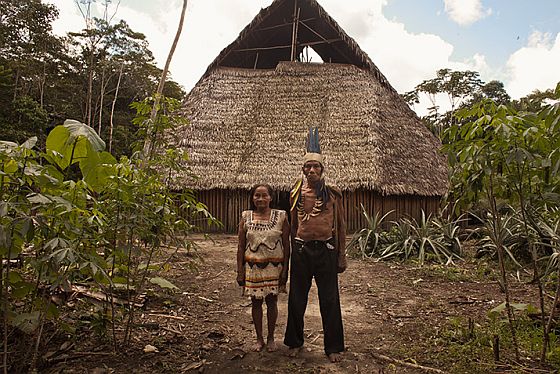
Jitoma Safiama, 70 -- seen here with his wife Rosita Garcia, a Muynane, in front of their maloca -- is a shaman and chief of a small subtribe of Uitotos, descendants of those who were chased by the rubber barons from their original lands around 1925.
Joshua Hammer writes: On a cloudless afternoon in the foothills of the Andes, Eliana Martínez took off for the Amazon jungle in a single-engine Cessna 172K from an airstrip near Colombia’s capital, Bogotá. Squeezed with her in the tiny four-seat compartment were Roberto Franco, a Colombian expert on Amazon Indians; Cristóbal von Rothkirch, a Colombian photographer; and a veteran pilot. Martínez and Franco carried a large topographical map of Río Puré National Park, 2.47 million acres of dense jungle intersected by muddy rivers and creeks and inhabited by jaguars and wild peccaries — and, they believed, several isolated groups of Indians. “We didn’t have a lot of expectation that we’d find anything,” Martínez, 44, told me, as thunder rumbled from the jungle. A deluge began to pound the tin roof of the headquarters of Amacayacu National Park, beside the Amazon River, where she now serves as administrator. “It was like searching for the needle in the haystack.”
Martínez and Franco had embarked that day on a rescue mission. For decades, adventurers and hunters had provided tantalizing reports that an “uncontacted tribe” was hidden in the rainforest between the Caquetá and Putumayo rivers in the heart of Colombia’s Amazon. Colombia had set up Río Puré National Park in 2002 partly as a means of safeguarding these Indians, but because their exact whereabouts were unknown, the protection that the government could offer was strictly theoretical. Gold miners, loggers, settlers, narcotics traffickers and Marxist guerrillas had been invading the territory with impunity, putting anyone dwelling in the jungle at risk. Now, after two years’ preparation, Martínez and Franco were venturing into the skies to confirm the tribe’s existence — and pinpoint its exact location. “You can’t protect their territory if you don’t know where they are,” said Martínez, an intense woman with fine lines around her eyes and long black hair pulled into a ponytail.
Descending from the Andes, the team reached the park’s western perimeter after four hours and flew low over primary rainforest. They ticked off a series of GPS points marking likely Indian habitation zones. Most of them were located at the headwaters for tributaries of the Caquetá and the Putumayo, flowing to the north and south, respectively, of the park. “It was just green, green, green. You didn’t see any clearing,” she recalled. They had covered 13 points without success, when, near a creek called the Río Bernardo, Franco shouted a single word: “Maloca!”
Martínez leaned over Franco.
“Donde? Donde?” — Where? Where? she yelled excitedly.
Directly below, Franco pointed out a traditional longhouse, constructed of palm leaves and open at one end, standing in a clearing deep in the jungle. Surrounding the house were plots of plantains and peach palms, a thin-trunked tree that produces a nutritious fruit. The vast wilderness seemed to press in on this island of human habitation, emphasizing its solitude. The pilot dipped the Cessna to just several hundred feet above the maloca in the hope of spotting its occupants. But nobody was visible. “We made two circles around, and then took off so as not to disturb them,” says Martínez. “We came back to earth very content.”
Back in Bogotá, the team employed advanced digital technology to enhance photos of the maloca. It was then that they got incontrovertible evidence of what they had been looking for. Standing near the maloca, looking up at the plane, was an Indian woman wearing a breechcloth, her face and upper body smeared with paint.
Franco and Martínez believe that the maloca they spotted, along with four more they discovered the next day, belong to two indigenous groups, the Yuri and the Passé — perhaps the last isolated tribes in the Colombian Amazon. Often described, misleadingly, as “uncontacted Indians,” these groups, in fact, retreated from major rivers and ventured deeper into the jungle at the height of the South American rubber boom a century ago. They were on the run from massacres, enslavement and infections against which their bodies had no defenses. For the past century, they have lived with an awareness — and fear — of the outside world, anthropologists say, and have made the choice to avoid contact. Vestiges of the Stone Age in the 21st century, these people serve as a living reminder of the resilience — and fragility — of ancient cultures in the face of a developmental onslaught. [Continue reading…]
Music: Esbjörn Svensson Trio — ‘Dolores in a Shoestand’
Obama’s plan to expand the war on terrorism
Rosa Brooks writes: When a government is accused of activities that stretch or violate the law, it has three choices: 1) change the activities to conform with the law; 2) change the law to conform with the activities; or 3) lie (about the nature of the activities, the meaning of the law, or both).
Option 3 isn’t a comfortable one for the Obama administration, which is, thank heaven, not prone to outright lying. Some senior officials tolerate a moderate amount of fudging and obfuscation, but when the fudge factor gets too high, it induces visible queasiness. Over the last couple of weeks, we’ve seen more than a little such discomfort on the faces of those stuck with justifying U.S. drone policy to Congress and the public.
That’s not surprising: As the targets of U.S. drone strikes have expanded from senior Taliban and al Qaeda operatives to a far broader range of individuals with only the most tenuous links to al Qaeda, the administration’s legal arguments for targeted killings have grown ever more tortured and complex. In particular, it’s gotten progressively more difficult for officials to avoid blushing while claiming that U.S. drone policy is fully consistent with Congress’s 2001 Authorization for Use of Military Force (AUMF), which authorizes force only against those who bear some responsibility for the 9/11 attacks.
With Option 3 — lie, lie, lie — off the table, and fudging and obfuscation growing harder to comfortably sustain, the thoughts of administration officials turn naturally to Option 2: change the law. Thus, as the Washington Post reported last weekend, some administration officials are apparently considering asking Congress for a new, improved “AUMF 2.0,” one that would place U.S. drone policy on firmer legal footing.
Just who is behind this notion is unclear, but the idea of a revised AUMF has been gaining considerable bipartisan traction outside the administration. In a recent Hoover Institution publication, for instance, Bobby Chesney, who served in the Obama Justice Department, teams up with Brookings’s Ben Wittes and Bush administration veterans Jack Goldsmith and Matt Waxman to argue for a revised AUMF — one that can provide “a new legal foundation for next-generation terrorist threats.”
I’m as fond of the rule of law as the next gal, so in a general sense, I applaud the desire to ensure that future executive branch counterterrorist activities are consistent with the laws passed by Congress. But “laws” and “the rule of law” are two different animals, and an expanded new AUMF is a bad idea.
Sure, legislative authorization for the use of force against “next generation” terrorist threats would give an additional veneer of legality to U.S. drone policy, and make congressional testimony less uncomfortable for John Brennan and Eric Holder. But an expanded AUMF would also likely lead to thoughtless further expansion of targeted killings. This would be strategically foolish, and would further undermine the rule of law.
An expanded AUMF is also unnecessary. Even if Congress simply repealed the 2001 AUMF (as the New York Times editorial board urges) instead of revising it, the president already has all the legal authority he needs to keep the nation safe.
If U.S. drone policy is currently on shaky legal ground, it’s not for lack of inherent executive authority (or international law authority) to use force against any terrorist organization that poses an imminent and grave threat to the United States. U.S. drone policy is on shaky legal ground because the administration has lost sight of the difference between threats that are imminent and grave and threats better characterized as speculative and minor. [Continue reading…]
Prisoner protest at Guantánamo Bay stains Obama’s human rights record
Amy Goodman writes: Reports are emerging from the US military prison at Guantánamo Bay that a majority of the prisoners are on a hunger strike. Of the detainees, 166 remain locked up, although more than half have been cleared by the Obama administration for release. Yet, there they languish – in some cases, now in their second decade – in a hellish legal limbo, uncharged yet imprisoned.
President Barack Obama’s failure to close Guantánamo, as he boldly promised to do with an executive order signed on 22 January 2009, and the deterioration of conditions at the prison under his watch will remain a lasting stain on his legacy. From Guantánamo, Yemeni prisoner Bashir al-Marwalah wrote to his lawyer:
“We are in danger. One of the soldiers fired on one of the brothers a month ago. Before that, they send the emergency forces with M-16 weapons into one of the brothers’ cell blocks … Now they want to return us to the darkest days under Bush. They said this to us. Please do something.”
Al-Marwalah was referring to the first recorded use of rubber bullets being fired at a Guantanamo prisoner by the US military guards there. [Continue reading…]
Blackwater — a virtual extension of the CIA
Eli Lake reports: Last month a three-year-long federal prosecution of Blackwater collapsed. The government’s 15-felony indictment — on such charges as conspiring to hide purchases of automatic rifles and other weapons from the Bureau of Alcohol, Tobacco, Firearms, and Explosives — could have led to years of jail time for Blackwater personnel. In the end, however, the government got only misdemeanor guilty pleas by two former executives, each of whom were sentenced to four months of house arrest, three years’ probation, and a fine of $5,000. Prosecutors dropped charges against three other executives named in the suit and abandoned the felony charges altogether.
But the most noteworthy thing about the largely failed prosecution wasn’t the outcome. It was the tens of thousands of pages of documents — some declassified — that the litigation left in its wake. These documents illuminate Blackwater’s defense strategy — and it’s a fascinating one: to defeat the charges it was facing, Blackwater built a case not only that it worked with the CIA — which was already widely known—but that it was in many ways an extension of the agency itself.
Founded in 1997 by Erik Prince, heir to an auto-parts family fortune, Blackwater had proved especially useful to the CIA in the early 2000s. “You have to remember where the CIA was after 9/11,” says retired Congressman Pete Hoekstra, who served as the Republican chairman of the House Permanent Select Committee on Intelligence from 2004 to 2006 and later as the ranking member of the committee. “They were gutted in the 1990s. They were sending raw recruits into Afghanistan and other dangerous places. They were looking for skills and capabilities, and they had to go to outside contractors like Blackwater to make sure they could accomplish their mission.” [Continue reading…]
Why gun makers fear the NRA
Bloomberg: In the days after the Sandy Hook Elementary School massacre on Dec. 14, executives with a half-dozen major U.S. gun manufacturers contacted the National Rifle Association. The firearm industry representatives didn’t call the NRA, which they support with millions of dollars each year, to issue directives. On the contrary, they sought guidance on how to handle the public-relations crisis, according to people familiar with the situation who agreed to interviews on the condition they remain anonymous.
While the Obama administration had reacted meekly to mass shootings in Tucson and Aurora, Colo., Sandy Hook would be different. Twenty first-graders were dead. The president, a gun control supporter who previously had avoided the radioactive issue, wiped away tears when talking on television about the “beautiful little kids.” As a nation, the normally stoic president added, “We have been through this too many times.” In crass political terms, he was newly reelected and had less to lose in confronting pro-gun forces. The NRA’s leadership faced a choice: Go to the mattresses as usual, or acknowledge the special horror of Sandy Hook and offer an olive branch.
That decision rested with Wayne LaPierre, the NRA’s chief executive since 1991. One of Washington’s most durable and enigmatic power brokers, LaPierre arrived at the organization in 1978 with a master’s in political science from Boston College. The bookish Roanoke (Va.) native didn’t know much about firearms. Colleagues joked that duck hunting with Wayne was more dangerous for the hunters than the ducks. Nevertheless, driven by an ambition impressive even by Washington standards, he rose swiftly, a mild-mannered presence in private who developed an Elmer Gantry-like persona for speeches and interviews.
In the immediate wake of Sandy Hook, the NRA reassured nervous gun company reps that they could stand down, according to people familiar with the situation. LaPierre would handle it.
One week after the massacre, he delivered a nationally televised tirade tinged with his trademark cultural resentment and paranoia. “Is the press and the political class here in Washington, D.C., so consumed by fear and hatred of the NRA and American gun owners,” he said, “that you’re willing to accept the world where real resistance to evil monsters is [an] unarmed school principal left to surrender her life, her life, to shield those children in her care?”
As intended, LaPierre’s performance received massive media attention. It also upset many—including some gun makers. “The funerals were still going on in Newtown,” says Joseph Bartozzi. “Parents were burying their children.” A senior vice president at O.F. Mossberg & Sons, a shotgun and rifle manufacturer in North Haven, Conn., Bartozzi belongs to the NRA and applauds its stalwart defense of Second Amendment rights. But this time, LaPierre’s diatribe struck him as ill-timed and graceless.
The companies that make and market firearms might prefer a softer tone, but they rarely complain publicly about NRA fear mongering because it’s been so good for business. Corporate donations to the NRA, which together with its affiliates has annual revenue of $250 million, have risen during the past decade, a period when the organization has taken increasingly absolutist positions. Still, it’s not the industry that muscles the NRA.
“NRA leadership worries about two things above all else: perpetuating controversy to stimulate fundraising from individual members and protecting its right flank from the real crazies,” says Richard Feldman, author of a feisty 2007 memoir, Ricochet: Confessions of a Gun Lobbyist. Feldman has worked in various capacities for both the NRA and the industry. “The idea that the NRA follows orders from the gun companies is a joke,” he says. “If anything, it’s the other way around.”
NRA spokesman Andrew Arulanandam declined to comment for this article, as did LaPierre and other top officials at the lobby group’s Fairfax (Va.) headquarters. New York Mayor Michael Bloomberg, a gun control advocate, founded Bloomberg LP, which owns this magazine.
Gun companies defer to the NRA for two main reasons: First, there’s intimidation. The lobby group has incited potentially ruinous consumer boycotts against firearm makers that fail to follow the NRA line with sufficient zeal. Second, regardless of some executives’ concerns about civil discourse, gun companies benefit financially from the NRA’s hype. Alarms about imminent gun confiscation—an NRA staple, despite its implausibility—reliably send firearm owners back to retail counters. Sales are booming. Mossberg is running three shifts a day. “Demand,” Bartozzi says, “is very strong.” [Continue reading…]
Why the character of the new pope matters

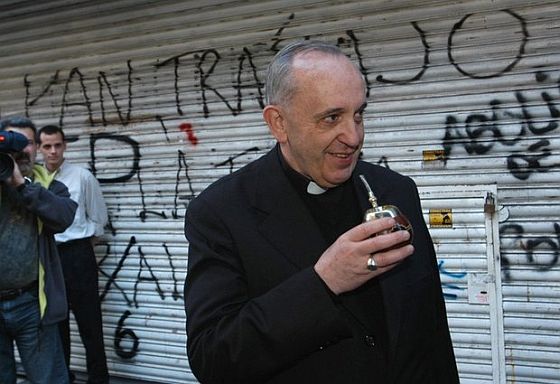
Archbishop Jorge Mario Bergoglio (now Pope Francis) drinks the local beverage, "mate," in Buenos Aires, Argentina.
“Journalists sometimes risk becoming ill from coprophilia and thus fomenting coprophagia: which is a sin that taints all men and women, that is, the tendency to focus on the negative rather than the positive aspects,” said Jorge Mario Bergoglio in an interview with Vatican Insider last month, before becoming the new pope.
Maybe the press would become less vulnerable to the charge of peddling in shit if they were better versed in Latin.
To suggest that journalists and the public harbor an unhealthy fascination with dirt is not unreasonable. No doubt many of the things that gain the most media attention would better be ignored, but the problem is less general than simply an excessive focus on the negative. More often, it involves focusing on the negative for the wrong reasons, resulting in excessive attention on trivia while overlooking matters of enduring significance.
Look, for instance, at the ‘evolution’ of Huffington Post which began its life as a reasonably decent mainstream progressive outlet and gradually turned into a kind of liberal National Inquirer. On a descending spiral in search of more traffic, journalism enslaves itself to whatever will capture readers’ interest, and in the process it further corrupts both itself and its audience.
Too rarely do editors pause to ask simple qualitative questions — is this a story about something that matters? — because their overriding concern is quantitative: it’s about counting eyeballs and dollars.
This reductive approach to news not only means that the world gets presented through a distorted lens, but also that stories get broken into easy-to-consume news nuggets. Thus the story of the election of a new pope becomes:
- New name — first Francis
- First South American pope
- First Jesuit
- Condemns inequality
- Anti-gay; anti-abortion; anti-euthanasia; anti-contraception
- Linked to junta
- Next story…
Adding a small layer of nuance, a number of quotations get tossed into the mix. For me, one stands out: “Human rights are not only violated by terrorism, repression or assassination, but also by unfair economic structures that creates huge inequalities.”
Just imagine if an American president said that! Those would be revolutionary words.
But beyond the quotes, the biographical details, the questions about possible collusion with Argentinian dictators, the quality that appears to distinguish the new pope above all others is humility.
This has been widely noted and is indeed noteworthy for many reasons. First of course is the juxtaposition of a humble character with an institutional position of unparalleled grandiosity. Will the Buenos Aires priest bring humility to the institution or will the institution corrupt the man?
Cynics will have already concluded that Pope Francis’s humble facade is just that — a cunning means for gaining power. Call me naive, but I prefer to take what I see at face value and regard these manifestations of humility as genuine — unless or until there is evidence that proves otherwise.
Yet as an atheist, why should I even have any interest in the qualities of the new pope? Isn’t he just another proponent of an unscientific view of the world that the world would be better without?
Firstly, let’s not tar all the faithful with the same brush. This isn’t a Bible-thumping anti-intellectual. Before receiving a doctorate in theology, Bergoglio gained a masters degree in chemistry and taught literature and psychology at the University of El Salvador, in Buenos Aires. While being doctrinally conservative, he is a strong advocate of social justice and appears to live in accordance with the values that he preaches.
And here’s the point: however Pope Francis might be characterized in sound-byte journalism, the degree of influence he exerts across the Catholic world will in large measure be determined by his character.
People of all faiths and no faith are inclined to form views about others — whether in direct relationships or by seeing them on TV — based as much if not more on the manner through which individuals express themselves. Viscerally we respond to bearing, facial expressions and a constellation of largely non-verbal impressions out of which we construct our sense of the person.
If the first impression of this pope — that he is a genuinely humble man — turns out to be an enduring image, then this may also be the most significant feature of his character.
But what is humility?
American culture, with its emphasis on personal freedom, individuality, self-expression, and self-made success, accords little value to a virtue associated with meekness and a lack of assertiveness. It might be called a virtue but to many American eyes humility also looks like weakness. Americans are proud to be proud — rarely esteemed for their humility.
Maybe humility could be called an un-American virtue since it eschews the exceptional; it puts others first; it connects to the earth by being rooted in common ground.
One doesn’t have to share their beliefs or endorse the power of the papacy, to nevertheless recognize that popes, no less than American presidents, have an enduring impact on the world. A pope who is a genuine expression of humility and who exerts a significant influence on the lives of about 20% of the people on this planet, has great potential as a force for good.

Pope Francis: questions remain over his role during Argentina’s dictatorship
The Guardian reports: As head of the Jesuit order from 1973 to 1979, Jorge Bergoglio – as the new pope was known until yesterday – was a member of the hierarachy during the period when the wider Catholic church backed the military government and called for their followers to be patriotic.
Bergoglio twice refused to testify in court about his role as head of the Jesuit order. When he eventually appeared in front of a judge in 2010, he was accused by lawyers of being evasive.
The main charge against Bergoglio involves the kidnapping of two Jesuit priests, Orland Yorio and Francisco Jalics, who were taken by Navy officers in May 1976 and held under inhumane conditions for the missionary work they conducted in the country’s slums, a politically risky activity at the time.
His chief accuser is journalist Horacio Verbitsky, the author of a book on the church called “El Silencio” (“The Silence”), which claims that Bergoglio withdrew his order’s protection from the two priests, effectively giving the military a green light for their abduction.
The claims are based on conversations with Jalics, who was released after his ordeal and later moved to a German monastery.
Bergoglio has called the allegations “slander” and holds that, on the contrary, he moved behind the scenes to save the lives of the two priests and others that he secretly hid from the death squads. In one case, he claims he even gave his identity papers to one dissident who looked like him so that he could flee the country.
For some, that makes him a hero. Other are sceptical. Eduardo de la Serna, co-ordinator of a left-wing group of priests who focus on the plight of the poor, told Radio del Plate that: “Bergoglio is a man of power and he knows how position himself among powerful people. I still have many doubts about his role regarding the Jesuits who went missing under the dictatorship.”
Many in the church are keen to move on from that dark period in the history of Argentina and the church. They say the new pope helped to heal the wounds of the dirty war and to restore the credibility of the Catholic hierarchy.