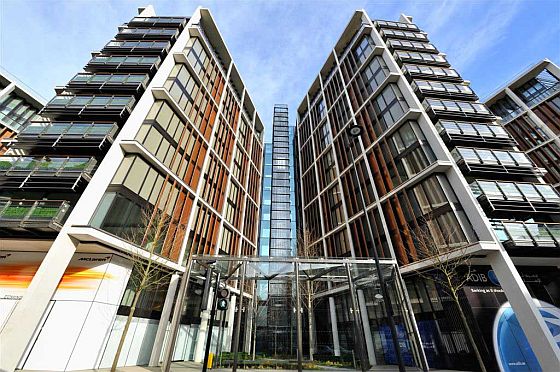
Nicholas Shaxson writes: Up until the 18th century, Knightsbridge, which borders genteel Kensington, was a lawless zone roamed by predatory monks and assorted cutthroats. It didn’t come of age until the Victorian building boom, which left a charming legacy of mostly large and beautiful Victorian houses, with their trademark white or cream paint, black iron railings, high ceilings, and short, elegant stone steps up to the front door.
This will not be the impression a visitor now gets as he emerges from the Knightsbridge subway station’s south exit. He will be met by four hulking joined-up towers of glass, metal, and concrete, sandwiched between the Victorian splendors of the Mandarin Oriental Hotel, to the east, and a pretty five-story residential block, to the west. This is One Hyde Park, which its developers insist is the world’s most exclusive address and the most expensive residential development ever built anywhere on earth. With apartments selling for up to $214 million, the building began to smash world per-square-foot price records when sales opened, in 2007. After quickly shrugging off the global financial crisis the complex has come to embody the central-London real-estate market, where, as high-end property consultant Charles McDowell put it, “prices have gone bonkers.”
From the Hyde Park side, One Hyde Park protrudes aggressively into the skyline like a visiting spaceship, a head above its red-brick and gray-stone Victorian surroundings. Inside, on the ground floor, a large, glassy lobby offers what you’d expect from any luxury intercontinental hotel: gleaming steel statues, thick gray carpets, gray marble, and extravagant chandeliers with radiant sprays of glass. Not that the building’s inhabitants need venture into any of these public spaces: they can drive their Maybachs into a glass-and-steel elevator that takes them down to the basement garage, from which they can zip up to their apartments.
The largest of the original 86 apartments (following some mergers, there are now around 80) are pierced by 213-foot-long mirrored corridors of glass, anodized aluminum, and padded silk. The living spaces feature dark European-oak floors, Wenge furniture, bronze and steel statues, ebony, and plenty more marble. For added privacy, slanted vertical slats on the windows prevent outsiders from peering into the apartments.
In fact, the emphasis everywhere is on secrecy and security, provided by advanced-technology panic rooms, bulletproof glass, and bowler-hatted guards trained by British Special Forces. Inhabitants’ mail is X-rayed before being delivered. [Continue reading…]
Issandr El Amrani writes:Free Arabs, a new Web site run by a group of Arabs — some in the Middle East, others in the West — is causing a stir. Gathered under the slogan “Democracy, Secularism, Fun,” it laments the fact that “millions of Arabs have internalized the notion that secularism is tantamount to faithlessness, and is all about demonizing Islam and promoting a dissolute way of life.
Not only can secularism coexist with religion, Free Arabs argues, but it protects the free exercise of religion and can help promote other civil liberties, like gay rights.
The group is defending a no-compromise version of secularism — one that may be too much to ask of many Arab politicians, particularly those in the fledging new liberal parties that have emerged since the Arab uprisings.
Some don’t want to be dragged into culture wars, a favorite ground for Islamists who bank on the fact that many Arab societies are still socially conservative. Others are just plain conservative themselves, even on issues far more basic than gay rights — like whether gender equality should be applied to inheritance and other questions traditionally governed by Islamic law.
Still, the controversy triggered by Free Arabs is just the kind of debate Islamists and secularists in the Arab world should be having, if only because they couldn’t have had it under the old regimes. Also, there’s plenty of room for debate: In this part of the world, the term “secular” means very different things to different people. [Continue reading…]
Sami Ramadani writes: It has always been painful for me to write about Iraq and Baghdad, the land of my birth and the city of my childhood. They say that time is a great healer, but, along with most Iraqis, I feel the pain even more deeply today. But this time the tears for what has already happened are mixed with a crippling fear that worse is yet to come: an all-out civil war. Ten years on from the shock and awe of the 2003 Bush and Blair war – which followed 13 years of murderous sanctions, and 35 years of Saddamist dictatorship – my tormented land, once a cradle of civilisation, is staring into the abyss.
Wanton imperialist intervention and dictatorial rule have together been responsible for the deaths of more than a million people since 1991. And yet, according to both Tony Blair and the former US secretary of state Madeleine Albright, the “price is worth it“. Blair, whom most Iraqis regard as a war criminal, is given VIP treatment by a culpable media. Iraqis listen in disbelief when he says: “I feel responsibility but no regret for removing Saddam Hussein.” (As if Saddam and his henchmen were simply whisked away, leaving the people to build a democratic state). It enrages us to see Blair build a business empire, capitalising on his role in piling up more Iraqi skulls than even Saddam managed.
As an exile, I was painfully aware of Saddam’s crimes, which for me started with the disappearance from Baghdad’s medical college of my dearest school friend, Hazim. The Iraqi people are fully aware, too, that Saddam committed all his major crimes while an ally of western powers. On the eve of the 2003 invasion I wrote this for the Guardian: “In Iraq, the US record speaks for itself: it backed Saddam’s party, the Ba’ath, to capture power in 1963, murdering thousands of socialists, communists and democrats; it backed the Ba’ath party in 1968 when Saddam was installed as vice-president; it helped him and the Shah of Iran in 1975 to crush the Kurdish nationalist movement; it increased its support for Saddam in 1979…helping him launch his war of aggression against Iran in 1980; it backed him throughout the horrific eight years of war (1980 to 1988), in which a million Iranians and Iraqis were slaughtered, in the full knowledge that he was using chemical weapons and gassing Kurds and Marsh Arabs; it encouraged him in 1990 to invade Kuwait…; it backed him in 1991 when Bush [senior] suddenly stopped the war, exactly 24 hours after the start of the great March uprising that engulfed the south and Iraqi Kurdistan…; and it backed him as the ‘lesser evil’ from March 1991 to September 11 2001 under the umbrella of murderous sanctions and the policy of “containment”.” [Continue reading…]
“War in Context is an indispensable resource, both for its posting of valuable comment and analysis from around the web and for Paul Woodward’s progressive voice which, rather than constraining itself in an ideological straitjacket, is always attentive to facts and the perspectives of suffering people internationally.”
— Robin Yassin-Kassab, author of the novel The Road from Damascus, journalist, and co-editor of Critical Muslim and PULSE
“Paul Woodward’s War In Context provides an idiosyncratic and effusively heterodox view of what important is going on in the world. Never predictable, never dogmatic, the site is always alert to writers and themes that, if not part of standard Beltway discourse, are critical to understanding a struggling planet. I read it often, and always learn something new.”
— Scott McConnell, Founding Editor, The American Conservative
As an independent news editor and commentator, I use my own judgment. I don’t bow to anyone — not to governments, or political parties, or corporations, or the mainstream media, or advertisers, or think tanks, or academia, or popular opinion, or ideology, or the blogosphere, or social media, or even my own readership.
If you value this kind of liberated journalism, please support this site and make a donation. Thank you — Paul Woodward
Click the button above to make a secure donation via PayPal.
If you would prefer to make a donation by check, please contact me using the contact form or directly by email to: editor[at]warincontext.org and I will send you my mailing address.
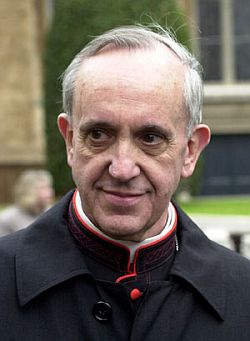
The Guardian reports: Cardinal Jorge Mario Bergoglio, who has become the Catholic church’s 266th pope, is the choice of humility, a Jesuit intellectual who travels by bus and has a practical approach to poverty: when he was appointed a cardinal, Bergoglio persuaded hundreds of Argentinians not to fly to Rome to celebrate with him but instead to give the money they would have spent on plane tickets to the poor.
Something of a surprise choice – he was quoted as a 30/1 outsider going into the conclave – the archbishop of Buenos Aires was one of the leading challengers to Joseph Ratzinger during the 2005 conclave that elected the latter as Benedict XVI.
A champion of liberation theology which some thought might have been too much for conservatives in the Vatican, he nonetheless is considered a candidate that everyone in the higher echelons of the church respects. He becomes the church’s first Latin American pope.
Much is made of his humility: he gave up the grandiose setting of the cardinal’s residence in the Argentine capital for the trappings of a small apartment, and rejected the notion of a chauffeur driven car for public transport.
Bergoglio, who will take the name Francis as pope, was born in December 1936, one of five children of an Italian railway worker. He taught literature and psychology in Argentina before being ordained in 1969. He was created a cardinal by John Paul II on 21 February 2001.
The Associated Press reports: He considers social outreach, rather than doctrinal battles, to be the essential business of the church.
He accused fellow church leaders of hypocrisy and forgetting that Jesus Christ bathed lepers and ate with prostitutes.
“Jesus teaches us another way: Go out. Go out and share your testimony, go out and interact with your brothers, go out and share, go out and ask. Become the Word in body as well as spirit,” Bergoglio told Argentina’s priests last year.
Bergoglio’s legacy as cardinal includes his efforts to repair the reputation of a church that lost many followers by failing to openly challenge Argentina’s murderous 1976-83 dictatorship. He also worked to recover the church’s traditional political influence in society, but his outspoken criticism of President Cristina Kirchner couldn’t stop her from imposing socially liberal measures that are anathema to the church, from gay marriage and adoption to free contraceptives for all.
“In our ecclesiastical region there are priests who don’t baptize the children of single mothers because they weren’t conceived in the sanctity of marriage,” Bergoglio told his priests. “These are today’s hypocrites. Those who clericalize the Church. Those who separate the people of God from salvation. And this poor girl who, rather than returning the child to sender, had the courage to carry it into the world, must wander from parish to parish so that it’s baptized!”
Hazem Kandil writes: The Egyptian revolt is trapped in a balance of weakness. None of the key actors has the power to consolidate a new regime, or even to resurrect the old one. Alliances are necessary, but nobody knows which will last. Every combination seems equally plausible, but each would lead the country in a very different direction. Egypt’s old regime depended on a ‘power triangle’: an uneasy partnership between the military (primarily the army), the security services (the police and secret police under the control of the Interior Ministry), and the political establishment. The uprising in January 2011 disrupted this delicate balance. It inadvertently enhanced the leverage of the military, left the security services largely untouched and created a political vacancy which Islamists, secular revolutionaries and old regime loyalists all scrambled to fill. The three political rivals would find themselves playing a game of musical chairs under the fretful gaze of the military and the security services, and it isn’t yet clear who is the winner.
The armed forces facilitated the popular uprising that ousted Mubarak because – contrary to the academic consensus – they had become the least privileged partner in Egypt’s ruling bloc. Eager to increase its autonomy and regional influence, the army welcomed the chance to renegotiate the existing power arrangements. The Supreme Council of the Armed Forces (SCAF) dissolved Mubarak’s National Democratic Party and flirted with the idea of restructuring the Interior Ministry and restricting the powers of the security services. But since no one turned up who was powerful enough to replace Mubarak, the SCAF was forced instead to co-operate with the ministry to avert chaos. By the summer of 2012, it was ready to hand over government to anyone who seemed reasonably capable, so long as they pledged to respect the military’s status. The Muslim Brotherhood was the most plausible candidate. Its familiar willingness to appease whoever was in power made it a safer ally than any of the embittered remnants of the old regime. And the hostility of its rhetoric where Israel is concerned had the twin advantages of justifying the maintenance of a strong army, while alarming Western powers just enough to make them accept the army’s continued oversight: the army would curb Islamist excess, should there be any.
Mohamed Morsi was sworn in in June, and six weeks later, on 12 August, he managed to reshuffle the armed forces’ general command without offending military sensibilities. The defence minister and chairman of the SCAF, Mohamed Hussein Tantawi, and the military chief of staff, Sami Hafez Anan, were decorated and given honorary roles after leaving their posts. Other high-ranking officers did even better: the outgoing commander of the navy was put in charge of the Suez Canal; the commander of the air defence force became chairman of the Arab Organisation for Industrialisation; and another senior SCAF officer, Mohamed al-Assar, became assistant minister of defence. To further emphasise his reluctance to rock the boat, Morsi chose their replacements from a list of senior commanders. The director of military intelligence, Abdel Fattah al-Sisi, was handed the defence portfolio, and the commander of the Third Field Army, Sedky Sobhy, was promoted to chief of staff. On the night these measures were announced, Morsi promised – it was a telling speech – to respect the armed forces’ independence. He also promised weapons and training from a wider range of sources, i.e. not just the US. In November the army was able to buy Turkish drones for the first time. Morsi also gave his support to the army’s counterterrorist operations in Sinai in order to satisfy the military’s overwhelming desire to re-establish sovereignty over the peninsula, demilitarised since the Camp David Accords. The extent of the Islamists’ deference to the military was made plain when the Supreme Guide of the Muslim Brotherhood was forced to retract derogatory remarks he had made about the military’s willingness to bend to the wishes of politicians. And at the end of February, it was reported that Morsi had cancelled plans to replace the now intransigent al-Sisi as minister of defence in light of the armed forces’ objections. [Continue reading…]
Rashid Khalidi writes: What should Barack Obama, who is to visit Israel next Wednesday for the first time in his presidency, do about the Israeli-Palestinian conflict?
First, he must abandon the stale conventional wisdom offered by the New York-Washington foreign-policy establishment, which clings to the crumbling remnants of a so-called peace process that, in the 34 years since the Camp David accords, has actually helped make peace less attainable than ever.
When the most recent iteration of this process began with high hopes at the Madrid peace conference in 1991, which led to the Oslo accords two years later, there were 200,000 Israelis illegally settled in the occupied Palestinian territories: today, there are more than twice as many.
During this time, under four successive presidents, the United States, purportedly acting as an honest broker, did nothing to prevent Israel from gradually gobbling up the very land the two-state solution was to be based on.
Until 1991 most Palestinians, although under Israeli military occupation, could nonetheless travel freely. Today, an entire generation of Palestinians has never been allowed to visit Jerusalem, enter Israel or cross between the West Bank and Gaza. This ghettoization of the Palestinians, along with the unrest of the second intifada of 2000-5 and the construction of seemingly permanent settlements and of an apartheid-style wall, are the tragic fruits of the so-called peace process the United States has led.
The “peace process” has consisted of indulging Israeli intransigence over Palestine in exchange for foreign-policy goals unrelated to the advancement of peace and Palestinian freedom. [Continue reading…]
Rabbi Jill Jacobs writes that a group of North American rabbis, cantors, rabbinical and cantorial students from all denominations of Judaism, who in January were petitioning Israeli Prime Minister Benjamin Netanyahu to cease plans for construction of a new settlement, did not get the hearing they deserved. She writes:
There are some who say that Diaspora Jews have no say in what goes on in Israel, since we don’t put our lives on the line to live there. I don’t buy this argument for a second. We have a stake in Israel because it is the Jewish homeland. We have a stake in Israel because we invest millions of dollars there, and lobby for the U.S. government to invest billions more of our tax dollars. We worry about family and friends in the Israeli army, who risk and sometimes lose their lives defending the misguided settlement project. And we are the ones who must explain to members of other communities, members of our own communities, and even our children why a state built on Jewish values perpetuates a military occupation of another people.
Since long before the creation of the state, the relationship between Israel and Diaspora Jews has been an unequal one. For too long, we have accepted the assumption that Diaspora Jews will send money and keep our mouths shut. We have perpetuated a myth that real Judaism lives in Israel, while our own Diaspora lives offer only a pale shadow of Jewish life. So we send our children to Israel for their Jewish inspiration and engagement, we fund hospitals and schools in Israel, and we devote our own political capital to defending Israel from criticism.
Jacobs writes: “We have a stake in Israel because we invest millions of dollars there, and lobby for the U.S. government to invest billions more of our tax dollars.” I have a problem with that. “We” refers to Diaspora Zionists but the tax dollars referred to as “our tax dollars” come from a much wider source, including vast numbers of Americans who do not have the slightest interest or desire to bankroll Israel’s defense forces — 20% of Israel’s defense budget is paid for by American taxpayers. So when Jacobs talks about lobbying the U.S. government to invest billions of tax dollars in Israel, she should be clear about who provides those tax dollars.
The pro-settler Israel National News reports: In yet another success for Samaria’s advocacy initiatives, a group of European parliamentarians agreed to take a 36-hour trip to the area this week. The European Union generally views Samaria (Shomron) [the Israeli occupied West Bank] as Arab land and condemns Israeli construction in the area.
The parliamentarians came as guests of Samaria Regional Council head Gershon Mesika.
They began their tour with a trip to the Barkan industrial zone. Many were surprised to see that Israeli Jews and Palestinian Authority Arabs were employed side-by-side in the factories.
Regional Council staff noted that boycotts of Israeli businesses in Judea and Samaria, including a threatened EU boycott, would primarily hurt industrial zones such as Barkan which provide a major source of employment for PA residents.
The tour then continued to a nearby lookout point from which the visitors could see the Tel Aviv region and Israel’s coastline. “We are in the heart of the land of the Bible and the center of Jewish heritage,” said Yossi Dagan. “From here we can see the ‘narrow waist’ of the State of Israel. Tel Aviv, the coastline and the Ben Gurion Airport are below us.”
“The State of Israel is the dam protecting Europe from fundamentalist Islam,” he added. “As you see with your own eyes, without Samaria the State of Israel is unlikely to survive.”
Marc Lynch writes: Two of Saudi Arabia’s most prominent human rights activists, Mohammed Fahd al-Qahtani and Abdullah al-Hamed, were sentenced over the weekend to lengthy jail terms. As Ahmed al-Omran reports today for the Middle East Channel, the sentences were not a surprise (when I met him in January, Qahtani told me that they were inevitable), but the optics for American foreign policy are frankly appalling. Their sentencing was sandwiched between John Kerry’s first visit to Riyadh as secretary of state and a visit by Attorney General Eric Holder. Neither appears to have publicly said anything whatsoever about this case nor about any of the massive human rights and democracy issues in Saudi Arabia, Bahrain, or the rest of the GCC.
Quite the contrary. Instead, both Kerry and Holder waxed rhapsodic about U.S.-Saudi cooperation on strategic issues and went out of their way to praise the kingdom’s appointment of thirty women to its unelected Shura Council. Holder was quoted across the Arab press as praising the Saudi Interior Ministry’s counter-extremism efforts and the Kingdom’s reforms. In Kerry’s March 4 press conference with Saudi Foreign Minister Saud al-Faisal, he had this to say:
“Across the Arab world, men and women have spoken out demanding their universal rights and greater opportunity. Some governments have responded with willingness to reform. Others, as in Syria, have responded with violence. So I want to recognize the Saudi Government for appointing 30 women to the Shura Council and promoting greater economic opportunity for women. Again, we talked about the number of women entering the workforce and the transition that is taking place in the Kingdom. We encourage further inclusive reforms to ensure that all citizens of the Kingdom ultimately enjoy their basic rights and their freedoms.”
In other words, he places the kingdom within the ranks of the regimes who have “responded with a willingness to reform.” In a meeting with embassy staff, Kerry was even more effusive. On nearly every issue which concerns the United States, he said, “Saudi Arabia has stepped up and helped.” (For those keeping score, those issues were the sanctions on Iran, arms to Syria, Yemen, counterterrorism, Israel, and Egypt’s transition.)
And why should he be more critical? It’s not like he was being pushed on these issues. In his various press availabilities in Riyadh and Doha and in the seven interviews he recorded in Doha on March 5, Kerry was peppered with questions about arming Syrian rebels and negotiations with Iran and how he was getting along with President Obama. Not a single question was asked about human rights or reform in the Gulf. No worries, though — there was time for a question about Dennis Rodman. Because the American people want to know. [Continue reading…]
It’s good Marc Lynch is drawing attention to this. It would be even better if he didn’t use euphemisms like “optics” but instead described U.S. diplomacy as a venal display of disgusting hypocrisy, or something like that.
American Muslim civil liberties groups released a new report today, Mapping Muslims: NYPD Spying and Its Impact on American Muslims, documenting the devastating impacts of the New York Police Department’s (NYPD) extensive surveillance program that targeted American Muslims throughout the Northeast and spread outrage throughout the nation.
Since 2002, the NYPD embarked on a covert domestic surveillance program that monitored American Muslims throughout the Northeast, from spying on neighborhood cafes and places of worship to infiltrating student whitewater-rafting trips — a program that continued despite the NYPD’s own acknowledgment that, over the course of six years, these efforts had not generated a single lead. The report is an unprecedented collection of voices from affected community members reflecting how the NYPD spying and infiltration creates a pervasive climate of fear and suspicion that encroaches upon every aspect of their religious, political, and community lives.
“Paul Woodward epitomizes the new internet journalist, that combination of fiercely independent judgment and intellectual depth that the internet has brought to journalism in our time. He has a roving mind with a philosophical bent, but he is tenacious when it comes to the corruption of American foreign policy and mainstream journalism by the special relationship with Israel; and his pithy, newsy and ironical observations of this process have made his site indispensable to anyone who wants to understand the American role in the world today.”
— Philip Weiss, journalist and co-editor of Mondoweiss
As an independent news editor and commentator, I use my own judgment. I don’t bow to anyone — not to governments, or political parties, or corporations, or the mainstream media, or advertisers, or think tanks, or academia, or popular opinion, or ideology, or the blogosphere, or social media, or even my own readership.
If you value this kind of liberated journalism, please support this site and make a donation. Thank you — Paul Woodward
Click the button above to make a secure donation via PayPal.
If you would prefer to make a donation by check, please contact me using the contact form or directly by email to: editor[at]warincontext.org and I will send you my mailing address.
“Anwar al-Awlaki, the firebrand preacher, born in New Mexico, who had evolved from a peddler of Internet hatred to a senior operative in Al Qaeda’s branch in Yemen” — thus the New York Times sets the tone in a report in which the Obama administration leaked a suitable amount of classified information necessary for defending its presidentially-directed assassination program.
The video above shows the preacher back in the days when he was “a peddler of internet hatred” — a description that one might expect to appear somewhere like the New York Daily Post.
“The fact that the U.S. has administered the death and homicide of over one million civilians in Iraq; the fact that the U.S. is supporting the deaths and killing of thousands of Palestinians, does not justify the killing of one U.S. civilian in New York City or Washington D.C. And the deaths of 6,000 civilians in New York and Washington D.C. does not justify the death of one civilian in Afghanistan.” Is this peddling hatred?
The killing of Awlaki in a CIA drone strike in Yemen on September 30, 2011, has stirred considerable debate about whether an American president has the legal authority to murder an American citizen without any judicial process.
A question of equal importance that has received much less attention is whether the government’s claims that Awlaki had an operational role in organizing acts of terrorism are based on hard intelligence, or whether less substantial evidence was used as merely to provide a pretext to conduct a political killing?
In other words, in the eyes of the Obama administration, did Awlaki pose a threat to the United States because he played an instrumental role in planning acts of terrorism, or because he had sufficient influence to inspire acts of terrorism?
As a figure who could inspire others to plan and carry out attacks, Awlaki arguably posed a much greater threat than he might have as a figure with an operational role in specific acts of terrorism, yet not even the most creative of legal teams would have been able to construct a credible legal argument to justify Awlaki’s killing on the basis that he posed such an inspirational threat.
The New York Times report provides clues that the steps leading to Awalki’s death followed a process in which the decision to kill him preceded the construction of a legal case or the crafting of an operational plan for carrying out the killing. Once all the legal, political, and operational hurdles had been crossed, Awlaki was killed within a few days.
While the Obama administration insists that it only kills terrorist suspects who cannot be captured, Awlaki had in fact been arrested in Yemen in 2006 and then interrogated by two FBI agents while being imprisoned without facing any charges. As the New York Timesreported in 2010:
John D. Negroponte, then the director of national intelligence, told Yemeni officials that the United States did not object to his detention, according to American and Yemeni sources.
But by the end of 2007, American officials, some of whom were disturbed at the imprisonment without charges of a United States citizen, signaled that they no longer insisted on Mr. Awlaki’s incarceration, and he was released.
“He was different after that — harder,” said a Yemeni man who knows Mr. Awlaki well.
While the new report describes Awlaki having been in hiding during the period leading up to his death — the implication being that wherever he was hiding he could also act in the role of an al Qaeda operational leader — it might have been more accurate to simply say that he was attempting to avoid being killed.
That he was believed to be in the home territory of his family’s tribe, the Awaliq, and that in negotiations with Yemen’s then-president, Ali Abdullah Saleh, tribal leaders had offered to hold Awlaki under house arrest, suggests that his capture was not out of the question.
The problem with capturing Awlaki may have had less to do with determining his whereabouts than in not having enough evidence to put him on trial.
It appears that the Obama administration had less interest in building a case upon which Awlaki could be tried than in documenting a legal justification for killing him. That task fell into the hands of two lawyers in the Justice Department’s Office of Legal Counsel: David Barron and Martin Lederman. For that purpose, they wrote a 63-page memorandum “citing dense thickets of intelligence reports supporting the premise that Mr. Awlaki was plotting attacks.”
That this memorandum would come laden so heavily with intelligence specifically on Awlaki, suggests that the lawyers had less interest in establishing any kind of broad legal principles than in justifying this specific assassination and thus mitigating their own potential culpability in murders that had yet to be planned.
At the same time, if there really was such an abundance of evidence proving that Awlaki was directly involved in plotting attacks and that his killing actually “saved lives,” why has this evidence not been made public a year and a half after his death?
In the trial of Rajib Karim, a British Airways computer expert who in 2011 was convicted of plotting an attack that supposedly would have rivaled the 9/11 attacks, evidence was presented of email communications between him and someone referred to as “the professor.” The emails are highly incriminating and present strong evidence of a terrorist plot. Their content alone would not been of much help in convicting Karim however, were it not for the fact that they were found on a computer in his physical possession.
“The professor” is alleged to have been Awlaki and if that turned out to be true, it would support the Obama administration’s assertions about his operational role in al Qaeda. But there’s a missing link: where’s the evidence that the author of these messages was indeed Awlaki?
That isn’t a question that would merely concern a defense attorney — there are plenty of reasons to doubt that Awlaki would have made a transition from preaching to plotting.
This isn’t a matter of assessing the degree of his radicalism, but rather, even if we take it as well established that he supported terrorism, it’s hard to see any reason why he would not remain focused on his well-honed and highly effective skill as an orator. In other words, wouldn’t it have always made sense both to Awlaki and those around him that he continue to expand his power as a professional ideologue, rather than become an amateur terrorist? For al Qaeda, Awlaki’s preeminent value was that he could preach jihad with an American accent and reach a wide audience in the West.
In 2010, Jack Barclay, an analyst for the International Centre for the Study of Radicalisation and Political Violence, noted the breadth of Awlaki’s appeal:
The ostensibly benign nature of many of his oratories, which often avoid substantive discussion of politics, Jihad, and current affairs, may also have given him a greater level of accessibility and thus helped him cement a stronger online following than some of his more outspoken contemporaries. It is possible therefore, that many of Al-Awlaki’s supporters first developed an affinity for him not because they were actively seeking radical Islamist content to begin with, but because they were initially pursuing broader, beneficial Islamic guidance on the Internet and came across one or more of Al-Awlaki’s more broadly appealing lectures on Islam’s fundamental tenets.
Al-Awlaki’s committed support base have ensured not only that his many audio lectures receive widespread distribution, but that his reputation is vigorously defended whenever it is called into question on Internet blogs and forums.
It is also noteworthy that Al-Awlaki’s popularity appears to rise each time he is perceived to have shown bravery in defending his religion, despite harassment and the threat of imprisonment. Until his move to Yemen, this harassment might have amounted to little more than the periodic attention of television network journalists and the FBI. However, his later imprisonment in Sana’a and subsequent targeting by the US and Yemeni authorities after he continued his controversial writings and oratories, has further elevated his standing. His supporters consider this harassment proof that his enemies are attempting to silence him for merely telling the truth about Islam and the obligation upon Muslims to defend their religion. It is worth considering whether such pressure has been self-defeating in as much as it may have bolstered the perceived credibility of a Salafi-Jihadi cleric who would otherwise have been no more prominent than many of his contemporaries.
When a government grants itself the power to execute its own citizens without any kind of judicial process and refuses to reveal the legal grounds upon which it claims it can exercise such power, then there is every reason to wonder what other powers it might assume.
Having granted itself this absolute power, why would it show restraint in the use of lesser powers? Why, when it insists on shrouding its deliberations in such secrecy, should we have confidence that it would not target for elimination — Constitution be damned — those who in a Stalinist fashion it marks as America’s most threatening political enemies?
When it comes to fighting “al Qaeda affiliates”, the U.S. approach under Obama seems no less lawless than it was under Bush. And with a history of complicity in the operation of death squads in Iraq (even during a period when hundreds of international journalists were reporting from there), it’s hard not to wonder how much latitude the CIA will give itself now that the world pays so little attention to what happens inside Iraq.
The Wall Street Journal reports: The Central Intelligence Agency is ramping up support to elite Iraqi antiterrorism units to better fight al Qaeda affiliates, amid alarm in Washington about spillover from the civil war in neighboring Syria, according to U.S. officials.
The stepped-up mission expands a covert U.S. presence on the edges of the two-year-old Syrian conflict, at a time of American concerns about the growing power of extremists in the Syrian rebellion.
Al Qaeda in Iraq, the terrorist network’s affiliate in the country, has close ties to Syria-based Jabhat al Nusra, also known as the Nusra Front, an opposition militant group that has attacked government installations and controls territory in northern Syria. The State Department placed al Nusra on its list of foreign terror organizations in December, calling the group an alias for al Qaeda in Iraq.
In a series of secret decisions from 2011 to late 2012, the White House directed the CIA to provide support to Iraq’s Counterterrorism Service, or CTS, a force that reports directly to Iraqi Prime Minister Nouri al-Maliki, officials said.
The CIA has since ramped up its work with the CTS — taking control of a mission long run by the U.S. military, according to administration and defense officials. For years, U.S. special-operations forces worked with CTS against al Qaeda in Iraq. But the military’s role has dwindled since U.S. troops pulled out of the country at the end of 2011.
Charlie Savage and Scott Shane are two reporters who were party to a lawsuit filed under the Freedom of Information Act by the New York Times to try and force the Obama administration to make public memoranda and related materials providing the legal justification for the targeted killing of a United States citizen, Anwar al-Awlaki. In early January a federal judge ruled in favor of the government.
A report written by the same journalists (along with Mark Mazzetti) and published on Sunday begs the question: were Savage and Shane provided with any of the classified information they had sought through FOIA? If so — and it seems virtually certain that they were — then they seem to have seriously compromised their own journalistic integrity.
How can someone argue that the memoranda need to be made public but then go and serve the interests of the administration that refuses to release them, by allowing that administration to cherry pick which portions of the memoranda it wants to reveal?
This website or its third-party tools use cookies, which are necessary to its functioning. By closing this banner, you agree to the use of cookies.