George Monbiot writes: If you are too well connected, you stop thinking. The clamour, the immediacy, the tendency to absorb other people’s thoughts, interrupt the deep abstraction required to find your own way. This is one of the reasons why I have not yet bought a smartphone. But the technology is becoming ever harder to resist. Perhaps this year I will have to succumb. So I have asked a simple question: can I buy an ethical smartphone?
There are dozens of issues, such as starvation wages, bullying, abuse and 60-hour weeks in the sweatshops manufacturing them, the debt bondage into which some of the workers are pressed, the energy used, the hazardous waste produced. But I will concentrate on just one: are the components soaked in the blood of people from the eastern Democratic Republic of the Congo? For 17 years, rival armies and militias have been fighting over the region’s minerals. Among them are metals critical to the manufacture of electronic gadgets, without which no smartphone would exist: tantalum, tungsten, tin and gold.
While these elements are by no means the only reason for conflict there, they help to fund it, supporting a fragmented war that – through direct killings, displacement, disease and malnutrition – has now killed several million people. Rival armies have forced local people to dig in extremely dangerous conditions, have extorted minerals and money from self-employed miners, have tortured, mutilated and murdered those who don’t comply, and have spread terror and violence – including gang rape and child abduction – through the rest of the population. I do not want to participate. [Continue reading…]
The global drone swarm
P.W. Singer writes: “One plan was to use an unmanned aerial vehicle to carry 20kg of TNT to bomb the area, but the plan was rejected because we were ordered to catch him alive.” This is what Liu Yuejin, director of China’s public security ministry’s anti-drug bureau, described of the manhunt for Naw Kham, the ringleader of a large drug trafficking outfit based in the Golden Triangle, who was suspected of killing 13 Chinese sailors. Ultimately, they got him via a cross-border nighttime ambush, the Chinese version of the Abbottabad raid.
This case, however, is useful to think about when talking about the global market for unmanned aerial systems (aka “drones”) and where it is headed, a topic that got new energy last week with a New York Times report on the confusion as to whether it was American or Pakistani drones that carried out a controversial airstrike.
Too often in policy and media circles, we discuss a supposed American monopoly on drones that is potentially ending. Or, as Time magazine entitled a story, “Drone Monopoly: Hope You Enjoyed It While It Lasted.” The article goes on to say,”It is going to happen; the only question is when.”
The answer is: several years ago.
Today, the United States is ahead in the field of military robotics, and, given that we spend the most money and make the most operational use of unmanned systems, we certainly should be. All told, there are over 8,000 unmanned aircraft in the U.S. military inventory and another 12,000 plus unmanned ground vehicles. A growing number are large and armed, including the MQ-1 Predator and MQ-9 Reapers that get so much attention in the press.
Depending on which source you want to cite, there are currently between 75 and 87 countries that have used unmanned aircraft in their militaries. Of these, at least 26 have larger systems, including Predator equivalents that are already armed or of a model that has been armed in the past, such as the Heron, made by IAI and used by the Israeli Defense Forces, as well as several countries via export. Only the United States, the United Kingdom, and Israel are known to have used armed drones operationally, but as the case of Naw Kham illustrates, the limit on why others have not is frequently political, not technological. They are either not at war or have chosen not to go that route yet. However, these political limits are changing. Witness China’s open discussion of its plans in the People’s Daily, or Germany’s recent decision to acquire armed drones for deployments abroad, which follows Italy’s, France’s, etc.
In short, when we often talk about a supposed future of drone proliferation, we usually ignore the reality of the present. We already have a market that is global in both its customers, from Australia to Turkey, and in its manufacturers, from American firms like General Atomics and Lockheed to ASN Technology, one of the major makers in China, and ADE of India. [Continue reading…]
Aleppo’s river of death
The Guardian reports: It is already one of the defining images of the Syrian civil war: a line of bodies at neatly spaced intervals lying on a river bed in the heart of Syria’s second city Aleppo. All 110 victims have been shot in the head, their hands bound with plastic ties behind their back. Their brutal execution only became apparent when the winter high waters of the Queiq river, which courses through the no man’s land between the opposition-held east of the city and the regime-held west, subsided in January.
It’s a picture that raises so many questions: who were these men? How did they die? Why? What does their story tell us about the wretched disintegration of Syria? A Guardian investigation has established a grisly narrative behind the worst – and most visible – massacre to have taken place here. All the men were from neighbourhoods in the eastern rebel-held part of Aleppo. Most were men of working age. Many disappeared at regime checkpoints. They may not be the last to be found. Locals have since dropped a grate from a bridge, directly over an eddy in the river. Corpses were still arriving 10 days after the original discovery on January 29, washed downstream by currents flushed by winter rains. [Continue reading…]
Mali’s army shut out of the north
Bruce Whitehouse writes: Mali’s armed forces have been almost shut out of military operations in the northern-most combat zone. Since late January Malian troops, alongside counterparts from France, Niger and Chad, have occupied Gao, Timbuktu and other towns along the Niger River; Malian soldiers were patrolling jointly with French counterparts near Tin Keraten, according to the Associated Press. But further north, in the region of Kidal (birthplace of many rebellions over the years), the fight against Islamist rebels is being waged by troops from France and Chad, who have now been present there for more than a month. The Chadians have taken heavy casualties, with at least 27 dead thus far. Occupying Kidal alongside these forces are fighters of the Mouvement National pour la Liberation de l’Azawad (MNLA), the Tuareg separatist rebels who a year ago were allied with the Islamists. But the Malian army is not there, at least not in force. (A handful of Malian troops are reportedly in the area: last week Malian Army Col. El Hadj Ag Gamou told the French newspaper L’Humanité that 19 of his men, all Tuareg, are there acting as guides for the French and Chadians.)
“It’s the lack of means that explains the absence of the Malian armed forces in Kidal. If they give us the means, we’ll go beyond Kidal,” the deputy director of Mali’s armed forces public information bureau told a press conference in Bamako. Public reactions among Malians have been skeptical of this claim; army spokesmen have little credibility with the Malian people these days.
The truth is that France and the MNLA don’t want Malian troops in Kidal. Given the army’s track record over the last several weeks — torture and summary execution of prisoners, plus recriminations against alleged “collaborators” — Tuareg residents there have every reason to fear a massacre. The army, no doubt under pressure from France, recently arrested some of its own soldiers suspected of carrying out abuses against Arab civilians. The Malian armed forces may lack the means to send their troops to Kidal, but more importantly, they lack discipline and a credible command structure to keep their men in line.
Still, the Malian army’s absence from Kidal rankles some Malians, who see it as an affront to national sovereignty. Bamako newspapers routinely cast the MNLA as an unreformed terrorist organization. “The MNLA’s presence today in Kidal not only contradicts the principal of Mali’s territorial integrity, but also calls into question the reconquest of northern Mali,” wrote an editorialist in today’s Le Flambeau. “And from this endorsement flows, on the one hand, the MNLA’s legitimacy in Kidal, and on the other the Malian state’s disinterest toward this part of its territory.” Other papers have accused the MNLA of continued collaboration with Islamist groups. [Continue reading…]
Leaked audio of Bradley Manning’s court statement
Freedom of the Press Foundation: Today, Freedom of the Press Foundation is publishing the full, previously unreleased audio recording of Private First Class Bradley Manning’s speech to the military court in Ft. Meade about his motivations for leaking over 700,000 government documents to WikiLeaks. In addition, we have published highlights from Manning’s statement to the court.
While unofficial transcripts of this statement are available, this marks the first time the American public has heard the actual voice of Manning.
Music: Lars Hollmer — ‘Träumerei’
This site needs your support now
![]()
“The United States has been at war one place or another almost every year since 1981. The American public forgets. War in Context does not.”
— Christopher Dickey, Paris Bureau Chief / Middle East Editor, Newsweek & The Daily Beast.“War in Context is one of the most reliable blogs on the Middle East. It is filled with sharp commentary, useful summaries, and an excellent selection of the best articles. Paul Woodward is smart and plugged in. He knows the Middle East. I read it every day.”
— Joshua Landis, SyriaComment, Director, Center for Middle East Studies, University of Oklahoma.“Paul Woodward’s War in Context has been one of my top reads every morning since before the invasion of Iraq. With thoughtful and incisive analysis of world events, War in Context is must-reading for anyone interested in the Middle East, the War on Terror, or the trials and tribulations of the Global South.”
— Hassan M. Fattah, Editor-in-Chief, The National newspaper.
![]()
As an independent news editor and commentator, I use my own judgment. I don’t bow to anyone — not to governments, or political parties, or corporations, or the mainstream media, or advertisers, or think tanks, or academia, or popular opinion, or ideology, or the blogosphere, or social media, or even my own readership.
If you value this kind of liberated journalism, please support this site and make a donation. Thank you — Paul Woodward
Click the button above to make a secure donation via PayPal.
If you would prefer to make a donation by check, please contact me using the contact form or directly by email to: editor[at]warincontext.org and I will send you my mailing address.
![]()
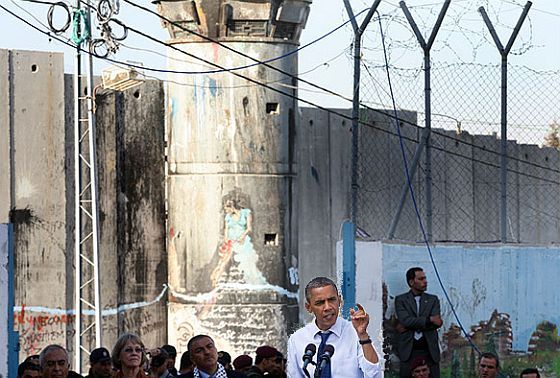
Imagine: Obama’s historic speech in Bethlehem

Haaretz reports President Obama will be visiting the Church of the Nativity in Bethlehem during his visit to Israel and the West Bank in a few days.
Four years ago Pope Benedict made the same visit and drew attention to Israel’s apartheid wall by giving a speech in its shadow.
“In a world where more and more borders are being opened up — to trade, to travel, to movement of peoples, to cultural exchanges — it is tragic to see walls still being erected,” Benedict said.
Obama could do the same — at least we can imagine what that would be like and how it would go down in history, like JFK declaring “Ich bin ein Berliner” or Reagan challenging the Soviet Union to “Tear down this wall!”
But what’s he going to do instead? Stand in front of an Iron Dome missile battery for a photo-op alongside Prime Minister Benjamin Netanyahu and President Shimon Peres.
Obama still prizes secrecy more than transparency
McClatchy reports: President Barack Obama has relied on state secrets and secret laws to make national security decisions with little congressional or public oversight much as his predecessor did, according to a report being released Sunday by a liberal government watchdog group.
The Center for Effective Government’s study on transparency finds that Obama has issued important open government policy reforms in his first term, but that implementation is inconsistent across federal agencies despite his claim of being the most open president in history.
“While the Obama administration deserves praise for the important work it has done to build a platform for open government in its first term, the job is unfinished,” according to the report.
The center, formerly called OMB Watch, issued the report at the start of Sunshine Week, an effort by civics groups, governments and newspapers to promote transparency in government across the nation. A copy was sent to the White House, but officials there did not respond to a request for comment.
The 50-page study says the area most in need of improvement is national security. The White House has withheld decisions and documents that have the force of law, labeled documents as classified even if they do not need to be and aggressively prosecuted whistleblowers, bringing six cases against employees for leaks compared to only three known previous cases since 1917. [Continue reading…]
Five ways privatization is poisoning America
Paul Buchheit writes: It gets more maddening every day. Essential human needs are being packaged into products to be bought and sold. The right to food and water, education, health care, public spaces, and unrestricted speech shouldn’t be based on who can pay the most, or on who can generate profits with the slickest marketing pitch.
The free-market capitalism that drives our economy is a doctrine of individuals pursuing profit. Nothing else matters. An executive for Roche, a healthcare company, said “We are not in the business to save lives, but to make money.”
With privatization of the common good we risk losing both our heritage and our humanness.
1. The Taking of Public Land
Attempts to privatize federal land were made by the Reagan administration in the 1980s and the Republican-controlled Congress in the 1990s. In 2006, President Bush proposed auctioning off 300,000 acres of national forest in 41 states.
The assault on our common areas continues with even greater ferocity today, as the euphemistic Path to Prosperity has proposed to sell millions of acres of “unneeded federal land,” and libertarian groups like the Cato Institute demand that our property be “allocated to the highest-value use.” Mitt Romney admitted that he didn’t know “what the purpose is” of public lands.
Examples of the takeaway are shocking. Peabody Coal is strip-mining public lands in Wyoming and Montana and making a 10,000% profit on the meager amounts they pay for the privilege. Sealaska is snatching up timberland in Alaska. The Central Rockies Land Exchange would allow Bill Koch to pick up choice Colorado properties from the Bureau of Land Management, while neighboring Utah Governor Gary Herbert sees land privatization as a way to reduce the deficit. Representative Cliff Stearns recommended that we “sell off some of our national parks.” One gold mining company even invoked an 1872 law to grab mineral-rich Nevada land for which it stands to make a million-percent profit.
The National Resources Defense Council just reported that oil and gas companies hold drilling and fracking rights on U.S. land equivalent to the size of California and Florida combined. Much of this land is“split estate,” which means the company can drill under an American citizen’s property without consent. Unrestrained by government regulations, TransCanada was able to use eminent domain in Texas to lay its pipeline on private property and then have the owner arrested for trespassing on her own land, and Chesapeake Energy Corporation overturned a 93-year-old law to frack a Texas residence without paying a penny to the homeowners. Most recently, the oil frenzy in North Dakota has cheated Native Americans out of a billion dollars worth of revenue from drilling leases.
Away from the mountains and the plains, back in the cities of Chicago and Indianapolis and L.A. and San Diego, our streets and parking spaces have been surrendered to corporations until the time of our great-grandchildren, with some of the highest profit margins in the corporate world. [Continue reading…]
Chomsky: Can civilization survive capitalism?
Noam Chomsky writes: There is “capitalism” and then there is “really existing capitalism.”
The term “capitalism” is commonly used to refer to the U.S. economic system, with substantial state intervention ranging from subsidies for creative innovation to the “too-big-to-fail” government insurance policy for banks.
The system is highly monopolized, further limiting reliance on the market, and increasingly so: In the past 20 years the share of profits of the 200 largest enterprises has risen sharply, reports scholar Robert W. McChesney in his new book “Digital Disconnect.”
“Capitalism” is a term now commonly used to describe systems in which there are no capitalists: for example, the worker-owned Mondragon conglomerate in the Basque region of Spain, or the worker-owned enterprises expanding in northern Ohio, often with conservative support – both are discussed in important work by the scholar Gar Alperovitz.
Some might even use the term “capitalism” to refer to the industrial democracy advocated by John Dewey, America’s leading social philosopher, in the late 19th century and early 20th century.
Dewey called for workers to be “masters of their own industrial fate” and for all institutions to be brought under public control, including the means of production, exchange, publicity, transportation and communication. Short of this, Dewey argued, politics will remain “the shadow cast on society by big business.”
The truncated democracy that Dewey condemned has been left in tatters in recent years. Now control of government is narrowly concentrated at the peak of the income scale, while the large majority “down below” has been virtually disenfranchised. The current political-economic system is a form of plutocracy, diverging sharply from democracy, if by that concept we mean political arrangements in which policy is significantly influenced by the public will. [Continue reading…]
Ultras violence spreads, and Morsi runs out of answers
Issandr El Amrani writes: In the days that followed the toppling of Hosni Mubarak, Egypt’s revolutionaries feared the plots of the deep state: the military and political nomenklatura of the regime, deep-pocketed businessmen and security agencies conspiring to save what they could of a system tailor-made for them. It may turn out that the fear was misplaced. What Egypt suffers most from today is not plots hatched in the shadows, but a shallow state that is cracking on the surface.
In parts of the country, citizens are in open rebellion against that state, which has long failed to provide economically and, since the 2011 uprising, has largely failed to provide security. In recent weeks, the targets of often-violent protests have been administrative buildings, the offices of provincial governors and anything associated with the police.
What prompts these protests is often a sense of injustice, as in the now weeks-long turmoil that has hit the Suez Canal region and Port Said in particular. The spark may have been the death sentences handed out to 21 football supporters from the city for their role in the February 2012 stadium massacre. The sense of grievance, though, is wider and is obscuring the fact that football hooligans need to be held to account.
Like the droogs of Anthony Burgess’s A Clockwork Orange, some young Egyptian men seem to have grown fond to taking to the streets for some mindless ultra-violence. They may fancy themselves as freedom fighters, but they are bullies.
In Cairo, Ultras from Al Ahly, the leading Egyptian football team, have for weeks staged protests to block major thoroughfares and the metro system. They have used violence and intimidation. The torching of a police social club, the country’s association football federation, a fast-food restaurant and the offices of a newspaper on Saturday is the culmination of an environment in which these Ultras feel increasingly emboldened to act antisocially whenever they feel wronged. [Continue reading…]
The devastating cost of Australia’s mining boom

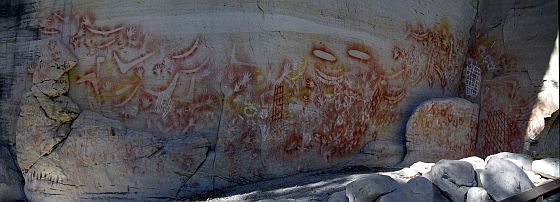
Global Mail reports: Tucked away in the sandstone ridges of the rugged tropics near Australia’s north-eastern tip, the ochre “bullymen” with their big penises and staring eyes still cling to the rock.
These are secret paintings, made by Aboriginal men who were driven from their lowlands by colonials hungry for gold, and who were then harassed in the hills by the Native Mounted Police, both black troopers and their white officers.
The locals painted the police, or “bullymen”, onto the rock, in the belief that these works would conquer the enemy through sorcery, as Tommy George, a descendant of the “black trackers” now in his 80s (and the last surviving speaker of Agu Alaya, or Taipan Snake language) has explained to archaeologist Noelene Cole.
The Aboriginal fugitives believed that the paintings were a weapon that gave them power over the armed lawmen, George explained.
“It was so deeply embedded in culture that they could use the rock paintings to kill people – that’s how powerful the art was.
“The paintings were there to kill the police.
“It shows the power of that visual culture. They thought it was as strong as guns,” Cole said.
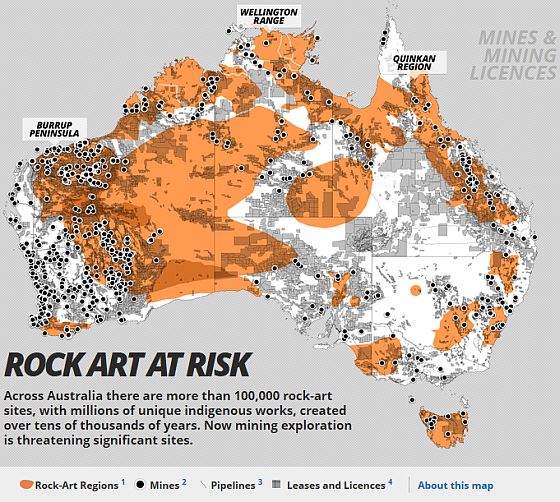
But now these poignant paintings, along with hundreds of other Aboriginal works in this remote Queensland gallery, which United Nations Educational, Scientific and Cultural Organisation (UNESCO) has recognised as one of the great rock-art precincts of the globe, are under a new threat from another power source: mining.
Prospectors have targeted the land beneath and around the art because it is rich in exploitable resources. These paintings are emblematic of the perils befalling rock art throughout Australia, where the resources sector has been booming for more than a decade, fuelled by China’s insatiable energy needs.
This is a recurring Australian story, as mining, industry and urbanisation surge across a landscape which harbours millions of images at more than 100,000 rock-art sites. State and territory heritage laws have proved weak in protecting the works, under governments keen to cash in on the mining bonanza. [Continue reading…]
Music: Lars Hollmer — ‘Boeves Psalm’
This site needs your support
![]()
“I check out War in Context daily. It’s an invaluable ‘ally’ in my own work. It has just what I want from a political website: a sharp-as-tacks editor with a great eye for riveting writing and reportage from around the world that I might otherwise miss, a way of framing our world that increases my understanding and makes me look at it differently, and an idiosyncratic, original way of taking that world in. It’s a great package. The focus on the Greater Middle East and on American power (but with regular treats and surprises beyond those subjects) seals the deal for me. What more could I ask for?”
— Tom Engelhardt, TomDispatch, author of The United States of Fear and End of Victory Culture.
![]()
As an independent news editor and commentator, I use my own judgment. I don’t bow to anyone — not to governments, or political parties, or corporations, or the mainstream media, or advertisers, or think tanks, or academia, or popular opinion, or ideology, or the blogosphere, or social media, or even my own readership.
If you value this kind of liberated journalism, please support this site and make a donation. Thank you — Paul Woodward
Click the button above to make a secure donation via PayPal.
If you would prefer to make a donation by check, please contact me using the contact form or directly by email to: editor[at]warincontext.org and I will send you my mailing address.
![]()
Showing with logic why Israel does not have the right to exist as a Jewish state
Joseph Levine writes: I was raised in a religious Jewish environment, and though we were not strongly Zionist, I always took it to be self-evident that “Israel has a right to exist.” Now anyone who has debated the Israeli-Palestinian conflict will have encountered this phrase often. Defenders of Israeli policies routinely accuse Israel’s critics of denying her right to exist, while the critics (outside of a small group on the left, where I now find myself) bend over backward to insist that, despite their criticisms, of course they affirm it. The general mainstream consensus seems to be that to deny Israel’s right to exist is a clear indication of anti-Semitism (a charge Jews like myself are not immune to), and therefore not an option for people of conscience.
Over the years I came to question this consensus and to see that the general fealty to it has seriously constrained open debate on the issue, one of vital importance not just to the people directly involved — Israelis and Palestinians — but to the conduct of our own foreign policy and, more important, to the safety of the world at large. My view is that one really ought to question Israel’s right to exist and that doing so does not manifest anti-Semitism. The first step in questioning the principle, however, is to figure out what it means.
One problem with talking about this question calmly and rationally is that the phrase “right to exist” sounds awfully close to “right to life,” so denying Israel its right to exist sounds awfully close to permitting the extermination of its people. In light of the history of Jewish persecution, and the fact that Israel was created immediately after and largely as a consequence of the Holocaust, it isn’t surprising that the phrase “Israel’s right to exist” should have this emotional impact. But as even those who insist on the principle will admit, they aren’t claiming merely the impermissibility of exterminating Israelis. So what is this “right” that many uphold as so basic that to question it reflects anti-Semitism and yet is one that I claim ought to be questioned?
The key to the interpretation is found in the crucial four words that are often tacked on to the phrase “Israel’s right to exist” — namely, “… as a Jewish state.” As I understand it, the principle that Israel has a right to exist as a Jewish state has three parts: first, that Jews, as a collective, constitute a people in the sense that they possess a right to self-determination; second, that a people’s right to self-determination entails the right to erect a state of their own, a state that is their particular people’s state; and finally, that for the Jewish people the geographical area of the former Mandatory Palestine, their ancestral homeland, is the proper place for them to exercise this right to self-determination.
The claim then is that anyone who denies Israel’s right to exist as a Jewish state is guilty of anti-Semitism because they are refusing to grant Jews the same rights as other peoples possess. If indeed this were true, if Jews were being singled out in the way many allege, I would agree that it manifests anti-Jewish bias. But the charge that denying Jews a right to a Jewish state amounts to treating the Jewish people differently from other peoples cannot be sustained. [Continue reading…]
When the victor belongs to the spoils of war
Andrew J. Bacevich writes: Judgments rendered by history tend to be tentative, incomplete and reversible. More than occasionally, they arrive seasoned with irony. This is especially true when it comes to war, where battlefield outcomes thought to be conclusive often prove anything but.
Rather than yielding peace, victory frequently serves as a prelude to more war. Once opened, wounds fester. Things begun stubbornly refuse to end. As the renowned strategic analyst F. Scott Fitzgerald once observed, “The victor belongs to the spoils.”
Next year marks the centennial of the conflict once known as the Great War. Germany lost that war. Whether France and Britain can be said to have won in any meaningful sense is another matter. Besides planting the seeds for an even more horrific bloodletting just two decades later, the fighting of 1914-1918 served chiefly to provide expansion-minded British politicians with a pretext for carving up the Ottoman Empire. It proved a fateful move.
What London wanted from this new Middle East that it nonchalantly cut and pasted was profit and submission; what it got was resentment and resistance, yielding a host of intractable problems that in due time it bequeathed to Washington. In effect, victory in 1918 expanded Britain’s imperial domain only to accelerate its demise, with the United States naively assuming the mantle of imperial responsibility (euphemistically termed “leadership”). Thank you, Perfidious Albion.
Many another storied triumph has contained its own poison pill. More recent examples include the Six Day War, which saddled Israel with a large, restive minority that it can neither pacify nor assimilate; the ouster of the Soviet Union from Afghanistan, giving rise to the Taliban; and Operation Desert Storm, after which the garrisoning of U.S. forces in Saudi Arabia helped light the long fuse that would eventually detonate on Sept. 11, 2001.
Think you’ve won? Wait until all the returns are in.
With the passage of time, near-term military results matter less than long-term political consequences. [Continue reading…]
The danger of suppressing the leaks
Margaret Sullivan writes: Imagine if American citizens never learned about the abuse of prisoners at Abu Ghraib. Imagine not knowing about the brutal treatment of terror suspects at United States government “black sites.” Or about the drone program that is expanding under President Obama, or the Bush administration’s warrantless wiretapping of Americans.
This is a world without leaks.
And a world without leaks — the secret government information slipped to the press — may be the direction we’re headed in. Since 9/11, leakers and whistle-blowers have become an increasingly endangered species. Some, like the former C.I.A. official John Kiriakou, have gone to jail. Another, Pfc. Bradley Manning, is charged with “aiding the enemy” for the masses of classified information he gave to Julian Assange’s WikiLeaks. He could face life in prison.
The government has its reasons for cracking down. Obama administration officials have consistently cited national security concerns and expressed their intention to keep prosecuting leakers.
“The government has legitimate secrets that should remain secrets,” Michael V. Hayden, the former C.I.A. director, said in a telephone interview.
Journalists tend to view the situation differently, and not just because they want, in the oft-heard phrase, “to sell newspapers.” They see leaks — which have many motivations, not all altruistic — as vital to news gathering.
Declan Walsh, a reporter who wrote many WikiLeaks-based stories for The Guardian before coming to The Times, calls leaks “the unfiltered lifeblood of investigative journalism.” He wrote in an e-mail from his post in Pakistan: “They may come from difficult, even compromised sources, be ridden with impurities and require careful handling to produce an accurate story. None of that reduces their importance to journalism.” [Continue reading…]