Palestinians have yet again been denied their due. The recently concluded session of UNESCO’s World Heritage Committee rejected the first-ever Palestinian nomination. While it considered proposals from six West Asian countries, it overlooked Palestine’s proposal to include the Church of the Nativity in Bethlehem, one the oldest functioning churches, in the world heritage list. The proposal was rejected not on merits, but because UNESCO did not consider Palestine a sovereign state. Getting world heritage status has been critical to improving the protection of heritage sites. In 2002, the Israeli forces besieged and damaged parts of the Church of the Nativity, which is more than 1500 years old and a site of importance for Muslims as well. In 2005, experts listed many more instances of wanton destruction. For example, the Israeli Military Command destroyed 22 historic structures in the old city of Hebron, and permanent structures were built atop the archaeological site of Tell Rumeida. As recently as in 2010, instances of illegitimate appropriation of Palestinian monuments were reported. The hope was that a formal international recognition would serve as an additional deterrent and help Palestinians in nation-building.
Realising the urgent need to protect the cultural sites, UNESCO started training Palestinians to identify important heritage structures and implement the World Heritage Convention. In 2005, a list of 17 monuments located in historic cities such as Bethlehem and Nablus was published. Unfortunately, when it came to the critical phase of nomination, UNESCO, which might plead its hands are tied by convention and the limitations of international law, failed to demonstrate the innovativeness and progressive spirit expected of it. It needs to revisit the founding moments of the World Heritage movement. About 50 years ago, the world came together to save Abu Simbel. Collective concern and gravity of the situation compelled the international community to act creatively and boldly. UNESCO demonstrated some of these traits in 1981, when it overruled Israel’s objection and accepted Jordan’s proposal to nominate the old city of Jerusalem and its walls for the world heritage list. The reality is that many of the identified heritage sites are in areas administered by the Palestinian National Authority, which is an internationally accepted representative of the Palestinians, and the formation of Palestine State is inevitable. There is no convincing reason to further deny Palestine heritage sites the protection and recognition they deserve and urgently need.
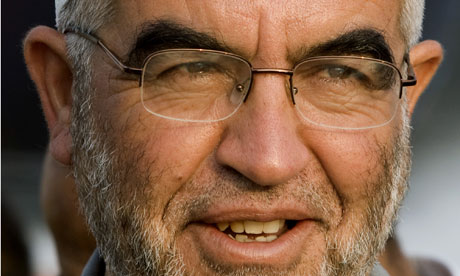
Arab Israelis and Palestinians have accused the British government of collaborating with Israel in detaining Sheikh Raed Salah, the leader of the Islamic Movement in Israel.
Ibrahim Sarsur, a United Arab List member of the Knesset, the Israeli parliament, described the arrest of Salah as “strange”. He said: “Sheikh Salah is one of the leading figures in the Arab Israeli community. He travelled to the UK legitimately, and he had no knowledge of any ban on his entering the UK, so we are surprised and disappointed by this illegitimate procedure.”
Sarsur called on Britain to release Salah immediately. “We know that Israel is not happy with anyone that opposes its policies, but we see Britain as the most democratic place in the world and the birthplace of democracy. Britain should deal with delicate matters of the Middle East with delicacy and not act as a collaborator with the Israeli government.”
Ben White, a writer and activist who was due to speak at an event with Salah on Wednesday, said there was a stark contrast between how Britain treated Palestinian and Israeli leaders. “The same government that sent police to arrest a Palestinian civil society leader from his hotel bedroom is changing UK legislation explicitly to facilitate the entry of accused Israeli war criminals,” he said.
Muammar Gaddafi’s fearsome security apparatus appears to be weakening in Tripoli, but it is still too powerful to risk an uprising — that is the view of Libyans who say they are part of a burgeoning underground opposition network in the capital.
The handful of activists, who spoke to Reuters journalists on condition that neither their identities nor the location of the meeting be revealed, said Gaddafi was keeping control of the city through informants, mass arrests and killings.
“No single event will bring down the regime here in Tripoli,” said one activist who goes by the name of Niz.
“And it will take time,” he added, saying more NATO bombing, a push by Libyan rebels outside the city and better coordination of the opposition inside the capital would probably be needed.
Yet Niz and others also spoke of a system of repression that was showing signs of strain, with a shortage of places to hold detainees, interrogators who do not know what questions to ask and people arrested and then released apparently at random.
That Reuters foreign journalists staying at a tightly monitored hotel were able to slip away from government minders to meet people who said they represented active opposition cells was itself a sign of disarray in the decades-old security system — a disarray NATO is counting to bring Gaddafi down eventually.
Four activists from two different opposition movements — groups which have maintained contact with foreign media for the past few months — gave an account of what they thought it would take for Gaddafi’s grip on his Tripoli stronghold to be broken.
It was an assessment that will be sobering for those in Western capitals, and in the rebel-held Libyan cities of Benghazi and Misrata, who have been hoping for a swift end to the four-month old conflict.
An uprising in Tripoli is seen by some NATO member states as the best bet for toppling the Libyan ruler after months of coalition air strikes, and rebel attacks outside the capital, failed to produce a decisive outcome.
“The rebels don’t really have a chance of breaking out from the east, making their way to Tripoli,” said Shashank Joshi of the Royal United Services Institute in London. “It will rely on some sort of urban uprising within the city itself.”
Niz said outsiders, and the eastern rebels, should be patient if they were were waiting for Tripolitanians to rise up:
“Four months is a long time for those being shelled,” he said of those under siege in Misrata and elsewhere. “It’s a long time for those being raped or tortured,” he added.
“But, objectively, it’s not a long time when you consider the regime has been in power for 42 years.”
Until a few weeks ago, the rebellious towns in the Nafusah Mountains were struggling to survive on dwindling supplies of barley, water and gas during a long siege by Col. Muammar el-Qaddafi’s soldiers.
But after an improbable series of military victories over the past three weeks — with fewer than 100 rebel fighters killed, their military leaders say — residents of a broad area in this mountain region are celebrating virtual secession from Colonel Qaddafi’s Libya. While there have been defeats, and the Grad rockets of Colonel Qaddafi’s forces still menace the outskirts of Nalut near the Tunisian border and Yafran to the east, rebels point hopefully to the growing stability of the towns under their control as evidence of how tenuous Colonel Qaddafi’s grip may be.
“This is the new Libya,” said Anwar Fekini, a Sorbonne-educated French-Libyan lawyer, rebel organizer and local tribal leader who returned for a weekend trip to his ancestral home to strategize with local allies. “It feels good.”
He delicately accepted an aging Belgian rifle from two gray-haired rebel fighters, just for safekeeping.
The Nafusah Mountains have emerged as a strategically significant front in the battle for Libya, in part because the rebels there are closest to Colonel Qaddafi’s stronghold in the capital, Tripoli, and in part because they have the potential to cut off vital supply lines from the border. And though barely trained and few in number — one rebel leader estimated that there were about 2,000 armed fighters — they have used their knowledge of the terrain and the sympathies of much of the local population to expand their territory as the fighting around Benghazi to the east and Misurata on the central coast has moved toward a stalemate.
France is providing weapons to Libyan rebels in the Western Mountains in an effort to help them push on to Muammar Gaddafi’s stronghold in the Libyan capital Tripoli, Le Figaro newspaper reported on Wednesday.
Citing unidentified sources, Le Figaro said France had parachuted “large amounts” of weapons, including rocket launchers, assault rifles, machine guns and anti-tank missiles into the Jebel Nafusa region.
The decision to send arms without consulting its NATO partners was “because there was no other way to proceed,” a senior source was quoted as saying.
$644.75 for a small gear smaller than a dime that sells for $12.51: more than a 5,100 percent increase in price. $1,678.61 for another tiny part, also smaller than a dime, that could have been bought within DoD for $7.71: a 21,000 percent increase. $71.01 for a straight, thin metal pin that DoD had on hand, unused by the tens of thousands, for 4 cents: an increase of over 177,000 percent.
The May 3, 2011, unclassified “For Official Use Only” report is 142 pages. Prior to POGO’s publication of the full report, the only publicly available version was a 3-page “results in brief” on the DoD OIG’s website, first reported by Bloomberg News. The findings in the results in brief, while shocking on their own, pale in comparison to the detail contained within the full report. The DoD OIG scrutinized Army Aviation and Missile Life Cycle Management Command (AMCOM) transactions with Boeing that were in support of the Corpus Christi Army Depot (CCAD) in Texas. The audit focused on 24 “high-dollar” parts. Boeing had won two sole-source contracts (the second was a follow-on contract awarded last year) to provide the Army with logistics support—one of those support functions meant Boeing would help buy and/or make spare parts for the Army—for two weapons systems: the Boeing AH-64 Apache and Boeing CH-47 Chinook helicopters.
Overall, for 18 of 24 parts reviewed, the DoD OIG found that the Army should have only paid $10 million instead of the nearly $23 million it paid to Boeing for these parts—overall, taxpayers were overpaying 131.5 percent above “fair and reasonable” prices. The audit says Boeing needs to refund approximately $13 million Boeing overcharged for the 18 parts. Boeing had, as of the issuance of the audit, refunded approximately $1.3 million after the DoD OIG issued the draft version of its report. Boeing also provided a “credit” to the Army for another part for $324,616. The Army has resisted obtaining refunds worth several million dollars on some of the overpriced spare parts, in opposition to the DoD IG’s recommendations. For instance, one of the IG’s recommendations was that the Army should request a $6 million refund from Boeing for charging the Army for higher subcontractor prices even though Boeing negotiated lower prices from those subcontractors. In response, the Army said that “there is no justification to request a refund.”
In calculating what it says the Army should have paid, the DoD OIG assumed Boeing reasonably should charge a 34 percent surcharge fee for overhead, general and administrative costs, and profit, according to the audit report.
Above and beyond what the DoD OIG viewed as fair and reasonable (including the 34 percent surcharge), Boeing’s average overcharges to the Army for these 18 parts range from 33.3 percent to as much as 5,434 percent, based on the DoD OIG’s analysis.
What is even more shocking is the difference in prices the Army would have paid if it procured many of these parts directly from the Defense Logistics Agency (DLA) and from the Army’s own procurement offices, the audit shows. The largest percentage differences cited in the DoD OIG report—such as the 177,475 percent example (which is not among the 18 parts the report focuses on)—compare DLA unit prices to Boeing unit prices.
The amount the U.S. military spends annually on air conditioning in Iraq and Afghanistan: $20.2 billion.
That’s more than NASA’s budget. It’s more than BP has paid so far for damage during the Gulf oil spill. It’s what the G-8 has pledged to help foster new democracies in Egypt and Tunisia.
“When you consider the cost to deliver the fuel to some of the most isolated places in the world — escorting, command and control, medevac support — when you throw all that infrastructure in, we’re talking over $20 billion,” Steven Anderson tells weekends on All Things Considered guest host Rachel Martin. Anderson is a retired brigadier general who served as Gen. David Patreaus’ chief logistician in Iraq.
Later this month an American ship, the Audacity of Hope, will leave Greece on a journey to the Gaza Strip to attempt to break Israel’s blockade. It will join an expected nine other ships flying numerous flags and carrying hundreds of passengers from around the world. I will be one of those passengers.
I am an Israeli Jewish American. I was born in Israel, and I grew up in a very different Jerusalem from the one today. The Jerusalem of my childhood was a smallish city of white-stone neighborhoods nestled in the elbows of hills. Near the center, next to the central post office, the road swerved sharply to the left because straight ahead stood a big wall, and on the other side of it was “them.”
And then, on June 9, 1967, the wall came down. Elsewhere, Israeli troops were still fighting what came to be known as the Six-Day War, but on June 9, as a small crowd stood and watched, demolition crews brought down the barrier wall, and after it, all other buildings that had stood between my Jerusalem and the walls of the Old City, their Jerusalem. A few weeks later a wide road would lead from my Jerusalem to theirs, bearing the victors’ name: Paratroopers Way.
A soldier helped me sneak into the Old City. Snipers were still at large and the city was closed to Israeli civilians. By the Western Wall, a myth to me until then, the Israeli army was already evicting Palestinian residents in the dead of night and demolishing all houses within 1,000 feet. Eventually, the area would turn into the huge open paved space it is today, a place where only last month, on Jerusalem Day, masses of Israeli youths chanted “Muhammad is dead” and “May your villages burn.”
The secretive business havens of Cyprus and the Cayman Islands face a potent rival: Cheyenne, Wyoming.
At a single address in this sleepy city of 60,000 people, more than 2,000 companies are registered. The building, 2710 Thomes Avenue, isn’t a shimmering skyscraper filled with A-list corporations. It’s a 1,700-square-foot brick house with a manicured lawn, a few blocks from the State Capitol.
Neighbors say they see little activity there besides regular mail deliveries and a woman who steps outside for smoke breaks. Inside, however, the walls of the main room are covered floor to ceiling with numbered mailboxes labeled as corporate “suites.” A bulky copy machine sits in the kitchen. In the living room, a woman in a headset answers calls and sorts bushels of mail.
A Reuters investigation has found the house at 2710 Thomes Avenue serves as a little Cayman Island on the Great Plains. It is the headquarters for Wyoming Corporate Services, a business-incorporation specialist that establishes firms which can be used as “shell” companies, paper entities able to hide assets.
Wyoming Corporate Services will help clients create a company, and more: set up a bank account for it; add a lawyer as a corporate director to invoke attorney-client privilege; even appoint stand-in directors and officers as high as CEO. Among its offerings is a variety of shell known as a “shelf” company, which comes with years of regulatory filings behind it, lending a greater feeling of solidity.
“A corporation is a legal person created by state statute that can be used as a fall guy, a servant, a good friend or a decoy,” the company’s website boasts. “A person you control… yet cannot be held accountable for its actions. Imagine the possibilities!”
Among the entities registered at 2710 Thomes, Reuters found, is a shelf company sheltering real-estate assets controlled by a jailed former prime minister of Ukraine, according to allegations made by a political rival in a federal court in California.
The owner of another shelf company at the address was indicted in April for allegedly helping online-poker operators evade a U.S. ban on Internet gambling. The owner of two other firms there was banned from government contracting in January for selling counterfeit truck parts to the Pentagon.
All the activity at 2710 Thomes is part of a little-noticed industry in the U.S.: the mass production of paper businesses. Scores of mass incorporators like Wyoming Corporate Services have set up shop. The hotbeds of the industry are three states with a light regulatory touch-Delaware, Wyoming and Nevada.
The pervasiveness of corporate secrecy on America’s shores stands in stark contrast to Washington’s message to the rest of the world. Since the September 11 attacks in 2001, the U.S. has been calling forcefully for greater transparency in global transactions, to lift the veil on shadowy money flows. During a debate in 2008, presidential candidate Barack Obama singled out Ugland House in the Cayman Islands, reportedly home to some 12,000 offshore corporations, as “either the biggest building or the biggest tax scam on record.”
Yet on U.S. soil, similar activity is perfectly legal. The incorporation industry, overseen by officials in the 50 states, has few rules. Convicted felons can operate firms which create companies, and buy them with no background checks.
Too Much, an online weekly publication of the Institute for Policy Studies, says:
Sober central bankers the world over — and their political pals — have been hyperventilating the last few months about the debts of the world’s most notorious deadbeat nations.
Over in Old Europe, we have Greece with a standing debt of some $485 billion. Over here in the New World, meanwhile, the United States owes some $9.4 trillion to the outside investing public.
“Crushing” debts like these, the debt hawks squawk, have only one remedy. The average people of deadbeat nations must swallow hard and accept austerity. They must shut down their libraries and overcrowd their classrooms — and start selling off their public assets as well. Anybody want to buy the Parthenon?
Amid all this debt hysteria, we might want to slow down a bit, unless we relish the possibility of having Donald Trump ending up the owner of the Acropolis. We need a little perspective, the sort we can get from the 15th annual World Wealth Report, a joint effort from Merrill Lynch Global Wealth Management and Capgemini, a Paris-based corporate and financial consultancy.
This latest World Wealth Report, released just last week, calculates — among other fascinating numbers — the total investible wealth of everyone in the world who now has at least $30 million available to invest.
Remember, we’re not talking total wealth here, only investible assets. The Capgemini-Merrill Lynch tallies don’t include the residences wealthy people call home, their diamonds, their luxury cars and yachts, or any other personal luxury goods and collectibles that sit in wealthy households.
The world now hosts, reckon Capgemini and Merrill Lynch, 103,000 individuals with $30 million or more sloshing in their investment accounts. Together, these “ultra-high net worth individuals” hold $15 trillion in investible wealth.
Cogitate on that total a moment. If the world’s ultra-high net worth folks had a hankering, they could totally pay off the Greek and U.S. debts, and still have almost $50 million each, on average, left to invest, on top of their mansions, Bentleys, and jewels. And the Greeks would get to keep the Acropolis!
The folks over at Capgemini and Merrill Lynch would never, of course, want to suggest for even a moment that the world’s “ultra-highs” — about 40 percent of whom, incidentally, live in the United States — either ought to have this hankering or be taxed into it. They’ve put together this World Wealth Report to impress the wealthy into becoming their clients, not to scare them.
But the rest of us remain free to suggest whatever we want — after we thank Capgemini and Merrill for providing all this wonderfully suggestive inspiration.
Three days before the congressional elections last fall, Hillary Rodham Clinton stood halfway around the world, pledging to young victims of human trafficking at Cambodia’s s Siem Reap Center that they would continue to enjoy the support of the U.S. State Department, which then provided some $336,000 to the shelter. The acclaimed center, situated near the magnificent temples of Angkor Wat, was an oasis of peace for some 50 survivors who, before they were rescued or escaped, had endured slavery in brothels, where they were forced to have sex with as many as 30 men a day. At the shelter, they received counseling, studied hairdressing, learned to sew, and otherwise worked to rebuild their lives and reclaim their humanity. In the evening, they did aerobics together.
On Monday afternoon, some eight months after that visit, as she unveiled the State Department’s 11th annual Trafficking in Persons (TIP) Report to a packed room in the department’s ornate Benjamin Franklin Room, Clinton only hinted that the result of the congressional elections had left the long-term value of her pledge to the survivors in doubt. “Even in these tight economic times, we need to find ways to do better,” Clinton told the overflow crowd.
Clinton’s confidence belied the fact that in April, Congress slashed the grant-making capacity of the State Department’s Office to Monitor and Combat Trafficking in Persons. When the Republicans won the House last November, the office’s $21.2 million annual budget to fight the war on slavery was already microscopic. At the time, it was barely equal to the U.S. government’s daily budget to fight the war on drugs. For fiscal year 2012, Congress sliced away nearly a quarter of those antislavery funds, as part of its broader $8 billion State Department budget cuts.
Efforts to combat human rights abuses are easily undermined by politics. Often – and with good reason – the US and other western countries are accused of highlighting abuses by their enemies while turning a blind eye to similar abuses by their friends.
One way of pushing political considerations into the background is to look at the problem comparatively, by considering where each country stands in relation to others. That is what the US state department has been doing for 11 years now, with its global reports on human trafficking.
The result, as seen in the latest report issued on Monday, is a robust critique, which places some of the staunchest US allies – Kuwait and Saudi Arabia – in the same rotten boat as long-time foes such as Cuba, North Korea and Iran.
“Trafficking in persons” covers various forms of exploitation including, in the words of the international Palermo protocol, “sexual exploitation, forced labour or services, slavery or practices similar to slavery, servitude or the removal of organs”.
Conservative pundit Glenn Beck will advise MKs [members of the Knesset] on fighting the delegitimization of Israel abroad during a trip to Israel in July.
Knesset Immigration, Absorption and Diaspora Affairs Committee chair MK Danny Danon (Likud) invited Beck, a Fox News and radio host and an outspoken supporter of Israel, to address the committee on how to recruit friends of Israel in the US to defend Israel’s right to exist.
“When we face an international wave of hatred of Israel and Jews – which is expressed in Facebook pages and films calling for our destruction – it’s good that Israel has talented friends that can contribute to our public-relations efforts,” Danon said.
The Likud MK added that the July 11 committee meeting with Beck will focus on September’s UN General Assembly, where the Palestinian Authority has said it will unilaterally declare statehood.
“September isn’t just a crisis,” Danon explained. “It’s an opportunity to explain to the world that we are not occupying anything.”
A YouTube video featuring a man who presented himself as an American gay rights activist disillusioned with the latest Gaza flotilla campaign has been exposed as a hoax.
The man in the video, who introduced himself to viewers as Marc and claimed that the organizers of the latest flotilla of ships bound for Gaza had rejected his offer to mobilize a network of gay activists in support of their cause, was identified as Omer Gershon, a Tel Aviv actor involved in marketing, by the Electronic Intifada, a pro-Palestinian Web site.
As my colleague Ethan Bronner explains, pro-Palestinian activists, including the prominent American author Alice Walker, are planning to sail a flotilla of small ships from European ports toward Gaza to protest Israel’s naval blockade of the Palestinian territory.
Just hours after the supposedly homemade video was uploaded to YouTube on Thursday, Benjamin Doherty of the Electronic Intifada pointed out that it had suspiciously high production values — most obviously, lights and what is known as B-roll — and was attributed to an activist calling himself Marc Pax, who seemed to have no other online presence.
While it remains unclear who produced the video, and Mr. Gershon has not responded to a request for comment, bloggers were quick to point out that people in three different Israeli government offices promoted it on Twitter soon after it was posted online.
As the blogger Max Blumenthal reported on Friday, one of the first people to draw attention to the video was Guy Seemann, who is an intern in the office of Benjamin Netanyahu, the Israeli prime minister.
The same day, the Israeli government’s press office advised its Twitter followers to watch the video and follow Mr. Seemann’s feed.
Seeman has subsequently deleted his entire Twitter feed and refuses to reveal the identity of the “friend” who he claims informed him about the video.
Haaretz sent the prime minister’s office a series of questions inquiring whether the office was involved in the production of the video in any way. The premier’s office in response did not deny that that the government was involved in the video’s production, and admitted that government bodies had distributed the link.
“Various bodies dealing with international media campaigns continuously monitor and distribute internet content when they recognize content that can serve Israel’s campaigns,” the prime minister’s office said in a statement.
Omer Gershon was not available for comment on his Facebook account or on the phone.
Meanwhile, although the flotilla does actually include gay participants, Israeli gay hasbara sometimes clashes with reality.
The Interior Ministry is refusing citizenship and new immigrant status to a homosexual married to a Jewish new immigrant, despite the law’s stipulation that the child, grandchild and partner of a Jew are entitled to Jewish immigrant rights.
Joshua Goldberg and Bayardo Alvarez, both American citizens, immigrated to Israel two weeks ago. Goldberg, who is Jewish, received an Israeli identity card and immigrant certificate on arrival, under the Law of Return. Alvarez, despite exerting much pressure on the ministry, was granted only temporary residence.
The Law of Return stipulates: “A Jew’s rights and an immigrant’s rights … are also imparted to the child, grandchild and partner of a Jew, except in the case of a Jew who willingly converted to another religion.”
Attorney Nicky Maor, director of the Legal Aid Center for Olim, says if the couple were a man and woman, there is no doubt they would both have received Israeli citizenship.
“The only reason the Interior Ministry doesn’t know how to handle it is that they’re gay,” Maor said. “The Law of Return says ‘partner,’ not husband and wife. There is no definition preventing recognition of same-sex partners.”
Goldberg and Alvarez, from Baltimore, Maryland, have been living together for 11 years. At the end of 2007, they were married in Canada, where same-sex marriages have been legalized, even for non-Canadians. They started immigration procedures about six months ago, with the help of the Israel Religious Action Committee.
In 2006, the High Court of Justice instructed the Interior Ministry to register same-sex marriages of couples who were married outside Israel in the Population Registry. In the wake of this ruling, the Interior Ministry registered Goldberg and Alvarez as married when they came to Israel. But despite the implications, the ministry refused to give Alvarez citizenship and an immigrant’s certificate.
“We demanded an immigrant’s status for Alvarez before Passover,” says Maor. “Since then they’ve promised they are discussing it on all levels, and say they must discuss it with the State Prosecution department and formulate a stand.”
The ministry knows that if it refuses, the issue will be brought to the High Court of Justice. “They want the prosecution’s backing. They say this is holding things up,” Maor says.
Goldberg, 40, a publicist and PR agent, and Alvarez, 33, a flower arranger for weddings and events, both work as waiters in an Eilat hotel and are looking for work and housing in the central region.
Alvarez was granted temporary residence after the couple had been summoned six times to the Interior Ministry branch in Eilat, where they say they were treated in a hostile, humiliating way by the clerk. Goldberg claims it was clear they were looking for excuses not to grant him residence.
Last week suspected Mossad agents showed up at the US boat, The Audacity of Hope, currently waiting to depart from Athens and now another flotilla ship has had its propeller cut off. It’s not wild conjecture to suggest that the Israeli government is responsible for the sabotage.
One of the ships due to participate in the Gaza flotilla was deliberately tampered with while it was docked in Greece’s Piraeus port, Gaza flotilla activists told Haaretz on Monday.
The ship, due to carry Greek, Norwegian, and Swedish passengers to Gaza, was found with its propeller shaft broken, the ship’s spokesman Israeli activist Dror Feiler told Haaretz.
A scuba diver who examines the ship on a daily basis discovered Monday that the ship’s propeller shaft, which connects the transmission inside the vessel directly to the propeller, was cut off.
According to Feiler, there is no doubt that the action was a deliberate attempt at sabotage, which he believed also violated Greece’s sovereignty.
Even though the problem can be fixed, it is still unclear how long it would take, especially with Greece’s recently declared general strike on Tuesday and Wednesday.
This action adds to a series of delays that have kept the Gaza flotilla from sailing, including Greece’s determination to carry out additional non-routine examinations on several of the ships.
To most Gazans the flotilla mission is not really about bringing in a small amount of humanitarian aid. Rather, it is about drawing world attention to Israel’s continued entrapment of 1.6 million people who are just as human as people everywhere else in the world.
“All the international people who [were] coming [in] the flotilla [last year], the Turkish people, … they lost their life to reach Gaza, they really … reached not only to Gaza; they reached … all the heart[s of] the human and the free people in the world — their message really reached and they succeed[ed],” says a Gazan fisherman. “And even the second flotilla we hope to reach safely to Gaza, but if even they didn’t succeed and Israel stop them, really their message [will] succeed and they reach actually.”
According to recent tweets from the US boat “The Audacity of Hope,” which is part of the flotilla waiting to depart from Greece towards Gaza any day now, “the boat successfully completed its sea trials – there is no reason for any further delays on this matter, we are ready to sail.”
Speaking to a packed room of over 70 international journalists in a sweltering Athens conference room, organizers of Freedom Flotilla II said that the flotilla will set sail from various Mediterranean ports in the “coming days.” Organizers informed the international press corps that the purpose of the flotilla is both humanitarian and political in nature. Despite, clear safety warnings to both journalists and passengers by the Israeli government, flotilla representatives said that they will sail to Gaza in solidarity with the people of Palestinian. New York Times journalist Jim Roberts recently tweeted that he WILL cover the flotilla.
On June 24, Joseph Dana, a journalist who will traveling aboard the US boat to Gaza, discovered that an anonymous private legal complaint had been filed against the Gaza Freedom Flotilla. The complaint alleged that US boat, “The Audacity of Hope,” was not sea worthy and therefore was unfit to sail. In response, the harbor master in Athens, Greece, where the boat was docked, told the crew that he could not allow them to leave until the complaint was resolved.
Two days later, the Israel Law Center, Shurat Hadin, accepted responsibility for the complaint, which was essentially a baseless but startlingly successful exercise in legal harassment. Who is Shurat Hadin, and what is their agenda? According to the group’s website, Shurat Hadin is a Tel Aviv-based law center that specializes in lawsuits against “terrorists.” Its founder, Nitsana Darshan-Leitner, describes herself in her bio as a “human rights activist.”
Darshan-Leitner began her harassment of the US boat to Gaza began weeks ago when it filed a civil action against “perceived supporters of Hamas” on behalf of Alan Bauer, an American doctor who was injured along with his son in a 2002 Jerusalem bombing attack. The action also threatened maritime insurance companies with legal consequences if they insured any of the boats involved in the flotilla.
I have discovered that a major donor to Shurat Hadin is the homophobic far-right Pastor John Hagee. In March 2010, I reported that Hagee appeared beside Prime Minister Benjamin Netanyahu at a major rally in Jerusalem to denounce the two state solution and announce the financial contributions he and his supporters were making to Israeli organizations. Among the organizations Hagee said he had bankrolled was Shurat Hadin.
Monday marked the second day of discussions by senior ministers on the planned Gaza flotilla. On Sunday, Netanyahu told the inner cabinet that Israel would not allow any ships to breach its maritime blockade of Gaza.
Security officials and Foreign Ministry representatives informed the cabinet on Sunday that Israel has no information indicating that terrorists or anyone affiliated with a terror group is planning to take part in the flotilla, said a government source. Nonetheless, there may be clashes between Israeli forces and some Arab activists aboard the ships.
“The critical mass of participants will include human rights activists from European Union countries, Canada and the United States,” said a senior security official.
Some 10 ships are planning to set sail on Tuesday in an attempt to breach Israel’s blockade of the Strip. The government and army are hoping the ships will stop on their own, possibly early Thursday, and that the Israel Navy will not have to board them, a move that would not be well received in the world.
Some 500 people are expected to be aboard the flotilla, which will include six or seven ships currently docked in Greece.
Assuming the ships do sail from Greece, they will meet up with two or three that have already set sail from Spain and France, and continue toward the Gaza coast.
The announcement two weeks ago from the Turkish group IHH that the Mavi Marmara ship will not take part in the flotilla has changed the security establishment’s views regarding the anticipated resistance. IHH members violently resisted the naval takeover of the Mavi Marmara in the flotilla of May 2010, and nine of them were killed in the clashes. In addition, since the Mavi Marmara won’t be part of this flotilla, only smaller ships will be involved, increasing the likelihood that Israel will not have to board them to force them to turn back.
Cabinet ministers were told on Sunday that after IHH announced that the Mavi Marmara would not be in the flotilla, there was less reason for concern about possible violent confrontations.
Government and defense sources said the fact that most, if not all, the flotilla participants will be European peace activists presumably not interested in violence will present a “more difficult public diplomacy challenge,” and Israel wants to avoid clashes with the activists.
In contrast to the decision last year to deploy naval commandos onboard the ships when they ignored Israeli warnings not to continue to Gaza – this year Israel will try other methods to stop the ships and direct them toward Egypt’s El Arish port.
Israel said on Monday it was rethinking its threat to bar foreign journalists from entering the country for 10 years if they board a new aid flotilla that plans to challenge the Israeli naval blockade of the Gaza Strip.
“(Prime Minister Benjamin Netanyahu) heard about it on the news and asked to re-examine this issue because it’s problematic,” Deputy Prime Minister Moshe Yaalon said, referring to Sunday’s warning from Israel’s Government Press Office (GPO).
“I know the prime minister was as surprised as I was to hear this,” he said, without disclosing who had made the decision to deliver the threat.
“There’s no way to stop the media in this day and age if they (are on board) anyway. It’s better not to clash with them.”
If there’s one resounding message from the last decade, it is the effectiveness with which Americans can be bludgeoned and coerced into what amounts to self-applied lebotomization. All it takes is to utter the word “terrorism” and the average person’s brain ceases to function.
A new documentary, “If a Tree Falls: A Story of the Earth Liberation Front,” tells the story of environmental activist Daniel McGowan. Four years ago this month, McGowan was sentenced to a seven-year term for his role in two acts of politically motivated arson in 2001 to protest extensive logging in the Pacific Northwest—starting fires at a lumber company and an experimental tree farm in Oregon. The judge ruled he had committed an act of terrorism, even though no one was hurt in any of the actions. McGowan participated in the arsons as a member of the Earth Liberation Front but left the group after the second fire led him to become disillusioned. He was arrested years later after a key member of the Earth Liberation Front—himself facing the threat of lengthy jail time—turned government informant. McGowan ultimately reached a plea deal but refused to cooperate with the government’s case. As a result, the government sought a “terrorism enhancement” to add extra time to his sentence. McGowan is currently jailed in a secretive prison unit known as Communication Management Units, or CMUs, in Marion, Illinois. We play an excerpt from the film and speak with the film’s director, Marshall Curry. We also speak with Andrew Stepanian, an animal rights activist who was imprisoned at the same CMU as McGowan, and with Will Potter, a freelance reporter who writes about how the so-called “war on terror” affects civil liberties.
As the Israeli government does everything it can to prevent the second flotilla to Gaza from setting sail and while the US State Department has effectively given Israel a green light to use any means — peaceful or violent — to prevent the flotilla from reaching its destination, passengers on board the American boat, The Audacity of Hope, describe why they are going.
This website or its third-party tools use cookies, which are necessary to its functioning. By closing this banner, you agree to the use of cookies.