West presses rebels for more details on a post-Gaddafi government

The New York Times reports:

As NATO airplanes and attack helicopters struck fresh targets in Tripoli and the oil port of Brega on Sunday, senior British and American officials said there was no way of knowing how long it might take for the rebellion against Col. Muammar el-Qaddafi — already in its fourth month, and the third month of NATO airstrikes — to drive him from power.

But Britain’s foreign secretary, William Hague, returning from a brief visit to the rebel headquarters in the eastern Libyan city of Benghazi, hinted at concern in Western capitals about what might come after the toppling of Colonel Qaddafi. Mr. Hague said he had pressed the rebel leaders to make early progress on a more detailed plan for a post-Qaddafi government that would include sharing power with some of Colonel Qaddafi’s loyalists.

In particular, Mr. Hague said, the rebels should learn from Iraq’s experience, in which a mass purge of former Saddam Hussein loyalists occurred under the American-backed program of “de-Baathification,” and shun any similar undertaking. The reference was to a policy that many analysts believe helped to propel years of insurgency in Iraq by stripping tens of thousands of officials of jobs.

According to news agency reports, crowds in Benghazi’s streets greeted Mr. Hague and Britain’s overseas aid minister, Andrew Mitchell, with shouts of “Libya free!” and “Qaddafi, go away!” as they met with leaders of the rebels’ Transitional National Council, headed by Mustafa Abdul Jalil, who was justice minister in Colonel Qaddafi’s government until the rebellion began in February. Back in London, Mr. Hague described the rebel leaders as “genuine believers in democracy and the rule of law,” but said that they should make more detailed post-Qaddafi plans.

Al Jazeera reports:

Libyan rebels have entered the northwestern town of Yafran, previously held by Muammar Gaddafi’s forces, reports say.

Youssef Boudlal, a Reuters photographer in the town, on Monday said the town had been wrested by the rebels.

“We are inside the town … There is no sign of any Gaddafi forces. I can see the rebel flags … We have seen posters and photos of Gaddafi that have been destroyed,” he said.


Facebooktwittermail

Bahraini doctors and nurses charged

Al Jazeera reports:

Scores of Bahraini doctors and nurses who treated injured anti-government protesters have been charged with attempting to topple the kingdom’s monarchy.

The 23 doctors and 24 nurses were formally charged on Monday during a closed door hearing in a special security court.

The 47 accused have been in detention since March, when the country declared martial law in order to clamp down on a wave of demonstrations that swept the tiny kingdom earlier this year.

Facebooktwittermail

Yemeni president in Saudi hospital with ‘extensive’ injuries from palace attack

The Guardian reports:

Ali Abdullah Saleh, the Yemeni president, suffered “extensive” injuries including severe burns in an attack on his Sana’a palace last week, reducing the chances that he will be able to return home after undergoing treatment in Saudi Arabia.

Saleh was said on Monday to be in a stable condition in a military hospital in Riyadh after he was operated on by a Saudi-German medical team for shrapnel wounds to his face, neck and chest.

Aides initially claimed he had suffered only minor injuries, but diplomatic sources estimated that he had received burns to 40% of his body.

Al-Jazeera Arabic TV reported that he would require cosmetic surgery and quoted Saudi medical sources as saying he would need to recuperate for two weeks before returning to the Yemeni captial, a timeframe which looks far too long in the current uncertain and volatile climate.

Facebooktwittermail

On deaf ears: Obama’s message to Israel

Robert Grenier writes:

Late May’s extraordinary sequence of speeches and meetings involving US President Barack Obama and Israeli Prime Minister Binyamin Netanyahu – and the commentary surrounding it from official circles in both countries – did not make for an edifying interlude. The week beginning May 19 will not be remembered for displays of farsighted statecraft, or high moral courage. What we saw instead was brash, unapologetic chauvinism from Netanyahu, an outright refusal of moral leadership from Obama, and acts of political cowardice and opportunism from the US Congress outrageous even by the low standards of that frequently ignominious body.

But that is not to say that the week’s display was not useful. On the contrary, much of importance was accomplished. Now, more clearly than ever, we can see the future. For if there were any questions remaining about the current nature and direction of the Israeli-Palestinian dispute, May’s events have put an end to them. Zionism is far from dead, and will surely survive, at least in altered form. But a fundamental change in the nature of the Israeli state has become inevitable.

To understand why, we should start with President Obama. It may seem mystifying in one so intelligent and insightful, but when, at the beginning of his administration, Obama set about to solve the Arab-Israeli dispute once and for all, he really had no idea what he was getting into. To this most logical, detached, and rational of men, the solution to the dispute must have seemed obvious. The salient issues had been reviewed endlessly for decades by all the parties. The key components of an agreement were well known. All he needed to do to get the negotiating process properly underway, he believed, was to address one key impediment: Israeli settlement policy.

Facebooktwittermail

Netanyahu’s extremist mistake

James Carroll writes:

The most astounding aspect of Israeli Prime Minister Benjamin Netanyahu’s pronouncements in Washington last month was not his resounding “no!” to the Palestinians, or even his discourtesies to President Obama. It was his repudiation of mainstream thinking in his own country, especially about Jerusalem.

Netanyahu’s utter dismissal of any Palestinian claim on the city is a radical shift away from an Israeli political consensus that has emerged over the last two decades. His insistence that Jerusalem will be eternally “undivided” ignores the movement that had been made away from the idea of “division” — as if any one wants a return to the era when barbed wire sliced through Jerusalem’s heart — to the idea of a city “shared,” with each party able to satisfy an ancient longing.

Until recently, Israeli leaders steadily signaled openness to a compromise that would give a Palestinian authority control over Muslim and Arab sections of the city, with equivalent authority over Jewish areas remaining with Israel. Structures of cooperation for overlapping municipal administration and economic activity were to be worked out.

When proposed as part of a comprehensive settlement of all issues, the idea of East Jerusalem as capital of a Palestinian state drew solid majorities of support among Israelis. Just as they had come to embrace the hope of a “two-state solution,” they understood that Jerusalem would necessarily be the capital of both states. Negotiations never reached defined details for Israeli-Palestinian sharing of Jerusalem, including the possible participation of other nations, but the principle had taken hold. So had the spirit of compromise — the spirit Netanyahu now wants to snuff out.

Facebooktwittermail

J Street: Netanyahu refuses to meet delegation

Ynet reports:

Despite enjoying a hearty welcome at the US Congress recently, Prime Minister Benjamin Netanyahu has refused to meet with a delagation of representatives organized by J Street, the liberal Jewish lobby said Sunday.

Congressmen cheered Netanyahu on enthusiastically 50 times during his speech, 29 of those being standing ovations. However when five of those same Congress members planned a visit Israel, requesting a meeting with the prime minster or any other official representative of the state, not a single one complied.

The delegation, composed of Democratic Congress members, was set to arrive in Israel on Monday. The trip was initiated by J Street, considered a controversial group known for its fierce criticism of Israel, particularly over the issue of West Bank settlements.

The organizers attempted to arrange meetings with Netanyahu ahead of time, however they were turned down due to alleged schedule conflicts.

Organizers claim this is an excuse, stating that the actual reason is due to Netanyahu’s government policy, which bans meetings with US legislators brought here by J Street.

The delegation includes five representatives: Steve Cohen from Tennessee, Betty McCollum from Minnesota, John Yarmuth from Kentucky, and Sam Farr and Lynn Woolsey from California. Two of them are Jewish.

Facebooktwittermail

The no-longer temporary occupation

Joseph Dana writes:

One particular success of Israel’s 44-year control of the West Bank and Gaza Strip has been the government’s ability to convince the Israeli population of the temporary nature of the occupation. Every sector of Israeli society, except religious settlers and the military establishment, understand the occupation to be an ephemeral security measure necessary only in the absence of a peace agreement with the Palestinians. Ask any Israeli on the streets of Tel Aviv whether they think that Israel will permanently control the Occupied Territories and the immediate answer will be no, it is all about immediate security. This charade is exploited by successive Israeli governments as they proclaim a desire for peace while simultaneously creating permanent facts on ground like Jewish settler roads, checkpoints for Palestinians and new settlements.

Despite the proximity of the Occupied Territories to major Israeli population centers, few Israelis other than soldiers and settlers visit the Territories. Since the creation of Israel’s controversial separation barrier and the denial of thousands of Palestinian work permits to Israel, Israeli society has all but disengaged from Palestinian society. This allows the occupation to feel distant and outside the everyday lives of Israelis. Palestinians, of course, are still confronted with the daily presence of Israeli military power and mechanisms of control.

Some Israeli scholars, such as Bar Ilan University lecturer Ariella Azoulay, and Tel Aviv University professor Adi Ophir, have proposed that without this perceived temporariness and external character of the occupation, Israel would have a hard time maintaining its mandatory military conscription. A greater number of citizens would question the long- term objectives.

Facebooktwittermail

Solidarity with Palestinians rises, and so is risk for activists

Sean O’Neill writes:

An Israeli activist friend called me Thursday night with some parting advice as I left for my hostel after getting a beer with him. I had mentioned that Friday I would head down to the weekly protest at Sheikh Jarrah.

“Be careful,” he said, “it’s getting dangerous out there.” Then he added a clarifying point: “For people on this side.” He gestured with his head to the streets of West Jerusalem behind him, lined with bars and cafes. By “this side” he meant Israelis, and while I’ve never been part of any side, his point was taken.

Two years ago I was denied entry at Ben Gurion airport, putting an abrupt end to my work with Christian Peacemaker Teams in the South Hebron Hills. For most of 2006 to 2009 I worked on CPT’s project based in the village of At-Tuwani, supporting a nascent, grassroots Palestinian-led movement of nonviolent resistance to continued Israeli occupation and settlement expansion. Often on Saturdays, anywhere from a handful to several dozen Israeli activists would come to the area to be in solidarity with the Palestinians. It wasn’t always an easy relationship, but there was a sense on both sides that it was the nucleus of something important.

Back now for the first time since then, that movement seems to have taken some significant steps. For one thing, I used to be able to recognize the majority of Israeli activists that would turn up to stand with Palestinians at actions or protests. Friday at Sheikh Jarrah I recognized only one. Another Israeli activist friend, who I’ll call Eli, contends that the weekly Sheikh Jarrah demonstrations have helped get more Israelis involved. Showing up at Sheikh Jarrah, after all, is an easier first step than taking to the the hills south of Yatta.

Facebooktwittermail

Saleh is gone. What next for Yemen?

The Associated Press reports:

Protesters danced, sang and slaughtered cows in the central square of Yemen’s capital Sunday to celebrate the departure of the country’s authoritarian leader for medical treatment in Saudi Arabia after he was wounded in a rocket attack on his compound.

President Ali Abdullah Saleh was undergoing surgery to his chest at a military hospital in the Saudi capital, Riyadh, said a Yemeni diplomat, speaking on condition of anonymity under diplomatic rules. One of Saleh’s allies said the president, in his late 60s, was hit by jagged pieces of wood that splintered from the mosque pulpit when his compound was hit by a rocket on Friday.

There was no official announcement on who was acting as head of state. But under Yemen’s constitution, the vice president takes over for up to 60 days when the head of state is absent. Vice President Abed Rabbo Mansour Hadi met Sunday with U.S. Ambassador Gerald Michael Feierstein, a strong indication that he is in charge.

Brian Whitaker writes:

With the departure of President Ali Abdullah Saleh for medical treatment in Saudi Arabia, Yemenis now have a chance to resolve the political crisis that has bedevilled the country since February.

Contrary to the official story that he merely suffered scratches and/or a slight head wound in the explosion on Friday, latest reports say he has second-degree burns to his face and chest, plus a piece of shrapnel lodged near his heart which is affecting his breathing – though Saleh, who is 69, is said to have been able to walk from the plane when he landed in Riyadh.

A second plane followed him, reportedly carrying 24 members of his family. This is one indication that to all intents and purposes the Saleh era is finished. He is unlikely ever to return to Yemen as president – and the Saudis and Americans will be working behind the scenes to ensure that he doesn’t.

It’s also worth mentioning that others injured by the explosion include the prime minister, deputy prime minister, the heads of both houses of parliament and the governor of Sana’a, the capital. Some of them have also been flown to Saudi Arabia for treatment. One of Saleh’s nephews, the commander of the special forces, is said to have been killed. So, even discounting Saleh himself, what’s left of his regime is in serious disarray.

Facebooktwittermail

Why sanctions against Iran won’t work

Reza Marashi writes:

To the surprise of few, new Iran sanctions legislation was recently introduced in the House and Senate, shortly before this year’s AIPAC conference commenced. In what has become a game of domestic political one-upsmanship, some members of Congress are now supporting Iran-related legislation that would effectively seek to impose an oil embargo on the Islamic Republic — irrespective of the economic costs to the U.S. or the humanitarian costs to the Iranian people — and reduce President Obama’s waiver authority on sanctions that run counter to U.S. national interests (read: China).

Ostensibly, sanctions are devised as a multi-level (unilateral and multilateral) strategy to sharpen Iran’s choices, and build tough-minded international recognition of Iran’s failure to adhere to its international obligations. In practice, political constraints at home and abroad inhibit America’s ability to move beyond tactics centered on sanctions, and instead toward a strategy that deconstructs the U.S.-Iran institutionalized enmity through sustained diplomacy. Sanctions are a tool that American policymakers know — they know how to add them, change them, intensify them, push them through Congress, and negotiate them bilaterally and at the U.N. Lesser known is how Iran perceives this paradigm that seemingly traps U.S. policy. Indeed, the logic of some in Congress (and the Obama administration) regarding what sanctions can achieve is largely misguided.

For decision-makers in Tehran, the heart of the matter is how they perceive that the West will (and will not) react to its foreign policy posturing in general and the nuclear question in particular. The Iranian narrative can be summarized as follows: Former President Mohammad Khatami’s détente failed, so Iran must now deal with the West from a position of strength. To that end, when Mahmoud Ahmadinejad assumed the presidency in 2005, the Islamic Republic analyzed the finite scenarios surrounding the nuclear impasse, observed the inherent limitations of sanctions as panacea and perceived a reasonable degree of strategic flexibility over the short to medium term.

Daniel Luban writes:

Seymour Hersh’s new piece in the New Yorker has generated a fair amount of buzz, so much so that Iran hawks have quickly leaped into action to try to discredit it. Virtually none of the criticism of Hersh’s piece has actually addressed the substance of his article, however, and since the article is subscription-only, it’s possible that not many people have actually gotten a chance to read it. It may therefore be worthwhile simply to spell out what Hersh’s piece actually says.

By far the most significant revelation in the piece concerns the recently-completed 2011 National Intelligence Estimate (NIE). NIEs represent the consensus judgments of the 16 agencies that make up the U.S. intelligence community, and as such their findings frequently have major political ramifications. The 2007 NIE was particularly important (and contested), for it concluded that Iran had halted its nuclear weapons program in 2003 and found no evidence that the program had resumed.

Predictably, the 2007 NIE elicited howls of outrage from hawks who have been pushing military action against Tehran, and in the years since they have constantly attempted to discredit it. It’s worth making clear, however, just what the NIE did and didn’t say. It found no evidence of an active Iranian nuclear weapons program — that is, a nuclear program with elements that had no conceivable civilian uses (e.g., nuclear warhead design). The NIE never claimed that Iran had halted its nuclear program entirely, only that none of the nuclear program’s projects were unambiguously military in scope. Thus, to point to the fact that Iran continues to enrich uranium as evidence that the 2007 NIE has been discredited, as the Iran hawks have frequently tried to do, simply misses the point; the NIE did not suggest that Iran had stopped enriching uranium.

Facebooktwittermail

Pakistan and the US: A too-close embrace?

Asad Hashim writes:

It is of little surprise that in the weeks following the killing of Osama bin Laden, al-Qaeda’s leader, in a Pakistani military garrison town, the Pakistani relationship with the United States has been described using various analogies of romantic dysfunction: as an abusive relationship, as one partner cheating on another, and as a failing marriage where the partners stay together for the sake of the children.

The children, in this case, being various distinct (but linked) violent, armed groups that are waging war on both parties, separately and at times in concert.

But if the relationship between these states really is a romantic entanglement gone wrong, then the latest batch of US embassy cables to be leaked by the whistleblowing website Wikileaks is like having access to the email and text message exchanges between the two, revealing the many faces of the partnership.

In short, the cables show that while the Pakistani government wears a certain face in public, rejecting US missile strikes on its territory and military cooperation on Pakistani soil with aggressive rhetoric about sovereignty, in private, both military and civilian officials approve (or “acquiesce”, to use a term from one of the cables) to both of these.

Facebooktwittermail

Who killed Syed Saleem Shahzad?

Amir Mir writes:

In the shadowy world of Pakistan, journalists can be reasonably sure of living until the next morning when their byline appears. From there on, you don’t know who might take affront to your report, abduct, torture or even kill you. This is the essence of the tragic story of Syed Saleem Shahzad, 40-year-old Pakistan bureau chief of Asia Times Online, whose mutilated body was found in a canal 150 km away from Islamabad on May 31.

Shahzad went missing on the evening of May 29, just two days after the article “Al-Qaeda had warned of Pakistani strike” was published. The article stated that al-Qaeda was engaged in negotiations with the Pakistan Navy for the release of naval personnel incarcerated for alleged links to the terror outfit. The report said the navy had agreed to free them only on the completion of their interrogation, a term al-Qaeda rejected. The audacious attack on the Mehran naval base in Karachi on May 22, Shahzad’s story claimed, was an outcome of the breakdown in the navy-al-Qaeda negotiations, thereby testifying to the militant-military nexus.

Shahzad’s post-mortem report, prepared by a team of three doctors, found the journalist died soon after he was kidnapped. Dr Farrukh Kamal, who headed the autopsy team, said, “There were at least 17 wounds, including deep gashes… The ribs from the left and right sides seemed to be hit with violent force, using a blunt object. The broken ribs pierced Shahzad’s lungs, apparently causing the death.”

Facebooktwittermail

14 unarmed Palestinians killed while protesting near Israeli border

AFP reports:

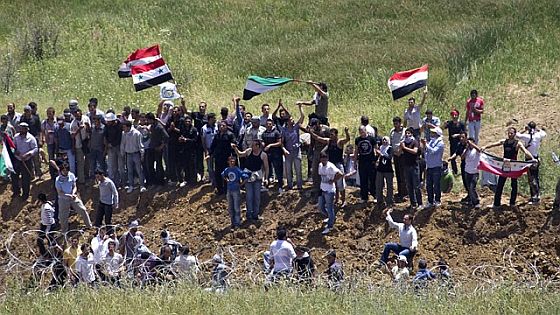
Israeli troops opened fire as protesters from Syria stormed a ceasefire line in the Golan Heights, killing 14 of the demonstrators.

Hundreds of protesters rushed towards the ceasefire line, cutting through a line of barbed wire as they tried to head into the Golan Heights in a repeat of demonstrations last month that saw thousands mass along Israel’s north.

Similar protests were held in the West Bank, where hundreds demonstrated at Qalandia checkpoint near Ramallah, and in the Gaza Strip, where several hundred more gathered in the north of the coastal enclave.

In Majdal Shams, on the occupied Golan, Israeli troops opened fire as demonstrators sought to push through the mined ceasefire line, which had been reinforced with several rows of barbed wire blocking access to a fence.

“Despite numerous warnings, both verbal and later warning shots in the air, dozens of Syrians continue to approach the border and IDF (Israel Defence Forces) forces were left with no choice but to open fire towards the feet of protesters in efforts to deter further actions,” an army spokesman told AFP.

Updating an earlier toll, Syrian state media reported that 14 people were killed, including a woman and child, and more than 220 wounded. The Israeli military said it was aware of 12 casualties, but gave no more details.

Haaretz reports:

Uri Avneri, former MK and activist with Gush Shalom left-wing organization, said Sunday that the IDF used excessive force against the protesters in the Golan Heights. “The trigger-happy behavior stands out in particular when compared to the softness with which violent settlers are treated,” he said.

Avneri conceded that a country has a right to defend its borders and prevent illegal entrance to its territory, yet added that “in order to effectively protect its borders, the state should first know where its borders are and have them recognized by the international community – and this is a decision which Israel has been avoiding for years.”

“A state that trespasses its neighbors’ borders, steals their land and erects settlements on them will have a hard time justifying actions taken to protect its own borders,” Avneri said. “Contrary to what Prime Minister Netanyahu says, only a recognized and agreed upon international border – that is, a border based on the 1967 lines – is a defensible border.”

Facebooktwittermail

Can equality exist in the Jewish state?

Kieron Monks writes:

In 2005, following the arrest of several high profile Arab politicians and lobbyists living in Israel, the Shin Bet security agency made a statement justifying their actions: “The security service will thwart the activity of any group or individual seeking to harm the Jewish and democratic character of the State of Israel, even if such activity is sanctioned by the law.”

The statement highlighted a fundamental tension between democratic freedom in Israel, and the need to maintain its Jewish character. Thwarting harm to that character has been extrapolated to require controls on Israel’s Arab minority in many departments of society, from education to the right of dissent. The need to ensure Jewish demographic and institutional domination has prompted a raft of controversial policies and practises.

The confilct is most revealing at the level of political representation. Israel can point to the presence of 11 Arab Knesset members out of 120 as evidence of its civil rights credentials. Proportionally this is a reasonably fair reflection of a minority that accounts for 18 per cent of Israel’s population; given that the Arab community habitually votes in lower numbers.

In practise, the mandate to represent Arab concerns dictates that they work against – rather than with – the rest of parliament. Knesset Member Haneen Zouabi of the Balad party is open about her role being fundamentally oppositional. “I was elected to speak for those who voted for me, not to reinforce the Zionist consensus,” she says. “My role is to represent injustice and to make it more visible.” Zouabi has long argued against the legitimacy of a Jewish state for allowing “institutionalised discrimination”, instead favouring “a bi-national state not based on ethnicity”.

She has suffered for her beliefs. After participating in the 2010 Gaza flotilla, aimed at breaking the Israeli siege, a seven to one majority voted to strip her of parliamentary privileges. Likud Knesset Member Danny Danon called for her to be tried for treason, and there were attempts to disqualify her party from elections. The hostility was so great that Zouabi was forced to travel with an armed escort. A year later she remains a pariah in parliament, branded a traitor and a terrorist-sympathiser.

Facebooktwittermail

Syria forces kill 70 in anti-Assad protests

Reuters reports:

Syrian forces killed at least 70 protesters on Friday, activists said, in one of the bloodiest days since the start of an 11-week revolt against the authoritarian rule of President Bashar al-Assad.

Tens of thousands of protesters took to the streets on Friday in defiance of security forces determined to crush the uprising, and some activists said the death toll could hit 100.

Rami Abdulrahman, head of the Syrian Observatory for Human Rights, said at least 60 people were killed in Hama, where Assad’s father Hafez crushed an armed revolt 29 years ago by killing up to 30,000 people and razing parts of the city.

A political activist in Hama said tens of thousands of people were attending the funerals of dead protesters on Saturday, and that more protests were planned later in the day.

“Anger is very high in the city, people will never be silent or scared. The whole city is shut today and people are calling for a three day strike,” the activist, who gave his name as Omar, told Reuters by phone from the city.

Zénobie, a journalist in Damascus, writes:

“From now on, no more fear!” (Ma fi khawf baad al-yawm!) chanted the people of Deraa, in southern Syria, on 18 May. State repression intensified, but the protestors rejected the culture of fear, and in many towns declared they were ready to die: “Martyrs are going to heaven in their millions”; “There is only one God, and God loves martyrs”; “Resist Banias, freedom is worth giving your life for” (Banias is the name of a port). Martyrdom was a theme in every region, expressed in a slogan currently popular in the Middle East: “With our souls, with our blood, we sacrifice ourselves for you, oh martyr.” To express solidarity with a town where many people have died, they chant another version: “With our souls, with our blood, we sacrifice ourselves for you, oh Deraa” (Bi-ruh bi-damm, nafdîk ya shahîd).

Every protest since March has called for freedom by twisting a slogan of the regime; so “God, Syria, Bashar – that’s all!” has become “God, Syria, freedom – that’s all!” Syria was under a state of emergency from 1963 until this April, so freedom is associated with democracy: “We demand freedom and democratic elections.” This transcends sectarian divisions: “Freedom, freedom, Muslims and Christians!”; “We are the partisans of freedom and peace”.

The latest style, which is high-flown, is meant to mark the dignity of the individual citizen. And you can hear the growing rumble of anger in: “Don’t insult the Syrian people” (Al-shaab al-suri ma byandhal).

Matyrdom cleanses humiliation and restores an individual as a person and a believer (virtues traditionally reserved for nationalist heroes and saints): “Better to die than be debased” (Al-mawt wa lâ-l-madhalleh). At the beginning of the intifada it was common to hear opposition supporters, at gatherings of friends or family, greet someone from Deraa or its region with: “You have raised our heads high” (Rafa’tu-l-na ra’sna).

Ordinary people have tried to respond to accusations of division, violence and conspiracy. They proclaim their support for pacifism and unity, and reject sectarianism: “One, one, the Syrian people are one!”; “In peace, Muslims and Christians, in peace. No to sectarianism!”; “No to violence, no to vandalism!”

Facebooktwittermail

Iran and the bomb

In “Iran and the Bomb,” Seymour Hersh writes:

Is Iran actively trying to develop nu-clear weapons? Members of the Obama Administration often talk as if this were a foregone conclusion, as did their predecessors under George W. Bush. There is a large body of evidence, however, including some of America’s most highly classified intelligence assessments, suggesting that the United States could be in danger of repeating a mistake similar to the one made with Saddam Hussein’s Iraq eight years ago––allowing anxieties about the policies of a tyrannical regime to distort our estimations of the state’s military capacities and intentions. The two most recent National Intelligence Estimates (N.I.E.s) on Iranian nuclear progress, representing the best judgment of the senior officers from all the major American intelligence agencies, have stated that there is no conclusive evidence that Iran has made any effort to build the bomb since 2003.

Despite years of covert operations inside Iran, extensive satellite imagery, and the recruitment of many Iranian intelligence assets, the United States and its allies, including Israel, have been unable to find irrefutable evidence of an ongoing hidden nuclear-weapons program in Iran, according to intelligence and diplomatic officials here and abroad. One American defense consultant told me that as yet there is “no smoking calutron,” although, like many Western government officials, he is convinced that Iran is intent on becoming a nuclear state sometime in the future.

Further into the article, Hersh writes:

The political stress between Washington and Tehran has promoted some unconventional thinking. A group of English diplomats and public officials have suggested thinking in terms of containing an Iranian bomb, and not in terms of getting rid of it. “We just don’t think the Iranians will deal with us,” a former senior adviser to the British Foreign Office told me. “We want to talk about nuclear bombs, and they talk about regional issues.” The officials at 10 Downing Street were amused by the initial optimism of the Obama Administration. “The President thought an initiative to talk about the bomb with Iran would work, and then he found it would not. And the U.S. had no Plan B.”

One of the worries is that Netanyahu “might take a pot shot” at Iran, as the former adviser put it. “Everything in London is now about containment and the notion that if the Iranians get a bomb we’ll have to live with it. I believe that the Iranians do understand the logic of nuclear deterrence, but the Israelis do not. London believes we cannot allow containment to be seen as a policy of failure”—in terms of a fallback policy for dealing with Iran. “And so we’re trying to shift the public perception of deterrence so it is seen as a good. The Brits are really concerned about the Israelis, and what they might do unilaterally.”

Hersh discusses the article on Democracy Now!

Hersh on the Arab Spring, “disaster” U.S. wars in Afghanistan and Pakistan, and the looming crisis in Iraq:

Facebooktwittermail