I have seen the moment of my greatness flicker,
And I have seen the eternal Footman hold my coat, and snicker,
And in short, I was afraid.
—T. S. Eliot, “The Love Song of J. Alfred Prufrock.”
Like so many of life’s varieties of experience, the novelty of a diagnosis of malignant cancer has a tendency to wear off. The thing begins to pall, even to become banal. One can become quite used to the specter of the eternal Footman, like some lethal old bore lurking in the hallway at the end of the evening, hoping for the chance to have a word. And I don’t so much object to his holding my coat in that marked manner, as if mutely reminding me that it’s time to be on my way. No, it’s the snickering that gets me down.
On a much-too-regular basis, the disease serves me up with a teasing special of the day, or a flavor of the month. It might be random sores and ulcers, on the tongue or in the mouth. Or why not a touch of peripheral neuropathy, involving numb and chilly feet? Daily existence becomes a babyish thing, measured out not in Prufrock’s coffee spoons but in tiny doses of nourishment, accompanied by heartening noises from onlookers, or solemn discussions of the operations of the digestive system, conducted with motherly strangers. On the less good days, I feel like that wooden-legged piglet belonging to a sadistically sentimental family that could bear to eat him only a chunk at a time. Except that cancer isn’t so … considerate.
Most despond-inducing and alarming of all, so far, was the moment when my voice suddenly rose to a childish (or perhaps piglet-like) piping squeak. It then began to register all over the place, from a gruff and husky whisper to a papery, plaintive bleat. And at times it threatened, and now threatens daily, to disappear altogether. I had just returned from giving a couple of speeches in California, where with the help of morphine and adrenaline I could still successfully “project” my utterances, when I made an attempt to hail a taxi outside my home—and nothing happened. I stood, frozen, like a silly cat that had abruptly lost its meow. I used to be able to stop a New York cab at 30 paces. I could also, without the help of a microphone, reach the back row and gallery of a crowded debating hall. And it may be nothing to boast about, but people tell me that if their radio or television was on, even in the next room, they could always pick out my tones and know that I was “on,” too.
Like health itself, the loss of such a thing can’t be imagined until it occurs. In common with everybody else, I have played versions of the youthful “Which would you rather?” game, in which most usually it’s debated whether blindness or deafness would be the most oppressive. But I don’t ever recall speculating much about being struck dumb. (In the American vernacular, to say “I’d really hate to be dumb” might in any case draw another snicker.) Deprivation of the ability to speak is more like an attack of impotence, or the amputation of part of the personality. To a great degree, in public and private, I “was” my voice. All the rituals and etiquette of conversation, from clearing the throat in preparation for the telling of an extremely long and taxing joke to (in younger days) trying to make my proposals more persuasive as I sank the tone by a strategic octave of shame, were innate and essential to me. I have never been able to sing, but I could once recite poetry and quote prose and was sometimes even asked to do so. And timing is everything: the exquisite moment when one can break in and cap a story, or turn a line for a laugh, or ridicule an opponent. I lived for moments like that. Now, if I want to enter a conversation, I have to attract attention in some other way, and live with the awful fact that people are then listening “sympathetically.” At least they don’t have to pay attention for long: I can’t keep it up and anyway can’t stand to.
Usually, when billionaires or millionaires give a large sum of money to a university, even a private one, they can specify where that gift will go — which department or function, facilities, new hires, dorms, or what have you. And it’s no secret that some of those big donations may lead to a little bit of wink-and-nudge affirmative action when it comes time for the little billionaires Jr. to apply to college.
But what these monied donors cannot do, what remains taboo in the academic world, is leverage that kind of gift to influence who gets hired and fired by the faculty and what they teach–until now, thanks to Charles G. Koch.
A recent op-ed in a Florida newspaper brought to light a shady deal by billionaire Koch, one of the Koch brothers, who donated a hefty million-dollar plus pledge to Florida State University, with some very big and ethically compromised strings attached.
According to the St. Petersburg Times‘ Kris Hundley’s thorough report:
A foundation bankrolled by Libertarian businessman Charles G. Koch has pledged $1.5 million for positions in Florida State University’s economics department. In return, his representatives get to screen and sign off on any hires for a new program promoting “political economy and free enterprise.”
Traditionally, university donors have little official input into choosing the person who fills a chair they’ve funded. The power of university faculty and officials to choose professors without outside interference is considered a hallmark of academic freedom.
Under the agreement with the Charles G. Koch Charitable Foundation, however, faculty only retain the illusion of control. The contract specifies that an advisory committee appointed by Koch decides which candidates should be considered. The foundation can also withdraw its funding if it’s not happy with the faculty’s choice or if the hires don’t meet “objectives” set by Koch during annual evaluations.
Again, to be clear, such conditional donations have been rejected by universities in the past, even when they were not political in nature.
David Ignatius writes: The ISI is, in the biblical phrase, a house with many mansions. What was known in one wing was not always shared with others. Indeed, if the ISI had transmitted information about sheltering bin Laden, U.S. intelligence almost certainly would have picked it up through surveillance.
Pakistani officials reject the allegation — rapidly becoming conventional wisdom in Washington — that they didn’t adequately pursue al-Qaeda. In interviews, they disclosed some new details that support their account. A U.S. official responded: “The Pakistanis indeed provided information that was useful to the U.S. government as it collected intelligence on the bin Laden compound. That information helped fill in some gaps.”
The Pakistani dossier starts with a joint CIA-ISI raid in the Abbottabad area in 2004, pursuing Abu Faraj al-Libi, often described as al-Qaeda’s No. 3 official. He was captured the next year in another joint operation in Mardan, west of Abbottabad.
The Pakistanis argue their telephone intercepts may have helped CIA analysts identify the courier who was sheltering bin Laden and trace him to the compound in Abbottabad. ISI officials, in particular, cite several calls in Arabic in 2009 that may have been crucial, including at least one from the general vicinity of Abbottabad.
Communications intercepts have always been crucial to U.S. operations against al-Qaeda. In some instances, such as wireless calls, the United States can collect signals unilaterally. But in intercepting some landline and Internet communications, the United States had secret official cooperation, according to a Pakistani source. The source says this led to the sharing of many hundreds of useful calls and numbers. (Washington Post)
William Saletan writes: One after another, elements of the U.S. account of Osama Bin Laden’s death have unraveled. First it was the human shields. Then the armed Bin Laden. Then the million-dollar mansion. Then the ongoing firefight.
Which parts of the story will unravel next? Here’s my guess: the 50-50 gamble and the improvised intelligence harvest.
The gamble has been a favorite administration theme. According to the official story, the CIA never had solid evidence that Bin Laden was in the Abbottabad compound. So President Obama had to go off by himself and make the tough call. He rolled the dice.
Sending U.S. ground troops into Pakistan did take guts. But the crux of the gamble story is that Bin Laden might not have been in the compound, in which case the raid would have been a risk for nothing.
A week ago, CIA Director Leon Panetta said his analysts had calculated a 60 percent to 80 percent chance that Bin Laden was in the compound. Then Obama, taping an interview for 60 Minutes, called it “a 55/45 situation.” Then National Security Advisor Tom Donilon went on the Sunday shows and claimed it had been “50/50.” As the number shrinks, the legend grows.
To convey the magnitude of the gamble, Obama asked 60 Minutes viewers to imagine the consequences if the SEALs had arrived at the compound to find that its occupant was a “prince from Dubai.” But that’s absurd. The CIA had found the compound by tracking Bin Laden’s couriers. It had studied the building and its inhabitants for months with satellite imagery, telephoto lenses, and eavesdropping devices. It knew that the men who owned and ran the compound were sons of a longtime Bin Laden associate and that their family had married into Bin Laden’s. And agency operatives had watched a third man—a tall man who never joined the other two men in their chores—take regular walks through an internal courtyard.
The only open question was the identity of the tall man. What the CIA knew for sure was that the compound and its inhabitants were linked to Bin Laden.
That’s important, because a major objective of the raid was to harvest intelligence from the compound. And that objective was attainable even if Bin Laden turned out not to be there. (Slate)
Spencer Ackerman writes: Osama bin Laden’s death was the end result of a massive investment in surveillance and spy tools that arose after the 9/11 attacks, designed to end the emergency that al-Qaida posed. But according to the chairman of the House intelligence committee, rolling back that huge security state after bin Laden’s death would not only miss an opportunity to destroy al-Qaida once and for all, it would effectively give bin Laden one last laugh.
“This is the time to step on the gas and break their back,” Rep. Mike Rogers, a Michigan Republican and former FBI agent, told the Council on Foreign Relations in a Wednesday speech. The choice, as he laid it out, is between ratifying the post-9/11 redefinition of liberty and security and getting attacked again.
“All the tools” of the security state created after the Twin Towers fell need to be retained, Rogers argued. The Patriot Act, whose most controversial surveillance provisions are to expire on May 27? Keep it. The doubling of intelligence cash, which now stands at $80 billion annually? Keep it. The explosion of drones and other spy technologies that “didn’t exist ten years ago?” Keep it all.
Rogers argued that lesson of the bin Laden raid is that ballooning the surveillance state paid off — and that scaling back spycraft just leaves the U.S. vulnerable. Back in the 1990s, the government viewed “the intelligence community as the opportunity for the peace dividend for the fall of the Soviet Union,” he said. “We see what a serious mistake that was.”
And there are even more spy advances on the horizon, Rogers said, like better methods for analysts to navigate the flood of drone and satellite data coming in every day. He didn’t give any specific examples, but the Air Force is building a supercomputer-in-sky inside a giant blimp that will crunch drone footage before beaming it down to soldiers on the ground.
Not many people are calling for an intelligence rollback — especially not right as a team of spies sifts through a trove of hard drives, removable media, recording devices and cellphones taken from bin Laden’s compound. Besides, al-Qaida these days is more of a global franchise of terror groups than a strict hierarchy. And it’s not like bin Laden’s former crew are the only terrorists on the block.
By contrast, Rogers’ remarks come as the House Armed Services Committee is considering a measure that would reauthorize and expand the war to unnamed affiliates of al-Qaida. But, some wonder, if bin Laden’s death doesn’t prompt a chance to reconsider the security state, whatever will? (Danger Room)
NATO carried out its most forceful attacks in weeks in Libya on Tuesday, part of an apparently coordinated push with rebel forces to bring an end to Moammar Gaddafi’s 41-year-long rule.
NATO warplanes pummeled command-and-control targets in four cities, including Tripoli and Gaddafi’s home town of Sirte. U.S. officials said NATO had increased the tempo of its airstrikes throughout the country, and members of the alliance spoke of improved targeting of dug-in loyalist forces, made possible in part by the presence of U.S. Predator drone aircraft.
The new assault appeared to reflect increased cooperation between NATO and the rebel army, allowing the rebels to make modest gains on the ground this week, particularly in and around the western city of Misurata. Although it was too early to tell whether the advances would mark a meaningful turning point in a conflict that has left the country divided since February, the progress “shows where the momentum lies,” said a European diplomat privy to NATO’s internal discussions.
“It is noteworthy that Gaddafi’s forces have not been able to mount a sustained attack for quite some time,” said the official, who spoke on the condition of anonymity to discuss ongoing military operations. He said the rebels’ recent success in Misurata was largely due to the fact that government troops had been forced to abandon entrenched positions, making them vulnerable to ground attack. (Washington Post)
leader Muammar Gaddafi has until the end of May to agree his exile before an arrest warrant from the International Criminal Court is issued, Italian Foreign Minister Franco Frattini said on Wednesday.
‘There are countries that in recent weeks have indicated… a willingness to welcome him,’ Mr Frattini said in an interview with RAI public radio.
‘It’s clear that if there is an international arrest warrant it would be more difficult to find an arrangement for the colonel and his family,’ he said.
‘This will happen by the end of May,’ he added.
Mr Frattini also said he believed there were ‘many defections’ from the regime underway, adding: ‘This shows we have probably arrived at a turning point.’ (AFP)
Three weeks ago, a traveler spotted a man’s body in the farmland on this city’s outskirts, shot twice in the head with his hands and feet bound. He had disappeared earlier that day, after visiting a market.
Ten days later, near the same spot, a shepherd stumbled upon the body of a second man, killed with a single bullet to the forehead. Masked, armed men had taken him from his home the night before, without giving a reason, his wife said.
The dead men, Nasser al-Sirmany and Hussein Ghaith, had both worked as interrogators for Col. Muammar el-Qaddafi’s internal security services, known for their brutality against domestic dissidents. The killings, still unsolved, appeared to be rooted in revenge, the families said, and have raised the specter of a death squad stalking former Qaddafi officials in Benghazi, the opposition stronghold.
The killings have unsettled an already paranoid city, where rebel authorities have spent weeks trying to round up people suspected of being Qaddafi loyalists — members of a fifth column who they say are trying to overthrow the rebels. If the violence continues, it will pose a stern challenge to a movement trying to present a vision of a new country committed to the rule of law, while potentially undermining hopes for a peaceful transition if Colonel Qaddafi surrenders power.
The rebels say their security forces are not responsible for the killings. Prosecutors here say they are investigating at least four attacks, including another murder in March, and they are exploring the possible involvement of Islamists who were imprisoned by the Qaddafi government and are now settling old scores. “It’s our responsibility to protect people,” said Jamal Benour, the justice coordinator for the opposition in Benghazi. “It’s important the killers are punished. The law is most important.”
But some here dismiss talk of Islamists, saying they believe the killings are being carried out by an armed group allied with the rebels, or possibly Qaddafi loyalists pretending to be. (New York Times)
Rebels in the contested western city of Misurata stormed the city’s airport on Wednesday afternoon, swarming over the grounds from the south and east and reclaiming it from the military of Col. Muammar el-Qaddafi.
Seizing the airport in Misurata, Libya’s third-largest city, which has been under siege for nearly two months, marked one of the most significant rebel victories in the Libyan conflict.
The airport and its approaches were the last remaining pieces of significant terrain in the city to be controlled by the Qaddafi soldiers. (New York Times)
Nick Clegg has backed a decision by the home secretary, Theresa May, not to open Britain’s borders to migrants fleeing the turmoil in Libya and North Africa.
Instead the Liberal Democrat leader said Italy should be offered practical assistance in helping those refugees and migrants who manage to complete the dangerous journey from Libya across the Mediterranean.
On Thursday May is to confirm Britain’s rejection of calls to take part in a European-wide “burden-sharing” scheme when she meets EU interior ministers in Brussels to discuss the north African situation. (The Guardian)
Simon Tsidall writes: Given the mad rush to war in Libya, when Britain and others suddenly decided Benghazi risked becoming the new Srebrenica, it is unsurprising that little or no thought was given to the seemingly unrelated question of sub-Saharan migration into the EU. But the law of unintended consequences is inexorable. What began as a quixotic fight in a faraway country has mutated into a life-or-death struggle on the tourist beaches of Europe. Apparently, nobody saw it coming.
The people dying in this war within a war are not Libyans, not the Gaddafi-ites, not the rebels. They are not the endlessly affronted residents of Lampedusa and other Italian and Maltese islands. Nor are they British or other Nato airmen. They are the people who always die first in such situations: the poor, the uneducated, the dark-skinned.
They are people from Eritrea and Somalia, from Chad and Niger, and from other sub-Saharan loser nations. And they are now being washed up daily on Europe’s shores, some just alive, others not so lucky – washed up in their hundreds and thousands, unknowing and blameless, the helpless collateral victims of the high-handed US-British-French decision to rid the world of Colonel Muammar Gaddafi and damn the consequences. (The Guardian)
Secret filming conducted by Al Jazeera has revealed shocking evidence of the brutal crackdown against pro-democracy protesters in the Gulf state of Bahrain.
An undercover investigation conducted by Al Jazeera’s correspondent, Charles Stratford, has unearthed evidence that Bahraini police carried out periodic raids on girls’ schools since the unrest began.
The government of Bahrain deployed security forces onto the streets on March 14 in an attempt to quell more than four weeks of protests.
A three-month “state of emergency” that was declared by King Hamad bin Isa Al Khalifa on March 15, is due to be lifted on June 1.
At the height of the protests, up to 200,000 people rallied against the government. The crackdown was an attempt to end the protests that demanded the end of the despotic rule of the Khalifah royal family.
In an interview “Heba”, a 16-year-old schoolgirl, alleges she, along with three of her school friends, were taken away by the police from their school and subjected to severe beatings while in custody for three consecutive days. (Al Jazeera)
Witnesses say Yemeni security forces and snipers have opened fire on thousands of anti-government protesters marching towars the cabinet building in Sanaa, the capital.
A doctor who treated some of the wounded said that at least one protester had been killed and dozens more wounded.
The doctor, who wished to remain anonymous, said that wounded protesters were still arriving at a field hospital where he was treating patients.
The protesters were calling for the resignation of Ali Abdullah Saleh, the country’s logtime president, when they came under fire on Wednesday. (Al Jazeera)
The adult sons of Osama bin Laden have lashed out at President Obama over their father’s death, accusing the United States of violating its basic legal principles by killing an unarmed man, shooting his family members and disposing of his body in the sea.
The statement said the family was asking why the leader of Al Qaeda “was not arrested and tried in a court of law so that truth is revealed to the people of the world.” Citing the trials of Saddam Hussein and Slobodan Milosevic, the statement questioned “the propriety of such assassination where not only international law has been blatantly violated,” but the principles of presumption of innocence and the right to a fair trial were ignored.
“We maintain that arbitrary killing is not a solution to political problems,” the statement said, adding that “justice must be seen to be done.”
The statement, prepared at the direction of Omar bin Laden, a son who had publicly denounced his father’s terrorism, was provided to The New York Times by Jean Sasson, an American author who helped the younger Bin Laden write a 2009 memoir, “Growing Up bin Laden.” A shorter, slightly different statement was posted on a jihadist Web site Tuesday. (New York Times)
India is ratcheting up pressure on Pakistan ahead of next week’s terrorism trial in the U.S., releasing a document that alleges the Inter-Services Intelligence spy agency was directly involved in the attacks on Mumbai in 2008.
The move comes as Pakistan is facing accusations from the U.S. and India that some element of the military must have helped hide al Qaeda chief Osama bin Laden, who was killed last week in a secret raid by U.S. Navy SEALs on a house only four kilometers from the elite Pakistan Military Academy in Abbottabad.
A court in Chicago will begin hearings this month in the trial of seven men alleged to have aided David Coleman Headley, the Pakistani-American who has pleaded guilty of scouting sites for the Mumbai attacks, which led to the deaths of more than 160 people, including six Americans. (Wall Street Journal)
India kicked off war games involving thousands of troops on Monday along its border with arch-rival Pakistan, which is still smarting from the US operation that killed Osama bin Laden.
A military spokesperson told reporters the six-day exercise, codenamed Vijayee Bhava (Be Victorious) was being held in the Thar desert region in the Indian state of Rajasthan.
“This exercise envisages sustained massed mechanised manoeuvres,” S D Goswami said, adding the drill involved an array of weaponry that India has acquired as part of its ongoing military modernisation programme.
More than 20 000 combat troops were taking part. (AFP)
In revelations that could further embarrass Pakistan, WikiLeaks has released a fresh set of US diplomatic cables that show how the country’s spy agency, the Inter-Services Intelligence (ISI), allowed militants to go to India to carry out strikes on targets chosen by the Pakistan army.
The revelations are part of nearly 800 interrogation reports of suspects held in Guantanamo Bay prison.
WikiLeaks, in one of the several cables that exposes ISI’s links to terror groups, quotes a US cable as saying that an Algerian Al Qaeda militant arrested in 2002 said that his mission was to “kill Indians in India”. (NDTV)
The US and Pakistan struck a secret deal almost a decade ago permitting a US operation against Osama bin Laden on Pakistani soil similar to last week’s raid that killed the al-Qaida leader, the Guardian has learned.
The deal was struck between the military leader General Pervez Musharraf and President George Bush after Bin Laden escaped US forces in the mountains of Tora Bora in late 2001, according to serving and retired Pakistani and US officials.
Under its terms, Pakistan would allow US forces to conduct a unilateral raid inside Pakistan in search of Bin Laden, his deputy, Ayman al-Zawahiri, and the al-Qaida No3. Afterwards, both sides agreed, Pakistan would vociferously protest the incursion.
“There was an agreement between Bush and Musharraf that if we knew where Osama was, we were going to come and get him,” said a former senior US official with knowledge of counterterrorism operations. “The Pakistanis would put up a hue and cry, but they wouldn’t stop us.” (The Observer)
Dozens of African migrants were left to die in the Mediterranean after a number of European military units apparently ignored their cries for help, the Guardian has learned. Two of the nine survivors claim this included a Nato ship.
A boat carrying 72 passengers, including several women, young children and political refugees, ran into trouble in late March after leaving Tripoli for the Italian island of Lampedusa. Despite alarms being raised with the Italian coastguard and the boat making contact with a military helicopter and a warship, no rescue effort was attempted.
All but 11 of those on board died from thirst and hunger after their vessel was left to drift in open waters for 16 days. “Every morning we would wake up and find more bodies, which we would leave for 24 hours and then throw overboard,” said Abu Kurke, one of only nine survivors. “By the final days, we didn’t know ourselves … everyone was either praying, or dying.”
International maritime law compels all vessels, including military units, to answer distress calls from nearby boats and to offer help where possible. Refugee rights campaigners have demanded an investigation into the deaths, while the UNHCR, the UN’s refugee agency, has called for stricter co-operation among commercial and military vessels in the Mediterranean in an effort to save human lives. (The Guardian)
The United Nations refugee agency has urged the crews of ships in the Mediterranean to keep watch for unseaworthy vessels carrying migrants from war-torn Libya after a report that a ship with 600 people on board broke up just off the port of Tripoli on Friday.
Witnesses in Tripoli said the ship was only 100 yards from shore when it broke up, Sybella Wilkes, a spokeswoman for the Geneva-based organization, said Monday. “It’s not clear how many people died or drowned,” she said, but 16 bodies — including those of two babies — had been recovered.
Refugees who left on another vessel later on Friday said they saw bodies and pieces of a ship in the water, said Laura Boldrini, a spokeswoman in Italy for the agency, the United Nations High Commissioner for Refugees.
Ms. Wilkes said there had been a “dramatic increase in the number of boats making this terrible journey,” as migrants, many of them from sub-Saharan Africa, tried to flee Libya’s turmoil, heading for sanctuary on the Italian island of Lampedusa. (New York Times)
The family photo albums, abandoned on the sand, lay open and fluttering in the desert wind. Around them were the personal items with which they had been packed: heaps of clothing, sandals, DVDs, combs, bottles of perfume, cooking utensils, razors, toothbrushes, several teapots, bundled blankets and a few biscuits, broken and dry. Every several yards a dropped suitcase rested on the dirt, looted bare.
War can strip those caught in its path to almost nothing, which is what happened to the people who had gathered here last Wednesday. They were African migrants caught in the conflict in Libya. They had long ago winnowed their meager possessions down, first to leave their small flats to move into tents, then to leave the tents to stand in line with a suitcase or two at this plot of bare desert, where they were told to wait for a ride to a ship. Here they stood until they ran. They dashed away so quickly and with such panic that they left behind the last things to which they had clung.
Like more than 10,000 other migrant workers in Misurata, they had been idled from work by the outbreak of war, and then cut off from routes overland toward home when the military of Col. Muammar el-Qaddafi put this city under siege. They had waited two months for an evacuation vessel to arrive in the city’s harbor and carry them out. (New York Times)
Rebel fighters made significant gains Monday against forces loyal to Col. Muammar el-Qaddafi in both the western and eastern areas of the country, in the first faint signs that NATO airstrikes may be starting to strain the government forces.
In the besieged western city of Misurata hundreds of rebels broke through one of the front lines late on Sunday, and by Monday afternoon were consolidating their position on the ground a few miles to the city’s west.
The breakout of what had been nearly static lines came after NATO aircraft spent days striking positions and military equipment held by the Qaddafi forces, weakening them to the point that a ground attack was possible, the rebels said.
While not in itself a decisive shift for a city that remained besieged, the swift advance, made with few rebel casualties, carried both signs of rebel optimism and hints of the weakness of at least one frontline loyalist unit. (New York Times)
The Syrian government has gained the upper hand over a seven-week uprising against the rule of President Bashar al-Assad, a senior official declared Monday, in the clearest sign yet that the leadership believes its crackdown will crush protests that have begun to falter in the face of hundreds of deaths and mass arrests.
The remarks by Bouthaina Shaaban, an adviser to Mr. Assad who often serves as an official spokeswoman, suggested that a government accustomed to adapting in the face of crises was prepared to weather international condemnation and sanctions. Her confidence came in stark contrast to appearances just two weeks ago, when the government seemed to stagger before the breadth and resilience of protests in dozens of towns and cities.
“I hope we are witnessing the end of the story,” she said in an hourlong interview, for which a reporter was allowed in Syria for only a few hours. “I think now we’ve passed the most dangerous moment. I hope so, I think so.” (New York Times)
The wife of Syrian dictator Bashar al-Assad may have fled to London with the couple’s three young children, it has been claimed.
Asma Assad, 35, was said to be living in a safe house in or near the capital.
British-born Mrs Assad, who is considered to be one of the most glamorous first ladies in the world, has not been seen in public since the start of the Arab Spring. (Daily Telegraph)
The European Union has listed 13 Syrian officials on the bloc’s sanctions list, including a brother and a wealthy and influential cousin of Bashar al-Assad, the president, and intelligence chiefs.
Maher al-Assad commands Syria’s Republican Guard and is considered the second most powerful man in the country.
The EU’s official journal, in which the full list was published on Tuesday, described Maher al-Assad as the “principal overseer of violence against demonstrators”.
The measures, asset freezes and travel bans, are part of a package of sanctions, including an arms embargo which went into effect on Tuesday, as part of EU efforts to try to force Syria to end violence against anti-government protesters. (Al Jazeera)
Harrowing testimony of torture, intimidation and humiliation from a doctor arrested in the crackdown on medical staff in Bahrain has revealed the lengths to which the regime’s security forces are prepared to go to quash pro-democracy protests.
Interviews obtained by The Independent from inside Bahrain tell of ransacked hospitals and of terrified medical staff beaten, interrogated and forced into signing false confessions. Many have been detained, their fate unknown.
Inspired by the pro-democracy protests which swept Tunisia and Egypt earlier this year, Bahrainis took to the streets in their thousands in February, demanding greater political rights and more equality for the Shia Muslim majority, ruled over for decades by a Sunni monarchy. (The Independent)
At least 30 people have died in Bahrain, protesters and medical workers are being put on trial, and prominent opposition politicians are being arrested—but the United States has yet to toughen its talk or impose sanctions on its Gulf ally.
Bahrain, a predominantly Shiite country ruled by a Sunni monarchy, plays host to the U.S. Navy’s Fifth Fleet. McClatchy reports today that the government has bulldozed dozens of Shiite mosques. Shiite women and girls have also been detained and abused, according to McClatchy. The State Department has said little about these matters publicly, except to tell McClatchy it’s “concerned by the destruction of religious sites” and is “extremely troubled by reports of ongoing human rights abuses” in Bahrain.
The Bahraini government announced last week it would charge nearly 50 doctors and nurses for treating injured pro-democracy protesters. We’d previously noted the government’s detention of medical workers along with protesters, activists and journalists. (ProPublica)
Wendell Steavenson writes: Last week an activist I know came to see me and showed me a series of pictures on his mobile phone: men throwing Molotov cocktails, blurred fireballs, and debris-strewn streets.
“Where was this?” I asked him, thinking they were pictures taken during the revolution. “Moski,” he said, naming a downtown area of Cairo known for its street traders, “a half an hour ago.” “I was nearly stabbed,” he added. Apparently two rival streets had gone to battle over some kind of shop-to-shop dispute, using rocks, bricks, and shotguns. Sixty people were injured. It happened the same day as a smallish crowd of pro-Mubarak supporters tried to celebrate his birthday outside of the state TV building (a favorite spot for demonstrations; soldiers use the first-floor balconies as watchtowers in case of serious trouble) and clashed with a rival crowd.
Yesterday, I went to a conference for parties and people hoping to form a broad umbrella committee to begin to address issues like the economy and the constitutional process during this interim period. I met Dr. Mohamed Ghonim, a wise, tortoise-looking man who is a famous kidney specialist and elder statesman of sorts for the liberal front of the revolution. He ruminated on the role of the Army, currently the de facto ruling authority. “As you know, security in general is bad. Every day there are two or three major things happening and nothing serious is done to contain these incidents. The economy is going in a negative way, downhill…”
I asked him if he thought that these incidents were being deliberately allowed to erupt.
“Of course. How can people stop the railway?” he asked, referring to the disruption in the upper Egyptian town of Qena at the end of April, when local people cut rail lines that link the north and south of the country, to protest the imposition of an unpopular governor. Ghonim said that law and order, in the hands of the military since the police are still not deployed in anything like their pre-revolutionary numbers, was being allowed to disintegrate, “Until you get to a critical point and then people say ‘oh please step in politically!’” (The New Yorker)
Hassan Nafaa writes: The tragedy at St. Marmina church in Imbaba on Saturday is not a new story. A young Muslim man from Asyut claims he married a Christian woman who converted to Islam five years ago, and that his wife’s brothers kidnapped her in recent months. The young man then claims he received a phone call that his wife is detained at an Imbaba church. The young man then goes to Imbaba and gathers a group of Muslims, most of them Salafis, from nearby mosques. Together they head to the church and instigated yet another incident of sectarian strife.
When the police learned of the gathering in front of St. Marmina church, they sought the assistance of Sheikh Mohammad Ali, a prominent local Salafi leader and a preacher at the nearby Toba mosque. Along with other religious leaders, Sheikh Ali went to the gathering outside the church and listened to the young man recount his story in the presence of some police officers. The sheikh did not buy the story and was especially skeptical about the fact that the young man did not file a police report immediately after the kidnapping. To Sheikh Ali, it appeared that someone was trying to incite sectarian tensions.
Sheikh Ali immediately told the protesters that the young Muslim man was lying. “Because they trust me, they believed me and began to chant: ‘Muslims and Christians are one,’” he said. Ali added that he accompanied an interior ministry official to the church to inform church leaders that the conflict was over.
“But Copts residing in nearby apartment buildings thought we were entering the church to search it, so they started to throw bottles at us. Then I heard gun fire and things escalated from there.”
Rumors quickly spread through the media and a group of young men in the area headed to an adjacent church and set it ablaze. Clashes broke out and by the end of the evening 12 people were dead and over 100 were injured.
There will be more rumors tomorrow about imaginary incidents of rape, theft, marriage, and divorce that will provoke both sides to engage in more violence to avenge the dignity of their religious group. Many will fail to see that their anger is unwarranted.
In all these cases, the solution is that suspected criminal – regardless political, sectarian or class affiliation – be subjected to a fair trial. Taking the law into our own hands to avenge crimes committed against our family, or sect deals a serious blow to the idea of a civilized society. (Al-Masry Al-Youm)
The US government has frozen the bank accounts belonging to Hatem Abudayyeh, a Palestinian community organizer and director of a social service organization serving the Arab community in Chicago, and his wife, Naima.
Meanwhile, several members of Congress have written to the Obama administration to express their concerns about violations in civil liberties as a result of earlier government actions toward Abudayyeh and other activists.
The freezing of the Abudayyeh family’s bank accounts on Friday, 6 May is the latest development in a secret grand jury investigation that has been launched by US District Attorney Patrick Fitzgerald’s office in Chicago. The freezing of the accounts has raised concerns that criminal indictments in the case may be imminent. (Electronic Intifada)
Glenn Greenwald writes: On Friday, government officials anonymously claimed that “a rushed examination” of the “trove” of documents and computer files taken from the bin Laden home prove — contrary to the widely held view that he “had been relegated to an inspirational figure with little role in current and future Qaeda operations” — that in fact “the chief of Al Qaeda played a direct role for years in plotting terror attacks.” Specifically, the Government possesses “a handwritten notebook from February 2010 that discusses tampering with tracks to derail a train on a bridge,” and that led “the Obama administration officials on Thursday to issue a warning that Al Qaeda last year had considered attacks on American railroads.” That, in turn, led to headlines around the country like this one, from The Chicago Sun-Times:
The reality, as The New York Times noted deep in its article, was that “the information was both dated and vague,” and the official called it merely “aspirational,” acknowledging that “there was no evidence the discussion of rail attacks had moved beyond the conceptual stage“ In other words, these documents contain little more than a vague expression on the part of Al Qaeda to target railroads in major American cities (“focused on striking Washington, New York, Los Angeles and Chicago,” said the Sun-Times): hardly a surprise and — despite the scary headlines — hardly constituting any sort of substantial, tangible threat.
But no matter. Even in death, bin Laden continues to serve the valuable role of justifying always-increasing curtailments of liberty and expansions of government power. (Salon)
David Axe writes: The early-morning raid that killed Osama bin Laden was, according to CIA Director Leon Panetta, “the culmination of intense and tireless efforts on the part of many dedicated agency officers.” Panetta also thanked the “strike team, whose great skill and courage brought our nation this historic triumph.”
But it’s unclear who was on the strike team — the 25 people aboard two specially modified Army helicopters. Most of the “trigger-pullers” were, apparently, Navy commandos from the famed SEAL Team Six.
At the “pointy end” — a Beltway euphemism for combat — the operation targeting bin Laden in Abbottabad, Pakistan, looked overwhelmingly military. But the months-long process of gathering intelligence and planning had a CIA flavor.
Indeed, President Barack Obama described it as agency-led. The intelligence community pinpointed bin Laden’s location. Panetta monitored the raid in real time from Langley. The assault team may have included CIA operatives. Senior administration officials called it a “team effort.”
But did the CIA have people on the ground in Abbottabad? It’s not an academic question. Exactly who was on the strike force that killed bin Laden has major policy implications.
CIA presence places the operation on one side of an increasingly fuzzy legal boundary between two distinct U.S. legal codes: one exclusive to the military and another that defines the terms of open warfare for the whole U.S. government.
The extent of the CIA’s involvement also has serious implications with regard to a chain of presidential executive orders that prohibit Americans from participating in the assassination of foreign leaders. (Politico)
White House has demanded that Pakistan hand over intelligence seized from Osama bin Laden’s compound as relations between the two allies hit a new crisis over the outing of America’s top spy in Islamabad.
Mark Carlton, the purported CIA station chief, was named by a Pakistani newspaper and a private television news network over the weekend, the second holder of that post in less than a year to have his cover blown by the media, presumed to have official consent.
The reports documented a meeting between Mr Carlton and the head of Pakistan’s spy agency, the Inter- Services Intelligence, suggesting that the information came from them.
Washington has refused to comment on the development, which comes amid worsening relations between the US and Pakistan over how bin Laden came to be sheltering in a fortified compound in a garrison town.
Anger is mounting in Pakistan over how the US was able to carry out the raid in Abbottabad without detection, with calls for the Government to resign. (The Times)
The prime minister’s statements, along with the publication of the name of the C.I.A. station chief, signaled the depths of the recriminations and potential for retaliation on both sides as American officials demand greater transparency and cooperation from Pakistan, which has not been forthcoming.
The Pakistani spy agency, Inter Services Intelligence Directorate, gave the name of the station chief to The Nation, a conservative daily newspaper, American and Pakistani officials said.
The name appeared spelled incorrectly but in a close approximation to a phonetic spelling in Saturday’s editions of The Nation, a paper with a small circulation that is supportive of the ISI. The ISI commonly plants stories in the Pakistani media and is known to keep some journalists on its payroll.
Last December, American officials said the cover of the station chief at the time was deliberately revealed by the ISI. As a result, he was forced to leave the country. (New York Times)
President Obama’s national security adviser demanded Sunday that Pakistan let American investigators interview Osama bin Laden’s three widows, adding new pressure in a relationship now fraught over how Bin Laden could have been hiding near Islamabad for years before he was killed by commandos last week.
Both the adviser, Thomas E. Donilon, and Mr. Obama, in separate taped interviews, were careful not to accuse the top leadership of Pakistan of knowledge of Bin Laden’s whereabouts in Abbottabad, a military town 35 miles from the country’s capital. They argued that the United States still regards Pakistan, a fragile nuclear-weapons state, as an essential partner in the American-led war on Islamic terrorism.
But in repeatedly describing the trove of data that a Navy Seal team seized after killing Bin Laden as large enough to fill a small college library, Mr. Donilon seemed to be warning the Pakistanis that the United States might soon have documentary evidence that could illuminate who, inside or outside their government, might have helped harbor Bin Laden, the leader of Al Qaeda, who had been the world’s most wanted terrorist.
The United States government is demanding to know whether, and to what extent, Pakistani government, intelligence or military officials were complicit in hiding Bin Laden. His widows could be critical to that line of inquiry because they might have information about the comings and goings of people who were aiding him. (New York Times)
It is the unknown frontline in Libya’s civil war, a rebel town besieged by Gaddafi’s forces but almost ignored by the outside world.
Rockets and Scud missiles pour down. Water is running short. Tens of thousands are desperately trying to flee.
But transfixed by the horrors of Misurata, the international community – and the Nato military alliance – have all but overlooked the closely parallel drama in the mountain towns of Zintan and Yafran, little more than an hour’s drive from the capital.
“We have been under fire for about an hour and a half now,” said one Zintan resident, Mustafa Haider, by telephone from the town on Friday afternoon.
“From the south, from the north, from the east, from everywhere. They fire with Grad missiles, Scud missiles, anything. They have tried to enter Zintan many times but they couldn’t.” Homes, schools, and the town’s main hospital had been hit, causing panic, he said. (Daily Telegraph)
Libya: end indiscriminate attacks in western mountain towns
Human Rights Watch says: Libyan government forces have launched what appear to be repeated indiscriminate attacks on mountain towns in western Libya, Human Rights Watch said today.
Accounts from refugees who fled the conflict say the attacks are killing and injuring civilians and damaging civilian objects, including homes, mosques, and a school. Human Rights Watch called on Libyan forces to cease their indiscriminate attacks on civilian areas.
Human Rights Watch interviewed more than 50 refugees from Libya’s western Nafusa mountains in Tunisia from April 26 to May 1, 2011, as well as doctors and aid workers assisting those in need. The refugees gave consistent and credible accounts of indiscriminate shelling and possible rocket attacks in residential areas of the rebel-controlled towns of Nalut, Takut, and Zintan. Human Rights Watch could not confirm the refugees’ accounts due to government restrictions on travel in western Libya but, taken together, they describe a pattern of attacks that would violate the laws of war.
Amnesty International says: At least 48 people have been killed in Syria by the security forces in the last four days, local and international human rights activists have told Amnesty International, as the crackdown on the coastal city of Banias intensified.
More than 350 people – including 48 women and a 10-year-old child – are also said to have been arrested in the Banias area over the past three days with scores being detained at a local football pitch. Among those rounded up were at least three doctors and 11 injured people taken from a hospital.
“Killings of protesters are spiralling out of control in Syria – President Bashar al-Assad must order his security forces to stop the carnage immediately,” said Philip Luther, Amnesty International’s Deputy Director for the Middle East and North Africa.
Amnesty International has compiled the names of 28 people who were apparently shot dead by security forces on Friday and those of 12 others killed over the last three days.
The organization now has the names of 580 protesters and others killed since mid-March, when protests against the government of President Bashar al-Assad began.
The Syrian government is continuing its weeks-long crackdown on anti-government demonstrations, arresting opponents and deploying troops in protest hubs.
Rami Abdul-Rahman, director of the Syrian Observatory for Human Rights, said security forces were carrying out house-to-house raids targeting demonstration organisers and participants.
He said Monday’s raids were focused in the central city of Homs, the coastal city of Baniyas, some suburbs of the capital, Damascus, and villages around the southern flashpoint city of Deraa.
Live Blog Syria
Another activist said gunfire was heard in the town of Moadamiya, just west of the capital, Damascus, as troops carried out arrests. (Al Jazeera)
Ten years ago, as the main thrust of Egyptian society and the legal sphere was moving towards amending the constitution to make it more democratic and just, the collective brain of the regime’s inner circle was working in the opposite direction: twisting laws to fit the interests of the inner few — the oligarchs who had both wealth and political influence.
Steel magnate Ahmed Ezz, who is facing trial Today, Saturday, on charges of illegal profiteering and misuse of public funds, along with dozens of businessmen and officials considered to be close to the ousted regime, perfectly represents the marriage of wealth, party politics and undue power. Ezz became one of the first symbols that the Egyptian people decided to bring down after the January 25 Revolution.
On the night of 28 January, the headquarters of Ezz Steel in the Mohandeseen district was destroyed, along with other government headquarters and police stations, symbolising the downfall of the old regime.
“At the time he came to buy Alexandria National Iron and Steel Company (now Al-Ezz Al-Dekheila Steel Company) we had never heard of Ahmed Ezz,” said Ali Helmy, former chairman of the National Iron and Steel Company.
“The first time I met Ezz was in 1999 when Atef Ebeid, minister of the public enterprise sector at that time, invited managers of steel companies for a business dinner at a small factory in Sadat City producing galvanised iron,” recounted Helmy. “We were introduced to Ezz, a young engineer and owner of the factory.”
A few months later, continues Helmy, Ezz has already bought three million shares, accounting for LE456 million ($76.7 mln), of the Alexandria National Iron and Steel Company, and after a few months, he was appointed chairman of the company: first base for what would later become a great empire.
Ezz was born in 1959 to a family that was wealthy but not overly rich. After having graduated from the Faculty of Engineering at Cairo University in the mid-1980s, he worked as a percussionist in one of the most famous music bands at that time, Moudy and Hussein. At the time, Ezz had shown no interest in business until in 1995 his father, a steel trader, bought him a small plot of land in Sadat City and helped him build a steel factory.
His friendship with Gamal Hosni Mubarak, son of Egypt’s then president, helped to make his fortune, culminating in the buying of a huge amount of shares in Gamal’s 1998 Future Generation Foundation (FGF), a non-profit organisation that provided courses for young people to prepare them for entry to the workforce.
Several leading figures in Egypt‘s private sector, including Ahmed El-Maghrabi, former minister of tourism, and Rachid Mohamed Rachid, former minister of trade and industry were involved, and both now face trial.
From that point on, Ezz accompanied Gamal to all meetings and despite being a newcomer to politics, gradually became a familiar political face.
In 1999, the Alexandria National Iron and Steel Company faced a financial crisis due to dumped steel imports from Ukraine and other Eastern European countries coming into Egypt. Ezz quickly offered to buy shares in the troubled joint stock company. “For some reason, the biggest figures in the government helped Ezz finalise this deal,” said Helmy.
According to a 2007 report on Strategic Economic Trends by Al-Ahram Centre for Political and Strategic Studies, In 1999, Ezz bought some 540,000 shares in less than a month. Ezz had seized more than three million shares of the company, accounting for 27.9 per cent of total shares.
By the late 1990s, Ezz started his acquisition move in the steel market, through a strategy of taking loans from the biggest banks to buy shares in steel companies.
In 1999, Ezz was appointed chairman of the National Iron and Steel Company, despite the fact that he hadn’t paid back the loans he had taken from Egypt’s major banks, according to the same report.
“The National Bank of Egypt and Bank of Cairo (Egypt’s largest public banks) favoured Ezz because of his relationship with Gamal Mubarak and helped him get the loans, while denying credit to viable businesspeople who lacked the right political pedigree; they had for instance refused to issue loans for the same company bought by Ezz (Alexandria National Iron and Steel Company) a few months earlier to help it get out of its devastating financial crisis,” said Helmy.
“Ezz’s strategy from that time on was to take loans from Egyptians banks, buy shares and take a greater role in the steel market, but the thing is, he never gave a loan back. He would pay older loans by getting new loans,” elaborates Helmy. (Ahram Online)
Ali Abunimah writes: By deciding to join the US-backed Palestinian Authority led by Mahmoud Abbas, Hamas risks turning its back on its role as a resistance movement, without gaining any additional leverage that could help Palestinians free themselves from Israeli occupation and colonial rule.
Indeed, knowingly or not, Hamas may be embarking down the same well-trodden path as Abbas’ Fatah faction: committing itself to joining a US-controlled “peace process”, over which Palestinians have no say – and have no prospect of emerging with their rights intact. In exchange, Hamas may hope to earn a role alongside Abbas in ruling over the fraction of the Palestinians living under permanent Israeli occupation in the West Bank and Gaza Strip.
Whether Hamas realises it or not, it has effectively entered into a coalition with Israel and Abbas to manage the Occupied Territories, in which Hamas will have much responsibility, but little power. (Al Jazeera)
Saeed Kamali Dehghan writes: No Iranian president has ever dared to challenge the supremacy of Ali Khamenei’s two-decade-long leadership as publicly as Mahmoud Ahmadinejad did recently in an extraordinary power struggle between him and the ayatollah.
The unprecedented confrontation at the top of the Iranian regime began only a month ago when Khamenei, the supreme leader, intervened in a cabinet appointment by reinstating a minister who had initially resigned “under pressure from Ahmadinejad”.
In reaction to the reinstatement of Heydar Moslehi, the intelligence minister at the centre of the row, Ahmadinejad apparently staged an 11-day walkout from the presidential palace and refused to chair cabinet meetings.
At first glance, Ahmadinejad’s feud with the ayatollah seemed like a conventional disagreement between two leaders of one country but in Iran, where Khamenei is described as “God’s representative on Earth”, Ahmadinejad’s opposition was extremely serious. (The Guardian)
Osama bin Laden warned in his final audio tape recorded before being killed by American commandos there will be no US security before the Palestinians live in security, an Islamist website reported Sunday.
Addressing US President Barack Obama, he said: “America will not be able to dream of security until we live in security in Palestine. It is unfair that you live in peace while our brothers in Gaza live in insecurity.”
“Accordingly, and with the will of God, our attacks will continue against you as long as your support for Israel continues,” he warned in a message posted on Shamikh1.net, a conduit for Al-Qaeda communications.
The founder of Al-Qaeda said he had tried to send a “message” to the United States through Nigerian Umar Farouk Abdulmutallab, who tried to explode a bomb on a Detroit-bound US airliner in December 2009.
“If it were possible to send you messages by way of words, we would not have had to use planes to send them to you,” he said.
“So the message we wanted to convey through the plane of our hero, the fighter Umar Farouk, may God be with him, confirms a previous message which had been sent to you by our heroes of September 11,” he said in a clear reference to the September 11, 2001 attacks against the United States.
The audio recording lasting 1.02 minutes had no reference to the recent popular Arab uprising.
However, jihadists had said that the tape, made a week before bin Laden’s death, would have a message for the Arab Spring.
Another branch of the terror network, Al-Qaeda in the Islamic Maghreb (AQIM), gave bin Laden credit for the popular Arab revolutions and asked followers to turn their “grief into action” against the West.
“Do not cry for him… Instead rise and go on his path… Rise and thwart the American Zionist Western unjust aggression with all of your power and energy,” the AQIM said in a statement.
“These events that are storming through the Arab region are only a fruit among the fruits of jihad in which the Sheikh (bin Laden) had a prominent role,” the AQIM said. (AFP)
There’s little sign of an end to the conflict in Libya, nearly two months after Western fighter jets began bombing leader Moammar Gadhafi’s forces. The disorganized anti-Gadhafi rebels have been unable to break out of their stronghold of Benghazi in eastern Libya despite the air support.
With signs of a military deadlock, some in the West are calling for a renewed focus on isolating the Libyan dictator financially and politically. But NATO commanders leading the war effort caution patience and insist there has been more progress than meets the eye.
Everything points to a prolonged stalemate in Libya. In the east, the front is static: Gadhafi’s forces are dug in near the important oil ports of Brega and Ras Lanuf. In the west, the dictator’s forces are shelling the town of Zintan and are in firm control of Tripoli, the capital. In Misrata, the rebel’s main western enclave, Gadhafi’s forces still control the airport and all access to the city except the port, which Gadhafi has tried to mine and which he sporadically shells with heavy artillery.
But to U.S. Air Force Maj. Gen. Mark Ramsay, the glass is half full. NATO’s chief of operations and intelligence says Gadhafi now is unable to effectively command his forces in the field. Take communications: Gadhafi, he says, now has to use unsecured phones and couriers.
“He has to resort to all sorts of measures that no military professional wants to resort to,” Ramsay says. “I wouldn’t say he’s in the 1860 cavalry mode, but it’s getting pretty close to that.” (NPR)
Military forces loyal to Col. Muammar el-Qaddafi struck the fuel terminal of this rebel-controlled city early Saturday with ground-to-ground rockets, igniting a fire that threatened the city’s fuel supply.
The barrage struck shortly after midnight, when rockets began landing and exploding in several areas of the terminal, officials there said.
At least one rocket hit a set of three mammoth tanks, which ruptured and burst into a fireball. The fire settled into a leaping blaze that towered overheard, visible for miles. Its glow illuminated the eastern section of the city throughout the night. Residents woke to a thick, drifting cloud of black smoke.
The attack on the terminal was another escalation against the besieged city, and the second pinpoint attack by Colonel Qaddafi’s forces in two nights.
Residents woke Friday to the news that Misurata’s port, its only lifeline to the outside world, had been peppered with antitank land mines.
At the fuel terminal, a small contingent of firefighters worked throughout the night and the day trying to contain the fire, which had destroyed all three storage tanks in one section of the terminal, but had not spread.
“We want to protect the other tanks from exploding,” said Mufta Youssef, one of the firefighters, after backing away from the containers’ blackened remains for a break from the heat.
No one was wounded in the attack or the firefighting effort, officials said.
The tanks contained diesel fuel and gasoline — each roughly 6,000 cubic meters, or 1.5 million gallons — said Muftah Bazina, the terminal’s director.
The effect on the city’s energy supply was not immediately apparent. Misurata has been cut off from new sources of fuel since the uprising against the Qaddafi government began in February. But it began the siege with large reservoirs of diesel fuel and gasoline, and so far there have not been shortages. (New York Times)
How do you teach in schools where history books omitted revolutions, geography books had few maps and children learned never to question authority?
Libyan rebels are having to come up with responses to those and related issues as they try to reopen schools in rebel-held Benghazi where in the past much of the curriculum was devoted to the wisdom of longtime ruler Colonel Muamma Gaddafi.
Before the uprising against him began in February, “Mushtama” and “Fikr-al-Jamahiri” weekly lessons based on the Gaddafi doctrine were mandatory and the leader’s thinking permeated everything from history to Arabic textbooks, rebels say.
Schoolchildren studied insights from Gaddafi’s Green Book, which famously includes lines like “Women menstruate every month or so, while men, being male, do not” and were quizzed on topics like “Why was Gaddafi’s 1969 revolution successful?”
The correct answer to that, students learned, lay in four points, the first point being that it was planned in secret.
“It was really shameful that you had to memorise and repeat all the things it said as if you were convinced of it,” said Brayka Tarhouni, a doctor who was told to repeat her second year of university after passing all her medical subjects but failing Fikr-Al-Jamihiri.
Those subjects will no longer be taught when schools reopen, but rebel officials said there is much more to overhaul.
“My son in fourth grade was being taught about the Stone Age in history class,” said Hanal el-Gallal, who oversees education issues for the local council in the rebel base of Benghazi.
“History was completely distorted. If you ask any Libyan about historical events, they wouldn’t know about it.
“They don’t know anything about World War One, World War Two or the French Revolution. He (Gaddafi) was scared of any story that might make people stand up for their rights.” (Reuters)
Egypt’s military rulers have detained 190 people in connection with the clashes between Muslims and Christians in Cairo in which at least 12 people have been killed and more than 230 others wounded.
The situation remained tense on Sunday, a day after violence first erupted in the Egyptian capital’s northwestern neighbourhood of Imbaba.
Witnesses said the clashes broke out after a mob of ultraconservative Muslims marched on a Coptic Christian church in Imbaba.
The march began over an apparent relationship between a Coptic woman and a Muslim man, amid reports that the woman was being held inside against her will and prevented from converting to Islam.
The verbal clash soon developed into a full-fledged confrontation where the two sides exchanged gunfire, firebombs and stones, and another church nearby was set on fire. (Al Jazeera)
Two Muslim religious leaders were asked to leave a commercial airliner in Memphis – and were told it was because the pilot refused to fly with them aboard.
Masudur Rahman and another imam had already been allowed to board their Delta Connection flight from Memphis, Tennessee, to Charlotte, North Carolina before they were asked to get off the plane.
Ironically, the two men were headed to a North American Imams conference discussing Islamophobia or fears of Islam and discrimination against American Muslims.
Racism? Masudur Rahman and Mohamed Zaghloul were removed from a flight to North Carolina because the pilot did not want to fly with them
‘It’s racism and bias because of our religion and appearance and because of misinformation about our religion.’ Mr Rahman said. ‘If they understood Islam, they wouldn’t do this.’
Mr Rahman said he and Mohamed Zaghloul, of the Islamic Association of Greater Memphis, were cleared by security agents and boarded the plane for an 8.40am departure.
The aircraft pulled away from the gate, but the pilot then announced the plane must return, Mr Rahman said.
When it did, the imams were asked to go back to the boarding gate where they were told the pilot was refusing to accept them because some other passengers could be uncomfortable. (Daily Mail)
As Barack Obama continues his campaign of targeted killing — this time with a failed attempt to assassinate the American-born cleric, Anwar al-Awlaki, in Yemen — many Israelis regard this as a vindication of their own approach to eliminating their enemies.
As far as Jerusalem is concerned, President Barack Obama’s decision to assassinate Osama bin Laden constitutes a declared, if delayed, acknowledgment on the part of the Americans of the Israeli argument that targeted attacks on senior members of organizations are a necessary modus operandi in the struggle against terrorism. According to former director of Military Intelligence Maj. Gen. (res. ) Aharon Ze’evi-Farkash, bin Laden’s assassination reflects the administration’s understanding that it is impossible to separate the leader from the operational stratum below him.
The way the operation was carried out in Pakistan also carries significant implications for the objective of deterrence – not only in terms of the meticulous collection of intelligence and the impressive performance by the forces involved, but also with regard to the decision to dispatch a ground force and not carry out a remote-controlled aerial attack. The “close-up” assassination deprived the terrorist organizations, from Hamas to Al-Qaida, of the ability to claim that the West is cowardly and afraid to endanger its people in face-to-face combat. The methods used also helped avoid the killing of noncombatants and, of course, made it possible for the administration to ascertain that bin Laden had indeed been killed, though there will always be those who claim it was an American trick. The United States, for its part, is exempt from at least one Israeli concern: No one is about to send Obama and his officers to The Hague.
Maj.-Gen. Yoav Galant, the former head of the IDF’s Southern Command, spoke this week – for the first time publicly since the government retracted its decision to appoint him chief of staff – about the significance of assassinations in reference to bin Laden’s killing.
“Those who say that these operations don’t have an impact are mistaken,” said Galant, who personally participated in such operations as a longtime navy commando and later as head of the Southern Command. “The liquidation of terror leaders prevents terror attacks and influences the organizations.”
There are two categories of targets killed this way. The first is field operatives, people like Hezbollah’s military commander Imad Mughniyeh, reportedly killed by Israel in 2008 in Damascus, or Ali Mahmoud Mabhouh, the Hamas weapons smuggler reportedly killed by Israel in Dubai in 2010.
Their deaths are believed to have dealt critical blows to their respective organizations, to the point that over three years later, Israel still believes Hezbollah has yet to find an appropriate replacement for Mughniyeh.
Then there are symbolic figures whose assassination can have an effect on a terrorist group. This was the case in 2004 with the assassination of Sheikh Ahmed Yassin, the wheelchair-bound Hamas spiritual leader who was killed by an IAF missile as he left a mosque in the Gaza Strip.
Bin Laden’s death resembles Yassin’s in this respect, since while he was a leader at one point of a clear hierarchical organization, in the years since the 9/11 attacks, he has served more in the position of symbolic figurehead.
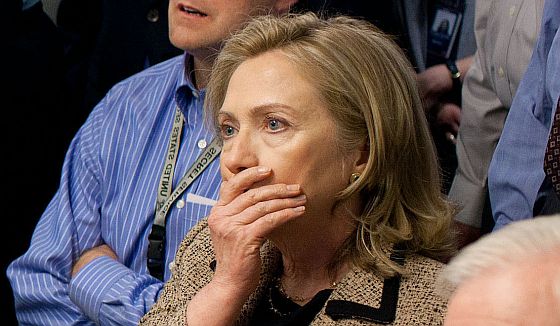
Hillary Clinton witnessing the operation to kill Osama bin Laden. Is this an expression of horror at the sight of seeing parents executed in front of their children?
Osama bin Laden’s daughter cradled the head of her wounded mother in the room where the al-Qaida leader had just been killed.
“I am Saudi,” she told Pakistani security officials shortly after US special forces had flown away with the terrorist’s bloodied body. “Osama bin Laden is my father.”
The 12-year-old had herself been injured by a piece of flying debris in her foot or ankle during the night-time raid on Bin Laden’s compound in Abbottabad, northern Pakistan, but she was comforting her father’s fifth wife, Amal Ahmed al-Sadah, 29, who was shot in the calf by commandos as they closed in on Bin Laden.
The woman lay quietly, her head in the girl’s lap, though she seemed conscious, the officials told the Guardian. Across the room stood another woman, hands tied behind her back and mouth taped, aged around 30 and possibly Bin Laden’s doctor from Yemen.
The tip on bin Laden’s whereabouts came in back in 2010. You have to assume the house was under surveillance. If they thought they “bagged him” they would be watching closely and choosing the right time to deep six the target (I actually wrote this lead paragraph sentence before reading this “Breaking News” from the Washington Post: “CIA had secret outpost in Abbottabad”).
“The CIA maintained a safe house in the Pakistani city of Abbottabad for a small team of spies who conducted extensive surveillance over a period of months on the compound where Osama bin Laden was killed by US special operations forces this week (US officials),” the newspaper reported.
Both Afghan agents and Pakistani intelligence now say they told the US about the house as early as 2009.
So, they knew he was there. That was a reason drones weren’t used.
The CIA wanted a more controlled high profile and dramatic intervention for public consumption, for what, in the end, was a marketing campaign – marketing the centrality of the agency’s role in a war whose main audience is not on the battlefield, but in the homeland.
They needed a heroic narrative to revive support for a war they have been losing, and a scalp to sell to a conflict-weary and disillusioned population. It is no surprise that the Seals labelled OBL “Geronimo”, reviving memories of fighting guerrilla-style Indian wars. Muslim renegades are apparently our new “savages”.
Consider the following scenario. A group of Irish republican terrorists carries out a bombing raid in London. People are killed and wounded. The group escapes, first to Ireland, then to the US, where they disappear into the sympathetic hinterland of a country where IRA leaders have in the past been welcomed at the White House. Britain cannot extradite them, because of the gross imbalance of the relevant treaty. So far, this seems plausible enough.
But now imagine that the British government, seeing the murderers escape justice, sends an aircraft carrier (always supposing we’ve still got any) to the Nova Scotia coast. From there, unannounced, two helicopters fly in under the radar to the Boston suburb where the terrorists are holed up. They carry out a daring raid, killing the (unarmed) leaders and making their escape. Westminster celebrates; Washington is furious.
What’s the difference between this and the recent events in Pakistan? Answer: American exceptionalism. America is subject to different rules to the rest of the world. By what right? Who says?
Consider another fictive scenario. Gangsters are preying on a small mid-western town. The sheriff and his deputies are spineless; law and order have failed. So the hero puts on a mask, acts “extra-legally”, performs the necessary redemptive violence and returns to ordinary life, earning the undying gratitude of the local townsfolk, sheriff included. This is the plot of a thousand movies, comic-book strips, and TV shows: Captain America, The Lone Ranger, and (upgraded to hi-tech) Superman. The masked hero saves the world.
Films and comics with this plot-line have been named as favourites by many presidents, as Robert Jewett and John Shelton Lawrence pointed out in The Myth of the American Superhero and Captain America and the Crusade Against Evil. The main reason President Obama has been cheered to the echo across the US, even by his bitter opponents, is not simply the fully comprehensible sense of closure a decade after the horrible, wicked actions of September 11 2001. Underneath that, he has just enacted one of America’s most powerful myths.
The Palestinian factions have reached a power-sharing deal – albeit a fragile one. Regional developments helped, affecting the calculations of both Fatah and Hamas. The role of post-Mubarak Egypt and its emerging independent regional policy cannot be underestimated. Israel’s current government, though, is key to the glue binding Fatah and Hamas together. While the peace process has long been moribund, the Netanyahu government’s refusal to indulge in the make-believe of possible progress rendered obsolete even Fatah’s well-honed capacity to suspend disbelief.
Yet if the deal is to last, the Palestinian factions will eventually have to address substance: their national goals and the strategies to be pursued in attaining them. A real political dialogue will force both Fatah and Hamas out of their respective comfort zones. Fatah will have to elaborate a post-negotiation and (one imagines ) non-violent plan for freedom, and decide how such a plan co-exists or breaks with existing donor and international relations, including coordination with Israel. Hamas will have to confront the requirements of international law (including abandoning the use of violence against civilians ), and ultimately resolve its own verbal acrobatics regarding a Palestinian state alongside Israel – if a serious deal becomes available.
Not surprisingly, unity is also popular in Israel. Israeli unity that is. Palestinian unity has been met with almost blanket condemnation at the political level. But in reacting to Palestinian developments, we Israelis should first of all be asking what the problem is that we need to address. For the Netanyahu government that major problem, apparently, is Israel’s international image and the prospect of pressure being exerted on Israel to advance peace. In the community of nations, Israel’s standing has further plummeted under the tutelage of Foreign Minister Avigdor Lieberman. The intra-Palestinian deal therefore offers a delightful opportunity for Israel to register some big points on the “Who’s to blame for no peace?” scorecard and to fend off any such pressure.
Israel’s challenge, though, goes way beyond public relations. Israel’s challenge is how to adapt, shape and secure its future in this region.
For that reason alone, we would benefit from our own national reconciliation dialogue, one focused on what Israel’s aspirations and strategies should look like.
As tectonic plates shift around us, Israel is clinging to an illusion, namely that when and if the Palestinians are ready, Israel will be able and willing to deliver a dignified two-state solution. The truth is less comforting. Currently there is no political path to an Israeli governing majority that could deliver a mutually acceptable two-state outcome. And there is no status quo: Israel’s predicament is deteriorating, not stable. It is time for Israel to engage in the exercise that Palestinians have begun, and to ask what it is that we really want for ourselves.
Military forces loyal to Col. Muammar el-Qaddafi scattered antitank land mines on the port of this besieged city late Thursday night, threatening once more to close the city’s only route for evacuation and supplies, according to accounts of witnesses, photographs and physical evidence collected on the ground.
The land mines were delivered by a Chinese-made variant of a Grad rocket that opens in flight and drops mines to the ground below, each slowed slightly and oriented for arming by a small green parachute, according to an identification of the sub-munitions by specialists who were provided photographs and dimensions of the weapons.
The mines hit the port at 9 or 10 p.m. Thursday, after rockets were heard being fired on the city from the southeast. A short while later, a truck driven by rebels who were patrolling the harbor struck two of them. Both men inside were wounded, according to a port supervisor and one of the victims, Faisal el-Mahrougi, the driver.
Officials and guards said more than 20 mines were distributed in the attack, and remains of at least 13 were observed firsthand. It was not possible to verify an exact number, as many had been destroyed by rebels who, to clear the mines, shot them with rifles, causing them to explode. By nightfall on Friday, the port appeared to have been cleared.
Attacks by forces loyal to Colonel al-Gaddafi on civilian and residential areas of Misratah may amount to war crimes, Amnesty International said today in a new report on the bleak situation in the besieged city.
Misratah: Under Siege and Under Fire [PDF] accuses al-Gaddafi forces of unlawful killing of civilians due to indiscriminate attacks, including use of heavy artillery, rockets and cluster bombs in civilian areas and sniper fire against residents.
It also documents systematic shooting at peaceful protesters and enforced disappearance of perceived opponents, which can amount to crimes against humanity.
Of all the generalizations commonly made by foreign observers and subjectively augmented by Gaddafi about Libya, especially during the people’s present remarkable quest for freedom and democracy, one of the least valid is that tribalism is pervasive in the Libyan society and its politics.
Characteristically, Libya is the most homogeneous, both culturally and religiously, in Africa and the Arab world. The tribal structure is merely a social phenomenon and has no fundamental importance aside from being only a thing of the past, a part of the cultural lore of the people and their history.
There is no lack of effective sense of national unity in Libya. This unity has been formally initiated by Independence and the establishment of a constitutional monarchy and subsequently preserved by astute political awareness on the part of the citizens and a deep sense of common destiny. Thus, conscious of their identity as an independent political unit, the Libyan people all over the liberated regions of the country are relentlessly and genuinely sounding their voice in their peaceful demonstrations nowadays that “Libya is one nation, one clan, one family” and that the myth of tribalism exists only in the mind of the dictator and his few deceived followers.
Furthermore, the appearance and amazing proliferation of the constitutional flag, the symbol of national independence, fluttering almost everywhere in great numbers and shapes, bear unmistakable witness to such unity.
Security forces fired on demonstrators in six Syrian towns and cities in a day of protests that activists declared a “Friday of Defiance.” Twenty-six people died, but a withering crackdown subdued the most restive town and prevented many protesters from gathering in larger demonstrations, activists and human rights groups said.
The worst violence was reported in Homs, Syria’s third largest city, where activists described a chaotic, bloody day, as tanks entered the town. The government said 10 soldiers had been killed there by what it described as “terrorists,” while activists said at least 9 soldiers had defected to their side. Sixteen protesters were killed, they said.
“We answered the call to protest today, but the intelligence forces attacked us right away by opening fire on us,” said a resident in Homs, reached by telephone.
Another resident there said the security forces fired without provocation.
“They took us by surprise,” he said by phone, over the sound of gunfire.
Both sides in the seven-week struggle claimed victories of sorts on Friday. Thousands of demonstrators gathered again in dozens of towns and cities, despite the government’s deployment of security and military forces from the Mediterranean coast to the steppe in southern Syria. But the crackdown seemed to have slowed the force of the protests, and even some of the government’s opponents acknowledged that crowds may have been smaller than on past Fridays.
While most of America is celebrating the death of Osama bin Laden, it’s worth giving credit where credit is due: he didn’t just nurse a quixotic ambition — to attack the US economy — but he also figured out how it could be done and succeeded. Perhaps he was inspired by the AIDS virus and realized that, just like triggering a deadly auto-immune reaction, the only way to attack America was to trick the US government into conducting and expanding the attack itself.
In a clear-eyed analysis of the cost of the massive convulsion called a global war on terrorism, the National Journal makes one mistake — the headline: “The Cost of bin Laden: $3 Trillion Over 15 Years.”
The real cost of al Qaeda’s attacks on US embassies, the USS Cole, New York and Washington DC was a few billion dollars. Beyond that, the additional cost was the cost of America’s overreaction.
If bin Laden and his cohorts had carefully studied the synergy through which American fearfulness, the mass media, commercial interests and political opportunism so easily combine to fuel national hysteria, they would have realized that all they needed to do was engineer a sufficiently potent catalyst (9/11), following which virtually no further effort would be required. Indeed, al Qaeda’s method of “attack” has now evolved to the point where it can attack America simply with ideas about the possibility of an attack.
It has harnessed the counterpart of asymmetric warfare which is asymmetric fear — a state of trauma in which smaller and smaller threats provoke more and more extreme reactions.
If a day ever comes when an America president can boldly declare that al Qaeda has been defeated, have little doubt that the US taxpayer will still be required to incur the massive cost of protecting this country from al Qaeda redux — an organization that has no name and in fact does not exist but lurks in the unmappable territory of the future, just waiting to pounce.
The most expensive public enemy in American history died Sunday from two bullets.
As we mark Osama bin Laden’s death, what’s striking is how much he cost our nation—and how little we’ve gained from our fight against him. By conservative estimates, bin Laden cost the United States at least $3 trillion over the past 15 years, counting the disruptions he wrought on the domestic economy, the wars and heightened security triggered by the terrorist attacks he engineered, and the direct efforts to hunt him down.
What do we have to show for that tab? Two wars that continue to occupy 150,000 troops and tie up a quarter of our defense budget; a bloated homeland-security apparatus that has at times pushed the bounds of civil liberty; soaring oil prices partially attributable to the global war on bin Laden’s terrorist network; and a chunk of our mounting national debt, which threatens to hobble the economy unless lawmakers compromise on an unprecedented deficit-reduction deal.
All of that has not given us, at least not yet, anything close to the social or economic advancements produced by the battles against America’s costliest past enemies. Defeating the Confederate army brought the end of slavery and a wave of standardization—in railroad gauges and shoe sizes, for example—that paved the way for a truly national economy. Vanquishing Adolf Hitler ended the Great Depression and ushered in a period of booming prosperity and hegemony. Even the massive military escalation that marked the Cold War standoff against Joseph Stalin and his Russian successors produced landmark technological breakthroughs that revolutionized the economy.
Perhaps the biggest economic silver lining from our bin Laden spending, if there is one, is the accelerated development of unmanned aircraft. That’s our $3 trillion windfall, so far: Predator drones.
Ashley Bright was 15 years old and on her way to school in Cottonwood, Ariz., when she stopped at a friend’s house and saw the news that two planes had hit the World Trade Center.
At the time, Ms. Bright did not even know what the twin towers were. “I had no concept of what it meant,” she said Tuesday, “except that suddenly we were saying the Pledge of Allegiance again every day and having assemblies about patriotism, and everyone was flying their flags again out of nowhere.”
Young Americans, like many others, had a variety of reactions to the death of Osama bin Laden — sadness and anger at the lives he had destroyed, questions about how much safer his death made the United States. But their response, in some notable instances, was punctuated by jubilant, if not jingoistic, celebrations.
In Washington, college students spilled in front of the White House chanting “U.S.A! U.S.A.!” and puffing cigars. In State College, Pa., 5,000 students waved flags, blew vuvuzelas, and sang the national anthem and the chorus to Bruce Springsteen’s “Born in the U.S.A.” Cheering students jumped into Mirror Lake at Ohio State — as they do with big football games — and swelled the Common in Boston.
Some, like Ms. Bright, thought the celebrations excessive. But they were not surprising, she and others said, in the context of how much their young lives had been shaped by Sept. 11. For them, it set off a new emphasis on patriotism, with constant reminders from teachers and parents that it is important to be proud of being an American — a striking contrast to the ambivalence of the Vietnam years that marked their parents’ generation.
The attacks were the first time they had considered that people in the rest of the world might harbor ill will toward Americans. The experience established the world in polarities of black and white, with Bin Laden being the new emblem of evil.
“I probably wouldn’t be as appreciative of living in America if I hadn’t seen 9/11 happen and grown up in this time,” said Ms. Bright, now a graduate student at American University.
“We carry the weight of it more because our entire adult lives have been during a time of war,” she said. “The strong reaction is because it’s the first goal that has been met that we can take ownership of.”
You can’t talk like a five-year old without ending up thinking like a five-year old, yet this is the mentality many Americans bring to bear when they look at the world through the prism of 9/11.
America is at war with “bad guys” and on Monday morning “we got him” — the baddest guy of all.
To the non-American ear there is something at turns amusing then disturbing about the fact that full-grown adults, including literate and less literate presidents, can, without any sense of irony, use this kind of comic-book language. Yet beneath these simplistic expressions is a sense of innocence that Americans cling to, born from the notion that this is a nation that can do no wrong; that at worst America can be misguided but its errors will ultimately never obscure its intrinsic virtue.
What 9/11 and its aftermath did was to widen the gap between the way America sees itself and the way it is seen by the world. If some of us might have hoped that this nation had grown up a bit over the last decade, there has been little evidence of that over the last few days.
On Thursday, President Obama was presented with an opportunity that had slipped through the fingers of his two predecessors: to “take out” Osama bin Laden.
At a moment when hesitation might have been seen as risking political suicide (Obama could have been destroyed by knowledge that he dithered and let America’s nemesis take flight), the president did just that: he put off making a decision.
Why? We’ll probably never know, but the fact was, the timing was awkward. A strike in Pakistan in the early hours of Friday would have happened at the same time that the global media’s attention was focused on London. A royal wedding and two billion viewers’ eyes represented an advertising cash-cow that few news producers would be willing to drag themselves away from.
The wedding played out and payed off just as everyone had hoped and within hours was to be followed by a drama hot enough to be turned into a Hollywood blockbuster.
US special forces swept into Pakistan and during an intense firefight ended the life and career of the most wanted terrorist on the planet. Faced by the overwhelming power of US Navy Seals, bin Laden acted just the way we’d been led to expect an evil low-life would: he used his wife as a human shield and tried to save his own skin. But justice was served — at least justice as a form of storytelling.
Only after bin Laden’s bloody body had been dumped in the Indian ocean did a more accurate and less glorious narrative emerge. This is the story that Hollywood will have a hard time telling.
The firefight was over before soldiers had even entered bin Laden’s house — a house on the edge of town, not a luxury mansion on an imposing hilltop.
Administration officials said that the only shots fired by those in the compound came at the beginning of the operation, when Bin Laden’s trusted courier, Abu Ahmed al-Kuwaiti, opened fire from behind the door of the guesthouse adjacent to the house where Bin Laden was hiding.
After the Seal members shot and killed Mr. Kuwaiti and a woman in the guesthouse, the Americans were never fired upon again.
They simply located, shot and killed the remaining men in the house. The surviving women and nine children had their hands bound and were then left in the company of the dead — with the exception of bin Laden and his son whose bodies were removed.
Bin Laden’s 12-year-old daughter Safia is said to have witnessed her father’s death. Will Americans ever hear her story? Are the expressions on her face or those of any of the other children still etched in the memories of the soldiers who killed their parents? If so, will those memories ever be recounted or must they be consigned to a national security vault of silence?
The story of 9/11 that America has been telling itself for ten years is what drove young people to the streets to celebrate bin Laden’s death in the early hours of Monday morning, but it’s not a story that resonates much beyond these shores. It is and never was an axis around which the world was meant to revolve.
In a letter to one of Pakistan’s leading newspapers, Moez Mobeen from Islamabad, explains why the 9/11 narrative has such little meaning in a region which for most Americans is defined by the 2001 attacks.
It has long been argued by western thinkers and strategists especially the policymakers that the West is not at war with the Muslim world; that it does not believe in the clash of civilisations and that the Muslim World generally does not have any reservations about the foreign policies pursued by the western nations. This was the point which Obama emphasised in his speech announcing the death of Osama bin Laden. Whatever the American narrative be, it is certain that the Muslim world does not believe in it. It is all but obvious that Osama bin Laden’s Al-Qaeda, Mullah Omer’s Taliban, Tahir Yuldashev’s Islamic Movement of Uzbekistan, Ahmad Yasin’s Hamas, Abu Sayyaf’s Harkat ul Islamiyah, to name a few, are reactionary movements formed to protest and fight against foreign policies pursued by the West with regard to the Muslim world. Obama may try to present these movements as the common enemies of humanity but the fact remains that for the Muslim world these movements are resistance movements fighting the imperial forces and their allies. If indeed it is the slaughter of Muslims which worries Obama then how does he justify the death of over one million Muslims in Iraq after the US imposed a brutal and destructive war there? How does he account for the deaths of tens of thousands of innocent civilians in Afghanistan at the hands of the US forces?
The Muslim world does not view its relationship with the West through the prism of the 9/11; it does not think that the wars in Afghanistan or Iraq are legitimate. It sees its relationship with the West with regards to the foreign policies of the western countries. Justice may have been done and closure achieved for the families who suffered losses on 9/11, but the Muslim world stills mourns the death of millions of its sons and daughters with no justice and no closure in sight.
The American story is a story of power and virtue we keep telling ourselves as though it would quickly be forgotten or disbelieved if not reinforced through constant repetition. Yet what might be conceived as a form of self- and national affirmation serves no good if it refuses to accommodate reality. If our self-image is not informed and modified by the perceptions of others, it is no more than a conceit — a picture we can only believe in by refusing to see ourselves through the eyes of others.
Troops loyal to Colonel Gaddafi continued to shell the port of Misrata on Wednesday as a British-funded rescue ship docked to deliver 180 tons of relief supplies.
Passengers quickly boarded the Red Star One, which left Misrata carrying about 800 migrants, journalists and wounded Libyans. At least four people were reportedly killed in the latest attack on the port.
When the bloody siege of this isolated city began, the rebels who rose against Col. Muammar el-Qaddafi’s conventional army had almost no firearms. Many of them relied on hands, knives and stones.
Now they roam the streets as a paramilitary force built around hastily armored trucks that have been fitted with captured machine guns set on crude turrets and mounts.
The transformation, evident in an offensive late last month that chased many of Colonel Qaddafi’s forces from Misurata’s center to its outskirts, is in part the result of a hidden side of this lopsided ground war: a clandestine network of rebel workshops, where these makeshift weapons have been designed, assembled and pushed out.
The workshops are officially a rebel secret. But for three days journalists for The New York Times were granted access to two of them, on the condition that their exact locations not be disclosed and that no photographs be taken of their entrances.
On display inside were both the logistics and the mentality of the seesaw fight for Libya’s third-largest city. In Misurata, an almost spontaneously assembled civilian force has managed, alone along Libya’s central and western stretch of Mediterranean coast, to withstand a sustained conventional attack from an army with all the arms and munitions an oil state can buy.
In these places — the fledgling war industry for a force that regards itself as a democratic insurgency — weapons manufactured in cold war-era factories to be operated remotely on aircraft and tanks have been modified for manual use.
Four-door civilian pickup trucks have been converted to sinister-appearing armored vehicles. And conventional munitions designed for one thing — land mines and tank shells, for which the rebels have little use — have been converted to other types of lethal arms.
The rebels remain ill equipped and materially outmatched. Some of their production is of questionable value. But they have acquired a collective sense that, to drive back the Qaddafi troops, any contribution matters.
In his harshest comments to date on the situation in Libya, Prime Minister Recep Tayyip Erdogan of Turkey, a regional power broker, told reporters here on Tuesday that Col. Muammar el-Qaddafi had chosen “blood, tears, oppression” and that he must “immediately step down.”
Turkey has historic and business ties to Libya, and during more than two months of conflict it has tried to act as an intermediary between Colonel Qaddafi’s government and the rebels seeking his ouster. As a result, each side has accused Turkey of favoring the other, or of hedging its bets.
But on Tuesday, Mr. Erdogan appeared to draw a line, saying during a televised news conference that Colonel Qaddafi had violently resisted calls for change and that he must leave power for the good of the country and the Libyan people.
“Muammar Qaddafi, instead of taking our suggestions into account, refraining from shedding blood or seeking for ways to maintain the territorial unity of Libya, chose blood, tears, oppression and attacks on his own people,” Mr. Erdogan said. “Now, at this stage, the thing that needs to be done is Muammar Qaddafi to immediately step down from power that he holds in Libya.”
About 25,000 Turkish workers were engaged in major construction projects in Libya at the beginning of the unrest in February, and Turkey led an extensive evacuation operation for its citizens and others. The two countries began a visa agreement last year, allowing Libyan citizens to stay in Turkey for at least three months without a visa and signaling a turn in diplomatic and business relations.
A Turkish Foreign Ministry spokesman said that Mr. Erdogan had spoken with Colonel Qaddafi three times in private, “urging him to step down peacefully and allow establishment of an administration to reflect people’s demands,” but that Colonel Qaddafi had refused.
We know Osama bin Laden wasn’t armed when he was shot and killed. We know he wasn’t hiding behind a woman. What we’ve yet to find out are the exact orders that were given to whoever pulled the trigger, but so far mounting evidence suggests that in the early hours of Monday morning, US Navy SEALs conducted an execution under the direction of President Obama.
Update: In a White House press briefing today, Jay Carney provided clarification on the execution order, which is to say that bin Laden would have been taken captive if he had made it clear that he wanted to surrender.
The team had the authority to kill Osama bin Laden unless he offered to surrender, in which case the team was required to accept his surrender, if the team could do so safely.
Carney did not respond when a reporter asked whether any of the US servicemen in the operation spoke Arabic.
Meanwhile, testifying in Congress Attorney General Eric Holder said that even if bin Laden had attempted to surrender, US Navy SEALs would have been justified in killing him.
A senior Pakistani security official told ABC News, the bin Laden was killed in front of his 13-year old daughter. In photographs published by Reuters showing three of the men killed in the compound, no weapons could be seen.
While many nations suffered from al-Qaida’s terrorism and few in the world will mourn Bin Laden’s death, the United States is the only place where it sparked spontaneous outpourings of raucous jubilation.
The national unity that Barack Obama has sought to harness following the announcement is indeed eerily familiar. Albeit in joy rather than sorrow, it’s the same kind of unity that followed 9/11. It is also the same kind of unity that rallies around flags, dismisses dissent and disdains reflection. And however comforting it may have been at the time, the consequences of that kind of unity has been disastrous.
The reason Bin Laden’s death was a source of such elation is in part because almost every other American response to 9/11 is regarded as a partial or total failure. Two thirds of the people believe that the Iraq invasion was not worth it, and the country is evenly divided on the issue of whether the invasion Afghanistan is a good idea. The public mostly supports keeping Guantánamo open – but nonetheless concedes that doing so will fuel anti-American sentiment.
So the frustration of the last decade, during which the limits of America’s military superiority were tested and found wanting, had their outlet in the murder of a single man at the hands of a crack team of US Navy Seals.
Having effectively declared war on the world it is hardly a surprise that Bin Laden would come to this kind of end.
This was not so much the exercise of American power as the performance of it. Coming eight years to the day after George W Bush landed on the USS Abraham Lincoln to announce “Mission accomplished” in Iraq, news of Bin Laden’s death was yet another mediated milestone in this war on an abstract noun. Like the capture of Saddam Hussein, the murder of Bin Laden changes little. Al-Qaida was never a top-down organisation, and was in decline anyhow – and the principal reason for its waning fortunes is the uprisings in the Arab world, revolts that have mostly taken place against America’s client states.
But to suggest that “justice has been done”, as President Obama did on Sunday night, seems perverse. This was not justice, it was an extra-judicial execution. If you shoot a man twice in the head you do not find him guilty. You find him dead. This was revenge. And it was served very cold indeed.
America resembles the land of the munchkins, as it celebrates the death of the Wicked Witch of the East. The joy is understandable, but in some respects, unattractive. It endorses what looks increasingly like a cold-blooded assassination ordered by a president who, as a former law professor, knows the absurdity of his statement that “justice was done”. Amoral diplomats and triumphant politicians join in applauding Bin Laden’s summary execution because they claim real justice – arrest, trial and sentence would have been too difficult in the case of Bin Laden. But in the long-term interests of a better world, should it not at least have been attempted?
That future depends on a respect for international law. The circumstances of Bin Laden’s killing are as yet unclear and the initial objection that the operation was an illegitimate invasion of Pakistan’s sovereignty must be rejected. Necessity required the capture of this indicted and active international criminal and Pakistan’s abject failure (whether through incompetence or connivance) justified Obama’s order for an operation to apprehend him. However, the terms of that order, as yet undisclosed, are all important. Bill Clinton admitted recently to having secretly approved teh assassination of Bin Laden by the CIA after the US embassy bombings in the1990s, while President Bush publicly said after 9/11 that he wanted Bin Laden’s head on a plate. Did President Obama order his capture, or his execution?
Al-Qaida strategists, propagandists, operatives and supporters will be relieved that Osama bin Laden, their iconic figurehead, died a martyr and was not captured alive and imprisoned to stand trial. To this extent the strategists determining US counterterrorism policy have shown a disregard for effective counterterrorism and instead fostered continuity with the war on terror which has boosted, rather than diminished, global support for al-Qaida since 9/11.
When Tony Blair and George Bush stood shoulder to shoulder in the aftermath of 9/11 it was clear to both leaders that military responses would replace criminal investigations as the preferred tools of counterterrorism. Sadly, in Iraq, Afghanistan and around the globe, the war on terror resulted in the deaths of far more civilians than suspected terrorists – whether high profile like Bin Laden or lesser and unknown known figures operating in the name of al-Qaida.
As a result, the war on terror lost moral authority and became a gift to al-Qaida propagandists. The fact that the most effective counterterrorism is always closely focused on the prosecution of terrorist conspirators appeared to be of no concern in the Pentagon or Whitehall.
According to al-Qaida propagandist Saif al-Adl, 9/11 was intended to provoke the US to “lash out militarily against the ummah” in the manner if not the scale of “the war on terror”.
“The Americans took the bait,” he continues, “and fell into our trap” – no doubt using hindsight to describe al-Qaida’s ability to predict the massive scale and range of the military responses to 9/11.
Al Qaeda is the most successful terrorist organization in history. By destroying the World Trade Centre in New York on 9/11 it provoked the US into launching wars damaging to itself in Afghanistan and Iraq. Al Qaeda aimed to destroy the status quo in the Middle East and it succeeded beyond its wildest dreams.
Its success has not been all its own doing. Ayman al-Zawahiri, al-Qaeda’s number two and chief strategist, wrote at the time of 9/11 that the aim of the group was to lure the US into an over-reaction in which it would “wage battle against the Muslims.” Once the US was committed to a ground war, and no longer exercised its power primarily through local surrogates, the way would be open for Muslims to launch a jihad against America. By over-reacting, President Bush, aided by Tony Blair, responded to 9/11 very much as al-Qaeda would have wished.
In the decade since the attack on the Twin Towers “terrorist experts” and governments have frequently portrayed al-Qaeda as a tightly organized group located in north-west Pakistan. From some secret headquarters its tentacles reach out across the world, feeding recruits, expertise and money to different battlefronts.
Al-Qaeda has never operated like that. The closest it ever came to being a sort of Islamic Comintern was when it had several hundred militants based in the Tora Bora mountains of Afghanistan in 1996-2001. Even at that time, when it could operate more or less freely in the Afghan mountains, its numbers were so small that it would hire local tribesmen by the day to be filmed for al-Qaeda propaganda videos, showing its men marching and training.
This website or its third-party tools use cookies, which are necessary to its functioning. By closing this banner, you agree to the use of cookies.