Israel must choose between Enlightenment and Romanticism

Carlo Strenger and Menachem Lorberbaum write:

Political discourse in Israel is governed by the presumption that Israel needs to decide whether it will be a Western state or a Jewish state. Ostensibly the question is: should Israel be more Jewish or more democratic? And the subtext is that this a choice between a state governed by the language of individual human rights, or by a specifically Jewish language.

This assumption is false. Israel is not about to choose between being Jewish or being democratic but rather which of two European traditions to embrace: that of the Enlightenment with its emphasis on universal individual rights and division of powers, or that of political romanticism with its emphasis on the connection between an entity called ‘the nation’ and land.

Israel’s right wing, to an ever growing extent, tends toward the position that Israel should not approve the language of individual human rights accepted today in international politics, but that it should insist on its right to be a purely ethnic state.

Facebooktwittermail

Hitchens on 9/11

From an interview of Christopher Hitchens by Australia’s ABC TV (the full interview can be viewed on broadband here on Windows Media Player):

TONY JONES: So let’s talk briefly about that day September 11, 2001.

CHRISTOPHER HITCHENS: Yes.

TONY JONES: You described it very tellingly soon afterwards, if not on the day, as it being as if Charles Manson had been made God for a day.

CHRISTOPHER HITCHENS: Mmm. Yes, I remember thinking that as I watched this huge cloud of filth emerge from the wreckage, as the towers sank, up came this sort of billowing cloud of ordure and wreckage and including the shredded remains of about 3,000 of my fellow creatures.

This is a really evil looking cloud. There was shot from a helicopter above Manhattan showing it sort of spreading on this really beautiful day all across the southern tip of my favourite island. And I thought “it’s as if Charles Manson is giving orders today, yes”.

TONY JONES: The other…

CHRISTOPHER HITCHENS: That’s how it felt. I think about it every day, still.

TONY JONES: Take yourself back then to watching it. Because one of the most horrific images – and I think you actually described this as one of the most horrific images that still remains in your head that you have ever seen and that is, the burning people falling or jumping, in fact, from the towers before they collapsed.

CHRISTOPHER HITCHENS: Yes.

Yes – hesitating between jumping to their deaths or being burnt alive and getting both – jumping while burning.

And a terrible little shrill cry that was overheard on the streets of Greenwich Village by a school teacher who was trying to escort some children along the sidewalk and one of them pointing and saying, “Look, teacher, the birds are on fire”.

A childish attempt to rationalise what was going on, make sense of it or, if you like – the wrong word but to humanise it.

That stayed in my mind as well. Still does.

TONY JONES: One of the more remarkable things that happened in the aftermath was the reaction of some on the Left – and I am sure this rather helped your – or helped galvanise the transformation that you were already undergoing – particularly from the reaction from people like Noam Chomsky.

Tell us a little bit about that.

CHRISTOPHER HITCHENS: Well, once I had sorted out my various impression of the day, which I had in common with everyone else – and which also included the realisation that a friend of mine had just been flown into the walls of the Pentagon.

I felt, with that additional horror, much as everyone else did, to discover, work through shock, rage, fear – not so much, oddly enough. I didn’t feel I was frightened by it but I was very powerfully shaken by it.

And then – I wasn’t sure whether to trust myself with this but I actually have to admit it – a sort of sense of exhilaration coming from, “Okay, it’s everything I hate versus everything I love”.

It’s a summons of a sort. It’s “Okay, now if you don’t recognise this as a crisis, when would you recognise one?”

And then very soon succeeded by the realisation – I then had been working for The Nation magazine as columnist for the flagship journal of the American Left for upwards of two decades – immediately realising I wasn’t going to like what a lot of my comrades were going to say.

And I remember thinking of Noam Chomsky, Michael Moore, Howard Zinn, and a few others. They would find a way of explaining this away.

And that I wasn’t in the mood for it. And I don’t just mean mood for that moment. It wasn’t a temporary sort of eruption of my digestive system or anything.

I wasn’t prepared to tolerate that.

To tar the Left with the suggestion that 9/11 would simply be “explained away” is to ignore a dimension of the response in many observers which had nothing to do with diminishing the magnitude of what had happened or claiming that America had it coming. We weighed the significance of the events of that single day against what we feared would follow in the years and decades to come. Which is to say, there were many of us who witnessed 9/11 with a sense of dread, convinced that what would follow would be vastly more destructive, but unlike al Qaeda’s attack be violence done in our name.
(H/t to Pulse.)

Facebooktwittermail

Hitchens on mortality

Christopher Hitchens interviewed by Australia’s ABC TV (the full interview can be viewed on broadband here on Windows Media Player):

TONY JONES: I want to ask you what you think about Martin Amis’ idea that writers like you must actually believe in some form of life after death because not all of you, not all of the parts of you are going to die because the printed words you leave behind constitute a form of immortality. I mean, is he just being kind, or do you think that there’s a truth to that?

CHRISTOPHER HITCHENS: Littera scripta manet – “The written word will remain”. That’s true, but it won’t be that much comfort to me.

Of course I do write – I’ve always had the sense of writing, as it were, posthumously. I once wrote an introduction to a collection of my own essays. I stole the formulation from Nadine Gordimer who said you should try and write as if for post-mortem publication because it only then can screen out all those influences: public opinion, some reviewer you might want to be impressing, some publisher who might want to publish you, someone you’re afraid of offending. All these distractions, you can write purely and honestly and clearly and for its own sake. And the best way of doing that is to imagine that you won’t live to see it actually written, then you can be sure that you’re being objective and you’re being scrupulous.

I think that’s a wonderful reflection, but it doesn’t – it isn’t the same term as immortality at all.

TONY JONES: As you say in your memoirs, you’ve written for decades day in, day out – I think you said at least 1,000 words a day for many, many years – despatches, articles, lectures, books – in particular books. Doesn’t it give you some comfort that your thoughts, and indeed some version of you, is going to exist after your death, is imperishable?

CHRISTOPHER HITCHENS: Well, if you want to know – because I try to avoid the blues when talking about all of this, but if you want to know one of the most sour reflections that I have when I think that I’m 61 now and I might not make 65 – I quite easily might not.

One of the bitter aspects of that is, well, I put in 60 years at the coalface, I worked very hard. In the last few years I’ve got a fair amount of recognition for it. In my opinion, actually, rather more than I deserve. Certainly more than I expected. And I could have looked forward to a few years of, shall we say, cruising speed, you know, just, as it were, relishing that, enjoying it.

Not ceasing to work, not resting on the laurels, but savouring it a bit and that – I was just getting ready for that, as a matter of fact. I was hit right at the top of my form, right in the middle of a successful book tour. I’m not going to get that and that does upset me. So that’s how I demarcate it from immortality.

Similarly, I’m not going to see my grandchildren – almost certainly not. One has children in the expectation of dying before them. In fact, you want to make damn sure you die before them, just as you plant a tree or build a house knowing, hoping that it will outlive you. That’s how the human species has done as well as it has.

The great Cuban writer Jose Marti said that a man – he happened to say it was a man – three duties: to write a book, to plant a tree and to have a son. I remember the year my first son was born was the year I published my first real full-length book, and I had a book party for it and for him – Alexander, my son – and I planted a tree, a weeping willow and felt pretty good for the age of, what?, I think 32 or something.

But, the thought of mortality, in other words of being outlived, is fine when it’s your children, your books or your trees, but it doesn’t reconcile you to an early death. No, it doesn’t.

Facebooktwittermail

Shock over senior UK Jewish leader’s Bibi criticism

Britain’s TheJC.com reports:

One of British Jewry’s most senior leaders this week shattered a longstanding taboo by publicly criticising Israeli Prime Minister Benjamin Netanyahu over the peace process, voicing moral reservations about some of Israel’s policies, and calling for criticism of Israel to be voiced freely throughout the community.

Mick Davis, chairman of both the UJIA and the executive of the Jewish Leadership Council, also warned that unless there were a two-state solution with the Palestinians, Israel risked becoming an apartheid state.

As news of his views, aired at a meeting in London on Saturday night, began to ripple around the Jewish community, other leaders backed his stance, although it also drew criticism.
[…]
He said that if the world community were to lose hope in the possibility of a two-state solution, then demographics would eventually cause Israel to become an apartheid state “because we then have the majority going to be governed by the minority”.

Mr Davis was appearing in a discussion with Peter Beinart, author of a recent essay critical of America’s Zionist leaders which sparked widespread debate overseas.

Facebooktwittermail

American supremacy

Matt Miller writes:

Does anyone else think there’s something a little insecure about a country that requires its politicians to constantly declare how exceptional it is? A populace in need of this much reassurance may be the surest sign of looming national decline.

American exceptionalism is now the central theme of Sarah Palin’s speeches. The supposedly insufficient Democratic commitment to this idea will be a core Republican complaint in 2012. Conservatives assail Barack Obama for his alleged indifference to it. It’s part of their broader indictment of Obama’s fishy cosmopolitanism, his overseas “apology tours,” his didn’t-wear-the-flag-lapel-pin-until-he-had-to peevishness. Not to mention the whole anti-colonial Kenyan resentment thing the president’s got going.

Real men – real Americans – know America is the greatest country ever invented. And they shout it from the rooftops. Don’t they?

Miller quotes newly-elected Republican senator, Marco Rubio, who offers this supercharged declaration of American exceptionalism: “Americans believe with all their heart, that the United States of America is simply the single greatest nation in all of human history, a place without equal in the history of all of mankind.”

Leave aside the fact that many Americans who hold this view have never actually visited another country, expressions of America’s exceptional character such as that by Rubio, represent a view of the world as much as one of America. Moreover, this is not merely about saying that America is unique but that it is superior to every other nation and that it must vigorously guard this position of supremacy.

If this was about praising a set of virtues, then one might imagine that those who see America in this way, would hope that every other nation might at some time share the same set of virtues. Clearly they do not hold this hope, because this is not about virtue or excellence — it is about power and domination. That America could be dislodged from its position of supremacy — this is the greatest fear of the supremacists.

In as much as American exceptionalism is rooted in a belief in American supremacy, then the power ascribed to the nation is implicitly shared by every American. That this is make-believe power is evident in the frequency and loudness with which it is declared and the fact that those who profess their conviction in this power nevertheless clearly easily feel threatened — threatened by the government; by the rest of the world; by immigrants; and by other Americans who don’t share their views.

And yet, the idea that the next presidential election will be a contest based on Americanism, is something that Democrats can justifiably fear. Even if Sarah Palin’s candidacy flops, this theme will be picked up by others as the cause of raw American nationalism easily resonates with a dispirited electorate.

As his victory speech made evident, Marco Rubio has an America-first message much harder to dismiss than Palin’s. The worst mistake of those who find this view of America unpalatable is to fail to take it seriously.

Facebooktwittermail

The fog of containment

Flynt Leverett and Hillary Mann Leverett write:

In the coming weeks, the United States may well be joining a new round of nuclear negotiations with Iran. But, rather than working to promote their success, most commentators seem to be consumed with explaining their anticipated failure. And their follow-up policy prescriptions seem designed to do more harm than good. Take Karim Sadjadpour’s article, “The Sources of Soviet Iranian Conduct,” in the November issue of Foreign Policy. Sadjadpour seeks to adapt George Kennan’s famous 1947 “Mr. X” article — which proposed the outlines of the Cold War “containment” strategy used against the Soviet Union — for America’s current Iran debate.

“Like the Soviet Union, the Islamic Republic is a corrupt, inefficient, authoritarian regime whose bankrupt ideology resonates far more abroad than it does at home,” Sadjadpour writes. “Also like the men who once ruled Moscow, Iran’s current leaders have a victimization complex and, as they themselves admit, derive their internal legitimacy from thumbing their noses at Uncle Sam.” It’s a clever conceit, but it would be a disaster for U.S. interests if Sadjadpour’s piece attains anything close to the level of influence achieved by Kennan’s.

That’s so for three main reasons. First, Sadjadpour’s reading of the drivers of Iranian foreign policy is profoundly at odds with the historical record of the Islamic Republic’s actual conduct. Second, his policy prescriptions would keep the United States from acting in its own best interests to pursue a comprehensive realignment of U.S.-Iranian relations. Third, his policy prescriptions would lead ultimately to a U.S.-initiated military confrontation with Iran.

Sadjadpour uses a highly selective exegesis of Ayatollah Ali Khamenei’s rhetoric about the United States as a basis for arguing that the Islamic Republic’s very survival requires antagonism with America. This is a politically convenient argument, absolving Washington of any responsibility to engage seriously with Tehran, until the deus ex machina of “regime change” solves the Iran problem.

Facebooktwittermail

The Return of Ghosts: Debating the rise of Geert Wilders and the far-right at the Nexus Symposium

Max Blumenthal writes:

I spent last week in Amsterdam, where I participated in the “Return of Ghosts” symposium of the Nexus Institute, a discussion/debate about the resurgence of neo-fascism in Europe and anti-democratic trends in the West. Besides providing a forum for debating European politics, the symposium was the occasion for the first public appearance in Europe by Peruvian writer Mario Vargas Llosa since he was awarded the Nobel Prize for Literature last month. The arrival of Vargas Llosa, one of the world’s foremost intellectuals, resulted in an overflow crowd filled with members of the Dutch media, the country’s political class, and the royal family.

Even with Vargas Llosa in the spotlight, the participants’ attention was focused on Geert Wilders, the leader of the far-right Dutch People’s Party for Freedom and Democracy, which is now the third leading party in the Netherlands. With his gathering influence, Wilders has essentially placed the Dutch coalition government in a stranglehold; the government meets with him every Wednesday to gauge his opinions and ask for his instructions. While Wilders dictates at will to the government, he remains independent of it, comfortably avoiding the consequences of policies he has helped to shape. It is the perfect position for a politician whose agenda is comprised exclusively of xenophobic populism, and typical strategy of the far-right in countries across the continent.

Wilders’ base lies in the mostly Catholic south, where ironically few people have ever encountered a Muslim. He has also generated support in the city of Groeningen, once a citadel of the communists. Seeking to expand his base, Wilders promised to hire scores of “animal cops” to investigate and prosecute the abuse of animals, a clever wedge strategy in the only country I know of that has a party dedicated exclusively to animal rights. Of course, Wilders could care less about our furry friends. His stated goal is to end immigration not just to Holland but to all of Europe; ban the Quran (free speech is only for the “Judeo-Christian” community), and severely limit the rights of Muslim citizens of Europe by, for instance, instituting what he called a “head rag tax” on Muslim women. Wilders’ international allies include the goosestepping neo-Nazis of the English Defense League, the far-right pogromist Pam Geller, the Belgian neo-fascist party Vlaams Belang, and a substantial portion of the US neocon elite. Over the course of just a few years, he has become perhaps the most influential Islamophobe in the world.

Facebooktwittermail

Will Miral be this generation’s Exodus?

Adam Horowitz writes:

Today, I saw Julian Schnabel’s new film Miral. It won’t be arriving in theaters in the US until next March, so it will be awhile until we see what effect it has, but my initial impression was amazement at what I was watching. Here was a film following many of the conventions of a traditional Hollywood film, but this time it was telling the Palestinian liberation story (which might explain why it was not produced in Hollywood and instead was a French/Israeli/Italian/Indian co-production).

The film, based on Rula Jebreal’s semi-autobiographical novel of the same name, takes us from the Nakba, and children orphaned during the Deir Yassin massacre, through the first Intifada to the signing of the Oslo Accords. I know there will be criticisms, and I have a few that I’ll share later, but right now I am struck by the emotional impact of the film. You follow the lead character through checkpoints, refugee camps, home demolitions, interrogations, humiliations and protests. After that it is impossible to not understand, and feel, the Palestinian call for justice.

This film was due for release on December 3 but this has been pushed back until March 25 when it will get a limited launch. Even if it doesn’t get shown widely, one way strong interest can be registered is if Netflix users add Miral to their DVD queue.

Facebooktwittermail

What we need to learn from Lawrence of Arabia

Michael Korda, author of a new biographer of TE Lawrence, Hero: The Life and Legend of Lawrence of Arabia, writes:

Lawrence fought against the Sykes-Picot Agreement, attempted to undermine it, drove the Arabs on in a desperate race to capture Damascus and declare an independent Arab state before the British Army could get there, argued against the Sykes-Picot Agreement vehemently with Wilson, Lloyd George, and Clemenceau after the war in Paris at the peace conference, as well as face to face with King George V at Buckingham Palace, and with the Marquess of Curzon at the War Cabinet. Even at the most courageous and daring moments of his service in the desert, Lawrence was gnawed by these doubts. When he rode off to enter Damascus in 1917, alone and with a price on his head, he wrote an agonized note to his chief in Cairo: “Clayton, I’ve decided to go off alone to Damascus, hoping to get killed on the way… We are calling them to fight for us on a lie, and I can’t stand it.”

It was his view then and later that the Allies had persuaded the Arabs to take up arms against the Turks with a false promise, and that even as the Arabs were fighting, the British and the French were secretly laying claim to the spoils of war in advance, and sharing between themselves the areas that the Arabs had been promised: Lebanon and Syria for France, Palestine, what is now Jordan, and what is now Iraq (with its rich oil reserves) for Great Britain, leaving for the Arabs only a few worthless strips of desert, without major ports or sensible frontiers, like throwing them the carcass of a chicken once the meat had been carved away.

It was not shame at having been beaten and gang-raped by the Turks when he was briefly captured at Deraa (fortunately for Lawrence, they did not recognize him) that caused him to refuse the Distinguished Service Order and the insignia of a Companion of the Bath from the hands of King George V, and also the king’s offer of a knighthood or the Order of Merit. Rather it was Lawrence’s guilt over the fact that the Allies had broken their promises to the Arabs that led him to reject all honors, give up his rank, and join the Royal Air Force in 1922 as an aircraftman second class, the equivalent of a private, under an assumed name, “solitary in the ranks.”

It is not necessary to agree with the Arab point of view about their own history, but it is foolish to ignore it. In the eyes of Arabs, the West (including the United States, which acquiesced to the brutal and cynical British and French partition of the Middle East) is responsible for the fragmented reality of the area today, and for its artificial frontiers. This is the unforgivable “original sin” to Arabs, and the subsequent partition of Palestine is merely a further extension of it, exacerbating wounds that were already there.

Many of the problems that exist in the area—including, but by no means limited to Syrian-armed interference in Lebanon, the failure to create a viable “Kurdistan” for the Kurd people, the hostility between Arabs and Jews in Palestine, the future of the West Bank—were addressed by Lawrence in the map [see below] he prepared for the British War Cabinet and the Paris Peace Conference, but brushed under the table by the great powers. Indeed, it is typical of Lawrence that he managed to get Prince Feisal, the leader of the Arab Revolt, and Chaim Weizmann, the Zionist leader, to sit down together in January 1919 and sign an extraordinary agreement (largely drafted by Lawrence himself) that would have created a joint Arab-Jewish government in Palestine, with unlimited Jewish immigration. Feisal conceded that Palestine could contain 4 million to 5 million Jewish immigrants without harm to the rights or property of the Arab population, a number not greatly different from the number of Jews living in Israel today. Had Wilson, Clemenceau, and Lloyd George been willing to agree to Arab demands, an Arab-Jewish state might have existed that could have absorbed the bulk of the European Jews whom the Germans would slaughter between 1933 and 1945, as well as producing a state with advanced agriculture, industry, and education, in which Jews and Arabs might have proved that they could live together peacefully and productively.

Facebooktwittermail

Do neoconservatives really care about the Iranian opposition?

Ali Gharib writes:

The rumblings of the largely underground Iranian Green Movement encourage neoconservative pundit Reuel Marc Gerecht. “I think it’s the most amazing intellectual second revolution…that we’ve seen in the Middle East,” he told a packed briefing room at Bloomberg’s D.C. headquarters last month. But even as he called on President Barack Obama to do more to vocally support the embattled rights movement — thinly veiled U.S. encouragement for regime change, in other words — Gerecht pushed for bombing Iran.

Yet Green activists who work on the ground in Iran roundly oppose a military attack precisely because it will undermine opposition efforts. Confronted with their warnings against strikes by his debate opponent, Gerecht was dismissive. He derided dissident journalist Akbar Ganji as “delusional” and spoke in dangerous innuendo about Shirin Ebadi, a human rights lawyer and Nobel laureate.”There is a huge difference between what some dissidents will say privately and what they’ll say publicly,” said Gerecht of Ebadi, “and I’ll leave it at that.”

In a phone interview, Ebadi couldn’t remember Gerecht by name (noting that she speaks to four or five journalists a day), but emphatically denied the charge that she talks out of both sides of her mouth. “Me, no! Everything I say, is exactly what I say,” she told me in Farsi. “Whoever said this, that I say different things in public and private, is wrong.” “I’m the same person in public and private,” she went on. “And I’m against war.”

Ebadi hasn’t been in Iran since the crackdown on demonstrators in the wake of the June 2009 elections, but she’s nonetheless a tireless advocate for reform and human rights in the Islamic Republic of Iran.”The military option will not benefit the U.S. interest or the Iranian interest,” she said recently in an interview with Think Progress, a Center for American Progress blog. “It is the worst option. You should not think about it. The Iranian people — including myself — will resist any military action.”

The soon-to-be-released “documentary,” Iranium, produced by the Clarion Fund, makes it plain that when it comes to Iran, the neoconservatives have only one objective: war.

Facebooktwittermail

Obama’s dubious Mideast bet

Tony Karon writes:

In the grand poker game of Middle East peacemaking, everyone around the table is wondering just what cards President Barack Obama is holding. That’s because the President has placed a potentially ruinous bet on what can be achieved over the 90 days of the partial settlement freeze he appears to have persuaded Israeli Prime Minister Benjamin Netanyahu to accept — in exchange for an extra $3 billion worth of advanced F-35 fighter aircraft. That is over and above the annual $2.75 billion military subsidy Israel receives from Washington. In addition, the Obama Administration has promised to run interference for Israel against any attempt to bring international law into play to settle the Israeli-Palestinian conflict via the U.N. But Obama is gambling with a lot more than $3 billion that the two sides can agree on borders between Israel and a Palestinian state within three months.

Netanyahu still has to convince his entire Cabinet to embrace the deal, and he’ll get some pushback from within his own party and among settlers furious about a new building slowdown (although the Israeli group Peace Now, which strongly opposes settlements, noted last week that over the six weeks since the last moratorium expired, settlers have started to work on pretty much the same number of housing units as they would have built over the 10 months it covered). The Palestinians, for their part, insist that they won’t return to negotiations until Israel completely halts building on occupied land, including in East Jerusalem. Netanyahu, however, is adamant that his construction freeze won’t apply to settlements in East Jerusalem, which he doesn’t deem to be settlements — although the international community does, having never recognized Israel’s annexation of those parts of the Holy City captured in the 1967 war.

But even if the deal manages to get talks restarted, the real gamble Obama has taken is giving the two sides just 90 days to agree on where to draw the final borders between Israel and a Palestinian state.

Facebooktwittermail

The origin of America’s intellectual vacuum

Chris Hedges writes:

The blacklisted mathematics instructor Chandler Davis, after serving six months in the Danbury federal penitentiary for refusing to cooperate with the House Un-American Activities Committee (HUAC), warned the universities that ousted him and thousands of other professors that the purges would decimate the country’s intellectual life.

“You must welcome dissent; you must welcome serious, systematic, proselytizing dissent—not only the playful, the fitful, or the eclectic; you must value it enough, not merely to refrain from expelling it yourselves, but to refuse to have it torn from you by outsiders,” he wrote in his 1959 essay “…From an Exile.” “You must welcome dissent not in a whisper when alone, but publicly so potential dissenters can hear you. What potential dissenters see now is that you accept an academic world from which we are excluded for our thoughts. This is a manifest signpost over all your arches, telling them: Think at your peril. You must not let it stand. You must (defying outside power; gritting your teeth as we grit ours) take us back.”

But they did not take Davis back. Davis, whom I met a few days ago in Toronto, could not find a job after his prison sentence and left for Canada. He has spent his career teaching mathematics at the University of Toronto. He was one of the lucky ones. Most of the professors ousted from universities never taught again. Radical and left-wing ideas were effectively stamped out. The purges, most carried out internally and away from public view, announced to everyone inside the universities that dissent was not protected. The confrontation of ideas was killed.

“Political discourse has been impoverished since then,” Davis said. “In the 1930s it was understood by anyone who thought about it that sales taxes were regressive. They collected more proportionately from the poor than from the rich. Regressive taxation was bad for the economy. If only the rich had money, that decreased economic activity. The poor had to spend what they had and the rich could sit on it. Justice demands that we take more from the rich so as to reduce inequality. This philosophy was not refuted in the 1950s and it was not the target of the purge of the 1950s. But this idea, along with most ideas concerning economic justice and people’s control over the economy, was cleansed from the debate. Certain ideas have since become unthinkable, which is in the interest of corporations such as Goldman Sachs. The power to exclude certain ideas serves the power of corporations. It is unfortunate that there is no political party in the United States to run against Goldman Sachs. I am in favor of elections, but there is no way I can vote against Goldman Sachs.”

The silencing of radicals such as Davis, who had been a member of the Communist Party, although he had left it by the time he was investigated by HUAC, has left academics and intellectuals without the language, vocabulary of class war and analysis to critique the ideology of globalism, the savagery of unfettered capitalism and the ascendancy of the corporate state. And while the turmoil of the 1960s saw discontent sweep through student bodies with some occasional support from faculty, the focus was largely limited to issues of identity politics—feminism, anti-racism—and the anti-war movements. The broader calls for socialism, the detailed Marxist critique of capitalism, the open rejection of the sanctity of markets, remained muted or unheard. Davis argues that not only did socialism and communism become outlaw terms, but once these were tagged as heresies, the right wing tried to make liberal, secular and pluralist outlaw terms as well. The result is an impoverishment of ideas and analysis at a moment when we desperately need radical voices to make sense of the corporate destruction of the global economy and the ecosystem. The “centrist” liberals manage to retain a voice in mainstream society because they pay homage to the marvels of corporate capitalism even as it disembowels the nation and the planet.

Facebooktwittermail

Israeli Rabbi: ‘Jews should make the Arabs flee’

The Independent reports:

First they threatened to burn his house down. Then they pinned leaflets to his front door, denouncing him as a Jewish traitor. But Eli Tzavieli, an 89-year-old Holocaust survivor, is defiant. His only “crime” is to rent out his rooms to three Arab students attending the college in Safed, a religious city in northern Israel that was until recently more famous for Jewish mysticism and Madonna.

A campaign waged by Shmuel Eliyahu, the town’s radical head rabbi, culminating in a ruling barring residents from renting rooms to Israeli Arabs, means that Safed is fast emerging as a byword for racism.

“I’m not looking for trouble, but if there is a problem, I’ll confront it,” says Mr Tzavieli, a Jew who survived Nazi forced labour camps and whose parents perished in Auschwitz. “These [tenants] are great kids. And I’m doing my best to make them comfortable.”

Didi Remez provides a translation of an article from the Hebrew Maariv:

Rabbi Shmuel Eliyahu, Chief Rabbi, of Safed is staging a tenacious battle these days. In his sights: Arabs, “who are fighting a land war against us” and “who want to throw us into the sea,” according to the rabbi. In a recent Halachic ruling the rabbi forbid Safed residents from selling or renting their homes to Arabs. The ruling sparked a storm, but Eliyahu was unmoved. “Jews don’t have to run away from Arabs,” said the rabbi in his first comprehensive interview, to be published in full in the Ma’ariv weekend supplement. “Jews should make the Arabs flee.”

“One person in Safed rented his home to three Bedouins,” says Rabbi Eliyahu. “I went to visit him. The tenants asked me ‘why are you against us?’ I told them we don’t want to make Safed into an Arab city. Even if this were Tel Aviv I would object. How much more so when talking about the holy city of Safed. They told me ‘you’ve got to recognize the fact. This is life. This is reality. And I couldn’t believe my ears. The Arabs don’t even bother denying they’ve got a system. It’s so simple: One person moves into a Jewish neighborhood, pays a high price and all the Jews leave immediately. Naturally, they don’t want to live next door to them.

“Their behavior is unpleasant. They stuck an old Arab woman into a public housing neighborhood. In theory, it was harmless. But as soon as she arrived she started to harass us. Every Shabbat ten cars of Arabs would come. The whole village was at her house. They played music, made noise. They had the nerve to act in a Jewish neighborhood in a way they never would have dared act in their village.”

Was that an isolated incident? Not if you ask the holy rabbi. “It is a behavioral phenomenon. You can’t come to a quiet tourist town and feel like you’re in an Arab village. If you’re a guest, act like a guest. But if you want to feel like you own the place, then the Halacha says it is forbidden to rent a home to you.

As soon as there are more than three Arabs in a neighborhood, [in practical terms] it means the Jews will yield the center to them. Jews don’t need to run away from Arabs. Jews should make the Arabs flee.

Facebooktwittermail

The myth of American pressure

Osamah Khalil writes:

Recent reports that the administration of US President Barack Obama offered Israel a series of incentives to continue its limited ten-month moratorium on settlement building have sparked an outcry among Palestinians and their supporters. Although the concessions for halting the construction of new settlements for only ninety days are unprecedented, Washington’s inability to maintain consistent pressure on Israel fits into a much broader historical pattern. The conventional wisdom is that when Washington has exerted pressure on Israeli governments they have eventually succumbed to American demands. However, a closer reading of the historical record and declassified American archival documents reveals a more complex dynamic between the two allies.

In this essay I examine four major crises in the “special relationship” between the US and Israel: the 1949 Lausanne Conference; the 1956 Suez Crisis; the October 1973 War; and the 1991 Madrid Peace Conference. I demonstrate that while Israel has on occasion publicly acceded to American demands, privately it has received concessions and agreements that rewarded its intransigence and improved its negotiating position at the expense of Palestinian rights. I argue that American pressure was negligible when compared to the policy options available to the different presidential administrations. Finally, I offer recommendations for Palestinians and their supporters.

Facebooktwittermail

Guantánamo Bay detainees to be paid compensation by UK government

The Guardian reports:

The [British] government will announce today that it will pay millions of pounds in compensation to former Guantánamo Bay detainees following weeks of negotiations between lawyers for the government and the former prisoners.

Ministers appear to have decided on the advice of the security services that they could not afford to risk the exposure of thousands of documents in open court on how Britain co-operated with the US on the so-called extraordinary rendition of terrorist suspects.

Some of the suspects, who were taken for interrogation in secret locations around the world before ending up in Guantánamo, were alleged to have links with the Afghan Taliban.

According to ITN, the high court has been notified that a settlement had been reached between the lawyers. The exact amounts may never be known, but at least one detainee is understood to be in line for a payout of more than £1m.

Facebooktwittermail

“We had to destroy [the villages] to make them safe”

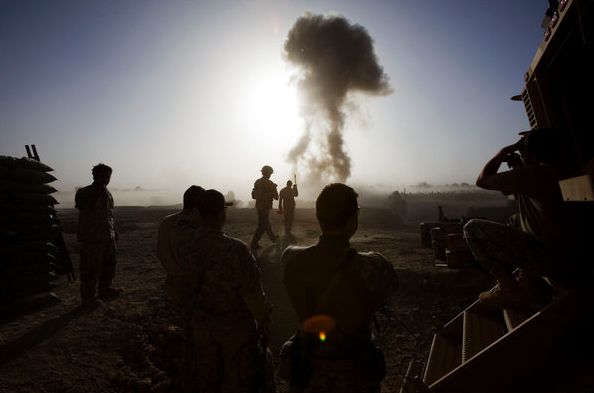
Hundreds and maybe thousands of Afghan homes are being bulldozed, blown up or hit by missile strikes in the effort to drive the Taliban out of the Kandahar region. As well as individual houses, whole villages have been destroyed. “We had to destroy them to make them safe,” the district governor, Shah Muhammed Ahmadi, is quoted telling the New York Times.

In the newly won districts around this southern city, American forces are encountering empty homes and farm buildings left so heavily booby-trapped by Taliban insurgents that the Americans have been systematically destroying hundreds of them, according to local Afghan authorities.

The campaign, a major departure from NATO practice in past military operations, is intended to reduce civilian and military casualties by removing the threat of booby traps and denying Taliban insurgents hiding places and fighting positions, American military officials said.

While it has widespread support among Afghan officials and even some residents, and has been accompanied by an equally determined effort to hand out cash compensation to homeowners, other local people have complained that the demolitions have gone far beyond what is necessary.

Facebooktwittermail

The new rules: globalization’s massive demographic bet

Thomas PM Barnett writes:

By calling the Chinese out explicitly on their currency manipulation in his concluding address to the G-20 summit last week, President Barack Obama may have torpedoed his relationship with Beijing for the remainder of what China’s bosses most certainly now hope is his first and only term. Burdened by a Republican-controlled, Tea Party-infused House, and bathed in hypocrisy thanks to the Fed’s own, just-announced currency manipulation (aka, QE2), Obama seems not to recognize either the gravity of his nation’s long-term economic situation or the degree to which his own political fate now hinges on his administration’s increasingly stormy ties with China.

Here’s the larger picture: Asia, anchored by China, is now the global economy’s center of gravity when it comes to deployable savings. As Europe heads into retirement and the U.S. refuses to come to grips with its unsustainable trajectory, China stands tall thanks to its capacity to spend and invest — even as that capacity seems woefully insufficient for the bevy of historical tasks at hand. Beijing must already see to the care and feeding of 22 percent of humanity, the bulk of whom remain impoverished by anybody’s reasonable standards. But in addition, China is now expected to cover the spendthrift West’s need to boost exports, while also serving as income-elevating engine for the rest of the world’s developing economies — largely through the Middle Kingdom’s ravenous resource demands.

And if all that wasn’t intimidating enough, China’s demographic clock is ticking like no other nation’s in human history. Already losing its cheap-labor advantage right now, China is set to stockpile elders from here on out at a pace never before witnessed. By 2050, it will have more non-working old people (400 million plus) than America’s total projected population (400 million). At that point, the U.S. median age will still be just below 40, while China’s will be closer to 50. It took Europe a century for its elder population to gradually rise from 10 percent of total population to the 20-percent level. America’s still-unfolding journey along the same path will run about six decades. But China will have 20 years, if it’s lucky.

Facebooktwittermail