Is J Street, AIPAC’s Trojan horse for disarming the American Jewish left?

After meeting last week with J Street‘s executive director, Jeremy Ben-Ami, the Jerusalem Post‘s Shmuel Rosner mused that J Street may have a complimentary role to the one performed by AIPAC.

Maybe as a separate organization with more credibility on the left J Street can help Israel more by way of helping curb the wacky initiatives of the far left (like divestment in Berkeley).

Richard Silverstein responds to that suggestion by saying:

I’d never quite thought of the fact that J Street either intentionally or unintentionally may serve to co-opt the political energy of the American Jewish peace movement. Progressives funnel their energy into the organization which transmutes it in turn into faintly liberal pro-Israel substance that bears only a slight resemblance to the actual political values of many of those progressives. In this way, J Street contributes to the dumbing down of progressive Jewish politics.

“Dumbing down” might be a charitable way of characterizing what J Street is doing. What J Street itself might claim to be a moderating influence in its efforts to occupy the supposedly all-powerful political center, can also be seen as classic Israeli divide-and-rule politics.

Where does Israel face some of its most serious political challenges coming from? The Goldstone Report, the embryonic but significant BDS movement, and the broad political trend that with increasing vigor and fearlessness is questioning Israel’s legitimacy. On all counts, J Street stands resolutely on Israel’s side. Yet even as it does so, it attempts to appeal to American Jews who already have a critical view of the Jewish state. It says, we hear you, we embrace you, and now you can quiet down.

To call J Street, AIPAC’s Trojan horse does not have to imply some kind of nefarious conspiracy behind the scenes but simply suggests that J Street by design or accident is on the way to becoming an integral part of the Israel lobby.

Facebooktwittermail

Tea partying through history

At TomDispatch, Steve Fraser and Joshua B. Freeman, put the Tea Party movement in a historical context.

[T]he Tea Party movement reminds us that the moral self-righteousness, sense of dispossession, anti-elitism, revanchist patriotism, racial purity, and “Don’t Tread on Me” militancy that were always at least a part of the populist admixture are alive and well. For all the fantastical paranoia that often accompanies such emotional stances, they speak to real experiences — for some, of economic anxiety, insecurity, and loss; for others, of deeper fears of personal, cultural, political, or even national decline and moral disorientation.

Though such fears and feelings are, in part, legacies of the corporate liberal order — one of the dark sides of “progress” under capitalism — in this new populist moment, anti-capitalism itself barely lingers on. Though outrage at the bank bailout did help propel the Tea Party explosion, anti-big-business sentiment is now a pale shadow of its former self, a muted sub-theme in the movement when compared to the Wallace moment, not to mention those of Huey Long or the Populists.

This is hardly surprising since, at least economically, capitalism has, according to recent surveys of Tea Party membership, served many of them reasonably well. Like Goldwater supporters of the 1960s, those who identify with the Tea Party movement are generally wealthier than the population as a whole, and more likely to be employed. They are also apparently better educated, so their fondness for Sarah Palin’s intellectual debilities may be more a case of resentment of bicoastal cultural snobbery than eye-popping ignorance.

Alongside an exalted rhetoric about threats to liberty lies a sour, narrow-minded defensiveness against any possible threat of income redistribution that might creep into the body politic… and so into their pockets. “Don’t Tread on Me,” once a rebel war cry, has morphed into: “I’ve got mine. Don’t dare tax it.” The state, not the corporation, is now the enemy of choice.

Facebooktwittermail

Tea Party or Taliban?

Any event that can be described as an act of terrorism will no doubt provoke some level of alarm, but the incendiary device that fizzed in Times Square apparently provoked as much curiosity as fear.

Taj Heniser from Seattle, who couldn’t get to see the show, “Next to Normal,” because 45th St had been blocked, told the New York Times that watching New York’s emergency services deal with the thwarted attack was a different kind of show. “It’s almost the equivalent of a $150 show,” she said.

If Taliban leaders in Pakistan were picking up that kind of response, I think they might have thought twice about claiming responsibility for what has universally been described as an amateurish effort.

Maybe the genius at work here had less interest in learning the finer details of bomb-making than he had in creating what he imagined was going to be a devastating political statement. He dreamed perhaps that he could engineer an Obama “My Pet Goat” moment of incompetence at a time of crisis.

Josh Marshall, along with the rest of the liberal media, was whooping it up at the White House Correspondents Dinner when news of the incendiary event first broke.

“I watched the administration folks to get a sense of how seriously I should be taking it,” Marshall wrote at Talking Points Media.

President Obama did not rush back to the Situation Room in the White House to closely monitor events at the first indication that America could be under attack. Likewise the media saw no reason to interrupt their merrymaking.

So, pretty much everything went according to plan — or so the bomber imagines, perhaps.

Now he’s trying to figure out why America is not reeling in shock and anger having witnessed the complacency of its government and the complicity of the media.

All speculation at this point, but if I was to place a bet on who did this, I’d go with someone whose sympathies are probably more Tea Party than Taliban.

The first lead fits the profile: white male in his 40s.

Facebooktwittermail

US lifting the veil on Israel’s nuclear status

The Wall Street Journal reports:

The U.S. is negotiating with Egypt a proposal to make the Middle East a region free of nuclear weapons, as the U.S. seeks to prevent Iran from derailing a monthlong U.N. conference on nuclear nonproliferation that begins Monday.

U.S. officials familiar with the move call it an important step in assuring countries that Washington—criticized by some for its silence about Israel’s undeclared nuclear arsenal—will equitably address weapons proliferation across the region, as Iran seeks to shift focus away from its own nuclear program.

But here’s the catch: before Washington applies any pressure on Israel, there must be significant progress in the peace process.

Still, there is one element here that should have been worthy of a headline of its own but doesn’t even get a mention in the article: the Obama administration seems to effectively be ending US complicity in Israel’s policy of nuclear ambiguity.

Another important part of this story that the WSJ article glides over without clarification is the reason the US is negotiating specifically with Egypt.

Washington is pushing for revisions to the Non-Proliferation Treaty to close some of its loopholes but for these to pass in the 189-nation conference, the US needs the support of the 118-non-aligned states led by Egypt. That support will not be forthcoming without some kind of agreement on a nuclear-free Middle East.

Facebooktwittermail

The future of Palestine: righteous Jews vs. the new Afrikaners

Professor John Mearsheimer, in a speech delivered at The Palestine Center in Washington DC on Thursday said:

As anyone who has spent time in the Occupied Territories knows, it is already an incipient apartheid state with separate laws, separate roads, and separate housing for Israelis and Palestinians, who are essentially confined to impoverished enclaves that they can leave and enter only with great difficulty.

Israelis and their American supporters invariably bristle at the comparison to white rule in South Africa, but that is their future if they create a Greater Israel while denying full political rights to an Arab population that will soon outnumber the Jewish population in the entirety of the land. Indeed, two former Israeli prime ministers have made this very point. Ehud Olmert, who was Netanyahu’s predecessor, said in late November 2007 that if “the two-state solution collapses,” Israel will “face a South-African-style struggle.” He went so far as to argue that, “as soon as that happens, the state of Israel is finished.” Former Prime Minister Ehud Barak, who is now Israel’s defense minister, said in early February of this year that, “As long as in this territory west of the Jordan River there is only one political entity called Israel it is going to be either non-Jewish, or non-democratic. If this bloc of millions of Palestinians cannot vote, that will be an apartheid state.”

Other Israelis, as well as Jimmy Carter and Bishop Desmond Tutu, have warned that if Israel does not pull out of the Occupied Territories it will become an apartheid state like white-ruled South Africa. But if I am right, the occupation is not going to end and there will not be a two-state solution. That means Israel will complete its transformation into a full-blown apartheid state over the next decade.

In the long run, however, Israel will not be able to maintain itself as an apartheid state. Like racist South Africa, it will eventually evolve into a democratic bi-national state whose politics will be dominated by the more numerous Palestinians. Of course, this means that Israel faces a bleak future as a Jewish state. Let me explain why.

For starters, the discrimination and repression that is the essence of apartheid will be increasingly visible to people all around the world. Israel and its supporters have been able to do a good job of keeping the mainstream media in the United States from telling the truth about what Israel is doing to the Palestinians in the Occupied Territories. But the Internet is a game changer. It not only makes it easy for the opponents of apartheid to get the real story out to the world, but it also allows Americans to learn the story that the New York Times and the Washington Post have been hiding from them. Over time, this situation may even force these two media institutions to cover the story more accurately themselves.

The growing visibility of this issue is not just a function of the Internet. It is also due to the fact that the plight of the Palestinians matters greatly to people all across the Arab and Islamic world, and they constantly raise the issue with Westerners. It also matters very much to the influential human rights community, which is naturally going to be critical of Israel’s harsh treatment of the Palestinians. It is not surprising that hardline Israelis and their American supporters are now waging a vicious smear campaign against those human rights organizations that criticize Israel.

The main problem that Israel’s defenders face, however, is that it is impossible to defend apartheid, because it is antithetical to core Western values. How does one make a moral case for apartheid, especially in the United States, where democracy is venerated and segregation and racism are routinely condemned? It is hard to imagine the United States having a special relationship with an apartheid state. Indeed, it is hard to imagine the United States having much sympathy for one.

Facebooktwittermail

Palestinian roads: cementing statehood, or Israeli annexation?

At The Nation, Nadia Hijab and Jesse Rosenfeld write:

Palestinian Authority Prime Minister Salam Fayyad has staked his political credibility on securing a Palestinian state by 2011 in the entire West Bank, Gaza and East Jerusalem, a program enthusiastically embraced by the international community. Ambitious PA plans include roads and other infrastructure across the West Bank, with funds provided by the United States, Europe and other donors.

Fayyad has argued that development will make the reality of a Palestinian state impossible to ignore. However, many of the new roads facilitate Israeli settlement expansion and pave the way for the seizure of main West Bank highways for exclusive Israeli use.

For decades Israel has carried out its own infrastructure projects in the occupied West Bank and East Jerusalem. These include a segregated road network that, together with the separation wall Israel began building in 2002, divides Palestinian areas from each other while bringing the settlements–all of which are illegal under international law–closer to Israel.

Now, armed with information from United Nations sources and their own research, Palestinian nongovernmental organizations are raising the alarm. Their evidence spotlights the extent to which PA road-building is facilitating the Israeli goal of annexing vast areas of the West Bank–making a viable Palestinian state impossible.

Facebooktwittermail

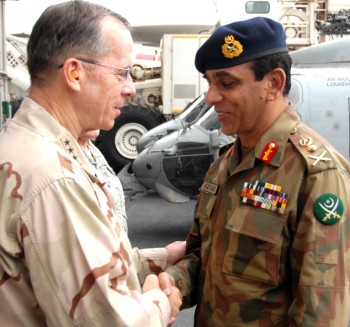
All Kayani’s men

Anatol Lieven, in an article where he notes that Pakistan’s military is among the most democratic of institutions in what otherwise remains a largely feudal society, writes:

American operations in South Asia… are threatening to upset [a] fragile balance between Islam and nationalism in the Pakistani military. The army’s members can hardly avoid sharing the broader population’s bitter hostility to U.S. policy. To judge by retired and serving officers, this includes the genuine conviction that either the Bush administration or Israel was responsible for 9/11. Inevitably therefore, there was deep opposition throughout the army after 2001 to American pressure to crack down on the Afghan Taliban and their Pakistani sympathizers. “We are being ordered to launch a Pakistani civil war for the sake of America,” an officer told me in 2002. “Why on earth should we? Why should we commit suicide for you?”

Between 2004 and 2007, there were a number of instances of mass desertion and refusal to serve in units deployed to fight militants, though mostly in the Pashtun-recruited Frontier Corps rather than in the regular army. These failures were caused above all by the feeling that these forces were compelled to turn against their own. We must realize in these morally and psychologically testing circumstances, anything that helps maintain Pakistani military discipline cannot be altogether bad—given the immense scale of the stakes concerned, and the consequences if that discipline were to fail.

For in 2007–2008, the battle was beginning to cause serious problems of morale. The most dangerous single thing I heard during my visits to Pakistan in those years was that soldiers’ families in villages in the NWFP and the Potwar region of the Punjab were finding it increasingly difficult to find high-status brides for their sons serving in the military because of the growing popular feeling that “the army is the slave of the Americans” and “the soldiers are killing fellow Muslims on America’s orders.”

By late 2009, the sheer number of soldiers killed by the Pakistani Taliban and their allies, and still more importantly, the increasingly murderous and indiscriminate Pakistani Taliban attacks on civilians, seem to have produced a change of mood in the areas of military recruitment. Nonetheless, if the Pakistani Taliban are increasingly unpopular, that does not make the United States any more well liked; and if Washington ever put Pakistani soldiers in a position where they felt that honor and patriotism required them to fight America, many would be willing to do so.

Facebooktwittermail

Pakistani intelligence officials say Taliban chief Hakimullah Mehsud is alive

The Washington Post reports:

Even by the standards of a bullet- and bomb-dodging Taliban commander, Hakimullah Mehsud has displayed notable survival skills.

The Pakistani Taliban chief was thought to have died in a leadership duel last summer, only to stage a news conference a few days later. A U.S. drone strike in January was followed by intense speculation about his fate, then statements by Pakistani intelligence officials that he was “100 percent” dead.

On Thursday, those intelligence officials circulated another message: Mehsud is alive.

Earlier reports that Mehsud was dead — repeated by U.S. officials — were hailed as a potentially fatal blow to the Pakistani Taliban, a loose network of border-based militants that has carried out a cascade of suicide attacks in recent years. News of his survival again underscored the staying power of a group that Pakistan’s military has targeted with unprecedented force in the past year. It also has exposed blind spots within the Pakistani and U.S. intelligence services, which struggle to develop reliable information in Taliban strongholds.

Meanwhile, the Los Angeles Times reports:

A Pentagon report presented a sobering new assessment Wednesday of the Taliban-led insurgency in Afghanistan, saying that its abilities are expanding and its operations are increasing in sophistication, despite recent major offensives by U.S. forces in the militants’ heartland.

The report, requested by Congress, portrays an insurgency with deep roots and broad reach, able to withstand repeated U.S. onslaughts and to reestablish its influence, while discrediting and undermining the country’s Western-backed government.

But the Pentagon said it remained optimistic that its counter-insurgency strategy, formed after an Obama administration review last year, and its effort to peel foot soldiers away from the Taliban will show success in months to come.

Facebooktwittermail

Iraq prime minister lashes out at rival

The Los Angeles Times reports:

Iraq’s prime minister dismissed his rival’s call for international help to resolve the country’s postelection political crisis as the dispute threatens to inflame rifts and undermine American plans for withdrawal.

In a televised speech Friday, Prime Minister Nouri Maliki, whose political bloc finished a close second behind former premier Iyad Allawi’s slate in the March 7 elections, alleged that “regional, international” players were attempting a coup d’etat against his government.

“We have accomplished very much in Iraq,” he said from the southern shrine city of Karbala, the symbolic heartland of Iraq’s Shiite Muslims, who were long oppressed under the Sunni-dominated Baath Party government of Saddam Hussein.

“We will not allow any foreign interference in our internal affairs that will breach our sovereignty,” Maliki said.

Meanwhile, earlier this week, the New York Times reported:

The torture of Iraqi detainees at a secret prison in Baghdad was far more systematic and brutal than initially reported, Human Rights Watch reported on Tuesday.

The existence of the prison, which housed mostly Sunni Arab prisoners, has created a political furor in Iraq, prompted government denials and fanned sectarian tensions.

“Abu Ghraib was a picnic” compared with the secret prison, said Sheik Abdullah Humedi Ajeel al-Yawar, one of the most influential Sunni Arab tribal leaders in the northern province of Nineveh, where the detainees were rounded up by Iraqi soldiers based on suspicions that they had links to the insurgency and brought to Baghdad with little due process. Abu Ghraib is the prison at which American guards tortured Iraqi prisoners, severely damaging Iraqis’ trust in the United States.

Human Rights Watch gained access on Monday to about 300 male detainees transferred from the once secret prison at the Old Muthanna military airfield to the Rusafa prison in Baghdad and documented its findings, which it described as “credible and consistent,” in a draft report provided to The New York Times on Tuesday by the rights group.

The group said it had interviewed 42 detainees who displayed fresh scars and wounds. Many said they were raped, sodomized with broomsticks and pistol barrels, or forced to engage in sexual acts with one another and their jailers.

Facebooktwittermail

What Israel means to me

By David Shasha*, April 30, 2010

Over the years there has been a constant spate of books containing the testimonials of American Jews proclaiming their teary-eyed and deeply emotional love of the state of Israel. These books are part of the larger program of Israeli Hasbarah, the form of advocacy that seeks to assert the total primacy of Zionism as the centerpiece of Jewish life the world over.

In order to establish what Israel means to me as a Jew, the first thing I need to do is figure out what it means to other Jews and how that relates to the reality of the Jewish past.

American Jews have been conducting a romantic affair with an Israel whose contours are outlined in two recent movies: In Adam Sandler’s comedy You Don’t Mess with the Zohan and Quentin Tarantino’s Inglourious Basterds, we find that the American Jewish love affair with Israel is based on an almost erotic identification with the perception of Zionism and Israel as a form of revenge fantasy. Sandler’s Zohan is a figure whose sexual potency rests in his skill as a Jewish superhero, a man who kills Arabs to defend the Jewish people. Similarly, Tarantino’s Nazi-era fantasy is a phantasmagoria of violence in the name of Jewish self-doubt and an inferiority complex.

These fantasies bring to mind the idealist aspects of the original Zionist program and its rejection of traditional Jewish identity. The Israeli scholar Oz Almog has examined this rejectionism in his book The Sabra: The Creation of the New Jew:

The Zionists greatly admired the physical beauty of the native, the “Jewish Gentile” who had been anointed king of the new Israel, and they contrasted him with the ostensible ugliness of the Diaspora Jew […]. Writers of this era […] described the native as a robust youth with “gentile” characteristics, a kind of Jewish muzhik, or Russian peasant — strapping, self-confident, and strong-spirited, as opposed to the stereotypical Diaspora Jew, who was pale, servile, and cowardly.

Especially prominent in descriptions of the native are his masculine vitality and health and his alienation from Judaism. The criteria are European-Christian ones, which have their source in ancient Greece and Rome […].

The paradox inherent in Zionism is the way in which it creates the “New Jew” by rejecting what it perceives to be the “Old Jew.” In both cases, the understanding of what it means to be Jewish is based on a completely Eurocentric model; the decrepit Diaspora Jew is seen in terms of the Shtetl Jew who is isolated from the general world, while the ideal Israeli Jew — typified by the Zohan and by the vengeful Jews of the Tarantino fantasy world — is seen as an uber-Gentile.

From a Sephardic perspective this transformation of Jewish identity has very real consequences. As Almog argues later in the book:

The Oriental immigrants, like all other immigrants, were perceived by the Israeli establishment as in need of a cure for the Diaspora disease from which they suffered, a cure that would turn them into Sabras. But in the case of the Oriental immigrants, the usual differences between the natives and the immigrants were supplemented by the cultural differences between East and West. The Yishuv leadership, and the Sabras after them, treated the Oriental immigrants with a mixture of affection, compassion, condescension, and arrogance — the products of the combined ethoses of ingathering the exiles and rejecting the Diaspora. The common wisdom regarding the acclimatizing of Oriental Jewish youth to their new country was that they should discard the Oriental culture, which the establishment considered backward, and ascend to a higher cultural level by adopting the characteristics of the Sabra and the more advanced Western culture.

For the traditional Jew, not just for Sephardim, the state of Israel represents a profound rejection of a millennia-old Jewish identity. The psychological impact of all this is formulated in the irrational American Jewish identification with Israel as the existential center of all Jewish life. Having rejected the traditions of the past, based on the religious values of Torah and Halakhah, contemporary Jews have recreated a religious culture based on the rituals and demands of the Jewish state and Zionism.

In typical Ashkenazi fashion, this new Zionist religion is authoritarian and draconian in its demand for conformity.

Two current examples — just in time for last week’s commemoration of Israeli Independence Day — are the Anat Kamm affair and the ongoing demonization of South African judge Richard Goldstone. Kamm has been charged with leaking confidential military documents to the press, while Goldstone continues to be vilified for the report that he prepared for the United Nations on the 2009 Gaza incursion. Kamm is currently under house arrest in Israel while Goldstone has found himself pressured from attending his own grandson’s Bar Mitzvah.

These two stories speak to the demands of the new Judaism which has replaced the Torah of Moses with the new Torah of Zionism. Had Kamm and Goldstone eaten a ham sandwich on Yom Kippur, they would not find themselves in the trouble they are now in. Rather than judging Jewish behavior in traditional religious terms, the new Zionist imperative seeks to control human behavior and speech by setting out a series of protocols regarding the way in which we see and speak about Israel. This regime is controlled internally by the Jewish community, which determines who is “one of us” and who is not.

The actions of Jews like Anat Kamm and Richard Goldstone speak to the Jewish tradition of self-examination and the idea of justice in a wider sense. The Talmudic tradition teaches that Jews must not allow other Jews to act in ways that violate standards of morality. This tradition extends to the Jewish court as well. Far from exonerating the court as infallible, the Talmudic tradition discussed the ways in which justice could be violated due to judicial error or malice.

But today Israel represents a reversal of the old moral codes. In its ethos is found a cruelty and meanness that is reflected in the way Jews conduct their discourse. Destroying individual Jews who are critical of Israel is seen as a positive commandment of the new Judaism. At the epicenter of this ideology is a pathological paranoia regarding anti-Semitism which often marks the Arab as the primordial enemy of the Jew.

Castigating Arab Jews for their native culture has led to a profound crisis in Sephardic civilization. Sephardim have been transformed by Ashkenazi Zionism into Arab-haters and as witnesses to the barbarity of Arabs and their culture. This has led the Sephardim to reject their traditional past and the wisdom of their Sages, many of whom were immersed in the Arab culture.

Gradually, Zionism has eroded the traditional Jewish past and replaced it with a new identity construct that mimics the authoritarian aspects of rabbinic culture even as it rejects its valuational content. Ironically, the secularization of Jewish tradition has led to a renewal of fundamentalist Orthodoxy in both Zionist and non-Zionist variations.

The Zionist religious Orthodoxy is well-described by Karen Armstrong in her classic book The Battle for God:

The extreme religious Zionists and members of Gush Emunim were also ready for a fight. They were rebels, mounting what they saw as a revolution against secular nationalism on the one hand, and Orthodoxy on the other. Life had changed drastically for the Jews. They felt there was no need for Jews to be constricted by traditions belonging to the Diaspora, because the messianic age had begun.

The irony here is that the standard articulations of Jewish tradition in its liturgy and religious calendar remain in force. A new messianic age has yet to be formally articulated in the liturgy. Anti-traditionalism is a paradox that lies behind the Settlement movement and allows it to become a part of the larger project of an anti-Jewish Zionism.

In the end, those who are on the receiving end of the Israeli whip understand all too well the pressures that have been placed on Jews to conform: Israel is the new God, the new revelation from on High, and all those who reject its commandments are to be excommunicated from the community, marked as Jewish heretics who deny the new order.

For Sephardim, what Israel means at present is not only the ongoing destruction of their culture and heritage and the near-complete triumph of Ashkenazi Judaism, but the requirement that Sephardim bear witness to their own cultural impotence and corruption.

What Israel means to me at the moment is the fact of Jews persecuting other Jews for speaking out and affirming the traditions of the past, of being “Old Jews” rather than “New Jews.”

* David Shasha is the director of the Center for Sephardic Heritage in Brooklyn, New York. This article previously appeared at The Huffington Post and is republished here with the author’s permission.

Facebooktwittermail

Israel official: Accepting Palestinians into Israel better than two states

After a recent poll indicated that in increasing numbers Palestinians are losing faith in the two-state solution, remarks by Reuven Rivlin, a senior member of Likud and the Speaker in Israel’s parliament, suggest that a one-state solution may be more likely than most commentators generally imagine.

Haaretz reports:

Knesset Speaker Reuven Rivlin said Thursday that he would rather accept Palestinians as Israeli citizens than divide Israel and the West Bank in a future two-state peace solution.

Speaking during a meeting with Greece’s ambassador to Israel Kyriakos Loukakis, Rivlin said that he did not see any point of Israel signing a peace agreement with the Palestinian Authority as he did not believe PA President Mahmoud Abbas “could deliver the goods.”

Referring to the possibility that such an agreement could be reached, Rivlin said: “I would rather Palestinians as citizens of this country over dividing the land up.”

Late last year, Rivlin said in a Jerusalem address that Israel’s Arab population was “an inseparable part of this country. It is a group with a highly defined shared national identity, and which will forever be, as a collective, an important and integral part of Israeli society.”

In a speech given in the president’s residence, the Knesset speaker called for a fundamental change in relations between Jews and Arabs in Israel, urging the foundation of a “true partnership” between the two sectors, based on mutual respect, absolute equality and the addressing of “the special needs and unique character of each of the sides.”

Rivlin also said that “the establishment of Israel was accompanied by much pain and suffering and a real trauma for the Palestinians,” adding that “many of Israel’s Arabs, which see themselves as part of the Palestinian population, feel the pain of their brothers across the green line – a pain they feel the state of Israel is responsible for.”

“Many of them,” Rivlin says, “encounter racism and arrogance from Israel’s Jews; the inequality in the allocation of state funds also does not contribute to any extra love.”

Facebooktwittermail

Israel’s fascist mood

Responding to the results of a poll I highlighted yesterday, Gideon Levy writes:

Israel is ready for a monster. Nothing will stop it. Every kind of violent and dangerous leader and every war crime will be welcomed here, welcomed by the stupid and ignorant.

Our immune systems have long weakened. The press will be silent, and the Supreme Court will forgive. Meanwhile, protest slumbers and civil society, a concept on the rise in world politics, doesn’t exist. Go explain to the Israel of 2010 that the media’s role is to expose wrongdoing, the non-governmental organizations’ role is to warn us, and the Supreme Court’s role is to be a gatekeeper. Instead, all of them are to be punished. Go explain that the tyranny of the majority is no less dangerous than control by the minority. Go explain that democracy means unlimited, free criticism.

All this is gone and forgotten. We have no one to instill these values. We have survived Pharaoh, and we will survive Iran, but not this problem. It filters down from within, threatening to bring everything down on the people. The current public atmosphere is the classic breeding ground, as if it were taken from the history books for cultivating savage regimes. There is no need for a military coup in Israel. The defense establishment has excessive control over most aspects of life. There is no need for a dictator, either. The tyranny of the majority is dangerous enough.

Facebooktwittermail

How to: risk World War III, and blow billions doing it

At Wired, Noah Shachtman writes:

The Pentagon’s plan to fire ballistic missiles at terrorists isn’t just a nuclear Armageddon risk. It’s a ludicrously expensive way to accidentally start World War III: each weapon could cost anywhere from a few hundred million to $1 billion.

The Defense Department wants to spend about $240 million next year on the controversial “prompt global strike” project. Eventually, it could lead to weapons that could strike virtually anywhere in the planet within an hour or two. But that quarter-billion would be the tiniest of down payments.

“There are no accurate cost estimates for the program, largely because the technology is unproven,” writes Joe Cirincione at ForeignPolicy.com. His back-of-the-envelope calculation: $10 billion for 10 conventionally-armed Intercontinental Ballistic Missiles, meant to strike at terrorists on the move. “Each missile with its tiny payload could easily go over $1 billion each.”

Visit msnbc.com for breaking news, world news, and news about the economy

Facebooktwittermail

The perils of PowerPoint


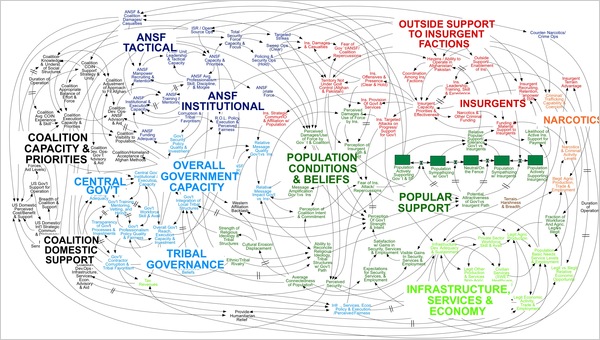
An article by Elisabeth Bumiller in the New York Times includes the diagram above. The illustration is indispensable for the lede — it does little to convey the principle failings of Powerpoint, least of all the cognitive style that Powerpoint engenders.

Gen. Stanley A. McChrystal, the leader of American and NATO forces in Afghanistan, was shown a PowerPoint slide in Kabul last summer that was meant to portray the complexity of American military strategy, but looked more like a bowl of spaghetti.

“When we understand that slide, we’ll have won the war,” General McChrystal dryly remarked, one of his advisers recalled, as the room erupted in laughter.

The slide has since bounced around the Internet as an example of a military tool that has spun out of control. Like an insurgency, PowerPoint has crept into the daily lives of military commanders and reached the level of near obsession. The amount of time expended on PowerPoint, the Microsoft presentation program of computer-generated charts, graphs and bullet points, has made it a running joke in the Pentagon and in Iraq and Afghanistan.

“PowerPoint makes us stupid,” Gen. James N. Mattis of the Marine Corps, the Joint Forces commander, said this month at a military conference in North Carolina. (He spoke without PowerPoint.) Brig. Gen. H. R. McMaster, who banned PowerPoint presentations when he led the successful effort to secure the northern Iraqi city of Tal Afar in 2005, followed up at the same conference by likening PowerPoint to an internal threat.

“It’s dangerous because it can create the illusion of understanding and the illusion of control,” General McMaster said in a telephone interview afterward. “Some problems in the world are not bullet-izable.”

In General McMaster’s view, PowerPoint’s worst offense is not a chart like the spaghetti graphic, which was first uncovered by NBC’s Richard Engel, but rigid lists of bullet points (in, say, a presentation on a conflict’s causes) that take no account of interconnected political, economic and ethnic forces. “If you divorce war from all of that, it becomes a targeting exercise,” General McMaster said.

Commanders say that behind all the PowerPoint jokes are serious concerns that the program stifles discussion, critical thinking and thoughtful decision-making. Not least, it ties up junior officers — referred to as PowerPoint Rangers — in the daily preparation of slides, be it for a Joint Staff meeting in Washington or for a platoon leader’s pre-mission combat briefing in a remote pocket of Afghanistan.

Last year when a military Web site, Company Command, asked an Army platoon leader in Iraq, Lt. Sam Nuxoll, how he spent most of his time, he responded, “Making PowerPoint slides.” When pressed, he said he was serious.

“I have to make a storyboard complete with digital pictures, diagrams and text summaries on just about anything that happens,” Lieutenant Nuxoll told the Web site. “Conduct a key leader engagement? Make a storyboard. Award a microgrant? Make a storyboard.”

Despite such tales, “death by PowerPoint,” the phrase used to described the numbing sensation that accompanies a 30-slide briefing, seems here to stay. The program, which first went on sale in 1987 and was acquired by Microsoft soon afterward, is deeply embedded in a military culture that has come to rely on PowerPoint’s hierarchical ordering of a confused world.

“There’s a lot of PowerPoint backlash, but I don’t see it going away anytime soon,” said Capt. Crispin Burke, an Army operations officer at Fort Drum, N.Y., who under the name Starbuck wrote an essay about PowerPoint on the Web site Small Wars Journal that cited Lieutenant Nuxoll’s comment.

In a daytime telephone conversation, he estimated that he spent an hour each day making PowerPoint slides. In an initial e-mail message responding to the request for an interview, he wrote, “I would be free tonight, but unfortunately, I work kind of late (sadly enough, making PPT slides).”

By Bumiller’s account, the military’s PowerPoint problem derives mostly from the ubiquity of its use, but as Edward Tufte, one of PowerPoint’s most ardent and cogent critics makes clear, the problem runs much deeper.

Imagine a widely used and expensive prescription drug that promised to make us beautiful but didn’t. Instead the drug had frequent, serious side effects: It induced stupidity, turned everyone into bores, wasted time, and degraded the quality and credibility of communication. These side effects would rightly lead to a worldwide product recall.

Yet slideware -computer programs for presentations -is everywhere: in corporate America, in government bureaucracies, even in our schools. Several hundred million copies of Microsoft PowerPoint are churning out trillions of slides each year. Slideware may help speakers outline their talks, but convenience for the speaker can be punishing to both content and audience. The standard PowerPoint presentation elevates format over content, betraying an attitude of commercialism that turns everything into a sales pitch.

Of course, data-driven meetings are nothing new. Years before today’s slideware, presentations at companies such as IBM and in the military used bullet lists shown by overhead projectors. But the format has become ubiquitous under PowerPoint, which was created in 1984 and later acquired by Microsoft. PowerPoint’s pushy style seeks to set up a speaker’s dominance over the audience. The speaker, after all, is making power points with bullets to followers. Could any metaphor be worse?

PowerPoint is packaged thought. The presenter has, supposedly, already done the required thinking and the audience is presented with the package on the understanding that the contents conform to the labeling. The PowerPoint spell is the illusion that a well-labelled package has valuable content when it may in fact turn out to be an empty box.

As Tufte concludes:

Presentations largely stand or fall on the quality, relevance, and integrity of the content. If your numbers are boring, then you’ve got the wrong numbers. If your words or images are not on point, making them dance in color won’t make them relevant. Audience boredom is usually a content failure, not a decoration failure.

At a minimum, a presentation format should do no harm. Yet the PowerPoint style routinely disrupts, dominates, and trivializes content. Thus PowerPoint presentations too often resemble a school play -very loud, very slow, and very simple.

The practical conclusions are clear. PowerPoint is a competent slide manager and projector. But rather than supplementing a presentation, it has become a substitute for it. Such misuse ignores the most important rule of speaking: Respect your audience.

Facebooktwittermail

Who’s afraid of nuclear terrorists?

A couple of weeks ago, President Obama hosted a nuclear security summit in Washington to address an issue so grave, 40 heads of state were in attendance. Had Obama also extended invitations to the mayors of America’s major cities, it’s unclear how many would have been able to squeeze the summit into their busy schedules.

The Washington Times reports:

The U.S. military has canceled a major field exercise that tests its response to a nuclear attack, angering some officials who say that what is now planned for this month will be a waste of time.

U.S. Northern Command in Colorado withdrew from major participation in this month’s National Level Exercise (NLE), a large-scale drill that tests whether the military and the Department of Homeland Security can work with local governments to respond to an attack or natural disaster.

The exercise was canceled recently after the planned site for a post-nuclear-attack response — Las Vegas — pulled out in November, fearing a negative impact on its struggling business environment.

A government official involved in NLE planning said a new site could not be found. The official also said the Northern Command’s exercise plans for “cooping” — continuity of operations, during which commanders go to off-site locations — also had been scratched.

“All I know is it’s been turned into garbage,” said the official, who asked not to be identified because of the sensitivity of the information. “It’s a nonevent.”

Will al Qaeda be emboldened by this turn of events? I kind of doubt it. In fact Las Vegas — which might not generally epitomize a realistic outlook — is probably making a safe bet here as it wagers that its economic health takes precedence over its need to be prepared to handle a nuclear attack.

Facebooktwittermail

How Israel operates as an apartheid state

In a talk delivered to the Fifth Bilin International Conference for Palestinian Popular Resistance, held in the West Bank village of Bilin on April 21, Jonathan Cook described some of the aspects of Israeli apartheid — the systematic discrimination between Jews and non-Jews inside the state of Israel.

A few weeks ago I met Uzi Ornan, an 86-year-old professor from the Technion University in Haifa, who has one of the few ID cards in Israel stating a nationality of “Hebrew.” For most other Israelis, their cards and personal records state their nationality as “Jewish” or “Arab.” For immigrants whose Jewishness is accepted by the state but questioned by the rabbinical authorities, some 130 other classifications of nationality have been approved, mostly relating to a person’s religion or country of origin. The only nationality you will not find on the list is “Israeli.” That is precisely why Professor Ornan and two dozen others are fighting through the courts: they want to be registered as “Israelis.” It is a hugely important fight – and for that reason alone they are certain to lose. Why?

Far more is at stake than an ethnic or national label. Israel excludes a nationality of “Israeli” to ensure that, in fulfillment of its self-definition as a “Jewish state,” it is able to assign superior rights of citizenship to the collective “nation” of Jews around the globe than to the body of actual citizens in its territory, which includes many Palestinians. In practice it does this by creating two main classes of citizenship: a Jewish citizenship for “Jewish nationals” and an Arab citizenship for “Arab nationals.” Both nationalities were effectively invented by Israel and have no meaning outside Israel.

This differentiation in citizenship is recognized in Israeli law: the Law of Return, for Jews, makes immigration all but automatic for any Jew around the world who wishes it; and the Citizenship Law, for non-Jews, determines on any entirely separate basis the rights of the country’s Palestinian minority to citizenship. Even more importantly, the latter law abolishes the rights of the Palestinian citizens’ relatives, who were expelled by force in 1948, to return to their homes and land. There are, in other words, two legal systems of citizenship in Israel, differentiating between the rights of citizens based on whether they are Jews or Palestinians.

That, in itself, meets the definition of apartheid, as set out by the United Nations in 1973: “Any legislative measures or other measures calculated to prevent a racial group or groups from participation in the political, social, economic, and cultural life of the country and the deliberate creation of conditions preventing the full development of such a group or groups.” The clause includes the following rights: “the right to leave and to return to their country, the right to a nationality, the right to freedom of movement and residence, the right to freedom of opinion and expression.”

Such separation of citizenship is absolutely essential to the maintenance of Israel as a Jewish state. Were all citizens to be defined uniformly as Israelis, were there to be only one law regarding citizenship, then very dramatic consequences would follow. The most significant would be that the Law of Return would either cease to apply to Jews or apply equally to Palestinian citizens, allowing them to bring their exiled relatives to Israel – the much-feared Right of Return. In either a longer or shorter period, Israel’s Jewish majority would be eroded and Israel would become a binational state, probably with a Palestinian majority.

Facebooktwittermail

Israelis have an un-American view of democracy

Imagine reading this report in an American newspaper:

More than half of white Americans think human rights organizations that expose immoral behavior by the United States should not be allowed to operate freely, and think there is too much freedom of expression here, a recent survey found.

The pollsters surveyed 500 white Americans who can be considered a representative sample of the adult white population.

They found that 57.6 percent of the respondents agreed that human rights organizations that expose immoral conduct by the United States should not be allowed to operate freely.

Slightly more than half agreed that “there is too much freedom of expression” in the US.

The poll also found that most of the respondents favor punishing journalists who report news that reflects badly on the actions of the US military.

Another 82 percent of respondents said they back stiff penalties for people who leak illegally obtained information exposing immoral conduct by the military.

In reality, the views related in the fictitious article above are not those of white Americans but come from Jewish Israelis and pertain to their own state, military, and press. The results of the poll commissioned by the Tami Steinmetz Center for Peace Research at Tel Aviv University, are reported by Haaretz.

During his recent visit to Israel, Vice President Joe Biden spoke about the “unbreakable bond borne of common values” shared by America and the Jewish state.

What the Israeli poll makes clear is that Jewish Israelis and Americans, far from having an unbreakable bond of common values, actually have significantly different views about how democracy works. As Daniel Bar-Tal, a professor at Tel Aviv university said: “The public recognizes the importance of democratic values, but when they need to be applied, it turns out most people are almost anti-democratic.”

Of course, even my attempt to contrive some kind of ethnic symmetry by juxtaposing the dominant ethnic group in the United States with that in Israel, is itself a tenuous parallel. We now have a non-white president but for as long as Israel remains a Jewish state it will surely never have a non-Jewish prime minister.

Most Americans understand that the separation of Church and State protects both democracy and religious freedom. In this era, we know that if any single ethnic or religious group were to assert a “right” to control this country, the United States would cease to be a democracy. The principle of equal rights does not come in different ethnic flavors.

Facebooktwittermail

When will time run out for a two-state solution?

Yousef Munayyer says it’s time for the Palestinians to give the Israelis an ultimatum: the Palestinian Authority should set a date for the Israeli occupation to end and settlements be dismantled. “If this deadline is not met, the PA should dissolve the authority and convert the disjointed national movement into a broad civil rights movement seeking equal rights in a bi-national state.”

Munayyer writes:

Among those involved in the Middle East peace process industry there is much talk about “time running out” for a two-state solution.

Recently, the same sentiments were echoed by the US state department, reflecting a shift in the way the Obama administration is publicly talking about the conflict.

On more than one occasion, the state department and other Obama administration figures have said that “the status quo is unsustainable”. Notice again the element of time.

Time has been running out for a two-state solution since the beginning of Israel’s colonial enterprise in occupied Palestinian territory in 1967. Yet despite this reality, analyses of the situation continue to repeat this now-meaningless cliche year after year, decade after decade. It seems that, to many, time in the Middle East can be magically be suspended. Gravity, in this war-torn region, ceases to affect the inverted hourglass.

The idea that time is running out presupposes some actual threshold beyond which time will actually have run out – a midnight hour when the Cinderella-style fantasy of a two-state solution wakes up to the embarrassing reality of facts on the ground.

However, we never hear analysts specify where the threshold lies – at what point Israeli actions of settlement construction and expansion are considered to have finally tipped it over the edge. Without this, the two-state solution becomes the consummate zombie, very much alive in the policy discussion despite being long dead in reality.

Meanwhile, AFP reports:

A growing number of Palestinians support the establishment of a single state for Jews and Arabs including Israel and the occupied territories, according to a poll released on Wednesday.

The survey by the Jerusalem Media and Communication Centre (JMCC) found that support for a bi-national state in which Israelis and Palestinians would have equal rights had grown to 33.8 percent from 20.6 percent in June 2009.

During the same period, support for a negotiated two-state solution dropped from 55.2 percent to 43.9 percent, while 32.1 percent of respondents said the “peace process is dead” in response to a separate question.

Most Palestinians, 43.7 percent, support peaceful negotiations, while 29.8 percent support armed struggle and 21.9 percent support peaceful resistance as the best strategy for ending the Israeli occupation, the poll found.

Facebooktwittermail