OPINION: We are drowning in a bottomless sea

This is the era of wise men

I am certain it is possible and feasible for us to solve all our issues here, yes here, in the alleyways of Gaza or Nablus or Ramallah, without the need to wait at the gates of the capitals that have grown tired of our frequent visits! There is no need to search for mediators of oriental or foreign skin. Yes we can succeed with distinction if all devote themselves to the national interest and give up all narrow calculations. We do not need to travel far. We do not need round or square “tables;” what we need are clean hearts and conscious minds.

As there are those who are concerned for and enthusiastic about the homeland in Hamas, there are also the same in Fatah, the two fronts [the Popular Front for the Liberation of Palestine and the Democratic Front for the Liberation of Palestine], Palestinian Islamic Jihad, and all other forces. All these hands can join together and bring us out of the cycles of misery and wretchedness. I say to you that our people are fed up with the strife, fed up with the dialogues, fed up with the multiplicity of governments and authorities, and with waiting for the unknown. They are fed up of blocked horizons and lost hopes. Do not torture them further. Show mercy on them. Show mercy on their elderly and youths who are unable to find work or breathing space. Show mercy on their students who are not allowed to travel, on their merchants who have gone bankrupt. Be a gentle hand to this people rather than a whip scalding their backs. Be a smile of hope to them, instead of these frowning expressions that appear from time to time to menacingly threatening!

Each side can say what it wants to say and claim what it wants to claim, but the voice of the homeland (the cleaner and clearer) is the voice that must be heard now. All must be silent to hear the voice of the wounded exhausted homeland, which says that we are walking in the wrong direction, the direction going against our liberation and independence march, the march of our unity and dignity. The homeland says: “No to the direction of war and estrangement. No to the direction of hate.” The voice of the homeland says that Gaza is not for Hamas and the West Bank is not for Fatah, but the homeland is one and the people are one. [complete article]

Facebooktwittermail

ANALYSIS: The Israeli military advantage over Hamas is shrinking

The IDF in Gaza – advantage over Hamas is shrinking

Until recently, it was obvious who was winning this confrontation. The IDF has an enormous advantage in terms of firepower, observation, control of the air, armored vehicles and troop training. Dozens of IDF operations in the strip following the abduction of Gilad Shalit in the summer of 2006 resulted in hundreds of Palestinian dead. During that period, the IDF suffered one dead soldier, killed by friendly fire.

But in recent months, the efforts by Iran and Hezbollah to improve Hamas’s military capabilities are beginning to be felt. It is not only better weaponry, but also careful study of the lessons of the Second Lebanon War. Dozens of militants trained in Iran and Lebanon have managed to enter the strip and have subsequently created a system of control and coordination. There is a chain of command for every area, which operates a coordinated network of observation posts, infantry and antitank forces. [complete article]

Facebooktwittermail

NEWS, ANALYSIS & EDITOR’S COMMENT: Why America uses torture

U.S. accused of torture

The United States’s willingness to resort to harsh interrogation techniques in its so-called war on terror undermined human rights and the international ban on torture, a United Nations spokesman says.

Manfred Nowak, UN Special Rapporteur on torture, said the US’s standing and importance meant it was a model to other countries which queried why they were subject to scrutiny when the US resorted to measures witnessed at Guantanamo Bay and Abu Ghraib prison.

Mr Nowak was speaking after releasing his finding that the use of torture was routine and widespread in Sri Lanka ,despite laws against it.

“I am very concerned about the undermining of the absolute prohibition of torture by interrogation methods themselves in Abu Grahib, in Guantanamo Bay and others, but also by rendition and the whole CIA secret places of detention. All that is really undermining the international rule of law in general and human rights but also the prohibition of torture,” said Mr Nowak. [complete article]

Editor’s Comment — The renewed debate on torture that has been provoked by statements made by AG-nominee Judge Mukasey on the legitimacy of waterboarding, has resulted in numerous assertions that torture is un-American. As Senate Judiciary Committee Chairman Patrick Leahy said today, “I remain very concerned that Judge Mukasey finds himself unable to state unequivocally that waterboarding is illegal and below the standards and values of the United States.”

To my mind, this is a rather weak moral argument. To say that we don’t torture because we’re American, is to imply that the majority of humanity, not being endowed with American virtue, might find the use of torture more acceptable than their high-minded stateside counterparts. But on the contrary, it is this notion that there is some intrinsic moral foundation to Americanness that is itself the great enabling force beneath a national trait that most of us would rather ignore: American hypocracy. The self-agrandizing virtue that this nation so often wants to celebrate is a mask that conceals a plethora of contradictions: that a nation that identifies itself as religious is so profoundly materialistic; that a nation that predominently identifies itself as Christian has such a strong preference for pre-Christian values; that a nation that sees itself as a moral beacon to the world has with such frequency chosen military engagement as its point of contact with the rest of the world. Americans can and do engage in torture not in spite of this being un-American, but because as Americans they find it all too easy to sustain an image of themselves that is a glaring contradiction with their actions.

If the Senate wants to assert that America will no longer condone torture, then first we need to acknowledge that the climate of fear engendered by the war on terrorism has in fact led many Americans to regard torture as an acceptable tool of national defense. And secondly, that if America wants to now change course and unequivocally renounce the use of torture, it will not be reclaiming moral high ground; it will be returning to an internationally recognized set of moral standards that for most of this decade it has chosen to ignore.

Waterboarding is torture… period

1. Waterboarding is a torture technique. Period. There is no way to gloss over it or sugarcoat it. It has no justification outside of its limited role as a training demonstrator. Our service members have to learn that the will to survive requires them accept and understand that they may be subjected to torture, but that America is better than its enemies and it is one’s duty to trust in your nation and God, endure the hardships and return home with honor.

2. Waterboarding is not a simulation. Unless you have been strapped down to the board, have endured the agonizing feeling of the water overpowering your gag reflex, and then feel your throat open and allow pint after pint of water to involuntarily fill your lungs, you will not know the meaning of the word.

Waterboarding is a controlled drowning that, in the American model, occurs under the watch of a doctor, a psychologist, an interrogator and a trained strap-in/strap-out team. It does not simulate drowning, as the lungs are actually filling with water. There is no way to simulate that. The victim is drowning. How much the victim is to drown depends on the desired result (in the form of answers to questions shouted into the victim’s face) and the obstinacy of the subject. A team doctor watches the quantity of water that is ingested and for the physiological signs which show when the drowning effect goes from painful psychological experience, to horrific suffocating punishment to the final death spiral.

Waterboarding is slow motion suffocation with enough time to contemplate the inevitability of black out and expiration –usually the person goes into hysterics on the board. For the uninitiated, it is horrifying to watch and if it goes wrong, it can lead straight to terminal hypoxia. When done right it is controlled death. Its lack of physical scarring allows the victim to recover and be threaten with its use again and again. [complete article]

On torture, 2 messages and a high political cost

Six years after the Bush administration embraced harsh physical tactics for interrogating terrorism suspects, and two years after it reportedly dropped the most extreme of those techniques, the taint of torture clings to American counterterrorism efforts.

The administration has a standard answer to queries about its interrogation practices: 1) We do not torture, and 2) we will not say what we do, for fear of tipping off future prisoners. In effect, officials want Al Qaeda to believe that the United States does torture, while convincing the rest of the world that it does not.

But that contradictory catechism is not holding up well under the battering that American interrogation policies have received from human rights organizations, European allies and increasingly skeptical members of Congress. [complete article]

Squeezing Mukasey on torture

George W. Bush has always wielded moral clarity as a weapon, beating Democrats by declaring his high purpose and principled resolve. But in recent months, as critics have shined new light on domestic spying and harsh interrogation techniques in the morally ambiguous world of counter-terrorism, Bush has had to retreat to gray-area defenses, using tailored definitions and legalisms to dodge questioners. And now, as Democrats raise the pressure on embattled Attorney General nominee Michael Mukasey to state his opinion on whether or not waterboarding constitutes torture, it is the President’s opponents who are using moral clarity against him.

Mukasey’s (and the White House’s) problems began during his Oct. 18 Judiciary Committee confirmation hearing to replace Alberto Gonzales as Attorney General. At the hearing veteran Illinois Senator Dick Durbin asked Mukasey a deceptively simple question: Is waterboarding torture? Waterboarding simulates drowning, and involves constraining a person, restricting their breathing and pouring water on all or part of their face. Some version of it is widely reported to have been used by U.S. interrogators in an attempt to extract information from high-level terrorism suspects in the wake of 9/11. [complete article]

See also, Dozens of ‘ghost prisoners’ not publicly accounted for (WP) and Judgment day for the CIA? (Christopher Dickey).

Facebooktwittermail

NEWS & ANALYSIS: It’s not about the West

Turkey is risking ties to the U.S. and Europe for a simple reason: its eyes are on the eastern front

Along its eastern borders, Turkey is forging closer ties with its neighbors—reinventing relationships that date back to when Ottoman Turkey was the colonial master of much of the Middle East. And small wonder, considering what is happening on Turkey’s western flank. In Brussels, Turkey has found its hopes of joining the European Union snubbed by Turko-skeptics like France’s Nicolas Sarkozy and Germany’s Angela Merkel, who have talked of a kind of second-rank “associate” membership instead.

At the same time, Ankara’s old NATO ally the United States has—in Turkish eyes—not only destabilized its neighborhood with a reckless war in Iraq, but also failed to clean up the mess it has made by refusing to crack down on Kurdish guerrillas in Qandil. And while dozens of Turkish soldiers have died in Kurdish rebel ambushes, the U.S. Congress has been spending its time considering a resolution that would label the massacres of Ottoman Armenians a “genocide,” one of the most controversial episodes in modern Turkish history. “Turkey will not move away from the West by its choice,” says Ahmet Davutoglu, chief foreign-policy adviser to Turkey’s prime minister. “But if Western countries continue to make the same mistakes, Turkey has other alternatives.” [complete article]

In Turkey, pressure builds to attack Iraq

The Turkish government is coming under enormous domestic pressure to crush Kurdish rebels in northern Iraq, but even as rebel positions are shelled and tens of thousands of troops moved to the border, leaders are reluctant to invade, fearing international isolation and a military quagmire.

Turkish Prime Minister Recep Tayyip Erdogan would prefer to avoid a full-scale invasion, according to people familiar with his thinking, and is pursuing diplomatic options. His government is also considering using economic leverage by rerouting valuable trade away from Iraq’s semiautonomous Kurdistan region, where the Turkish Kurd rebels have found safe harbor. [complete article]

In the rugged north of Iraq, Kurdish rebels flout Turkey

A low-slung concrete building off a steep mountain road marks the beginning of rebel territory in this remote corner of northern Iraq. The fighters based here, Kurdish militants fighting Turkey, fly their own flag, and despite urgent international calls to curb them, they operate freely, receiving supplies in beat-up pickup trucks less than 10 miles from a government checkpoint.

“Our condition is good,” said one fighter, putting a heaping spoonful of sugar into his steaming tea. “How about yours?” A giant face of the rebels’ leader — Abdullah Ocalan, now in a Turkish prison — has been painted on a nearby slope.

The rebel group, the Kurdistan Workers’ Party, or P.K.K., is at the center of a crisis between Turkey and Iraq that began when the group’s fighters killed 12 Turkish soldiers on Oct. 21, prompting Turkey, a NATO member, to threaten an invasion.

But the P.K.K. continues to operate casually here, in full view of Iraqi authorities. The P.K.K.’s impunity is rooted in the complex web of relationships and ambitions that began with the American-led invasion of Iraq more than four years ago, and has frustrated others with an interest in resolving the crisis — the Turks, Iraqis and the Bush administration. [complete article]

See also, Amid war drums, Turkey’s Kurds fear loss of rights (CSM) and A missed moment In Iraq (Henri J. Barkey).

Facebooktwittermail

NEWS: Gunmen in Iraq kidnap eleven tribal leaders allied with U.S.

Gunmen in Iraq kidnap eleven tribal leaders allied with U.S.

Eleven tribal leaders who had banded with U.S. troops to fight the Sunni insurgent group al-Qaeda in Iraq were kidnapped Sunday morning, the latest in a string of such attacks, fellow tribesmen said.

The Shiite and Sunni sheiks, members of the al-Salam Support Council, a group fighting al-Qaeda in Iraq in volatile Diyala province, were taken from their cars by gunmen as they were returning home from a meeting in Baghdad with a government official, the tribesmen said.

Hadi al-Anbaki, a spokesman for the mostly Shiite council, said the attack was carried out by the Mahdi Army, a militia controlled by the anti-American Shiite cleric Moqtada al-Sadr. “This was an ambush,” Anbaki said.

The kidnapping highlighted the complex and quickly shifting nature of the bloodshed convulsing Iraq, with Shiite and Sunni groups increasingly targeting members of their own sects who align themselves with U.S. forces. [complete article]

See also, Iraq hampers U.S. bid to widen Sunni police role (NYT).

Facebooktwittermail

NEWS: Iraqi Cabinet votes to repeal immunity for American mercenaries

Iraqi Cabinet votes to repeal immunity for U.S. guards

The Iraqi Cabinet today approved and sent on to parliament a proposed law repealing the immunity from prosecution in Iraqi courts that has been extended to foreign security contractors operating in the country.

A government statement said foreign security companies, their employees and contractors would be subject to Iraqi laws and the judicial system, and “all immunities they have are canceled.” It also said the law would require them to cooperate with Iraqi rules governing visas, weapons possession, vehicle licensing and taxation.

“The reason this law is being passed is basically to stop these security companies and American contractors from thinking that Iraqi blood is cheap and that they couldn’t be prosecuted,” said Adil Barwari, a member of parliament from the Kurdistan Democratic Party who sits on the security and defense committee, which will now review the legislation. “It’s something to make them think before they act.” [complete article]

See also, Immunity jeopardizes Iraq probe (WP) and Officials: Blackwater guards offered limited immunity (CNN).

Facebooktwittermail

FEATURE: The mega-bunker of Baghdad

The mega-bunker of Baghdad

When the new American Embassy in Baghdad entered the planning stage, more than three years ago, U.S. officials inside the Green Zone were still insisting that great progress was being made in the construction of a new Iraq. I remember a surreal press conference in which a U.S. spokesman named Dan Senor, full of governmental conceits, described the marvelous developments he personally had observed during a recent sortie (under heavy escort) into the city. His idea now was to set the press straight on realities outside the Green Zone gates. Senor was well groomed and precocious, fresh into the world, and he had acquired a taste for appearing on TV. The assembled reporters were by contrast a disheveled and unwashed lot, but they included serious people of deep experience, many of whom lived fully exposed to Iraq, and knew that society there was unraveling fast. Some realized already that the war had been lost, though such were the attitudes of the citizenry back home that they could not yet even imply this in print.

Now they listened to Senor as they increasingly did, setting aside their professional skepticism for attitudes closer to fascination and wonder. Senor’s view of Baghdad was so disconnected from the streets that, at least in front of this audience, it would have made for impossibly poor propaganda. Rather, he seemed truly convinced of what he said, which in turn could be explained only as the product of extreme isolation. Progress in the construction of a new Iraq? Industry had stalled, electricity and water were failing, sewage was flooding the streets, the universities were shuttered, the insurgency was expanding, sectarianism was on the rise, and gunfire and explosions now marked the days as well as the nights. Month by month, Baghdad was crumbling back into the earth. Senor apparently had taken heart that shops remained open, selling vegetables, fruits, and household goods. Had he ventured out at night he would have seen that some sidewalk cafés remained crowded as well. But almost the only construction evident in the city was of the Green Zone defenses themselves—erected in a quest for safety at the cost of official interactions with Iraq. Senor went home, married a Washington insider, and became a commentator on Fox News. Eventually he set himself up in the business of “crisis communications,” as if even he finally realized that Iraq had gone horribly wrong. [complete article]

Facebooktwittermail

NEWS: Bhutto’s return brings Pakistani politics to a boil

Bhutto’s return brings Pakistani politics to a boil

Home for just over a week, the opposition leader Benazir Bhutto has raised the temperature in Pakistan a hundredfold, stirring friend and foe alike as she rallies supporters, courts the news media and plunges back into the muck of Pakistan’s politics.

Her arrival procession on Oct. 18 demonstrated the strength of her Pakistan Peoples Party, as did the quarter of a million loyal and enthusiastic supporters who went to Karachi to greet her. But the bomb blasts, which killed 140 of them, showed her enemies to be equally fervent.

Since then, the charges and counter-charges hurled in both directions have shown that Ms. Bhutto — daughter of a famous politician executed by the military, twice prime minister before, and an exile for eight years to avoid corruption cases — “remains an intensely polarizing figure,” as Shafqat Mahmood, a former member of Parliament and a columnist, put it. [complete article]

See also, Suicide bomber strikes within a mile of Musharraf (NYT).

Facebooktwittermail

EDITORIAL: The box on the Euphrates

The box on the Euphrates

Writing in The American Conservative, former CIA officer Philip Giraldi sees in the Syrian-nuclear-reactor story the hallmarks of a disinformation campaign:

In the intelligence community, a disinformation operation is a calculated attempt to convince an audience that falsehoods about an adversary are true, either to discredit him or, in an extreme case, to justify military action. When such a campaign is properly conducted, information is leaked to numerous outlets over a period of time, creating the impression of a media consensus that the story is true, as each new report validates earlier ones.
[…]
The [news] pieces [on the target of the Israeli air attack in Syria] have a common thread: they rely entirely on information provided by Israeli sources without independent corroboration. And the ongoing play they are getting in the international media, without much critical commentary and without direct attribution to Israel, mark them as classic disinformation.

As nuclear proliferation expert Jeffery Lewis notes, the latest revelation — that the “box-on-the-Euphrates” is at least four years old, its existence having already been noted by the intelligence community (IC) — provides a compelling explanation why national security adviser Stephen J. Hadley has kept such a tight lid on the dissemination of the “new” intelligence: “we’d already looked at the building and Hadley knew what the IC would say.”

In the absence of further hard evidence, the ensuing commentary and analysis, most of which is extremely sketchy, has nevertheless become conventional wisdom in part because a few usually reliable sources have given the narrative a veneer of credibility:

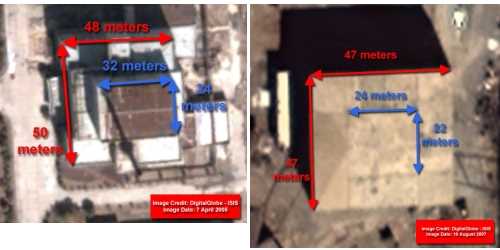
    — Respected former IAEA inspector, David Albright, has lent support to the idea that the box resembles the North Korean Yongbyon reactor based on not a lot more than the fact that the two buildings share the same diameter footprint. But whereas Yongbyon comprises a larger box with smaller boxes stacked on top of it, the image of the Syrian cube has been helpfully marked up with locations for imaginary boxes. “There also appears to be a faint square on top of the Syrian building’s roof. It is unclear whether something would be built there, but its dimensions, 24 meters by 22 meters, are consistent with the subsequent construction of an upper roof.” Four years after this faint square was first photographed, it remained a faint square [PDF].

boxes.jpg

    Global Security‘s John Pike refers to the site as being located in “the middle of nowhere” — everyone has now seen images of the barren location — yet one only needs to spend a few minutes on Google Earth to discover that the Box on the Euphrates lies right in the middle of Syria’s agricultural heartland with sizable communities either direction from this supposedly isolated location.

middle of nowhere

    This makes it all the more strange that nothing in the images appear to indicate the existence of a secure perimeter to this facilitiy — something that can easily be discerned if one looks at similar resolution images of, for instance, Israel’s nuclear facility at Dimona. However laid-back the Syrians might be, I’d wager that come the day that there was anything of high value at this site, there would be some serious security to keep out unwelcome intruders.
    — Washington’s high priest of gossip, Chris Nelson, after originally being convinced that the facility was related to Scud missile assembly, has now been won over to the nuclear reactor theory. The “evidence” that shifted his opinion? The fact that US-North Korea negotiator Chris Hill, in his recent Congressional testimony, did not refuted the theory. The absence of a denial is the same as an affirmation? Not according to my understanding of logic.

So what do we really know at this point?

A large cube-shaped building next to the Euphrates was visible from space in 2003. Given its size it must have taken a while to construct. The primary structure looked pretty much the same from above in August 2007. New images reveal that it’s not there now, the site has been leveled and it is reasonable to assume that the site clearing occured after, and very likely as a result of, an Israeli air force attack on September 6, 2007.

Do we have hard evidence that Syria was engaged in constructing a nuclear reactor? Not yet. Are any journalists hunting down that hard evidence? Probably not — why go to the trouble when you can kick back and get paid for schmoozing with John Bolton.

Meanwhile, IAEA director Mohamed ElBaradei is pissed off about the “bomb first and then ask questions later” approach. “I think it undermines the system and it doesn’t lead to any solution to any suspicion, because we are the eyes and ears of the international community. It’s only the agencies and inspectors who can go and verify the information.” He notes that in all the years that John Bolton and his cohorts have been making accusations about a Syrian nuclear program, “we have not received information about any nuclear-related activities, clandestine nuclear-related activities in Syria.”

Perhaps then we can infer that the real target of the Israeli strike was not a nuclear facility: it was the IAEA inspections processa troublesome log that the neocons are eager to clear off the road leading to Tehran.

Facebooktwittermail

OPINION: Israel never had as few excuses for evading progress toward peace

The importance of a failed summit

Israel never had as few excuses for evading progress toward peace, the ambient climate was never more conducive to progress. The terror card cannot be played again, because the terror has abated. Qassams landing on Sderot and a childish assassination attempt are not a reason to evade the peace process. This low level of terror will, unfortunately, continue to accompany Israeli-Palestinian relations for years to come. We must learn to live with it, and above all recognize that it will not stop in the absence of an agreement that will put an end to the occupation. There is more. The security issue is much greater today on the Palestinian side. Israel can no longer continue to mouth slogans about security, after seven years in which it killed 4,267 Palestinians, 861 of them children and teens, in comparison to 467 Israelis who were killed, according to data from B’Tselem.

Another excuse that no longer washes is the “no partner” one. Israel has never had an easier peace partner than Mahmoud Abbas. True, he represents barely half the Palestinian people – Olmert represents an even smaller proportion – and true, it would be preferable if the Palestinian team going to Annapolis were to include Hamas, but that is no reason not to try. We destroyed Yasser Arafat as a partner – and the time has come to regret it – but we can no longer use the weakness of his successor as an excuse: Israel did all it could to create that situation. [complete article]

Facebooktwittermail

NEWS: In Gaza: “The backbone of the economy is being destroyed.”

Under Hamas, Gaza is besieged

The streets are quiet now and the electricity works most of the time. Crime is down and even weapons smuggling is at least being regulated. But four months after Hamas seized control of Gaza, the already precarious economy has been sent into a tailspin as the militant Islamic group reigns over a pariah state.

Although Hamas’ claims that its June takeover has brought peace and order to Gaza bear some credence, its four-day military rout of the Fatah faction has ushered in an abysmal new chapter for the 1.5 million people crowded into this impoverished coastal sliver.

Now more than ever, Gaza is besieged: from the outside by economic sanctions and from the inside by a continuing battle of wills between Hamas and Fatah loyalists. [complete article]

Facebooktwittermail

OPINION: The terroriste-in-chief

Bush’s dangerous liaisons

Much as George W. Bush’s presidency was ineluctably shaped by Sept. 11, 2001, so the outbreak of the French Revolution was symbolized by the events of one fateful day, July 14, 1789. And though 18th-century France may seem impossibly distant to contemporary Americans, future historians examining Mr. Bush’s presidency within the longer sweep of political and intellectual history may find the French Revolution useful in understanding his curious brand of 21st- century conservatism.

Soon after the storming of the Bastille, pro-Revolutionary elements came together to form an association that would become known as the Jacobin Club, an umbrella group of politicians, journalists and citizens dedicated to advancing the principles of the Revolution.

The Jacobins shared a defining ideological feature. They divided the world between pro- and anti-Revolutionaries — the defenders of liberty versus its enemies. The French Revolution, as they understood it, was the great event that would determine whether liberty was to prevail on the planet or whether the world would fall back into tyranny and despotism. [complete article]

Facebooktwittermail

ANALYSIS & OPINION: The storm after the storm

Bombing Iran wouldn’t be just that

Iran’s ability to retaliate against the United States and its interests abroad spans the gamut from economic, by driving up the price of oil, to political, by spurring restive Shiite populations in Saudi Arabia and other Gulf countries to openly revolt against regimes that, for now, are American allies. Iran can also hit back militarily, against American troops in Iraq and Afghanistan.

Finally, Iran could target America’s closest ally in the Middle East—Israel. While Israel has a missile defense system that can shoot down ballistic missiles, Iran’s military rulers might try to provoke an Israeli response anyway. Saddam Hussein tried that during the first Gulf War and failed, because the first Bush administration successfully pressured Israel to exercise restraint, and Israeli casualties were minimal.

But it’s impossible to know if Israel would keep its powder dry under a similar assault, and an Israeli response could bring us back to the problem with the Arab street. “If Iran were to attack Israel, and cause the Israelis to retaliate, it would no longer be the United States against Iran, it would be a Western-Jewish alliance against another Muslim country, and that’s not going to play well on the Arab street,” said Trita Parsi, the author of “Treacherous Alliance: The Secret Dealings of Israel, Iran, and the U.S.” [complete article]

Walking into Iran’s trap

If we look at what’s going on behind the scenes in the two capitals, we can begin to disentangle the strands of this crisis. First, the military option: Despite all the saber rattling from Bush and Vice President Cheney, the United States doesn’t have good military choices now — and the Iranians know it. That’s one reason they are being so provocative; they believe that a U.S. military strike would hurt America more than Iran.

Here’s how one Gulf official sums up the problems with use of force against Iran: “When you look at it seriously, what’s the objective and what are the consequences? People talk about a bombing campaign, but in six weeks of bombing in the Gulf War in 1991, you didn’t take out the [Iraqi] Scud missiles. If the Iranians fire a missile across the Gulf, what happens to the price of oil? Or suppose they sink a tanker in the Gulf. And then they have Hezbollah, they have sleeper cells. What is your target?”

Many Arabs argue that the Iranians actually want America to attack. Politically, that would help the hard-liners rally support. And militarily, it would lure the United States onto a battlefield where its immense firepower wouldn’t do much good. The Iranians could withdraw into the maze of their homeland and keep firing off their missiles — exacting damage on the West’s economy and, most important, its will to fight. [complete article]

See also, Will Bush really bomb Iran? (The Sunday Times), ‘War on terror’ is now war on Iran (Pepe Escobar), and Europe faces tough choices on Iran (LAT).

Facebooktwittermail

FEATURE & OPINION: End of times for the Christian right

The evangelical crackup

Just three years ago, the leaders of the conservative Christian political movement could almost see the Promised Land. White evangelical Protestants looked like perhaps the most potent voting bloc in America. They turned out for President George W. Bush in record numbers, supporting him for re-election by a ratio of four to one. Republican strategists predicted that religious traditionalists would help bring about an era of dominance for their party. Spokesmen for the Christian conservative movement warned of the wrath of “values voters.” James C. Dobson, the founder of Focus on the Family, was poised to play kingmaker in 2008, at least in the Republican primary. And thanks to President Bush, the Supreme Court appeared just one vote away from answering the prayers of evangelical activists by overturning Roe v. Wade.

Today the movement shows signs of coming apart beneath its leaders. It is not merely that none of the 2008 Republican front-runners come close to measuring up to President Bush in the eyes of the evangelical faithful, although it would be hard to find a cast of characters more ill fit for those shoes: a lapsed-Catholic big-city mayor; a Massachusetts Mormon; a church-skipping Hollywood character actor; and a political renegade known for crossing swords with the Rev. Pat Robertson and the Rev. Jerry Falwell. Nor is the problem simply that the Democratic presidential front-runners — Senator Hillary Rodham Clinton, Senator Barack Obama and former Senator John Edwards — sound like a bunch of tent-revival Bible thumpers compared with the Republicans.

The 2008 election is just the latest stress on a system of fault lines that go much deeper. The phenomenon of theologically conservative Christians plunging into political activism on the right is, historically speaking, something of an anomaly. Most evangelicals shrugged off abortion as a Catholic issue until after the 1973 Roe v. Wade decision. But in the wake of the ban on public-school prayer, the sexual revolution and the exodus to the suburbs that filled the new megachurches, protecting the unborn became the rallying cry of a new movement to uphold the traditional family. Now another confluence of factors is threatening to tear the movement apart. The extraordinary evangelical love affair with Bush has ended, for many, in heartbreak over the Iraq war and what they see as his meager domestic accomplishments. That disappointment, in turn, has sharpened latent divisions within the evangelical world — over the evangelical alliance with the Republican Party, among approaches to ministry and theology, and between the generations. [complete article]

Rudy, the values slayer

Since the dawn of the new century, it has been the rarely questioned conventional wisdom, handed down by Karl Rove, that no Republican can rise to the top of the party or win the presidency without pandering as slavishly as George W. Bush has to the most bullying and gay-baiting power brokers of the religious right.

When Rudy’s candidacy started to show legs, pundits and family values activists alike assumed that ignorant voters knew only his 9/11 video reel and not his personal history or his stands on issues. “Americans do not yet realize how far outside of the mainstream of conservative thought that Mayor Giuliani’s social views really are,” declared Tony Perkins, the Family Research Council leader, in February. But despite Rudy’s fleeting stabs at fudging his views, they are well known now, and still he leads in national polls of Republican voters and is neck and neck with Fred Thompson in the Bible Belt sanctuary of South Carolina.

There are various explanations for this. One is that 9/11 and terrorism fears trump everything. Another is that the rest of the field is weak. But the most obvious explanation is the one that Washington resists because it contradicts the city’s long-running story line. Namely, that the political clout ritualistically ascribed to Mr. Perkins, James Dobson of Focus on the Family, Gary Bauer of American Values and their ilk is a sham.

These self-promoting values hacks don’t speak for the American mainstream. They don’t speak for the Republican Party. They no longer speak for many evangelical ministers and their flocks. The emperors of morality have in fact had no clothes for some time. Should Rudy Giuliani end up doing a victory dance at the Republican convention, it will be on their graves. [complete article]

Facebooktwittermail

NEWS: War profiteer hauled off in handcuffs

One down: Obscenely decadent war profiteer hauled off in handcuffs

America’s most ostentatious war profiteer is no longer a free man. In a long-anticipated move, FBI agents arrested bulletproof vest maker David H. Brooks in his Manhattan apartment at dawn on Thursday. In the tradition of Al Capone, Brooks was nabbed on allegations of financial shenanigans, despite strong suspicions that the defense contractor has much more serious crimes on his hands.

Brooks emerged as the poster boy for shameless war profiteering in November of 2005 when he blew some $10 million in profits from military contracts on a celebrity-studded party for his daughter. Leaked details of the bash drew national attention, including a description of Brooks’ pink suede suit and photos of his daughter on stage with the rapper 50 Cent. A New York Times editorial compared Brooks to the ill-fated Marie Antoinette.

And indeed, while Brooks won’t face a guillotine for his greed, he could spend up to 70 years in prison if convicted of all charges. The 71-page indictment alleges that while Brooks was chief executive of DHB Industries, a leading provider of military body armor, he pocketed more than $185 million from insider trading, fraud and tax evasion. He is also charged with using millions of dollars in DHB funds for personal expenses. [complete article]

Facebooktwittermail

OPINION: The Israeli intelligence attack on Egypt

War against Egypt in the winter

The profound frustration because war did not break out with Syria during the summer – although there are some who argue that the summer has not yet ended – is being vented by channeling the anger against another neighbor: Egypt. October is an appropriate month to set upon a state that meticulously adheres to the peace accord it signed with Israel about 30 years ago.

In briefings with Israeli journalists, intelligence officials claim that Egypt wants to see “Israel bleeding.” Perhaps it even aspires to revoke the peace accord or reach an agreement with Hamas to appease the Muslim Brotherhood, the experts suggest in an erudite explanation. In Israel, Egypt serves the role Syria fills in the United States. It is responsible for Hamas’ increased military strength, for the smuggling of weapons via tunnels, for the continued firing of Qassams and for smuggling drugs and women across the border.

Israel is furious that Egypt allowed about 80 Hamas explosive experts – allegedly trained in Iran – to enter the Gaza Strip. As if the Qassams had been waiting for them to arrive. In fact, Egypt represents an excellent culprit because it can also be punished – by freezing U.S. economic assistance, for instance. The purveyors of these intelligence briefings would do well to calm down a bit. Israel itself did not succeed in preventing arms smuggling, even when it controlled every centimeter of Gaza. Tunnels were dug under Israel’s nose and used for smuggling and perpetrating lethal attacks. Israel has yet to repair some sections of the fence along its border with Egypt because the money allocated for this, NIS 200 million, disappeared somewhere. [complete article]

Facebooktwittermail

NEWS: Discontent among Egypt’s workers

Discontent among Egypt’s workers

President Hosni Mubarak faces discontent from many quarters, but perhaps the most intense criticism resonates from the banners and shaking fists of militant workers who have broken away from government-controlled unions and staged sporadic strikes across the nation.

The Egyptian government frequently muffles free speech and political dissent, but these ragged and often disorganized picket lines present a widening crisis for a president viewed as detached from the working class and unable to lift wages and stem double-digit inflation.

“Mubarak doesn’t care about workers at all anymore,” said Mohammed Shorbagy, who held a Koran in a plastic bag and stood amid litter and lean-tos during a strike last month at the Misr Spinning and Weaving Factory in this Nile Delta city. “Why is the president asleep? We’ve been here for four days and he’s done nothing.” [complete article]

See also, The Militancy of Mahalla al-Kubra (MERIP).

Facebooktwittermail