Iran wants full nuclear deal and investment, Rouhani tells Davos

Reuters reports: Iran is determined to negotiate a comprehensive deal on its nuclear programme with major powers so it can develop its battered economy, President Hassan Rouhani said on Thursday, inviting Western companies to seize opportunities now.

Addressing the World Economic Forum in Davos, the pragmatic president said Tehran was negotiating with the United States as part of a “constructive engagement” with the world and wanted Washington to back up its words with actions.

However, a day after a chaotic Syria peace conference from which Iran was excluded, he was unbending in his support for Syrian President Bashar al-Assad. Ending “terrorism” backed by some of Syria’s neighbours was a precondition for any settlement of the country’s civil war, he said. [Continue reading…]

Facebooktwittermail

The kidnapping of journalists in Syria

James Traub writes: In the ancient southeastern Turkish city of Antakya,1 20 miles from the border with Syria, a plump Syrian merchant who calls himself Abu Nabil can be found most evenings drinking tea in the Bellur, a pleasant open-air cafe. Abu Nabil is the kind of mysterious middleman who germinates spontaneously in war zones. His specialty, or so he says, is arranging the release of journalists and activists kidnapped by the regime of President Bashar al-Assad in Damascus.

When I met Abu Nabil, in the first days of October 2013, he told me that he was at that very moment negotiating for the freedom of James Foley, an American freelance journalist who had disappeared the year before. I said that I had heard that Foley was held by rebels, not by the regime. Abu Nabil shot me a masterful look.

“The company” — Kroll Risk and Compliance Solutions, the private security firm working the case — “doesn’t know anything; the government doesn’t know anything; nobody knows anything,” he said, through an interpreter. “James Foley will come to his family in 15 days.”

Foley did not come to his family in 15 days; whatever hole he has been deposited in, he is there still. Abu Nabil’s tale, like so many of the narratives emerging from a vicious civil war now well into its third year, was a compound of outright lies, exaggerations, and, quite possibly, truth. The kidnapping and ransom specialists at Kroll had been sufficiently persuaded of Abu Nabil’s veracity that they dispatched two agents to Antakya, where they had spent weeks trying fruitlessly to press this Arabian Sydney Greenstreet for hard proof.

The fate of journalists kidnapped in Syria is a terrifying mystery. As of press time, at least 30 journalists, as well as a number of humanitarian actors, are languishing in captivity. In only a few cases do their colleagues or employers know where they are or who is determining their fate. In almost no cases have their captors made any effort to communicate. It is as if these unlucky men and women have simply disappeared.

The early days of the war saw a number of tragic deaths of journalists, including the Sunday Times of London’s Marie Colvin and freelance photographer Remi Ochlik, killed by regime shelling during the bombardment of Homs. And then things took an even nastier turn. On August 13, 2012, Austin Tice, an American former Marine, law student, and sometime journalist, was nabbed, apparently by the regime. Nothing has been heard from him since October 2012. Two months later, the NBC reporter Richard Engel and his team were kidnapped by what Engel described as the pro-regime militia known as shabiha. They escaped after five days when their captors drove into a rebel checkpoint. Those were just early mile markers on the road to anarchy. Today, rampant kidnapping has become the norm.

Covering wars is, of course, a dangerous job; that’s one of the things many war correspondents like about it. But Syria is dangerous in a way that is less thrilling than sickening. Stephanie Freid, who covers the war for the Chinese CCTV network, says, “I’ve never been in a bleaker, darker setting; it’s a godless place. Whenever I go in I feel like, ‘Just let me get out alive.'” While some major news organizations continue to work inside Syria, many of the world’s most experienced war correspondents — including C.J. Chivers of the New York Times, Paul Wood of the BBC, and Janine di Giovanni of Newsweek — stopped crossing into Syria in September 2013. They’re not afraid of being killed, at least no more than any sentient being would be in such a dangerous place. “I can take anything but kidnapping,” says di Giovanni.

Thus at a moment when Syria’s destiny hangs in the balance, and states opposed to Assad’s regime debate how, if at all, to support the rebels, it has become almost impossible to know what is actually happening inside the country. Though YouTube videos and citizen journalism of various bias and veracity litter the Internet, the average engaged person knows less and less about the real balance of forces, both between the regime and its opponents, and among the rebels themselves. Of course, given the actual state of chaos and internecine warfare on the ground, more coverage might not result in more support for the rebel cause.

The Assad regime has arrested journalists and probably targeted others like Colvin for death. That is what pitiless regimes do in the midst of wars. What makes Syria unique is the growing role of foreign jihadi forces among the rebels. Since the summer, the al Qaeda affiliate known as the Islamic State of Iraq and al-Sham (ISIS) has spread like a contagion across the “liberated” region of northern Syria, from Idlib in the west to Raqqa in the east. Journalists who travel there are thus all too likely to come in direct contact with al Qaeda, which rarely happened even in the wars in Iraq and Afghanistan. And al Qaeda has made clear that it views Western journalists as infidels and worse — CIA agents. They seize them not in order to get something in exchange, as criminal gangs and even “moderate” rebels brigades do. They seize them as agents of the enemy. The only mystery is why ISIS doesn’t kill them. [Continue reading…]

Facebooktwittermail

Testy exchange sets tone as peace talks open on Syria

The New York Times reports: Friction and acrimony broke out almost immediately on Wednesday with the start of a long-delayed peace conference on Syria, punctuated by a testy exchange between the Syrian foreign minister and the leader of the United Nations, casting doubt on the prospects for easing hostilities or even opening up emergency aid corridors to help besieged civilians.

The conference of delegates representing some 30 countries in the lakeside Swiss city of Montreux, already troubled by last-minute diplomatic stumbles, was described by Secretary of State John Kerry as a test for the international community. But the meeting had barely begun when the atmosphere grew even more charged over divisions between the United States and Russia and especially among the Syrians themselves.

The Syrian foreign minister, Walid al-Moallem, who led his country’s delegation, was openly defiant, calling Syrian insurgents evil and ignoring appeals by Ban Ki-moon, the United Nations secretary-general, to avoid invective or even yield the floor as a bell rang signaling that he had exceeded the allotted time for his remarks.

“You live in New York, I live in Syria,” Mr. Moallem snapped after Mr. Ban asked that he conclude his speech, which lasted more than 30 minutes.

After Mr. Moallem finished Mr. Ban lamented that his injunction that participants take a constructive approach to the crisis “had been broken.” [Continue reading…]

Facebooktwittermail

Likelihood diminishes for vote on Iran sanctions bill

Greg Sargent: Add two more prominent Senators to the list of lawmakers who oppose a vote on an Iran sanctions bill right now: Patty Murray and Elizabeth Warren.

Murray’s opposition — which she declared in a letter to constituents that was sent my way by a source — is significant, because she is a member of the Senate Dem leadership, which is now clearly split on how to proceed. While Chuck Schumer favors the Iran sanctions bill, Murray, Harry Reid and (reportedly) Dick Durbin now oppose it. This could make it less likely that it ever gets a vote.

Facebooktwittermail

Egypt charges renowned scholar with espionage

The New York Times reports: An internationally respected Egyptian political scientist said Wednesday that prosecutors had filed espionage charges against him, making him the second such scholar targeted this month in a widening crackdown on dissent against last summer’s military takeover.

Emad Shahin, a scholar of political Islam who has taught at Harvard, Notre Dame and the American University in Cairo and edited the Oxford Encyclopedia of Islam and Politics, was charged along with several senior leaders of the Muslim Brotherhood with conspiring with foreign organizations to undermine Egypt’s national security. He is listed as defendant 33 in a lengthy criminal complaint that also names former President Mohamed Morsi, who was deposed in the takeover.

The charges against Mr. Shahin were filed more than two weeks ago, but they have come to light just as prosecutors have also charged Amr Hamzawy, a liberal political scientist and former lawmaker, with the crime of “insulting the judiciary” because he questioned a ruling against a group of Western nonprofit organizations.

Both men were among the few public critics of the bloody crackdown on Mr. Morsi’s Islamist supporters after the military takeover. Both were also fiercely critical of Mr. Morsi and the Brotherhood while they were in power, although previously Mr. Shahin had been relatively more sympathetic to the idea that the Brotherhood might play a constructive role in building a new democracy. [Continue reading…]

Facebooktwittermail

What killed Egyptian democracy?

Mohammad Fadel writes: On February 11, 2011, after eighteen days of protests, Hosni Mubarak resigned as President of Egypt. Now, three years later, the Egyptian security state appears to have re-established political control of the country.

Why did the democratic transition fail? Answers range widely. Some blame the poorly designed transition process, which made trust among different political groups unachievable. Others point to a lack of leadership within Egypt’s political organizations, particularly the Muslim Brotherhood. Still others focus on a devastating economic crisis that post-Mubarak governments could never address given the political divisions within the country.

These explanations are plausible and not mutually exclusive. But they all miss something important. The January 25 Revolution was also a striking failure of political theory. More precisely, it was a failure of the theories embraced by the most idealistic revolutionaries. Their demands were too pure; they refused to accord any legitimacy to a flawed transition—and what transition is not flawed?—that could only yield a flawed democracy. They made strategic mistakes because they did not pay enough attention to Egypt’s institutional, economic, political, and social circumstances. These idealists generally were politically liberal. But the problem does not lie in liberalism itself. The problem lies in a faulty understanding of the implications of political liberalism in the Egyptian context—an insufficient appreciation of factors that limited what could reasonably be achieved in the short term. A more sophisticated liberalism would have accounted for these realities. [Continue reading…]

Facebooktwittermail

U.S. psychology body declines to rebuke member in Guantánamo torture case

The Guardian reports: America’s professional association of psychologists has quietly declined to rebuke one of its members, a retired US army reserve officer, for his role in one of the most brutal interrogations known to have to taken place at Guantánamo Bay, the Guardian has learned.

The decision not to pursue any disciplinary measure against John Leso, a former army reserve major, is the latest case in which someone involved in the post-9/11 torture of detainees has faced no legal or even professional consequences.

In a 31 December letter obtained by the Guardian, the American Psychological Association said it had “determined that we cannot proceed with formal charges in this matter. Consequently the complaint against Dr Leso has been closed.”

But the APA did not deny Leso took part in the brutal interrogation of the suspected 20th 9/11 hijacker, Mohammed al-Qahtani, whose treatment the Pentagon official overseeing his military commission ultimately called “torture”. [Continue reading…]

Facebooktwittermail

Independent commission to investigate future of internet after NSA revelations

The Guardian reports: A major independent commission headed by the Swedish foreign minister, Carl Bildt, was launched on Wednesday to investigate the future of the internet in the wake of the Edward Snowden revelations.

The two-year inquiry, announced at the World Economic Forum at Davos, will be wide-ranging but focus primarily on state censorship of the internet as well as the issues of privacy and surveillance raised by the Snowden leaks about America’s NSA and Britain’s GCHQ spy agencies.

The investigation, which will be conducted by a 25-member panel of politicians, academics, former intelligence officials and others from around the world, is an acknowledgement of the concerns about freedom raised by the debate.

Bildt, the former Swedish prime minister, said: “The rapid evolution of the net has been made possible by the open and flexible model by which it has evolved and been governed. But increasingly this is coming under attack.

“And this is happening as issues of net freedom, net security and net surveillance are increasingly debated. Net freedom is as fundamental as freedom of information and freedom of speech in our societies.” [Continue reading…]

Facebooktwittermail

Why Americans got bored of the NSA story

National Journal reports: When President Obama announced his long-awaited reforms to the National Security Agency’s controversial surveillance program, it was met by a collective yawn. It was the Friday before a holiday weekend, and not many Americans were listening. Those who were were finding it difficult.

Fifty percent of Americans have heard nothing about the president’s proposals, and 41 percent said they’d heard just a little, according to a new Pew Research Center/USA Today poll. Taken together the numbers mean that nine out of 10 citizens had little interest in what Obama had to say following six months of heated policy debate in Washington.

It’s not that the issue isn’t important (the poll also found 53 percent of respondents disapprove of the government’s bulk collection practices around Internet and telephone metadata), but that something was missing—an element that would capture the imagination of Americans and allow them to pay attention to an important (wonky!) area of policy.

In his speech, Obama stuck to policy, avoiding nearly all talk of controversial leaker Edward Snowden. “I am not going to dwell on Mr. Snowden’s actions or his motivations,” Obama said. That, perhaps, is where he lost much of America. The question of whether Edward Snowden is a hero or a villian has been a favorite debate topic of Americans since news of the survellaince program first broke in June. [Continue reading…]

Facebooktwittermail

Snowden calls Russian-spy story ‘absurd’

Jane Mayer reports: Edward J. Snowden, the former National Security Agency contractor turned whistleblower, strongly denies allegations made by members of Congress that he was acting as a spy, perhaps for a foreign power, when he took hundreds of thousands of classified U.S. government documents. Speaking from Moscow, where he is a fugitive from American justice, Snowden told The New Yorker, “This ‘Russian spy’ push is absurd.”

On NBC’s “Meet The Press,” Mike Rogers, a Republican congressman from Michigan who is the chairman of the House Intelligence Committee, described Snowden as a “thief, who we believe had some help.” The show’s host, David Gregory, interjected, “You think the Russians helped Ed Snowden?” Rogers replied that he believed it was neither “coincidence” nor “a gee-whiz luck event that he ended up in Moscow under the handling of the F.S.B.”

Snowden, in a rare interview that he conducted by encrypted means from Moscow, denied the allegations outright, stressing that he “clearly and unambiguously acted alone, with no assistance from anyone, much less a government.” He added, “It won’t stick…. Because it’s clearly false, and the American people are smarter than politicians think they are.”

If he was a Russian spy, Snowden asked, “Why Hong Kong?” And why, then, was he “stuck in the airport forever” when he reached Moscow? (He spent forty days in the transit zone of Sheremetyevo International Airport.) “Spies get treated better than that.” [Continue reading…]

Facebooktwittermail

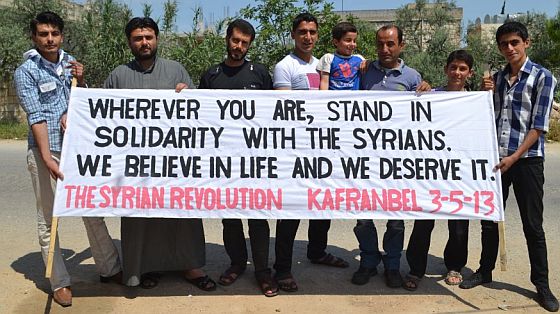
Should the fate of Syria concern you?

The Guardian reports: The cache of evidence smuggled out of Syria showing the “systematic killing” of 11,000 detainees in Syrian jails may only be the tip of the iceberg, international aid agencies have said.

The International Committee of the Red Cross, various United Nations bodies and Human Rights Watch have repeatedly complained of having next to no access to detainees and being stone-walled by Syrian authorities despite repeated requests to visit infamous detention sites, such as Sayednaya prison in Damascus.

They said Monday’s report by three eminent international lawyers that at least 11,000 victims have been killed while in detention represents numbers in only one part of the country.

“All I know after years of trying to get access is that this is likely to eventually shock the world,” one senior official from an international body told the Guardian, on condition of anonymity. “What we have seen in the [war crimes lawyers’] report broadly reflects what we have pieced together over the past few years.”

Syrian activists say an estimated 50,000 detainees remain unaccounted for. Tens of thousands of Syrians have been held in the country’s infamous detention centres and released, often after months of deprivation and torture.

In reaction to this report, here is a sampling of the comments from readers at The Guardian. While there are a few expressions of outrage, the comments I’ve picked out are fairly representative of the prevailing sentiment.

— “Assad, while not being the best of leaders, is arguably what many Arab countries need in the face of aggressive militant fanatics.”

— “Propaganda alert somebody wants to bomb them back to the stone age”

— “we should keep out of it. We can do no good here. Any attempt to intervene will inevitably result in uncoordinated disaster.”

— “All these allegations just before the peace conference smack of propaganda and manipulation. Obama was so sure that Assad had used sarin until it was shown to be a lie. But, of course, no one in the land of the free would report it (nor the Guardian). Cry wolf too many times and many will be skeptical. The timing of this report and the fact it was sponsored by Qatar is very suspicious.”

— “I supposed they need some Anti-Assad material before the scheduled talks. One last try by Qatar and the Saudi’s to propaganda us into their view. Won’t work.”

— “the west should be backing assad in his fight against the islamists/ as bad as assad might be, he is far better than the islamists/ al qaeda would butcher far more people if they took power”

— “This is nothing to do with us. We have nothing to gain from involving ourselves in this war and we’re in no position to make things better. We need to just leave them to it.”

— “Look, I’m sorry that I’m so cynical, but it’s really not my fault. They lied us into Iraq, twice! Once using the ‘babies being thrown out of incubators’ lie and once using Curveball’s lies. They have already tried to lie us into Syria once, with what looked very much like a false flag sarin attack (in that nobody could provide any real evidence of culpability). Now they are trying a new tack.”

— “I don’t think we can trust any mainstream report on issues in the middle east and elsewhere. There are to many untrustworthy players, Saudis Israel, the US can’t be trusted on Syria. You can’t trust report coming from the other side as they are not much better. Best we stop interfering in other countries affairs and most of these problems will resolve themselves.”

— “Whilst I have no doubt that the Syrian government is responsible for atrocities in Syria, I have misgivings about this report. It seems to have come out at a very convenient time, just before the peace talks, and is sponsored by the Qatar government (who back the rebels), so is hardly subjective. Seems to be another attempt to persuade Western governments to start yet another war.”

— “Haven’t we seen regimes we backed torture their population and kill thousands without a murmur of objection from our political masters? It’s time we kept out of this type of conflict. We only make things worse for the innocents.”

Never has a war been fought in which so many lives were lost, so many families displaced, and so much destruction wrought, while an antiwar “movement” was seized by one concern alone: that the West not intervene.

Of course this isn’t really an antiwar movement since with no Western government on the brink or even considering military intervention, there is nothing to protest against.

Neither is it really antiwar, since there is much less interest in ending this war than there is in making sure it not become our war.

Look at the level of public interest in Syria as measured through Google searches since the uprising began in March 2011. The only major spike came after the Ghouta chemical attack when briefly there was the prospect of very limited Western military intervention. For about three weeks, Syria — or to be more precise, the fear of war — overshadowed America’s fascination with Justin Bieber.

I used to think that being opposed to war had something to do with wanting to make the world a better place, yet in recent years the deeply conservative underpinnings of this orientation have become increasingly evident.

When Western opponents of war look at Syria or pretty much anywhere else in the Middle East, the answer to the question — am I my brother’s keeper? — appears to be a resounding, no.

Granted, whether it’s in the geopolitical realm or within the narrow sphere of ones own life, it is always necessary to balance ones aspirations with a realistic assessment of ones capabilities. And the principal of do no harm applies just as well to international affairs as it does to medicine.

But to be able to casually dismiss a report on “industrial-scale killing” seems to have less to do with expressing humility in the face of what looks like an intractable conflict and more to do with a very mundane mentality: I’ve got enough problems of my own; I don’t need to hear about yours.

Yet it’s not as though anyone reading about the latest accounts of Syria’s horrors in The Guardian has been asked to do anything. It’s not as though we have to decide whether we might be willing to make some personal sacrifice and, for instance, accommodate some refugees.

We do indeed live in a world where for vast numbers of people the demands of everyday life make it next to impossible to pay attention to the plight of people living far away.

There are however significant numbers of people who profess a concern about social justice and in the name of some kind of global conscience, champion causes such as supporting the rights of Palestinians, yet for many, their internationalism inexplicably halts at the Syrian border.

In the name of not “starting another war” (no one bothers to explain how it’s possible to start a war half way through), the antiwar camp is content to absolve itself of all concern on the basis that in Syria there are supposedly no “good guys”; that to oppose Assad is to support al Qaeda; and because it’s not our job to solve the world’s problems.

OK. But if you think Syria looks so difficult, forget about climate change, forget about inequality, and forget about opposing war. You might as well just go fishing and forget about the world.

syrian-solidarity

Facebooktwittermail

Assad goes into Geneva with the upper hand

Rajan Menon writes: It would certainly be wonderful if Wednesday’s peace conference in Geneva were to result in some kind of blueprint, however fragile, for winding down a Syrian civil war that is now approaching the three-year mark. The carnage has consumed some 130,000 lives — at least half of them civilians — turned 2.4 million Syrians into refugees in neighboring countries and displaced another 6.5 million within Syria itself.

Add to this devastation the children who have lost one or both of their parents, the destruction of essential infrastructure, the outbreak, actual or potential, of multiple diseases and the scarcity of basic necessities, and what’s evident is that Syria is being consumed by catastrophe. Syrians will feel its malign effects for years to come, as will people in adjacent countries, particularly Lebanon and Iraq, where Syria’s sectarian war has aggravated Sunni-Shi’a tensions.

With all of these factors in play, it appears unlikely that a substantive and sustainable resolution will be reached in this week’s “Geneva II” peace talks.

First, there’s a deep divide between the Syrian groups in exile — which claim to be the authentic voice of Syrians and have been recognized as such by many governments — and the most effective fighting forces within Syria. The former are organized as the National Coalition of Syrian Revolutionary and Opposition Forces (aka the Syrian National Coalition, SNC) and have established a provisional government — based in Turkey — as well as a Supreme Military Council. But no matter the rhetoric of the SNC and its backers in Washington and elsewhere, other opposition groups that do not answer to the SNC bear the brunt of the fighting and are therefore more consequential to Syria’s political future.

The pressure the United States has applied on the SNC to join Geneva II has further divided what was already a creaky coalition. When the SNC voted Saturday on whether to participate in the talks, about half of its members refused to vote, voted no or abstained. The dissenters worried, with good reason, that sitting down with Assad’s representatives would further erode their standing within Syria and diminish the likelihood of removing the dictator from power. [Continue reading…]

Facebooktwittermail

Egypt’s drift back into authoritarianism

Marc Lynch writes: Citizens of an Arab country recently went to the polls to vote in a highly-touted referendum designed to turn the page on a violent and authoritarian past. The relatively progressive new constitution — which promised multiparty democracy, expanded freedoms, and even provided for unprecedented term limits on the president — was approved overwhelmingly, with 89 percent of people voting in favor and turnout hitting 57 percent. The architects of the initiative hoped that it would restore some legitimacy to a regime that had badly lost internal and foreign approval.

Of course, the Syrian constitutional referendum of February 2012 did no such thing. And who thought that it would? In the context of a bloody civil war and the enduring oppression of a brutal authoritarian single party regime, everyone — even, probably, the most vocal pro-Assad loyalists — understood that the words on paper meant nothing.

It’s unlikely that many people thought of Syria’s farcical vote as they followed the news of Egyptians heading to the polls this week to vote on a new military-backed constitution. The official results showed that a whopping 98.1 percent of voters backed Egypt’s new charter — considerably more than in Syria’s referendum. Gen. Abdel Fattah al-Sisi’s Egypt is not Bashar al-Assad’s Syria, but the lessons from Damascus should not be lost on those seeking to parse the meaning of this referendum.

Syria’s swiftly forgotten bit of political theater helps to highlight what really matters about any constitutional referendum: Does the new document actually establish consensual and legitimate rules of the political game? That’s why Egypt’s political prisoners suffering for their political affiliation, peaceful protests, or journalism are a more crucial window into the real significance of the referendum than turnout or approval percentages. [Continue reading…]

Facebooktwittermail

85 richest people as wealthy as poorest half of the world

The Guardian reports: The world’s wealthiest people aren’t known for travelling by bus, but if they fancied a change of scene then the richest 85 people on the globe – who between them control as much wealth as the poorest half of the global population put together – could squeeze onto a single double-decker.

The extent to which so much global wealth has become corralled by a virtual handful of the so-called ‘global elite’ is exposed in a new report from Oxfam on Monday. It warned that those richest 85 people across the globe share a combined wealth of £1tn, as much as the poorest 3.5 billion of the world’s population.

The wealth of the 1% richest people in the world amounts to $110tn (£60.88tn), or 65 times as much as the poorest half of the world, added the development charity, which fears this concentration of economic resources is threatening political stability and driving up social tensions. [Continue reading…]

Facebooktwittermail

In China, U.S. tech firms weigh ‘Snowden Effect’

Reuters reports: Battling a perfect storm of government suspicion and pricing probes in China, U.S. technology companies are having to re-think how they sell hardware and services in the world’s second-biggest economy.

U.S. multinationals, including IBM, Cisco Systems and Qualcomm, are looking to settle price-gouging investigations and restore trust with Chinese regulators in the wake of reports that U.S. government agencies directly collect data and tap networks of the biggest domestic technology companies.

All U.S. IT firms are “on the defensive” in China, said Scott Kennedy, director of the Research Center for Chinese Politics and Business at Indiana University. “They are all under suspicion as either witting or unwitting collaborators in the U.S. government’s surveillance and intelligence gathering activities.” [Continue reading…]

Facebooktwittermail

Sharon: The man who made peace impossible

Ali Jarbawi writes: Since Ariel Sharon’s death, the Israeli media have been grumbling about the lack of an official Palestinian response — and in particular from the Palestinian president, Mahmoud Abbas.

But what can Israelis possibly expect a Palestinian president — or any Palestinian for that matter — to feel toward Mr. Sharon? Are they supposed to celebrate his sponsorship of violence and bloodshed against them throughout his long military career? Or laud his expansionist colonialist policies against them during his long political career?

Only out of respect for the stature of death itself was the official Palestinian response of silence appropriate. Many believe that a full accounting for Mr. Sharon’s violent and bloody history was warranted — nothing less than what Human Rights Watch did when it issued a statement expressing regret that he had died without facing justice for his crimes against Palestinians. [Continue reading…]

Facebooktwittermail

Evidence of ‘industrial-scale killing’ by Syria spurs call for war crimes charges

The Guardian reports: Syrian government officials could face war crimes charges in the light of a huge cache of evidence smuggled out of the country showing the “systematic killing” of about 11,000 detainees, according to three eminent international lawyers.

The three, former prosecutors at the criminal tribunals for the former Yugoslavia and Sierra Leone, examined thousands of Syrian government photographs and files recording deaths in the custody of regime security forces from March 2011 to last August.

Most of the victims were young men and many corpses were emaciated, bloodstained and bore signs of torture. Some had no eyes; others showed signs of strangulation or electrocution.

The UN and independent human rights groups have documented abuses by both Bashar al-Assad’s government and rebels, but experts say this evidence is more detailed and on a far larger scale than anything else that has yet emerged from the 34-month crisis.

The three lawyers interviewed the source, a military policeman who worked secretly with a Syrian opposition group and later defected and fled the country. In three sessions in the last 10 days they found him credible and truthful and his account “most compelling”.

They put all evidence under rigorous scrutiny, says their report, which has been obtained by the Guardian and CNN.

The authors are Sir Desmond de Silva QC, former chief prosecutor of the special court for Sierra Leone, Sir Geoffrey Nice QC, the former lead prosecutor of former Yugoslavian president Slobodan Milosevic, and Professor David Crane, who indicted President Charles Taylor of Liberia at the Sierra Leone court.

The defector, who for security reasons is identified only as Caesar, was a photographer with the Syrian military police. He smuggled the images out of the country on memory sticks to a contact in the Syrian National Movement, which is supported by the Gulf state of Qatar. Qatar, which has financed and armed rebel groups, has called for the overthrow of Assad and demanded his prosecution.

The 31-page report, which was commissioned by a leading firm of London solicitors acting for Qatar, is being made available to the UN, governments and human rights groups. Its publication appears deliberately timed to coincide with this week’s UN-organised Geneva II peace conference, which is designed to negotiate a way out of the Syrian crisis by creating a transitional government. [Continue reading…]

Facebooktwittermail
