Music: Wayne Shorter Quartet — ‘Over Shadow Hill Way’

This clip comes from a French television documentary. For the keen-eyed as you watch this you might be wondering: where did the orchestra go? It happens at 3 minutes 6 seconds. (It doesn’t take keen ears to hear the pitch and tempo transition.)

The film editor, Tal Zana, explains:

My favorite shot is the one that nobody notices when watching the film (which is unfortunately an indicator of a successful effect): the disappearing orchestra behind the bass player, John Patitucci. The idea here was to cut between two performances of the same composition (Over Shadow Hill Way), starting with a full-orchestra rendition and transitioning smoothly to the quartet-only performance. This was achieved by masking the foreground by hand, frame by frame (a couple of days’ work), and then carefully cutting to the close-up shot of Patitucci.

Facebooktwittermail

In harshest move yet, Egypt declares Muslim Brotherhood a ‘terrorist’ group

The New York Times reports: Egypt’s military-backed leaders on Wednesday designated the Muslim Brotherhood a terrorist organization, outlawing the country’s most successful political movement and vowing to treat anyone who belongs to it — or even takes part in its activities — as a terrorist.

The country’s leaders have been locked in conflict with the movement since July, when the military deposed Mohamed Morsi, Egypt’s first democratically elected president and a former Brotherhood leader. The state’s security forces have killed hundreds of the movement’s supporters during protests against Mr. Morsi’s removal. Most of the Brotherhood’s leaders and thousands of its members have been imprisoned.

Now, with Wednesday’s decision, the government signaled its determination to cut off any air to the more than 80-year-old Islamist organization.

Analysts said the designation opened the door to the most severe crackdown on the movement in decades, requiring hundreds of thousands of Brotherhood members to abandon the group or face prison, and granting the military and the police new authority to violently suppress protests. The decision makes it a crime to promote the Brotherhood and could also outlaw hundreds of welfare and charitable organizations affiliated with the movement that help Egyptians who have little access to government services.

The move came a day after officials blamed the Brotherhood for a suicide bombing at a police headquarters north of Cairo that killed 16 people, though on Wednesday a separate group — Ansar Beit al-Maqdis, which has derided the Brotherhood for its lack of militancy — claimed responsibility for that bombing. [Continue reading…]

Facebooktwittermail

Pope calls on believers and atheists to unite in promoting peace

The New York Times reports: Pope Francis used the first Christmas address of his papacy on Wednesday to make a broad call for global peace and an end to violence in Syria and parts of Africa, urging atheists and followers of other religions to join together in this common cause.

On a windy Christmas Day, Francis spoke from the central balcony of St. Peter’s Basilica as a throng estimated at 70,000 people listened below. The traditional address, known as “Urbi et Orbi,” Latin for “to the city and the world,” offered the pope an opportunity to give Christmas greetings to the world’s 1.2 billion Roman Catholics and draw attention to issues that concern him — in this case, the universal desire for peace.

“True peace is not a balance of opposing forces,” Francis said. “It is not a lovely façade which conceals conflicts and divisions. Peace calls for daily commitment.”

In the nine months since he became pope, Francis has generated global excitement among Roman Catholics, and others, with his humble demeanor and his shift in tone from the more strident papacy of his predecessor, Benedict XVI, whose resignation last February stunned the Catholic world.

Francis has regularly attracted huge crowds in Vatican City, and almost overnight he has emerged as a major figure on the global stage, surprising many Catholics with his nonjudgmental tone on issues like homosexuality and divorce, and his focus on the plight of the world’s poor. He has also been unpredictable, telephoning ordinary people who have written him letters, embracing a badly disfigured man at St. Peter’s, and making unannounced visits in Rome.

He proved unpredictable again on Wednesday, when he went off script to include atheists in his call for peace, rare for a Catholic leader.

“I invite even nonbelievers to desire peace,” he said. “Let us all unite, either with prayer or with desire, but everyone, for peace.” [Continue reading…]

Facebooktwittermail

The War on Terror’s Jedi mind trick

Julian Sanchez writes: A Republican-appointed judge and President Obama’s own handpicked Surveillance Review Group both came to the same conclusion last week: The National Security Agency’s controversial phone-records program has been of little real value to American security. Yet its defenders continue to insist that it is necessary, clinging desperately to long-debunked claims about foiled terror plots. Their stubbornness fits a decade-long pattern of fear trumping evidence whenever the word “terrorism” is uttered — a pattern it is time to finally break.

Since the disclosure of the NSA’s massive domestic phone-records database, authorized under a tortured reading of the Patriot Act’s Section 215 authority to obtain business records, intelligence officials and their allies in Congress have claimed it plays a vital role in protecting Americans from “dozens” of terror attacks. But as the expert panel Obama appointed to review the classified facts concluded, in a report released Wednesday, that just isn’t true.

“Our review suggests that the information contributed to terrorist investigations by the use of section 215 telephony meta-data was not essential to preventing attacks,” the report found, “and could readily have been obtained in a timely manner using conventional section 215 orders.”

In other words, instead of vacuuming up sensitive information about the call patterns of millions of innocent people, the government could have followed the traditional approach of getting orders for specific suspicious numbers. As for those “dozens” of attacks, the review groups found that the NSA program “generated relevant information in only a small number of cases, and there has been no instance in which NSA could say with confidence that the outcome would have been different without the section 215 telephony meta-data program.” [Continue reading…]

Facebooktwittermail

The funders behind climate-change denial

Drexel University: A new study conducted by Drexel University environmental sociologist Robert J. Brulle, PhD, exposes the organizational underpinnings and funding behind the powerful climate change countermovement. This study marks the first peer-reviewed, comprehensive analysis ever conducted of the sources of funding that maintain the denial effort.

Through an analysis of the financial structure of the organizations that constitute the core of the countermovement and their sources of monetary support, Brulle found that, while the largest and most consistent funders behind the countermovement are a number of well-known conservative foundations, the majority of donations are “dark money,” or concealed funding.

The data also indicates that Koch Industries and ExxonMobil, two of the largest supporters of climate science denial, have recently pulled back from publicly funding countermovement organizations. Coinciding with the decline in traceable funding, the amount of funding given to countermovement organizations through third party pass-through foundations like Donors Trust and Donors Capital, whose funders cannot be traced, has risen dramatically.

Brulle, a professor of sociology and environmental science in Drexel’s College of Arts and Sciences, conducted the study during a year-long fellowship at Stanford University’s Center for Advanced Study in the Behavioral Sciences. The study was published today in Climatic Change, one of the top 10 climate science journals in the world.

The climate change countermovement is a well-funded and organized effort to undermine public faith in climate science and block action by the U.S. government to regulate emissions. This countermovement involves a large number of organizations, including conservative think tanks, advocacy groups, trade associations and conservative foundations, with strong links to sympathetic media outlets and conservative politicians.

“The climate change countermovement has had a real political and ecological impact on the failure of the world to act on the issue of global warming,” said Brulle. “Like a play on Broadway, the countermovement has stars in the spotlight – often prominent contrarian scientists or conservative politicians – but behind the stars is an organizational structure of directors, script writers and producers, in the form of conservative foundations. If you want to understand what’s driving this movement, you have to look at what’s going on behind the scenes.”

To uncover how the countermovement was built and maintained, Brulle developed a listing of 118 important climate denial organizations in the U.S. He then coded data on philanthropic funding for each organization, combining information from the Foundation Center with financial data submitted by organizations to the Internal Revenue Service.

The final sample for analysis consisted of 140 foundations making 5,299 grants totaling $558 million to 91 organizations from 2003 to 2010. The data shows that these 91 organizations have an annual income of just over $900 million, with an annual average of $64 million in identifiable foundation support. Since the majority of the organizations are multiple focus organizations, not all of this income was devoted to climate change activities, Brulle notes.

Key findings include:

  • Conservative foundations have bank-rolled denial. The largest and most consistent funders of organizations orchestrating climate change denial are a number of well-known conservative foundations, such as the Searle Freedom Trust, the John William Pope Foundation, the Howard Charitable Foundation and the Sarah Scaife Foundation. These foundations promote ultra-free-market ideas in many realms.
  • Koch and ExxonMobil have recently pulled back from publicly visible funding. From 2003 to 2007, the Koch Affiliated Foundations and the ExxonMobil Foundation were heavily involved in funding climate-change denial organizations. But since 2008, they are no longer making publicly traceable contributions.
  • Funding has shifted to pass through untraceable sources. Coinciding with the decline in traceable funding, the amount of funding given to denial organizations by the Donors Trust has risen dramatically. Donors Trust is a donor-directed foundation whose funders cannot be traced. This one foundation now provides about 25% of all traceable foundation funding used by organizations engaged in promoting systematic denial of climate change.
  • Most funding for denial efforts is untraceable. Despite extensive data compilation and analyses, only a fraction of the hundreds of millions in contributions to climate change denying organizations can be specifically accounted for from public records. Approximately 75% of the income of these organizations comes from unidentifiable sources.
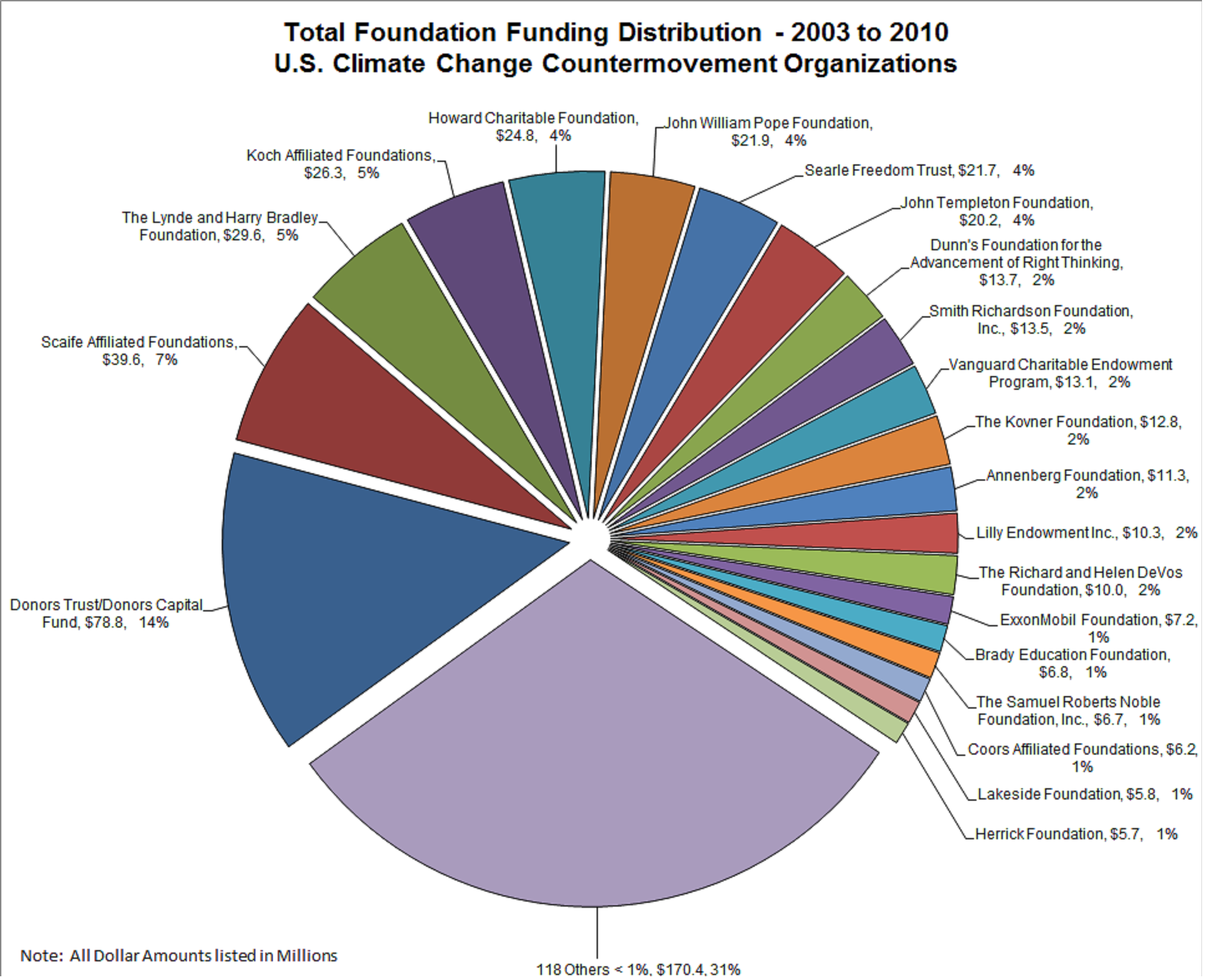
 This chart shows the overall amount and percentage distribution of foundation funding of countermovement organizations

“The real issue here is one of democracy. Without a free flow of accurate information, democratic politics and government accountability become impossible,” said Brulle. “Money amplifies certain voices above others and, in effect, gives them a megaphone in the public square. Powerful funders are supporting the campaign to deny scientific findings about global warming and raise public doubts about the roots and remedies of this massive global threat. At the very least, American voters deserve to know who is behind these efforts.”

This study is part one of a three-part project by Brulle to examine the climate movement in the U.S. at the national level. The next step in the project is to examine the environmental movement or the climate change movement. Brulle will then compare the whole funding flow to the entire range of organizations on both sides of the debate.

Brulle has authored numerous articles and book chapters on environmental science, and is a frequent media commentator on climate change. He co-edited Power, Justice and the Environment: A Critical Appraisal of the Environmental Justice Movement (2005) with David Pellow, and is the author of Agency, Democracy, and Nature: U.S. Environmental Movements from a Critical Theory Perspective (2000).

Brulle previously served as a commissioned officer in the United States Coast Guard for two decades. He received a doctorate in sociology from George Washington University, a master of science degree in natural resources from the University of Michigan, a master of arts degree in sociology from the New School for Social Research and a bachelor of science degree in marine engineering from the United States Coast Guard Academy.

The full paper is available here.

Facebooktwittermail

2013: Climate change and energy in charts

Think Progress charts the data:

  • Global Temperatures Keep Going Up
  • Carbon Dioxide Levels Hit 400ppm For The First Time In Recorded History
  • Most Congressional Republicans Denied Climate Change
  • The First Bulk Freighter Passed Through The Arctic, Carrying Coal
  • Arctic Sea Ice Volume Still In Jeopardy
  • The Price Of Solar Dropped Dramatically
  • 99 Percent of New Electric Capacity In October Came From Renewables
  • Turns Out More Shale Gas Will Not Bring A Major Climate Benefit
Facebooktwittermail

Talking to animals

chimpanzee

As a child, I was once taken to a small sad zoo near the Yorkshire seaside town of Scarborough. There were only a handful of animals and my attention was quickly drawn by a solitary chimpanzee.

We soon sat face-to-face within arm’s reach, exchanging calls and became absorbed in what seemed like communication — even if there were no words. Before the eyes of another primate we see mirrors of inquiry. Just as much as I wanted to talk to the chimp, it seemed like he wanted to talk to me. His sorrow, like that of all captives, could not be held tight by silence.

The rest of my family eventually tired of my interest in learning how to speak chimpaneze. After all, talking to animals is something that only small children are willing to take seriously. Supposedly, it is just another childish exercise of the imagination — the kind of behavior that as we grow older we grow out of.

This notion of outgrowing a sense of kinship with other creatures implies an upward advance, yet in truth we don’t outgrow these experiences of connection, we simply move away from them. We imagine we are leaving behind something we no longer need, whereas in fact we are losing something we have forgotten how to appreciate.

Like so many other aspects of maturation, the process through which adults forget their connections to the non-human world involves a dulling of the senses. As we age, we become less alive, less attuned and less receptive to life’s boundless expressions. The insatiable curiosity we had as children, slowly withers as the mental constructs which form a known world cut away and displace our passion for exploration.

Within this known and ordered world, the idea that an adult would describe herself as an animal communicator, naturally provokes skepticism. Is this a person living in a fantasy world? Or is she engaged in a hoax, cynically exploiting the longings of others such as the desire to rediscover a lost childhood?

Whether Anna Breytenbach (who features in the video below) can see inside the minds of animals, I have no way of knowing, but that animals have minds and that they can have what we might regard as intensely human experiences — such as the feeling of loss — I have no doubt.

The cultural impact of science which is often more colored by belief than reason, suggests that whenever we reflect on the experience of animals we are perpetually at risk of falling into the trap of anthropomorphization. The greater risk, however, is that we unquestioningly accept this assumption: that even if as humans we are the culmination of an evolutionary process that goes all the way back to the formation of amino acids, at the apex of this process we somehow stand apart. We can observe the animal kingdom and yet as humans we have risen above it.

But instead, what actually sets us apart in the most significant way is not the collection of attributes that define human uniqueness, but rather it is this very idea of our separateness — the idea that we are here and nature is out there.

Facebooktwittermail

Snowden’s mission ‘already accomplished’

In the first in-person interview Edward Snowden has conducted since his arrival in Moscow in June, Barton Gellman reports:

“For me, in terms of personal satisfaction, the mission’s already accomplished,” he said. “I already won. As soon as the journalists were able to work, everything that I had been trying to do was validated. Because, remember, I didn’t want to change society. I wanted to give society a chance to determine if it should change itself.”

“All I wanted was for the public to be able to have a say in how they are governed,” he said. “That is a milestone we left a long time ago. Right now, all we are looking at are stretch goals.”

Snowden is an orderly thinker, with an engineer’s approach to problem-solving. He had come to believe that a dangerous machine of mass surveillance was growing unchecked. Closed-door oversight by Congress and the Foreign Intelligence Surveillance Court was a “graveyard of judgment,” he said, manipulated by the agency it was supposed to keep in check. Classification rules erected walls to prevent public debate.

Toppling those walls would be a spectacular act of transgression against the norms that prevailed inside them. Someone would have to bypass security, extract the secrets, make undetected contact with journalists and provide them with enough proof to tell the stories.

The NSA’s business is “information dominance,” the use of other people’s secrets to shape events. At 29, Snowden upended the agency on its own turf.

“You recognize that you’re going in blind, that there’s no model,” Snowden said, acknowledging that he had no way to know whether the public would share his views.

“But when you weigh that against the alternative, which is not to act,” he said, “you realize that some analysis is better than no analysis. Because even if your analysis proves to be wrong, the marketplace of ideas will bear that out. If you look at it from an engineering perspective, an iterative perspective, it’s clear that you have to try something rather than do nothing.”

By his own terms, Snowden succeeded beyond plausible ambition. The NSA, accustomed to watching without being watched, faces scrutiny it has not endured since the 1970s, or perhaps ever.

Facebooktwittermail

How the NSA became an advanced persistent threat to global cybersecurity

In the first in-person interview Edward Snowden has conducted since his arrival in Moscow in June, Barton Gellman reports:

The documents leaked by Snowden compelled attention because they revealed to Americans a history they did not know they had.

Internal briefing documents reveled in the “Golden Age of Electronic Surveillance.” Brawny cover names such as MUSCULAR, TUMULT and TURMOIL boasted of the agency’s prowess.

With assistance from private communications firms, the NSA had learned to capture enormous flows of data at the speed of light from fiber-optic cables that carried Internet and telephone traffic over continents and under seas. According to one document in Snowden’s cache, the agency’s Special Source Operations group, which as early as 2006 was said to be ingesting “one Library of Congress every 14.4 seconds,” had an official seal that might have been parody: an eagle with all the world’s cables in its grasp.

Each year, NSA systems collected hundreds of millions of e-mail address books, hundreds of billions of cellphone location records and trillions of domestic call logs.

Most of that data, by definition and intent, belonged to ordinary people suspected of nothing. But vast new storage capacity and processing tools enabled the NSA to use the information to map human relationships on a planetary scale. Only this way, its leadership believed, could the NSA reach beyond its universe of known intelligence targets.

In the view of the NSA, signals intelligence, or electronic eavesdropping, was a matter of life and death, “without which America would cease to exist as we know it,” according to an internal presentation in the first week of October 2001 as the agency ramped up its response to the al-Qaeda attacks on the World Trade Center and the Pentagon.

With stakes such as those, there was no capability the NSA believed it should leave on the table. The agency followed orders from President George W. Bush to begin domestic collection without authority from Congress and the courts. When the NSA won those authorities later, some of them under secret interpretations of laws passed by Congress between 2007 and 2012, the Obama administration went further still.

Using PRISM, the cover name for collection of user data from Google, Yahoo, Microsoft, Apple and five other U.S.-based companies, the NSA could obtain all communications to or from any specified target. The companies had no choice but to comply with the government’s request for data.

But the NSA could not use PRISM, which was overseen once a year by the surveillance court, for the collection of virtually all data handled by those companies. To widen its access, it teamed up with its British counterpart, Government Communications Headquarters, or GCHQ, to break into the private fiber-optic links that connected Google and Yahoo data centers around the world.

That operation, which used the cover name MUSCULAR, tapped into U.S. company data from outside U.S. territory. The NSA, therefore, believed it did not need permission from Congress or judicial oversight. Data from hundreds of millions of U.S. accounts flowed over those Google and Yahoo links, but classified rules allowed the NSA to presume that data ingested overseas belonged to foreigners.

Disclosure of the MUSCULAR project enraged and galvanized U.S. technology executives. They believed the NSA had lawful access to their front doors — and had broken down the back doors anyway.

Microsoft general counsel Brad Smith took to his company’s blog and called the NSA an “advanced persistent threat” — the worst of all fighting words in U.S. cybersecurity circles, generally reserved for Chinese state-sponsored hackers and sophisticated criminal enterprises.

Facebooktwittermail

The NSA has assumed the expansive powers of colonial Britain against which Americans fought

In the first in-person interview Edward Snowden has conducted since his arrival in Moscow in June, Barton Gellman reports:

Snowden likened the NSA’s powers to those used by British authorities in Colonial America, when “general warrants” allowed for anyone to be searched. The FISA court, Snowden said, “is authorizing general warrants for the entire country’s metadata.”

“The last time that happened, we fought a war over it,” he said.

Technology, of course, has enabled a great deal of consumer surveillance by private companies, as well. The difference with the NSA’s possession of the data, Snowden said, is that government has the power to take away life or freedom.

At the NSA, he said, “there are people in the office who joke about, ‘We put warheads on foreheads.’ Twitter doesn’t put warheads on foreheads.”

Privacy, as Snowden sees it, is a universal right, applicable to American and foreign surveillance alike.

“I don’t care whether you’re the pope or Osama bin Laden,” he said. “As long as there’s an individualized, articulable, probable cause for targeting these people as legitimate foreign intelligence, that’s fine. I don’t think it’s imposing a ridiculous burden by asking for probable cause. Because, you have to understand, when you have access to the tools the NSA does, probable cause falls out of trees.”

Facebooktwittermail

Snowden took on a responsibility that others refused to exercise

In the first in-person interview Edward Snowden has conducted since his arrival in Moscow in June, Barton Gellman reports:

It is commonly said of Snowden that he broke an oath of secrecy, a turn of phrase that captures a sense of betrayal. NSA Director Keith B. Alexander and Director of National Intelligence James R. Clapper Jr., among many others, have used that formula.

In his interview with The Post, Snowden noted matter-of-factly that Standard Form 312, the ­classified-information nondisclosure agreement, is a civil contract. He signed it, but he pledged his fealty elsewhere.

“The oath of allegiance is not an oath of secrecy,” he said. “That is an oath to the Constitution. That is the oath that I kept that Keith Alexander and James Clapper did not.”

People who accuse him of disloyalty, he said, mistake his purpose.

“I am not trying to bring down the NSA, I am working to improve the NSA,” he said. “I am still working for the NSA right now. They are the only ones who don’t realize it.”

What entitled Snowden, now 30, to take on that responsibility?

“That whole question — who elected you? — inverts the model,” he said. “They elected me. The overseers.”

He named the chairmen of the Senate and House intelligence committees.

“Dianne Feinstein elected me when she asked softball questions” in committee hearings, he said. “Mike Rogers elected me when he kept these programs hidden. . . . The FISA court elected me when they decided to legislate from the bench on things that were far beyond the mandate of what that court was ever intended to do. The system failed comprehensively, and each level of oversight, each level of responsibility that should have addressed this, abdicated their responsibility.”

“It wasn’t that they put it on me as an individual — that I’m uniquely qualified, an angel descending from the heavens — as that they put it on someone, somewhere,” he said. “You have the capability, and you realize every other [person] sitting around the table has the same capability but they don’t do it. So somebody has to be the first.”

Facebooktwittermail

Snowden blew the whistle from the inside before he went public

In the first in-person interview Edward Snowden has conducted since his arrival in Moscow in June, Barton Gellman reports:

Beginning in October 2012, he said, he brought his misgivings to two superiors in the NSA’s Technology Directorate and two more in the NSA Threat Operations Center’s regional base in Hawaii. For each of them, and 15 other co-workers, Snowden said he opened a data query tool called BOUNDLESSINFORMANT, which used color-coded “heat maps” to depict the volume of data ingested by NSA taps.

His colleagues were often “astonished to learn we are collecting more in the United States on Americans than we are on Russians in Russia,” he said. Many of them were troubled, he said, and several said they did not want to know any more.

“I asked these people, ‘What do you think the public would do if this was on the front page?’ ” he said. He noted that critics have accused him of bypassing internal channels of dissent. “How is that not reporting it? How is that not raising it?” he said.

Facebooktwittermail

Snowden alerted his superiors about serious flaws with NSA information security

In the first in-person interview Edward Snowden has conducted since his arrival in Moscow in June, Barton Gellman reports:

Snowden recounted another set of conversations that he said took place three years earlier, when he was sent by the NSA’s Technology Directorate to support operations at a listening post in Japan. As a system administrator, he had full access to security and auditing controls. He said he saw serious flaws with information security.

“I actually recommended they move to two-man control for administrative access back in 2009,” he said, first to his supervisor in Japan and then to the directorate’s chief of operations in the Pacific. “Sure, a whistleblower could use these things, but so could a spy.”

That precaution, which requires a second set of credentials to perform risky operations such as copying files onto a removable drive, has been among the principal security responses to the Snowden affair.

Facebooktwittermail

The Democratic senators willing to risk a war with Iran

The Huffington Post reports: As the United States finally puts a decade of war behind it, a group of senators, including 15 Democrats, is defying the White House and threatening to push the country into a fresh war with Iran.

Sen. Bob Menendez (D-N.J.) is leading the charge to pass legislation in January that would impose tougher sanctions on Iran, despite dire warnings from the White House, Iranian leaders, 10 Democratic committee chairs and a host of liberal groups that such an effort could sink a delicate nuclear agreement already in place. Under that Nov. 24 deal, Tehran would curb its nuclear program in exchange for some relief from economic sanctions for a period of six months.

The Senate bill, which has 19 Republican cosponsors, takes a hard line, levying new sanctions on Iran unless the country’s leaders agree to abandon all uranium enrichment — what some have called an “absurd” stance. In the past, both John Kerry, then a U.S. senator, and Mohamed ElBaradei, former head of the International Atomic Energy Agency, have said that Iran has the right to enrich uranium for peaceful purposes.

Iranian Foreign Minister Javad Zarif said earlier this month that if the Senate moved forward with its bill, the current nuclear deal would be dead. A senior Obama administration official went further, telling The Huffington Post that Senate action makes it “far more likely that we’ll be left only with a military option” regarding Iran. [Continue reading…]

Facebooktwittermail

When ‘60 Minutes’ checks its journalistic skepticism at the door

David Carr writes: Last week, a study commissioned by the president concluded that the National Security Agency had reached too far into the private lives of Americans. The study, which came after a series of journalistic revelations exposing the agency’s surveillance practices, recommended numerous reforms that would curb the N.S.A.’s prerogatives. President Obama said he was “open to many” of the suggestions.

It was exactly the kind of news-making moment that “60 Minutes” — America’s leading purveyor of serious television news — has often been responsible for creating. For more than four decades, the program has exposed C.I.A. abuses, rogue military contractors and hundreds of corporate villains.

But where was “60 Minutes” on the N.S.A. story? The Sunday before the damning study, the program produced a segment that scanned as a friendly infomercial for the agency. Reported by John Miller, a CBS News reporter, the piece included extensive interviews with Gen. Keith Alexander, the director of the N.S.A.

In a scene that served as something of a metaphor for the whole segment, the producers negotiated access to the Black Chamber, a supersecret area where the nation’s top code breakers work. The door is briefly opened, we see a deserted office hall that looks like any other and then the door is closed. We get a look in, but we learn nothing.

Coming as it does on the heels of the now-discredited Benghazi report — in which “60 Minutes” said it was fooled by an eyewitness who was apparently nothing of the kind — the N.S.A. segment raises the question of whether the program has not just temporarily lost its mojo, but its skepticism as well. It didn’t help that the day after the piece aired, a federal judge ruled that the agency’s program of collecting phone records was most likely unconstitutional. [Continue reading…]

Facebooktwittermail

A spy world reshaped by Edward Snowden

The Los Angeles Times reports: After news reports that the National Security Agency had secretly monitored German Chancellor Angela Merkel’s cellphone calls, America’s top intelligence official was asked why congressional oversight committees were kept in the dark.

Shouldn’t Congress have been briefed, Rep. Adam B. Schiff (D-Burbank) asked James R. Clapper, the director of national intelligence, about a spying operation that would embarrass the U.S. government if exposed?

“Well, sir, there are many things we do in intelligence that, if revealed, would have the potential for all kinds of blowback,” Clapper replied at a House Intelligence Committee hearing in October. “The conduct of intelligence is premised on the notion that we can do it secretly, and we don’t count on it being revealed in the newspaper.”

Not these days. [Continue reading…]

Facebooktwittermail

RSA denies taking $10m from NSA to default backdoored algorithm

ZDNet reports: EMC-owned RSA Security has denied reports that the company had entered into secret contracts with the NSA worth $10 million to use the flaws Dual Elliptic Curve Deterministic Random Bit Generator (Dual_EC_DRBG) as the default pseudorandom number generator for the company’s encryptions products.

Over the weekend, sources told Reuters that as part of the US National Security Agency’s (NSA) efforts to promote Dual_EC_DRBG, the use of the algorithm by RSA allowed the agency to point to its usage within government to help push for its inclusion in the National Institute of Standards and Technology’s Recommendation for Random Number Generation Using Deterministic Random Bit Generators (PDF).

“Recent press coverage has asserted that RSA entered into a ‘secret contract’ with the NSA to incorporate a known flawed random number generator into its BSAFE encryption libraries. We categorically deny this allegation,” RSA responded today in a blog post.

Facebooktwittermail