Are we alone in the Universe?

Paul Davies writes: The recent announcement by a team of astronomers that there could be as many as 40 billion habitable planets in our galaxy has further fueled the speculation, popular even among many distinguished scientists, that the universe is teeming with life.

The astronomer Geoffrey W. Marcy of the University of California, Berkeley, an experienced planet hunter and co-author of the study that generated the finding, said that it “represents one great leap toward the possibility of life, including intelligent life, in the universe.”

But “possibility” is not the same as likelihood. If a planet is to be inhabited rather than merely habitable, two basic requirements must be met: the planet must first be suitable and then life must emerge on it at some stage.

What can be said about the chances of life starting up on a habitable planet? Darwin gave us a powerful explanation of how life on Earth evolved over billions of years, but he would not be drawn out on the question of how life got going in the first place. “One might as well speculate about the origin of matter,” he quipped. In spite of intensive research, scientists are still very much in the dark about the mechanism that transformed a nonliving chemical soup into a living cell. But without knowing the process that produced life, the odds of its happening can’t be estimated.

When I was a student in the 1960s, the prevailing view among scientists was that life on Earth was a freak phenomenon, the result of a sequence of chemical accidents so rare that they would be unlikely to have happened twice in the observable universe. “Man at last knows he is alone in the unfeeling immensity of the universe, out of which he has emerged only by chance,” wrote the biologist Jacques Monod. Today the pendulum has swung dramatically, and many distinguished scientists claim that life will almost inevitably arise in Earthlike conditions. Yet this decisive shift in view is based on little more than a hunch, rather than an improved understanding of life’s origin. [Continue reading…]

Facebooktwittermail

Social complexity and facial diversity among primates

UCLA Newsroom: Why do the faces of some primates contain so many different colors — black, blue, red, orange and white — that are mixed in all kinds of combinations and often striking patterns while other primate faces are quite plain?

UCLA biologists reported last year on the evolution of 129 primate faces in species from Central and South America. This research team now reports on the faces of 139 Old World African and Asian primate species that have been diversifying over some 25 million years.

With these Old World monkeys and apes, the species that are more social have more complex facial patterns, the biologists found. Species that have smaller group sizes tend to have simpler faces with fewer colors, perhaps because the presence of more color patches in the face results in greater potential for facial variation across individuals within species. This variation could aid in identification, which may be a more difficult task in larger groups.

Species that live in the same habitat with other closely related species tend to have more complex facial patterns, suggesting that complex faces may also aid in species recognition, the life scientists found.

“Humans are crazy for Facebook, but our research suggests that primates have been relying on the face to tell friends from competitors for the last 50 million years and that social pressures have guided the evolution of the enormous diversity of faces we see across the group today,” said Michael Alfaro, an associate professor of ecology and evolutionary biology in the UCLA College of Letters and Science and senior author of the study.

“Faces are really important to how monkeys and apes can tell one another apart,” he said. “We think the color patterns have to do both with the importance of telling individuals of your own species apart from closely related species and for social communication among members of the same species.” [Continue reading…]

Facebooktwittermail

‘Syria is not a revolution any more — this is civil war’

Ghaith Abdul-Ahad reports: For three men in northern Syria, the second civil war started shortly after the first staggered into a quagmire of sectarian violence. The goals of the first war – freedom, Islam, social equality of some sort – were replaced by betrayal, defeat and anger towards rival militias, jihadis and foreign powers fighting in Syria.

Like many others, the three men are bewildered at what has become of their war. Their alliances – and their goals – are shifting. The regime is far away, the jihadis are near – and seem unstoppable. Their resources are dwindling; their families are shattered. Their villages and farm lands are lost to regime militias. Their allies are at best unreliable, and at worst actively conspiring against them.

They are a businessman, a smuggler and an army defector who became respectively the political officer, treasurer and military commander of a once-formidable battalion in northern Syria.

The businessman is the shrewdest: a tall, wide-shouldered man with a square head and thinning hair. A devout Salafi, he was once a rich man in Homs, but after two and half years of war, most of his fortune has been spent on arms and ammunition. What remains of his wealth is being slowly drained by the families of his dead, injured and missing relatives, many of them languishing in refugee camps.

On a cold autumn evening he sat in the courtyard of a newly built concrete house on the Turkish side of the Syrian border – the latest in a string of temporary homes since his house was razed by the Syrian government in the early days of the revolution.

“I need Bashar [al-Assad] to last for two more years,” said the businessman. “It would be a disaster if the regime fell now: we would split into mini-states that would fight among each other. We’ll be massacring each other – tribes, Islamists and battalions.

“Maybe if the regime lasts for a few more years we can agree on the shape of the new Syria. At least then we might end up with three states rather than 10,” he said. Meanwhile, the killings and massacres will continue, until sectarian cleansing has been carried out in all of Syria’s cities and regions, he added. “There will be either Alawites or Sunnis. Either them or us. Maybe in 10 years we will all be bored with fighting and learn how to coexist.” He paused, then added: “In 10 years maybe, not now.”

The battalion that the three men were part of was once the darling of the rebels’ foreign backers: Qatari royalty, Saudi preachers and Kuwaiti MPs all donated money and funnelled weapons to them. The businessman regularly met Turkish military intelligence officers on the border who safeguarded his arms shipments from Mediterranean ports.

But as jihadi influence grew among the opposition forces, the battalion’s position came under threat. A clash – as much about resources as it was about ideology – was inevitable. A jihadi leader was assassinated and the battalion was forced from its footholds in the oil-rich east. Further divisions within the battalion followed and some of its men left to join other factions or set up their own.

Gulf dignitaries accused the three men of sowing dissent in the Muslim community and financial backers switched their support to other battalions with a stricter Islamic outlook.

As his brother spread out blankets on the porch, the businessman stared up at the night sky, and smoked his last cigarette of the day. “This is not a revolution against a regime any more, this is a civil war,” he said. [Continue reading…]

Facebooktwittermail

Why has the UN given Assad a free pass on mass murder?

Colum Lynch reports: During the past year, the United Nations’ chief relief agency has routinely withheld from the public vital details of the Bashar al-Assad regime’s systematic campaign to block humanitarian assistance to Syrian civilians. This silence has infuriated human rights advocates, who believe that greater public exposure of Assad’s actions would increase political pressure on the Syrian government to allow the international community to help hundreds of thousands of ordinary Syrians who are trapped in the line of fire.

Instead, the U.N. Office for the Coordination of Humanitarian Affairs (OCHA) — which oversees international relief efforts in Syria — has relied on low-key, behind-the-scenes diplomacy to quietly persuade the Syrian regime to open the aid floodgates. So far, critics say, the strategy has been ineffective. Worse, it provides a measure of political cover to the Assad regime as it carries out mass starvation and slaughter, these critics contend.

The U.N. “should be much more willing to point the finger at the Syrian government when they are responsible for vast blockages of aid. They haven’t said enough about who is responsible for violations and the character of those violations,” said Peggy Hicks, the head of advocacy for Human Rights Watch. “There is always a balancing act, but we have been concerned that the U.N. has been reluctant to recognize the limits of working behind the scenes.” [Continue reading…]

Facebooktwittermail

Even Israel would benefit from a nuclear weapons-free Middle East

Scott McConnell writes: Faced with a contest between an arms-control intellectual—soberly pointing that a deal reducing Iran’s enrichment capacity and placing its remaining centrifuges under international inspection will do far more to ensure that Iran doesn’t build a nuclear weapon than continued sanctions and no deal at all—and a Nentayahuite screaming about Hitler and Munich and making racist comments about Iranians, the most attentive and educated slice of the population will favor diplomacy. But I suspect that more flamboyant arguments register more deeply with more of the American population. Obama risks having diplomats left high and dry without the backing of mass public opinion.

In fact, more emotive arguments to defend an Iran deal are available and shouldn’t be left in the closet. Take the obvious one. It is political malpractice that the administration’s allies, including those in Congress, fail to question the role Israel’s nuclear arsenal has played in the development of the current crisis. What role do Israel’s nukes play in pushing other Middle East states to take massive risks to develop their own nuclear technology? M.J. Rosenberg recently reminded readers of John F. Kennedy’s long and ultimately futile effort to monitor Israel’s nuclear program, constructed with blatant deception and dishonesty by French engineers at Dimona. Kennedy and the diplomats of the era pointed out again and again that by introducing nukes into the region, Israel risked setting off a cascade of nuclear proliferation. JFK was, of course, correct. If you speak to average Americans, there is an implicit assumption that the golden rule is a fair guide to thought and action, and there is something rather odd about Israel, stuffed to to gills with nuclear rockets and submarines, insisting that no one else can ever have them. But no one on Capitol Hill raises this point. What do they fear would happen to them?

(It’s a rhetorical question; I know they would face AIPAC-generated opposition. But I’m not sure AIPAC would know what to do if 40 members of Congress suggested exploring a nuclear free Mideast).

Farah Stockman writes: When Israeli Prime Minister Benjamin Netanyahu demands that Iran’s plutonium reactor at Arak be completely dismantled because it has “no peaceful purpose,” he is speaking from experience. Israel had built a similar plant, and engaged in similar deception, at Dimona.

That’s what spooks Israeli policymakers: Iran’s nuclear playbook feels all too familiar.

“When Israel looks at Iran, they see Iran as if Iran is like Israel 50 years ago,” said Avner Cohen, professor at the Monterey Institute of International Studies and author of “Israel and the Bomb” and “The Worst Kept Secret.”

If you look at things that way, the Iranian bomb feels downright inevitable.

But Iran isn’t Israel, Cohen points out. There are plenty of reasons the Iranian program could turn out differently.

Israel had a much deeper reason to seek the bomb. Surrounded by hostile neighbors bent on its destruction, Israel felt that nuclear weapons were the key to the Jewish state’s very survival. Iran faces no such existential threat.

And, unlike Israel, Iran signed the Nuclear Nonproliferation Treaty. Iran is therefore subject to far stricter inspections than Israel ever allowed at Dimona. If Iran does decide to try to start producing weapons-grade fuel, the world is likely to discover it in time to stop it.

And while Johnson’s administration pressed Israel to sign the Nuclear Nonproliferation Treaty, he looked the other way when Israel refused. Drawing attention to Israel’s refusal would have doomed the treaty. Arab countries would have jumped ship. At the end of the day, Americans could live with an Israeli bomb, as long as Israelis didn’t advertise it by testing it. Iran can’t expect the same deal.

“I think Iranians know the world is not going to allow them” to have a nuclear weapon, Cohen said.

Instead, he said, Iran appears to be trying to keep its nuclear options open, inching as close to the ingredients for a bomb as the Nonproliferation Treaty allows, while refraining from actually building one. [Continue reading…]

Facebooktwittermail

Iranian human rights activists blast Congress’s sanctions push

Ali Gharib writes: Many Iran hawks in Washington claim the mantle of human rights advocacy in their push for ever harsher measures against the Islamic Republic, up to and sometimes including the use of military force against Iran’s nuclear facilities. But there’s a disconnect: While D.C.’s Iran hawks never relent in their push for more sanctions, human rights activists working inside and outside Iran feel that sanctions are impinging on their work. That’s the backdrop for the push by the Obama administration to get Congress to hold off on more sanctions. But Members of Congress, especially from the Republican right, appear poised to press on in their quest to further cripple the Iranian economy.

“Adding more sanctions at this stage in the negotiations, when there is a lot of hope about the fate of nuclear talks with Iran, is tantamount to sabotage,” said Hadi Ghaemi, the head of the International Campaign for Human Rights in Iran, in a statement released by the group today. “The idea of adding more sanctions at this crucial point in the negotiations disappoints millions of Iranians who are hopeful these talks will lead to a compromise and help lift the sanctions, and sounds like a drumbeat leading to war.”

The release singled out a statement by Sen. Mark Kirk, one of Congress’s most avid Iran hawks, to reporters: “How do you define an Iranian moderate? An Iranian who is out of bullets and out of money.” The line refers to Iran’s moderate President Hassan Rouhani. While Iran’s elections are deeply flawed—only regime-approved candidates can run—it’s worth noting that Rouhani was not Supreme Leader Ali Khamenei’s choice for president. “The 18 million Iranians who defied the odds and voted for change in this year’s presidential elections might take issue with Senator Kirk’s insulting characterization,” noted Jamal Abdi, of the National Iranian American Council, a U.S.-based group that opposes new sanctions, in a press release.

Laying bare Kirk’s cynical attack on Iranian moderates requires only remembering his plea for Iran to free the Green movement leaders under house arrest; both Mir Hossien Mousavi and Mehdi Karroubi, while reformers, were also stalwarts of the Islamic Republic. And Kirk has made impolitic statements before: In 2011, he said, “It’s okay to take the food out of the mouths” of ordinary Iranians to punish them for the acts of their government. [Continue reading…]

Facebooktwittermail

Blasts target Iranian embassy in Beirut

Reuters reports: Two explosions, at least one caused by a suicide bomber, rocked Iran’s embassy in Lebanon on Tuesday, killing at least 23 people, including an Iranian cultural attaché, and hurling bodies, cars and debris across the street.

A Lebanese-based al Qaeda-linked group known as the Abdullah Azzam Brigades claimed responsibility for what it described as a double suicide attack on the Iranian mission in southern Beirut.

Lebanon has suffered a series of bomb attacks and clashes linked to the 2-1/2-year-old conflict in neighboring Syria.

Security camera footage showed a man in an explosives belt rushing towards the outer wall of the embassy before blowing himself up, Lebanese officials said. They said the second explosion was caused by a car bomb parked two buildings away from the compound.

In a Twitter post, Sheikh Sirajeddine Zuraiqat, the religious guide of the Abdullah Azzam Brigades, said the group had carried out the attack. “It was a double martyrdom operation by two of the Sunni heroes of Lebanon,” he wrote. [Continue reading…]

Facebooktwittermail

Strains with Israel over Iran snarl U.S. goals in Mideast

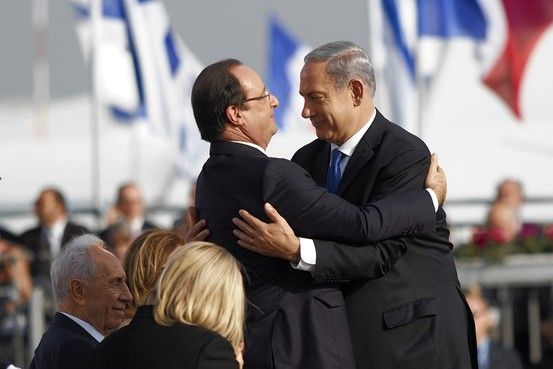
Hollande recoils slightly from Netanyahu's suffocating embrace.

Hollande recoils slightly from Netanyahu's suffocating embrace.

The Wall Street Journal reports: The Obama administration’s overtures to Iran are straining the U.S. alliance with Israel in ways not seen in decades, compounding concerns about the White House’s ability to manage the Middle East’s proliferating security crises, said current and former American diplomats.

In a sign of Israel’s growing disaffection with Washington, French President François Hollande was given a hero’s welcome when he arrived in Tel Aviv on Sunday for a three-day visit that would showcase Paris’s hard line against Iran’s nuclear program ahead of international talks in Geneva this week.

Mr. Netanyahu reiterated his criticism that the U.S.-backed compromise was a “very bad deal” while hailing Mr. Hollande for his opposition to the agreement at a joint news conference Sunday evening in Jerusalem.

“Your support and your friendship is real. It’s sincere. You were one out of six,” he said, referring to the six world powers participating in talks with Iran.

Both the U.S. and Israel insist the relationship is strong enough to sustain even a pronounced disagreement. But the State Department said on Sunday that it was considering sending Secretary of State John Kerry back to Jerusalem for the second time this month to try and repair the breach with Israeli Prime Minister Benjamin Netanyahu. [Continue reading…]

Facebooktwittermail

Why Iran’s military won’t spoil détente with the U.S.

Akbar Ganji writes: It is fair to assume that any deal between Iran and the United States to freeze Iran’s nuclear program will be greeted by the Iranian Revolutionary Guard Corps with cries of “Death to America!” Hassan Rouhani was elected president earlier this year with a mandate to seek just such a deal. But he still has to reckon with the fact that Iran’s most powerful military force has traditionally been a bastion for ideological hard-liners uninterested in building closer relations with the United States.

At the same time, any hope that the Revolutionary Guards have of playing the spoiler in a U.S.-Iranian rapprochement will be undermined by the fact that the force is implacably divided against itself, between those who are dead set against closer relations with the United States and those who are likely to support a deal.

This is not to suggest that the Revolutionary Guards don’t pose a threat to détente; its most hard-line factions certainly do. And those tend to be the most vocal — or at least the most visible. On September 30, just a few days after Rouhani’s breakthrough telephone conversation with U.S. President Barack Obama, the chief of the Guards, Mohammad Ali Jafari, labeled the move a “tactical error,” adding that his forces would be monitoring the issue in the future so that it could issue “necessary warnings.” Two weeks later, on October 13, Jafari declared that “the people have figured out what [the reformists] are up to and will not be duped by their provocations in the interests of the enemy.” That same day, Yahya Rahim Safavi, a general in the Guards, expressed the Islamic Republic’s standard ideological line against relations with Washington when he said that the United States had proved repeatedly that it could not be trusted.

Around the same time, however, other prominent Guardsmen were offering a strikingly different message, by way of a revisionist interpretation of recent Iranian history. [Continue reading…]

Facebooktwittermail

Supreme Court rejects case challenging NSA phone spying

Wired reports: The Supreme Court today rejected a challenge to the National Security Agency’s once-secret telephone metadata spying program.

The justices, without comment, declined to entertain a challenge from the Electronic Privacy Information Center seeking to halt the program that was disclosed in June by NSA leaker Edward Snowden.

The court’s inaction means that the there isn’t likely to be any court resolution to constitutional challenges to the metadata program for years. Legislation, however, is pending to gut the program.

What’s more, several cases challenging the snooping are pending in federal courts across the country. EPIC’s petition was unusual in that it went directly to the Supreme Court without first being litigated in the lower courts.

The Washington, D.C. based non-profit privacy group went straight to the justices after Snowden’s leak because of the gravity of the phone spying, which includes telephone companies having to provide the NSA the phone numbers of both parties involved in all calls, the International Mobile Subscriber Identity (IMSI) number for mobile callers, calling card numbers used in the call, and the time and duration of the calls. [Continue reading…]

Facebooktwittermail

In Germany, legacy of Stasi puts different perspective on NSA spying

The Washington Post reports: The secret police, or Stasi, roped in an estimated 190,000 part-time, secret informants and employed an additional 90,000 officers full time – in total, more than one in every 50 adult East Germans as of 1990. East Germans who dared to criticize their government — even to a spouse, a best friend or a pastor — could wind up disappearing into its penal system for years.

In east Berlin sits the former Hohenschoenhausen prison, which was reserved for East Germany’s most politically sensitive cases.

Hubertus Knabe — a West German who smuggled banned books into the East, and later discovered that he had been betrayed by a priest who had encouraged him to do so — now has a plate-glass view of the most perilous destination for victims of Stasi surveillance. He is the director of the prison museum, which is hidden away in a Berlin neighborhood whose rows of imposing apartment blocks still house many former Stasi officers.

Knabe said the consequences of the Stasi’s excesses were far more devastating than anything ever associated with the NSA. “They forget what it’s like to live in a dictatorship versus a democracy,” he said of people who say that the NSA has behaved like the Stasi.

Former inmates now lead tours of the dank, tiny cells in which they were incarcerated, and they say they sometimes run into their old tormenters on the street or at the grocery store.

Many Germans — from both sides of the German border, since East German spying reached deep into its sibling country — have thick Stasi files that they can now request to see. More painfully, they can also learn which of their friends or associates did the collecting of information in those files.

Thousands of people who were collaborators have been chased from public life. Even now, new accusations of Stasi associations can dog politicians and celebrities around Germany.

“We hear that the Stasi was some kind of dilettante agency compared to the NSA,” since the NSA is probably collecting more data overall than the East Germans did, Knabe said. “But East Germans know that the Stasi was a lot worse.”

Knabe said the East German system created a level of fear that few of his fellow citizens truly have about the American spy efforts. Nevertheless, he said, there were other similarities. He has filed a criminal complaint about the NSA spying in a German court.

“The western system punished someone when they had committed a crime. The eastern system punished people when they were only thinking about committing a crime,” he said. If the NSA’s material starts being used not just for counterterrorism efforts but for other kinds of preemptive crime-fighting, he said, “that would be a completely different type of state.”

According to an ARD-Infratest dimap poll released Friday, just 35 percent of Germans find the U.S. government trustworthy, second only to Russia as a target of mistrust. [Continue reading…]

Facebooktwittermail

Give Snowden asylum in Germany

Malte Spitz and Hans-Christian Ströbele write: Almost every day, new information is released about how American and British intelligence agencies have monitored governments, embassies and the communications of whole societies. These revelations have provided us with a deep and terrifying insight into the uncontrolled power of intelligence agencies.

They show that data collection is no longer about targeted acquisition of information to avert threats, and it’s certainly not about the dangers of “international Islamist terrorism.” After all, which terrorist is going to call or text Chancellor Angela Merkel?

All of our current knowledge about this surveillance is thanks to one man, Edward J. Snowden. Without him, Ms. Merkel would still be a target for monitoring, and surveillance of German diplomats, businessmen and ordinary citizens would be continuing, undetected.

Without Mr. Snowden, there wouldn’t have been months of discussions in the German Bundestag, the European Parliament and the American Congress about better protection of citizens’ private and commercial communications. Mr. Snowden is paying a high price for having opened the eyes of the world. He can no longer lead a normal life.

He acted in an emergency situation to stop and prevent terrible things. According to both German and American law, the government can grant immunity when criminal laws are violated in order to defend the paramount right to freedom. Publicly announcing a crime should not be a crime. The United States has long had laws to protect whistle-blowers from punishment — and we Germans aspire to have such laws.

According to recent surveys by ARD, a German TV station, 60 percent of Germans see Mr. Snowden as a hero and only 14 percent as a criminal. They know his courageous revelations were intended to protect freedom and the values that we share with America. [Continue reading…]

Facebooktwittermail

The high cost of the Pentagon’s bad bookkeeping

Part One — How the Pentagon’s payroll quagmire traps America’s soldiers:
As Christmas 2011 approached, U.S. Army medic Shawn Aiken was once again locked in desperate battle with a formidable foe. Not insurgents in Iraq, or Taliban fighters in Afghanistan – enemies he had already encountered with distinguished bravery.

This time, he was up against the U.S. Defense Department.

Aiken, then 30 years old, was in his second month of physical and psychological reconstruction at Fort Bliss in El Paso, Texas, after two tours of combat duty had left him shattered. His war-related afflictions included traumatic brain injury, severe post-traumatic stress disorder (PTSD), abnormal eye movements due to nerve damage, chronic pain, and a hip injury.

But the problem that loomed largest that holiday season was different. Aiken had no money. The Defense Department was withholding big chunks of his pay. It had started that October, when he received $2,337.56, instead of his normal monthly take-home pay of about $3,300. He quickly raised the issue with staff. It only got worse. For all of December, his pay came to $117.99.

All Aiken knew was that the Defense Department was taking back money it claimed he owed. Beyond that, “they couldn’t even tell me what the debts were from,” he says.

At the time, Aiken was living off base with his fiancee, Monica, and her toddler daughter, while sharing custody of his two children with his ex-wife. As their money dwindled, the couple began hitting church-run food pantries. Aiken took out an Army Emergency Relief Loan to cover expenses of their December move into a new apartment. At Christmas, Operation Santa Claus provided the family with presents – one for each child, per the charity’s rules.

Eventually, they began pawning their possessions – jewelry, games, an iPhone, and even the medic bag Aiken used when saving lives in Afghanistan. The couple was desperate from “just not knowing where food’s going to come from,” he says. “They just hit one button and they take your whole paycheck away. And then you have to fight to get the money back.”

Aiken’s injuries made that fight more difficult. He limped from office to office to press his case to an unyielding bureaucracy. With short-term and long-term memory loss, he struggled to keep appointments and remember key dates and events. His PTSD symptoms alienated some staff. “He would have an outburst … (and) they would treat him as if he was like a bad soldier,” says Monica. “They weren’t compassionate.”

They were also wrong. The money the military took back from Aiken resulted from accounting and other errors, and it should have been his to keep. Further, even after Aiken complained, the Defense Department didn’t return the bulk of the money to Aiken until after Reuters inquired about his case. [Continue reading…]

Part Two — Behind the Pentagon’s doctored ledgers, a running tally of epic waste:
Linda Woodford spent the last 15 years of her career inserting phony numbers in the U.S. Department of Defense’s accounts.

Every month until she retired in 2011, she says, the day came when the Navy would start dumping numbers on the Cleveland, Ohio, office of the Defense Finance and Accounting Service, the Pentagon’s main accounting agency. Using the data they received, Woodford and her fellow DFAS accountants there set about preparing monthly reports to square the Navy’s books with the U.S. Treasury’s – a balancing-the-checkbook maneuver required of all the military services and other Pentagon agencies.

And every month, they encountered the same problem. Numbers were missing. Numbers were clearly wrong. Numbers came with no explanation of how the money had been spent or which congressional appropriation it came from. “A lot of times there were issues of numbers being inaccurate,” Woodford says. “We didn’t have the detail … for a lot of it.”

The data flooded in just two days before deadline. As the clock ticked down, Woodford says, staff were able to resolve a lot of the false entries through hurried calls and emails to Navy personnel, but many mystery numbers remained. For those, Woodford and her colleagues were told by superiors to take “unsubstantiated change actions” – in other words, enter false numbers, commonly called “plugs,” to make the Navy’s totals match the Treasury’s.

Jeff Yokel, who spent 17 years in senior positions in DFAS’s Cleveland office before retiring in 2009, says supervisors were required to approve every “plug” – thousands a month. “If the amounts didn’t balance, Treasury would hit it back to you,” he says.

After the monthly reports were sent to Treasury, the accountants continued to seek accurate information to correct the entries. In some instances, they succeeded. In others, they didn’t, and the unresolved numbers stood on the books.

At the DFAS offices that handle accounting for the Army, Navy, Air Force and other defense agencies, fudging the accounts with false entries is standard operating procedure, Reuters has found. And plugging isn’t confined to DFAS (pronounced DEE-fass). Former military service officials say record-keeping at the operational level throughout the services is rife with made-up numbers to cover lost or missing information. [Continue reading…]

Facebooktwittermail

A digital underworld cloaked in anonymity

glen-parkNick Bilton writes: So this is where they collared the man they call the Dread Pirate Roberts.

It’s up a flight of stone steps, past the circulation desk and the Romance stacks, over in Science Fiction, far corner.

On a sunny Tuesday in October, federal officers entered the public library in the Glen Park section of this city and arrested a young man who they say ran a vast Internet black market — an eBay of illegal drugs.

Their mark, Ross William Ulbricht, says he is not the F.B.I.’s Dread Pirate Roberts, the nom de guerre of the mastermind behind the marketplace, Silk Road. And the facts, his lawyer says, will prove that.

However this story plays out, Silk Road already stands as a tabloid monument to old-fashioned vice and new-fashioned technology. Until the website was shut down last month, it was the place to score, say, a brick of cocaine with a few anonymous strokes on a computer keyboard. According to the authorities, it greased $1.2 billion in drug deals and other crimes, including murder for hire.

That this story intruded here, at a public library in a nice little neighborhood, says a lot about the dark corners of the Internet. Glen Park isn’t the gritty Tenderloin over the hills, or Oakland or Richmond out in East Bay. And that is precisely the point. The Dark Web, as it is known, is everywhere and nowhere, and it’s growing fast.

No sooner was the old Silk Road shut down than a new, supposedly improved Silk Road popped up. Other online bazaars for illegal guns and drugs are thriving.

And the Dread Pirate Roberts — the old one, a new one, who knows? — is back, taunting the authorities. (The pseudonym is a reference to a character in the film “The Princess Bride” who turns out to be not one man but rather many men passing down the title.)

“It took the F.B.I. two and a half years to do what they did,” the Dread Pirate Roberts wrote last week on the new Silk Road site. “But four weeks of temporary silence is all they got.”

So catch us if you can, the Dread Pirate is saying. The new Silk Road has overhauled its security and “marks the dawn of a brand new era for hidden services,” he wrote.

The question is, can anyone really stamp out the Dread Pirates? Like the rest of the Internet, the Dark Web is being shaped and reshaped by technological innovation. [Continue reading…]

Facebooktwittermail

The challenge of removing Syria’s chemical weapons

The New York Times reports: A plan announced over the weekend for getting the bulk of Syria’s chemical weapons out of the country in coming weeks has raised major concerns in Washington, because it involves transporting the weapons over roads that are battlegrounds in the country’s civil war and loading them onto a ship that has no place to go.

Security for the shipments is being provided entirely by Syrian military units loyal to President Bashar al-Assad, who has surprised American officials with how speedily he has complied with an agreement brokered by Russia to identify and turn over his chemical weapon stockpiles. Intelligence analysts and Pentagon officials say the shipments will be vulnerable to attack as they travel past the ruins of a war that has raged for two and a half years.

Asked over the weekend what the backup plan would be if the chemical weapons components were attacked by opposition forces linked to Al Qaeda, or even elements of Mr. Assad’s own forces, a senior American official said: “That’s the problem — no one has attempted this before in a civil war, and no one is willing to put troops on the ground to protect this stuff, including us.”

Another official noted that the choice now facing the United States and other nations was to “either leave the stuff in place and hope for the best, or account for it, get it out of there, and hope for the best. That’s the ‘least worst’ option.”

A range of current and former administration and Pentagon officials discussed the risks of moving the Syrian chemical munitions on the condition of anonymity. Most were reluctant to even disclose their concerns, because of the delicacy of the continuing operations to clear the country of chemical weapons. Even if the chemicals make it safely to a Syrian port and are loaded on cargo ships to be taken out of Syrian territory by the deadlines set in the agreement — Dec. 31 for the most critical material, Feb. 5 for most of the rest — the problems would hardly be over.

On Friday, Albania turned down an appeal by the United States to destroy the weapons on its territory, after thousands of Albanians took to the street in protest. Norway rejected an earlier request, saying it did not have the expertise or the facilities to destroy the weapons. The issue caused a major political dispute there as well.

As a result, Syria’s chemical weapons material may be on the high seas for a long time, as officials seek a country willing and able to destroy it. Already there are fears that the cargo ships bearing the material could become the weapons equivalent of a barge loaded with garbage that left Long Island in 1987 but could not find a place to unload for four months. American law prohibits the importation of chemical weapons for destruction here, and Russia says it is still overwhelmed by the task of destroying its own stockpiles. [Continue reading…]

Since the primary threat posed by these weapons (other than the threat they posed to Syria’s own population) was to Israel and since Israel is the primary beneficiary of Syria being disarmed, why not destroy the chemical weapons in Israel rather than transport them any greater distance?

Facebooktwittermail

Qatar migrant workers ‘treated like animals’

BBC News reports: Qatar’s construction sector is rife with abuse, Amnesty International (AI) has said in a report published as work begins on Fifa World Cup 2022 stadiums.

Amnesty says migrant workers are often subjected to non-payment of wages, dangerous working conditions and squalid accommodation.

The rights group said one manager had referred to workers as “animals”.

Qatari officials have said conditions will be suitable for those involved in construction of World Cup facilities.

It has not yet commented on the latest report.

Amnesty said it conducted interviews with 210 workers, employers and government officials for its report, The Dark Side of Migration: Spotlight on Qatar’s construction sector ahead of the World Cup. [Continue reading…]

Facebooktwittermail