Ian Black writes: Big changes make governments nervous, so it is striking to observe the jitters emanating from Saudi Arabia at the incipient thaw in relations between the US and Iran. Riyadh had long been rumbling with discontent over Washington’s responses to the Arab spring but their differences burst into the open with last month’s US-Russian deal to destroy Syria’s chemical weapons — putting Bashar al-Assad out of range of punitive air strikes. Now the prospect of agreement on the Islamic Republic’s nuclear programme is said to be giving the Saudi royals bad dreams.
Saudi Arabia and Iran have been strategic rivals since before the 1979 revolution – the shah was known as the “policeman of the Gulf” – as well as the respective leaders of the Sunni and Shia branches of Islam. Iran’s position was inadvertently strengthened by the US-led invasion of Iraq and the installation of a Shia government in Baghdad. Tehran backs Assad and Hizbullah in Lebanon while Riyadh openly advocates regime change in Damascus. Syria’s conflict is indeed, in some ways, a proxy war.
The Saudis also fear Iran’s nuclear ambitions – King Abdullah famously urged the US to “cut off the head of the snake” – and have repeatedly signalled that they will acquire nuclear weapons if Iran does. They blame Tehran – though without much evidence – for encouraging Shia opposition to the Sunni monarchy in neighbouring Bahrain. Shias in the kingdom’s eastern provinces face state repression and Saudi clerics have used inflammatory sectarian language over Syria, especially Assad’s Alawite community.
Saudi diplomacy is unusually opaque, so the signs of anxiety are subtle but unmistakable. Saud al-Faisal, the foreign minister, cancelled his speech to the UN general assembly out of pique at the Syria CW agreement. In private conversations senior Saudis are scathing about President Obama’s preference for inspections and disarmament over military action. Obama’s high-profile phone call with Hassan Rouhani, Iran’s new president, is another big factor in this diplo-sulk. Like the Israelis, the Saudis do not believe, or do not want to believe, that Rouhani is a genuine moderate or can overcome hardline elements at home. Their fear is that in a much-touted “grand bargain” between Washington and Tehran, the Gulf states will be the losers. [Continue reading…]
Iraq study estimates war-related deaths at 461,000
BBC News reports: About half a million people died in Iraq as a result of war-related causes between the US-led invasion in 2003 and mid-2011, an academic study suggests.
University researchers from the US, Canada and Iraq based their estimate on randomised surveys of 2,000 households.
The toll includes not only violent deaths from the invasion and subsequent insurgency, but avoidable fatalities linked to infrastructure collapse.
It exceeds the 112,000 violent civilian deaths reported by Iraq Body Count.
The British-based organisation bases its tally on media reports, hospital and mortuary records, and information from official and non-governmental sources.
There has been a surge in sectarian violence in Iraq in the past year, with almost 5,000 civilians killed in attacks between January and September, according the UN. It says more than 3,000 people died in 2012.
Eat cats and dogs, imam tells starving Syrians
The Telegraph reports: An imam in a rebel-held district of Damascus has issued a fatwa allowing residents to eat cats and dogs, in a desperate bid to ward off starvation after months under siege by the Assad regime.
Salah al-Khatib, the cleric who issued the edict, said he had been left with no choice but to lift the usual restrictions under Islamic law, after government forces and pro-regime militias choked off food and medical supplies to three rebel-held suburbs of Damascus and to a camp housing Palestinian refugees.
This is “not because it is religiously permitted, but because it is a reflection of the reality we are suffering”, Mr Khatib told AFP on Tuesday.
Tens of thousands of civilians remain trapped in these areas, some of them living under siege for more than a year. Residents have told The Telegraph that as food has run out, they have been forced in recent weeks to survive on stray dogs, rotting animal carcasses, tree leaves and weeds.
“I have watched the poorer families eat stray dogs because they have nothing else,” said Ehab, a resident of the Yarmouk camp, speaking to The Telegraph via Skype. “There is no food here now.” [Continue reading…]
Israel’s brain drain crisis
Max Fisher writes: For decades, educated and talented Jews from around the world and particularly Europe have migrated to Israel, contributing to an Israeli economic boom that began in the late 1980s and has continued since. In recent years, though, some Israelis have been going the other direction, migrating back to Europe or to the United States. That development has sparked particular concern in Israel about losing some of its highly educated, entrepreneurial citizens – the sort who helped drive the economic miracle.
That anxiety was crystallized for Israel with this year’s list of Nobel Prize laureates. The chemistry prize went to three Americans, two of whom were born in Israel but had immigrated to the United States. It’s felt like a reversal of the natural order for Israel, which prides itself on attracting other countries’ talent. The Nobel was a symbol of that: Of Israel’s 11 Nobel laureates, six had been born in other countries before immigrating.
These two chemists, of course, don’t definitively prove anything about Israel’s trajectory. But this was a live debate in Israel long before the Nobel announcement, which the Associated Press says has “touched a raw nerve about an exodus of scientists, academics and business leaders over the years, and fueled an anguished debate about whether the country can do more to retain its best talent.”
A recent study by the Taub Center for Social Policy Studies in Israel found that, since just 2008, a little over one in five faculty members at Israeli universities have left the country to work at American universities. Another study found that one in four Israeli scientists had left the country. [Continue reading…]
Al Qaeda’s Syrian strategy
Barak Barfi and Aaron Y. Zelin write: Al Qaeda is storming across northern Syria. Last month, the al Qaeda affiliate the Islamic State of Iraq and al-Sham (ISIS) captured the city of al-Bab in the northern province of Aleppo from a rival rebel militia. The capture of the city, one of the largest in the region, gives ISIS control over a key transit point linking Aleppo to its strongholds to the east. And that’s just the latest in a long string of ISIS’s military successes: After brief clashes with outgunned rebel opponents, ISIS took the towns of Azaz and Jarablus, which straddle Syria’s border with Turkey.
To commemorate its victories, the first thing ISIS did in these places was hang its black flag from the top of the highest building. After that, it began to gradually impose its strict interpretation of Islamic law.
ISIS has embarked on al Qaeda’s most comprehensive campaign yet to win Arab hearts and minds by providing social services to a war-ravaged society. But though the organization’s star is ascendant, its abuses, coupled with an international strategy to limit its influence, could still torpedo its plan to transform northern Syria into an Islamic emirate under its command.
ISIS is thought to count 5,000 to 6,000 fighters within its ranks. That means it’s a lot smaller than other rebel groups, such as the hard-line Salafi Syrian Islamic Front, which boasts 15,000 to 20,000 fighters. But ISIS has one important advantage: Many of its members have previously fought in other jihads, including in Iraq, Afghanistan, Yemen, and Libya.
Nowhere is ISIS stronger than in the northern province of Raqqa. It controls the governorate’s capital, Raqqa city, whose prewar population of approximately 277,300 residents has mushroomed due to an influx of displaced persons from other regions. Meanwhile, the brigades affiliated with the Free Syrian Army (FSA) are focused on squabbling among themselves. As a result, no FSA unit is strong enough to challenge the group in Raqqa, making it the largest city al Qaeda has ever controlled in the Islamic world.
ISIS has exploited its grip on the region to supply the provincial capital with the commodities essential to function. It provides most of the wheat for the city’s bread factories, trucking the grain in from its silos in the northern parts of the province on the border with Turkey. It also delivers the majority of the city’s oil needs, drawing on rebel-controlled wells in eastern Syria.
ISIS is doing far more than keeping the lights on. It runs a court with a mix of judges and religious scholars that draws on a strict interpretation of Islamic law. It adjudicates cases ranging from theft to financial malfeasance. According to Raqqan politicians and residents, in one ruling this summer the court ordered that a house confiscated by a rebel brigade be returned to its owner. It also provides abandoned houses to those whose living quarters were destroyed by regime bombings.
ISIS’s Raqqa Outreach Bureau, meanwhile, is trying to educate residents in what it considers the proper teachings of Islam. Raqqan politicians and residents say that the organization distributes pocket Qurans and flash drives with jihadi chants and videos showing the group’s military operations. Some of the leaflets that ISIS circulates include: “The Prohibition of Democracy,” “The Virtue of Jihad Over Remaining Silent,” and “Excommunicating the Alawites” — the latter a reference to the heterodox minority sect to which President Bashar al-Assad’s clan belongs. Nor has ISIS just restricted its attention to adults: It recently opened a children’s school in a city where the education system ceased functioning long ago.
By providing such services, ISIS seeks to prove that al Qaeda can make positive contributions and build institutions to serve society. Unlike in Iraq, the organization has produced dozens of videos highlighting this outreach. In doing so, the group hopes to illustrate that it has learned the lessons of its failures in the last decade, when Iraqi Sunnis rebelled against al Qaeda’s brutal ways. “As for our mistakes, we do not deny them,” ISIS spokesman Abu Muhammad al-Adnani al-Shami noted in a July 30 audio release. “Rather, we will continue to make mistakes as long as we are humans. God forbid that we commit mistakes deliberately.”
Despite these efforts, however, ISIS has proved unable to avoid the mistakes that have caused it to lose support in countries such as Mali and Yemen. The al Qaeda affiliate continues to persecute anti-Assad activists who don’t agree with its hard-line Islamic vision — the incarceration of Father Paolo Dall’Oglio, an outspoken regime critic, has particularly angered Raqqans, according to residents of the city.
In other areas of northern Syria, the horror stories have been even worse. In Aleppo province, ISIS imprisoned a 14-year-old girl in dungeon-like conditions for use in a prisoner exchange, according to a fellow inmate. As a consequence of ISIS’s growing strength, many journalists have been kidnapped — and many more have opted to stay out of Syria. [Continue reading…]

Crush of Syrian refugees overwhelming efforts to help, aid groups say
McClatchy reports: Only weeks ahead of what forecasters say could be a brutal winter, humanitarian aid agencies working on the Syrian conflict are sounding the alarm that little is being done to provide assistance to a refugee population that’s expected to reach 3 million by the end of the year.
The United Nations has collected only half of the $5 billion it needs to provide assistance, and humanitarian aid groups say they’re resigned that they’ll be able to provide help to only a portion of the 2 million refugees outside Syria and the millions more who’ve fled their home but remain in Syria.
“The reality is, a huge amount of aid is needed and as long as countries are sending guns and ammunition rather than food or blankets, the crisis is only going to worsen,” said Noah Gottschalk, senior humanitarian policy adviser for Oxfam America, an international aid group that focuses on poverty and hunger.
“It’s not too late, but it’s getting closer and closer. The clock is ticking,” Gottschalk added, referring to the narrow window of opportunity to mobilize winter aid before communities begin to suffer and roads to some areas become impassable. [Continue reading…]
Ignoring Bahrain’s iron fist
Sarah Margon and Mary Laurie write: For two years, as the United States has condemned massive abuses of protesters throughout the Middle East, it has largely turned a blind eye to equally horrific treatment in Bahrain, a small but significant ally. As the situation in Manama shows no sign of abating, the United States needs to step up its game– before it’s too late.
Last week, a Bahraini court sentenced 50 Shiites, including the human rights activist Naji Fateel, to harsh prison terms of up to 15 years after a mass trial allegedly linking the activists to the “February 14” movement, which it claims is working to overthrow the government. February 14 is the date in 2011 when the recent protest movement began. The leaders of those largely peaceful protests remain in prison and have been joined over the past two years by other activists convicted solely for exercising their rights to freedom of expression, association, and peaceful assembly.
A week before the sentencing, U.S. President Barack Obama made an unexpected reference to Bahrain, alongside Iraq and Syria, as a country fraught with sectarian tensions that challenge democracy and regional stability in his September 24 address to the U.N. General Assembly. This reference prompted the Bahraini foreign affairs minister to issue a statement extolling the country’s culture as tolerant. Bahrain’s U.S. ambassador also responded, contending the speech did not properly portray Bahrain’s progressive and open-minded society.
The presidential mention ruffled feathers in Manama — a sure sign of U.S. diplomatic leverage there — but it was not enough to stop last week’s sentencing. [Continue reading…]
Iran presents ‘timetable’ to end nuclear talks deadlock
The Guardian reports: The Iranian delegation to international talks in Geneva has presented proposals which it claims will end the longstanding deadlock over its nuclear programme.
Iran’s foreign minister, Mohammad Javad Zarif, gave an hour-long PowerPoint presentation of the proposals, entitled “Closing an unnecessary crisis: Opening new horizons”, to senior diplomats from the US, UK, France, Germany, Russia, and China at the Palace of Nations in Geneva on Tuesday.
The presentation was not made public, but it is believed to lay out a timetable for a confidence-building deal that would place limits on Iran’s nuclear programme in return for relief from sanctions and international recognition of the country’s right to enrich uranium.
The presentation marked the opening gambit in the first round of negotiations between the new Iranian government of President Hassan Rouhani and the six-nation negotiating group chaired by the EU foreign policy chief, Lady Ashton. All sides have described the talks as the most constructive for years.
Unlike previous negotiations, the two days of talks are being carried out in English, as Zarif and his deputy, Abbas Araqchi, are fluent, so they moved at at least twice the speed, without the need for interpreters.
Speaking to reporters after the presentation, Araqchi said: “We believe our proposal has the capacity to make a breakthrough.”
He said the Iranian plan set out a timeline of six months to get to a deal and that Iran hoped the next step, a new round of talks on the details of a deal, would take place within a month. [Continue reading…]
Netanyahu’s absurd demand that Israel be recognized ‘as a Jewish state’
M.J. Rosenberg writes: Prime Minister Binyamin Netanyahu gave a major speech the other day at Bar Ilan University. Most of it was saber rattling at Iran. But enough of it was about the Palestinians to steel my belief that negotiating with Netanyahu is a waste of time and that Kerry’s initiative is a charade.
The centerpiece of his discussion of the Israeli-Palestinian conflict was this: his demand that Palestinians recognize Israel “as a Jewish state.”
This is the nation state of the Jewish people….Recognize the Jewish state. As long as you refuse to do so, there will never be peace. Recognize our right to live here in our own sovereign state, our nation state – only then will peace be possible. I emphasize this here – this is an essential condition.
It’s a new demand, one that only became Israeli policy when Netanyahu came to office. Every prime minister prior to Netanyahu only demanded that the Palestinians recognize Israel. But then, on September 9, 1993, PLO Chairman Yasir Arafat sent this statement to Prime Minister Yitzhak Rabin (in exchange for Rabin’s recognition of the PLO as the legitimate representative of the Palestinian people). This agreement stands to this day and is recognized as binding by both sides.
The PLO recognizes the right of Israel to exist in peace and security. The PLO accepts United Nations resolutions 242 and 338. The PLO commits itself to the peaceful resolution of the conflict between the two sides and declares that all outstanding issues related to final status will be resolved through negotiations.
This commitment — encompassing Palestinian acceptance of Israel’s three long-standing conditions – led to Rabin’s agreement to begin negotiations with the Palestinians.
Netanyahu, who was then leader of the Likud opposition, vehemently opposed Rabin’s acceptance of Arafat’s concessions and began a campaign of incitement against Rabin himself. He understood then, as he does now, that Palestinian recognition of Israel meant that the largest obstacle to a land-for-peace agreement was gone. [Continue reading…]
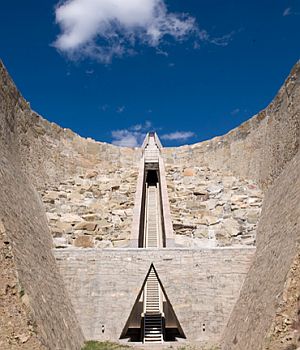
Star Axis, a masterpiece forty years in the making

Ross Andersen writes: On a hot afternoon in late June, I pulled to the side of a two-lane desert highway in eastern New Mexico, next to a specific mile marker. An hour earlier, a woman had told me to wait for her there at three o’clock, ‘sharp’. I edged as far off the shoulder as I could, to avoid being seen by passing traffic, and parked facing the wilderness. A sprawling, high desert plateau was set out before me, its terrain a maze of raised mesas, sandstone survivors of differential erosion. Beyond the plateau, the landscape stretched for miles, before dissolving into a thin strip of desert shimmer. The blurry line marked the boundary between the land and one of the biggest, bluest skies I’d ever seen.
I had just switched off the ignition when I spotted a station wagon roaring toward me from the plateau, towing a dust cloud that looked like a miniature sandstorm. Its driver was Jill O’Bryan, the wife and gatekeeper of Charles Ross, the renowned sculptor. Ross got his start in the Bay Area art world of the mid‑1960s, before moving to New York, where he helped found one of SoHo’s first artist co-ops. In the early 1970s, he began spending a lot of time here in the New Mexico desert. He had acquired a remote patch of land, a mesa he was slowly transforming into a massive work of land art, a naked-eye observatory called Star Axis. Ross rarely gives interviews about Star Axis, but when he does he describes it as a ‘perceptual instrument’. He says it is meant to offer an ‘intimate experience’ of how ‘the Earth’s environment extends into the space of the stars’. He has been working on it for more than 40 years, but still isn’t finished.
I knew Star Axis was out there on the plateau somewhere, but I didn’t know where. Its location is a closely guarded secret. Ross intends to keep it that way until construction is complete, but now that he’s finally in the homestretch he has started letting in a trickle of visitors. I knew, going in, that a few Hollywood celebrities had been out to Star Axis, and that Ross had personally showed it to Stewart Brand. After a few months of emails, and some pleading on my part, he had agreed to let me stay overnight in it.
Once O’Bryan was satisfied that I was who I said I was, she told me to follow her, away from the highway and into the desert. I hopped back into my car, and we caravanned down a dirt road, bouncing and churning up dust until, 30 minutes in, O’Bryan suddenly slowed and stuck her arm out her driver’s side window. She pointed toward a peculiar looking mesa in the distance, one that stood higher than the others around it. Notched into the centre of its roof was a granite pyramid, a structure whose symbolic power is as old as history.
Twenty minutes later, O’Bryan and I were parked on top of the mesa, right at the foot of the pyramid and she was giving me instructions. ‘Don’t take pictures,’ she said, ‘and please be vague about the location in your story.’ She also told me not to use headlights on the mesa top at night, lest their glow tip off unwanted visitors. There are artistic reasons for these cloak-and-dagger rituals. Like any ambitious artist, Ross wants to polish and perfect his opus before unveiling it. But there are practical reasons, too. For while Star Axis itself is nearly built, its safety features are not, and at night the pitch black of this place can disorient you, sending you stumbling into one of its chasms. There is even an internet rumour — Ross wouldn’t confirm it — that the actress Charlize Theron nearly fell to her death here. [Continue reading…]
Naming the dead: the victims of U.S. drone attacks in Pakistan
The Bureau of Investigative Journalism: Over the past nine years, the tribal region of Pakistan’s north west has been hit by hundreds of drone attacks as the CIA has sought to stamp out al Qaeda fighters and the militant groups that have given them shelter.
Missiles launched from these high-tech, unmanned aircraft have hit homes, cars, schools, shops and gatherings. At least 2,500 people have been killed, according to data already collected by the Bureau as part of our wider Covert Drone War research.
Senior US officials have described drones as highly precise weapons that target and kill enemies of the US. John Brennan, who oversaw the development of the drone campaign and is now director of the CIA, has called drone technology an ‘essential tool’ for its ‘surgical precision – the ability, with laser-like focus, to eliminate the cancerous tumour called an al Qaeda terrorist while limiting damage to the tissue around it.’
Those killed by drones include high-ranking militant leaders – figures such as Abu Yahya al Libi, al Qaeda’s feared second-in-command, or Baitullah Mehsud, commander of the Pakistan Taliban (TTP).
But according to credible media reports analysed by the Bureau, the dead also include at least 400 civilians. Some were unlucky enough to be nearby when militants were attacked. Others were killed alongside their husbands or fathers, who were believed to be militants. Still others were mistaken for terrorists by drone operators sitting thousands of miles away.
In most cases, there is little information available about who the drones are really killing. Most of the dead – an estimated four-fifths of those killed – are believed to be militants. But their deaths are typically reported as a number – their names, origins and livelihoods remain a mystery.
For so many people to die in obscurity, unnamed and unacknowledged, is a tragedy. But it is a further tragedy that the public, and even policy makers, are unable to properly test whether drones are ‘highly precise weapons’ when so little is known about who is actually dying.
Through Naming the Dead, the Bureau aims to increase the transparency around this conflict and inform the public debate. Initially this project will record all names published in open-source material – in credible reports by journalists, in legal documents presented in court, in academic studies and in field investigations carried out by human rights groups. [Continue reading…]
Video: Edward Snowden is a patriot
Farewell to Syria, for a while
The Syrian writer and political dissident, Yassin al-Haj Saleh, recently fled from Damascus where he had been in hiding for the last two years, and returned to Raqqa, the city of his youth where he hoped to be reunited with several of his brothers. During a grueling 19-day journey to reach the city, he learned that two of his brothers had been captured and that the city was now under the control of the Islamic State of Iraq and the Levant, al Qaeda.
In Raqqa, I spent two months and a half in hiding without succeeding in getting one piece of information about my brother Firas. Nothing could be worse than this. Therefore, instead of celebrating my arrival at Raqqa, I had to keep in hiding in my own liberated city, watching strangers oppress it and rule the fates of its people, confiscating public property, destroying a statue of Haroun Al-Rasheed or desecrating a church; taking people into custody where they disappeared in their prisons. All the prisoners were rebel political activists while none of them was chosen from the regime’s previous loyalists or shabiha. With the exception of this flagrant oppression of the people, their property and symbols, the new rulers have shown no sign of the spirit of public responsibility which is supposed to be the duty of those who are in power.
I wished to stay in Raqqa for the longest possible time to understand why events had taken this turn and to form an idea about the new leaders. I was able to collect some useful information but not as much as I had wished because I was not able to explore the city’s streets and listen to the people tell me their stories, not to mention holding interviews with the Emirs of the State of Iraq and the Levant and their mujahideen.
Not to walk in the streets of Raqqa in autumn? This is not an adequate reason for leaving, yet it is quite important on its own for me. At the onset of the Revolution, I used to say jokingly to my friends: I wish to topple the regime so as to get a passport. I wanted a passport to feel free and to travel where I wished. Today I leave behind comrades who will carry the struggle on. Our presence together inside the country used to give us courage and the strength to continue. I do not feel bitter, but I am a little angry. I realize how impossible our situation has become, yet notwithstanding, I feel that whenever I am able to understand something or shed light on another, I believe I am taming the brutal multi- headed monster which wants to keep us in darkness, without the right to speak up, and not desiring but what it desires.
What frightens me most now is not to be able to understand the world outside Syria and for things to lose their clarity for me. I used to understand things Syrian. Syria was my country. I do not know exactly what I am going to do in exile. I always felt ill at ease with this word. It seems to me to be making a mockery of the people still inside the country. Perhaps its meaning will change and expand to include the whole of our terrible experience: the experience of uprootedness, seeking asylum, dispersion then eventually the hope of return. I do not know exactly what I am going to do, but I am now part of this massive Syrian exodus and the dreamt of return, although it feels right now as an amputation.
This is our country which is all that we have. I know that there is no other country that can be as merciful to us as this terrible country.
Assad expresses respect for the West and contempt for Arabs and Hamas
The Lebanese Al-Akhbar English interviewed Bashar al-Assad:
Assad is bitter. “Not one Arab official has contacted us with a plan for mediation or for an Arab solution,” he says. The Arabs, he says, were always only an echo of their Western “masters,” if not worse.
The Syrian president adds that the West, despite all its flaws, “Always dealt with us more honorably than some Arabs.” Kofi Annan was honest and resigned, he remarks, while his Arab aides were not.
The conversation moves to Hamas when the president is asked about the reports regarding Meshaal’s visit to Tehran, and whether Damascus, specifically the presidential palace, would be his next stop. But Assad is keen on clarifying everything in this regard, ending all equivocation.
First, Assad says that the Muslim Brotherhood, for 80 years, has been known for its opportunism and betrayal, but stresses that Damascus did not treat Hamas in the beginning as being part of the international Islamist organization. “The Europeans would come to us and ask what Hamas was doing here, and we would say that it was a resistance movement,” the Syrian president says, adding that only that capacity made Syria welcome and sponsor Hamas.
Assad says, “When the crisis began, [Hamas officials] claimed that they gave us advice. This is a lie. Who are they to give Syria advice? Then they said that we asked for their help, which is also not true. What business do they have in internal Syrian affairs?”
Later, the president of the World Federation of Muslim Scholars, Yusuf al-Qaradawi, made his insulting statements about Syria. Assad says, “Yes, we demanded that they take a stance. A while later, they came and said that they spoke with Qaradawi. We said that those who want to take a political stance should do so publicly. What value does a stance have if taken in closed rooms?”
Estrangement between Hamas and the Syrian regime ensued. Assad holds that Hamas ultimately decided to abandon resistance and to fully merge with the Muslim Brotherhood. He adds, “This was not the first time they had betrayed us. It happened before in 2007 and 2009. Their history is one of treachery and betrayal.” Assad then wished “someone would persuade them to return to being a resistance movement,” but says that he doubts this will happen. “Hamas has sided against Syria from day one. They have made their choice,” he adds.
Egypt’s military ruler: ‘Islam is now synonymous to killing, blood and destruction’
Al-Masry Al-Youm interviewed General Abdel-Fattah Al-Sisi:
I remember asking you after Morsy won the presidency if he was going to be able to break free of the Brotherhood’s control over him and become a president for all Egyptians. You said it was not about whether he was able to do that, but rather about whether he was willing to do that in the first place.
So you predicted that he was not going to let the interests of the country take priority over the interests of the Brotherhood. How did you arrive at that conviction?
Let me be frank with you. I did not want my expectations to come true. I wanted to see a new rule that would protect the country from surrounding threats, provide an atmosphere of security and stability and achieve development that satisfies the ambitions of the people. My conviction that the president was not going to let the interests of the country take priority over the interests of the group was based on an in-depth study of several factors, including the general features of the president’s personality and his relationship with the group [the Muslim Brotherhood] and its genuine goals.
The problem here– and I do not mean to offend anybody– emanates from the intellectual and ideological structure of the Brotherhood. This does not belittle them but it affects their efforts in managing a state. There is a big difference between the intellectual and ideological system of any group and that of a state. Both have to be in harmony. Problems occur when they clash. In order for the two to be harmonious, one of the two has to rise to the level of the other–so either the state rises to the level of the group, which is impossible, or the group rises to the level of the state by giving up its ideological, religious system, which I think is something they will not be able to do because it goes against the intellectual structure of their group. The discrepancy between the two systems will continue to generate differences and, sensing it, the people will take to the streets in protest.
Just like a group has an intellectual and ideological system, individuals also do. However, the intellectual system an individual has may be harmonious with that of the state because an individual may choose to rise to the level of the state. This is more difficult in the case of a group because a group has one ideology and it believes that giving up one individual is akin to giving up its ideology.
The answer to the question on whether the former president wanted to be a president for all Egyptians or not was not based on an opinion but a good reading of the situation because I knew what the reality of the situation was. When the Brotherhood reached power, the question was not whether Morsy was going to be a president for all Egyptians, but rather if he wanted to be a president for all Egyptians. I am not saying this to criticize anyone. In fact, this problem will face any current [leader] that is not aware of this issue. Islam for an individual is different from Islam for a group or for a state. There are things that an individual might accept while keeping his beliefs, but in the case of groups, we have a number of people who share some thoughts, which they are free to believe in. However, a group cannot force the people to have the same thoughts. This is particularly the problem with Islam for a group. Islam for a state, meanwhile, is more flexible and wider in scope, with room for diligence.
Can anybody question the Islamists’ keenness on Islam? No, but the problem is they cannot distinguish between the practices of an individual of them as a human being, his practices as a member of a group, and his practices as part of a state. It is the lack of harmony between the systems governing the individual, the group and the state that has led to the current situation. They have made people see Islam as destruction. I want to tell you that those so-called Islamists have done harm to the image of Islam. Those who seem to be keen on religion have harmed Islam like never before. Islam is now synonymous to killing, blood and destruction. We have to assess the situation in an objective way and see how the world and other countries see Islam. The problem is definitely with implementation, not with the approach. It is implementation that has done harm to Islam.
Who was James Henry Lunn? — Updated
Update: A reader in Malaysia claims to have known James Lunn and provides what sounds to me like a very credible explanation about who he was and how he ended up in Egypt — a tragic story:
Jim Lund was a retired truck driver from San Diego, living in Malaysia. Some years ago Jim was in a bad car wreck and suffered organic brain damage. For years he has pretended that he is an ‘undercover’ US Army general and had written his name in his passport as ‘Gen. James Lunn’. For some years he has had delusions that he would save the world. Two years ago Jim ‘invented’ a hundred-mile-long seagoing device that could transport water to dry climates. In August he left for Egypt with a small model of the device to ‘give to the Palestinians’. That was the ‘unknown electronic device’ he was carrying. A harmless nut but one who loved to be thought of as a secret agent.
A further note: The James Lunn dead in Egypt is definitely the James Lunn living in Malaysia. I read the quote from his web blog that you published and noted the reference to the arc of the covenant. That was one of his obsessions. If you read further you might find references to an asteroid that will hit the earth in 20 years. That was another of his obsessions. Egyptian Jim is Malaysian Jim is San Diego Jim the head-injured truck driver.
The Guardian reports: A US citizen has been found dead in a provincial Egyptian jail, six weeks after being arrested in Egypt’s restive north Sinai peninsula, Egyptian officials have confirmed.
James Henry Lunn, 66, is the second foreigner to die in police custody since the July overthrow of Mohamed Morsi, and one of several to have fallen foul of Egypt’s brutal and labyrinthine judicial system this summer.
Lunn was first detained on 29 August in Sheikh Zuweid, North Sinai, an area in which the Egyptian army is currently waging a controversial counter-insurgency against Islamist extremists.
Lunn aroused suspicion because he had allegedly broken curfew, and because he was carrying “a map of Egypt and a very hi-tech electronic device”, said Badr Abdellatty, a spokesman for Egypt’s foreign ministry.
Following his arrest, Lunn was taken to a jail in Ismailia, a city on the Egyptian mainland, where he had been detained without trial ever since. Thousands of Egyptians also remain detained without charge following this summer’s mass arrests of Morsi supporters.
Egyptian prosecutors said Henry was found dead in a prison bathroom on Sunday morning, and appeared to have taken his own life.
Lunn’s death will naturally provoke all kinds of speculation. Was he a spy? Was he simply a victim of the xenophobia now rampant across Egypt? Did he kill himself or was he murdered?
The only clues that might suggest possible answers to any of these questions can be found at Amazon where Lunn published three e-books. Descriptions of those books make it sound like whatever mission Lunn was on had nothing to do with any government and perhaps nothing to do with this world.
His description of Blogging with Muhammad says:
The following anthology is composed of a variety of blog comments and stories which were posted over a two year period (2008-2010) under my Islamic name Muhammad on the My Space page entitled Flying Puppet. The general thrust of these threads was to provide for myself a platform where I could give voice to the most glorious news that I have had the good fortune to receive…this being that the Ark of the Covenant of Moses existed still and was well and truly enshrined within the Kaaba in Mecca.
Along with this revelation came a sense of purpose and euphoria which would be most commonly identified as a messianic delusion. I must admit that even though this news came to me through diplomatic channels from the office of the Prime Minister of Malaysia in the scope of my duties as an intelligence officer of the United States Army, I was not really prepared to receive it and the emotional response that it provoked lays, still today, just under the surface of my demeanor. Indeed, I tremble at the magnitude of this disclosure. Who am I to manhandle the cross of Jesus Christ, for heaven’s sake?
In the intervening years I have tried to pass the burden of this knowledge off to others better placed to reveal it…those more educated and better trained and with greater credibility than me, to no avail.
I am left, after many attempts and with the most profound apologies for my many shortcomings, with the following mismatched jumble of attempts to keep a grasp on reality with one hand as the other reached for the stars:
NSA collects millions of e-mail address books globally
The Washington Post reports: The National Security Agency is harvesting hundreds of millions of contact lists from personal e-mail and instant messaging accounts around the world, many of them belonging to Americans, according to senior intelligence officials and top-secret documents provided by former NSA contractor Edward Snowden.
The collection program, which has not been disclosed before, intercepts e-mail address books and “buddy lists” from instant messaging services as they move across global data links. Online services often transmit those contacts when a user logs on, composes a message, or synchronizes a computer or mobile device with information stored on remote servers.
Rather than targeting individual users, the NSA is gathering contact lists in large numbers that amount to a sizable fraction of the world’s e-mail and instant messaging accounts. Analysis of that data enables the agency to search for hidden connections and to map relationships within a much smaller universe of foreign intelligence targets.
During a single day last year, the NSA’s Special Source Operations branch collected 444,743 e-mail address books from Yahoo, 105,068 from Hotmail, 82,857 from Facebook, 33,697 from Gmail and 22,881 from unspecified other providers, according to an internal NSA PowerPoint presentation. Those figures, described as a typical daily intake in the document, correspond to a rate of more than 250 million a year. [Continue reading…]
Bush administration feared chemical weapons inspections would conflict with rationale for invading Iraq
The New York Times reports: More than a decade before the international agency that monitors chemical weapons won the Nobel Peace Prize, John R. Bolton marched into the office of its boss to inform him that he would be fired.
“He told me I had 24 hours to resign,” said José Bustani, who was director general of the agency, the Organization for the Prohibition of Chemical Weapons in The Hague. “And if I didn’t I would have to face the consequences.”
Mr. Bolton, then an under secretary of state and later the American ambassador to the United Nations, told Mr. Bustani that the Bush administration was unhappy with his management style.
But Mr. Bustani, 68, who had been re-elected unanimously just 11 months earlier, refused, and weeks later, on April 22, 2002, he was ousted in a special session of the 145-nation chemical weapons watchdog.
The story behind his ouster has been the subject of interpretation and speculation for years, and Mr. Bustani, a Brazilian diplomat, has kept a low profile since then. But with the agency thrust into the spotlight with news of the Nobel Prize last week, Mr. Bustani agreed to discuss what he said was the real reason: the Bush administration’s fear that chemical weapons inspections in Iraq would conflict with Washington’s rationale for invading it. Several officials involved in the events, some speaking publicly about them for the first time, confirmed his account. [Continue reading…]