Monthly Archives: November 2007

NEWS: Iran’s internal divisions widen

Former Iran negotiator charged with spying for UK

Iran’s former chief nuclear negotiator, Hossein Mousavian, has been charged with passing classified information to the British embassy, the Iranian intelligence minister has revealed.

The decision to make the charges public could be a further sign that the radical Iranian President, Mahmoud Ahmadinejad, is consolidating his hold over the country’s nuclear policy. A deepening split has become apparent within the normally secretive leadership, which is facing increased international pressure to halt its uranium enrichment programme.

Ayatollah Ali Khamenei, the country’s supreme leader, remains in charge of nuclear policy but Mr Ahmadinejad appears to be increasingly influential.

The Foreign Office had no comment yesterday on the comments by the intelligence minister, Gholam Hossein Mohseni Ejehi, who told the official news agency that Mr Mousavian’s crime “from the viewpoint of the Intelligence Ministry is obvious and provable”. [complete article]

Gloves come off as Iran moderates battle Ahmadinejad

Iran’s moderates are intensifying criticism of hardline President Mahmoud Ahmadinejad, landing their first blows in a bitter political fight ahead of elections next year.

The moderate heavyweights Mohammad Khatami and Akbar Hashemi Rafsanjani have been unusually explicit in their criticism of Ahmadinejad’s economic policies and his analysis of the threat posed by the United States.

Ahmadinejad has shot back using language colourful even by his standards, warning he would expose “traitors” in the nuclear standoff and accusing critics of “being less intelligent than a goat”.

The sharp rhetoric is the upshot of concerns over the mounting international crisis over the Iranian nuclear programme and a sign of the proximity of legislative elections on March 14. [complete article]

Facebooktwittermail

OPINION: Israel prevents the two-state solution

Who wants a Jewish state

Foreign Minister Tzipi Livni has been speaking enthusiastically about “two states, two nations” ever since her conversion from the Greater Israel ideology. She can easily convince people why Israel must have a right of return only for Jews, while an independent Palestine would grant the same right only to Palestinians.

Like Prime Minister Ehud Olmert, Livni has realized belatedly that this is the only way two democratic nation states could survive. This simple, rational idea could have been implemented easily had not Israel’s leaders rejected it for generations – for 40 years the border line has been obstructed by settlement building.

Now on the eve of the Annapolis conference, Israel has suddenly come up with the absurd demand that the Palestinians recognize Israel as a Jewish state – after Israel’s own leaders have done everything in their power to sabotage it.

It is easy to speak about a Jewish state, but difficult to find the political courage required to do what it takes: Settlements scattered in the heart of the Palestinian population make it impossible to separate between Israel and Palestine along a plausible and viable border. With each passing day and each passing year, every settlement expansion, every outpost and every road built to reach it disrupt the chance to separate the two nations. [complete article]

Facebooktwittermail

NEWS: Abbas calls for overthrow of Hamas

Abbas calls for Hamas overthrow in Gaza

Palestinian President Mahmoud Abbas on Thursday called for the overthrow of Gaza’s Islamic Hamas rulers, his first explicit call that they be removed.

“We have to bring down this bunch that took over Gaza with armed force, and is abusing the sufferings and pains of our people,” Abbas said in a speech in Ramallah.

The Palestinian leader, who has set up a separate government in the West Bank, previously had not gone beyond demanding that Hamas apologize for overrunning Gaza and reverse the takeover. [complete article]

Facebooktwittermail

NEWS: The media’s role in promoting Islamophobia

Study shows ‘demonisation’ of Muslims

A “torrent” of negative stories has been revealed by a study of the portrayal of Muslims and Islam in the media, according to a report published yesterday.

Research into one week’s news coverage showed that 91% of articles in national newspapers about Muslims were negative. The London mayor, Ken Livingstone, who commissioned the study, said the findings were a “damning indictment” of the media and urged editors and programme makers to review the way they portray Muslims.

“The overall picture presented by the media is that Islam is profoundly different from and a threat to the west,” he said. “There is a scale of imbalance which no fair-minded person would think is right.” Only 4% of the 352 articles studied were positive, he said.

Livingstone said the findings showed a “hostile and scaremongering attitude” towards Islam and likened the coverage to the way the left was attacked by national newspapers in the early 1980s. “The charge is that there are virtually no positive or balanced images of Islam being portrayed,” he said. “I think there is a demonisation of Islam going on which damages community relations and creates alarm among Muslims.” [complete article]

Facebooktwittermail

NEWS: CIA taped interrogations

CIA admits to recording interrogations of top al Qaida captives

The CIA has three video and audio recordings of interrogations of senior al Qaida captives but misled federal judges about the evidence during the case against terrorist Zacarias Moussaoui, federal prosecutors revealed in a Nov. 9 court filing that was made public Tuesday.

The disclosure is unlikely to undo Moussaoui’s conviction because the agency said the material on the tapes doesn’t pertain to his case.

However, the disclosure that the government taped some interrogations of high-value detainees could invite fresh scrutiny of the CIA’s treatment of so-called “enemy combatants” who were held at secret prisons or U.S. bases overseas.

John Radsan, a former CIA assistant general counsel who teaches at the William Mitchell College of Law in St. Paul, Minn., called the revelation of the tapes “huge” news.

“So far, there has been great mystery about what was actually done to the high-value detainees,” he said. “A videotape is worth a thousand words.” [complete article]

Facebooktwittermail

FEATURE: Dowd’s split with Bush

Bush strategist looks back in sadness

Matthew Dowd knows sorrow and loss. He has been divorced twice. A daughter died two months after she was born. And then there is the added heartbreak — a word he uses — of his split with President Bush.

Dowd, 46, is one of the nation’s leading political strategists, a onetime Democrat who switched sides to help put Bush in the White House, then win a second term. He spent years shaping and promoting Bush’s policies — policies that Dowd now views with a mixture of anguish and contempt.

He began expressing his disillusionment, tentatively at first, at a UC Berkeley conference in January. Since then, he has grown more forceful.

On the administration’s response to the Sept. 11 attacks: “I asked, ‘Why aren’t we doing bonds, war bonds? Why aren’t we asking the country to do something instead of just . . . go shopping and get back on airplanes?’ ” [complete article]

Facebooktwittermail

OPINION: The West’s silence on Egypt’s assault on human rights

Behind closed doors

The justice systems in Britain and the US may not be perfect. But viewed from Egypt, the jurisprudence and transparency that attend the vast majority of trials there are very much to be envied.

In Cairo today, some 40 leading members of the Muslim Brotherhood are facing a secret military tribunal. Thirty sessions have been held so far, while all journalists, reporters and domestic or international human rights observers have been denied access. These members of the country’s most powerful political opposition – which holds about a fifth of the seats in Egypt’s parliament – stand before this tribunal despite civilian courts acquitting them four times of all charges brought by the notorious state security prosecutor, describing them as “fabricated, groundless, and politically motivated”.

They are standing before the tribunal despite a court ruling that found the president’s decision to transfer them to a military tribunal “unconstitutional”, on the basis that they are civilian opposition leaders who should be tried by civilian courts. The treatment of these representatives of the region’s largest Islamist movement, which advocates a moderate, peaceful approach, has been roundly condemned by international human rights organisations, including Amnesty International and Human Rights Watch. [complete article]

Facebooktwittermail

NEWS: LAPD ditches Muslim map plan

LAPD’s Muslim mapping plan killed

The LAPD on Wednesday abruptly scrapped a program to map the city’s Muslim population, a major retreat for a department that said the system was needed to identify potential hotbeds of extremism.

The reversal comes after a week of protests from Muslim groups and civil libertarians, who equated the mapping with religious profiling. Others questioned whether it was possible for the LAPD to accurately map the city’s far-flung Muslim community.

Los Angeles Police Department Deputy Chief Michael P. Downing said Wednesday that in the wake of the protests, officials would drop the mapping aspect of the plan but continue their efforts to reach out to the Muslim community. Downing and other police officials plan to outline the new strategy to Muslim American activists at a meeting today. [complete article]

Facebooktwittermail

EDITORIAL & ANALYSIS: Negroponte – the messenger without a message

Negroponte goes to schmooze with the indispensable General

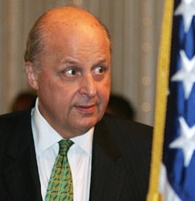
negroponte.jpgSo, Deputy Secretary of State, John Negroponte, is rushing off to Islamabad (via Africa). Having last week told Congress that the Bush administration regards General Musharraf as “indispensable,” Negroponte is now going to say what?

Several times today the New York Times has insisted on referring to Negroponte as an “envoy” even though at the White House press gaggle this morning, press secretary Dana Perino made it clear that the administration wants to dampen expectations that anything of consequence may follow from the Negroponte-Musharraf tête-à-tête:

MS. PERINO: I think that description was a little bit too strong in terms of “envoy.” Deputy Secretary Negroponte will be traveling there later in the week. I believe that’s who they were referring to [as an “envoy”].

Q But why is “envoy” too strong?

MS. PERINO: Well, he’s not going in terms of — he’s not going in a different capacity than what he is, which is the Deputy Secretary of State.

Later in the day, State Department spokesman Tom Casey was at pains to “deal with some of the other stories that were out there today that seemed to talk about some kind of special envoy or talk of him as a special envoy to Pakistan.” He was eager to impress upon those most obstinate members of the press who were still referring to him as an envoy that Negroponte is not an envoy.

Here’s where he cut to the chase after being asked whether Deputy Secretary Negroponte would be taking any special letter or any kind of message from Secretary Rice or President Bush other than to repeat what has already been said. “No, I think you’ll expect him to, again, deliver the same kind of message that we’ve already talked about publicly before. I’m not aware,” Casey said, “of him carrying any kind of special proposals or letters or things like that.”

So there we have it. Negroponte is not an envoy because he doesn’t have anything to say that hasn’t already been said before.

Will he have any time for sightseeing? Pick up any souvenirs? Maybe join in one of those festive get-togethers that all the lawyers are having.

I do have one suggestion though: He might want to consider compressing his Africa schedule by a few days. Otherwise, by the time he shows up in Islamabad, the General might be too busy to have the Deputy Secretary of State over for tea and scones.

His bridges burned, Musharraf has nowhere to turn

With pressure mounting on him at home and from abroad, the chances that General Pervez Musharraf will survive politically are looking increasingly bleak.

The prospects of a power-sharing deal with the opposition leader Benazir Bhutto that would have enabled Musharraf to cling on to power as president are diminishing rapidly. The more pressure Musharraf is applying on Bhutto, the more she is pushing back.

Today, as she was put under house arrest for the second time in five days, the opposition leader moved closer to a clean break with Musharraf.

For the first time, Bhutto called on him to resign as president altogether, adding for good measure that she could never serve in a government under him. Anyone associated with the general, she said, “gets contaminated”. [complete article]

Miscalculations

Musharraf’s miscalculations were abetted by the United States, which until recently all but ignored the political aspects of counterinsurgency in Pashtun territory. The Bush Administration, distracted by the war in Iraq, and conditioned by its long dependence on Pakistan’s Army, outsourced its Pakistan policy to Musharraf and bankrolled his narrow, increasingly self-defeating strategies. Of the approximately ten billion dollars in overt funds delivered to Pakistan since September 11th, for example, less than a hundred million has gone toward education, an issue about which Musharraf has spoken often but done very little.

The Pakistani Army’s intermittent attempts to suppress the Pashtun Islamists have failed, and these reversals have recently produced stresses within the military not witnessed since the country broke in half, in 1971: the humiliating surrender and capture of hundreds of Pakistani soldiers and local Pashtun paramilitaries, which have led to prisoner exchanges with the Taliban; reports of desertion and mutiny; and a succession of demoralizing battlefield defeats. About fifteen per cent of Pakistan’s Army officers are Pashtun, and the danger of revolt or division among them is deepening. [complete article]

See also, Musharraf’s army losing ground in insurgent areas (WP) and The answer in Pakistan (Thomas R. Pickering, Carla Hills and Morton Abramowitz).

Facebooktwittermail

NEWS: The not-so hidden costs of war

‘Hidden costs’ double price of two wars, Democrats say

The economic costs to the United States of the wars in Iraq and Afghanistan so far total approximately $1.5 trillion, according to a new study by congressional Democrats that estimates the conflicts’ “hidden costs”– including higher oil prices, the expense of treating wounded veterans and interest payments on the money borrowed to pay for the wars.

That amount is nearly double the $804 billion the White House has spent or requested to wage these wars through 2008, according to the Democratic staff of Congress’s Joint Economic Committee. Its report, titled “The Hidden Costs of the Iraq War,” estimates that the wars in Iraq and Afghanistan have thus far cost the average U.S. family of four more than $20,000. [complete article]

Facebooktwittermail

NEWS: Chalabi returns

Chalabi returns to prominence and power

Three years ago when the U.S. military came calling on the onetime darling of Washington’s neoconservatives, it raided 11 of his properties and left his compound in ruins.Chalabi, who helped the Bush administration make the case for the U.S.-led invasion of Iraq,denounced the American occupation of Iraq. It was the denouement to an increasingly fractured relationship between Washington and Chalabi, the Iraqi exile who provided intelligence about Saddam Hussein’s alleged weapons of mass destruction program that proved to be false.

The Pentagon, which had provided millions of dollars to Chalabi’s group, the Iraqi National Congress, cut off funding and accused him of passing sensitive U.S. secrets to Iran. His prospects appeared to reach a nadir last year, after his party failed to win a single seat in Iraq’s 2005 parliamentary elections and he was later excluded from the government.

Now the 63-year-old Chalabi, ever the political chameleon, has maneuvered back into prominence and power. Prime Minister Nouri Maliki appointed him to a pivotal position last month overseeing the restoration of vital services to Baghdad residents such as electricity, potable water, healthcare and education. The U.S. and Iraqi governments say the job is crucial to cement security gains of recent months — and that failure could cause the country to backslide into chaos. [complete article]

Facebooktwittermail

ANALYSIS: Peace through division

In Iraq, the silence of the lambs

The separation of religious groups in the face of sectarian violence has brought some semblance of relative calm to Baghdad. But many Iraqis see this as the uncertain consequence of a divide and rule policy.

Claims are being made that sectarian violence in Iraq has fallen because that the US military “surge” has succeeded in reducing attacks against civilians. But Baghdad residents say that they now live in a largely divided city that has brought an uneasy calm.

“I would like to agree with the idea that violence in Iraq has decreased and that everything is fine,” retired general Waleed al-Ubaidy told Inter Press Servce (IPS) in Baghdad. “But the truth is far more bitter. All that has happened is a dramatic change in the demographic map of Iraq.” [complete article]

Facebooktwittermail

OPINION, NEWS & ANALYSIS: The Palestinian struggle

Hamas and Fatah are betraying Arafat’s legacy

Yasser Arafat has been dead for three years, harried to an early death by the Israeli siege of his battered presidential compound in Ramallah. Two camps – his own secular Fatah faction and the Islamist group Hamas – that claim to carry on his struggle for Palestinian rights have effectively been at war for months. In so doing, they have undermined their shared goal of justice for the Palestinian people and trampled a principle of ideological inclusiveness that was perhaps the most important hallmark of Arafat’s leadership. And now they have marred the anniversary of his death with bloodshed.

Leaders of both Fatah and Hamas need very much to take a step back and think about the position of their people – not their respective constituents, but the Palestinian people whom they both purport to represent – and therefore about the consequences of their actions. Their people have been dispossessed for decades, and their Arab allies have never been of much help except (in a limited fashion) when it has suited their own purposes. Their would-be peace partner, the Israeli government, has made clear that it is in no rush to conclude an agreement, and the Jewish state’s cohorts in Washington can be relied upon to support this intransigence as best they can. [complete article]

Fatah members rounded up in Gaza

Hamas says it has rounded up dozens of Fatah activists in Gaza, a day after a huge rally commemorating Yasser Arafat ended in gunfire killing seven people.

Witnesses say security forces opened fire on unarmed crowds after the rally turned into a protest against the Hamas movement’s takeover of Gaza in June.

Hamas says its police came under attack from Fatah gunmen and returned fire. [complete article]

Hamas debates the future – Palestine’s Islamic Resistance Movement attempts to reconcile ideological purity and political realism

Palestine’s Islamic Resistance Movement — Hamas — won a surprising electoral victory in the January 2006 Palestinian parliamentary elections. Almost immediately, Hamas leaders, movement activists, and Islamist academics began to debate the future course of the movement. Under what conditions would Hamas recognize Israel? What was its place as a movement in the Middle East? How should it approach the question of governance of the Palestinian territories? And finally, and most importantly, how would it balance its need to remain an Islamist party while adopting more pragmatic political programs? [complete article]

Facebooktwittermail

NEWS: Ahmadinejad lashes out at opponents

Ahmadinejad steps up rhetoric against critics at home with threat to expose ‘traitors’

Mahmoud Ahmadinejad, Iran’s president, raised domestic tensions over the country’s nuclear policy to higher levels yesterday by labelling his opponents “traitors” who are working for the west and threatened to expose them in a political witch-hunt.

In an offensive that exposed the fissures within the Islamic republic’s power structure, he accused “domestic elements” of seeking to sabotage Iran’s uranium enrichment programme and said they had inflicted more damage than its foreign enemies.

“If the domestic elements do not stop imposing pressure over the nuclear issue, they will be unmasked before the Iranian nation,” Ahmadinejad told students at Tehran’s science and industry university. [complete article]

Facebooktwittermail

NEWS: Fight against terrorism threatens “fundamental principles of a democratic society”

Panel decries terrorism blacklist process

The methods used by the United Nations and the European Union for blacklisting terrorism suspects are “totally arbitrary” and “violate the fundamental principles of human rights and rule of law,” a European human rights panel said Monday.

The Council of Europe’s legal committee urged an overhaul of international regulations so that individuals and groups being blacklisted — which imposes a freeze on assets and a ban on traveling — would have access to evidence against them, rights to a fair trial or impartial review within a reasonable time and compensation for wrongful designation as a terrorist. [complete article]

Facebooktwittermail

REVIEW: The Second Civil War

Division of the U.S. didn’t occur overnight

During President George W. Bush’s first term, one of his senior political advisers summed up the prevailing philosophy at the White House like this: “This is not designed to be a 55 percent presidency,” he said. “This is designed to be a presidency that moves as much as possible of what we believe into law while holding 50 plus one of the country and the Congress.” Bold ideas that could mobilize his conservative Republican base were prized over efforts to convince independent voters in the center; sharp divisions over the administration’s policies were regarded as proof of Mr. Bush’s decisiveness and willingness to challenge conventional thinking.

amazon-secondcivilwar.jpgAs the veteran political reporter Ronald Brownstein observes in his timely and compelling new book, this is very much how President Bush has governed: “In his congressional strategy he consistently demonstrated that he would rather pass legislation as close as possible to his preferences on a virtually party-line basis than make concessions to reduce political tensions or broaden his support among Democrats.” And in his dealings with both Congress and other nations before the invasion of Iraq, Mr. Brownstein goes on, Mr. Bush “sought not to construct a consensus for a common direction on Iraq, but rather to obtain acquiescence for the undeviating direction he had charted in his own mind.” [complete article]

Facebooktwittermail

ANALYSIS & EDITOR’S COMMENT: Is war talk just talk?

‘And then what?’ A strike on Iran may be one problem too many for Bush

Mr Bush himself has often been depicted as willing to use force to avoid going down in history as the president on whose watch Tehran made the decisive steps towards the bomb. But administration staff paint a very different picture of the president’s priorities during his last 14 months in office.

“For those problems we can solve, let’s solve them,” a senior administration official tells the Financial Times, setting out a framework the president has given his top staff. “For those that we cannot solve, let’s leave our successors a set of policies and instruments that provide them with, in our view, the best prospect for success after we leave office.”

Such comments almost sound like an advance excuse for not resolving the Iran dispute. But then the state of the US as a whole and the Bush administration in particular is very different from the days of 2002-03.

The terrorist attacks of September 11 2001 remain a powerful memory but the overwhelming support for Mr Bush that followed them is long gone. Instead of the enthusiasm America once exhibited for the invasion of Iraq and the toppling of Saddam Hussein, the country is now war-weary and its forces are already fighting in Iraq and Afghanistan. Oil is almost $100 a barrel and could go far higher in the event of an attack on Iran.

Of particular importance are the US military’s deep reservations about a pre-emptive attack on Iran, largely because of the uncertain consequences that would result. In addition, pragmatists have replaced hawks among Mr Bush’s closest colleagues. [complete article]

Editor’s Comment — Nothing seems more emblematic of the state of American presidential power than the fact that General Musharraf appears quite indifferent to its influence. And if there is a word that captures this moment it is “path.” If Pakistan can at least present the appearance of being oriented in the direction of democracy; if it can take one or two baby steps along that path, then that’s good enough for President Bush and his Secretary of State. It seems strange then that even when the president is clearly so weak that those competing to take his place are finding it so difficult to muster their own strength. Bush may have little power to shape the world, yet his administration seems as powerful as ever when it comes to shaping American political debate.

How to prevent Iran from acquiring nuclear weapons has been described as the defining foreign policy of the presidential race. Although that might currently be the case, the fact that it is, is not a reflection of a reality to which everyone is bound; it is a reflection of the weakness of the Democratic candidates in setting their own agendas.

Two questions on which the candidates should be pressed are these:

Firstly, as you strive to become the next president, will you allow the current presidency to define your own agenda?

And secondly, in as much as it can be assumed that dealing with Iran will be a major concern of the next president, do you anticipate that there will be other issues that command more of your attention — issues such as global warming?

Anyone with the courage to deconstruct the Iranian issue should start by posing a simple question: Is this about Iran or is it about nuclear weapons?

Nuclear proliferation is not unthinkable. In the space of a few years, India, Pakistan, and North Korea all barged into the nuclear club. Are we to understand then that whereas the new entries were undesirable, Iran’s possession of nuclear weapons would place it in a unique category? The suicidal state?

On the other hand, if we are to assume that Iran is not a country governed by people possessed by a death wish, then the issue must focus squarely on nuclear proliferation. Yet the underlying logic here is one that any eight-year old can understand. In the playground of global affairs we have two options: We either let the playground bullies make up rules that they can impose on others yet ignore themselves, or alternatively we accept that the strong and the weak must abide by an impartial set of rules that apply to everyone. In this case we would have to conclude that the issue is not Iran; it is a pressing need to halt proliferation which is itself an objective that can only exert the force of principle if bound to a practical effort to accomplish global nuclear disarmament. That’s an objective that several of the Democratic candidates tried on for size recently but one that thus far they have been much too timid to deploy for the purpose of setting the political agenda. It seems ironic that so many could aspire to become president, yet so few have much appetite for showing how they intend to be presidential.

Facebooktwittermail

OPINION & EDITOR’S COMMENT: The options table

Will wou attack Iran?

In the last few weeks, the Democratic field has settled on an attack against the frontrunner: Doublespeak. “I believe Senator Clinton should be held to the same standard that every one of us should be held to,” says John Edwards. “Tell the truth, no more double-talk.” Indeed, the Edwards camp even asked the Clinton campaign five simple question on Iraq, questions, “that every candidate should have to answer.”

The questions the Edwards camp asks are good ones. I too would like the various Democrats to go on the record as to whether they’ll leave permanent bases in Iraq. But here’s another question every campaign should have to answer, and that none of them have: Will you attack Iran in order to prevent their construction of a nuclear weapon?

That is, after all, the defining foreign policy question of the race. Iraq is a more acute concern, but so much of the damage there has already been done, and we are so hostage to the facts on the ground, that the differences and distinctions between the candidates are, in some ways, of relatively uncertain importance. Once in office, their actions on Iraq will be governed by the realities of the war and the domestic polls.

Not so with a nuclear Iran, where the executive really will be allowed to make the decision as to whether we launch air strikes, or whether we seek a policy of deterrence, negotiation, and engagement. Yet till now, the candidates have largely been allowed to divert such questions, and all have done so in the same way. Speaking at the Herzliya Conference, John Edwards said that, “to ensure that Iran never gets nuclear weapons, we need to keep all options on the table.” Asked by 60 Minutes where he would use military force to disrupt the Iranian weapon program, Barack Obama said, “I think we should keep all options on the table.” And Hillary Clinton, speaking to AIPAC, said, “We cannot, we should not, we must not, permit Iran to build or acquire nuclear weapons, and in dealing with this threat, as I have said for a very long time, no option can be taken off the table.” [complete article]

Editor’s Comment — It’s strange how a piece of gibberish — “no options can be taken off the table” — can so easily be elevated to the status of unassailable truth. Implicit in the assertion that options can’t be taken off the table is the idea that all possible options are cluttered there, in their abundance, all within easy reach. If this were not implied then we would perforce have to engage in as many debates about what can be put on the table as there are about what cannot be removed.

Consider then one option — on the table in as much as it is possible — that the Iranian conundrum be dealt with, with a finality that no one could dispute: a strategic nuclear strike. In as literal a sense as the expression can be used, Iran could be wiped off the map. The United States (and Israel) have the physical means to do this, but we all know it’s not going to happen because, fortunately, this is an option that is well and truly off the table. Neither Dick Cheney, nor Norman Podhoretz, nor Rudy Guiliani are going to say that incinerating 70 million Iranians is an option that must stay on the table.

Facebooktwittermail