Monthly Archives: December 2007

NEWS: Israel’s Vice PM: Jerusalem must be divided

Vice PM Ramon: Parts of Jerusalem must be given to Palestinians

Vice Premier Haim Ramon responded on Sunday to U.S. criticism of plans to build additional homes in an East Jerusalem neighborhood by saying parts of the city must be given to the Palestinians to avoid losing U.S. support.

Ramon said Israel would not give up the Jewish neighborhood of Har Homa, where the building plan announced last week sparked Palestinian anger and a warning from U.S. Secretary of State Condoleezza Rice that it risked harming a peace process she helped relaunch last month at the Annapolis conference.

The vice premier said, however, that Prime Minister Ehud Olmert’s opponents were being unrealistic in hoping for U.S. support for any peace plan that would give Israel all the present Jerusalem municipality, including all of East Jerusalem, as its capital.

Ramon told Army Radio that he is “convinced that all Jewish neighborhoods, including Har Homa, should be under Israeli sovereignty and the Arab neighborhoods should not be under Israeli sovereignty because they pose a threat to Jerusalem being the capital of Jewish Israel. [complete article]

Facebooktwittermail

NEWS: Destroying the evidence

CIA was urged to keep interrogation videotapes

White House and Justice Department officials, along with senior members of Congress, advised the Central Intelligence Agency in 2003 against a plan to destroy hundreds of hours of videotapes showing the interrogations of two operatives of Al Qaeda, government officials said Friday.

The chief of the agency’s clandestine service nevertheless ordered their destruction in November 2005, taking the step without notifying even the C.I.A.’s own top lawyer, John A. Rizzo, who was angry at the decision, the officials said.

The disclosures provide new details about what Gen. Michael V. Hayden, the C.I.A. director, has said was a decision “made within C.I.A. itself” to destroy the videotapes. In interviews, members of Congress and former intelligence officials also questioned some aspects of the account General Hayden provided Thursday about when Congress was notified that the tapes had been destroyed. [complete article]

Inquiry sought on CIA tapes

Democratic lawmakers yesterday angrily demanded a Justice Department investigation into the CIA’s decision to destroy videotapes of harsh interrogation tactics used on two terrorism suspects.

The White House said that President Bush was unaware of the tapes or their destruction until this week, but administration sources acknowledged last night that longtime Bush aide Harriet E. Miers knew of the tapes’ existence and told CIA officials that she opposed their destruction.

The Senate intelligence committee also announced the start of its own probe into the destroyed videotapes, said Chairman John D. Rockefeller IV (D-W.Va.). [complete article]

Facebooktwittermail

NEWS: More on NIE

Diving deep, unearthing a surprise

As they digested the new findings, Bush and his aides chose to focus on the part that confirmed their suspicions — that Iran previously had a secret weapons program and might still restart it. In their discussions at the White House, officials said, no one suggested Bush tone down his public rhetoric or change his policy.

Still, they understood the sensitivity of the new conclusions. At first, Mike McConnell, the director of national intelligence, decided to keep the new findings secret, but reluctantly reversed course in a flurry of discussions last weekend out of fear of leaks and charges of a coverup, officials said. At that point, only the Israelis had gotten a heads-up. Congress, European allies and the U.N. nuclear watchdog agency were not given full briefings about the report until hours before it was released.

That irritated European allies. “The administration is going to pay a price for not allowing allies in on it at an earlier date,” said Robert J. Einhorn, a former State Department nonproliferation official. “The French had carried the administration’s water on this issue and really went out on a limb to get the European Union to adopt tough sanctions. And now the rug has been pulled out from under them.” [complete article]

Intelligence expert who rewrote book on Iran

The intelligence came from an exotic variety of sources: there was the so-called Laptop of Death; there was the Iranian commander who mysteriously disappeared in Turkey. Also in the mix was video footage of a nuclear plant in central Iran and intercepts of Iranian telephone calls by the British listening station GCHQ.

But pivotal to the US investigation into Iran’s suspect nuclear weapons programme was the work of a little-known intelligence specialist, Thomas Fingar. He was the principal author of an intelligence report published on Monday that concluded Iran, contrary to previous US claims, had halted its covert programme four years ago and had not restarted it. Almost single-handedly he has stopped – or, at the very least, postponed – any US military action against Iran. [complete article]

Unilateral military strike still an option, senior ministers insist

Senior Israeli officials warned yesterday that they were still considering a military strike against Iran, despite a fresh US intelligence report that concluded Tehran was no longer developing nuclear weapons.

Although Israel says it wants strong diplomatic pressure put on Iran, it is reluctant to rule out the threat of a unilateral attack. Matan Vilnai, Israel’s deputy defence minister, told Army Radio yesterday: “No option needs to be off the table.”

Avigdor Lieberman, the hard-right deputy prime minister, said Israel should be ready to act if sanctions did not work. “If they don’t, we will sit and decide whatever we have to decide,” he told the Jerusalem Post in an interview yesterday. [complete article]

Facebooktwittermail

NEWS: Gaza ceasefire?

Report: Hamas wants cease-fire with Israel in the Gaza Strip

Hamas is making efforts to reach a ceasefire with Israel in the Gaza Strip, London-based newspaper Al-Quds al-Arabi reported Saturday.

According to the report, senior Hamas officials are attempting to dissuade militants from firing Qassam rockets and mortar shells from the Strip into southern Israel in efforts to prevent a large-scale Israel Defense Forces ground operation in the Hamas-ruled territory.

Israel Radio reported Saturday that Damascus-based Hamas political leader Khaled Meshal had met with the head of the Islamic Jihad in Lebanon to discuss the issue. Islamic Jihad sources told the Al-Quds al-Arabi that the group had agreed to Hamas’ proposal, but only if Israel agrees to a mutual ceasefire.

The newspaper also reported that Egyptian officials have offered to broker the deal between Israel and the Palestinian factions in the Gaza Strip. [complete article]

Facebooktwittermail

NEWS & ANALYSIS: Destroying evidence of war crimes

CIA destroyed 2 tapes showing interrogations

The Central Intelligence Agency in 2005 destroyed at least two videotapes documenting the interrogation of two Qaeda operatives in the agency’s custody, a step it took in the midst of Congressional and legal scrutiny about its secret detention program, according to current and former government officials.

The videotapes showed agency operatives in 2002 subjecting terrorism suspects — including Abu Zubaydah, the first detainee in C.I.A. custody — to severe interrogation techniques. The tapes were destroyed in part because officers were concerned that video showing harsh interrogation methods could expose agency officials to legal risks, several officials said. [complete article]

Obstruction of justice at the CIA

Let’s first focus on this question: Why is this evidence being destroyed? The answer is painfully acknowledged. The CIA leadership and other senior administration officials are fully cognizant of the fact that the use of a number of specific practices which these tapes almost certainly document, to-wit: waterboarding, long-time standing, hypothermia, psychotropic drugs and sleep deprivation in excess of two days, are serious crimes under American law and the law of almost all nations. Consequently, those who have used them and those who have authorized their use will almost certainly ultimately face criminal prosecution at some point in the future. The Administration’s attempts to immunize the perpetrators have failed. Any purported grant of a pardon by President Bush will be legally ineffective, because Bush himself is a collaborator in the scheme. And there is no statute of limitations. Therefore the prospect of prosecution is hardly far-fetched. It is a virtual certainty. So the evidence is being destroyed precisely because it would be used as evidence of criminal acts in a prosecution of administration figures and those acting under their direction. Therefore, this is a conscious, calculated obstruction of justice. [complete article]

See also, CIA destroyed videos showing interrogations (WP), Marty Lederman – includes Hayden’s message to CIA employees (Balkinization), and This is a banana republic (Andrew Sullivan).

Facebooktwittermail

ANALYSIS, OPINION & EDITOR’S COMMENT: Iran’s new Arab friends

Iran’s new Gulf friends

A curious event took place in the Gulf as the new National Intelligence Estimate appeared in Washington, undermining the Bush administration’s threats and angry rhetoric by revealing that Iran had suspended in nuclear weapons program back in 2003.

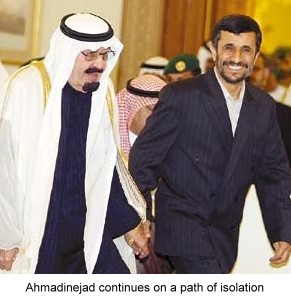
king-abdullah-with-president-ahmadinejad.jpgThe arch-demon of President Bush’s rhetoric, Iran’s President Mahmoud Ahmedinejad, was sitting politely in a conference room with the Arab leaders of the Gulf Cooperation Council. He was all sweetness and light and neighborly good manners, offering a regional security pact and a 12-point cooperation plan, including free trade and joint investments in oil and gas.

Ahmedinejad was so courteous that the GCC leaders hailed his “gestures of goodwill.” Qatar’s Prime Minister Skeikh Hamad al Thani, whose emirate hosted the summit, said, “If Iran was serious in its positive intentions, we can develop our relations for the sake of regional stability.” [complete article]

The new chapter and taking poison

There are good foundations for cooperative and friendly relations between the Gulf state and Iran; there are also good reasons to justify the conflicts and caution between the two sides of the Arab Gulf. The region is passing through a gray phase in which interests and goals are too intertwined. The only way to put friendship and cooperation ahead of conflict and caution is by direct dialogue. [complete article]

GCC to launch common market in January

Leaders of the six-member Gulf Cooperation Council (GCC) yesterday announced their plan to launch a common market in January 2008 and a currency union by 2010 in addition to maintaining their currencies’ peg to the US dollar. [complete article]

See also, As Dubai heats up, is Israel frozen out? (The Forward).

Editor’s Comment — While some headlines in the US press are still pushing the old narrative (such as the LA Times’Report on Iran fuels Arab fears“), the image across the Middle East is somewhat different. Mahmoud Ahmadinejad might not be universally popular, but President Bush is deluding himself if he thinks that Iran can now be isolated. Neither should the significance of Ahmadinejad’s overtures to the GCC be underestimated. The GCC (an acronym that will be unfamiliar to most Americans) might be made up of mostly small and autocratic states but this bloc also happens to be a financial superpower possessing more than double the available investment funds of China.

Facebooktwittermail

ANALYSIS & OPINION: A new approach to Iran

Why containing Iran won’t work: Washington’s flawed new Middle East strategy

The Middle East is a region continuously divided against itself. In the 1960s, radical Arab regimes contested the legitimacy and power of traditional monarchical states. In the 1970s, Islamic fundamentalists rejected the prevailing secular order and sought to set the region on the path to God. In the 1980s, much of the Arab world supported the genocidal Saddam Hussein as he sought to displace Iran’s theocratic regime. Today, the Middle East is fracturing once more, this time along sectarian and confessional lines, with Sunnis clamoring to curb Shiite ascendance. Again and again, in the name of preserving the balance of power, U.S. policy has taken sides in the region’s conflicts, thus exacerbating tensions and widening existing cleavages. Beyond the Arab-Israeli conflict, the United States has shown limited interest in mediating conflicts, settling disputes, or bringing antagonists together. Washington sided with the conservative monarchies against Arab socialist republics, acquiesced in the brutal suppression of fundamentalist opposition by secular governments, buttressed Saudi power and the Iraqi war machine to temper Ayatollah Ruhollah Khomeini’s Islamist rage. It is now courting Sunni regimes to align against Iran and its resurgent Shiite allies. Every time, as Washington has become mired in the Middle East’s rivalries, its goal of stabilizing the region has slipped further away.

Instead of focusing on restoring a former balance of power, the United States would be wise to aim for regional integration and foster a new framework in which all the relevant powers would have a stake in a stable status quo. The Bush administration is correct to sense that a truculent Iran poses serious challenges to U.S. concerns, but containing Iran through military deployment and antagonistic alliances simply is not a tenable strategy. Iran is not, despite common depictions, a messianic power determined to overturn the regional order in the name of Islamic militancy; it is an unexceptionally opportunistic state seeking to assert predominance in its immediate neighborhood. Thus, the task at hand for Washington is to create a situation in which Iran will find benefit in limiting its ambitions and in abiding by international norms.

Dialogue, compromise, and commerce, as difficult as they may be, are convincing means. An acknowledgment by the U.S. government that Tehran does indeed have legitimate interests and concerns in Iraq could get the two governments finally to realize that they have similar objectives: both want to preserve the territorial integrity of Iraq and prevent the civil war there from engulfing the Middle East. Resuming diplomatic and economic relations between Iran and the United States, as well as collaborating on Iraq, could also be the precursor of an eventual arrangement subjecting Iran’s nuclear program to its obligations under the Nuclear Nonproliferation Treaty. If Iran enjoyed favorable security and commercial ties with the United States and was at ease in its region, it might restrain its nuclear ambitions. [complete article]

After the Iran NIE

Since the NIE’s release, Bush has emphasized the passages of the report that continue to sound warning bells. But this effort will be dismissed as—and, in fact, will be—lame propaganda unless he also acknowledges, and embraces, the positive passages.

If Bush wants the rest of the world to acknowledge the caveats, he has to acknowledge—and act on—the main message. In other words, if he wants Russia, China, and the European Union to continue the diplomatic pressure on Iran, he has to offer Iran diplomatic inducements. Pressure may be needed to keep the Iranians from resuming their nuclear-weapons program. But negotiations should be started, as a reward for halting their program—and the prospect of further rewards should be held out if they unwind their program still further.

Bush should have started serious talks with Iran two years ago, for a variety of reasons. The NIE offers two additional, compelling reasons for starting them now. [complete article]

The zero-sum fiasco

Bush’s woefully misguided invasion and occupation of Iraq in 2003, carried out under false pretences, has not only drained the United States treasury, but reduced Washington’s standing in the Middle East in a way not yet fully grasped by most commentators. Whereas Washington once played off Tehran against Baghdad, while involved in a superpower zero-sum game with the Soviet Union, the Bush administration is now engaged in a zero-sum game, as a virtual equal, with Iran. That is, America’s loss has become Iran’s automatic gain, and vice-versa. [complete article]

A new Chinese red line over Iran

The highly respected former Australian foreign minister Gareth Evans has assessed after a recent visit to Tehran and meetings with top Iranian officials that the outlines of a deal are emerging and the NIE “gives us the chance to break out of this impasse [of Iran insisting on its right to enrich]”. He suggested that the “red line” should no longer be the issue of enrichment, but could be between the “civilian and military capability” of NPT signatories, and if such a new red line would hold, “it would not matter whether Iran was capable of producing its own nuclear fuel”.

Evans added, “That [red] line will hold if we can get Iran to accept a highly intrusive monitoring, verification and inspection regime” with additional safeguards, and if Iran could be persuaded to “stretch out over time the development of its enrichment capability and to have any industrial-scale activity conducted not by Iran but by an international consortium”.

Evan assesses that Iran is “capable of being persuaded” if incentives include the lifting of sanctions and normalization of relations with the US. Evans concluded: “This is a country seething with both national pride and resentment against past humiliations, and it wants to cut a regional and global figure by proving its sophisticated technological capability. One only wishes that something less sensitive than the nuclear fuel cycle had been chosen to make that point.” [complete article]

Facebooktwittermail

NEWS: Republicans want intelligence to their liking

Review of Iran intelligence to be sought

Senate Republicans are planning to call for a congressional commission to investigate the conclusions of the new National Intelligence Estimate on Iran as well as the specific intelligence that went into it, according to congressional sources.

The move is the first official challenge, but it comes amid growing backlash from conservatives and neoconservatives unhappy about the assessment that Iran halted a clandestine nuclear weapons program four years ago. It reflects how quickly the NIE has become politicized, with critics even going after the analysts who wrote it, and shows a split among Republicans.

Sen. John Ensign (R-Nev.) said he plans to introduce legislation next week to establish a commission modeled on a congressionally mandated group that probed a disputed 1995 intelligence estimate on the emerging missile threat to the United States over the next 15 years. [complete article]

Facebooktwittermail

NEWS & ANALYSIS: Israel and American Jewish organizations respond to NIE

Israel warns Iran to co-operate or pay price

Israel has warned Iran to either co-operate with the West over its uranium enrichment program or face military action.

Ron Prosor, Israel’s newly appointed ambassador to Britain and one of his country’s leading experts on Iran’s nuclear program, said that Tehran could enrich enough uranium to make an atomic bomb by 2009.

“At the current rate of progress, Iran will reach the technical threshold for producing fissile material by 2009,” he said.

“This is a global threat and it requires a global response.

“It should be made clear that if Iran does not co-operate, then military confrontation is inevitable. It is either co-operation or confrontation.”

Mr Prosor, who served Ehud Olmert, the Israeli Prime Minister, as his senior adviser on Iran, said that time for resolving the nuclear issue was rapidly running out. But he was non-committal about the possibility of Israel launching military action. [complete article]

Intel bombshell sends community scrambling to hold line on Iran threat

American Jewish groups are scrambling to reformulate their message on Iran following the release this week of a new American intelligence report that states with “high confidence” that Tehran halted its nuclear weapons program four years ago.

In a conference call Tuesday hurriedly arranged by the umbrella body of Jewish organizations, communal leaders decided to immediately send letters to the presidential candidates from both parties, urging them to continue pushing for sanctions against Iran.

According to participants in the conference call, concern is high that the unexpected conclusions drawn in the National Intelligence Estimate not only may lead Washington to withdraw the threat of military action against Iran but may also erode the recently reached international consensus on pressuring Iran to abandon its nuclear ambitions. [complete article]

Israeli policy on Tehran unchanged by American assessment

Israel will continue reviewing the implications of the U.S. intelligence assessment that Iran has no nuclear program, and will not stop its diplomatic and public relations efforts against the Iranian bomb, government officials decided yesterday.

The statement came after a meeting called by Prime Minister Ehud Olmert to discuss the significance of the U.S. National Intelligence Estimate.

Olmert said at the meeting that Israel’s strict working assumption had not changed. [complete article]

Is Iran NIE a blessing in disguise for Israel?

The US National Intelligence Estimate’s assertion that Iran currently does not have a nuclear weapons program has caused much frustration in Israel. Deputy Defense Minister Ephraim Sneh referred to the report as a lie at a recent breakfast in New York, and Infrastructure Minister Binyamin Ben-Eliezer reportedly “doesn’t buy” its findings.

Though the report aggravates Israel’s effort to compel Washington to pursue an increasingly harsh line against Tehran, all is not lost for Israel. In fact, despite these initial knee-jerk reactions, the NIE may very well end up being a blessing in disguise for the Jewish state by pulling Israel out of its state of paralysis vis-à-vis Iran.

Israel has long been at odds with Washington’s intelligence agencies. It started sounding the alarm bells on Iran’s nuclear program back in 1991, arguing that in the post-Cold War world, Iran and Shi’ite fundamentalism were emerging as the new strategic threat to the Middle East.

The Israeli warnings were met with great skepticism and surprise within the Beltway. After all, only a few years earlier – at a time when Iran’s revolutionary fervor was still riding high – the Israelis had gone to great lengths to bring Iran and the US back on talking terms, dismissing all notions that Iran was a threat. [complete article]

Facebooktwittermail

NEWS, ANALYSIS & EDITOR’S COMMENT: Missile defense against what?

Europe’s missile shield: NIE casualty?

TThat the new U.S. intelligence assessment of Iran’s nuclear program has put the kibosh on hawkish calls for a military response has been discussed to death, but there’s been very little focus on a second potential casualty: the U.S. plan to base ground-based missile defenses in Poland and the Czech Republic. The plan to station interceptor missiles in Poland and tracking radars in the Czech Republic is regarded warily by citizens of those countries, and with outright hostility by the Russians who see it as aimed at blunting their own missile capability in the event of a showdown with the U.S. The plan has helped freeze U.S.-Russia ties to Cold War levels of enmity, with President Vladimir Putin just last week suspending Russia’s participation in 1990s Conventional Forces in Europe treaty.

Against the barrage of criticism from the Russians, Pentagon officials have always insisted that the purpose of the missile-defense system is to protect Europe and the U.S. from an Iranian missile attack. “It’s not the Russians that we’re worried about,” Air Force Lieutenant General Henry “Trey” Obering, chief of the Pentagon’s Missile Defense Agency, said over breakfast earlier this year. “It is the Iranian missiles that we’re worried about.” But if the best those missiles could carry is conventional explosives, the case for deploying the missile defense system in the face of the heavy diplomatic cost and financial burden ($4 billion through 2013) becomes increasingly dubious. For one thing, the Pentagon faces mounting bills of tens of billions of dollars to “reset” the U.S. military — replacing everything worn out in Afghanistan and Iraq — over the coming decade. [complete article]

Russia alleges U.S. ‘rollback’ on anti-missile plan

The United States has backed away from proposals it made orally in October to allay Russian fears about the deployment of a missile defense system in Eastern Europe, Russia’s foreign minister, Sergei Lavrov, alleged Wednesday.

Lavrov said an oral proposal to permanently station Russian officers at sites in Poland and the Czech Republic to ensure that the system’s radar would not be used to peer into Russian airspace was withdrawn when the United States submitted its proposals to Moscow in writing last month.

“We received the document, and unfortunately a serious rollback from what we agreed upon was evident,” Lavrov said at a news conference Wednesday in his first detailed comments on the U.S. written proposals. “The issue no longer concerns the permanent presence of Russian officers at possible facilities . . . in the Czech Republic and Poland.” [complete article]

Editor’s Comment — I’m not sure why I haven’t read anyone else make this observation, but there’s always seemed to me to be a glaring contradiction that the administration on the one hand asserts that Iran will never be allowed to possess nuclear weapons, while on the other hand argues to its European allies that they need a missile defense shield for protection against Iranian ballistic missiles. Either the shield was always presumed to be unnecessary or it was always presumed that efforts to prevent Iran acquiring nuclear weapons would fail. The Pentagon’s claim that the “missile-defense program is not geared to any kind of specific defense against a specific weapon,” is baloney.

Facebooktwittermail

INTERVIEW: Israel has to take the first step

“Israel has to take the first step”

A revived road-map? A photo-opportunity? Or a real possibility for peace? “The key is in Israeli hands. Israel is the occupier and Israel has to take the first step”. Gideon Levy, left-wing Israeli journalist of Haaretz, former spokesman for Shimon Peres (1978 -1982), and, according to the French newspaper Le Monde, “a thorn in Israel’s side”, does not beat around the bush when talking about the recent Annapolis peace conference. Not overly optimistic on its likely outcomes, although conceding that it offers a glimmer of hope, Levy urges both Israeli and Palestinian leaders to take a leap forward by abandoning brinkmanship and approaching peace with courage. [complete article]

Facebooktwittermail

NEWS, ANALYSIS & OPINION: NIE reverberations continue

Why the Pentagon is happy about the NIE

The latest National Intelligence Estimate on Iran was the final factor in a military equation that now appears to guarantee that there will be no war with Iran during the Bush Administration. It meshes with the views of the operational types at the Pentagon, who have steadfastly resisted the march to war led by some Administration hawks. The anti-war group was composed of Defense Secretary Robert Gates; Admiral Michael Mullen, chairman of the Joint Chiefs; and Admiral William Fallon, who oversees the U.S. forces that would have had to wage that war. In recent months, all have pushed back privately and publicly, on the wisdom of going to war with Tehran. Indeed, the Pentagon’s intelligence units were instrumental in forming the NIE’s conclusions.

The U.S. military contributes nine of the 16 intelligence agencies whose views are cobbled together in NIEs: the Counterintelligence Field Activity, the Air Force Intelligence, Surveillance and Reconnaissance Agency, Army Intelligence, the Defense Intelligence Agency, the Marine Corps Intelligence Activity, the National Geospatial-Intelligence Agency, the National Reconnaissance Office, the National Security Agency, and the Office of Naval Intelligence. Some critics have suggested that the military simply found a public way to quiet the drumbeat for war coming from Vice President Dick Cheney and his shrinking band of allies in the Administration.

There was no formal response from the Pentagon. It is evident, however, that the U.S. military, already strained by wars in Afghanistan and Iraq, has no appetite for a third war. That’s true even if a series of strikes against nuclear and other targets inside Iran were carried out by the Air Force and Navy, the two services who have sat, somewhat frustrated, on the sidelines as the Army and Marine Corps has done the heavy lifting in the two wars now under way. Some Pentagon officials welcomed the new NIE as evidence that the intelligence community is not tied to ideology, as some critics argued was true during the buildup to the Iraq war in 2003. [complete article]

Details in military notes led to shift on Iran, U.S. says

American intelligence agencies reversed their view about the status of Iran’s nuclear weapons program after they obtained notes last summer from the deliberations of Iranian military officials involved in the weapons development program, senior intelligence and government officials said on Wednesday.

The notes included conversations and deliberations in which some of the military officials complained bitterly about what they termed a decision by their superiors in late 2003 to shut down a complex engineering effort to design nuclear weapons, including a warhead that could fit atop Iranian missiles.

The newly obtained notes contradicted public assertions by American intelligence officials that the nuclear weapons design effort was still active. But according to the intelligence and government officials, they give no hint of why Iran’s leadership decided to halt the covert effort. [complete article]

Bush tells Iran to disclose nuclear activities

President Bush called on Iran to “come clean” about the scope of its nuclear activities Wednesday, as the White House made it clear there will be no change in its policy toward Tehran despite new intelligence questioning his claims about the country’s nuclear ambitions.

Traveling here for a political fundraiser, Bush indicated that he still sees Iran as a serious threat. He demanded that its leaders fully disclose details of its nuclear weapons program, which the intelligence community said Monday was shut down in the fall of 2003.

“The Iranians have a strategic choice to make,” Bush told reporters. “They can come clean with the international community about the scope of their nuclear activities and fully accept” the U.S. offer to negotiate if they suspend their nuclear enrichment program — “or they can continue on a path of isolation.” [complete article]

Iran’s nukes: now they tell us?

In August, National Intelligence Director McConnell ordered CIA Director Michael Hayden to have ready by Labor Day a new intelligence estimate reflecting the latest information. Hayden said he needed more time. McConnell set a Nov. 30 deadline. Because some of the information sources were new, Hayden decided to launch a “red team” counter-intelligence operation to make sure that the U.S. wasn’t falling for Iranian disinformation. In late October, the Persia House and red-team analysts offered their findings to Hayden and his deputy, Steve Kappes, around the coffee table in Hayden’s office. The red team found that the possibility of Iranian disinformation was “plausible but not likely.” That assessment led two of the 16 intelligence agencies, but not the CIA, to dissent from the final “high” degree of certainty that Iran had stopped its weapons program in 2003. On the other hand, there was general agreement on a “moderate” finding that Iran had not restarted the program. The National Intelligence Board met and reached its conclusions on Tuesday, Nov. 27. “The meeting took a little more than two hours,” a senior intelligence official told me. “There have been times when it has taken multiple meetings that went on for hours and hours to reach a consensus, especially when dealing with one of Iran’s neighbors.”

Hayden and his senior Iran analysts briefed President Bush on the new NIE on Wednesday, Nov. 28. But it seems apparent the President made little effort to figure out how his Administration could leverage the shocking candor of the intelligence report to his advantage in dealing with Iran. “He could have said to the Iranians, ‘This document shows that we’re not rushing to war. We’re not out to get you,'” said Kenneth Pollack, a National Security Council staff member during the Clinton Administration and author of The Persian Puzzle. “‘But we — and the rest of the world — are very concerned about your uranium-enrichment program, and so let’s sit down and talk about it.'”

Oddly, Bush didn’t seem to ask for a delay in the release of the report. He could easily have requested a few weeks for his Administration to chew over the import of the NIE, discuss it with our allies, organize a new diplomatic initiative to negotiate with the Iranians. As it was, Under Secretary of State Nicholas Burns briefed the U.N. Security Council members who had been considering a new round of sanctions against Iran about the same time that word of the NIE broke in the press. When it did, the Chinese, who had seemed surprisingly ready to approve the sanctions, started backing away from that position. [complete article]

See also, Spinning the NIE Iran report (Tony Karon), A pattern of deception (Dan Froomkin), White House Iran intel story 2.0 (TPM).

Facebooktwittermail

NEWS: Mosul “center of gravity for the insurgency”; Gates cautiously optimistic; Cheney irrationally exuberant

Pushed out of Baghdad, insurgents move north

Sunni insurgents pushed out of Baghdad and Anbar Provinces have migrated to this northern Iraqi city and have been trying to turn it into a major hub for their operations, according to American commanders.

A growing number of insurgents have relocated here and other places in northern Iraq as the additional forces sent by President Bush have mounted operations in the Iraqi capital and American commanders have made common cause with Sunni tribes in the western part of the country.

The insurgents who have ventured north include Abu Ayyub-al Masri, the leader of Al Qaeda in Mesopotamia, a predominantly Iraqi group that American intelligence says has foreign leadership. American officials say the insurgent leader has twice slipped in and out of Mosul in Nineveh Province to try to rally fellow militants and put end to infighting. [complete article]

Gates cautiously upbeat on Iraq

Defense Secretary Robert M. Gates said Wednesday that a stable and democratic Iraq is “within reach.” But he cautioned that threats remain, pointing to insurgent efforts to create a stronghold in northern Iraq as U.S. commanders seek more than 1,400 additional Iraqi and U.S. troops there.

Gates, who during Senate confirmation hearings a year ago stated that the United States was neither winning nor losing in Iraq, was unusually upbeat in his remarks. He said several recent trends have given him hope, including the lowest levels of violence since early 2006, a substantial increase in the number of displaced Iraqis returning to their homeland, rising international investments and the willingness of more than 70,000 Iraqis to volunteer to protect their neighborhoods.

“More than ever, I believe that the goal of a secure, stable and democratic Iraq is within reach,” Gates said at a news conference in the fortified Green Zone. “We need to be patient, but we also need to be absolutely resolved in our desire to see the nascent signs of hope across Iraq expand and flourish.” [complete article]

Top U.S. military brass in Iraq resist quick drawdown

The U.S. military’s internal debate over how fast to reduce its force in Iraq has intensified in recent weeks as commanders in Baghdad resist suggestions from Pentagon officials for a quicker drawdown.

Army Lt. Gen. Raymond T. Odierno, the day-to-day military commander in Iraq, said he was worried that significant improvements in security conditions would sway policymakers to move too quickly to pull out troops next year.

“The most important thing to me is we cannot lose what we have gained,” Odierno said in an interview last week with The Times after he toured Nahrawan, a predominantly Shiite city of about 100,000 northeast of Baghdad with a market that is now showing signs of life. “We won’t do that.” [complete article]

Cheney: Iraq to be self-governing by 2009

Vice President Cheney today predicted Iraq will be a self-governing democracy by the time he leaves office, calling the current U.S. surge strategy “a remarkable success story” that will be studied for years to come.

In an interview with Politico, Cheney offered a remarkably upbeat view of Iraq, despite continued violence and political paralysis in the war-torn nation.

Cheney, who has been widely criticized for overly optimistic — and sometime flat wrong — projections in the past, sounded as confident as ever that the Bush administration will achieve its objectives in Iraq. [complete article]

Facebooktwittermail

EDITORIAL: When reason prevails

When reason prevails

To some political observers there is something vaguely disappointing about witnessing events shaped by reason. Reasonable behavior is somewhat predictable and lacks the zest and drama of the unexpected.

In as much as news-watching is driven by the stimulating effect of the shock of the new, there is then a tendency for one revelation to trigger a desire that this be followed by a cascade of revelations. In the current context, this is provoking a notion that now, anything could happen.

In a game of whack-a-mole, as soon as the National Intelligence Estimate had knocked down the notion of the “mad mullahs”, the image of “mad dog” Israel popped up.

For the past several years, U.S. intelligence analysts have doubted hawkish U.S. and Israeli rhetoric that Iran is dominated by “mad mullahs” — clerics whose fanatical religious views might lead to irrational decisions. In the new NIE, the analysts forcefully posit an alternative view of an Iran that is rational, susceptible to diplomatic pressure and, in that sense, can be “deterred.”

“Tehran’s decisions are guided by a cost-benefit approach rather than a rush to a weapon irrespective of the political, economic and military costs,” states the NIE. Asked if this meant the Iranian regime would be “deterrable” if it did obtain a weapon, a senior official responded, “That is the implication.” He added: “Diplomacy works. That’s the message.”

But not so fast, says Seymour Hersh — “there’s always Israel… Israel can always decide to take military action.” And on CNN last night, Hersh continued. “I’m told that Olmert had a private discussion with Bush about it during Annapolis — before Annapolis. Bush briefed him about it.” This contradicts National Security Adviser Stephen Hadley’s claim that Bush was not briefed on the NIE until Wednesday — the day after the Annapolis Conference. Indeed, there is further evidence that the Israelis were informed well before the conference.

In today’s Haaretz, Amos Harel writes:

Israel has known about the report for more than a month. The first information on it was passed on to Defense Minister Ehud Barak, and to Shaul Mofaz, who is the minister responsible for the strategic dialog with the Americans. The issue was also discussed at the Annapolis summit by Barak and U.S. Secretary of Defense Robert Gates, and it seems also between Bush and Prime Minister Ehud Olmert.

What surprised Israel is the sharp turn from the previous line presented by the DNI [Director of National Intelligence, Mike McConnell], and the fact the report was made public. Based on his short comments yesterday, it seems Barak, like Olmert, is trying to avoid open disagreement with the U.S. government.

But the issue of the NIE is expected to create tension on two levels. It will cloud the tight cooperation between the two countries intelligence agencies, since now it will no longer look as if it is only a disagreement over timing, but a fundamental disagreement over Iran’s intentions. It will also cause a feeling of distress on the Israeli side, as now it will seem that the U.S. is abandoning Israel to fight alone.

But is there really much likelihood that Israel would take on the fight alone?

Some would argue that Israel’s September 6 strike on Syria was intended as a warning shot — a signal to Tehran that “mad dog” Israel can, if it chooses, just as easily strike Iranian targets. At the time, it was certainly easy to accept such an interpretation. Now, things look different.

It seems more reasonable — in accordance with the principle of Ockham’s razor (cleaving to the simplest explanation) — to believe that bombs dropped on Syria were intended to send a message to Syria, not Iran. The message? Just because of last summer’s mess in Lebanon, don’t get the idea that you’d stand a chance in a military confrontation with Israel. We can hit you whenever we want, wherever we want. Now we’ve made that clear, we’re ready to talk.

When it comes to Iran, the political challenge now is for those who until very recently were hysterically presenting Iran as the greatest threat to the world, to make an about face without losing face and say that Iran can now effectively be engaged.

Those still feeling the sting of the NIE’s claims will predictably revive Rumsfeld’s line of reasoning that the absence of evidence is not evidence of absence. But this always was, and remains, a faultless yet deceptive line of reasoning since the absence of evidence is not evidence of concealment. Just as there are still those who believe that Saddam Hussein’s WMD were never found because they were so well hidden, the same line is being used again: “The Israelis interpret the evidence to mean the Iranians have almost certainly continued to conduct their military nuclear program in secret.”

That’s all well and good, but while the masters-of-secrecy argument might have some limited value in sustaining the image of Iran’s government as a nefarious and deceptive entity, at the same time, it’s hard to plausibly argue in favor of missile strikes on targets so well hidden that their locations are unknown.

The neocons know the game is up and some of them are being surprisingly quick to concede the fact. Norman Podhoretz sees the intelligence community engaged in a scheme to “head off the possibility that the President may order air strikes on the Iranian nuclear installations.” But even if the father of neoconservatism doesn’t like what he sees, he concedes that the plot has worked.

Robert Kagan, perhaps the most nimble-minded among the neocons, says, “With its policy tools broken, the Bush administration can sit around isolated for the next year. Or it can seize the initiative, and do the next administration a favor, by opening direct talks with Tehran.” Part of Kagan’s motive for advocating talks now is that this “would give the United States a better chance to frame the discussion, at home and abroad.” Which is to say, a better chance for Kagan and his friends to frame the issues.

Be that as it may, the opportunity that has now opened up needs to be grasped. The question is, who is going to quickest off the mark in becoming the strongest advocate of a bold and strategic policy shift? Those who have nothing to advocate will do no more than sustain the culture of political reactivity in which nothing really gets said and nothing much gets done.

So far there are no signs that inside Bush’s brain there are any new neuronal pathways being tickled by an action potential. It’s time for Iran to “come clean” he says — and Ahmadinejad could say just the same. If the absence of cunning is a precondition for U.S.-Iranian talks, they’re not going to happen.

But Bush’s isn’t the only voice that needs to be heard right now. There are a bunch of folks waltzing around America at the moment claiming they want to lead the nation. OK. Now’s the time to show your mettle. And just in case anyone needs reminding: whether or not Iran has an active program for developing nuclear weapons, it does remain the strategically most important country in the Middle East.

The release of the NIE may have the effect of making presidential candidates think that Iran can quietly be dropped from the political agenda. This would be a mistake. The opportunity here is not limited to finding a new way to approach Iran; with some courage and imagination the conversation could actually start to shift away from its myopic focus on national security threats and towards a new focus on engagement. Instead of talking about how America must lead the world, save the world or protect itself from the world, it’s time to start talking about working together and raising America’s awareness of a convergence of national and global interests.

Facebooktwittermail

ANALYSIS: Détente with Syria

The Syrians are back

The report of UN prosecutor Serge Brammertz on the Harriri assassination came out last week. Not only did it fail to name any Syrian suspects (contrary to original reports in 2005) but also praised Syria’s cooperation in the UN probe. Simultaneously, the US Department of State did not veto a United Nations technological grant to Syria, to be used for sophisticated surveillance by the Customs Department, knowing that the equipment will be coming from Cisco Systems. Cisco received a special export license from the US Department of Commerce to ship routers, switches, and high-tech equipment to Syria.

The US has been accusing Syria of supporting the insurgency in Iraq, destabilizing Lebanon, and honeymooning with Iran. Why the sudden change?

In fact, the thaw has been under way for some time. It started with a Syrian-US meeting at a regional conference on Iraq back in March 2006. The Americans reasoned that in order to achieve stability in Iraq, they had to deal with either Syria or Iran.

Dealing with both was too difficult for the Bush White House, and continuing to sideline both was equally destructive. It was easier to talk to Syria than Iran, the Americans reasoned, since Syria was reasonable and did not have a history of anti-Americanism. This new perception led to a groundbreaking encounter between Foreign Minister Moualem and his US counterpart Condoleezza Rice. [complete article]

Facebooktwittermail

NEWS & ANALYSIS: Evolving perspectives on Iran

Time has come for U.S. to pursue talks with Iran

The American intelligence report that makes the option of a military strike against Iran – and possibly the next dose of sanctions – less likely to materialize gives us an important time-out to try a new avenue vis-a-vis the Islamic Republic.

That route would center on diplomacy aimed at neutralizing Tehran’s motivation to further pursue the development of nuclear arms. For some time now, Iran has held an internal debate – which sometimes reaches the Iranian media – on how far Tehran can go in defying international pressure to abandon its nuclear program. [complete article]

Europeans see murkier case for sanctions

The Bush administration’s new intelligence assessment that Iran halted its nuclear weapons program in 2003 is likely to complicate efforts to impose new sanctions on Iran at the United Nations Security Council, European officials said Monday.

The officials, who declined to be identified under normal diplomatic rules, stressed that their governments were formally studying the new assessment of Iran’s nuclear intentions and capabilities by the administration’s intelligence agencies.

But they added that they were struggling to understand why the United States chose to issue the report just two days after the six powers involved in negotiating with Iran — the United States, Russia, China, France, Britain and Germany — had decided to press ahead with a new Security Council resolution.

“Officially, we will study the document carefully; unofficially, our efforts to build up momentum for another resolution are gone,” said one European official involved in the diplomacy. [complete article]

Anatomy of an about-face on Iran

The new intelligence was considered compelling enough to call it to Bush’s attention in August. In a news conference at the White House on Tuesday, Bush said that the nation’s intelligence director, J. Michael McConnell, “came in and said, ‘We have some new information.’ ”

Bush said that McConnell did not provide details. “He didn’t tell me what the information was,” Bush said. “He did tell me it was going to take awhile to analyze.”

The decision to hold those details back has come under question because Bush and others in the administration continued in the succeeding months to use heated rhetoric to warn of the dangers posed by a nuclear-armed Iran. In October, Bush described that scenario as potentially pointing to World War III.

But U.S. intelligence officials said they felt compelled to employ that level of caution in part because of the searing experience surrounding the war in Iraq.

“Back in 2002, one of the knocks on the process at the time was that information was not vetted by analysts and was being rushed into the Oval Office,” said the senior U.S. intelligence official.

That experience showed, the official said, that bringing unvetted intelligence to senior officials could backfire.

This time, even as they vetted the new intelligence and launched into major revisions of the estimate on Iran’s nuclear program, intelligence officials said, they deliberately shielded analysts from administration officials and policymakers. [complete article]

Spies show Bush a way forward on Iran

The NIE does refer to the role of “international pressures” in halting Iran’s program, but contrary to Hadley’s argument, it suggests that the decision to halt weaponization was not prompted by threats and pressure. The key finding of the estimate also indicates that the intelligence community believes Iran is more likely to forego the nuclear weapons option if the United States deals with its security and political interests than if it relies on threats and sanctions.

The estimate concludes that the halt in the weapons program was ordered “in response to increasing international scrutiny and pressure resulting from exposure of Iran’s previously undeclared nuclear work”. That is a reference to the situation facing the Iranian leadership in 2003, when its acquisition of nuclear technology from Pakistani Abdul Qadeer Khan’s network had already been exposed but there was no threat of either military action or economic sanctions against Iran over the nuclear issue.

A major feature of the diplomatic situation in the autumn of 2003 was the willingness of Britain, France and Germany to negotiate an agreement with Iran on a wider range of security issues, based on voluntary Iranian suspension of uranium enrichment. [complete article]

Diplomatic “disaster” led to Iran intel spill?

The National Intelligence Estimate on Iran’s nukes has been in the works for months. So why did it get released now? Various commentators are guessing that hardening opposition had “caused Cheney and his team to fold their cards,” or that a Democratic-controlled Congress pushed the Director of National Intelligence, or that the spooks are trying to undermine Bush. The latter two, respectively, appear to be untrue and ridiculous, and Cheney’s team folding its cards sounds unlikely in the extreme.

Another possibility exists, though: the Bush administration may have wanted to salvage negotiations with Iran after the “disaster” this weekend in London. This story has been largely lost in the NIE furor, but the new Iranian nuclear negotiator, Saeed Jalili, told diplomats that all proposals made in previous negotiations over the nuclear issue were irrelevant – that the diplomatic efforts to date were for naught. This led to intimations that the negotiations would shut down, with one official quoted saying “we can’t do business with these guys at this point.” [complete article]

Facebooktwittermail

NEWS: “More a cease-fire than a peace” in Iraq

A calmer Iraq: fragile, and possibly fleeting

The reduced violence in Iraq in recent months stems from three significant developments, but the clock is running on all of them, Iraqi officials and analysts warn.

“It’s more a cease-fire than a peace,” said Deputy Prime Minister Barham Salih, a Kurd, in words that were repeated by Qassim Daoud, a Shiite member of Parliament.

Officials attribute the relative calm to a huge increase in the number of Sunni Arab rebels who have turned their guns on jihadists instead of American troops; a six-month halt to military action by the militia of a top Shiite leader, Moktada al-Sadr; and the increased number of American troops on the streets here.

They stress that all of these changes can be reversed, and on relatively short notice. The Americans have already started to reduce troop levels and Mr. Sadr, who has only three months to go on his pledge, has issued increasingly bellicose pronouncements recently. [complete article]

Facebooktwittermail

EDITORIAL: The diplomatic shift

The who-knew-what-when questions and the larger story

According to President Bush, “it wasn’t until last week that I was briefed on the NIE that is now public.” National Security Adviser, Stephen Hadley, was yesterday even more specific: “…the intelligence community finally came to the judgments that they came to on this issue Tuesday of last week. The President was briefed on Wednesday.” Was that before or after Israel’s foreign delegation in Washington had been briefed?

Haaretz today reports that the findings of the National Intelligence Estimate, “did not catch the Israeli leadership by surprise. During their visit to Washington last week, Prime Minister Ehud Olmert, Foreign Minister Tzipi Livni and Defense Minister Ehud Barak were briefed on the report.” The Israelis arrived on Sunday and left on Wednesday evening.

So, given that the subtext for the Annapolis Conference was the configuration of an alliance aimed at containing Iran, are we to believe that just before Olmert left Washington (and just after Bush had been briefed), the Israeli prime minister was pulled aside by administration officials who said, “Oh, by the way, we’d like to share our latest intelligence findings on Iran’s nuclear weapons program – or lack thereof. We think you’ll find them interesting.” I suspect that didn’t happen. When Hadley says Bush was briefed on Wednesday, he’s probably being economical with the truth and might under cross-examination concede that “briefed” merely means being shown the final draft of a text with which Bush was already familiar. I’ll leave it to bloggers more tenacious than me to get to the bottom of this. It’s not that these aren’t interesting questions, but they risk generating more heat than light.

reflections.jpg

The hyperfocus on a major news day in Washington has the unfortunate effect of reinforcing the kinds of perception that were summed up today in the New York Times by the line, “Rarely, if ever, has a single intelligence report so completely, so suddenly, and so surprisingly altered a foreign policy debate here.”

There has actually been a build up to this watershed event, but because the build up didn’t fit the conventional wisdom, it has largely been unnoticed. The conventional wisdom has been that the administration — until yesterday — was on a fairly steady trajectory in the direction of a military confrontation with Iran. But over the last few months there have been a number of signs that inside the administration, the proponents of military action had in fact already lost the argument.

The resurgence of diplomacy has been quietly driven by Defense Secretary Robert Gates. Gates’ low-profile approach has meant that his efforts have frequently escaped the attention of the media. Even so, to be neither the focus of cable news nor blogosphere banter, is not to be politically ineffective. The pivotal role Gates has played in shifting the administration’s approach is described in Newsweek:

Late this summer, Secretary of Defense Robert Gates traveled to the Middle East, to Saudi Arabia, Egypt, Jordan, Kuwait and the United Arab Emirates. At each stop, high-ranking Arab officials anxiously asked him: was the United States preparing to attack Iran? Gates reassured them all that the United States had no plans to do so, at least any time soon. He wasn’t dramatic about it, says a Defense Department official who accompanied Gates on the trip but declined to be identified discussing secret talks. “He didn’t grab anyone’s arm and say, ‘I’ve got Cheney under control, wink, wink’,” says this official. But Gates was low-key, straightforward, steadying—calming, even soothing in a dry and matter-of-fact way. A little later, at the end of September, Gates met with the Democratic Senate Policy Committee (something his predecessor, Donald Rumsfeld, would never do). One of the senators nervously asked if the Bush administration was looking for a reason to bomb Tehran. “It would be a strategic calamity to attack Iran at this time,” Gates replied. Sen. Evan Bayh, who was at the meeting, told Newsweek: “You could almost feel the relief around the table. It was, ‘Well, I guess he’s not here just to repeat the party line.’ It was just such a breath of fresh air from Rumsfeld and the ‘my way or the highway’ attitude of others.”

While among Bush critics it has often been assumed that the so-called reality-based community only exists outside the administration, it seems clear that Gates belongs to this community and that while Bush and Cheney are unlikely to admit as much, it is under Gates’ tutelage that they are now willing to give diplomacy a chance. Cheney might remain a skeptic but the ball — at least for now — is out of his hands.

The time is now ripe for an initiative. Bush alluded to such a possibility today when he said, “There has been a moment during my presidency in which diplomacy provided a way forward for the Iranians. And our hope is we can get back on that path again.” He was harking back to 2003 but engaging in a bit of revisionism by neglecting to mention that it was he and the vice president who then refused to receive the diplomatic ball when it was being tossed in their direction by Iran. Is it now possible — even with Khatami partially out of the picture — that the administration is hinting that it might be open to another grand bargain?

Facebooktwittermail