Yearly Archives: 2010

Daniel Ellsberg: Obama tougher on leaks than any other US president

The Economist interviewed Daniel Ellsberg who pointed out President Obama’s hypocrisy:

Do you think the government is actively working against Wikileaks?

Ellsberg: I’m sure they are, in the sense of trying to discover the sources of truth-telling from within. This administration has shown more eagerness to prosecute leaks than any other administration in our history. As a matter of fact, Barack Obama has now, with the prosecution of Bradley Manning, indicted as many people for whistleblowing or leaks as all previous presidents put together. Did you realise that?

Economist: I did not.

Ellsberg: Well it’s a small number. It’s three. It’s that small because we don’t have an official secrets act the way that the British and most countries do. And therefore we’ve only had three such prosecutions in the past. I was the first, with Tony Russo, under Richard Nixon. And two other presidents each brought one case. Obama has now prosecuted three people. Two of whom are being prosecuted for acts carried out under George Bush and for which Bush chose not to prosecute — Thomas Drake, who is under indictment, and Shamai Leibowitz, who pleaded guilty (a mistake in my mind). So Obama’s famous position of not looking backward seems to apply only to crimes like torture or illegal warrantless surveillance. He’s given absolute amnesty to the officials of the Bush administration. But in the case of Thomas Drake, who told a reporter about a billion-and-half-dollar waste at the NSA, and in the case of Shamai Leibowitz, who says he exposed acts to a blogger that he regarded as illegal, Obama was willing to look backward and prosecute. With Manning he has shown more eagerness to do that. I think we can assume that those who don’t use Wikileaks’s technology to get the information out can be assured of prosecution. I have to assume that if I had now put out the Pentagon Papers as I did, using that now outmoded technology of Xerox, Obama would prosecute me to the full extent of the law. [Emphasis mine.]

Facebooktwittermail

America’s sense of the sacred

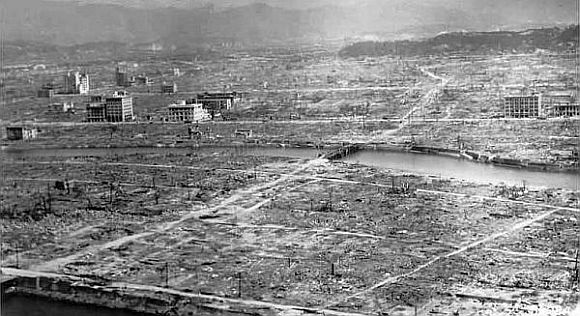
Hiroshima: the original Ground Zero

The New York Times reports:

An influential Jewish organization on Friday announced its opposition to a proposed Islamic center and mosque two blocks north of ground zero in Lower Manhattan, intensifying a fierce national debate about the limits of religious freedom and the meaning of the Sept. 11 terrorist attacks.

The decision by the group, the Anti-Defamation League, touched off angry reactions from a range of religious groups, which argued that the country would show its tolerance and values by welcoming the center near the site where radical Muslims killed about 2,750 people.

But the unexpected move by the ADL, a mainstream group that has denounced what it saw as bigoted attacks on plans for the Muslim center, could well be a turning point in the battle over the project.

In New York, where ground zero has slowly blended back into the fabric of the city, government officials appear poised to approve plans for the sprawling complex, which would have as many as 15 stories and would house a prayer space, a performing arts center, a pool and a restaurant.

But around the country opposition is mounting, fueled in part by Republican leaders and conservative pundits. Sarah Palin, the 2008 Republican vice-presidential nominee, has urged “peace-seeking Muslims” to reject the center, branding it an “unnecessary provocation.” A Republican political action committee has produced a television commercial assailing the proposal. And former House Speaker Newt Gingrich has decried it in speeches.

The complex’s rapid evolution from a local zoning dispute into a national referendum highlights the intense and unsettled emotions that still surround the World Trade Center site nine years after the attacks.

To many New Yorkers, especially in Manhattan, it is a construction zone, passed during the daily commute or glimpsed through office windows. To some outside of the city, though, it stands as a hallowed battlefield that must be shielded and memorialized.

Those who are fighting the project argue that building a house of Muslim worship so close to ground zero is at best an affront to the families of those who died there and at worst an act of aggression that would, they say, mark the place where radical Islam achieved a blow against the United States.

“The World Trade Center is the largest loss of American life on our soil since the Civil War,” Mr. Gingrich said. “And we have not rebuilt it, which drives people crazy. And in that setting, we are told, why don’t we have a 13-story mosque and community center?”

He added: “The average American just thinks this is a political statement. It’s not about religion, and is clearly an aggressive act that is offensive.”

Several family members of victims at the World Trade Center have weighed in against the plan, saying it would desecrate what amounts to a graveyard. “When I look over there and see a mosque, it’s going to hurt,” C. Lee Hanson, whose son, Peter, was killed in the attacks, said at a recent public hearing. “Build it someplace else.”

Those who support it seem mystified and flustered by the heated opposition. They contend that the project, with an estimated cost of $100 million, is intended to span the divide between Muslim and non-Muslim, not widen it.

Oz Sultan, the programming director for the center, said the complex was based on Jewish community centers and Y.M.C.A.’s in Manhattan. It is to have a board composed of Muslim, Christian and Jewish leaders and is intended to create a national model of moderate Islam.

“We are looking to build bridges between faiths,” Mr. Sultan said in an interview.

City officials, particularly Mayor Michael R. Bloomberg, have forcefully defended the project on the grounds of religious freedom, saying that government has no place dictating where a house of worship is located. The local community board has given overwhelming backing to the project, and the city’s landmarks commission is expected to do the same on Tuesday.

“What is great about America, and particularly New York, is we welcome everybody, and if we are so afraid of something like this, what does that say about us?” Mr. Bloomberg asked recently.

“Democracy is stronger than this,” he added. “And for us to just say no is just, I think — not appropriate is a nice way to phrase it.”

Still, the arguments against the Muslim center appear to be resonating. Polling shows that a majority of Americans oppose building it near ground zero.

It’s not surprising that the destructive force of two massive collapsing buildings — sinking like atomic mushroom clouds in reverse — would at that time have evoked comparisons with nuclear destruction. Even so, the fact that the name “ground zero” stuck shows how little effort was ever made to view the horror of that day with a sense of proportion.

On August 6, 1945, beneath the original ground zero where at 8.15 that summer morning the “Little Boy” nuclear weapon exploded, two-thirds of Hiroshima was instantly destroyed and a third of the inhabitants perished.

If survivors of America’s nuclear attack on Japan, from which over 200,000 people died, feel that it is inappropriate to associate that level of destruction with the way America suffered on 9/11, I can understand why. It is as if to say, nothing more devastating the 9/11 could be imagined — when of course it can, and to do so we need not look far back in history or to the deeds of some horrific foreign foe.

That the sanctity of the World Trade Centers site is said to be threatened by the construction of a mosque a few blocks away says more about the way the site remains a potent vehicle of American nationalism than it does about anyone’s insensitivity towards the memory of those who died there.

Want to know what gross insensitivity looks like? Then look at another construction site 5,000 miles further east, to Jerusalem where the inaptly named Museum of Tolerance is being built on top of an historic Muslim cemetery. A round-the-clock excavation has proceeded with haste under high security as skeletons are stuffed in boxes and carted off the site — apart from those that get trampled under foot. A senior archaeologist told Haaretz: “They wanted to create a done deed, after which people could yell all they wanted to, but there wouldn’t be any graves left anymore.”

Facebooktwittermail

Israeli youth being raised on racism

Max Blumenthal reports:

On July 26, Israeli police demolished 45 buildings in the unrecognized Bedouin village of al-Arakib, razing the entire village to the ground to make way for a Jewish National Fund forest. The destruction was part of a larger project to force the Bedouin community of the Negev away from their ancestral lands and into seven Indian reservation-style communities the Israeli government has constructed for them. The land will then be open for Jewish settlers, including young couples in the army and those who may someday be evacuated from the West Bank after a peace treaty is signed. For now, the Israeli government intends to uproot as many villages as possible and erase them from the map by establishing “facts on the ground” in the form of JNF forests. (See video of of al-Arakib’s demolition here).

One of the most troubling aspects of the destruction of al-Arakib was a report by CNN that the hundreds of Israeli riot police who stormed the village were accompanied by “busloads of cheering civilians.” Who were these civilians and why didn’t CNN or any outlet investigate further?

I traveled to al-Arakib yesterday with a delegation from Ta’ayush, an Israeli group that promotes a joint Arab-Jewish struggle against the occupation. The activists spent the day preparing games and activities for the village’s traumatized children, helping the villagers replace their uprooted olive groves, and assisting in the reconstruction of their demolished homes. In a massive makeshift tent where many of al-Arakib’s residents now sleep, I interviewed village leaders about the identity of the cheering civilians. Each one confirmed the presence of the civilians, describing how they celebrated the demolitions. As I compiled details, the story grew increasingly horrific. After interviewing more than a half dozen elders of the village, I was able to finally identify the civilians in question. What I discovered was more disturbing than I had imagined.

Arab Negev News publisher Ata Abu Madyam supplied me with a series of photos he took of the civilians in action. They depicted Israeli high school students who appeared to have volunteered as members of the Israeli police civilian guard (I am working on identifying some participants by name). Prior to the demolitions, the student volunteers were sent into the villagers’ homes to extract their furniture and belongings. A number of villagers including Madyam told me the volunteers smashed windows and mirrors in their homes and defaced family photographs with crude drawings. Then they lounged around on the furniture of al-Arakib residents in plain site of the owners. Finally, according to Matyam, the volunteers celebrated while bulldozers destroyed the homes.

“What we learned from the summer camp of destruction,” Madyam remarked, “is that Israeli youth are not being educated on democracy, they are being raised on racism.” [Read Max’s full report which includes photos.]

Facebooktwittermail

Do disclosures of atrocities change anything?

At Counterpunch, Alexander Cockburn writes:

The hope of the brave soldier who sent 92,000 secret U.S. documents to Wikileaks was that their disclosure would prompt public revulsion and increasing political pressure on Obama to seek with all speed a diplomatic conclusion to this war. The documents he sent Wikileaks included overwhelming documentary evidence – accepted by all as genuine, of:

* the methodical use of a death squad made up of US Special Forces, known as Task Force 373,

* willful, casual slaughter of civilians by Coalition personnel, with ensuing cover-ups,

*the utter failure of “counter-insurgency” and “nation building”,

*the venality and corruption of the Coalition’s Afghan allies,

*the complicity of Pakistan’s Intelligence Services with the Taliban,

Wikileaks’ founder, Julian Assange, skillfully arranged simultaneous publication of the secret material in the New York Times, the Guardian and Der Spiegel.

The story broke on the eve of a war-funding vote in the U.S. Congress. Thirty-six hours after the stories hit the news stands, the U.S. House of Representatives last Tuesday evening voted Aye to a bill already passed by the Senate that funds a $33 billion, 30,000-troop escalation in Afghanistan. The vote was 308 to 114. To be sure, more US Reps voted against escalation than a year ago when the Noes totted up to only 35. That’s a crumb of comfort, but the cruel truth is that in 24 hours the White House and Pentagon, with the help of licensed members of the Commentariat and papers like the Washington Post, had finessed the salvoes from Wikileaks.

“WikiLeaks disclosures unlikely to change course of Afghanistan war” was the Washington Post’s Tuesday morning headline. Beneath this headline the news story said the leaks had been discussed for only 90 seconds at a meeting of senior commanders in the Pentagon. The story cited “senior officials” in the White House even brazenly claiming that that it was precisely his reading of these same raw secret intelligence reports a year ago that prompted Obama “to pour more troops and money into a war effort that had not received sufficient attention or resources from the Bush administration.” (As in: “Get that death squad operating more efficiently” – an order consummated by Obama’s appointment of General McChrystal as his Afghan commander, transferred from his previous job as top U.S. Death Squad general in charge of the Pentagon’s world-wide operations in this area.)

There’s some truth in the claim that long before Wikileaks released the 92,000 files the overall rottenness and futility of the Afghan war had been graphically reported in the press. Earlier this year, for example, reporting by Jerome Starkey of The Times of London blew apart the U.S. military’s cover-up story after Special Forces troops killed two pregnant Afghan women and a girl in a February, 2010, raid, in which two Afghan government officials were also killed.

It’s oversell to describe the Wikileaks package as a latterday Pentagon Papers. But it’s undersell to dismiss them as “old stories”, as disingenuous detractors have been doing. The Wikileaks files are a damning, vivid series of snapshots of a disastrous and criminal enterprise. In these same files there is a compelling series of secret documents about the death squad operated by the US military known as Task Force 373. an undisclosed “black” unit of special forces, which has been hunting down targets for death or detention without trial. From Wikileaks we learn that more than 2,000 senior figures from the Taliban and al-Qaida are held on a “kill or capture” list, known as Jpel, the joint prioritized effects list.

There are logs showing that Task Force 373 simply killed their targets without attempting to capture. The logs reveal that TF 373 has also killed civilian men, women and children and even Afghan police officers who have strayed into its path.

One could watch Assange being interviewed on US news programs where he would raise the fact that the US military has been – is still – running a death squad along the model of the Phoenix Program, His interviewers simply changed the subject. Liberal gate-keepers complained that the Wikileaks documents were raw files, unmediated by responsible imperial journalists such as themselves. This echoed the usual ritual whines from the Pentagon about the untimely disclosures of “sources and methods”.(I recommend to CounterPunchers Doug Valentine’s pieces on this site — try the one from August 11, 2003 — on the fundamental objective of big assassination programslike Phoenix in instilling general social terror in the target population.)

The bitter truth is that wars are not often ended by disclosures of their horrors and futility in the press, with consequent public uproar.

Facebooktwittermail

Secrets worth revealing

“Dr Ellsberg, do you have any concern about the possibility of going to prison for this?”

“Wouldn’t you go to prison to help end this war?” Ellsberg responded when asked by reporters about the repercussions he might face after leaking the Pentagon Papers.

The 40-year old former US military analyst who was then working for the RAND Corporation, knew exactly the risks he was taking. In 1971, his was a courageous act of conscience, clear-eyed and utterly responsible.

Almost 40 years later, Wikileaks founder Julian Assange sees himself in the same role — with a difference. Assange seems to have become caught up in the mystique of whistleblowing and allowed the actors and the mechanism through which they reveal secrets to assume as much importance as the secrets themselves.

Someone using the handle Bradass87 seems to have been the source of the leaked Afghan war logs, which he described like this: “its open diplomacy … its Climategate with a global scope and breathtaking depth … its beautiful and horrifying … It’s public data, it belongs in the public domain.”

It would appear that Bradass87 is a 22-year old intelligence analyst, Private Bradley Manning. He was arrested on May 26 and was transferred today from Kuwait to Quantico, Virginia where he is in military custody and has been placed on suicide watch.

Assuming that Manning was indeed the source, it’s hard to believe that he deeply weighed up the risks he was taking. The comparison with the so-called Climategate is perhaps telling — another leak where the act of revelation had more significance than the content.

It was Assange who held up the Pentagon Papers parallel, which again perhaps said less about the documents than about the Wikileaks founder’s desire to be seen as a modern Ellsberg — even though Assange’s role is actually much closer to that of a newspaper publisher than that of a whistleblower.

Through Wikileaks, Assange has created a new and immensely valuable infrastructure for whistleblowing, but as with everything else enabled by the internet, the medium should not be confused with the content. But since in this case that is to a significant degree what has happened, the story that has captivated the media for a week has been a story about Wikileaks as much as it has been about the war in Afghanistan.

In the short run, this might provide a boost to Wikileaks and draw wider attention to its work, but in the long run the value of whistleblowing itself will be undermined if it comes to be regarded as political theater where the actors claim more attention that the text.

When asked to comment on the war logs, Ellsberg said that they are significant more for what they lack than what they contain: they provide no plausible justification for the war. But when asked by the Washington Post whether there are indeed important documents, yet to be leaked, declassified or otherwise made public, that could fundamentally alter public understanding of key national security issues and foreign policy debates, he gladly drew up a wish list:

1. The official U.S. “order of battle” estimates of the Taliban in Afghanistan, detailing its size, organization and geographic breakdown — in short, the total of our opponents in this war. If possible, a comparison of the estimate in December 2009 (when President Obama decided on a troop increase and new strategy) and the estimate in June or July 2010 (after six or seven months of the new strategy). We would probably see that our increased presence and activities have strengthened the Taliban, as has happened over the past three years.

2. Memos from the administration’s decision-making process between July and December 2009 on the new strategy for Afghanistan, presenting internal critiques of the McChrystal-Petraeus strategy and troop requests — similar to the November 2009 cables from Ambassador Karl W. Eikenberry that were leaked in January. In particular, memos by Vice President Biden, national security adviser Jim Jones and others; responses to the critiques; and responses to the responses. This paperwork would probably show that, like Eikenberry, other high-level internal critics of escalation made a stronger and more realistic case than its advocates, warranting congressional reexamination of the president’s policy.

3. The draft revision, known as a “memo to holders,” of the National Intelligence Estimate on Iran from November 2007. This has been held up for the past several months, apparently because it is consistent with the judgment of that NIE that Iran has not made a decision to produce nuclear weapons. In particular, the contribution to that memo by the State Department’s Bureau of Intelligence and Research (INR), since the INR has had the best track record on such matters. Plus, estimates by the INR and others of the likelihood of an Israeli attack on Iran later this summer. Such disclosures could arrest momentum toward a foreseeably disastrous U.S.-supported attack, as the same finding did in 2007.

4. The 28 or more pages on the foreknowledge or involvement of foreign governments (particularly Saudi Arabia) that were redacted from the congressional investigation of 9/11, over the protest of then-Sen. Bob Graham (D-Fla.).

On each of these matters, congressional investigation is called for. The chance of this would be greatly strengthened by leaks from insiders. Subsequent hearings could elicit testimony from the insiders who provided the information (whose identities could be made known to congressional investigators) and others who, while not willing to take on the personal risks of leaking, would be ready to testify honestly under oath if requested or subpoenaed by Congress. Leaks are essential to this process.

Through the revelation of such documents, Wilileaks would demonstrate its value, but if such revelations are to occur it will most likely require a selfless act of courage from someone who occupies a higher perch in government than the one held by Private Bradley Manning.

Facebooktwittermail

Obama administration in danger of establishing ‘new normal’ with worst Bush-era policies

The Obama administration has repudiated some of the Bush administration’s most egregious national security policies but is in danger of institutionalizing others permanently into law, thereby creating a troubling “new normal,” according to a new report released today by the American Civil Liberties Union.

“Establishing a New Normal: National Security, Civil Liberties, and Human Rights Under the Obama Administration,” an 18-month review of the Obama administration’s record on national security issues affecting civil liberties, concludes that the current administration’s record on issues of national security and civil liberties is decidedly mixed: President Obama has made great strides in some areas, such as his auspicious first steps to categorically prohibit torture, outlaw the CIA’s use of secret overseas detention sites and release the Bush administration’s torture memos, but he has failed to eliminate some of the worst policies put in place by President Bush, such as military commissions and indefinite detention. He has also expanded the Bush administration’s “targeted killing” program.

The 22-page report, which was researched and written by staff in the ACLU’s National Security Project and Washington Legislative Office, reviews the administration’s record in the areas of transparency, torture and accountability, detention, targeted killing, military commissions, speech and surveillance and watchlists. [ACLU press release.]

(Download the ACLU report here.)

Facebooktwittermail

Taliban hunt Wikileaks outed Afghan informers

Channel 4 News reports:

The Taliban has issued a chilling warning to Afghans, alleged in secret US military files leaked on the internet to have worked as informers for the Nato-led coalition, telling Channel 4 News “US spies” will be hunted down and punished.

Speaking by telephone from an undisclosed location, Zabihullah Mujahid told Channel 4 News that the insurgent group will investigate the named individuals before deciding on their fate.

“We are studying the report,” he said, confirming that the insurgent group already has access to the 92,000 intelligence documents and field reports.

“We knew about the spies and people who collaborate with US forces. We will investigate through our own secret service whether the people mentioned are really spies working for the US. If they are US spies, then we know how to punish them.”

Facebooktwittermail

One man’s terrorist

Larry Derfner writes:

In the hypocrisy that characterizes Israel’s view of Palestinians, this is the height of it: The greatest denouncers of Palestinian violence against Israel also tend to be the greatest defenders of pre-state Zionist violence against Britain.

After electing [Menachem] Begin prime minister, we elected Yitzhak Shamir, who had been one of the leadership trio of Lehi (the Hebrew acronym for “Fighters for the Freedom of Israel”). Lehi went Etzel [the Hebrew acronym for “National Military Organization in the Land of Israel”] one better — not only did it kill for Israeli statehood, it killed after statehood, too. On September 17, 1948, Lehi men in Jerusalem shot to death Count Folke Bernadotte, the UN’s envoy to the Middle East (who, as a Swedish diplomat during World War II, had saved many thousands of Jews from the Nazi death camps).

At Lehi’s 70th anniversary celebration in Jerusalem last month, National Union MK Arye Eldad (whose father, Yisrael, had been one of Shamir’s partners in the leadership) said from the podium: “Count Bernadotte wanted to internationalize Jerusalem. In response, Lehi killed him. With his death, the concept of taking Jerusalem away from the Jewish people died with him.”

Hooray. And after Yitzhak Shamir dies, there will be highways, neighborhoods, hospitals and schools named after him, too.

It seems to me that if you are going to condemn the Munich Olympics killings and the Coastal Road Massacre, you also have to condemn the King David Hotel bombing and the Bernadotte assassination. By the same token, if you justify or even “understand” Begin’s and Shamir’s violence, you also have to justify or at least understand the violence of Muhammad Oudeh and Dalal Mughrabi.

And if you don’t — if violence in the name of your nation’s freedom is what you call heroism, but violence in the name of the enemy nation’s freedom is what you call terrorism — then you have no principles at all. Then the only thing you stand for in this world is the side you happen to have been born on.

Facebooktwittermail

Time for a free and independent Palestinian state in the Gaza Strip

Geoffrey Aronson writes at Foreign Policy:

Prime Minister David Cameron during his recent visit to Turkey warned that the Gaza Strip “cannot and must not be allowed to remain a prison camp.” Britain, however, along with the rest of the European community, and of course, Washington, are ambivalent guardians of the self-described prison camp run by Israel, with Egyptian assistance. The prisoners, of course, want their freedom. And so too it seems does Israel’s right-wing foreign minister Avigdor Lieberman, who has emerged as an unlikely proponent of ending Israel’s status as an occupying power in the Gaza Strip.

Cameron’s prison camp description gave voice among critics to uncomfortable associations with some of the worst excesses of Nazi Germany. Some apologists for Gaza’s strangulation have, certainly unintentionally, evoked similar associations. The shameful press attention paid to the appearance of a new shopping mall in Gaza and the fine fare on offer at one of the Strip’s restaurants by those anxious to give lie to the pain and suffering caused by the siege is a particularly evocative case in point. The efforts by Gaza’s besieged population to create a semblance of normality, like the orchestra of the Warsaw ghetto, is a lasting testament to the triumph of the best instincts of human spirit over those who would crush it. Did the reaffirmation of humanity by Jews staring into the abyss negate the gruesome, bestial reality of the ghetto? And so it is with Gaza.

The casualties of the “freedom flotilla” sailing out of Turkey highlighted the malign neglect of the international diplomatic community in this engineered calamity and roused Washington to demand welcome, if minor, changes in the draconian border regime. These less than half measures, however, do not offer even the hint of an end to the regime of collective punishment that Gazans are being forced to endure.

Facebooktwittermail

To avert disaster, stop isolating Hamas now

Chris Patten writes in the Financial Times:

As we all know, peace will come to the Middle East when Israel and Palestine agree to a two-state solution, with a viable Palestinian state rising from the rubble of more than 60 years of turbulence to live peacefully alongside Israel within the 1967 borders as modified through negotiation. All that is required is political will, brave leadership and a following wind. However, visitors to Israel and occupied Palestine may require increasing quantities of blind faith to go on repeating this mantra. There is no other acceptable outcome. But the chances of the dynamic external interventions necessary for this to happen seem slight.

In the West Bank you see more construction of large urban developments than I have seen anywhere in Europe (apart from perhaps the southern Andalusia coast before the credit crunch). These are primarily Israeli settlements, the colonies planted illegally in Palestinian territory and now housing about half a million people. There are 149 of these colonies according to the UN’s Office for the Co-ordination of Humanitarian Affairs and there are a further 100 outposts – the smaller “facts on the ground” that are destined to grow.

As the Obama administration has told us there is an “unprecedented freeze” in settlement activity. Who is fooling whom?

Facebooktwittermail

Tension mounts in Lebanon

Nicholas Noe (co-founder of Mideastwire.com) writes at Foreign Policy:

With the announcement from Sayyid Hassan Nasrallah this week that Hizbullah members may be indicted for the 2005 assassination of former Lebanese Prime Minister Raifk Hariri, one thing is now (publicly) clear, no matter what one may think about the integrity of the Special Tribunal for Lebanon (STL): the militant Shiite party is both angry and concerned. Of course, this isn’t a wholly new development: the party has apparently been preparing for just such an eventuality at least since the summer of 2006 when the first media reports began circulating in this regard (interestingly, in Hizbullah’s analysis, these reports came just after Israel found itself unable to smash its bitter enemy in open battle during the July War).

At that time, and over the intervening years, the party was genuinely fearful that an STL indictment against it — for the murder of the leading Sunni in the country — might be added to an already formidable, though not insurmountable, “Cedar Revolution” cocktail of threats and weaknesses pressed by its many domestic, regional and international opponents. Indeed, more than the danger of another Israeli assault, it can be said that Hizbullah felt existentially threatened at the time by the prospect of an open civil war, aided and abetted by outside powers and fought along sectarian lines (mainly Sunni-Druze vs. Shiite). Hizbullah had learned, and painfully so, that its ultimate fight against Israel could not be properly conducted in times of internal bloodshed — such as during the Amal-Hizbullah engagements of the late 1980s — and that an STL indictment during a period of already high sectarian tension could tip the balance.

Now, however, the party has reached a fundamentally different — and more secure — position of political, diplomatic and military power, not to mention ideological coherence. Which is precisely why one should not over-emphasize Hizbullah’s concern vis-à-vis the STL’s current (purported) track — unless you are a partisan and/or polemicist and have a stake in shaping the course of the fight.

Facebooktwittermail

The student who lost an eye protesting in Israel — but none of her vision

“I guess I can be grateful to the IDF for giving me the chance to see the world in a new way.”

This is Emily Henochowicz’s wry observation after having been hit in the face by a tear gas cannister fired by a soldier in the Israeli Defense Forces in Jerusalem on May 31. The impact destroyed her left eye.

The 21-year old art student from Maryland evinces no bitterness but has mixed emotions:

“I’m happy all these things are happening, that people are listening to me and looking at my work [ — the New York–based Center for Constitutional Rights is considering hosting a show of her art work],” she says. But she knows the attention is because of who she is. “I have just the right ethnicity and nationality for this to be a bigger case,” she says. If the person hit “were Palestinian,” she adds, “it is very unlikely they would get the same response. It’s just the way the world works.”

The Village Voice describes what happened after the young American was shot.

Stuart Henochowiz raced to Jerusalem, and for the week his daughter was in the hospital — the canister had also broken several bones in her skull and knocked out a tooth — he slept in a chair at the foot of her bed. The situation was worrisome enough even without all the guns nearby. “Emily was in one room with another patient, and next door was one of the prisoners from the flotilla,” he recalls. “There were four soldiers there with their submachine guns in front of that room. While I was in the darkened room with Emily, this soldier comes in with a nurse, dangling his submachine gun.” Dr. Henochowicz says he knew that the soldier was just following orders, but “the thought of her facing a submachine gun at night, after everything she’d been through — I didn’t appreciate the lack of tact.”

Adding to the situation were comments from one doctor and nurses who spoke, he says, “with racism that was straight out of the 1930s.”

“There was one doctor who was explaining Emily’s CT scan,” Dr. Henochowicz recalls, “and what they’d done with the surgery, and then he asked me, in Hebrew, ‘Are you Jewish? Because, then, how could your daughter be involved in such an activity?’ ”

Several nurses, he says, tried to explain Middle East politics in terms they thought he would relate to. “You have your blacks — and we have our Palestinians,” he says they told him. He adds, “They thought I should think of Palestinians in the same way. And I told them, ‘We don’t really think that way in the States anymore! We have a black president.’ And I told them I voted for him and gave money to his campaign, and they replied, ‘You mean, Hussein Obama?’ ”

At least, he says, “they come honestly by their racism. It’s right there. They don’t sugar-coat it. They just come out and say it.” And despite everything, the hospital was used to dealing with acts of war and terrorism and gave his daughter decent medical care.

But Stuart Henochowicz says he’s outraged by what he calls “a basic lack of decency” from the Israeli government. He says he knows that “Israel takes a very hard line,” and so he thinks the military’s stance is that “her face got in the way of the canister.” But, he adds, “these people are fathers. Couldn’t they even bother to ask, ‘Gosh, how is she doing?’ No one from the Israeli government would even talk to me. No one. Why is that? You might not agree with me, or with Emily, but why didn’t they even call me?”

Facebooktwittermail

Good guests don’t overstay their welcome

“Be a good guest. Treat the Afghan people and their property with respect,” Gen David Petreaus advises his forces in a new counterinsurgency manifesto.

Maybe during his tenure in Tampa, Florida, Petreaus used to shop regularly at Target and thus has a more elastic definition of the word “guest”, but the way I understand the term, good guests always defer to the wishes of their hosts. Good guests don’t invite themselves into anyone’s home and they don’t overstay their welcome.

Petreaus says: “Live with the people: Position joint bases and combat posts as close to those we’re seeking to secure as is feasible.”

Now when Hezbollah does this in Southern Lebanon where it is the indigenous military force, it gets accused of using the local population as human shields. US and NATO forces in Afghanistan who “live with the people” — they’re just getting cozy with their hosts.

Facebooktwittermail

Israel’s latest act of ethnic cleansing

Electronic Intifada reports:

Early morning on 27 July, Israeli bulldozers, flanked by helicopters and throngs of police, demolished the entire Bedouin village of al-Araqib in the northern Negev desert. Despite their land rights cases still pending in the court system, hundreds of al-Araqib villagers were instantly made homeless a month after Israeli police posted demolition orders.

Eyewitness reports say the police were accompanied by several busloads of right-wing Israeli civilians who cheered during the demolitions.

The Electronic Intifada spoke with Dr. Yeela Ranaan of the Regional Council for Unrecognized Villages (RCUV) in the Negev, who was in al-Araqib all day long during the demolitions.

“Approximately 1,500 Israeli police came at 5:30 in the morning and evacuated everyone from their beds,” Ranaan said. “They brought tear gas and water cannons, but didn’t use them. There was a handful of Israeli peace activists who had come the night before to stay with the villagers, and the police beat them up and detained them. Once they evacuated everyone in the village, they started to demolish it. It took three hours to flatten the village. For the people of al-Araqib, it was a nightmare to see their village destroyed.”

Since the establishment of the State of Israel in 1948, al-Araqib villagers have been fighting for recognition in the courts. Ranaan told The Electronic Intifada that in the early 1950s, after they were forcefully expelled from their land by Israeli forces, villagers were fined for “trespassing” in their own homes by the Israeli government. Israel has refused to acknowledge al-Araqib villagers’ land deeds and receipts of land taxes paid to the Ottoman authorities well before Israel’s establishment.

“As we speak, the fate of al-Araqib hasn’t been decided in a court,” Ranaan said. “Despite this, Israel came and demolished the homes. Israel is not just changing the facts on the ground, it’s erasing them.”

Facebooktwittermail

Turkey’s diplomatic persistence with Iran may pay off

The Wall Street Journal reports:

Iran has pledged to stop enriching uranium to the higher grade needed for a medical research reactor if world powers agree to a fuel-swap deal it outlined earlier this year with Turkey and Brazil, Turkish Foreign Minister Ahmet Davutoglu said Wednesday.

The offer marks the latest in an international tug-of-war over the nuclear ambitions of Iran, which denies international allegations that it is pursuing nuclear weaponry. U.S. and European diplomats say Iran’s offer suggests it has felt the pinch of a rash of economic sanctions imposed on Tehran since June.

The United Nations imposed sanctions in part because Iran insisted it would continue enriching nuclear fuel to 20%, a level Tehran said was necessary to fuel a medical-research reactor and that the U.S. and others feared was a step toward creating nuclear weapons.

Mr. Davutoglu said Iranian foreign minister Manouchehr Mottaki offered to change Tehran’s position on continuing enrichment when the two men met in Istanbul on Sunday. Mr. Mottaki had said “there will be no need for Iran to continue 20% enrichment if the Tehran Agreement was realized and the country gets the fuel it needs,” Mr. Davutoglu told a joint press conference with German Foreign Minister Guido Westerwelle on Wednesday.

The Obama administration is said to be “studying” the discussions. I would hope that behind the scenes they are sending unambiguous positive signals to Turkey. The issue of continued enrichment was the supposedly the reason for earlier rejecting the Turkish-Brazilian brokered deal with Iran. If Turkey can now deliver on the administration’s key demands, we will get to find out whether Washington is operating in good faith. Let’s see.

Facebooktwittermail

War against Iran more likely — thanks to Wikileaks

If the release of the Pentagon Papers epitomized the value of government leaks as a means of speaking truth to power, Wikileaks at this point can claim no such distinction.

As if to underline the extent to which the Afghan war logs are making the fog of war more, not less, dense, Katrina vanden Heuvel says: “more than a few commentators — including Daniel Ellsberg himself — have called [the war logs] a 21st-century Pentagon Papers.”

She may understandably have been misled by a headline in The Guardian that read: “Daniel Ellsberg describes Afghan war logs as on a par with ‘Pentagon Papers’.” However, “These documents are not the Pentagon Papers — we still await their equivalent for Afghanistan,” is what Ellsberg unambiguously told the Financial Times.

While Wikileak’s founder, Julian Assange, is no doubt sincere in his hope that these intelligence revelations will expose the futility of war, the fact is, because intelligence is not intelligent it can very easily be used to serve a host of diverging political agendas.

If opponents of the war in Afghanistan now feel better armed, so do proponents of an expanding war in Pakistan. Likewise, those pushing for military action against Iran will welcome a new supply of ammunition served by Wikileaks.

Yesterday, the Wall Street Journal reported:

Cooperation among Iran, al Qaeda and other Sunni extremist groups is more extensive than previously known to the public, according to details buried in the tens of thousands of military intelligence documents released by an independent group Sunday.

U.S. officials and Middle East analysts said some of the most explosive information contained in the WikiLeaks documents detail Iran’s alleged ties to the Taliban and al Qaeda, and the facilitating role Tehran may have played in providing arms from sources as varied as North Korea and Algeria.

The officials have for years received reports of Iran smuggling arms to the Taliban. The WikiLeaks documents, however, appear to give new evidence of direct contacts between Iranian officials and the Taliban’s and al Qaeda’s senior leadership. It also outlines Iran’s alleged role in brokering arms deals between North Korea and Pakistan-based militants, particularly militant leader Gulbuddin Hekmatyar and al Qaeda.

Here we see one of the most bizarre twists in the story: US government sources now using the leaked documents to buttress the current anti-Iran narrative and in the process acting as though the intelligence reports are providing information that hadn’t been accessible inside government until they were leaked!

At the very same time, the State Department’s leading expert on Iran, John Limbert — a genuine source of intelligence and “the most qualified person on the Iran team at State in the three decades I have lived in the United States,” according to Haleh Esfandiari, head of the Middle East program at the Woodrow Wilson International Center for Scholars — is about to resign.

At Foreign Policy, Barbara Slavin writes:

[I]t’s hard not to view Limbert’s departure as a turning point and yet another missed opportunity in U.S.-Iran relations. A number of players with more skeptical views about the prospect of rapprochement with Tehran — such as White House aide Dennis Ross and nonproliferation experts like Robert Einhorn and Gary Samore — appear to be driving U.S. policy now, and the president himself blames the Iranian government for failing to respond to his outreach.

What could please the attack-Iran lobby more than to see the departure of the most skilled American proponent of engagement and at the same time to be served a prize piece of propaganda by an outfit aligned with the anti-war movement?!

Facebooktwittermail

Afghan war logs in search of good journalism

“[T]he task of good journalism is to turn this raw material — who, when, where, how, how many — into something that emotionally engages people who can apply levers on decision-making,” said Wikileaks founder Julian Assange at a press conference in London on Monday.

And there’s the rub, since the war logs offer a resource from which an almost unlimited number of stories can be gleaned and to which a disproportionate amount of credibility will be attached for no other reason than that they are based on leaked intelligence reports.

Consider, for instance, one of the latest reports from Danger Room with the headline “WikiLeak: U.S. Battling Militants from Turkey, Its NATO Ally.”

Oh my god, it’s the Turks again! No wonder Israel was alarmed by the approach of the Turk-laden Mavi Marmara.

Spencer Ackerman has been studying reports indicating that Turkish fighters, supported by the al-Qaeda-aligned Haqqani network, may have operated out of militant safe havens in Pakistan.

U.S. troops at the Bermel base, part of Task Force Eagle — a team of five infantry companies and a cavalry troop operating in the area — began to notice in early May 2007 that Turkish fighters south of the base were scoping out how Pashtun insurgents conducted attacks against U.S. Army Blackhawk helicopters. On May 19, they struck, sending a 107-millimeter rocket into the base. No one was harmed, and an official assessment noted that the incident was amateurish: “fighters were having a difficult time coordinating and carrying out relatively routine actions leading up to an attack.”

But a military record that day noted something had changed. “Todays [sic] single rocket was the first involvement of Turkish fighters in directly attacking [coalition forces],” it reads, and went on to suspect that the incident was a test run for something more serious down the line.

That report proved to be prescient.

Thus unfolds a tale of a Turkish threat, looming from Pakistan but rooted in a Salafist-Wahhabist movement rising in Turkey — at least, that’s the impression you get from Ackerman’s only source of expert analysis.

“It’s a story that hasn’t been mainstreamed, this Turkish involvement in jihad,” says Bryan Glyn Williams, an associate professor of history at the University of Massachusetts-Dartmouth who’s studied Islamic militancy in Turkey, including Turkish extremist infiltration into Afghanistan. “There is a growing Salafist-Wahhabist movement in Turkey, a lot more extreme than the [ruling Isalmic-based] AK Party.”

Given that the AK Party isn’t extreme at all, that’s a strange contrast to draw.

How reliable a source is Williams? It’s hard to say, but he must have scored points at the CIA last month when he released a study claiming that drone strikes in Pakistan have been far more accurate than previously reported. He says that for every 22 militants killed, there was one civilian casualty. Contrast that with a report in Pakistan’s leading newspaper Dawn last year, which said for “each Al Qaeda and Taliban terrorist killed by US drones, 140 innocent Pakistanis also had to die. Over 90 per cent of those killed in the deadly missile strikes were civilians, claim authorities.”

How did Williams come up with such radically different numbers? The only dead he counted were those whose names were recorded — and note, the brief news reports on the results of drone attacks are not filled with copious detail.

Just in case anyone might think that the Turkish threat to Task Force Eagle in 2007 saw the end of Turkish militant infiltration to Afghanistan, Ackerman warns:

A different report from November 2009 details U.S. forces finding a trove of Turkish cash in a militant compound. (The amount of money isn’t detailed.)

That doesn’t surprise the University of Massachusetts’ Williams. He’s been going to Turkey since the 1990s and has been disturbed to see growing anti-Americanism and sympathy for terrorists on websites like Cihaderi, a phenomenon he says has grown by inches since the 1990s, when Turks went to fight on behalf of Islamic militants in Bosnia and Chechnya. Now, it’s being channeled through Deobandi mosques in tribal Pakistan, where radicalized Turks go as an entrance point “to take shots at Americans and even fellow Turks” fighting for the International Security Assistance Force in Afghanistan.

How significant is all of this? Who’s to say. If a contingent of 20 or 30 Turks have been fighting alongside the Taliban, might we not ask: so what?

Meanwhile, at The Guardian, Simon Tisdall digs out a story much more prosaic yet a narrative that conveys far more about the war:

Winning hearts and minds in Afghanistan can be uphill work, as US soldiers attached to Task Force Catamount discovered when they visited the remote village of Mamadi in Paktika province, near the Pakistan border.

“It seems to always be this way when we go there. No one wants anything to do with us,” the mission report’s author complained sadly. Nor does the Mamadi patrol’s experience appear to be untypical.

The report, circulated by US military intelligence in April 2007, is one of numerous accounts of attempted bridge-building contained in the classified war logs and examined by The Guardian. The material offers an unprecedented insight into the gaping cultural and societal gulfs encountered by US troops trying to win grassroots support for the west’s vision of a peaceful, developing, united Afghanistan.

The purpose of the Mamadi visit, reassuringly termed a “non-combat event”, was to meet local leaders and distribute food and other assistance. But things started badly when a Humvee broke down, the road turned muddy and the weather deteriorated. To be safe, half the patrol of 29 US servicemen plus Afghan army personnel stayed with the Humvee. The rest went on to Mamadi.

Their reception there is distinctly unenthusiastic. The children mostly stay indoors. The village elder is described as “a very disgruntled man” who does not want American handouts. “He personally blamed George Bush for his AK-47 being taken from him. He doesn’t want us to give stuff to his village because of fear from the enemy punishing him. He did say he would take the money, though,” the report said.

A talk with a 30-year-old male villager with black hair and “skinny” build is similarly uninspiring. “Not very outgoing, [he] sits on the edge of the conversation and just listens to what is going on.” It transpires that the man’s silence may be connected to his prior detention for “involvement with IEDs”. He was sacked by the Afghan army for the same offence.

After a curtailed stay, the patrol hands out 30 sweaters, 30 backpacks, 10 bags of beans and 10 bags of rice then departs. Back at base, the anonymous author reaches a surprising conclusion: “The mission in Mamadi was success.” But this seems to be largely because they fixed the Humvee. “The village of Mamadi is definitely anti-coalition. They want nothing to do with US or ANA [Afghan national army] forces. Nothing further to report.”

Facebooktwittermail

Ellsberg: ‘These documents are not the Pentagon Papers’

In an interview with Der Spiegel, Wikileaks founder Julian Assange when asked why he published the Afghan war logs, said:

These files are the most comprehensive description of a war to be published during the course of a war — in other words, at a time when they still have a chance of doing some good. They cover more than 90,000 different incidents, together with precise geographical locations. They cover the small and the large. A single body of information, they eclipse all that has been previously said about Afghanistan. They will change our perspective on not only the war in Afghanistan, but on all modern wars.

Those are very grand claims which appear to be based more than anything on the sheer quantity of information that has been released. Even so, Assange is probably over-estimating the capacity of the American public to become deeply politically engaged on an issue with which most people lack personal involvement.

Comparisons are being made between the war logs and the release of the Pentagon Papers which were leaked to the New York Times by Daniel Ellsberg in 1971, yet the content of the documents and the contexts in which they appeared are vastly different. The Pentagon Papers revealed a massive level of deception through which US governments had led, by that point, 54,000 Americans to their deaths in Vietnam.

“These documents are not the Pentagon Papers — we still await their equivalent for Afghanistan,” Ellsberg told the Financial Times. “But they do add to the strong doubts that most of us have about a war that has cost us more than $300bn so far in which the Taliban only appears to get stronger with each passing year. They reinforce the question: What is the point of this war?”

Ellsberg told the Wall Street Journal he had mixed feelings about the release of so many documents:

“To put out such a large amount of material is of some risk if you haven’t read it all,” said Ellsberg, reached in Mexico where he was attending a screening of “The Most Dangerous Man in America,” a documentary about his Pentagon Papers ordeal.

Because the leaker was taking a risk in releasing the material, Ellsberg concluded it was released quickly and not likely carefully vetted…

Ellsberg said he had studied every word of the Pentagon Papers and carefully weighed whether their release would harm anyone.

“I had read all of it and made a judgment of the 7,000 papers and concluded they deserved to be out and would not harm any Americans,” he said.

However, Ellsberg said, such a volume of material can be noteworthy for what it lacks: in this case, a justification for the U.S. continuing to wage war in Afghanistan.

Facebooktwittermail