Yearly Archives: 2010

The terrorist-naming game

On September 11, 2001, George Bush changed the way Americans look at the world and the success with which he accomplished this feat is evident in the fact that his perspective largely remains unchallenged — even among many of his most outspoken critics. Bush’s simplistic for-us-or-against-us formula was transparently emotive yet utterly effective.

For almost a decade, Americans have been told to look at the world through the lens of “terrorism” and while differences of opinion exist about whether the lens has too wide or narrow an angle or about the extent to which it brings things into focus, those of us who say the lens is so deeply flawed that it should be scrapped, remain in a minority.

The Obama administration may now refrain from using the term itself, preferring instead “violent extremists,” but the change is merely cosmetic (as are so many other “changes” in the seamless continuity between the Bush- and post-Bush eras).

A couple of days ago Philip Weiss drew attention to the fact that when former Israeli foreign minister Tzipi Livni described her parents as “freedom fighters,” Deborah Solomon, her interviewer in the New York Times, echoed Livni’s sentiment by saying that the fight for Israel’s independence took place in “a more romantic era.”

As Weiss notes, Livni’s parents belonged to the Irgun, the Zionist group which blew up the King David Hotel in Jerusalem on July 22, 1946, killing 91 and injuring 46.

The first public account of what had happened that day was accidentally released in advance of the bombing.

In By Blood and Fire, Thurston Clark writes:

“Jewish terrorists have just blown up the King David Hotel!” This short message was received by the London Bureau of United Press International (UPI) shortly after noon, Palestine time. It was signed by a UPI stringer in Palestine who was also a secret member of the Irgun. The stringer had learned about Operation Chick but did not know it had been postponed for an hour. Hoping to scoop his colleagues, he had filed a report minutes before 11.00. A British censor had routinely stamped his cable without reading it.

The UPI London Bureau chief thought the message too terse. There were not enough details. He decided against putting it on the agency’s wire for radio and press until receiving further confirmation that the hotel had been destroyed.

Despite the efforts of Irgun leaders to restrict knowledge of the target and timing of Operation Chick, there were numerous other leaks. Leaders in both the Haganah and Stern Gang knew about the operation. Friends warned friends. The King David had an extraordinary number of last-minute room cancellations. In the Secretariat [the King David’s south wing that housed the headquarters of the British government in Palestine], more than the usual number of Jewish typists and clerks called in sick.

The next day the British prime minister, Clement Attlee referred to the bombing as an “insane act of terrorism” while a few days later the US president, Harry Truman, wrote “the inhuman crime committed… calls for the strongest action against terrorism…”

That was 64 years ago. From the sheltered perch of the New York Times, that’s apparently far enough back in history that it can now be referred to as a “romantic era.”

It’s hardly surprising then that many observers with an interest in justice for Palestinians take offense at the New York Times’ complicity in papering over the reality of Jewish terrorism. Yet here’s the irony: the effort to promote an unbiased use of the term “terrorism” simply plays into the hands of the Israelis.

The word has only one purpose: to forestall consideration of the political motivation for acts of violence. Invoke the word with the utmost gravity and then you can use your moral indignation and outrage to smother intelligent analysis. Terrorists do what they do because they are in the terrorism business — it’s in their blood.

So, when Tzipi Livni calls her parents freedom fighters, I have no problem with that — she is alluding to what they believed they were fighting for rather than the methods they employed. Moreover, by calling people who planted bombs and blew up civilians in the pursuit of their political goals, “freedom fighters,” Livni makes it clear that she understands that “terrorism” is a subjective term employed for an effect.

When Ehud Barak a few years ago acknowledged that had he been raised a Palestinian he too would have joined one of the so-called terrorist organizations, he was not describing an extraordinary epiphany he had gone through in recognizing the plight of the Palestinians. He was merely being candid about parallels between groups such as the Irgun and Hamas — parallels that many Israelis see but less often voice.

The big issue is not whether the methods employed by Zionist groups such as the Irgun could be justified but whether the political goals these groups were fighting for were legitimate. Zionism would not have acquired more legitimacy if it had simply found non-violent means through which it could accomplish its goal of driving much of the non-Jewish population out of Palestine.

We live in an era in which “terrorism” — as a phenomenon to be opposed — has become the primary bulwark through which Zionism defends itself from scrutiny. Keep on playing the terrorist-naming game and the Zionists win.


Facebooktwittermail

Grave injustice: Maher Arar and unaccountable America

At Middle East Report Online, Lisa Hajjar writes:

On June 14, the Supreme Court buried the prospect of justice for Maher Arar, a Canadian citizen of Syrian origin who was “extraordinarily rendered” by the United States (via Jordan) to Syria in 2002. Arar was suing the US officials who authorized his secret transfer, without charge, to a country infamous for torture. With the justices’ 22-word statement, the case of Arar v. Ashcroft exited the American legal system and entered the annals of American legal history under the category “grave injustice.” Alphabetically, Arar precedes Dred Scott v. Sanford, which upheld slavery, and Korematsu v. United States, which upheld the internment of Japanese Americans. In this case, however, the grave is literal: Arar spent ten months of his year in Syrian custody confined in what he describes as “an underground grave.”

Facebooktwittermail

Obama about to get tough with Netanyahu?

Preemptive reporting of news that has yet to happen is an irritating phenomenon in and of itself. Accounts about policy statements that yet to be released or about meetings that have yet to take place are transparent ways in which journalists allow themselves to be led by officials who believe that it is a government’s right to control the way its actions are described.

But then there’s a special class of preemptive reporting — reporting things that could conceivably happen but will be less likely to happen if a report itself then prompts a denial. For instance, staff for the Israeli prime minister could describe to an Israeli journalist the worst case scenario of what might result in the upcoming Obama-Netanyahu meeting in the White House. The Israel lobby, duly alerted, will then kick into gear and force White House staff to placate their fears before the meeting has even occurred.

Of course I have no way of knowing whether the following report from Yediot Ahronoth is example of such conniving, but it certainly sounds like it. A translation of the Hebrew article comes from Didi Remez:

The lifting of the blockade on the Gaza Strip and permission for Palestinians to leave the Gaza Strip freely through Israeli border crossings. These are the unequivocal demands that President Barack Obama is expected to make during his meeting with Prime Minister Binyamin Netanyahu in the White House in two weeks.

If anyone thought that lifting the economic blockade of the Gaza Strip would satisfy the Americans, it is now clear to them that is only the beginning. Reliable sources who have been apprised of the preparations that the White House is making for the meeting between Obama and Netanyahu revealed that the demands are much more significant. While Obama voiced his satisfaction with the relief measures that Israel announced, he believes that the situation in which more than a million and a half inhabitants of the Gaza Strip are living is intolerable.

The American president is particularly angry that the inhabitants are not free to leave the Gaza Strip. He sees that as a kind of “collective punishment.” Political sources say that Netanyahu, who has chosen not to change the situation with the Gaza Strip, now finds himself under a great deal of international pressure and must act under pressure from the United States.

Obama also intends to examine the issue of extending the construction freeze with Netanyahu. It may be assumed that Netanyahu will make a continuation of the construction freeze conditional upon going over to direct talks with Abu Mazen.

But considering the firm demands to be made in the private meetings, White House officials are planning quite a warm reception for Netanyahu. Obama’s advisers are preparing quite a few “photo ops” in which the president and Netanyahu will be seen together in public. According to the plan, they will go out into the Rose Garden, which overlooks Obama’s office, where they will answer questions from the media.

Reliable sources say that one of the reasons for the special effort is requests from Jewish Democrats running in the interim Congressional elections this coming November, who are urging the White House to provide them with “friendly pictures” of Obama and Netanyahu.

So all the lobby needs is a few friendly pictures? No way!

Facebooktwittermail

The Obama administration adopts an imperious tone with Turkey

Philip H Gordon is the US Assistant Secretary of State at the Bureau of European and Eurasian Affairs. He sat down with an AP reporter this week to talk about Turkey.

Turkey is alienating US supporters and it needs to demonstrate its commitment to partnership with the West, Gordon says. “We think Turkey remains committed to NATO, Europe and the United States, but that needs to be demonstrated,” he said. “There are people asking questions about it in a way that is new, and that in itself is a bad thing that makes it harder for the United States to support some of the things that Turkey would like to see us support.”

“There are people…” Gordon say. And those people would be? Oh yeah — members of the United States Congress who serve at the pleasure of the Israel lobby.

Gordon cited Turkey’s vote against a U.S.-backed United Nations Security Council resolution on new sanctions against Iran and noted Turkish rhetoric after Israel’s deadly assault on a Gaza-bound flotilla last month. The Security Council vote came shortly after Turkey and Brazil, to Washington’s annoyance, had brokered a nuclear fuel-swap deal with Iran as an effort to delay or avoid new sanctions.

Some U.S. lawmakers who have supported Turkey warned of consequences for Ankara since the Security Council vote and the flotilla raid that left eight Turks and one Turkish-American dead. The lawmakers accused Turkey of supporting a flotilla that aimed to undermine Israel’s blockade of Gaza and of cozying up to Iran.

The raid has led to chilling of ties between Turkey and Israel, countries that have long maintained a strategic alliance in the Middle East.

Turkey’s ambassador to the United States, Namik Tan, expressed surprise at Gordon’s comments. He said Turkey’s commitment to NATO remains strong and should not be questioned.

“I think this is unfair,” he said.

Tan said Turkish officials have explained repeatedly to U.S. counterparts that voting against the proposed sanctions was the only credible decision after the Turkish-brokered deal with Iran. Turkey has opposed sanctions as ineffective and damaging to its interests with an important neighbor. It has said that it hopes to maintain channels with Tehran to continue looking for a solution to the standoff over Iran’s alleged nuclear arms ambitions.

“We couldn’t have voted otherwise,” Tan said. “We put our own credibility behind this thing.”

Tan said that Turkish Prime Minister Recep Tayyip Erdogan was expected to discuss these issues with President Barack Obama on the margins of a summit of world economic powers in Toronto on Saturday.

Gordon said Turkey’s explanations of the U.N. episode have not been widely understood in Washington.

“There is a lot of questioning going on about Turkey’s orientation and its ongoing commitment to strategic partnership with the United States,” he said. “Turkey, as a NATO ally and a strong partner of the United States not only didn’t abstain but voted no, and I think that Americans haven’t understood why.”

Just two weeks ago, before Gordon decided his primary duty was to placate the Israel lobby, in an interview with the BBC he rejected the suggestion that the US and Turkey have become strategic competitors in the Middle East.

“I think the United States and Turkey remain strategic partners,” he said. “We have so many interests in common. We can have disagreements, and there are things we disagree on, not least the vote on Iran at the United Nations. Throughout that process we have been frank with each other about our differences. We’ve explained to them why we think it was important for countries to vote yes in the Iran resolution. They have explained to us why they think the Tehran declaration was something worth pursuing. And we’ve explained to them what we think the shortcomings are. That’s what friends and partners do.”

But can friends be so overbearing that they issue demands for a demonstration of commitment to their partnership?

The US wants Turkey to help advance America’s agenda in the Middle East. Is the Obama administration helping advance Turkey’s agenda in the region? Turkey after all is now in a much stronger position to promote regional stability than any of its Western tutors.

As deeply in debt as the United States is, there is one currency that it can use without fear of ever running short and it’s a currency whose value is appreciated in every corner of the globe. It’s called respect. A little goes a long way.

Facebooktwittermail

Idiocy holds sway on the Supreme Court and inside the Obama administration

It seems hard to fathom but the evidence is now overwhelming: if someone repeats the word “terrorist” often enough their brain will become functionally useless.

Consider the Supreme Court’s decision on Monday in support of the Obama administration’s sweeping definition of “material support” as applied to so-called Foreign Terrorist Organizations (FTO) — a designation applied by the State Department.

If an NGO such as the Humanitarian Law Project (HLP) wants to train a group such as the Kurdistan Workers’ Party (PKK) on how to use humanitarian and international law to peacefully resolve disputes, then the HLP risks criminal prosecution. Why? Such training could help legitimize the PKK and also free up resources that it can dedicate to its terrorist activities.

Solicitor General Elena Kagan (who is nominated to become a Supreme Court Justice) argued the case for the Obama administration.

Kay Guinane described the decision:

The Court ruled that even though pure speech is entitled to a high level of constitutional scrutiny, it would forgo such scrutiny and defer to Congress and the executive branch, which asserted unsupported, theoretical findings that support aimed at countering violence can somehow indirectly support violence. The Court’s reasoning was that the matter involves national security.

With its overly deferential approach, the Court failed to fulfill its responsibilities in the checks-and-balances system that keeps our democracy healthy. If it had looked behind the broad generalizations cited by the government, it would have seen there are no facts either in the Congressional Record or elsewhere that support the Congressional or State Department “findings.” And even if there are some circumstances where conflict mediation and human rights training can be co-opted to support violence, it is not inevitable that it will happen in all cases.

For an obvious example of the fault in the findings, one need look no further than the Good Friday Accords that brought a lasting peace to Northern Ireland for the first time in more than eight centuries. For years, non-governmental organizations (NGOs) had worked to bring violent factions of Catholics and Protestants to the bargaining table. Their work behind the scenes was instrumental in persuading those groups — “terrorists” in the eyes of most of their captive civilian populations, as well as the governments seeking to disarm them — to put down their weapons and negotiate a peaceful resolution to 850 years of violence.

If the “material support” law had been in place, as authorized by the Supreme Court today, those organizations would have been criminals. And the people of Northern Ireland would likely still be victims of sectarian violence that only a very few supported.

“Orwellian” doesn’t begin to describe a law that makes it a crime to promote peaceful conflict resolution.

If the administration actually intends to uphold the law in the way they argue it should be applied, then the Israeli-Palestinian conflict can be expected to continue forever.

There is a rather broad consensus among foreign policy analysts in the US and Europe, that Hamas, a designated FTO, has far too much grassroots political support among ordinary Palestinians for the organization to be destroyed. Neither Israel’s war on Gaza nor it’s internationally supported siege of Gaza, succeeded in bringing the Islamist organization and democratically-elected government to its knees.

If the Obama administration wants to revive the Middle East peace process, sooner or later Hamas will have to be involved. It’s hard if not impossible to anticipate that those involved in the initial efforts to open dialogue with Hamas can avoid falling foul of the broad definition of “material support” that the Supreme Court has just upheld.

The Obama administration told the Supreme Court that the United States is engaged in an effort to “delegitimize and weaken” groups such as Hamas, yet it would behoove Washington and democratic governments everywhere to remember where political legitimacy springs from: not idiotic Supreme Court rulings, but the will of the people — and that includes the Palestinians.

Facebooktwittermail

Risk-free killing and the fear of death

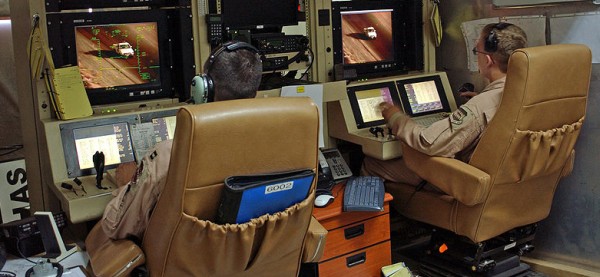
There was an age when those afraid of dying knew they should, if they could, stay away from war. They could instead, if so inclined, read about war and fantasize about battlefield heroics from the comfort of an armchair. Nowadays, America’s newest class of warriors enjoy the same comfort with as little risk.

Tom Engelhardt writes:

The drone is our latest wonder weapon and a bragging point in a set of wars where there has been little enough to brag about.

CIA director Leon Panetta has, for instance, called the Agency’s drones flying over Pakistan “the only game in town” when it comes to destroying al-Qaeda; a typically anonymous U.S. official in a Washington Post report claims of drone missile attacks, “We’re talking about precision unsurpassed in the history of warfare”; or as Gordon Johnson of the Pentagon’s Joint Forces Command told author Peter Singer, speaking of the glories of drones: “They don’t get hungry. They are not afraid. They don’t forget their orders. They don’t care if the guy next to them has been shot. Will they do a better job than humans? Yes.”

Seven thousand of them, the vast majority surveillance varieties, are reportedly already being operated by the military, and that’s before swarms of “mini-drones” come on line. Our American world is being redefined accordingly.

In February, Greg Jaffe of the Washington Post caught something of this process when he spent time with Colonel Eric Mathewson, perhaps the most experienced Air Force officer in drone operations and on the verge of retirement. Mathewson, reported Jaffe, was trying to come up with an appropriately new definition of battlefield “valor” — a necessity for most combat award citations — to fit our latest corps of pilots at their video consoles. “Valor to me is not risking your life,” the colonel told the reporter. “Valor is doing what is right. Valor is about your motivations and the ends that you seek. It is doing what is right for the right reasons. That to me is valor.”

There is a simple calculus upon which American warfare depends: the fewer Americans get killed, the longer the war can continue.

Maimed Americans don’t count. As for dead or maimed non-Americans, they are a variable part of the calculus, problematic or not depending on the circumstances.

The Pentagon’s love of the drone is Washington’s dread of the dead — let’s not pretend that valor has any place in this equation.

When through the press of a button a soldier in an air-conditioned office rains down death and destruction thousands of miles away, whatever military virtues he might possess, there’s no reason to assume they include bravery. Indeed, the risk-free killing of remote warfare is really the most cowardly form of combat, far removed as it is from battlefields that demand courage because the killers risk being killed.

In Shakespeare’s Henry V, as the Battle of Agincourt is about to commence, the king addresses his men — “We few, we happy few, we band of brothers” — heavily outnumbered by the French and facing the risk of imminent slaughter.

Henry — a king who fights with his men and doesn’t simply issue commands — declares:

… he which hath no stomach to this fight,
Let him depart; his passport shall be made,
And crowns for convoy put into his purse;
We would not die in that man’s company
That fears his fellowship to die with us.

To the extent that there is a noble dimension to warfare it is this: that those willing to kill are also willing to die. Those taking the lives of others do so knowing that just as easily they could lose their own.

The technological advance of war has broken this equation and broken it so thoroughly that not only does the new class of drone-armed killers face no risk of being killed; they may not even lose any sleep.

Facebooktwittermail

Where kindness is a crime

Max Blumenthal reports:

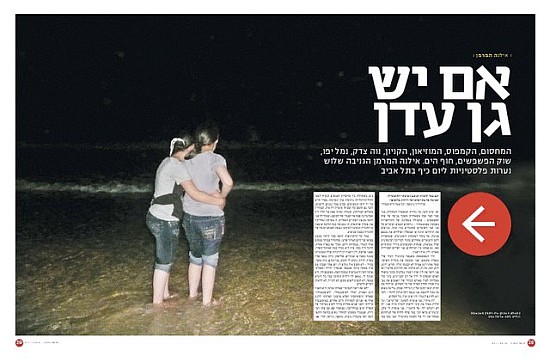
In a May 7 article, Haaretz reporter Ilana Hammerman described in dramatic detail a crime she had methodically planned and committed. In defiance of laws supposedly related to Israel’s security, Hammerman picked up three teenage Palestinian girls in their village in the West Bank, took them through the Betar checkpoint, and drove them into Tel Aviv. There they ate ice cream, visited the mall and museum, and played in the sea. Even though the girls lived just a few kilometers from the beach, Israel’s military occupation had prevented them from ever visiting it before their illegal “day of fun.”

Hammerman wrote in her account of the experience, “If There Is A Heaven:”

“The end was wonderful. The last photos show them about two hours after the trip to the flea market, running in the darkness on Tel Aviv’s Banana Beach. They didn’t want to stop for even a minute at the restaurant there to have a bite to eat or something to drink, or even to just relax a bit. Instead they immediately removed their sandals again, rolled up their pants and ran into the water. And ran and ran, back and forth, in zig-zags, along the huge beach, ponytails flying in the wind. From time to time, they knelt down in the sand or crowded together in the shallow water to have their picture taken. The final photo shows two of them standing in the water, arms around each others’ waists, their backs to the camera. Only the bright color of their shirts contrasting with the dark water and the sky reveals that the two are Yasmin and Aya, because Lin was wearing a black shirt.”

But the fun ended as soon as a group called The Legal Forum for the Land of Israel filed a request with Israeli Attorney General Yehuda Weinstein demanding that Hammerman be prosecuted for breaking the country’s “Law of Entry to Israel” forbidding Israelis from assisting Palestinians in entering Israel. If Weinstein agrees to the request, Hammerman could face as much as two years in prison.

Facebooktwittermail

Let the flotillas through

In the Jerusalem Post, Larry Derfner writes:

The Iranians say the ship Infants of Gaza is due to sail on Sunday, carrying humanitarian aid and 10 pro- Palestinian activists to the Gazan shore.

The Lebanese say two more relief ships, one of them carrying just women passengers, will leave soon for Cyprus and go on from there to Gaza.

Israel has sworn to stop the ships, saying Gaza cannot become an “Iranian port.”

Navy commandos are preparing to face suicide bombers.

I feel another fiasco in the making, only this time we’re in much worse shape because we’re still reeling from the one with the Mavi Marmara. So if these Iranian and Lebanese ships come sailing toward Gaza, I say we let them through.

It’ll be a victory for Iran, Lebanon and Hamas and a humiliation for Israel, as well as for the moderate West Bank Palestinians. The problem is that if we forcibly stop the ships, especially if there’s bloodshed, which there well may be, it’ll be an even greater victory for the Islamists and an even worse humiliation for Israel and the West Bankers. There’s a clear downside to ending the blockade, but there’s no future at all in maintaining it.

The folks on the flotillas have discovered our weak spot. They’re attacking us at our least defensible point – our control over the Palestinians and their coast in Gaza, which the world opposes. These flotillas are turning our own military power against us. There are more relief ships getting ready to go to Gaza than there are captains to steer them – and the passengers will be not only Islamists, but also many decent, reasonable people, including Jews, who believe they’re doing what’s best for Palestinians and Israelis both.

“The experience of the Free Gaza Movement over the past few years, which sent half a dozen boat expeditions to deliver humanitarian aid to Gazans, suggests to many that in-your-face confrontation is the most effective way to challenge Israel and force it to change its policies,” Rami Khouri, the liberal editor-at-large of Lebanon’s Daily Star, wrote on Wednesday. “I suspect that the Free Gaza Movement’s siege-breaking ships will go down in modern history as critical elements in the struggle for justice in Palestine, aiming for conditions that allow Jews, Christians and Muslims… to live in this land with equal rights.”

Khouri suggests:

Jews, Christians and Muslims may well remember the challenge and collapse of the Israeli siege of Gaza as that pivotal moment in the struggle between Zionism and Arabism in Palestine. The ships to come will clarify this in due course, because they do not challenge Israel’s existence or security, but only its inhumanity towards the Palestinians.

If this does indeed turn out to have been such a pivotal moment it will in large measure be because the world’s attention was drawn not by the siege-challengers themselves but by Israel’s irrational and unconscionable use of violence — and the Jewish state’s proclivity to make self-defense, self-destructive.

The Western media’s lack of interest in the Freedom Flotilla was perfectly evident from the fact that there were only two mainstream media journalists aboard — Paul McGeough and Kate Geraghty from the Sydney Morning Herald who secured berths at the last minute. Had the IDF not attacked the Mavi Marmara and killed civilians, this particular challenge to the siege would have been nothing more than a one day story in much of the global press — and a rather minor one at that. The Netanyahu government can take full “credit” for having given this act of civil disobedience its lasting importance. If the Israelis still fail to recognize that fact, the depth of their stupidity is staggering.

Larry Derfner is no doubt very well-intentioned in his appeal that Israel’s leaders now come to their senses, but he’s clearly realistic and without optimism when he says: “I’d feel safer if this government, as a matter of principle, tried to take as little action as possible. On everything, even the little things, but certainly on something with as much potential for catastrophe as a confrontation at sea with ships from Iran and Lebanon.”

Meanwhile, DPA reports:

Council of Europe parliamentarians Thursday called on Israel to completely lift its siege of the Gaza Strip, days after Prime Minister Benjamin Netanyahu ordered an ease of the land blockade.

“Without prejudice to its own security,” Israel should allow goods to be delivered to the coastal enclave by land and sea, so Palestinians can enjoy “normal living conditions,” a resolution adopted by a large majority of the Parliamentary Assembly of the Council of Europe (PACE) said.

PACE, consisting of parliamentarians from the 47 members of the Council of Europe, meets four times a year to debate topical issues and give policy advice to the European Parliament in Strasbourg.

The parliamentarians also criticized the Israeli raid of a Gaza- bound aid flotilla last month as a breach of international law, calling it “manifestly disproportionate.”

Facebooktwittermail

Was McChrystal ready to get pushed out?

The problem with owning a military strategy the way Gen Stanley McChrystal owned the counterinsurgency strategy at the center of the war in Afghanistan, is that it’s hard to admit it’s not working. It might be easier just to get fired.

Are we really supposed to believe that McChrystal knew so little about journalism or the magazine that he couldn’t have anticipated what kind of material would end up in his Rolling Stone profile? And more to the point, is it conceivable that another story from just two years ago somehow escaped his attention: the Esquire profile of Admiral William Fallon that led to his swift resignation?

On some level, most indiscretions can be seen as a loss of faith.

Meanwhile, in a short follow up to profile that toppled McChrystal, Michael Hastings writes at Rolling Stone:

President Obama, in announcing the replacement of Gen. Stanley McChrystal moments ago, sought to reassure the American people about the war in Afghanistan. “This is a change in personnel,” he declared, “but not a change in policy.”

That’s precisely the problem.

Changing generals isn’t likely to resolve the real trouble in Afghanistan: the fundamental flaws in the U.S. strategy of counterinsurgency.

So why did the president pick David Petraeus, the most political — and media-savvy — general of his generation, to replace McChrystal? Petraeus makes sense. He’s considered the hero of Iraq, and he has the public’s trust. He won’t be caught dead calling the offensive in Marja a “bleeding ulcer,” as McChrystal did. His appointment neutralizes him as a potential (though highly unlikely) political rival for 2012. He literally wrote the book on counterinsurgency, drafting the Army field manual on the U.S. strategy that is being pursued in Afghanistan. Above all, he is a master at crafting a narrative that Americans are eager to hear. He has almost single-handedly convinced many Washington insiders that his “surge” in Iraq resulted in some kind of major victory in Mesopotamia — a notion that is right up there with thinking that Pizza Hut has good pizza.

Here is the narrative we’re about to be sold: Things will be tough in Afghanistan. It’s going to get worse before it gets better. But eventually, with good old American perseverance, violence will drop (fingers crossed). When that happens, U.S. soldiers will stop dying in large numbers — and Americans will stop paying attention in large numbers.

Thomas Barnett, whose Esquire profile led to Admiral Fallon’s undoing, suggests that Petraeus will now have a bigger say in the conduct of the war than does his own commander in chief:

If Petraeus says the strategy needs more time, then Obama’s running for re-election as a wartime president. Period. There’s just no way that Obama can overrule Petraeus on this one without wounding himself politically. McChrystal had been signaling that Obama’s summer 2011 deadline to begin withdrawing combat troops was too optimistic. Expect Petraeus to press that case — however subtly — from day one.

Facebooktwittermail

McChrystal gets the boot

I guess they just couldn’t figure out the seating chart for this morning’s meeting of the national security team in the Situation Room.

Have McChrystal sit between Gen “Clown” Jones and Richard “Wounded Animal” Holbrooke?

Instead, after meeting President Obama for 30 minutes, McChrystal returned to his home in Ft. McNair, Washington, D.C. He is being replaced by Gen David Petraeus.

The Wall Street Journal reports:

The decision to put Gen. Petraeus in command sends a signal that the president stands behind the counterinsurgency tactics pushed hard by Gen. McChrystal and championed by Gen. Petraeus.

Mr. Obama said his acceptance of Gen. McChrystal’s recommendation didn’t reflect a disagreement about strategy or personal insult. “We are in full agreement about our strategy,” he said Wednesday, expressing “great admiration” for the general.

“But war is bigger than any one man,” Mr. Obama said. He said the change was necessary to maintain a “unity of effort” in Afghanistan. “I welcome debate among my team, but I won’t tolerate division.”

As for sentiment among US troops on the ground, that might have been best summed up by a US Marine at Combat Outpost Hanson in Marjah:

A lance corporal from Denver explains that political news tends to trickle down slowly among Marines with limited access to the Internet, newspapers and other creature comforts readily available at rear bases. “Half of these guys don’t even know why we’re here in the first place,” he said with a laugh.

Facebooktwittermail

America’s war and its illusive heroes

The Russian mystic, Gurdjieff, is said to have advised that if a spiritual seeker wants to guard his faith, he should avoid getting too close to a saint. Perfection can rarely withstand close scrutiny.

The same can be said of war heroes.

The legend of General Stanley McChrystal has been years in the making, but even now, at a moment when he has in his own words “compromised the mission,” there are aspects of his character that for the very same reasons that they cause him trouble also burnish his image as an American hero — the kind captured in the US Army’s ridiculous (and short-lived) slogan “Army of One.”

In a passage of his Rolling Stone profile, Michael Hastings recounts a scene where McChrystal and his badboy comrades let it all hang out during a fraternity-style rebellion. They are up against the stiff cultural challenges presented by Paris nightlife with its “Gucci” restaurants — “Gucci” in McChrystal’s mind is apparently an all-purpose metaphor for what to his eye are Europe’s aristocratic affectations.

The night after his speech in Paris, McChrystal and his staff head to Kitty O’Shea’s, an Irish pub catering to tourists, around the corner from the hotel. His wife, Annie, has joined him for a rare visit: Since the Iraq War began in 2003, she has seen her husband less than 30 days a year. Though it is his and Annie’s 33rd wedding anniversary, McChrystal has invited his inner circle along for dinner and drinks at the “least Gucci” place his staff could find. His wife isn’t surprised. “He once took me to a Jack in the Box when I was dressed in formalwear,” she says with a laugh.

The general’s staff is a handpicked collection of killers, spies, geniuses, patriots, political operators and outright maniacs. There’s a former head of British Special Forces, two Navy Seals, an Afghan Special Forces commando, a lawyer, two fighter pilots and at least two dozen combat veterans and counterinsurgency experts. They jokingly refer to themselves as Team America, taking the name from the South Park-esque sendup of military cluelessness, and they pride themselves on their can-do attitude and their disdain for authority. After arriving in Kabul last summer, Team America set about changing the culture of the International Security Assistance Force, as the NATO-led mission is known. (U.S. soldiers had taken to deriding ISAF as short for “I Suck at Fighting” or “In Sandals and Flip-Flops.”) McChrystal banned alcohol on base, kicked out Burger King and other symbols of American excess, expanded the morning briefing to include thousands of officers and refashioned the command center into a Situational Awareness Room, a free-flowing information hub modeled after Mayor Mike Bloomberg’s offices in New York. He also set a manic pace for his staff, becoming legendary for sleeping four hours a night, running seven miles each morning, and eating one meal a day. (In the month I spend around the general, I witness him eating only once.) It’s a kind of superhuman narrative that has built up around him, a staple in almost every media profile, as if the ability to go without sleep and food translates into the possibility of a man single-handedly winning the war.

By midnight at Kitty O’Shea’s, much of Team America is completely shitfaced. Two officers do an Irish jig mixed with steps from a traditional Afghan wedding dance, while McChrystal’s top advisers lock arms and sing a slurred song of their own invention. “Afghanistan!” they bellow. “Afghanistan!” They call it their Afghanistan song.

McChrystal steps away from the circle, observing his team. “All these men,” he tells me. “I’d die for them. And they’d die for me.”

Bands of brothers always impress each other with their willingness to engage in seemingly heroic acts of self-sacrifice. They also often allow the power of solidarity to dissolve the strength of individual judgement.

McChrystal may well suffer the affliction of every cult leader: that the mutual psychological reinforcement provided by a closed social system inside which one individual becomes idealized, is that the guru becomes blind to his own failings. In turn these failings become amplified because they engender no social penalty among a circle of uncritical admirers.

President Obama now has a problem. Interestingly, the most useful lifeline he’s been presented comes from the Afghan government which sees McChrystal as an ally. President Karzai’s spokesman Waheed Omer says that at this critical juncture “we hope that there is not a change of leadership in the international forces here in Afghanistan.”

If Obama wants to creatively change the subject then he could turn it into an opportunity to implement not merely a structural or strategic adjustment to a war that’s going nowhere. He could initiate a paradigm shift.

Just suppose the war in Afghanistan was approached from a radically new perspective: as though Afghanistan and its people matter.

It’s Afghanistan, stupid — not the war.

Change the subject from the war to Afghanistan and McChrystal is no longer this gigantic figure.

The central issue should be: what will best serve the interests of Afghanistan?

Any American who asks that question should in the very asking, have the humility and intelligence to recognize that, by definition, this is not a question an American can answer. What we can reasonably hope is that if we are ultimately seen as having served this troubled nation’s greater interests, this will also serve our own interests. The key, though, is to abandon the missionary’s conceit: that we know better.

The lesson of a decade of war should be that when it comes to Afghanistan we have learned next to nothing.

As Winston Churchill said: “Americans can always be counted on to do the right thing… after they have exhausted all other possibilities.”

Facebooktwittermail

Maverick McChrystal out of line again

Gen Stanley McChrystal looks bemused at the sight of President Obama in a bomber jacket during a surprise visit to Afghanistan in March, 2010.

A Rolling Stone profile of Gen Stanley McChrystal due out on Friday “was a mistake reflecting poor judgment and it should have never happened,” the commander of US forces in Afghanistan now says.

It was a mistake to say what he and his staff said, or it was a mistake to make these remarks in the presence of a journalist?

The incident reveals the ambivalence Americans feel when it comes to the institutional power at the center of American democracy. Whatever keeps the wheels of Washington working smoothly, it isn’t candor.

Coming as I do from a country that has a real and ancient monarchy (for which I have little respect), during twenty-some years in the United States I’ve always viewed this country’s republican credentials with a certain measure of skepticism.

If at its conception America cast aside regal authority because of an unambiguous faith in the power of the people, why is it that so many Americans have such a gooey-eyed fascination with British royalty? Why the obsession with another form of royalty: celebrity? Why, in a supposedly egalitarian society, is such a high value attached to very visible displays of social status?

Americans seem to have had less interest in completely abandoning rule by a monarch than in modifying regal power and repackaging it in the quasi-regal institution of the presidency.

Having been crowned, a president always remains a president — even once out of office. He lives in a little palace, can never move around without being surrounded by a huge entourage of somewhat venal and sycophantic characters. And as in all forms of palace politics, those individuals who have wormed their way close to the center of power will do whatever they can to protect the status of the institution as they make frequent expressions of obeisance to the king-president.

But the concentration of power always involves the consolidation of power and so a president, just like any king, always needs to be on his guard, aware that one of his dukes or generals might pose a challenge.

Enter, Gen Stanley McChrystal.

McChrystal isn’t trying to stage a coup but he’s a repeat offender when it comes to upholding the most important principle in regal politics: never undermine the authority of the monarch or his highest officers.

National Security Adviser, Gen James Jones is a “clown.” Senior envoy Richard Holbrooke is a “wounded animal.” Joe Biden is “Bite me.” This is not language that can be uttered louder than a whisper in any palace.

As McChrystal heads to Washington for yet another dressing down, there’s one thing we can be sure of: President Obama won’t be wearing a bomber jacket when he lectures his top general. He’ll simply relying on the power of his throne — the Oval Office.

In his Rolling Stone profile of McChrystal, Michael Hastings writes:

The general prides himself on being sharper and ballsier than anyone else, but his brashness comes with a price: Although McChrystal has been in charge of the war for only a year, in that short time he has managed to piss off almost everyone with a stake in the conflict. Last fall, during the question-and-answer session following a speech he gave in London, McChrystal dismissed the counterterrorism strategy being advocated by Vice President Joe Biden as “shortsighted,” saying it would lead to a state of “Chaos-istan.” The remarks earned him a smackdown from the president himself, who summoned the general to a terse private meeting aboard Air Force One. The message to McChrystal seemed clear: Shut the fuck up, and keep a lower profile

Now, flipping through printout cards of his speech in Paris [in mid-April], McChrystal wonders aloud what Biden question he might get today, and how he should respond. “I never know what’s going to pop out until I’m up there, that’s the problem,” he says. Then, unable to help themselves, he and his staff imagine the general dismissing the vice president with a good one-liner.

“Are you asking about Vice President Biden?” McChrystal says with a laugh. “Who’s that?”

“Biden?” suggests a top adviser. “Did you say: Bite Me?”

When Barack Obama entered the Oval Office, he immediately set out to deliver on his most important campaign promise on foreign policy: to refocus the war in Afghanistan on what led us to invade in the first place. “I want the American people to understand,” he announced in March 2009. “We have a clear and focused goal: to disrupt, dismantle and defeat Al Qaeda in Pakistan and Afghanistan.” He ordered another 21,000 troops to Kabul, the largest increase since the war began in 2001. Taking the advice of both the Pentagon and the Joint Chiefs of Staff, he also fired Gen. David McKiernan – then the U.S. and NATO commander in Afghanistan – and replaced him with a man he didn’t know and had met only briefly: Gen. Stanley McChrystal. It was the first time a top general had been relieved from duty during wartime in more than 50 years, since Harry Truman fired Gen. Douglas MacArthur at the height of the Korean War.

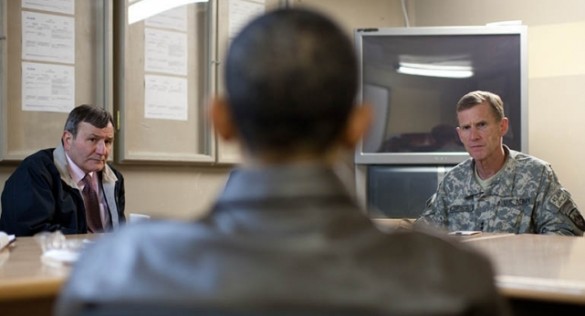
Even though he had voted for Obama, McChrystal and his new commander in chief failed from the outset to connect. The general first encountered Obama a week after he took office, when the president met with a dozen senior military officials in a room at the Pentagon known as the Tank. According to sources familiar with the meeting, McChrystal thought Obama looked “uncomfortable and intimidated” by the roomful of military brass. Their first one-on-one meeting took place in the Oval Office four months later, after McChrystal got the Afghanistan job, and it didn’t go much better. “It was a 10-minute photo op,” says an adviser to McChrystal. “Obama clearly didn’t know anything about him, who he was. Here’s the guy who’s going to run his fucking war, but he didn’t seem very engaged. The Boss was pretty disappointed.”

Facebooktwittermail

Syria’s new alliances

At Foreign Policy, Helena Cobban writes:

From 2003 to 2008, when the Bush White House was working hard to encircle and isolate Syria, with a definite view to overthrowing the Asad regime, Damascus’s strengthening tie to NATO member Turkey provided what regime insiders have described as “almost literally, a lifeline for us.”

Today, Syria’s relationship with Turkey has matured even further. At the official level, Syria now has a “no-visa” open border with Turkey, and just last week Turkey’s large, state-backed company Turk Telekom announced a massive deal to install a 2,500-kilometer, state-of the-art fiber-optic network in Syria, Jordan, and Saudi Arabia that will link those three countries through Turkey to European networks.

At the popular level, Syrians have really appreciated the opportunity to travel freely throughout Turkey, and to trade with it. (Along the way, they even somehow forgot their country’s longtime claim to the lovely seaside province of Alexandretta, which is now Turkey’s province of Hatay.) Many Syrian citizens see their ties to Turkey as providing a valuable counterbalance to their government’s much older ties to Iran. They see Turkey as providing a much more attractive example than Iran for how a traditional Middle Eastern country can successfully modernize.

The Turkish government’s growing activism on the Palestinian cause, and in particular on Gaza, has been more recent icing on the Syrian-Turkish cake.

Facebooktwittermail

US-Israeli relations improve — time to bulldoze Palestinian homes

Since US-Israeli relations are so famously cozy, maybe it’s time to extend the familial metaphor a bit further: Washington is a victim of domestic violence.

Every time the Obama administration reaches out to the Netanyahu government, it gets slapped in the face. Netanyahu has once again been invited to Washington — due to the poorly-time Mavi Marmara massacre he had to bail on a visit planned for early this month. He’s now due for his long-awaited kiss and make up session at the White House on July 6. But true to form, as soon as this was announced, word came from Jerusalem that 22 Palestinian homes are going to be bulldozed to clear space for a tourist center.

Another diplomatic snafu? On the contrary. These unfortunate “coincidences” have become so predictable that it’s hard to interpret them in any other way than as a calculated effort by Israeli officials to humiliate their American counterparts.

Just as some victims of serial abuse collude with their abuser by finding ways to excuse their partner’s violence, Washington’s tolerance of treatment that would be unthinkable coming from any other ally, is perpetually excused when the offending nation is Israel.

Haaretz now reports:

The Jerusalem municipal planning committee approved Monday a contentious plan to raze 22 Palestinian homes to make room for a tourist center that Palestinians fear would tighten Israel’s grip on the city’s contested eastern sector.

Jerusalem mayor Nir Barkat has asked the municipal planning committee earlier Monday to give preliminary approval to the plan which affects the neighborhood of Silwan in East Jerusalem, and risks more U.S.-Israeli friction.

Tensions have already been raised in Jerusalem, when conflict erupted during the meeting between committee members and the residents of Silwan. Silwan residents starkly objected to the plan and demanded the committee discuss their alternative plan, which does not include razing homes.

What will the White House say? That this is “unhelpful”? Hillary Clinton has already expressed her “dismay and disappointment.”

Just as the expansion of Jewish settlements on Palestinian land has been relentless, the Israeli assault on Washington perpetually expands the boundaries of impunity. The notion that Israel might go too far in testing the limits of American tolerance is repeatedly invalidated as Washington demonstrates that its diplomatic tool box is equipped with nothing more threatening than the occasional harsh word — and even those are in short supply and never particularly harsh.

Facebooktwittermail

White House welcomes empty promise from Israel on Gaza

“Today, the United States welcomes the new policy towards Gaza announced by the Government of Israel, which responds to the calls of many in the international community. Once implemented, we believe these arrangements should significantly improve conditions for Palestinians in Gaza, while preventing the entry of weapons,” the White House press secretary’s office said in a statement released on Sunday morning.

And what, one might wonder, is the substance of the new policy that Washington is so swift to praise? This is what an Israeli official told Haaretz: “we will allow the entry of food items, house wares, writing implements, mattresses and toys. Beyond that, we have not said a thing.” The Los Angeles Times notes: “the government has yet to specify what items will be banned or when the changes will take effect.”

The Guardian says:

Aid agencies have cautioned that concrete implementation of any relaxation of the siege could be hampered by Israeli foot-dragging. “The siege must be ended, not just eased,” said UN spokesman Chris Gunness. “Otherwise Israel continues to be in breach of international law.”

Gisha, an Israeli human rights organisation, said in a statement: “A policy consistent with international law would allow free passage of raw materials into Gaza, export of finished goods, and the travel of persons not just for ‘humanitarian’ reasons but also for work, study, and family unity – subject only to reasonable security checks.”

Ziad al-Zaza, a Hamas cabinet minister, called the Israeli move a “deception”. The blockade must be lifted completely “to allow Gaza to import all necessary materials, particularly cement, iron, raw materials for industry and agriculture, as well as import and export between Gaza and the world”, he said.

Meanwhile, if Israel is adopting a more liberal approach to Gaza, this wasn’t evident on Saturday.

Haaretz reported:

German Development Aid Minister Dirk Niebel was denied entry into the Gaza Strip during his current visit to Israel, German officials said Saturday evening.

A ministry spokesman said talks had continued to the last moment with Israeli officials over Niebel’s aim to visit the Palestinian areas.

Niebel, who arrived in Israel earlier Saturday, had hoped to visit a sewage treatment plant being financed with German development aid.

Speaking on the second German TV network ZDF program”heute” (today) Saturday evening, Niebel expressed his anger about being denied entry.

“I would have wished for a clear political signal would be sent for an opening and for transparency,” said Niebel, of Germany’s liberal Free Democratic Party (FDP).

“Sometimes the Israeli government does not make it easy for its friends to explain why it behaves the way it does,” he added.

Niebel said that Israel’s latest announcement on easing the Gaza blockade was “not sufficient” and that Israel must “now deliver” on its pledge.

Beyond that, the government in Jerusalem should be “clear about how Israel, within an international context, wants to cooperate with its friends in the future as well,” the German minister said.

The United States has no fear of meeting a similar rebuff. As far as one can tell, George Mitchell has no interest in visiting Gaza.

Facebooktwittermail

Mordechai Vanunu: prisoner of conscience

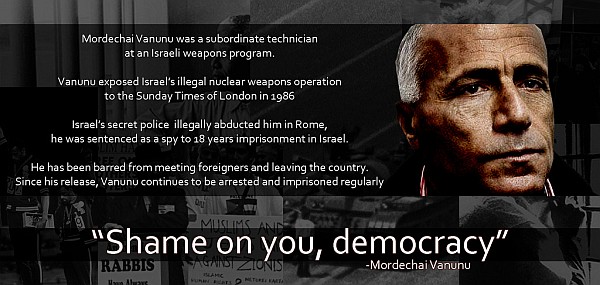
How many countries in the world are there where someone can be thrown in jail for talking to a foreigner? That was one of Mordechai Vanunu’s most recent “crimes” as a citizen in “the only democracy in the Middle East.”

Having spent 18 years in prison — more than 11 of those in solitary confinement — after revealing to the world Israel’s clandestine nuclear weapons program, Vanunu is now back in solitary confinement.

Amnesty International has rightly declared that he is a “prisoner of conscience,” and called for his immediate release.

The state persecution that Vanunu has suffered for decades and other details provide reason to suspect that he may the individual who in a report several days ago was simply referred to a Mr X.

A June 13 report in the Hebrew edition of Ynet (translated by Didi Remez, h/t to Richard Silverstein) said:

Nobody knows who Mr. X. is. Ynet has learned that a man has been imprisoned for some time in wing 15 of Ayalon Prison but nobody knows who he is and what charges he is being jailed for. Nobody talks to him, nobody sees him, nobody visits him, nobody knows he is in jail. “He was placed in full and complete separation from the outside world,” said an Israel Prison Service official.

To enter the wing where the detainee is being held, you have to pass the jailers on the southern side of the prison and go through double iron doors. Unlike regular separation wings, where prisoners can talk loudly between the cells or see the goings-on in the corridors with mirrors, wing 15 has only one cell without neighboring cells and without a corridor, so that whoever is jailed in it is completely isolated from any living being.

“I don’t know any other prisoner or IPS detainee held in such severe conditions of separation and isolation,” said a Prison Service official. “There is confidentiality surrounding the detainee in wing 15 in every respect, including his identity and the crimes he committed. I doubt even the jailers in charge of him know who he is. There is too much confidentiality surrounding him. It is scary that in 2010 a man is imprisoned in Israel without us even knowing who he is.”

The official said, “it is simply a person without a name and without an identity who was placed in complete and absolute isolation from the outside world. We don’t know if he gets visits, if he gets the rights that every detainee deserves by law and if anybody even knows he is in jail.” The IPS declined to divulge who the person jailed there is. Its spokesman, Lt. Col. Yaron Zamir, said: “The IPS does not provide information about locations and names out of security considerations.”

Mr. X. is being kept in the wing originally built in order to jail Prime Minister Rabin’s assassin, Yigal Amir. Amir was jailed in the same cell under heavy security, with security cameras in the cell until December 2006, when he was moved to the separate wing at Rimonim prison in the Sharon district. The cell in wing 15 is relatively large and, in the case of Amir, his family met him in the cell so that he would not have to be taken out during visits.

Amnesty confirms that Vanunu is being held in Ayalon Prison.

Earlier this year, Rannie Amiri wrote on Vanunu’s “Nobel stand”:

“He [Vanunu] has written letters to us this year and last year also, where he stated explicitly that he did not want to be a candidate for the Nobel Peace Prize. The reason he gave was that Simon Peres had received the Nobel Peace Prize, and Peres he alleged was the father of the Israeli atomic bomb and he did not want to be associated with Peres in any way.” – Geir Lundestad, Director of the Norwegian Nobel Institute and Secretary of the Norwegian Nobel Committee, 24 February 2010.

For the first time in the history of the Norwegian Nobel Committee, a preemptive request to withdraw a nomination—by the nominee—was made.

It was revealed last week that in a letter to the Committee, Mordechai Vanunu had asked for his candidacy to be rescinded. It was unusual enough for Geir Lundestad to acknowledge that a nomination had even been received, let alone publicly disclose Vanunu’s request. But for Vanunu—a man who should have been awarded the Peace Prize long ago—it was in full keeping with the dignity, integrity and uncompromising nature of one to whom the world owes a great debt.

Mordechai Vanunu – more than just a whistleblower

Vanunu worked as a technician at Israel’s Dimona nuclear plant in the Negev Desert from 1976-1985. In a 1986 interview with The Sunday Times, he courageously exposed, for the first time, his country’s clandestine nuclear activity. A week prior to the interview’s publication, he was lured by a Mossad agent from London to Rome, where he was apprehended and whisked off to Israel. In secret proceedings, Vanunu stood trial for treason, was swiftly convicted, and sentenced to 18 years behind bars. He spent more than 11 of them in solitary confinement.

Vanunu was released from Ashkelon’s Shikma prison in April 2004, unapologetic and unrepentant. “I am proud and happy to do what I did,” he said.

As for enduring nearly two decades of incarceration?
“I said to the Shabak [Shin Bet], the Mossad, ‘you didn’t succeed to break me, you didn’t succeed to make me crazy.’”
Conditions of his parole prohibited him from speaking with journalists, supporters, or non-Israelis of any kind. He was restricted from travelling within the country and barred altogether from leaving it.

In 2007, Vanunu was found to be in violation of his parole, in part for attempting to travel from Jerusalem to Bethlehem, and it landed him in jail for another three months. Being a convert to Christianity and an advocate for Palestinian rights did not help his case, but only served to increase the scorn heaped upon him by his countrymen.

Although the term “whistleblower” is usually appended to Vanunu’s name, the description is weak and understated. He was more like the “siren” that alerted the world to Israel’s undeclared nuclear bombs and the introduction of weapons of mass destruction to the Middle East.

Facebooktwittermail

Israel’s Secret Weapon

A BBC documentary, “Israel’s Secret Weapon,” which first aired in 2003 just weeks before the start of the war in Iraq, examines Israel’s nuclear weapons program, the secrecy in which it has always been shrouded, and the ruthless measures through which Israel’s “nuclear taboo” is enforced. The film reveals:

  • The brutality with which Mordechai Vanunu, Israel’s most famous political prisoner has been treated. By the time this film was made, Vanunu had been held in solitary confinement for longer than any prisoner in the West.
  • The mafia-like power wielded by the ulta-secret Yechiel Horev, who as Director of Security of the Defense Establishment was committed to ensuring that Vanunu never be permitted to leave Israel.
  • The deception through which Israel concealed the most sensitive areas of the Dimona nuclear facility from scrutiny by American inspectors.
  • The cover-ups and threats that have forced injured Dimona workers to maintain their silence about accidents, injuries and sickness caused their exposure to nuclear materials.
  • Israel’s biological and chemical weapons program that appears to have involved the use of chemical weapons in Gaza.
  • The blanket refusal by members of the Bush administration to discuss any questions relating to Israel’s large stock of weapons of mass destruction just as Washington was insisting that an active WMD program in Iraq (which of course turned out to be non-existent) necessitated war.
  • Facebooktwittermail