Yearly Archives: 2010

Who’s pushing to strike Iran?

[Update: See this post which confirms that Goldberg twisted the narrative here.]

After an exchange between the UAE ambassador to the US Yousef al-Otaiba and Jeffrey Goldberg on Tuesday we learn that “the UAE would sooner see military action against Iran’s nuclear program than see the program succeed” — at least that’s what Goldberg says.

But the ambassador also said: “There are many countries in the region who, if they lack the assurance the US is willing to confront Iran, they will start running for cover towards Iran.”

In other words, countries like the UAE will ultimately align themselves with whichever ends up being the most durable power in the region. Even so, autocratic rulers who rely on American support would naturally like the defender of their tenuous legitimacy to maintain its regional dominance.

The Washington Times quotes from the same exchange between Goldberg and al-Otaiba in Aspen:

“I think it’s a cost-benefit analysis,” Mr al-Otaiba said. “I think despite the large amount of trade we do with Iran, which is close to $12 billion … there will be consequences, there will be a backlash and there will be problems with people protesting and rioting and very unhappy that there is an outside force attacking a Muslim country; that is going to happen no matter what.”

“If you are asking me, ‘Am I willing to live with that versus living with a nuclear Iran?,’ my answer is still the same: ‘We cannot live with a nuclear Iran.’ I am willing to absorb what takes place at the expense of the security of the UAE.”

And this is how Goldberg interprets the UAE/Arab position:

It is not only Israel that fears the rise of a nuclear Iran; the Arabs, if anything, fear such a development to a greater degree. The Jews and Arabs have been fighting for one hundred years. The Arabs and the Persians have been going at for a thousand. The idea of a group of Persian Shi’ites having possession of a nuclear bomb scares Arab leader like nothing else — it certainly scares them more than the reality of the Jewish bomb.

Goldberg speaks for Netanyahu and the lobby, but the UAE government does not accept his interpretation of their ambassador’s remarks:

The UAE Assistant Foreign Minister for Political Affairs, Tareq al Haidan said today that the statements attributed by the Washington Times to the UAE Ambassador to the United States, Youssef al Otaiba “are not precise”.

“These statements came as part of general discussions held on the sidelines of an unofficial gathering and were taken out of their context in which Mr. Otaiba was speaking,” Mr al Haidanl said.

“Iran is a neighboring country and we maintain historic relations with it.” He stressed that “the UAE respects and believes in the sovereignty of other states and in the principle of non-interference, of all forms, in their internal affairs.”

“Already, the UAE declared, more than one time and in official statements issued by the Foreign Ministry, its position on the Iranian nuclear issue,” Mr al Haidan added.

“The UAE totally rejects the use of force as a solution to the Iranian nuclear issue and rather calls for a solution through political means that are based on the international legitimacy, transparency as well as the need for working, through the International Atomic Energy Agency [IAEA], on the right of all states to the peaceful use of nuclear energy.

“The UAE, at the same time, believes in the need of keeping the Gulf region free of nuclear weapons,” Mr al Haidan said.

As for whether the Arab world is as vexed about Iran as Goldberg claims, perhaps a clearer indication came from one of Israel’s few allies, Jordan, when King Abdullah spoke to the Wall Street Journal in April:

WSJ: What do you think when you look at Iran and international policy. There’s a lot of talk now about how active Iran is in Iraq as far as trying to push their political clients. Do you see it active in Hezbollah/Lebanon? In the Palestinian territories? Is the engagement track working?

HM KING ABDULLAH: Again, I look at it from a different angle. If there are those that are saying that Iran is playing mischief, then I say it is being allowed to play mischief. The platform they use is the injustice of the Palestinians and Jerusalem. So if you start taking those cards off the table, then Iranian influence on the Mediterranean through Hezbollah and Hamas in Gaza diminishes or becomes non existent. My view is that I am really against any military action in Iran, that is Pandora’s box. But by dealing with the core issue, that’s when you start taking cards away from the Iranian regime.

The core issue is Palestine — not an Iranian bomb — and a strike on Iran, that’s Pandora’s box.

Just because Obama put on a shameless performance yesterday to please the Israelis and the lobby, and just because there is no evidence that he is a man of principle, doesn’t mean he’s stupid. He knows what Pandora’s box looks like and he’s just as reluctant as anyone else to find out what it contains.


Facebooktwittermail

Integrity — now you see it, now you don’t

Anyone who believes a resolution to the Israeli-Palestinian conflict hinges on the actions of Barack Obama and Benjamin Netanyahu, might as well turn their attention elsewhere — The moral bankruptcy of both men was on full display at the White House yesterday.

If before engaging in their vacuous performance, they had cared to study what meaningful engagement actually looks like, they could have done nothing better than to witness a recent meeting between two very different men: Haim Bajayo, 75-year old Jew and Hebron’s Palestinian Mayor Khalid Al-Useili.

Ma’an reports:

An elderly Jewish man from Hebron has asked the city’s mayor to permit his burial in a Muslim cemetery when he dies, insisting that his body not be placed in one of the sites now controlled by Israeli settlers.

Haim Bajayo, 75, visited Mayor Khalid Al-Useili at his office in the southern West Bank city and described in detail how Jews and Arabs had generally enjoyed amiable relations until the arrival of tens of thousands of foreign immigrants from the 1920s until 1948, the year Israel was established and most of Hebron’s Jews fled to the new state established in their name.

Bajayo was born in Hebron in 1935 and grew up in its Daboya neighborhood with his family, which owned a home there and held official property documents until 1977. A decade after Israel seized control of the Palestinian city and began permitting its citizens to settle there, Bajayo ceremoniously ceded his home for the benefit of the Palestinian municipality. The mayor at that time was Fahd Al-Qawasmi.

“As long as [the settlers] are in Hebron, there is no chance of reaching an agreement” to end the six-decade conflict, he told the mayor. “I don’t want any of my property or my house back as long as Palestinian homes and lands are not returned. The same day the Palestinians regain what was taken from them in 1948, I’ll come to you and say, ‘I have a house … registered in the real estate department.'”

Facebooktwittermail

The war Israel can’t win

At The Daily Beast, historian Thaddeus Russell writes:

When Israeli Prime Minister Benjamin Netanyahu visits the White House Tuesday, President Obama will have the chance to be the first American president since the founding of Israel to ask The Question.

The Question is never addressed by Israel’s supporters and rarely raised by Israel’s detractors. But for those of us who are taxpayers in a nation that has been the state of Israel’s chief benefactor for 42 years — or those of us with Jewish ancestry — it is becoming the only question to ask. It is simple, self-interested, and fundamental: Does the existence of Israel make Americans and Jews safer?

And here is the paradox: Though support for Israel among Americans, and especially Jewish Americans, remains high according to recent Gallup polls, historical evidence says the answer to The Question is “no.”
“There was not a single act of Arab terrorism against Americans before 1968, when the U.S. became the chief supplier of military equipment and economic aid to Israel.”

The history of Israel and its relationship with the U.S. is infinitely complex, but there’s one damning fact that’s ignored as often as The Question: There was not a single act of Arab terrorism against Americans before 1968, when the U.S. became the chief supplier of military equipment and economic aid to Israel. In light of this fact, it’s difficult to credibly sustain the argument that Arab terrorism is spawned by Islam’s alleged promotion of violence and antipathy toward American culture or by a “natural” Arab anti-Semitism. It also suggests that no matter what policies Israel enacts to protect itself — even a withdrawal from the occupied territories or a two-state “solution” — it must be a perpetual wartime state.

Very few Americans today are aware that the question of American and Jewish self-interest was first raised at the time of Israel’s founding by officials in the highest levels of the U.S. government. In 1948, several members of Harry Truman’s Cabinet predicted that the creation of a Jewish state in the Middle East would spur Arab violence against Jews and Americans, advising the president to shun Israel.

These included Secretary of State George Marshall, Defense Secretary James Forrestal, and George Kennan, then the leading policy strategist in the State Department. They argued that if the United States helped to set up an independent Jewish nation it would provoke terrorist attacks on Americans and inaugurate an endless war between Arabs and Jews. “There are 30 million Arabs on one side and about 600,000 Jews on the other,” Forrestal told those in the administration who favored recognizing Israel. “Why don’t you face up to the realities?”

Israel apologists will plead that Thaddeus Russell’s commentary is one more instance among international efforts — rapidly gaining steam — to delegitimize Israel.

Strangely, in response to what is perceived as a campaign of degitimization, there is, as far as I’ve seen, no Israel legitimization campaign. Those mounting a defense, do nothing more than attack their critics — and usually do so with an unbridled viscousness.

For instance, Robin Shepherd, writing in the Jerusalem Post about a decision last week by the Methodist Church of Britain to launch a boycott against goods emanating from settlements in the West Bank and East Jerusalem, says:

Overall, a church that behaves in the manner of the Methodists has buried its credibility under a gigantic dunghill of intransigence, pedantry, lies and distortions.

But let us not allow this matter to rest with a mere recognition of whom and what they have chosen to become.

If the Methodist Church is to launch a boycott of Israel, let Israel respond in kind: Ban their officials from entering; deport their missionaries; block their funds; close down their offices; and tax their churches.

If it’s war, it’s war. The aggressor must pay a price.

While it’s often said that attack is the best form of defense, that principle does not hold in the art of persuasion (and rarely for that matter in national security). The ranks cheering an attack such as Shepherd’s are small and shrinking. Indeed, the more venomous Israel and its supporters become, the less sympathy the Jewish state will evoke and the closer we will move to a critical juncture: where the world has given up on Israel and Israel has given up on the world. At that point, Israel’s isolation becomes the world’s nuclear peril.

Facebooktwittermail

Israel bans parachutes from Gaza

If Hamas had plans to form a paratroopers brigade, these will now need to be put on hold.

Israel’s long-awaited release of its blacklist of items banned from importation into the strip include parachutes. How exactly parachutes might be used in Gaza, if the ban gets lifted, is hard to envisage. What’s the use of a parachute if you can’t fly?

As Israel eases its economic blockade on Gaza, the manner by which it does so exposes the multi-layered deceit with which the siege was imposed and now unravels.

In its new policy, Israel now specifies which items are banned rather than which are allowed entry. But a ban on arms and munitions and items which could be used to develop, produce or enhance the military capabilities of the Gaza militias, begs a rather obvious question: were any such items allowed into Gaza before the siege started four years ago?

Of course not. So the idea that Israel’s goal, now or ever, has simply been to stem the flow of weapons into Gaza, doesn’t add up. Indeed, if that had actually been Israel’s primary concern it would have avoided creating a situation in which the principal conduit for the flow of goods into the strip had been through an unmonitored system of tunnels. Now as always, the easiest way to regulate what comes in and out of the Palestinian enclave is through carefully controlled land crossings.

The siege has always been and still remains a method of subjugation. Its purpose is to crush the will of the population in the hope that this might drain support for the resistance.

Now, in its effort to present a softer face to the world in the wake of its brutal attack on the flotilla, Israel is letting Gazans eat chocolate. What it remains much more reluctant to do is open the economic barriers that would allow Gazans to manufacture or perhaps even export their own chocolate.

Ultimately though, this isn’t about what Palestinians can be allowed to import or export — it’s about the one thing Israel continues to withhold from Palestinians in both Gaza and the West Bank. It’s about freedom.

Facebooktwittermail

Petraeus: mission will be accomplished

Predicting what will happen in Afghanistan is about as wise as declaring “mission accomplished.” As he arrived to take over command of US forces in what has become America’s longest war, Gen David Petraeus might not have actually predicted the outcome of the war but he certainly narrowed what can be deemed an acceptable conclusion:

In a ceremony on the tree-shaded lawn in front of NATO headquarters in Kabul, Petraeus assumed command from Gen. Stanley A. McChrystal, who was fired last month after a magazine quoted him and his staff making critical remarks about Obama administration officials.

A general with a sterling reputation for military creativity and political acumen, Petraeus, 57, struck a determined tone in his remarks to fellow officers, foreign diplomats and Afghan officials, insisting “we are in this to win.”

“We’re engaged in a contest of wills. Our enemies are doing all that they can to undermine the confidence of the Afghan people,” he said.

Before he mentioned the Taliban, Petraeus described those enemies as “al-Qaeda and its network of extremist allies,” harking back to the justification for invasion nine years ago. He said his mission is to demonstrate to Afghanistan and the world that the extremists “will not be allowed to once again establish sanctuaries in Afghanistan from which they can launch attacks on the Afghan people and on freedom-loving nations around the world.”

“We must demonstrate to the people and to the Taliban that Afghan and [U.S. and coalition] forces are here to safeguard the Afghan people, and that we are in this to win,” he said. “That is our clear objective.”

This commitment to safeguard the civilian population has inevitably been called into question each time an operation results in civilian casualties, yet Petraeus is now under great pressure to make it easier for his troops to fight.

A few days before Gen McChrystal got fired, CJ Chivers, a former US marine who now reports for the New York Times, wrote:

It is an axiom of military service that troops gripe; venting is part of barracks and battlefield life. Troops complain about food, equipment, lack of sleep, delays in their transportation and the weather where they work.

Complaints about how they are allowed to fight are another matter and can be read as a sign of deeper disaffection and strains within the military over policy choices. One Army colonel, in a conversation this month, said the discomfort and anger about the rules had reached a high pitch.

“The troops hate it,” he said. “Right now we’re losing the tactical-level fight in the chase for a strategic victory. How long can that be sustained?”

The Los Angeles Times reports today:

At his Senate confirmation hearings last week, Petraeus said he foresaw no major shift in strategy in the Afghanistan war. But he has made it clear that even if the rules of engagement do not change, the nuances of how they are implemented will get a close new look.

Assuming command Sunday, Petraeus told his troops that while civilian safety remains a critical consideration, “as you and our Afghan partners on the ground get into tough situations, we must employ all assets to ensure your safety.”

It was a remark apparently intended to reassure troops that the safeguarding of Afghans was not to come at the expense of military lives.

The problem with this idea that a balance can be struck between reducing the risks faced by Afghan civilians without putting American soldiers at unnecessary risk is that it implicitly overstates the military’s commitment to a humanitarian mission. The Pentagon is assuming a posture as though it treats all lives as being of equal value, yet the truth — transparent to everyone — is that America regards its soldiers’ lives as being of vastly greater value than the those of the citizens in any of the nations the US has decided to “save.”

Embedded in this is what I call the evangelical conceit: I know better than you do, what’s good for you; you will become better than you are, if you become more like me. It is the antithesis of respect, but describes the mindset with which so many Americans venture into the world on their military and religions missions.

Facebooktwittermail

A free republic and its limits

David Bromwich writes:

“Things are in the saddle,/ And ride mankind.” The words were written by Emerson in a poem about the Mexican war — the first crisis that took America out of itself. The second such crisis was the Spanish-American war, and we are now in the middle of the third. The extent of our empire would have shocked the signers of the Declaration of Independence. On July 4, 1776 they sought to establish their right to stay within themselves; to declare the integrity of a republic as something separate from an aggrandizing power that aimed at subjugation.

Things are in the saddle in Afghanistan, in Iraq, in Guantanamo.

Montesquieu observed of the elite of Augustan Rome that

virtue seemed to forget itself in order to surpass itself, and it made men admire as divine an action that at first could not be approved because it was atrocious.

Washington had in mind a similar warning against vainglory when he spoke the words of his Farewell Address on the infinite mischief of foreign entanglements. There may, he saw, be a wrong as well as a right love of one’s country. The wrong overpowers by a loyalty that takes us out of ourselves. The right leads back to constitutional integrity and self-sufficiency.

Facebooktwittermail

‘The world has divided into rich and poor as at no time in history’

Speaking ahead of the G20 summit held in Toronto last week, Maude Barlow, head of the Council of Canadian — Canada’s largest public advocacy organization — said:

On the eve of this G-20 gathering, let’s look at a few facts. Fact, the world has divided into rich and poor as at no time in our history. The richest 2% own more than half the household wealth in the world. The richest 10% hold 85% of total global assets and the bottom half of humanity owns less than 1% of the wealth in the world. The three richest men in the world have more money than the poorest 48 countries. Fact, while those responsible for the 2008 global financial crisis were bailed out and even rewarded by the G-20 government’s gathering here, the International Labor Organization tells us that in 2009, 34 million people were added to the global unemployed, swelling those ranks to 239 million, the highest ever recorded. Another 200 million are at risk in precarious jobs and the World Bank tells us that at the end of 2010, another 64 million will have lost their jobs. By 2030, more than half the population of the megacities of the Global South will be slumdwellers with no access to education, health care, water, or sanitation. Fact, global climate change is rapidly advancing, claiming at least 300,000 lives and $125 billion in damages every year. Called the silent crisis, climate change is melting glaciers, eroding soil, causing freak and increasingly wild storms, displacing untold millions from rural communities to live in desperate poverty in peri-urban centers. Almost every victim lives in the Global South in communities not responsible for greenhouse gas emissions and not represented here at the summit.

The atmosphere has already warmed up a full degree in the last several decades and is on course to warm up another two degrees by 2100. Fact, half the tropical forests in the world, the lungs of our ecosystem, are gone. By 2030, at the present rate of extraction or so-called harvest, only 10% will be left standing. 90% of the big fish in the sea are gone, victim to wanton predatory fishing practice. Says a prominent scientist studying their demise, there is no blue frontier left. Half the world’s wetlands, the kidneys of our ecosystem, have been destroyed in the 20th century. Species extinction is taking place at a rate 1,000 times greater than before humans existed. According to a Smithsonian scientist, we are headed toward of biodiversity deficit in which species and ecosystems will be destroyed at a rate faster than nature can replace them with new ones. Fact, we are polluting our lakes, rivers and streams to death. Every day, two million tons of sewage and industrial agricultural waste are discharged into the world’s water. That’s the equivalent of the entire human population of 6.8 billion people. The amount of waste water produced annually is about six times more water than exists in all the rivers of the world. We are mining our ground water faster than we can replenish it, sucking it to grow water guzzling chemical-fed crops in deserts or to water thirsty cities who dump an astounding 700 trillion liters of land-based water into oceans every year as waste.

Facebooktwittermail

It’s obvious, go talk to the Islamists

Rami G Khouri writes:

This nagging issue just will not go away: How do local or foreign governments best deal with leading Islamist groups in the Middle East and South Asia? Do you engage, negotiate with, ignore, or actively fight politically and militarily against Hizbullah, Hamas, the Muslim Brotherhood, the Taliban and other such groups that range widely along the spectrum of cultural and political activism and occasional armed militancy?

Since the rise of this generation of Islamists, native and Western governments alike have adopted two major strategies: politically containing movements like the Muslim Brotherhood by allowing them to have limited representation in toothless parliaments; and opposing or fighting more powerful movements like Hamas, Hizbullah, the Taliban and others that use military force for various reasons.

The results have been inconclusive, indeed largely unsatisfying. The Islamist movements continue to grow in most cases, to assert their power and legitimacy and share power in some countries, or to break away and rule on their own when that is the only option left to them. Only in Turkey have they assumed power nationally through a credible democratic process.

Two intriguing reports from the United States and Afghanistan in the past few days suggest that more realism may be creeping into the toolkit used to address this issue. In Afghanistan, President Hamid Karzai is reported to have approved a plan designed to reintegrate low-level Taliban foot soldiers and commanders into the government forces, while simultaneously making peace with more senior leaders and their backers in Pakistan. This effort hopes to succeed where previous ones failed, by offering community leaders jobs, education and development programs that might bring an end to local fighting. Karzai sensibly assumes that foreign military power cannot prevail against armed nationals who believe they are fighting to liberate their country from foreign occupation.

The two key elements in the new approach are the acknowledgment that the Taliban are a credible force that must be engaged in negotiations for power-sharing, and that local developmental needs must be seriously addressed. In other words, both the Afghan government and its NATO backers acknowledge the political legitimacy and core grievances of the Taliban and their supporters.

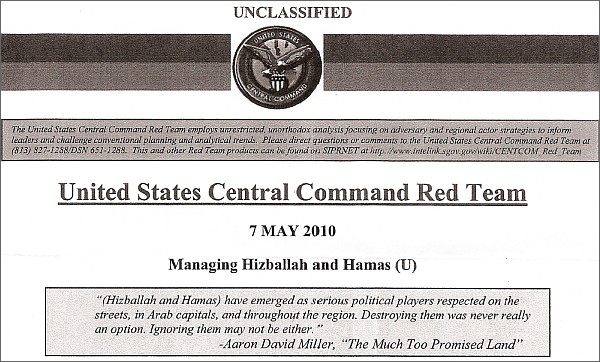
In the United States, according to Mark Perry, blogging at the Foreign Policy website, a team of senior intelligence officers at US Central Command (CENTCOM) has just issued a report titled “Managing Hizbullah and Hamas,” that questions the current US policy of isolating and marginalizing these movements, and instead suggests a variety of approaches that would integrate them into their Lebanese and Palestinian mainstreams.

Perry notes that the most controversial finding is the one stating that “[t]he US role of assistance to an integrated Lebanese defense force that includes Hizbullah; and the continued training of Palestinian security forces in a Palestinian entity that includes Hamas in its government, would be more effective than providing assistance to entities – the government of Lebanon and Fatah – that represent only a part of the Lebanese and Palestinian populace respectively.”

The report says that while Hizbullah and Hamas “embrace staunch anti-Israel rejectionist policies,” the two groups are “pragmatic and opportunistic.” Perry adds that, “there’s little question the report reflects the thinking among a significant number of senior officers at CENTCOM headquarters – and among senior CENTCOM intelligence officers and analysts serving in the Middle East.”

That such ideas are being pondered by analysts and officers who actually know the realities of the Middle East – as opposed to staunchly anti-Islamist Washington politicians and pro-Israel proxies masquerading as American think tank analysts – is an important early signal of possible policy changes. Most Islamist movements indeed are pragmatic and opportunistic, as recent decades of their evolutions have shown; they are also heavily political and nationalist in nature, rather than mainly religious.

Most importantly, Islamist groups of all kinds – from the docile reciters of holy scripture and purveyors of charity to children, to the militant resistance fighters of Hamas and Hizbullah, to the occasional Al-Qaeda-type terrorists – are deeply driven by practical, identifiable grievances. These grievances are anchored in three main spheres: national socio-economic conditions, the autocratic policies of national governments and out-of-control security agencies in the Arab-Asian region, and the policies of foreign governments and armed forces (mainly American and Israeli) in the same region.

Addressing and ultimately relieving those underlying grievances is the key to dealing with these Islamist groups, most of which will transform or wither into other, non-militant organizations in the wake of a redress of grievances. It is heartening that some people in positions of authority and power in Afghanistan, NATO and the United States armed forces are now considering this rational approach to conflict-resolution, which seeks to promote peace and stability by politically addressing basic needs of justice and dignity.

What took them so long to embrace the obvious?

Facebooktwittermail

‘The Gaza flotilla has done more for Gaza than 10,000 rockets’

The power that the emerging tactically adaptive resistance movement is acquiring draws largely from the fact that Israel is incapable of expressing itself in any other way than through the language of force.

The Wall Street Journal reports:

Hamas and Hezbollah, groups that have long battled Israel with violent tactics, have begun to embrace civil disobedience, protest marches, lawsuits and boycotts — tactics they once dismissed.

For decades, Palestinian statehood aspirations seemed to lurch between negotiations and armed resistance against Israel. But a small cadre of Palestinian activists has long argued that nonviolence, in the tradition of the American civil rights movement, would be far more effective.

Officials from Hamas, the militant group that controls the Gaza Strip, point to the recent Israeli raid on a Gaza-bound flotilla, in which Israeli troops killed nine activists, as evidence there is more to gain by getting Israel to draw international condemnation through its own use of force, rather than by attacking the country.

“When we use violence, we help Israel win international support,” said Aziz Dweik, a leading Hamas lawmaker in the West Bank. “The Gaza flotilla has done more for Gaza than 10,000 rockets.”

Hamas and Hezbollah, the Islamist movement in Lebanon that has been fighting Israel since the early 1980s, haven’t renounced violence and both groups continue to amass arms. Hamas still abides by a charter that calls for Israel’s destruction; Palestinian youths still hurl rocks at Israeli soldiers across the West Bank separation barrier. And the flotilla incident didn’t fall into conventional standards of peaceful protest: While most activists passively resisted Israeli soldiers, some on the boat where protesters were killed attacked commandos as they boarded, according to video footage released by Israel and soldiers’ accounts.

The incident triggered international condemnation and plunged Israel into one of its worst diplomatic crises in years. In response, Israel said it would take some steps to ease its blockade on the Gaza Strip.

After the incident, Hezbollah leader Hassan Nasrallah called on supporters to participate in the next flotilla bound for Gaza. Ghaleb Abu Zeinab, a member of the Hezbollah politburo in Beirut, said it was the first time Mr. Nasrallah had forcefully and publicly embraced such tactics against Israel.

“We saw that this kind of resistance has driven the Israelis into a big plight,” he said. Organizers in Lebanon say they have two ships ready to sail, but no departure date has been set.

A senior Israeli foreign ministry official said Israel recognizes “changes in the tactical thinking of Hamas and other resistance movements.” The official said the groups are no less committed to Israel’s destruction, but have simply concluded they are more likely to defeat Israel by encouraging its international isolation instead of through military force.

“People who are provoking violence are using peaceful protest as a cover,” said Israeli government spokesman Mark Regev.

The Palestinian protest movement picked up steam in the past year, spearheaded by activists in the West Bank and a coalition of pro-Palestinian international human-rights groups.

The absence of peace talks for much of the past two years has pushed the Palestinian Authority leadership to embrace the movement as well. Dominated by members of Hamas’s more moderate rival Fatah, they long advocated a negotiated settlement with Israel and dismissed popular protest campaigns.

But in January, Palestinian Prime Minister Salam Fayyad launched a campaign to boycott products produced in Israeli settlements and to plant trees in areas declared off limits by Israel. In April, Palestinian President Mahmoud Abbas outlawed settlement products in Palestinian Authority-controlled areas.

Hamas’s turnaround has been more striking, said Mustapha Barghouti, a prominent Palestinian advocate for nonviolent resistance. “When we used to call for protests, and marches, and boycotts and anything called nonviolence, Hamas used these sexist insults against us. They described it as women’s struggle,” Mr. Barghouti said. That changed in 2008, he said, after the first aid ship successfully ran the Israeli blockade of Gaza.

“Hamas has started to appreciate just how effective this can be,” Mr. Barghouti said.

Hamas has started organizing its own peaceful marches into the Israeli-controlled buffer zone along the Gaza border and supported lawsuits against Israeli officials in European courts. Hamas says it has ramped up support for a committee dedicated to sponsoring similar protests in Gaza.

Mr. Dweik, the Hamas lawmaker, recently began turning up at weekly protests against Israel’s West Bank barrier.

Salah Bardawil, a Hamas lawmaker in Gaza City, says Hamas has come to appreciate the importance of international support for its legitimacy as a representative of the Palestinian people and its fight against Israeli occupation, and has adapted its tactics. Hamas hasn’t claimed responsibility for a suicide bombing in years and now denounces the tactic as counterproductive. Since an Israeli military incursion into the territory in December 2008-January 2009, it has also halted rocket attacks into Israel.

“Hamas used to believe [international support] was just empty words,” said Mr. Bardawil. “Today it is very interested in international delegations … and in bringing Israeli officials to justice through legal proceedings.”

Facebooktwittermail

Petraeus schemed with neocon columnist to push pro-Israel pap

Philip Weiss reveals:

Last March General David Petraeus, then head of Central Command, sought to undercut his own testimony before the Senate Armed Services Committee that was critical of Israel by intriguing with a rightwing writer to put out a different story, in emails obtained by Mondoweiss.

The emails show Petraeus encouraging Max Boot of Commentary to write a story — and offering the neoconservative writer choice details about his views on the Holocaust:

Does it help if folks know that I hosted Elie Wiesel and his wife at our quarters last Sun night?! And that I will be the speaker at the 65th anniversary of the liberation of the concentration camps in mid-Apr at the Capitol Dome…

Petraeus passed the emails along himself through his own carelessness last March. He pasted a Boot column from Commentary‘s blog into in an “FYI” email he sent to an activist who is highly critical of the U.S.’s special relationship with Israel. Some of the general’s emails to Boot were attached to the bottom of the story. The activist, James Morris, shared the emails with me.

Facebooktwittermail

Mainstreaming realism

It was widely assumed that George Bush’s departure from Washington would coincide with a revival of strength for the reality-based community — the people the neocons swept aside for the sake of empire. But though the neocon dream was quick to perish, the reality-based community is still struggling to assert itself — at least inside the nation’s capital.

It turns out that Tampa, Florida, where CENTCOM is headquartered (and where General David Petraeus was in charge before being sent to Kabul), is more amenable to the expression of realism.

Since its publication in Foreign Policy yesterday, a report by Mark Perry has been causing a stir. In “Red Team — CENTCOM thinks outside the box on Hamas and Hezbollah,” Perry writes:

While it is anathema to broach the subject of engaging militant groups like Hizballah and Hamas in official Washington circles (to say nothing of Israel), that is exactly what a team of senior intelligence officers at U.S. Central Command — CENTCOM — has been doing. In a “Red Team” report issued on May 7 and entitled “Managing Hizballah and Hamas,” senior CENTCOM intelligence officers question the current U.S. policy of isolating and marginalizing the two movements. Instead, the Red Team recommends a mix of strategies that would integrate the two organizations into their respective political mainstreams. While a Red Team exercise is deliberately designed to provide senior commanders with briefings and assumptions that challenge accepted strategies, the report is at once provocative, controversial — and at odds with current U.S. policy.

Among its other findings, the five-page report calls for the integration of Hizballah into the Lebanese Armed Forces, and Hamas into the Palestinian security forces led by Fatah, the party of Palestinian Authority President Mahmoud Abbas. The Red Team’s conclusion, expressed in the final sentence of the executive summary, is perhaps its most controversial finding: “The U.S. role of assistance to an integrated Lebanese defense force that includes Hizballah; and the continued training of Palestinian security forces in a Palestinian entity that includes Hamas in its government, would be more effective than providing assistance to entities — the government of Lebanon and Fatah — that represent only a part of the Lebanese and Palestinian populace respectively” (emphasis in the original). The report goes on to note that while Hizballah and Hamas “embrace staunch anti-Israel rejectionist policies,” the two groups are “pragmatic and opportunistic.”

To call the Red Team report a “deliberately provocative piece” — as Spencer Ackerman describes it — is to misinterpret the intelligence team’s brief in providing what they do call “unorthodox analysis.”

A Red Team’s approach merely attempts to look at an issue from a broader perspective than the one that military culture engenders. The goal, nevertheless, is objectivity. This isn’t simply an exercise in creative thinking.

Consider, for instance, this uncontroversial observation in the report (written before the recent international outcry demanding a swift end to the siege of Gaza):

The hardships in Gaza may be radicalizing more people, especially the young, and increasing the number of potential recruits for HAMAS. This is the opposite effect Israel thought the blockade would have in Gaza, hoping instead that people would see HAMAS as the cause of their suffering and turn against it.

Yet even today while it is clear to rest of the world that Israel’s divide-and-rule strategy in Gaza has failed, Israel’s deputy foreign minister Danny Ayalon wrote on Twitter: “Our position is to differentiate between Hamas, the occupiers of Gaza, and the civilian population.”

Gaza under occupation — by Hamas!

Ayalon might imagine he’s cleverly modifying the concept of “occupation” but the twist will persuade no one in Gaza, which — an ease to the restrictions on the flow of goods notwithstanding — remains the world’s largest prison.

Indeed, the seeming intransigence of Hamas has been in response to this very fact: that the reward for the moderation that the Palestinian Authority has already exhibited and in whose footsteps Hamas is being implored to follow is not self determination but an occupation with no end in sight. In this respect, Hamas, far from representing the extreme position it is claimed to hold, exhibits a sober realism, which is to say, it sees little evidence that concessions by Palestinians are matched with concessions by Israel.

CENTCOM’s Red Team may have concerned themselves only with the issue of “mainstreaming” Hamas and Hezbollah yet the possibility of that happening may depend less on the internal workings of each Islamist organization and more on the extent to which realism can be mainstreamed inside Washington.

The Obama administration’s support for the Supreme Court’s recent ruling in favor of a ridiculously broad interpretation of the meaning of “material support” (as applied to so-called Foreign Terrorist Organizations and thus both Hamas and Hezbollah) is not a promising sign.

Facebooktwittermail

The limits of American power are like the borders of Israel

For much of the last decade, Rory Stewart has provided one of the wisest voices on Afghanistan. A theme he pounds away at relentlessly is the necessity to differentiate between what is desirable and what is possible.

Stewart, now a newly minted member of Britain’s parliament, writes in Der Spiegel:

The only way in which we could move beyond the counter-insurgency theory, or the hundred other theories which buttress and justify the Afghan war, is by rejecting their most basic underlying premises and objectives. Instead of trying to produce an alternative theory (on how to defeat the Taliban, create an effective, legitimate and stable Afghan state, stabilize Pakistan and ensure that al-Qaida could never again threaten the United States) we need to understand that however desirable such things might be, they are not things that we — as foreigners — can do.

We can do other things for Afghanistan but the West — in particular its armies, development agencies and diplomats — are not as powerful, knowledgeable or popular as we pretend. Our officials cannot hope to predict and control the intricate allegiances and loyalties of Afghan communities or the Afghan approach to government. But to acknowledge these limits and their implications would require not so much an anthropology of Afghanistan, but an anthropology of ourselves.

The cures for our predicament do not lie in increasingly detailed adjustments to our current strategy. The solution is to remind ourselves that politics cannot be reduced to a general scientific theory, that we must recognize the will of other peoples and acknowledge our own limits. Most importantly, we must remind our leaders that they always have a choice.

As simple as this message is, it is one that is virtually impossible for American leaders to hear, and even among those who grasp its truth it remains hard to bluntly acknowledge the fact.

The limits of American power are like the borders of Israel — reaching into terrain impossible to control yet just as difficult to relinquish.

And the struggle to adjust to reality is for Americans just as hard as it is for Israelis, since it depends on a resource severely depleted in both nations: humility.

Facebooktwittermail

The grim, relentless task of crushing of the Taliban and al Qaeda

John Bolton writes: “America’s Afghanistan policy is in chaos. Fear of another Vietnam is palpable, and our friends and adversaries worldwide sense it.”

Another Vietnam? If only the US might be so lucky! Vietnam was an exercise in nation building, interrupted by an American occupation, and then fairly swiftly brought to a peaceful conclusion after the US pulled out. The prospects for Afghanistan look much bleaker.

The fear of another Vietnam is more Bolton’s own — “I confess I had no desire to die in a Southeast Asian rice paddy,” he wrote in 1995 when explaining why he supported that war but declined to enter combat duty.

But at 61, Bolton still seems eager to prove his manhood and what better way than in another full-throated appeal for “a sustained military presence in Afghanistan devoted to the grim, relentless crushing of the Taliban and Al Qaeda.”

Americans “need to understand and agree to a ‘long war’.”

In the short war of World War II, Germany and Japan merely needed to be defeated (though more than 60 million people died in the process) — but the Taliban and al Qaeda must be crushed. Not because they pose a greater threat to the world than fascism but rather because they pose a greater affront to power.

This need to destroy an enemy thus aggrandized is inherently flawed in its design because it mirrors American vanity. Those who supposedly need to be crushed cannot be seen for what they are because their significance is seen utterly in terms of what their existence says about us.

Facebooktwittermail

Israel: the writing on the wall

Professor Gilbert Achcar, author of the recently published Arabs and the Holocaust: The Arab-Israeli War of Narratives, writes at Open Democracy:

The truth is that it is Israel – not the Arabs – that never missed an opportunity to miss an opportunity to conclude a real peace with its neighbors. And this has been true since the outset. Claims, like that of Abba Eban’s [in 1973], about Arab intransigence are usually buttressed with a reference to the founding act of the creation of Israel in international law: the UN General Assembly’s vote on the partition of Palestine in November 1947, at a time when the majority of UN member states were western and western-dominated countries. The Arabs and the Palestinians are blamed for having rejected this partition, which would have granted them a larger portion of Palestine than the one they – more accurately the Jordanian accomplice of the Zionist movement, King Abdullah – ended up controlling after the first Arab-Israeli war in 1948. In other words, the Arabs are blamed for having rejected a deal that granted 56% of the territory of Palestine west of the Jordan River to Jewish inhabitants, who constituted one-third of its total population – most of them immigrants/refugees who had arrived from Europe during the previous fifteen years.
The UN 1947 partition resolution could not have been reasonably accepted by any Arab leader – or by any people in their shoes, for that matter. Accepting it would have amounted to capitulation without battle and relinquishment of fundamental rights. As for sympathy for the plight of Jewish Holocaust survivors, the Arabs, let alone the Palestinians, could legitimately say that they had already accommodated much more than their fair share of them, compared with the rest of the world, especially the victors of World War II. On the other hand, the League of Arab states had made a peace offer that is hardly mentioned in the propagandistic literature that prevails on this topic. Their proposal was summed up by the UN Special Commission on Palestine in September 1947:

(a) That Palestine should be a unitary State, with a democratic constitution and an elected legislative assembly,

(b) That the constitution should provide, inter alia, guarantees for (i) the sanctity of the Holy Places and, subject to suitable safeguards, freedom of religious practice in accordance with the status quo; (ii) full civil rights for all Palestine citizens, the naturalization requirement being ten years’ continuous residence in the country; (iii) protection of religious and cultural rights of the Jewish community, such safeguards to be altered only with the consent of the majority of the Jewish members in the legislative assembly,

(c) That the constitution should provide also for (i) adequate representation in the legislative assembly of all important communities, provided that the Jews would in no case exceed one-third of the total number of members [that is, the proportion of Jews in the Palestinian population in 1947, regardless of the date on which they immigrated]; (ii) the strict prohibition of Jewish immigration and the continuation of the existing restrictions on land transfer, any change in these matters requiring the consent of a majority of the Arab members of the legislative assembly; (iii) the establishment of a Supreme Court which would be empowered to determine whether any legislation was inconsistent with the constitution.

This proposal was congruent with the perspective of a binational state in Palestine as advocated by pacifist “cultural” Zionists – the likes of Martin Buber and Judah Magnes – and, officially at least, by leftwing Zionist organizations such as Hashomer Hatzair. It was flatly rejected by the Zionist leadership, dedicated to the project of a Jewish State in Palestine. In reality, the Ben-Gurion Laborite leadership of the Zionist movement was always much closer to its rightwing rivals of Revisionist Zionism founded by Vladimir Jabotinsky than to the “cultural Zionists” and the radical left. In essence, the statist project of Ben-Gurion matched Jabotinsky’s aspiration, albeit in a more ‘realistic’ and tactical fashion. Thus Jabotinsky said openly and loudly what the others thought as well, but did not want to proclaim lest it spoil their Machiavellian manoeuvering.

Facebooktwittermail

The shifting sands of state power in the Middle East

In The Washington Quarterly, Alastair Crooke writes:

In his commendably candid interview with Time in January 2010, President Barack Obama noted that managing politics in the Israeli–Palestinian conflict “is just really hard.” The president, however, might well have been speaking about the Middle East as a whole. It is not just the Israeli-Palestinian track that has been difficult, so too have the Iranian and Syrian tracks, where engagement has not taken traction. Iran, Iraq, Israel, Lebanon, Syria—nothing has been exactly easy for US policymakers this past year. To be fair to the president, he has taken office at a time when the whole region is journeying into a new era. In a sense, the president is facing the consequences of three key events that took place in the region more than 20 years ago.

That the dynamics for change arising from this triumvirate of events should have culminated at the outset of Obama’s term is unfortunate. But the reality is that the strategic balance within the Middle East was already tipping. Change on several planes—at conventional state politics, economics, and within Islam—were already underway. The consequence of this is that the United States’ old allies in the ‘‘southern tier’’—namely Egypt and Saudi Arabia—are likely to wield less influence in the future. The ‘‘northern tier’’—which includes Turkey along with Iran, Qatar, Syria, and possibly Iraq and Lebanon—represents the nascent “axis of influence” for the coming regional era, barring war.

The prospective bitter struggle—already begun—over the future of the region, and over the shaping of Islam closely interconnected to the balance of power, will not see a region that becomes any “easier” for the United States to deal with. The question is whether or not the United States can accommodate some of the unfolding changes. As it remains obsessed with dissections of Israeli politics and bilateral relations, can it even recognize the broader regional changes? Will it adjust to them, or will the United States seek to inoculate itself by clinging to nation-state structures from the 1920s?

Download the complete article in PDF format here.

Facebooktwittermail

Jean MacKenzie: war by other means

It is a famous axiom of military strategy that “war is the continuation of politics by other means.” This GlobalPost special report looks at how economic aid in Afghanistan has become “war by other means.” It reveals how the “civilian surge” is struggling to succeed and in some places actually creating instability and inadvertently benefiting the Taliban.

Part one: aid as a weapon.

To recast the 19th-century military strategist Carl von Clausewitz’s enduring axiom of war, economic aid has become “the continuation of war by other means.”

Nowhere is this more obvious than in “The Commander’s Guide to Money as a Weapons System,” released by the U.S. Army in early 2009.

It is a handbook for using assistance as a tool of war.

“Warfighters at brigade, battalion, and company level in a counterinsurgency (COIN) environment employ money as a weapons system to win the hearts and minds of the indigenous population to facilitate defeating the insurgents,” says the handbook.

It continues, “Money is one of the primary weapons used by war fighters to achieve successful mission results in COIN and humanitarian operations.”

With the U.S. military escalating troops in Kandahar this summer, a development offensive is part of the strategy. In fact, the “civilian surge,” as it is being called, is already well under way.

A Channel Four News report on the role of Nato-backed militias in Khandahar:

Part two: arming the militias.

There is a whole new crowd of “security actors” on the Afghan scene.
Known, variously, as “militias,” “arbakai,” “defenders” and even the chillingly euphemistic “guardians,” these groups are springing up with U.S. funding and assistance in some of Afghanistan’s most unstable areas.

But, according to international experts on policing, the new quasi-military actors are more window dressing than actual additions to the security environment. They are intended to create the perception of improvement more than a real solution to a deteriorating security situation. These entities artificially boost numbers on the ground and allow local leaders to boast that they have matters well in hand.

But, in fact, some of the latest initiatives may actually make things worse, by bringing active insurgents into the government, by giving weapons and authority to barely trained local residents who may have personal scores to settle, and by further degrading the already fragile trust the population has in its government.

Part three: guardians of Wardak.

With his grey silk turban and bushy black beard, Ghulam Mohammad looks just like the Taliban commander that he was for many years.

To many critics what is less convincing is his current title: head of the Afghan Public Protection Program, known as “AP3,” a joint Afghan-American effort to bring security to his home province of Wardak.

Ghulam Mohammad himself seems a bit conflicted about his new role. When questioned about his former allegiance to the Taliban and how that squares with his work on behalf of an American-backed program, Ghulam Mohammad just smiled and shrugged.

“That’s my business,” he said.

With his Taliban past and his U.S.-affiliated present, Ghulam Mohammad seems to embody classically Afghan shades of gray — a mixture of both hope and peril — that make up a controversial component of the U.S. counterinsurgency strategy in Afghanistan.

Part four: the law of unintended consequences.

When a 13-year-old boy asked for admittance to Abdullah’s wedding feast, the groom thought it only hospitable to let him in.

He did, however, think it strange for this young, uninvited guest to be swathed in a blanket-like shawl, or “patu,” given the sweltering summer heat.

Rather than extending felicitations, the young boy darted into the center of a courtyard where the male guests were eating dinner, according to eyewitnesses of the attack.

Seconds later, a massive explosion rocked the night. Dead bodies lay on the carpets spread under the pomegranate trees. Cries and moans could be heard from the injured. Blood soaked into the ground in this remote village in the Arghandab Valley in Kandahar Province.

At least 50 people died in the June 9 attack, according to official estimates; local residents say the total was over 80, with more than 90 injured, including the groom. The June 9 attack in Nagahan was, by any measure, one of the worst of Afghanistan’s brutal suicide attacks, and certainly among the cruelest.

The groom, Abdullah, who like many Afghans goes only by his first name, and at least 12 of the men who were killed in the attack were members of a local tribal militia that sought to protect the village against the Taliban. The militia was also part of a little-known U.S. initiative known as the Local Defense Initiative (LDI) to arm local tribes in the fight against the Taliban in exchange for generous reconstruction projects.

Afghan leaders, U.S. military officials and tribal elders believe the boy was a suicide bomber sent to target the members of this U.S.-backed militia and the families who benefit from development projects attached to the militia’s service.

The attack seems to underscore what many aid and development experts believe is the peril of imposing military strategy into the realm of aid and development. The approach can often serve to create divisions and increase hostilities, these critics say, as it appears to have done in the horrific incident Nagahan.

Formerly program director for the Institute for War & Peace Reporting in Kabul, Jean MacKenzie now works as a journalist trainer and consultant and covers Afghanistan for GlobalPost. She has created a network of Afghan reporters who can gather news and information from all over the country, lending an all-important local perspective to coverage of the conflict there.

Facebooktwittermail

The price of perpetual war

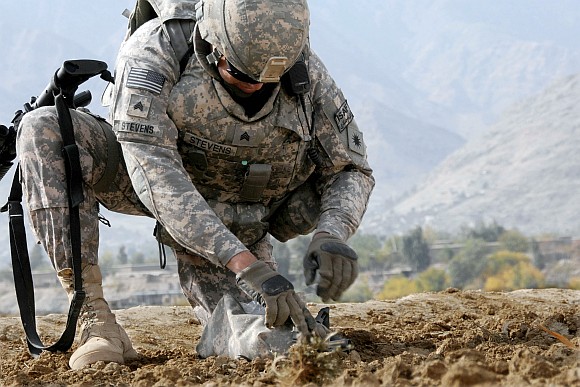
Sgt. Jason Stevens, a horticulturist with the California Army National Guard's 40th Infantry Division Agribusiness Development Team, gathers a soil sample from a field alongside the main road in Marawara, Afghanistan, Nov. 23, 2009. The ADT stopped in Marawara to meet with local farmers about their crop output and farming in the area, as well as to gather soil samples to learn how crop production might be increased in the area.

If wars could be won through slick advertising, no one would be better qualified to become the US commander in Afghanistan than General David Petraeus.

This is how he recently encapsulated his wisdom on counterinsurgency:

We have learned above all that, in campaigns such as those in Iraq or Afghanistan, the human terrain is the decisive terrain. We have to understand the people, their culture, their social structures and how systems to support them are supposed to work — and how they do work. And our most important tasks have to be to secure and to serve the people, as well as to respect them and to facilitate the provision of basic services, the establishment of local governance and the revival of local economies.

That’s a fine wish list — and to be fair, Petraeus makes no claims about the success of the US military in accomplishing these aims. Indeed, he concedes that success in the war is likely to go to whichever side is swifter to learn and adapt.

It might not quite rise to the level of being a law of physics, but the capacity for massive organizations to swiftly learn and adapt is about as great as the ability of oil tankers to make sudden U-turns. It doesn’t matter who’s in charge or how gifted he might be in charming the US Congress.

But Petraeus’ problems run deeper than the structural limitations of the military. As Andrew Bacevich makes clear, the US military is now suffering the corrupting effect of endless war. Far from seeing Gen Stanley McChrystal’s recently revealed contempt for civilian command as exceptional, Bacevich sees strong indications that the problem is systemic.

In the seemingly endless wars of the post-Sept. 11 era, a military that has demonstrated remarkable durability now shows signs of coming undone at the top. The officer corps is losing its bearings.

Americans might do well to contemplate a famous warning issued by another frustrated commander from a much earlier age.

“We had been told, on leaving our native soil,” wrote the centurion Marcus Flavius to a cousin back in Rome, “that we were going to defend the sacred rights conferred on us by so many of our citizens [and to aid] populations in need of our assistance and our civilization.” For such a cause, he and his comrades had willingly offered to “shed our quota of blood, to sacrifice our youth and our hopes.” Yet the news from the homeland was disconcerting: The capital was seemingly rife with factions, treachery and petty politics. “Make haste,” Marcus Flavius continued, “and tell me that our fellow citizens understand us, support us and protect us as we ourselves are protecting the glory of the empire.”

“If it should be otherwise, if we should have to leave our bleached bones on these desert sands in vain, then beware of the anger of the legions!”

Stanley McChrystal is no Marcus Flavius, lacking the Roman’s eloquence, among other things. Yet in ending his military career on such an ignominious note, he has, however clumsily, issued a warning that deserves our attention.

The responsibility facing the American people is clear. They need to reclaim ownership of their army. They need to give their soldiers respite, by insisting that Washington abandon its de facto policy of perpetual war. Or, alternatively, the United States should become a nation truly “at” war, with all that implies in terms of civic obligation, fiscal policies and domestic priorities. Should the people choose neither course — and thereby subject their troops to continuing abuse — the damage to the army and to American democracy will be severe.

Whether for an individual or an nation, change often hinges on reaching a point where the status quo is intolerable.

Over the last decade, perpetual war, far from becoming less tolerable has on the contrary become easier to ignore. It is the backdrop to normalcy — just like climate change — in a culture that barely has any sense of gravity.

Facebooktwittermail