Yearly Archives: 2010

Remember the illegal destruction of Iraq?

Remember the illegal destruction of Iraq?

British political news has been consumed for the last several weeks by a formal inquiry into the illegality and deceit behind Tony Blair’s decision to join the U.S. in invading Iraq. Today, Blair himself is publicly testifying before the investigative commission and is being grilled about numerous false claims he made in the run-up to the war, not only about Iraqi weapons programs (his taxi-cab-derived “45-minutes-to-launch!!” warning) and Saddam’s ties to Al Qaeda, but also about secret commitments he made to join the U.S. at a time when he and Bush were still pretending that they were undecided and awaiting the outcome of the U.N. negotiations and the inspection process.

A major focus of the investigation is the illegality of the war. Some of the most embarrassing details that have emerged concern the conclusions by the British Government’s own legal advisers that the invasion of Iraq would be illegal without U.N. approval. The top British legal officer had concluded that the war would be illegal, only to change his mind under substantial pressure shortly before the invasion. Several weeks ago, a formal investigation in the Netherlands — whose government had supported the invasion — produced the first official adjudication of the legality of the war, and found it illegal, with “no basis in international law.”

As Digby notes, all of this stands in stark and shameful contrast to the U.S., which pointedly refuses to “look back” or concern itself with whether it waged an illegal (and horribly destructive) war. The British inquiry has been widely criticized for being too passive and deferential and lacking any credible threat of accountability (other than disclosure of facts). Still, one can barely even imagine George Bush and Dick Cheney being hauled before an investigative body and forced, under oath, to testify publicly about what they did as a means of determining the legality or illegality of that war. [continued…]

Facebooktwittermail

Goodbye Howard Zinn

Goodbye Howard Zinn

Howard Zinn, the Boston University historian and political activist who was an early opponent of US involvement in Vietnam and the author of the seminal A People’s History of the United States, died today at the age of 87 of a heart attack in Santa Monica, California. He was in a swimming pool doing laps and was spotted immediately by lifeguards but died instantly.

Zinn’s brand of history put common citizens at the center of the story and inspired generations of young activists and academics to remember that change is possible. As he wrote in his autobiography, You Can’t Be Neutral on a Moving Train (1994), “From the start, my teaching was infused with my own history. I would try to be fair to other points of view, but I wanted more than ‘objectivity’; I wanted students to leave my classes not just better informed, but more prepared to relinquish the safety of silence, more prepared to speak up, to act against injustice wherever they saw it. This, of course, was a recipe for trouble.”

Watch these videos to get a sense of what we’ve lost.


[continued…]

Facebooktwittermail

If I were Jewish…

If I were Jewish…

We live with the feeling that death is always with us. Whether that feeling is good or not, I don’t know. It is always hanging over us, and here in Auschwitz you see how it became an industry, an industry of death. The Germans started it all and we are perpetuating it.

I thought a lot about whether this March of the Living is good or bad, this death industry…

We perpetuate death, and that’s why we will never become a normal people, because we emphasize death and what happened. We have to remember, no doubt, but we live too much in it, and it is preventing us from being normal people.
~ An Israeli assistant class teacher accompanying a party of Israeli teenagers on a March of the Living trip Poland.

There’s a kind of pathological narcisism, navel contemplation, when you are the richest, wealthiest, most successful ethnic group in the United States — you’ve got the world on a platter — and you sit around and you’re talking about anti-Semitism, it’s just kind of shameful I think.
~ Norman Finkelstein

If I were Jewish…

There will no doubt be some Jewish readers who see that line and instantly take offense.

You cannot know, cannot understand, cannot truly grasp what it means to have the experience of being Jewish. Why? Because of the Holocaust. Because this happened to my people, not yours.

To a degree I have to respect that point of view. Indeed, my response to the Holocaust is one that centers on a dread of human brutality rather than what it would mean to identify myself as belonging to a persecuted people.

Yet the thought, “if I was Jewish…” was triggered by watching a remarkable film: Defamation.

This documentary by the Israeli film-maker Yoav Shamir came out early last year and now it can and should be viewed in its entirety at PULSE.

If I were Jewish and a parent and I had a teenage son or daughter who came and asked me, which of these two films do you think it is most important that I watch: Schindler’s List or Defamation? I’d say: it depends whether you prefer to be told about or to reflect upon who you are.

Yoav Shamir’s film, at turns profound and irreverent, is above all a call for reflection on the meaning of Jewish identity. Among its many insights is that for many secular Jews the Holocaust now serves as a buttress against a loss of identity.

Perhaps most disturbing is to witness young Israelis going through an indoctrination process in which the Holocaust and the specter of anti-Semitism are being used to keep fear and hatred alive.

In the following segment, teenage Israelis are being prepared for a trip to Poland where they are told they will need the protection of secret service agents and should avoid contact with the locals:

Later in the film, Shamir talks to a girl about her reaction to visiting Auschwitz and she describes the hatred it evokes. She says:

When you see it you say: ‘I want to kill the people who did this!’…

Who would you like to kill?

Who would I like to kill? All of them…

Who is all of them?

The Nazis, our enemies who did this.

But you know they are dead…

Yes, but they have heirs, they may be different but they’re there.

Never forgive, never forget — an expression that has been turned into a mantra as though this is the only way of remembering and honoring the dead. In reality it has become a chain of anger, anchored to the past.

Ultimately the question of what it means to be Jewish is a question whose answer matters as much to the non-Jew as it does to the Jew.

If either believes that this identity is circumscribed by an unbridgeable divide then we will indeed have an unending conflict.

Facebooktwittermail

Did The American Conservative just get hacked by Zionists?

Did The American Conservative just get hacked by Zionists?

Philip Weiss drew my attention to an article that caught Andrew Sullivan‘s eye: Jihadism, anti-Jihadism and Palestine by Daniel Larison. It appears at Pat Buchanan’s The American Conservative. But if you follow the link at this time (1.20 PM Eastern) you won’t find much — just a GoDaddy.com placeholder.

TAC got hacked. By who?

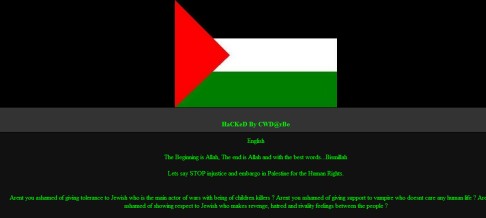
This is where it gets interesting. The Google cache page shows this — a statement by an ostensibly Turkish pro-Palestinian hacker/group. Here’s a screenshot:

If that looks familiar it’s probably because you read about the hacking of The Jewish Chronicle in Britain a week ago. The text and image appear to be the same:

There is one difference — the claim of authorship. The hackers of the Chronicle identified themselves as “PALESTINIAN MUJAHEEDS” whereas the TAC hackers used this name: “HaCKeD By CWD@rBe”.

So what can we infer? Some Turkish pro-Palestinians don’t know much about the American media? Perhaps.

The American Conservative is certainly a counter-intuitive target to pick. It’s one of the few American publications that acknowledges the legitimacy of the Palestinian cause and it is by no stretch of the imagination an Israel-friendly publication.

So who might the Palestinian Mujaheeds be? A Google search indicates that the name had never shown up until the Jewish Chronicle attack.

The equation between Palestinians and Mujahadins is a strange one to make — unless that is you happen to be an anti-Jihadist of the type that figures in Daniel Larison’s article. He writes:

The Palestinian cause generates remarkable reactions in Western anti-jihadists. For most of them, it is an article of faith that Palestinians, or at least the organized factions that speak for them, are just about as bad and hostile to “the West” as Al Qaeda itself, and so there is no point in attempting to make any deal with them. As far as they are concerned, the correct response is to back Israeli policies to the hilt, and to throw up as many obstacles to anyone here at home who would attempt to use U.S. influence to change those policies. The Bush-era habit of lumping together every Islamic revolutionary, militant and terrorist group under some catch-all term of “Islamofascism” made it easier to lump all these causes together, which is oddly enough exactly what jihadists would like, and once they were lumped together they could be that much more easily demonized together.

Now is that the kind of statement that a pro-Palestinian Turk believes should be blocked from public viewing? It’s conceivable but rather improbable. Much more plausible is the idea that a pro-Israeli hacker finds the expression of such views particularly unpalatable.

It’s not always possible to judge who you are dealing with simply by seeing the colors on the flag that they choose to waive.

Meanwhile, as TAC deals with the damage done by “HaCKeD By CWD@rBe”, be sure to look at Daniel Larison’s piece which I’ve reposted here. It’s essential reading.

Facebooktwittermail

Jihadism, anti-Jihadism and Palestine

Jihadism, anti-Jihadism and Palestine

A lot of ink has been spilled since 9/11 trying to argue that bin Laden doesn’t really care about Palestine. But that’s always been silly — nobody knows what he “really” cares about, and it doesn’t especially matter since he talks about it a lot and presents it as a major part of his case against the United States. An Israeli-Palestinian peace agreement surely would not convince bin Laden or al-Qaeda and its affiliated movements to give up their jihad — but it would take away one of their most potent arguments, and one of the few that actually resonates with mass publics. Marc Lynch (via Andrew)

One of the reasons there has been a consistent effort to deny that Bin Laden has any “real” interest in the Israeli-Palestinian conflict is that such an interest, sincere or not, suggests jihadist groups are fueled by U.S. and allied policies, or at least that they successfully exploit U.S. and allied policies for propaganda purposes. Washington would then be faced with at least one of two unpalatable truths. Either our policies are correct and necessary, but strategically disastrous in their effects on Arab and Muslim public opinion and jihadist recruiting, or they are and incorrect and unnecessary while also being strategically disastrous. Washington would then have to decide if it wants to live with perpetual, low-level conflict occasionally exploding into major military campaigns every decade, or if it wants to make enough policy changes (and push our allies to make similar changes) to reduce that conflict to a bare minimum.

For most of the last decade, our preference in and out of government has been to deny that U.S. and allied policies had anything to do with jihadist attacks and their ability to recruit and win sympathizers. This acknowledgement would be to “blame the victim,” so that even if it were the correct analysis it was politically incorrect to say it out loud. Instead we have been treated to a whole host of explanations for why jihadist violence exists and why it tends to be directed at the U.S. and our allies. The lamest of these has been rather popular, namely the claim that “they hate us for our freedom,” or modernity or secularism or whatever it is that the person making the argument finds worthwhile about the West and sees lacking in Muslim countries. Then, of course, there is the trusty appeal to the enemy’s insanity. Unlike us, they are not really rational, and so their actions cannot be explained by referring to anything so mundane and normal as political grievances.

Finally, there is the religious essentialist argument that jihadism is what Islam requires at its core, and therefore there is no way to weaken it without some dramatic transformation of the entire religion. This last argument has won more sympathizers because the people trying to challenge it inevitably go to the opposite extreme and simply ignore or dismiss past Islamic conquests as having nothing to do with Islam. If the essentialist argument really held up, however, Algerians would still be attacking France, Central Asian Muslims would still be warring against the Russians, and Saudis would have been attacking American targets long before the 1990s. We do see cases where separatist movements involving Muslim populations’ breaking away from non-Muslim states become intertwined with and dependent on jihadist groups, because these are the groups providing assistance and because they lend an extra religious and ideological veneer to the conflict that wins the separatists more sympathy abroad. As a general rule, when the cause of the political grievances has disappeared, violent resistance also disappears.

Anti-jihadists like to invoke one or more of these arguments. I am reminded again of a quote from George Kennan in which he described the flaws of the popular anticommunism of his day. His words apply to popular anti-jihadism almost perfectly:

They distort and exaggerate the dimensions of the problem with which they profess to deal. They confuse internal and external aspects of the communist threat. They insist on portraying as contemporary things that had their actuality years ago [bold mine-DL]….And having thus incorrectly stated the problem, it is no wonder that these people consistently find the wrong answers.

Even when anti-jihadists are willing to acknowledge that Al Qaeda uses the grievances of Muslim populations in Iraq or Palestine for propaganda purposes, they will usually hold that changing policy or addressing those grievances to minimize the effectiveness of the propaganda is a form of capitulation. We are supposed to be engaged in “global counterinsurgency,” but we must take little or no account of the stated motivations of jihadists and the reasons why many millions more sympathize with their immediate goals while often deploring the means they use.

The Palestinian cause generates remarkable reactions in Western anti-jihadists. For most of them, it is an article of faith that Palestinians, or at least the organized factions that speak for them, are just about as bad and hostile to “the West” as Al Qaeda itself, and so there is no point in attempting to make any deal with them. As far as they are concerned, the correct response is to back Israeli policies to the hilt, and to throw up as many obstacles to anyone here at home who would attempt to use U.S. influence to change those policies. The Bush-era habit of lumping together every Islamic revolutionary, militant and terrorist group under some catch-all term of “Islamofascism” made it easier to lump all these causes together, which is oddly enough exactly what jihadists would like, and once they were lumped together they could be that much more easily demonized together.

On the whole, it seems that the more sympathetic to or at least understanding of Palestinian grievances a Western observer is, the less willing he is to endorse standard anti-jihadist arguments. Likewise, the more one agrees with anti-jihadist arguments, the more reflexively hostile to Palestinian grievances one tends to be. When most Western anti-jihadists hear that Bin Laden has tied the Christmas bomber attack to the cause of Palestine and specifically to the treatment of Gaza, or when they learn that the bomber who killed the seven CIA operatives claimed that the Gaza operation early last year had driven him to jihadism, the conclusion they draw is not that there was and is something wrong with U.S. and Israeli policies with respect to Palestinians. There is no sudden revelation that the inexcusable blockade of Gaza is politically unwise as well as morally wrong.

On the contrary, the support Bin Laden expresses for the Palestinian cause makes that cause seem to most Western anti-jihadists to be that much more indistinguishable from Al Qaeda’s goals and therefore that much more antithetical to Western interests. This might very well be another purpose in Bin Laden’s exploitation of Palestinian grievances: to harden Western audiences against Palestinian claims even more by linking his cause to Palestine, which will make Americans in particular less interested in supporting an administration that tries to exert pressure in support of a peace settlement. Bin Laden would like to appropriate the Palestinian cause, which Palestinians definitely do not want, and most Western anti-jihadists would like nothing more than to let him have it. So while Lynch is right that resolving this conflict would deprive jihadists of one of their great sources of effective propaganda, our own anti-jihadists will do their utmost to thwart all efforts to that end.

Facebooktwittermail

The sanctity of military spending

The sanctity of military spending

In sum, as we cite our debtor status to freeze funding for things such as “air traffic control, farm subsidies, education, nutrition and national parks” — all programs included in Obama’s spending freeze — our military and other “security-related” spending habits become more bloated every year, completely shielded from any constraints or reality. This, despite the fact that it is virtually impossible for the U.S. to make meaningful progress in debt reduction without serious reductions in our military programs.

Public opinion is not a legitimate excuse for this utterly irrational conduct, as large percentages of Americans are receptive to reducing — or at least freezing — defense spending. A June, 2009 Pew Research poll asked Americans what they would do about defense spending, and 55% said they would either decrease it (18%) or keep it the same (37%); only 40% wanted it to increase. Even more notably, a 2007 Gallup poll found that “the public’s view that the federal government is spending too much on the military has increased substantially this year, to its highest level in more than 15 years.” In that poll, 58% of Democrats and 47% of Independents said that military spending “is too high” — and the percentages who believe that increased steadily over the last decade for every group.

The clear fact is that, no matter how severe are our budgetary constraints, military spending and all so-called “security-related programs” are off-limits for any freezes, let alone decreases. Moreover, the modest spending freeze to be announced by Obama tomorrow is just the start; the Washington consensus has solidified and is clearly gearing up for major cuts in Social Security, Medicare and Medicaid, with the dirty work to be done by an independent “deficit commission.” It’s time for “everyone” to sacrifice and suffer some more — as long as “everyone” excludes our vast military industry, the permanent power factions inside the Pentagon and intelligence community, our Surveillance and National Security State, and the imperial policies of perpetual war which feed them while further draining the lifeblood out of the country. [continued…]

Obama liquidates himself

A spending freeze? That’s the brilliant response of the Obama team to their first serious political setback?

It’s appalling on every level.

It’s bad economics, depressing demand when the economy is still suffering from mass unemployment. Jonathan Zasloff writes that Obama seems to have decided to fire Tim Geithner and replace him with “the rotting corpse of Andrew Mellon” (Mellon was Herbert Hoover’s Treasury Secretary, who according to Hoover told him to “liquidate the workers, liquidate the farmers, purge the rottenness”.)

It’s bad long-run fiscal policy, shifting attention away from the essential need to reform health care and focusing on small change instead.

And it’s a betrayal of everything Obama’s supporters thought they were working for. Just like that, Obama has embraced and validated the Republican world-view — and more specifically, he has embraced the policy ideas of the man he defeated in 2008. A correspondent writes, “I feel like an idiot for supporting this guy.” [continued…]

Obama would ‘rather be really good one-term president’

President Obama, buffeted by criticism of his massive health care reform bill and election setbacks, said today he remained determined to tackle health care and other big problems despite the political dangers to his presidency.

“I’d rather be a really good one-term president than a mediocre two-term president,” he told ABC’s “World News” anchor Diane Sawyer in an exclusive interview today. [continued…]

Editor’s Comment — As though he’s in a men’s store trying out a new suit for size, Obama’s trying on the One-Termer — wants to see if he likes the cut.

If as a bold political choice this president was to make a commitment not to run for re-election, that could be a decisive way of breaking free from the stranglehold of powerful interest groups. But with this statement, as in so many others, there’s nothing bold about what Obama is doing.

Bob Herbert, who is clearly clutching hold of the last straws of hope, sees tomorrow’s State of the Union speech as an slim opportunity for the renewal of faith: “Americans want to know what he stands for, where his line in the sand is, what he’ll really fight for, and where he wants to lead this nation. They want to know who their president really is.”

This really is the most damning statement: that after one year Americans have less of a sense of who occupies the White House than they did before he took office – back when he was perceived as an unknown.

The One-Termer — Obama doesn’t need to decide whether it’s a good fit or he can afford it — they’re giving them away for free. Try it on and it’s yours for keeps.

Facebooktwittermail

U.S. mulls legality of killing American al Qaeda “turncoat”

U.S. mulls legality of killing American al Qaeda “turncoat”

White House lawyers are mulling the legality of proposed attempts to kill an American citizen, Anwar al Awlaki, who is believed to be part of the leadership of the al Qaeda group in Yemen behind a series of terror strikes, according to two people briefed by U.S. intelligence officials.

One of the people briefed said opportunities to “take out” Awlaki “may have been missed” because of the legal questions surrounding a lethal attack which would specifically target an American citizen. [continued…]

Editor’s Comment — I’m not a lawyer, but isn’t this the way it works? If someone has an Arabic name, then citizenship is secondary. So long as they are “taken out” overseas, preferably in a state or area with a reputation for lawlessness, then legal process fits comfortably into the tip of a Hellfire missile. Extra latitude is of course provided when the “target” is not white.

But maybe the Justice Department could provide a little extra clarity — some new designations in citizenship status just so everyone understands which American citizens can be executed on the basis of a presidential order and which can’t. As for non-Americans, well, America has always reserved the right to kill them as and when it sees fit.

The drone surge

One moment there was the hum of a motor in the sky above. The next, on a recent morning in Afghanistan’s Helmand province, a missile blasted a home, killing 13 people. Days later, the same increasingly familiar mechanical whine preceded a two-missile salvo that slammed into a compound in Degan village in the tribal North Waziristan district of Pakistan, killing three.

What were once unacknowledged, relatively infrequent targeted killings of suspected militants or terrorists in the Bush years have become commonplace under the Obama administration. And since a devastating December 30th suicide attack by a Jordanian double agent on a CIA forward operating base in Afghanistan, unmanned aerial drones have been hunting humans in the Af-Pak war zone at a record pace. In Pakistan, an “unprecedented number” of strikes — which have killed armed guerrillas and civilians alike — have led to more fear, anger, and outrage in the tribal areas, as the CIA, with help from the U.S. Air Force, wages the most public “secret” war of modern times.

In neighboring Afghanistan, unmanned aircraft, for years in short supply and tasked primarily with surveillance missions, have increasingly been used to assassinate suspected militants as part of an aerial surge that has significantly outpaced the highly publicized “surge” of ground forces now underway. And yet, unprecedented as it may be in size and scope, the present ramping up of the drone war is only the opening salvo in a planned 40-year Pentagon surge to create fleets of ultra-advanced, heavily-armed, increasingly autonomous, all-seeing, hypersonic unmanned aerial systems (UAS). [continued…]

Facebooktwittermail

The meaning of the Eikenberry cables

The meaning of the Eikenberry cables

It was apparent as early as the summer of 2009 that Obama had no political choice but to throw in his lot with Petraeus and McChrystal and the “full-up” commitment of troops. Only a more far-sighted regard for prudence could have drawn him the other way.

And, in fact, Obama went in even faster than the generals asked him to; and he did so, we now can see, in open disregard of the practical wisdom of the Eikenberry cables. He did it on the supposition that the sooner he went in big, the sooner he could get out big. In a flattering article by Peter Baker on the “process” of the troop decision, President Obama was quoted as saying, of a left-to-right time chart of contemplated troop deployments: “I want this pushed to the left.” That is, move them in faster. Make the whole thing fast so we can have a credible ending by 2011. But Ambassador Eikenberry had already told him why “pushing” the graph in this way was a fantasy — a case of wishful thinking to the point of irresponsibility.

It is inconceivable that a president acting on a candid estimate of the commitment he was requiring of his country, would, in response to the Eikenberry cables, finally have bowed to the generals. No one could have done so whose guiding light was prudence and the direction of a wise policy. What drove this decision, instead, was Barack Obama’s desire for an appearance of conventional solidity. He had said so many times that Afghanistan was the right war. How could he unsay it? [continued…]

Facebooktwittermail

Haiti: Obama’s Katrina — and Israel’s mission accomplished

Haiti: Obama’s Katrina

Four years ago the initial medical response to Hurricane Katrina was ill equipped, understaffed, poorly coordinated and delayed. Criticism of the paltry federal efforts was immediate and fierce.

Unfortunately, the response to the latest international disaster in Haiti has been no better, compounding the catastrophe.

On Tuesday, Jan. 12, a major earthquake overwhelmed a country one hour south of Miami whose inhabitants include American citizens and their relatives. Thanks to the Internet, pictures of the death and destruction were familiar to the world within hours, and the need for a massive influx of relief and specialized medical care was instantaneously apparent. While particular fatalities such as head injuries or massive blood loss are rarely treatable in mass casualty situations, delayed deaths from infection may be preventable.

On Wednesday, the day after the quake, we organized a relief team in cooperation with the U.S. State Department and Partners in Health (a Boston-based humanitarian organization) to provide emergency orthopedic and surgical care. We wanted to reach the local hospitals in Haiti immediately—but were only allowed by the U.S. military controlling the local airport to land in Port-au-Prince Saturday night. We were among the first groups there. [continued…]

Israeli team preparing to leave Haiti

The Israeli medical and rescue team in Haiti will finish operations on the devastated island nation in the next few days, according to the Israel Defense Forces.

The team’s members are set to return to Israel by Thursday.

The decision to bring the team home came after the arrival of additional aid forces to Haiti, including military and civilian assistance from the United States that is now providing regular medical services, according to a statement released Monday by the IDF. Local hospitals also are functioning as well. [continued…]

Facebooktwittermail

International Holocaust Day becomes Attack Goldstone Day

Israel: Goldstone Report anti-Semitic

The world will mark International Holocaust Day on Wednesday. Monday will see President Shimon Peres fly to Berlin and Prime Minister Benjamin Netanyahu leave for a visit to the Auschwitz death camp in Poland. They will be joined by Foreign Minister Avigdor Lieberman in Budapest and Information Minister Yuli Edelstein in New York.

Before meeting with United Nations Secretary-General Ban Ki-moon, Edelstein referred to the report accusing Israel of committing war crimes in Gaza, calling it “anti-Semitic”.

Israel’s political echelon plans to slam then distortions in the Goldstone Report on International Holocaust Day of all days, in order to point to an anti-Semitic trend which blames the victims of Palestinian rockets. [continued…]

Editor’s Comment — 2009 saw a record number of anti-Semitic attacks – especially after the release of the Goldstone Report… well, no, it was actually in the three months immediately after the war on Gaza. I guess Judge Goldstone just got swept up in the rise in anti-Semitism.

The war on Gaza couldn’t possibly have driven the rise in anti-Semitism. Or could it? I wonder…

Benjamin Netanyahu: Israel will never quit settlements

The Israeli prime minister has taken part in tree-planting ceremonies in the West Bank while declaring Israel will never leave those areas.

Benjamin Netanyahu said the Jewish settlements blocs would always remain part of the state of Israel.

His remarks came hours after a visit by US envoy George Mitchell who is trying to reopen peace talks between Israel and Palestinians.

A Palestinian spokesman said the comments undermined peace negotiations.

“Our message is clear: We are planting here, we will stay here, we will build here. This place will be an inseparable part of Israel for eternity”, the prime minister said. [continued…]

Does Israel have an immigrant problem?

TThe presence of a large, non-Jewish population [of foreign workers] in the Jewish state stirs great unease. In November, Finance Minister Yuval Steinitz blamed foreign workers for a rise in unemployment and a “widening of social gaps”; the mayor of Eilat, Meir Yitzhak Halevi, recently called them a “burden on the welfare authorities.” He added: “They consume alcohol and have introduced cases of severe violence.” The situation is routinely described in the media as a ticking social time bomb. The military estimates that as many as 1 million Africans could try to cross into Israel (though the Office of the U.N. High Commissioner on Refugees puts the number at 45,000).

Responding to such concerns, Prime Minister Benjamin Netanyahu announced on Jan. 10 that Israel will build two fences along the Egyptian border — one around Eilat, the other near Gaza — in the hope of staunching the flow of “infiltrators and terrorists.” Construction is expected to take several years, and the fence will be entirely on Israeli territory. Netanyahu also directed the Justice Ministry to formulate a plan to sanction businesses that hire illegal immigrants. “This is a strategic decision to ensure the Jewish and democratic character of the state of Israel,” Netanyahu said. “Israel will remain open to war refugees but we cannot allow thousands of illegal workers to infiltrate into Israel via the southern border and flood our country.” There is reason to be skeptical. For two decades, Israeli policy toward foreign workers and refugees, has been widely regarded as a complete failure.

Foreign workers first arrived in Israel in the late 1980s to address a sudden labor shortage caused by the outbreak of the first Intifada. Following the Six Day War in 1967, Israel issued work permits to Palestinians for menial, low-wage jobs, primarily in construction and agriculture. By 1987, the year the Intifada began, Palestinians comprised nearly 8 percent of the Israeli labor force. The uprising, which prevented Palestinians from traveling back and forth to jobs inside Israel, threw the economy into crisis. In response, the Israeli government began to import workers from abroad. By 2000, foreign workers comprised 12 percent of the Israeli workforce. [continued…]

Facebooktwittermail

Iran opposition leaders drop demand for new election

Iran opposition leaders drop demand for new election

Two of Iran’s opposition leaders, Mohammed Khatami and Mehdi Karroubi, appear to have dropped their demand for a new presidential election, saying that while they still believe the vote in June was fraudulent, they accept Mahmoud Ahmadinejad as the head of state, according to Iranian news services.

The statements from Mr. Karroubi, a former presidential candidate and speaker of Parliament, and Mr. Khatami, a former president, follow the lead of Mir Hussein Moussavi, another opposition leader, who on New Year’s Eve criticized the government but offered a prescription for solving the political crisis that for the first time did not include holding a new vote.

The recent statements, however, may have spread more confusion than clarity amid the smoldering political crisis that began in June when the government declared that President Ahmadinejad had won in a landslide. At the same time Mr. Karroubi’s statement was made public, his political party, Etemad Melli, issued a call for a “free election.” [continued…]

Facebooktwittermail

Baghdad blasts shatter sense of security in capital

Baghdad blasts shatter sense of security in capital

In a coordinated attack as devastating as it was ruthlessly efficient, three bombs unleashed minutes apart on Monday wrecked landmark Baghdad hotels catering to foreigners, wilting a tattered sense of security and underscoring the uncertainty of the political landscape weeks before parliamentary elections.

The bombings, which killed 36 people and wounded 71, seemed to be the latest chapter of a campaign that began in August and that has hewn to a relentlessly political logic. With similar attacks in August, October and December, insurgents have sought to wreck pillars of Baghdad’s government and civic life, proving that the government and its security forces are unable to preserve the state’s fledgling authority.

The targets on Monday were hotels that served foreign journalists and expatriate businessmen, and they were soon to house observers of the March 7 parliamentary elections, suggesting that the attack was aimed as much at shaping opinions abroad of the government’s durability as it was aimed at wreaking destruction.

“The attackers wanted to send a message to the world,” said Hazim al-Nuaimi, a political analyst here. “The message is that Iraq can’t provide security for foreigners.” [continued…]

Facebooktwittermail

Does Gilbert Bigio make Israel look good?

Does Gilbert Bigio make Israel look good?

When Amos Radian, Israel’s Dominican Republic-based ambassador to the nations of the eastern Caribbean, spoke to the Jerusalem Post last week, he was unequivocal in expressing appreciation towards the Bigio family.

Gilbert Bigio, a Syrian Jew and honorary consul for Israel in Haiti also happens to be among the wealthiest men in that impoverished nation. The day before Israel’s relief team was due to arrive in Haiti, Ambassador Radian spoke to Reuven Shalom Bigio, son of the business magnate.

“Tomorrow the Israel Air Force is coming with two jets and 250 people and I have no place to put them,” Radian told Bigio. The response was swift as the Israelis were provided with Bigio-owned land to set up a field hospital. Radian said that the assistance provided “made us look so good”.

The billionaire industrialist’s loyalty to Israel is unquestionable. As the Jerusalem Post report said:

Gilbert Bigio’s own father came to Haiti in 1925 and was active in the Jewish community. He played a role in Haiti’s support for Israeli statehood in the November 1947 vote at the United Nations.

“Being in a city where there’s no synagogue, prayers are done at our house, Israel to us is the motherland. It’s the rock. It’s how we identify ourselves,” said Reuven Bigio. His father’s support for Israel’s mission here was immediate: “His desire to help was unconditional.”

Does the Bigio family have an unconditional desire to help Haitians? Not as far as one can tell.

In 2004, the Miami Herald reported on Haiti’s tiny and wealthy Jewish community and spoke to its de facto leader. Bigio saw no reason why the huge disparity between his own wealth and the poverty of those around him should breed in them any resentment.

Bigio, 68, lives in a big, beautiful house in Petionville, one of the few upscale neighborhoods in Port-au-Prince. Behind the well-guarded house is a luxurious swimming pool and a gazebo for outdoor parties.

Like most of the other Jews who remain in Haiti, Bigio is considered extremely wealthy in a country where 50 percent of the population is illiterate and 76 percent of children under 5 are underweight or suffer from stunted growth.

“I don’t think there’s resentment against people who are rich here,” says the retired businessman, who speaks English, French and Haitian Creole. “If you know how to manage success, people admire you instead of hate you.”

Cite Soleil, a seaside shantytown of more than 300,000 people residing in homes made of cinder blocks with tin roofs, has been described as poorer than India’s infamous slums of Calcutta. It is also the home of the Bigio business empire.

“Our purpose is to improve the quality of life of the communities we reach,” the GB Group says in its mission statement. A Haiti Information Project report from Cite Soleil published in January 2008 suggests otherwise.

While the surrounding residents of Cite Soleil are forced to literally eat dirt to stave off hunger, Bigio is a billionaire whose family supported the first coup against Aristide and reportedly helped to back the movement that forced his second ouster in 2004.

One need not look very far to see where Gilbert Bigio’s interests lie in relation to Cite Soleil. According to his own company’s web site his family maintains controlling interests in sixteen of Haiti’s largest companies. They are also the largest Haitian partner in the wireless communications giant Digicel, a mammoth company based in Ireland that has nearly cornered the cellular market in the Caribbean. Bigio’s family is not merely wealthy amidst a sea of poverty stricken residents in Haiti, his family represents the Über-wealthy who have benefited most since Aristide’s second ouster in 2004.

The Office of Foreign Assets Control of the US government blocked all of the Bigio family’s holdings in US banks following the brutal military coup against Aristide in 1991. Since Aristide’s second ousting in 2004, the financial wealth of the Bigio family along with those of other well off Haitian clans such as the Mevs, Brandts, Acras and Madsens have nearly doubled according to a confidential source at a private accounting firm.

Meanwhile, Israel’s image-boosting relief effort in Haiti is about to wrap up its operations – its medical and rescue team is set to return home by Thursday.

Facebooktwittermail

Israel at war

Israel at war

Yesterday I called attention to an article in Hebrew (appearing on an Israeli website) with the extraordinary headline: “The painful truth: Haiti’s disaster is good for the Jews.” Shmuel Sermoneta-Gertel has now translated the whole article which appears at Mondoweiss. It begins:

At a time when our country is under media attack on the basis of harsh and anti-Semitic reports, and we are forced to contend with terrorists who have assumed the winning image of victims of war, one could say that the Haiti disaster is the best thing that could have happened to us. So why are blood, destruction, poverty, hunger and orphans good for the Jewish State? First of all because global attention has been drawn elsewhere and the international media have a more interesting story to cover. Second, because every disaster-area needs a hero, and right now we are it. I must admit that I would not be surprised if the image aspect of setting up a hospital in Haiti, as well as the IDF rescue efforts, was given greater weight than humanitarian considerations. If I am right, then finally, someone in the Knesset has done the right thing, deciding to take advantage of the opportunity to prove to the world how kindhearted and capable we are. And if the Foreign Ministry manages to make further use of the Israeli success stories in Haiti and market them to the world, all the better. We can only hope that none of our talented politicians is caught in front of a camera saying “We showed the world. We were really awesome in Haiti,” or something like that – a distinct possibility considering the recent mess with the Turks. Better to be modest.

Those in Charge Don’t see Hasbara as Warfare

The tough question raised by our success in Haiti is why we do well in the media only when we have the opportunity to star in another country’s disaster, and not on a regular basis? After all, you can’t have a natural disaster every day. The answer to the question is a lack of concerted effort to garner sympathy from the countries of the world, alongside behaviour that actually creates antagonism, such as humiliating ambassadors on camera. Before criticizing current hasbara practice however, we must realize that our biggest problem lies in the way we approach the entire issue of image. First of all, our elected representatives see themselves as politicians rather than statesmen, and so prefer to focus on their own personal interests, rather than on those of the country. Every Israeli citizen is knows this, to the point that we can’t stand our own leaders, so why does it come as surprise that the rest of the world isn’t too crazy about us either? Second, those in charge of the country’s PR don’t see hasbara as warfare, just like any military operation, intended to safeguard and promote our national and security interests.

Depending on where you stand politically, hasbara is either Israel’s public diplomacy or pro-Israeli propaganda.

Let’s at this juncture set aside the issue of how obscene and self-defeating it is for some Israelis to turn a humanitarian relief effort in Haiti into a schmaltzy stage-show. What strikes me as particularly interesting in the argument that Tamir Haas is clumsily pressing is that once again we see how warfare has become the single lens through which Israelis see the world.

Hasbara is a form of warfare, Haas asserts, and I am reminded of Ariel Siegelman’s presentation of what he called a new kind of war as this American-Israeli reservist last year celebrated “victory” in Gaza:

After the Second Lebanon War, we learned some very valuable lessons. We learned that we had been living in an imaginary world and that the most dangerous type of war is the one that you call peace. We learned that we are not in fact in a “peace process” at all. We are at war…

The war is ongoing, with periods of more violence and periods of less violence, during which the enemy regroups and plans his next attack. When we feel the enemy is getting strong, we must be prepared to make preemptive strikes, hard and fast at key targets, with viciousness, as the enemy would do to us. Only then can we acquire, not peace, but sustained periods of relative calm.

If Tamir Haas and Ariel Siegelman happen to be two relatively unknown Israelis, what should concern those outside Israel is not whether their views exercise much influence but to what extent they reflect a generational mindset.

When war has become the principal force shaping life, there is indeed no peace process.

Facebooktwittermail

How Israel saved the world

How Israel saved the world

Dr Ariel Bar speaking from the Israeli field hospital in Haiti: “When we save the life of one person, we feel that we saved the world. So we saved the world several times in this mission.”

“No one but the Israeli’s have come to help any of our patients that are dying.”

Facebooktwittermail

Securing disaster: The US repeats past mistakes in Haiti

Securing disaster: The US repeats past mistakes in Haiti

One week after the devastating earthquake that struck Haiti on January 12, it’s now clear that the initial phase of the US-led relief operation has conformed to the three fundamental tendencies that have shaped the more general course of the island’s recent history. It has adopted military priorities and strategies. It has sidelined Haiti’s government and ignored the needs of the majority of its people. And it has proceeded in ways that reinforce the already harrowing gap between rich and poor. These three tendencies aren’t just connected, they are mutually reinforcing – and they look likely to continue to govern the imminent reconstruction effort unless determined political action is taken to avoid them.

Haiti is the only country where slaves won their own independence, in a war that left a third of the population dead and the economy in ruins. Today it is not only one of the poorest countries in the world, it is also one of the most polarised and unequal – in terms of wealth as well as access to political power. A small clique of rich and well-connected families continues to dominate the country and its economy, while the vast majority of the population live on less than $2 a day. [continued…]

Haiti earthquake: aid agencies fear child trafficking

Aid agencies continued to warn against adopting children from Haiti today, amid unconfirmed reports that a number of children who had gone missing from hospitals in the devastated country may have been trafficked.

An adviser for Unicef told reporters that about 15 children had disappeared from hospitals, presumed taken.

Jean Luc Legrand was quoted as saying: “Unicef has been working in Haiti for many years and we knew the problem with the trade of children in Haiti which existed before, and unfortunately many of these trade networks have links with the international adoption ‘market’.” [continued…]

More than 150,000 have been buried, Haiti says

Haiti’s government provided a preliminary assessment of the earthquake’s body count on Saturday, putting it at more than 150,000, and declared that the search for survivors trapped in the rubble would soon be coming to an end.

Marie-Laurence Jocelyn Lassegue, Haiti’s culture and communications minister, said that 150,000 bodies from the streets had been collected and buried in the past 11 days.

She also said that there were at least 250,000 people homeless and that 200,000 residents of Port-au-Prince and its outskirts had moved to the provinces since the earthquake hit. [continued…]

Facebooktwittermail

The return of the neocons

The return of the neocons

Technically, there is nothing “neo” about conservatives like Robert Kagan, the historian and another Washington Post columnist, or John Podhoretz, the editor of Commentary; each is a son of one of neoconservatism’s founding fathers. Indeed, no strain in American politics is so dynastic. It is akin to the right-wing Likud Party in Israel, whose religion and politics, world view, and succession rituals the neocons often share. The definitions, and analogy, are inexact, but both groups have recent ties to Europe and are haunted by the Holocaust, which has left them feeling wounded, suspicious, and sometimes bellicose, determined never again to be naive or to trust the world’s good intentions. Both spent decades in the po-litical wilderness before miraculously acquiring power; both begat “princes” who defied the normal generational tensions and allied themselves with their kingly fathers. When Bill Kristol rose to praise Irving that morning, he was really picking up his scepter.

Had you Googled “neoconservative” and “death” that day, four days after the 89-year-old Kristol expired, you’d have found lots on their long-rumored—and for some, much-anticipated and -savored—demise. On both the left and right, neoconservatism was deemed a spent force. Its ideas, Foreign Policy magazine had pronounced, “lie buried in the sands of Iraq.”

But obituaries can be premature. At the moment, in fact, the neocons seem resurrected. One of their own, Frederick Kagan of AEI (Robert’s younger brother), helped turn around the war in Iraq by devising and pushing for the surge there. More recent-ly, President Obama—whose foreign–policy pronouncements (nuanced, multi-lateral, interdependent) and style (low-key, self-critical, conciliatory, collegial) were a repudiation of neoconservative assertiveness—has swung their way, or so they believe. First, he’s sending an additional 30,000 troops to Afghanistan, nearly as many as leading neocons had sought. Then came his Nobel Prize acceptance speech, which, with its acknowledgment of the need for force, its nod to dissidents in Iran and elsewhere, and its talk about good and evil, was surprisingly congenial.

As if on cue, a Nigerian man with explosives in his crotch nearly brought down an American airliner over Detroit on Christmas Day, leaving the neocons feeling further vindicated and energized. Obama, who’d ratcheted up his rhetoric after an initial response that Bill Kristol and other neocons considered too tepid, had been “mugged by reality,” Kristol declared. It was an obvious homage to his father, who’d long ago defined “neocon” as a liberal to whom just that had happened. “Whether they praise or denounce Obama, the neocons are winning,” says Jacob Heilbrunn, a senior editor at The National Interest and author of They Knew They Were Right: The Rise of the Neocons (2008). “They’ve got him embracing the surge in Afghanistan and on the run for being ‘soft on terrorists.’ Either way, he ends up catering to them.” With Obama further weakened by an electoral repudiation in Massachusetts, that process might only intensify. [continued…]

Obama quietly continues to defend Bush’s terror policies

Although the FBI has acknowledged it improperly obtained thousands of Americans’ phone records for years, the Obama administration continues to assert that the bureau can obtain them without any formal legal process or court oversight.

The FBI revealed this stance in a newly released report, troubling critics who’d hoped the bureau had been chastened enough by its own abuses to drop such a position.

In further support of the legal authority, however, the Justice Department’s Office of Legal Counsel backed the FBI in a written opinion issued this month.

The opinion by the OLC — the section that wrote the memos that justified enhanced interrogation techniques during the last administration — appears to be yet another sign that the Obama administration can be just as assertive as Bush’s in claiming sweeping and controversial anti-terrorism powers. [continued…]

CIA deaths prompt surge in U.S. drone strikes

… officials deny that vengeance is driving the increased attacks, though one called the drone strikes “the purest form of self-defense.”

Officials point to other factors. For one, Pakistan recently dropped restrictions on the drone program it had requested last fall to accompany a ground offensive against militants in South Waziristan. And tips on the whereabouts of extremists ebb and flow unpredictably.

A C.I.A. spokesman, Paul Gimigliano, declined to comment on the drone strikes. But he said, “The agency’s counterterrorism operations — lawful, aggressive, precise and effective — continue without pause.”

The strikes, carried out from a secret base in Pakistan and controlled by satellite link from C.I.A. headquarters in Virginia, have been expanded by President Obama and praised by both parties in Congress as a potent weapon against terrorism that puts no American lives at risk. That calculation must be revised in light of the Khost bombing, which revealed the critical presence of C.I.A. officers in dangerous territory to direct the strikes. [continued…]

Editor’s Comment — The question that the New York Times‘ Washington-based reporters (true to form) fail to address is this: If the Khost bombing killed CIA officers who were critical in choosing the targets for drone attacks, how have subsequent targets been chosen? Are we supposed to believe that right in the aftermath of this huge blow to the CIA’s drone operation, a flood of valuable intelligence swept in?

How convenient… and improbable.

Facebooktwittermail

IDF to finally engage Goldstone, day late dollar short

IDF to finally engage Goldstone, day late dollar short

Ethan Bronner writes a N.Y. Times report on a new propaganda offensive by the IDF against the Goldstone Report. It seems Israel has finally decided to engage with the document’s claims that Israel may have committed war crimes during last year’s Gaza war. Of course, it could’ve done so by testifying to the UN investigative body so that Israel’s perspective could’ve been incorporated into the finished document. At the time, Israel evidently judged it could filibuster and disparage this effort, as they have so many previous international attempts to hold Israel accountable for its actions concerning the Palestinians. But for some reason, Goldstone has developed much more staying power than other similar past efforts. [continued…]

Editor’s Comment — Richard Silverstein does a nice job of critiquing the Bronner article — the only other thing I was struck by was the Netanyahu quote naming Israel’s three-pronged axis of evil: “We face three major strategic challenges: The Iranian nuclear program, rockets aimed at our civilians and Goldstone.”

Wow! Richard Goldstone, the diminutive and rather modest judge from South Africa, now poses an existential threat to Israel!

Or am I reading that the wrong way round? Maybe Netanyahu is moderating his rhetoric and conceding that Israel does not actually face external existential threats. Existential threats may well persist, but these would be the ones of Israel’s own making.

Facebooktwittermail