It was not a referendum on Barack Obama, who in every poll remains one of the most popular politicians in America. It was not a rejection of universal health care, which Massachusetts mandated (with Scott Brown’s State Senate vote) in 2006. It was not a harbinger of a resurgent G.O.P., whose numbers remain in the toilet. Brown had the good sense not to identify himself as a Republican in either his campaign advertising or his victory speech.
And yet Tuesday’s special election was a dire omen for this White House. If the administration sticks to this trajectory, all bets are off for the political future of a president who rode into office blessed with more high hopes, good will and serious promise than any in modern memory. It’s time for him to stop deluding himself. Yes, last week’s political obituaries were ludicrously premature. Obama’s 50-ish percent first-anniversary approval rating matches not just Carter’s but Reagan’s. (Bushes 41 and 43 both skyrocketed in Year One.) Still, minor adjustments can’t right what’s wrong.
Obama’s plight has been unchanged for months. Neither in action nor in message is he in front of the anger roiling a country where high unemployment remains unchecked and spiraling foreclosures are demolishing the bedrock American dream of home ownership. The president is no longer seen as a savior but as a captive of the interests who ginned up the mess and still profit, hugely, from it. [continued…]
There is something almost tragi-comic in Hillary Clinton’s use of the Berlin Wall as an analogy for China’s internet censorship. The Chinese Communist Party hardly shares the American view of Cold War history; the implication that unrestrained Googling will bring down authoritarian regimes is unlikely to persuade Beijing that internet censorship is a bad thing.
But while Winston Churchill’s metaphorical “iron curtain” separated western capitalism from the sclerotic planned economies of the socialist world, what lies behind the US secretary of state’s “information curtain” is the world’s most dynamic capitalist economy, providing credit on which the US’s own economy now depends. While the West endures anaemic growth rates and massive unemployment, China’s double-digit stimulus-based recovery is the envy of all.
The transition from third-world agrarian basket case to the world’s second largest economy in just three decades has been overseen by a Communist Party with a monopoly on power and complete dedication to the pursuit of wealth through capitalism. Its response to the recession was to inject hundreds of billions of dollars into infrastructure projects, consumer subsidies and measures to ensure that banks kept on lending.
Despite (indeed, perhaps because of) that programme’s evident success, doom-mongers abound in the western media. China will overheat; its property bubble will burst; it will be dragged down by over-capacity; the absence of democracy will strangle its entrepreneurs. And so on. But these prophecies are not new, and Chinese capitalism has proven remarkably resilient, nurtured by a government that is authoritarian but not unresponsive. [continued…]
The director of a British company that supplies bomb detectors to Iraq has been arrested on fraud charges, and the export of the devices has been banned, British government officials confirmed Saturday.
Iraqi officials reacted with fury to the news, noting a series of horrific bombings in the past six months despite the widespread use of the bomb detectors at hundreds of checkpoints in the capital.
“This company not only caused grave and massive losses of funds, but it has caused grave and massive losses of the lives of innocent Iraqi civilians, by the hundreds and thousands, from attacks that we thought we were immune to because we have this device,” said Ammar Tuma, a member of the Iraqi Parliament’s Security and Defense Committee.
But the Ministry of the Interior has not withdrawn the device from duty, and police officers continue to use them. [continued…]
Despite major bombings that have rattled the nation, and fears of rising violence as American troops withdraw, Iraq’s security forces have been relying on a device to detect bombs and weapons that the United States military and technical experts say is useless.
The small hand-held wand, with a telescopic antenna on a swivel, is being used at hundreds of checkpoints in Iraq. But the device works “on the same principle as a Ouija board” — the power of suggestion — said a retired United States Air Force officer, Lt. Col. Hal Bidlack, who described the wand as nothing more than an explosives divining rod.
Still, the Iraqi government has purchased more than 1,500 of the devices, known as the ADE 651, at costs from $16,500 to $60,000 each. Nearly every police checkpoint, and many Iraqi military checkpoints, have one of the devices, which are now normally used in place of physical inspections of vehicles. [continued…]
Vice President Joseph R. Biden Jr. promised Iraqi leaders on Saturday that the United States would appeal the dismissal of manslaughter charges against five Blackwater Worldwide security contractors involved in a deadly shooting here that has inflamed anti-American tensions.
Mr. Biden, tasked by the Obama administration to oversee policy in Iraq, made the statement after a day of meetings with Iraqi leaders that dealt, in part, with a political crisis that has erupted over the March 7 parliamentary elections. American officials view the vote, a barometer of the durability of Iraq’s political system, as a crucial date in American plans to withdraw tens of thousands of combat troops from Iraq by the end of August.
The vice president expressed his “personal regret” for the Blackwater shooting in 2007, in which contractors guarding American diplomats opened fire in a crowded Baghdad traffic circle, killing 17 people, including women and children.
“A dismissal is not an acquittal,” he said after meeting President Jalal Talabani. [continued…]
After giving up on winning victory in Afghanistan by military means, the international community is resorting to the centuries-old method of buying its way out.
In London this week, Hamid Karzai, the Afghan president, will launch a British and American-backed plan for “reintegration” of the Taliban and call for international funding to offer jobs and bribes to bring insurgents in from the cold.
The conference, which starts on Thursday, will be the first big international gathering on Afghanistan since President Barack Obama announced his military strategy last month, including a surge of 30,000 American troops.
The aim was to accompany the surge with a new political strategy and ways for the Afghans to provide their own security by setting up local militias, which could include former Taliban. [continued…]
Far from being the looting mobs that some media have portrayed them as, hardly anyone who has witnessed the response of the Haitians to this great catastrophe has not been moved by their incredible resilience and solidarity and their intact sense of humor in the face of an unimaginable tragedy.
As all the pillars of the Haitian state — a state that has often seemed only able to rouse itself to parasitically victimize its own people when it did make its presence felt — collapsed around them, the Haitians helped one another, dug through rubble, prayed, sang and showed everyone who has watched them what the meaning of true perseverance in the face of adversity looks like, even though the losses have been tremendous and irreplaceable.
Micha Gaillard, a university professor and son of one of Haiti’s eminent historians, was one of the first political leaders I met while traveling to Haiti, and I recall him greeting me in his modest home in the Turgeau neighborhood as his charming wife, Katy, prepared us coffee. Katy passed away far too early a few years ago, and Micha died after the Palais de Justice collapsed on him, dying in what must have been agony after having been trapped for many hours. Three of the country’s foremost feminist thinkers — Myriam Merlet, Magalie Marcelin and Anne Marie Coriolan — also died that day. The damage to the country’s artistic heritage, from the almost-total collapse of the Episcopal Cathédrale Sainte Trinité, which boasted stunning indigenous murals by such eminent Haitian painters as Wilson Bigaud and Philome Obin, to the loss of much of the Nader art collection, probably the best private collection of Haitian art in the world, is incalculable.
Sometimes since I have returned to Haiti in the immediate aftermath of the earthquake, I have felt as if I would be overcome by despair. Looking at block after block of ruins throughout the capital’s downtown, or seeing the terrible death and destruction caused by the collapse of the Université de Port-au-Prince, ringed by weeping, desperate relatives of those lost, one almost wants to turn away.
But the Haitians, always the Haitians, keep one going, and seeing their dignity in this moment has made me love them and their battered country as never before. [continued…]
Editor’s Comment — Dignity is perhaps the most precious human resource on the planet and its distribution bears no relationship with the distribution of material wealth. Indeed, it is so often to be found in greatest abundance among those who possess the least. That’s why at times such as these, hands reached out in help should also offer respect.
If I came up with a headline claiming the devastation in Haiti is “good for the Jews”, I could reasonably be accused of being anti-Semitic. But it’s not my headline. It comes from this report on a site run by Israel’s popular Hebrew daily, Maariv.
Every disaster needs a hero, the report says, and the heroes in Haiti are the Israelis.
The message that Israel is saving Haiti was likewise captured in an editorial cartoon in Yediot Aharonot which shows American soldiers digging for earthquake survivors. A voice from beneath the rubble calls out, “Would you mind checking to see if the Israelis are available?”
Bnei Akiva, the largest religious Zionist youth movement in the world, in partnership with Latet, an Israeli humanitarian aid organization, launched a Haiti appeal saying: “We are not only helping Haitians with their tragedy, but uniting the Jewish world and demonstrating the Jewish values of the State of Israel. We believe that it is a Jewish duty to help the people of Haiti. As the representative of the Jewish people, the State of Israel is leading the relief effort.”
Over the past week, the work of the Israeli medical team has become a kind of Rorschach for how people view Israel and Israelis. Most of the comment, it must be said, is supportive. Even on the part of those who cast the humanitarian misery in Gaza in contrast.
But for a shocking number of others, the bottom line is simple: Israel, and Israelis, can do no right.
In its most extreme form, there are those who have accused Israel of using the Haiti catastrophe as a new reservoir for harvesting organs.
But even many of those who shun blood libels, have seized on the Haiti mission to bash Israel, revealing in many cases a hatred – and a bigotry – that borders on the visceral.
Would Burston lump me in with the anti-Israel commentators? Maybe.
Do I think the Israeli doctors, nurses and rescue teams now working in Haiti are all toiling away purely in the service of Israel’s international image? I doubt it. I would expect that for most of these individuals, their response is like that of most of the other foreigners now providing relief to Haitians: it is above all a human response to human suffering.
Is there such a thing as an Israeli response or a Jewish response or an American response to human suffering? If so, it is laced with vanity.
To say this is what we do because this is who we are is to preen oneself in front of a mirror of self-praise. It is undignified. It spies a reward in someone else’s loss.
In this mirror, Israel now sees an image of itself as a big-hearted nation admired around the world for its humanitarian efforts in Haiti. But the self-satisfaction will be short-lived. Before long this glimmer of goodwill will once again be overshadowed by the enduring reality that in the minds of most Israelis the suffering of others seems just as likely to provoke callous indifference as it does an open heart.
The big Israeli heart shrivels at the sight of a Palestinian.
… the IDF field hospital in Haiti is a reflection of something very deep in the national character.
But so is everything that’s summed up in the name “Gaza.” It’s the Haiti side of Israel that makes the Gaza side so inexpressibly tragic. And more and more, the Haiti part of the national character has been dwarfed by the Gaza part.
Gaza, too, is a matter of life and death – not just for the people who were trapped in the rubble there not long ago, but for Israel. When will this big-hearted nation stop being heartless to the people in Gaza?
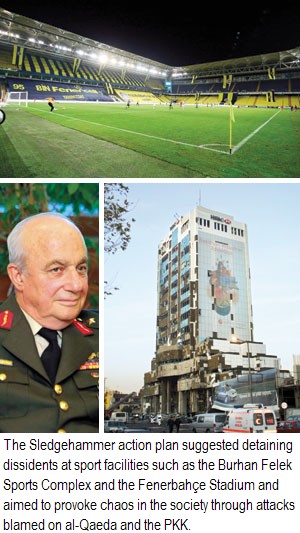
The Turkish Armed Forces (TSK) hoped to take Turkey back to 1923, the time when the republic was proclaimed, after the staging of a coup d’état against the Justice and Development Party (AK Party) government, the Taraf daily reported on Thursday.
According to the coup plan — titled the Balyoz (Sledgehammer) Security Operation Plan — all the key posts in the country, public and private, would be occupied by active and retired members of the military to “get rid of every single threat to the secular order of the state.”
“The plan will be based on an objective to clean up all state and public posts [of individuals suspected of posing a threat to the secular order of Turkey] and return Turkey to its dynamism of 1923. All the assets and financial resources of individuals and groups suspected of involvement in acts of reactionaryism will be confiscated, and necessary steps will be taken to freeze their financial resources abroad,” stated the document.
The armed forces also planned to take into custody and then arrest at least 200,000 individuals accused of reactionary activities in İstanbul after the coup. The total number of detainees around Turkey was estimated to reach 16 million, the plan stated. According to the document, individuals who stood against the coup would be taken into custody and brought to large sports facilities for interrogation. Among those facilities were the Burhan Felek sports complex and Fenerbahçe Stadium. The suspects would be questioned by security forces there and then would be sent to prisons. If the prisons were unable to accommodate all the arrestees, then military barracks would temporarily be turned into jails. [continued…]
Turkish police launched a nationwide crackdown on suspected militants linked to the al-Qaida terror network on Friday, rounding up 120 people in simultaneous pre-dawn raids, the state-run Anatolia news agency reported.
It was not clear if Friday’s raids in 16 provinces in this NATO member and western ally country would amount to a major blow to homegrown Islamic militants.
Yeni Safak newspaper this week reported that Turkish police had recently seized video recordings of alleged Turkish al-Qaida militants in Taliban camps in Afghanistan, as well as alleged plans for attacks on Turkish soldiers in Kabul and on police in Turkey. It did not cite a source for the report. [continued…]
Haitians are fleeing their quake-ravaged capital by the hundreds of thousands, aid officials said Friday, as their government promised to help nearly a half-million more move from squalid camps on curbsides and vacant lots into safer, cleaner tent cities.
Aid officials said some 200,000 people have crammed into buses, nearly swamped ferries and set out even on foot to escape the ruined capital. For those who stay, foreign engineers have started leveling land on the fringes of the city for tent cities, supposedly temporary, that are meant to house 400,000 people. [continued…]
Editor’s Comment — As the US is in the process of sending 20,000 troops to Haiti, one has to wonder how their mission has been conceived. Is this first and foremost what it purports to be, a humanitarian endeavor? Or is the highest priority in the minds of US government planners to prevent a massive exodus? Is this all about helping the Haitians over there so that we don’t have to help them here? Is the Obama administration afraid of being accused of being soft on refugees?
Before there were even any American marines’ boots on the ground, the message from the skies was unambiguous: “Listen, don’t rush on boats to leave the country,” said Raymond Joseph, Haiti’s ambassador in Washington, in a broadcast to homeless and destitute Haitians repeated for hours on end. “If you do that, we’ll all have even worse problems. Because, I’ll be honest with you: If you think you will reach the U.S. and all the doors will be wide open to you, that’s not at all the case. And they will intercept you right on the water and send you back home where you came from.”
The sound of Haiti’s suffering is deafening now but behind it one can hear already a familiar music begin to play. Haiti must be made new. This kind of suffering so close to American shores cannot be countenanced. The other evening I watched a television correspondent shake his head over what he movingly described as a “stupid death” — a death that, but for the right medical care, could have been prevented. “It doesn’t have to happen,” he told viewers. “People died today who did not need to die.” He did not say what any Haitian could have told him: that the day before, and the day before that, Haiti had seen hundreds of such “stupid deaths,” and, over the centuries, thousands more. What has changed, once again, and only for a time, is the light shone on them, and the volume of the voices demanding that a “new Haiti” must now be built so they never happen again.
Whether they can read or not, Haiti’s people walk in history, and live in politics. They are independent, proud, fiercely aware of their own singularity. What distinguishes them is a tradition of heroism and a conviction that they are and will remain something distinct, apart — something you can hear in the Creole spoken in the countryside, or the voodoo practiced there, traces of the Africa that the first generation of revolutionaries brought with them on the middle passage.
Haitians have grown up in a certain kind of struggle for individuality and for power, and the country has proved itself able to absorb the ardent attentions of outsiders who, as often as not, remain blissfully unaware of their own contributions to what Haiti is. Like the ruined bridges strewn across the countryside — one of the few traces of the Marines and their occupation nearly a century ago — these attentions tend to begin in evangelical zeal and to leave little lasting behind.
What might, then? America could start by throwing open its markets to Haitian agricultural produce and manufactured goods, broadening and making permanent the provisions of a promising trade bill negotiated in 2008. Such a step would not be glamorous; it would not “remake Haiti.” But it would require a lasting commitment by American farmers and manufacturers and, as the country heals, it would actually bring permanent jobs, investment and income to Haiti.
Second, the United States and other donors could make a formal undertaking to ensure that the vast amounts that will soon pour into the country for reconstruction go not to foreigners but to Haitians — and not only to Haitian contractors and builders but to Haitian workers, at reasonable wages. This would put real money in the hands of many Haitians, not just a few, and begin to shift power away from both the rapacious government and the well-meaning and too often ineffectual charities that seek to circumvent it. The world’s greatest gift would be to make it possible, and necessary, for Haitians — all Haitians — to rebuild Haiti. [continued…]
The United States recognizes that the Taliban are now part of the political fabric of Afghanistan, Defense Secretary Robert M. Gates said here on Friday, but the group must be prepared to play a legitimate role before it can reconcile with the Afghan government.
That means, Mr. Gates said, that the Taliban must participate in elections, not oppose education and not assassinate local officials. [continued…]
One of the three main leaders of the Afghan insurgency, mercurial warlord Gulbuddin Hekmatyar, has a long history of switching sides, and once fought against his current Taliban allies.
Now, he has held out the possibility of negotiating with Afghan President Hamid Karzai and outlined a roadmap for political reconciliation, opening what could be the most promising avenue for Mr. Karzai’s effort to peacefully resolve the conflict.
It is far from certain that any talks with Mr. Hekmatyar will begin, let alone succeed. But in contrast to Taliban leader Mullah Omar and allied insurgent chief Sirajuddin Haqqani, who refuse any talks with Kabul as long as foreign troops remain in the country, Mr. Hekmatyar took a much more conciliatory line in a recent video.
“We have no agreement with the Taliban—not for fighting the war, and not for the peace,” said Mr. Hekmatyar, who commands the loyalty of thousands of insurgents. “The only thing that unites the Taliban and [us] is the war against the foreigners.” [continued…]
The U.S. ambassador to Afghanistan and senior Afghan officials have resisted moving forward with a bold and potentially risky initiative to support local militias in Afghanistan that are willing to defend their villages against insurgents, according to U.S. officials.
Their concerns have slowed the implementation of a key effort to provide security in places where there are relatively few NATO forces or Afghan police and Army units. U.S. military officials had wanted to get the initiative — developed under the leadership of Gen. Stanley A. McChrystal, the top commander in Afghanistan — off to a quick start this year.
The plan was to take advantage of the emergence of informal village security forces that were taking up arms against outside insurgents. The hope was that the new program could yield thousands of new security forces relatively fast, bridging the gap until more army and police forces could be trained. But before the initiative can be implemented on a broader scale, Ambassador Karl W. Eikenberry must approve the release of more money for it. [continued…]
When it comes to the world of cartooning, Joe Sacco is considered a luminary. Sacco, who is hailed as the creator of war-reportage comics, is the author of such award-winning books as Palestine and Safe Area Gorazde.
His latest work, Footnotes in Gaza, is an investigation into two little-known and long-forgotten massacres in 1956 in the southern Gaza Strip that left at least 500 Palestinians dead. It is a chilling look back at an unrecorded past and an exploration of how that past haunts and shapes the present – including the beginning of mass home demolitions in 2003 in Rafah.
Sacco navigates the fuzzy lines between memory, experience and visual interpretation almost seamlessly all while painting an intimate portrait of life under occupation and in spite of occupation – a life not only of repression and anger but one full of humour and resilience. [continued…]
The Obama administration has decided to continue to imprison without trials nearly 50 detainees at the Guantánamo Bay military prison in Cuba because a high-level task force has concluded that they are too difficult to prosecute but too dangerous to release, an administration official said on Thursday.
However, the administration has decided that nearly 40 other detainees should be prosecuted for terrorism or related war crimes. And the remaining prisoners, about 110 men, should be repatriated or transferred to other countries for possible release, the official said, who spoke on the condition of anonymity because he was not authorized to speak about the numbers.
There are just under 200 detainees left at the detention center.
President Obama established the task force shortly after his inauguration last year as part of his administration’s effort to deal with the detainee issues left behind by the Bush administration. It was facing a deadline of Friday to complete its work. [continued…]
A Tennessee man accused of killing a soldier outside a Little Rock, Ark., military recruiting station last year has asked a judge to change his plea to guilty, claiming for the first time that he is affiliated with a Yemen-based affiliate of Al Qaeda.
In a letter to the judge presiding over his case, the accused killer, Abdulhakim Muhammad, calls himself a soldier in Al Qaeda in the Arabian Peninsula and calls the shooting “a Jihadi Attack” in retribution for the killing of Muslims by American troops.
“I wasn’t insane or post traumatic nor was I forced to do this Act,” Mr. Muhammad said in a two-page, hand-printed note in pencil. The attack, which he said did not go as planned, was “justified according to Islamic Laws and the Islamic Religion. Jihad — to fight those who wage war on Islam and Muslims.”
It remains unclear whether Mr. Muhammad really has ties to Al Qaeda in the Arabian Peninsula, which President Obama has said is behind the attempted Christmas Day bombing of an American plane by a Nigerian man.
But if evidence emerges that his claim is true, it will give the June 1, 2009, shooting in Little Rock new significance at a time when Yemen is being more closely scrutinized as a source of terrorist plots against the United States.
Mr. Muhammad, 24, a Muslim convert from Memphis, spent about 16 months in Yemen starting in the fall of 2007, ostensibly teaching English and learning Arabic. During that time, he married a woman from south Yemen. But he was also imprisoned for several months because he overstayed his visa and was holding a fraudulent Somali passport, the Yemen government said. [continued…]
Palestinian Legislative Council speaker Aziz Dweik on Thursday denied reports by Israeli news outlets that he said on Wednesday Israel has a right to exist.
“The media reports in question were inaccurate,” he said in a statement, adding that since his release from an Israeli prison last year, Israeli news outlets have repeatedly misrepresented his views.
The Jerusalem Post, an English-language Israeli newspaper, quoted Dweik as saying on Wednesday that the Islamic movement has accepted Israel’s right to exist and would be prepared to nullify its charter, which calls for dismantling the state.
The remarks were said to have been made during a meeting in Hebron with British millionaire David Martin Abrahams, who reportedly maintains close ties with senior Israeli and British government officials.
Dweik told Ma’an, however, that he offered no such recognition of Israel’s “right to exist on Palestinian land,” as was reported, and moreover, that he told Abrahams the PLO had made a mistake by nullifying its charter.
“The PLO canceled its charter, and Palestinians achieved nothing,” he said. “This is Hamas’ stance and the opinion of any Hamas leader regarding the nullification of [its] charter.”
Dweik said the talks was held at Abrahams’ request, and came within a series of meetings with the PLC’s leadership with international officials, delegations and other news outlets. There was nothing unusual about Abrahams’ visit, he said. [continued…]
Hamas has accepted Israel’s right to exist and would be prepared to nullify its charter, which calls for the destruction of Israel, Aziz Dwaik, Hamas’s most senior representative in the West Bank, said on Wednesday.
Dwaik’s remarks are seen in the context of Hamas’s attempts to win recognition from the international community.
Dwaik is the elected speaker of the Palestinian Legislative Council. He was released a few months ago after spending nearly three years in an Israeli prison.
Dwaik was among dozens of Hamas officials and members who were rounded up by Israel following the abduction of IDF soldier St.-Sgt. Gilad Schalit near the Gaza Strip in June 2006.
His latest remarks were made during a meeting he held in Hebron with British millionaire David Martin Abrahams, who maintains close ties with senior Israeli and British government officials.
Abrahams is scheduled to brief British Foreign Secretary David Milliband this weekend on the outcome of his meeting with Dwaik and other top Hamas officials in the West Bank.
Abrahams, a major donor to Britain’s Labor Party, told The Jerusalem Post he would urge Milliband to “consider the implications of Hamas’s positive overtures.” [continued…]
Speaking to reporters last night Israel’s Prime Minister Benjamin Netanyahu hammered away on one of his favorite points: the Palestinian precondition, no peace talks without a comprehensive freeze on West Bank settlement construction. “Let’s stop piling preconditions.” Said the Prime Minister, “Let’s get on with it. Let’s get on with peace negotiations.”
During the same speech, Netanyahu also insisted that East Jerusalem, which Palestinians want for a Capitol of their future state, is not up for negotiation and will remain part of Israel at the end of a peace deal. He demanded that Israel maintain a presence “on the Eastern side of a Palestinian state” to keep militants from using the territory to launch rockets at Israel ’s heartland. The Prime Minister was not clear if that simply meant a military presence on the Jordanian border or if Israel would keep the Jordan valley. Either way, it would leave the future Palestinian state as an Island with no control of its border. [continued…]
The Palestinians on Thursday rejected the idea of an Israeli presence on the eastern border of their future state, which was mooted by Israel’s hawkish prime minister.
“The Palestinian leadership will not accept the presence of a single Israeli soldier in the Palestinian territories after the end of the occupation,” Nabil Abu Rudeina, a spokesman for president Mahmud Abbas, told AFP. [continued…]
The underground tunnels between Egypt and Gaza are a lifeline for those trapped inside the blockaded Strip, but along with the clothes, furniture and food that make their way through the tunnels, a dangerous drug – Tramadol – is also entering the territory. Tramal, as it is known in Gaza, is a dangerously addictive painkiller which is illegal without a prescription, but an increasing number of Gazans are becoming hooked on it. Uncomfortably Numb talks to some of those addicts, those who are trying to help them and the authorities seeking to crack down on drug abuse.
Turkey and Israel are at loggerheads again, and this should come as no surprise.
Israeli Deputy Foreign Minister Danny Ayalon recently staged a rebuke of the Turkish ambassador in Tel Aviv over the contents of a Turkish television show. Israel subsequently apologized, but this will go down as yet another milestone in the ongoing tension between Turkey and Israel.
Despite some Israeli and American efforts to paint Turkey’s objections to Israeli policies as “anti-Semitic,” people in the business of statecraft understand very well where Turkey is coming from.
They recognize that disagreements between Turkey and Israel are likely to continue provided there is no recognizable change in issues such as improving the humanitarian situation in Gaza. They also recognize the complete and immediate freezing of settlements and the overall posture of Israel toward the peace process – if one can still talk about such a process. [continued…]
The American editor of a Palestinian news agency was removed from Israel on Wednesday after being questioned by authorities about his “anti-Israeli” views…
“They judged me to have anti-Israeli politics,” Malsin, 24, said from a cellphone as he boarded the El Al plane. “It’s outrageous that would even appear in a legal argument, that a person’s politics would be a relevant issue.”
An official with the Israeli Interior Ministry said Malsin had refused to answer questions about his presence in Israel and had “exploited” the fact that he is Jewish to say he wanted to explore immigrating to Israel.
“He was asked, why would he want to make aliya and become an Israeli citizen, as his opinions are clearly anti-Israeli,” Interior Ministry official Mietal Rochman wrote in an account of Malsin’s interrogation at the airport, which included a check of numbers stored in his cellphone and a review of his writings on the Internet. “The passenger chose to remain silent.” Malsin’s attorney provided a copy of Rochman’s report. [continued…]
There is no relief for the people of Haiti, it seems, even in their hour of promised salvation. More than a week after the earthquake that may have killed 200,000 people, most Haitians have seen nothing of the armada of aid they have been promised by the outside world. Instead, while the US military has commandeered Port-au-Prince’s airport to pour thousands of soldiers into the stricken Caribbean state, wounded and hungry survivors of the catastrophe have carried on dying.
Most scandalously, US commanders have repeatedly turned away flights bringing medical equipment and emergency supplies from organisations such as the World Food Programme and Médecins Sans Frontières, in order to give priority to landing troops. Despite the remarkable patience and solidarity on the streets and the relatively small scale of looting, the aim is said to be to ensure security and avoid “another Somalia” – a reference to the US military’s “Black Hawk Down” humiliation in 1993. It’s an approach that certainly chimes with well-established traditions of keeping Haiti under control.
In the last couple of days, another motivation has become clearer as the US has launched a full-scale naval blockade of Haiti to prevent a seaborne exodus by refugees seeking sanctuary in the United States from the desperate aftermath of disaster. So while Welsh firefighters and Cuban doctors have been getting on with the job of saving lives this week, the 82nd Airborne Division was busy parachuting into the ruins of Haiti’s presidential palace.
There’s no doubt that more Haitians have died as a result of these shockingly perverse priorities. As Patrick Elie, former defence minister in the government of Jean-Bertrand Aristide – twice overthrown with US support – put it: “We don’t need soldiers, there’s no war here.” It’s hardly surprising if Haitians such as Elie, or French and Venezuelan leaders, have talked about the threat of a new US occupation, given the scale of the takeover.
Their criticisms have been dismissed as kneejerk anti-Americanism at a time when the US military is regarded as the only force that can provide the logistical backup for the relief effort. In the context of Haiti’s gruesome history of invasion and exploitation by the US and European colonial powers, though, that is a truly asinine response. For while last week’s earthquake was a natural disaster, the scale of the human catastrophe it has unleashed is man-made. [continued…]
Soon after almost every disaster the crimes begin: ruthless, selfish, indifferent to human suffering, and generating far more suffering. The perpetrators go unpunished and live to commit further crimes against humanity. They care less for human life than for property. They act without regard for consequences.
’m talking, of course, about those members of the mass media whose misrepresentation of what goes on in disaster often abets and justifies a second wave of disaster. I’m talking about the treatment of sufferers as criminals, both on the ground and in the news, and the endorsement of a shift of resources from rescue to property patrol. They still have blood on their hands from Hurricane Katrina, and they are staining themselves anew in Haiti.
Within days of the Haitian earthquake, for example, the Los Angeles Times ran a series of photographs with captions that kept deploying the word “looting.” One was of a man lying face down on the ground with this caption: “A Haitian police officer ties up a suspected looter who was carrying a bag of evaporated milk.” The man’s sweaty face looks up at the camera, beseeching, anguished. [continued…]
Where does the fault lie in Haiti? For geologists, it lies on the line between the North American and Caribbean tectonic plates. For some, the earthquake is evidence of God’s wrath: the American evangelist Pat Robertson has even suggested that the horror is recompense for some voodoo pact made with the Devil at Haiti’s birth.
More sensible voices point to the procession of despots who have plundered Haiti over the years, depriving it of an effective infrastructure and rendering it uniquely vulnerable to natural disaster. But for many Haitians, the fault lies earlier — with Haiti’s colonial experience, the slavers and extortionists of empire who crippled it with debt and permanently stunted the economy. The fault line runs back 200 years, directly to France.
In the 18th century, Haiti was France’s imperial jewel, the Pearl of the Caribbean, the largest sugar exporter in the world. Even by colonial standards, the treatment of slaves working the Haitian plantations was truly vile. They died so fast that, at times, France was importing 50,000 slaves a year to keep up the numbers and the profits. [continued…]
Haiti isn’t impoverished because the devil got his due; it’s impoverished partly because of debts due. France imposed a huge debt that strangled Haiti. And when foreigners weren’t looting Haiti, its own rulers were.
The greatest predation was the deforestation of Haiti, so that only 2 percent of the country is forested today. Some trees have been — and continue to be — cut by local peasants, but many were destroyed either by foreigners or to pay off debts to foreigners. Last year, I drove across the island of Hispaniola, and it was surreal: You traverse what in places is a Haitian moonscape until you reach the border with the Dominican Republic — and jungle.
Without trees, Haiti lost its topsoil through erosion, crippling agriculture.
To visit Haiti is to know that its problem isn’t its people. They are its treasure — smart, industrious and hospitable — and Haitians tend to be successful in the United States (and everywhere but in Haiti). [continued…]
When a cover-up is exposed, nothing is more telling than the first reactions from those who are involved. Do they maintain their stories and face potentially aggravated consequences? Or do they simply remain silent? In making this choice, they often telegraph the depth of their anxiety and concern.
Last night on MSNBC’s Countdown with Keith Olbermann, I focused on the first responses to “The Guantánamo ‘Suicides.’” Colonel Michael Bumgarner, the former commander at Camp America, had sent an email to the Associated Press, the text of which AP confirmed to me, in which he said he would have to get clearance from the Defense Department to speak, but then stated:
This blatant misrepresentation of the truth infuriates me. I don’t know who Sgt. Hickman is, but he is only trying to be a spotlight ranger. He knows nothing about what transpired in Camp 1, or our medical facility. I do, I was there.
This statement merits closer inspection. The first sentence is a classic nondenial denial. It appears on the surface to deny part of the account, but in fact denies nothing. Bumgarner needs to state specifically what allegations he considers inaccurate. His failure to do so is telling. [continued…]
The Taliban have embarked on a sophisticated information war, using modern media tools as well as some old-fashioned ones, to soften their image and win favor with local Afghans as they try to counter the Americans’ new campaign to win Afghan hearts and minds.
The Taliban’s spiritual leader, Mullah Muhammad Omar, issued a lengthy directive late last spring outlining a new code of conduct for the Taliban. The dictates include bans on suicide bombings against civilians, burning down schools, or cutting off ears, lips and tongues.
The code, which has been spottily enforced, does not necessarily mean a gentler insurgency. Although the Taliban warned some civilians away before the assault on the heart of Kabul on Monday, they were still responsible for three-quarters of civilian casualties last year, according to the United Nations.
Now, as the Taliban deepen their presence in more of Afghanistan, they are in greater need of popular support and are recasting themselves increasingly as a local liberation movement, independent of Al Qaeda, capitalizing on the mounting frustration of Afghans with their own government and the presence of foreign troops. The effect has been to make them a more potent insurgency, some NATO officials said. [continued…]
A $300 million power plant in Afghanistan paid for with U.S. tax dollars was an ill-conceived and mismanaged project that the Afghan government can’t afford to switch on now that it’s almost finished, a watchdog agency has found.
The project in Kabul has ballooned $40 million over budget and is a year behind schedule because of missteps by the American contractors and the U.S. government, according to an audit released Wednesday by the Office of the Special Inspector General for Afghanistan Reconstruction.
If the plant ever runs to full capacity, it could provide tens of thousands of Afghans in the Kabul region with electricity, which would be an achievement in a country in which only 10 percent of the population has it.
Even when the plant is completed in March, however, the Afghan government is unlikely to be able to pay the millions of dollars for diesel fuel that’s needed to power the plant and maintain it, the auditors concluded. The U.S. Agency for International Development has agreed to pay for the fuel temporarily. [continued…]
Seven years after the United States-led invasion, and three years after the leader it overthrew was executed, a question in Iraq remains unanswered: Who is a Baathist?
The term is as malleable as it is incendiary, and the quandary it represents has underlined the growing dispute over the credibility of Iraq’s parliamentary elections in March, which the Obama administration had viewed as a milestone in its plans to withdraw tens of thousands of combat troops by August.
Some of the country’s more ardently Shiite leaders see the hand of the Baathists, followers of the secular Arab nationalist party of former President Saddam Hussein, in a spate of spectacular attacks, a sign that the party has yet to relinquish its ambition to return to power.
To many Sunni Arabs, though, it is a catchall term employed to disenfranchise them. This month, it has become the fig leaf, critics say, for a brazen campaign of score-settling that has reopened sectarian wounds and thrown into question the legitimacy of the March 7 vote.
“We’re caught between two fires,” said Omar Mashhadani, a spokesman for Iraq’s parliamentary speaker, Ayad al-Sammarai. “On the one hand, we don’t want the Baathists back in the political process. On the other, we don’t want the name used to settle scores. It’s as if all the Baathists are Sunnis, and all the Sunnis are Baathists.” [continued…]
The man accused of trying to blow up a U.S. airliner on Christmas Day should have been interrogated by special terrorism investigators instead of FBI agents, the nation’s intelligence chief said Wednesday, adding that senior national security officials were not consulted before FBI and Justice Department authorities questioned him and pursued criminal charges.
Director of National Intelligence Dennis C. Blair faulted the decision not to use the “High Value Interrogation Group” (HIG) to question alleged al-Qaeda operative Umar Farouk Abdulmutallab.
“That unit was created exactly for this purpose — to make a decision on whether a certain person who’s detained should be treated as a case for federal prosecution or for some of the other means,” Blair told the Senate homeland security committee.
The intelligence chief said the interrogation group was created by the White House last year to handle overseas cases but will be expanded now to domestic ones. “We did not invoke the HIG in this case; we should have,” he added.
Blair amended his remarks later in written statements, acknowledging that the interrogation group is not “fully operational.” However, he maintained, “There should be a decision process right at the outset as to the balance between intelligence-gathering and evidence for prosecution.” [continued…]
This website or its third-party tools use cookies, which are necessary to its functioning. By closing this banner, you agree to the use of cookies.









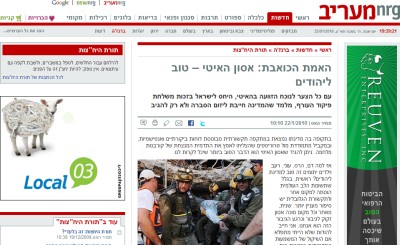 f I came up with a headline claiming the devastation in Haiti is “good for the Jews”, I could reasonably be accused of being anti-Semitic. But it’s not my headline. It comes from