Monthly Archives: July 2010

One state/two states: rethinking Israel and Palestine

As liberal Zionists and their allies repeatedly — if unpersuasively — proclaim that the implementation of a two-state solution is now a matter of urgency, the explicit urgency is that this is the only way of ensuring that Israel will thwart the “demographic threat” of Jews becoming a minority in the country they insist they must run. At the same time, the creation of a Palestinian state is presented as the means to fulfill the national aspirations of the Palestinian people.

What never gets stated in this narrative is that the two-state solution would be the ultimate concession for Palestinians as it cements the loss of a land which was once their own.

Danny Rubenstein writes at Dissent:

Against the background of Barack Obama’s attempt to defend the idea of “two states for two peoples” in Israel/Palestine, consider a recent talk given by the Palestinian Sufian Abu-Zayda. Abu-Zayda is fifty years old. He was born in the Jabalya refugee camp in northern Gaza, the largest of the Palestinian camps, and he is considered the Palestinian spokesman most fluent in Hebrew, which he learned during the fourteen years that he spent in an Israeli prison on charges of participating in terrorist activities. After his release in 1993, he was one of the senior Fatah leaders in Gaza and was appointed to various positions in the Palestinian government. Among other activities he has been active in the Israeli-Palestinian Geneva Initiative, in which moderates from both sides argue that it is possible to find a just two-state solution.

It was quite surprising, therefore, that Abu-Zayda, in his talk to an Israeli audience, announced that he had changed his mind. Like other Palestinians who spoke to the Israeli media over the last months, he was responding to Prime Minister Benjamin Netanyahu’s speech at Bar Ilan University—itself a response of sorts to President Obama’s June 2009 speech at the University of Cairo. With some drama, Netanyahu had agreed that a Palestinian state should be established in territory of the Land of Israel to the west of the Jordan River. This was a significant change for Netanyahu, whose roots are in the nationalist movement that has given up its earlier slogan—“There are two banks to the Jordan, this one is ours, and so is that one”—but that still demands Israeli rule in the “Greater” Land of Israel west of the Jordan. Commentators talked of a “fissure” on the Israeli Right; it was widely believed that as long as Ben Zion Netanyahu is still alive, his son wouldn’t dare rebel against the nationalist traditions of the family.

But what might have seemed unbelievable a short time ago has become a reality. Netanyahu, at the head of the nationalist, right-wing government with members like Benny Begin (son of Menachem Begin) who have consistently rejected all concessions, has accepted the idea of a Palestinian state.

In his talk at Tel Aviv University, Abu-Zayda responded to what the prime minister had said: “Many thanks to Benjamin Netanyahu. After twenty years of the peace process [since the Madrid Conference in 1991], and after the mutual recognition of Israel and the PLO [in the Oslo Accords], he finally agrees to a Palestinian state.” There was irony in his voice as he continued, “Do you think you are doing us a favor when you agree to two states? No favor at all. From my side, from the Palestinians’ side—let there be one state, not two…. I was introduced to you as Sufian Abu-Zayda from the Jabalya camp, but I’m not from Jabalya. I might have been born there, but my family had been exiled in 1948 from a village named “Breer,” where Kibbutz Bror Hayill now stands, near the Gaza border. If there will be one state, I’ll be happy to rent or buy a house near the kibbutz and live there.” And then Abu-Zayda said in a loud voice, “You are doing yourselves a favor by establishing two states, not us.”


Facebooktwittermail

Why Israel is so unpopular

Larry Derfner writes in the Jerusalem Post:

All the Islamic countries are afraid of Israel, and for good reason — because this country is much stronger than all of them put together. We do things to the Palestinians, to Syria, to Lebanon and, reportedly, to Iran that we would never let anyone do to us in a million years — and they can’t stop us. They are extremely reluctant to even try; our military power deters them.

So what more do we want from our enemies before we’ll stop screwing with them? Love? Recognition of the justice of the Zionist cause? An admission that they were wrong all these years and we were right?

If that’s what we’re waiting for, we came to the wrong neighborhood. If we’re going to go on intercepting ships until their sponsors accept our right to keep Gaza under lock and key, we’re going to be engaged in gunboat diplomacy for a long time. If we think we can rule the West Bank Palestinians until they give up even nonviolent resistance, fly spy planes over Lebanon until Hizbullah agrees that we have the right to bear arms but it doesn’t, and bomb enemy nuclear sites until the whole Middle East acknowledges Israel as its sole, rightful nuclear power, then our future here is untenable.

Maybe the United States and Russia can hold sway over their regions, maybe they can have spheres of influence, but a little Jewish state surrounded by 57 Muslim states cannot. Neither our enemies nor our friends will allow us to be a mini-empire, a hegemon, for long. That’s a recipe for escalating, never-ending conflict.

The new cry of gevalt around here is that Israel’s legitimacy is under worldwide attack — but the truth is that the West has accepted the legitimacy of the Jewish state since 1947, and nothing’s changed. As for the Muslim world, it never has and never will accept the legitimacy of the Jewish state — but it has accepted the hard fact of it since the Six Day War.

Between Israel’s legitimacy in the West and deterrent power in the Middle East, we have what we need to survive as a Jewish state within our rightful, democratic borders. But we can’t survive as the neighborhood bully.

Facebooktwittermail

Does the CIA know how to invest wisely?

“You don’t give something for nothing,” a CIA official told the Washington Post while trying to justify the $5 million payment made to Shahram Amiri, an Iranian nuclear scientist whose American dream turned out to be so short-lived it raised questions about whether his original defection was genuine. He arrived back in Tehran on Thursday, receiving a hero’s welcome.

Whether the agency received an adequate return on its investment in Amiri is difficult to assess. The size of the payment might offer some measure of the value of the information he shared. But it could also reflect a level of eagerness within the U.S. intelligence community for meaningful information on Iran.

Eagerness for success is what led seven Americans to their deaths at the end of last year as they were lured into a trap by a Jordanian doctor named Humam Khalil Abu-Malal al-Balawi when he blew himself up in the CIA base in Khost.

The case of Amiri might not have done as much damage to the Agency, but the assumption that everyone has their price — what amounts to an article of faith in a land where wealth has been deified — is a naive American perspective that repeatedly results in a distorted view of the world.

As for whether Amiri really was, as ABC News reported, one of the CIA’s “most valued former spies,” I have a hard time believing that a prize nuclear scientist would not already have a PhD. (The desire to acquire a doctorate was supposedly one of his reasons for coming to the US.) More likely, Amiri was a “prize catch” simply because he was willing to accept the prize.

Facebooktwittermail

Afghanistan: an Indo-Pak proxy war in which Nato is really a bit player

Pakistan retains Afghanistan within its sphere of influence, India retains Kashmir, while al Qaeda loses its foothold in the region — this is the potential resolution to a war over which the US and its allies now have little control, writes William Dalrymple.

Internally, the war is viewed primarily as a Pashtun rebellion against a Tajik, Uzbek and Hazara-dominated regime, which has only a fig leaf of Pashtun window-dressing in the person of Karzai. For although Karzai is a Pashtun, under his watch Nato installed the Northern Alliance in Kabul and drove out of power Afghanistan’s Pashtun majority.

In this way we unwittingly took sides in the Afghan civil war that began in the 1970s – siding with the north against the south, the town against the country, secularism against Islam, and the Tajiks against the Pashtuns. We installed a government and trained up an army that in many ways discriminated against the Pashtun majority, and whose top-down constitution allowed for little federalism or regional representation. No matter how much western liberals may dislike the Taliban, they are in many ways the authentic voice of rural Pashtun conservatism, whose wishes are ignored by the government in Kabul and who are largely excluded from power.

Externally the war has now turned, like Kashmir, into an Indo-Pak proxy war in which Nato is really a bit player. Under Karzai, India has established increasing political and economic influence in Afghanistan, opened four regional consulates and provided reconstruction assistance amounting to about $662m. The Pakistani military establishment, already terrified of India turning into a new economic superpower, has always believed it would be suicide to accept an Indian presence in what they regard as their strategic Afghan backyard, and is completely paranoid about the still small Indian presence, rather as the British used to feel about Russians in Afghanistan in the days of the Great Game.

According to Indian diplomatic sources there are still less than 3,600 Indians in Afghanistan, almost all of them businessmen and contract workers; there are only 10 Indian diplomatic officers as opposed to nearly 150 in the UK embassy. Yet The horror of being squeezed in an Indian nutcracker has led the ISI to risk its internal security and coherence – as well as Pakistan’s relationship with its main strategic ally, the US – in order to keep the Taliban in play and its leadership under watch and ISI patronage in Quetta. Indeed the degree to which the ISI has been controlling the Afghan Taliban has only just emerged. A report by Matt Waldman of the Carr Centre for Human Rights at Harvard, based on interviews with 10 former Taliban commanders, documented how the ISI “orchestrates, sustains and strongly influences” the Taliban, and that the ISI are even “represented as participants or observers on the Taliban supreme leadership council, the Quetta Shura”.

Karzai’s new deal with the Pakistanis, and his obvious intention to try to reach some accommodation with the Haqqani wing of the Taliban through Pakistan’s mediation, therefore represents a major strategic victory for the Pakistani military and a serious diplomatic defeat for India – though it remains to be seen if the ISI really can deliver the Taliban, who today were proclaiming their unwillingness to negotiate with Karzai. It also remains to be seen whether the Pakistani military can defend their own country from the jihadi Frankenstein’s monster they have created.

This dangerous new situation does offer some opportunities. Until now India, relishing its ever-growing international status, has understandably and angrily resisted any linkage between an Afghan settlement and Indo-Pak peace, which would involve finding a final agreement on Kashmir. Yet the linkage is already there, and there are many clear benefits for India if it is prepared to accept ground realities and negotiate.

The stage is now open for a deal whereby India could agree to minimise its presence in Afghanistan – which it could accept as Pakistan’s sphere of influence – in return for Pakistan withdrawing its longstanding sponsorship of the Kashmir jihad, which it could accept as India’s domain. To satisfy Nato, an undertaking by Pakistan to drive al-Qaida from the region would also need to be included.

At least, this might be the shape of a deal unless Gen David Petraeus and Senator Carl Levin have their way.

The New York Times reports:

The new American military commander in Afghanistan, Gen. David H. Petraeus, is pushing to have top leaders of a feared insurgent group designated as terrorists, a move that could complicate an eventual Afghan political settlement with the Taliban and aggravate political tensions in the region.

General Petraeus introduced the idea of blacklisting the group, known as the Haqqani network, late last week in discussions with President Obama’s senior advisers on Pakistan and Afghanistan, according to several administration officials, who said it was being seriously considered.

Such a move could risk antagonizing Pakistan, a critical partner in the war effort, but one that is closely tied to the Haqqani network. It could also frustrate the Afghan president, Hamid Karzai, who is pressing to reconcile with all the insurgent groups as a way to end the nine-year-old war and consolidate his own grip on power.

Facebooktwittermail

Remote-controlled killing

It takes just a week to train young Israeli women in the latest form of remote killing. Haaretz reports: “When the training program for the operators was being developed, the IDF wanted to learn from the experience of another country’s army, but couldn’t find a force doing anything similar.”

Jonathan Cook writes:

It is called Spot and Shoot. Operators sit in front of a TV monitor from which they can control the action with a PlayStation-style joystick.

The aim: to kill terrorists.

Played by: young women serving in the Israeli army.

Spot and Shoot, as it is called by the Israeli military, may look like a video game but the figures on the screen are real people — Palestinians in Gaza — who can be killed with the press of a button on the joystick.

The female soldiers, located far away in an operations room, are responsible for aiming and firing remote-controlled machine-guns mounted on watch-towers every few hundred metres along an electronic fence that surrounds Gaza.

The system is one of the latest “remote killing” devices developed by Israel’s Rafael armaments company, the former weapons research division of the Israeli army and now a separate governmental firm.

According to Giora Katz, Rafael’s vice-president, remote-controlled military hardware such as Spot and Shoot is the face of the future. He expects that within a decade at least a third of the machines used by the Israeli army to control land, air and sea will be unmanned.

The demand for such devices, the Israeli army admits, has been partly fuelled by a combination of declining recruitment levels and a population less ready to risk death in combat.

Oren Berebbi, head of its technology branch, recently told an American newspaper: “We’re trying to get to unmanned vehicles everywhere on the battlefield … We can do more and more missions without putting a soldier at risk.”

Rapid progress with the technology has raised alarm at the United Nations. Philip Alston, its special rapporteur on extrajudicial executions, warned last month of the danger that a “PlayStation mentality to killing” could quickly emerge.

According to analysts, however, Israel is unlikely to turn its back on hardware that it has been at the forefront of developing – using the occupied Palestinian territories, and especially Gaza, as testing laboratories.

Remotely controlled weapons systems are in high demand from repressive regimes and the burgeoning homeland security industries around the globe.

Facebooktwittermail

An Iranian nuclear espionage mystery

ABC News reports:

The CIA has lost one of its most valued former spies.
Iranian nuclear scientist Shahram Amiri, who defected to the US, is now on his way back home to Tehran after a very messy and public re-defection. ABC News obtained exclusive photos of Amiri leaving Washington’s Dulles International Airport late Tuesday night on a commercial flight to Doha, Qatar, en route to Iran.

Amiri was escorted directly to the jetway entrance by a security officer. He was flanked by what appeared to be a U.S. official and a representative from the Pakistani Embassy in Washington. He boarded the Qatar Airways flight ahead of the other passengers, and spoke only to his companions. After more than a year in the US, Amiri claimed he had never really defected. In a series of videos released on the internet, he insisted that he had been kidnapped, drugged and tortured by the CIA. The US flatly denies that it ever held Amiri against his will.

The Washington Post columnist and unofficial spokesman for the CIA, David Ignatius, attributes Amiri’s departure to a change of heart.

The CIA has struggled for decades with how to handle defectors better so that they are happy in a strange new land. The agency periodically tries to improve its tradecraft in working with these skittish guests. But defectors are trouble. They are like small boats in a heavy sea, not sure which way is home.

But Ignatius concedes that it is hard to understand why the Iranian scientist would have defected while leaving his wife and child behind. That detail, along with the deaths of Ardeshire Hassanpour and Masoud Alimohammadi, might seem to reinforce the claim that Amiri was in fact abducted and that all three cases be seen in the context of a US-backed, Israeli-led covert war targeting Iran’s nuclear programme.

What seems more likely however, is that the Iranians took the CIA for a ride — that Amiri’s “defection” took place so the Iran could glean more about the extent of American knowledge about its nuclear program and that the information he gathered was worth more valuable than the information he gave away.

Facebooktwittermail

Defending the unbreakable bond between Israel and Pennsylvania

When voters in Pennsylvania head to the polls this November to elect a new senator, Bill Kristol and his newly launched outfit want to make sure that the issue uppermost in the voters’ considerations is how great a friend of Israel their next senator will be — this is the first assignment adopted by the Emergency Committee for Israel (“we’re the pro-Israel wing of the pro-Israel community,” says Kristol) which is running this ad on Fox News and CNN:

This ad follows in the footsteps of an ad run earlier this year (before Congressman Joe Sestak won the Democratic primary) which says “keeping Israel safe helps keep America safe.”

For people like Bill Kristol and the rest of the gang that makes up the Israel lobby, keeping Israel safe keeps America safe, is a strong expression of the unbreakable bond that Israel’s Democratic and Republican subordinates all like to celebrate. Yet for others — and this may turn out to include a plurality of Pennsylvania voters — this is a message that has more than a hint of a mafia protection racket threat. If you want to sleep comfortably in Philadelphia or Pittsburgh, you’d better take care of Israel. It’s quite a sinister message.

Meanwhile, as Kristol’s emergency committee works to shore up the unbreakable bond between Pennsylvania and Israel, it seems like another bond — one they might have imagined would need no defense — is showing signs of disrepair.

In a report on discrimination against Palestinians in Jerusalem, Fox News veered dangerously off message. (H/t Matt Duss at Think Progress.)

When Joe Sestak won the Democratic primary in May, Jon Delano, political director of KDKA-TV in Pittsburgh, noted: “Sestak has done this all on his own. He has had no support from the Washington crowd. None whatsoever. This is a victory that he can savor all by himself.”

As the mid-term elections approach, the Israel lobby imagines it can leverage disenchantment with Obama in support of its cause, yet to the extent that the election is a contest between Washington insiders and outsiders, the lobby, as a pillar of the Washington establishment, will find itself on the wrong side of the divide.

Facebooktwittermail

The terrorist delisting program

How to reduce the terrorist threat: use the label “terrorist” less often.

A week ago Newsweek reported:

Even as they denounce reports of covert talks from news sources such as the New York Times and Al-Jazeera, high-ranking insurgents have begun very cautiously admitting for the first time that peace negotiations are not totally out of the question. “The Taliban will decide about an option other than war when the time comes that would favor such a decision,” says one senior Taliban provincial governor.

Washington is eager to make that happen — perhaps more eager than most Americans realize. “There was a major policy shift that went completely unreported in the last three months,” a senior administration official tells Newsweek, asking not to be named speaking on sensitive issues. “We’re going to support Afghan-led reconciliation [with the Taliban].” U.S. officials have quietly dropped the Bush administration’s resistance to talks with senior Taliban and are doing whatever they can to help Karzai open talks with the insurgents, although they still say any Taliban willing to negotiate must renounce violence, reject Al Qaeda, and accept the Afghan Constitution. (Some observers predict that those preconditions may eventually be fudged into goals.) One particular focus is the “1267 list,” which was established in 1999 by the U.N.’s Al-Qaida and Taliban Sanctions Committee. It takes its name from U.N. Security Council Resolution 1267. “There are 137 Taliban on the list,” says the senior administration official. “It’s a list of people who cannot travel, cannot have funds…We’re taking a very hard look at the 1267 list right now, looking at it on a case-by-case basis. We’ve been doing it for months.”

The Washington Post today reports:

Afghan President Hamid Karzai plans to seek the removal of up to 50 former Taliban officials from a U.N. terrorism blacklist — more than a quarter of those on the list — in a gesture intended to advance political reconciliation talks with insurgents, according to a senior Afghan official.

The Afghan government has sought for years to delist former Taliban figures who it says have cut ties with the Islamist movement. But the campaign to cull names from the list, which imposes a travel ban and other restrictions on 137 individuals tied to the Taliban, has taken on renewed urgency in recent weeks as Karzai has begun to press for a political settlement to Afghanistan’s nearly nine-year-old conflict.

Facebooktwittermail

Why kill World Cup fans?

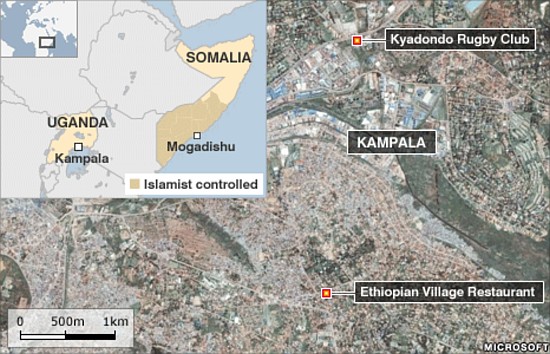
Bombings in Uganda that killed 74 football fans watching the World Cup final between Spain and the Netherlands have been attributed to Somalia’s al-Shabab militia. Earlier, the Washington Post described the way the sport and its fans were being targeted inside Somalia:

Al-Shabab, a hard-line Islamic militia that is waging a campaign of terror across Somalia, has banned playing soccer in many areas it controls. The al-Qaeda-linked militia, along with Hezb-i-Islam, a rival extremist group, prohibited broadcasts of the World Cup, describing the sport as “a satanic act” that corrupts Muslims.

The militants have brutally targeted politicians, clerics and peacekeepers — anyone who has challenged their extreme views. But in the past month, they have killed at least five people and arrested scores more for watching the World Cup. They have detained and tortured local soccer club owners on charges of misguiding youth.

So do Sunday’s bombings represent an escalation in a bloody fight against a satanic sport? Probably not.

At The Atlantic, Max Fisher considers possible reasons for the attacks that have no ideological basis.

There are two likely explanations for this act of terrorism, both with dark implications for Somalia and East Africa.

Though militants did not begin using the name al-Shabaab until 2006, they are part of the same Islamist insurgency that has plagued, and at times partially ruled, Somalia since the 1990s. Al-Shabaab is often compared to al-Qaeda, but the two groups have little in common. While both are violently Islamist, only al-Qaeda is ideology-driven, espouses global ambitions, and a has history of terrorism simply for the sake of killing. Al-Shabaab seeks only to rule Somalia and to impose an extreme form of Islamic law. The group has long privileged its fight for control of Somalia over ideology. As many have pointed out, the attack on Uganda makes sense as part of al-Shabaab’s fight against the African Union forces, to which Uganda contributes troops. Only days earlier, the East African block of the African Union voted to increase its peacekeeping force, which seeks to expel al-Shabaab from Somalia’s south, from 6,000 to 8,000 troops.

But Uganda’s participation in the African Union force does not fully explain Al-Shabaab’s attack. After all, several countries contribute to the peacekeeping mission. Uganda does not even border Somalia. If al-Shabaab wanted to expand the borders of its territorial control, it would have pushed into Kenya or Ethiopia. If the militant group was simply seeking revenge against the African Union, it would have targeted Ethiopia, the country most responsible for its removal from power in 2006, when it was known as the Islamic Courts Union. Ideologically, Uganda is also an unusual target. Al-Shabaab’s ideology is primarily concerned with fellow Muslims, on whom the group wishes to impose Taliban-like law, but Uganda is over 80 percent Christian.

The decision to bomb civilian gatherings in Kampala was almost certainly tactical. Al-Shabaab is not like the Taliban of 2000, which had secure control of Afghanistan and thus felt comfortable spreading violence and ideology outside the country’s borders. But al-Shabaab is still struggling in Somalia’s ongoing civil war. There are two likely tactical explanations for the attack. The first is that al-Shabaab is feeling increasingly threatened by the African Union force and is desperate to forestall or prevent the planned addition of 2,000 peacekeepers. In that case, this attack was a defensive act. Insurgents typically turn to terrorism when they are no longer able to challenge their opponents on the battlefield. While this may appear to be good news because it would mean that the group is weaker, a threatened al-Shabaab would become a threat to not just southern Somalia but all of East Africa. As Graeme Wood explained in his chronicling of the Lord’s Resistance Army insurgency in the Central African Republic, “the smaller and more resoundingly defeated the rebels are, the more brutally they fight.” This is how insurgencies, which can be negotiated or even reconciled with, become terrorist groups, which do not accept political compromises and can persist for many years. This attack on civilians outside Somalia would not be the last.

The other possibility is that al-Shabaab is stronger than we think and that this attack is the beginning of a push to expand its reach. Al-Shabaab only operates in Somalia’s south. If it feels confident in its control there, it may be planning to assault north into the contested horn of the country or even into the relatively calm Somaliland region in the north, which has been called an “oasis of stability.” This act of terrorism would be al-Shabaab way of opening a new front in a campaign to expel the peacekeepers from the regions al-Shabaab does not yet control. If the insurgency is indeed growing stronger, this would help explain why the African Union felt the need to increase its force strength by one third. It’s difficult to know how long the peacekeepers could hold back al-Shabaab from taking more of the country.

Facebooktwittermail

Opaque Obama

During the most violent summer of a war soon to enter its tenth year, Andrew Bacevich writes:

Much as Iraq was Bush’s war, Afghanistan has become Obama’s war. Yet the president clearly wants nothing more than to rid himself of his war. Obama has prolonged and escalated a conflict in which he himself manifestly does not believe. When after months of deliberation (or delay) he unveiled his Afghan “surge” in December 2009, the presidential trumpet blew charge and recall simultaneously. Even as Obama ordered more troops into combat, he announced their planned withdrawal “because the nation that I’m most interested in building is our own.”

The Americans who elected Obama president share that view. Yet the expectations of change that vaulted him to the presidency went well beyond the issue of priorities. Obama’s supporters were counting on him to bring to the White House an enlightened moral sensibility: He would govern differently not only because he was smarter than his predecessor but because he responded to a different — and truer — inner compass.

Events have demolished such expectations. Today, when they look at Washington, Americans see a cool, dispassionate, calculating president whose administration lacks a moral core. For prosecution exhibit number one, we need look no further than the meandering course of Obama’s war, its casualties and costs mounting without discernible purpose.

Bacevich concludes by asking:

Who is more deserving of contempt? The commander-in-chief who sends young Americans to die for a cause, however misguided, in which he sincerely believes? Or the commander-in-chief who sends young Americans to die for a cause in which he manifestly does not believe and yet refuses to forsake?

Any president who sends young Americans to die for no good reason is undoubtedly deserving great contempt, yet to observe that Obama’s war is a war he doesn’t believe in, begs an even more troubling question: Does Obama believe in anything?

How can a man whose ambitions, character, strengths and weaknesses were all hard to measure before he entered office, be even harder to read now that he has acquired a presidential track record — relatively short as that might be?

While George Bush might have entered office with a transparent sense of entitlement, what propelled Obama? Were his ambitions wrecked by impossibly difficult circumstances, or did they never hold any more substance than the nebulous promises of his campaign?

Facebooktwittermail

As Petraeus takes over in Afghanistan, could success be worse than failure?

While reflecting on the dangers of “success” in Afghanistan, Tom Engelhardt writes:

On the basis of our stated war objective — “[W]e cannot allow Al Qaeda or other transnational extremists to once again establish sanctuaries from which they can launch attacks on our homeland or on our allies,” as General Petraeus put it in his confirmation hearing at the end of June 2010 — success in Afghanistan means increasingly little. For al-Qaeda, Afghanistan was never significant in itself. It was always a place of (relative) convenience. If the U.S. were to bar access to it, there are so many other countries to choose from.

After all, what’s left of the original al-Qaeda — estimated by U.S. intelligence experts at perhaps 300 leaders and operatives — seems to have established itself in the Pakistani tribal borderlands, a place that the U.S. military could hardly occupy, no matter how many CIA drone attacks were sent against it. Moreover, U.S. intelligence experts increasingly suggest that al-Qaeda is in the process of fusing with local jihadist groups in those borderlands, Yemen, Somalia, North Africa, and elsewhere; that it is increasingly an amorphous “dispersed network,” or even simply an idea or crude ideology, existing as much online as anywhere in particular on the ground.

In this sense — and this is the only reason now offered for the American presence in Afghanistan — a counterinsurgency “success” there would be meaningless unless, based on the same strategic thinking, the U.S. then secured Pakistan, Somalia, Yemen, and a potential host of other places. In other words, the U.S. military would have to do one thing the Bush years definitively proved it couldn’t do: impose a Pax Americana on planet Earth.

Facebooktwittermail

Dignity — the mark of cultural integrity

It’s possible to catch glimpses of the Israeli-Palestinian conflict and see a social reality whose nature is transparent without any need for historical context — a social reality that contrasts dignity and its absence.

The following videos from B’Tselem, an Israeli Information Center for Human Rights in the Occupied Palestinian Territories, show Palestinian families in Hebron who are being imprisoned in their own homes in order to provide “freedom” for Jewish settlers. The settlers, who are quite explicit about their intent to drive their neighbors out, treat them worse than animals — and yet the Palestinians retain their dignity.

The undiluted contempt and arrogance displayed by both settlers and Israeli soldiers reveals their own lack of self-respect. It exudes an utter indifference to how they will be perceived outside their own small tribe. They have, in short, cut themselves off from humanity. They enjoy the comfort of the pariah who has abandoned any hope for human embrace.

(H/t Mondoweiss)

Facebooktwittermail

A source of emulation

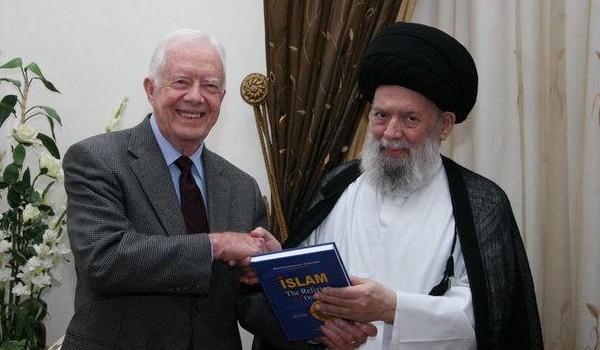
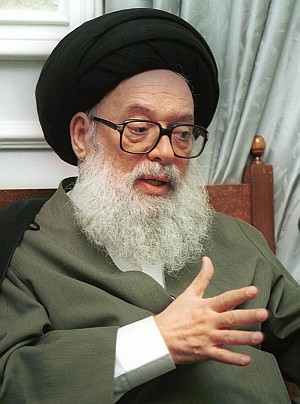
Jimmy Carter meeting Grand Ayatollah Mohammed Hussein Fadlallah in Hezbollah-controlled Dahiyeh, South Beirut, June 9, 2009

Consider this: When Jimmy Carter visited Grand Ayatollah Mohammed Hussein Fadlallah in Beirut just over a year ago, protection for the former US president was provided not only by the Secret Service but also Hezbollah’s own security personnel, both of whom feared that Carter might be assassinated by Israel’s Mossad!

Fourteen years earlier Fadlallah escaped an assassination attempt — that time it was a CIA covert operation in which 83 people died and 283 were injured.

The two incidents highlight the subjective nature of “terrorism” — a term used in the contemporary era to refer almost exclusively to violence carried out by non-government entities, yet a term that could just as reasonably be used to describe actions by the two governments that most loudly trumpet the threat from terrorism: Israel and the United States.

With that in mind, let’s consider once more the life of a man who the US government still designates as a “terrorist”: Grand Ayatollah Mohammed Hussein Fadlallah.

Rami G Khouri (who in confessionally fragmented Lebanon, it should be noted, is a Palestinian Arab Christian) writes:

Grand Ayatollah Mohammed Hussein Fadlallah, Lebanon’s most influential Shiite Muslim leader who died in Beirut this past weekend, was a marja, or a source of emulation for Shiites, during his lifetime — just about the highest achievement a human being can attain in this world.

It would be doing Fadlallah a disservice only or mainly to see him as a gifted Shiite religious figure. His great achievement, I believe, was to provide a living example of the combination of the best qualities that any Arab or Muslim could aspire to in this era of great mediocrity, corruption, materialism, mindless violence and abuse of power throughout much of the Arab world.

Fadlallah was — as Americans are fond of saying of sports figures who are talented, smart, humble, generous and personable — “the complete package.” He stood head and shoulders above his contemporaries in Lebanon and most of the region because he combined several qualities noteworthy each on its own: profound theological and academic learning; an analytical and active mind; extensive social activism to assist the needy; nationalist politics to protect one’s sovereignty and support Arab causes, like Palestine; a commitment to resisting and fighting foreign aggression and occupation; political modernism that appreciated pluralistic and accountable governance; a rejection of one-man rule in favor of collective leadership based on consultation and consensus; a deep commitment to dialogue and solidarity with those of different faiths, ideologies or ethnicities; a progressive sense of the rights of women and youth; humility of spirit that prevented him from assuming public or official positions; and — I suspect from reading some of his writings, as I never met him — a twinkle in his eye and generosity in his heart that accepted the need to enjoy life, without hurting others or blaspheming core religious dictates.

It is no surprise, therefore, that Fadlallah had followers in many parts of the world, far beyond his native Lebanon or Iraq where he grew up. A key reason for his charisma and a source of emulation was his philosophy of the obligation of the weak and oppressed to struggle and if necessary to fight for their humanity, liberation, dignity and rights. By the examples he set in his own life and behavior — education, contemplation, self-assertion, honesty, generosity toward the needy — he showed others how they could aspire to achieve their full potential as human beings, individually and collectively.

His was a very Shiite life story, given that the Shiites of Lebanon in just two generations — from the 1960s to the 2000s — transformed themselves from the abused and subjugated downtrodden of Lebanese society into the single most powerful group in the country. His rise to prominence coincided with and partly inspired this epic transformation, that now sees Hizbullah as the dominant Shiite organization in the political, social and military fields. This change in status is also controversial for many other Lebanese who distrust Hizbullah and see it as an Iranian- and Syrian-manipulated menace to Lebanon’s collective sovereignty, identity and stability.

Fadlallah’s life story is so noteworthy because it transcends the Hizbullah-dominated dimensions of Lebanese Shiism. There was a convergence of sentiments and struggle between the man and the nascent movement and its forerunners, for a while, in the 1970s and 1980s. Yet he went beyond Hizbullah’s focus on resistance, to embrace and develop the totality of human, communal and national dimensions that he believed was the obligation of any Muslim and any human being.

His recipe was simple but effective, for those who could apply it: Read. Study. Discuss. Debate. Question. Learn. Work hard. Be generous. Respect others, especially those who are different from you. Stand up for your rights. Use your power to defend your people and country. And, always, remain humble.

Perhaps his greatest feat — as is the case with others of his ilk who joined God’s world with ours, like Martin Luther King, Jr., Pope John Paul II, or Bishop Desmond Tutu — was his ability to make Islamic religious ethics a springboard for personal and collective human betterment, rather than an isolated obsession or source of autocratic fanaticism.

The learned man moved back and forth from his books to his neighborhood, from lofty divine inspirations to mundane social, economic and political problems that needed resolution — in this lifetime, not the one to come. Faith, in his view and life practice, gave you the power and confidence to fix the flaws and injustices of our world, rather than only to bemoan and endure them. That, in the end, was not just a holy man, but a very modern man — a model Lebanese, Arab and Muslim who was rightly respected and emulated by many in his lifetime, because he showed us what we could become if we put our mind to it.

Facebooktwittermail

When honesty gets dangerous, liars succeed

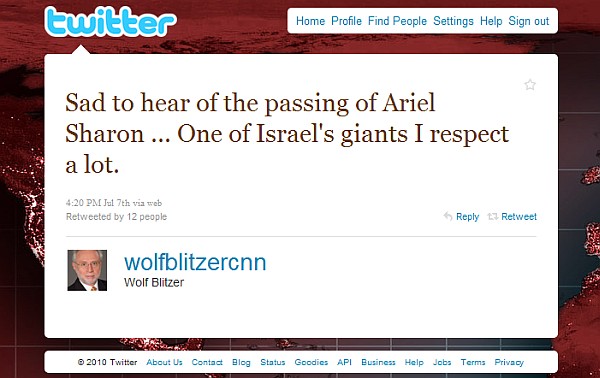
No, Ariel Sharon has not just died. But when he does, will Wolf Blitzer lose his job if he writes a tweet like the one above (a fake of course, created by yours truly)?

Certainly not, because as Glenn Greenwald correctly noted yesterday: “The speech prohibitions and thought crimes on the Middle East all run in one direction: to enforce ‘pro-Israel’ orthodoxies.”

Then again, Blitzer (who was at AIPAC and the Jerusalem Post before moving to CNN) will have no need to let his Zionist colors fly within the confines of a tweet. He’ll be content to report gushing praise for the former Israeli prime minister from President Obama or President Whoever, the day Sharon dies — a day when little if anything with be said in the Washington political/media establishment about Sharon’s personal responsibility in the slaughter of as many as 2,000 Palestinians killed in the Sabra and Shátila massacre in Beirut in 1982.

CNN’s Octavia Nasr, on the other hand, has been found guilty of praising Sayyid Mohammed Hussein Fadlallah, a man whose stature Sharon could never match — and for that offense, as has now been widely reported, the Lebanese-born journalist lost her job.

As Frances Guy, Britain’s ambassador to Lebanon, wrote in a blog post soon after Fadlallah’s death (a post she later removed “after mature consideration” according to the British Foreign Office):

When you visited him you could be sure of a real debate, a respectful argument and you knew you would leave his presence feeling a better person. That for me is the real effect of a true man of religion; leaving an impact on everyone he meets, no matter what their faith. Sheikh Fadlallah passed away yesterday. Lebanon is a lesser place the day after but his absence will be felt well beyond Lebanon’s shores. I remember well when I was nominated ambassador to Beirut, a muslim acquaintance sought me out to tell me how lucky I was because I would get a chance to meet Sheikh Fadlallah. Truly he was right. If I was sad to hear the news I know other peoples’ lives will be truly blighted. The world needs more men like him willing to reach out across faiths, acknowledging the reality of the modern world and daring to confront old constraints. May he rest in peace.

So why did CNN’s Nasr lose her job for expressing sadness at Fadlallah’s death? After all, his name is not a household word outside the Middle East.

Nasr’s mistake may well not have been that she expressed appreciation for this particular eminent Shia cleric but that she referred to him as one of “Hezbollah’s giants.”

So here’s one of the many ironies in this incident: while the Israel lobby controls the mainstream media with a well-oiled censorship machine that would be the envy of Joseph Goebbels, freedoms that journalists are being terrorized to abandon are nevertheless being exercised inside the US military. At CNN Hezbollah cannot be mentioned without also being demonized, yet at CENTCOM there are those calling for the powerful militia to be brought in from the cold. As Mark Perry revealed last month, a recent Red Team report called for the integration of Hezbollah into the Lebanese Armed Forces.

As for Sayyid Fadlallah himself, Lebanon’s prime minister, Saad Hariri — an Arab leader of the variety much-loved in the West — praised the cleric as “a voice of moderation and an advocate of unity.”

One of the reasons Fadlallah has been condemned by successive US governments is because of his alleged connections to the 1983 bombing in Beirut that killed 241 American servicemen, yet Robert Baer, who was himself a CIA field officer in Beirut, says: “there never has been a shred of evidence that Fadlallah was responsible for the Marine bombing, other than his preaching against foreign occupation.”

Opposing foreign occupation — this indeed was Fadlallah’s principal offense.

In his New York Times obituary, Fadlallah’s “extremism” was supposedly evident when in 2002 he told the Daily Telegraph:

[The Palestinians] have had their land stolen, their families killed, their homes destroyed, and the Israelis are using weapons, such as the F16 aircraft, which are meant only for major wars. There is no other way for the Palestinians to push back those mountains, apart from martyrdom operations.

Which reminds me of a line I came across on Facebook recently: a terrorist is someone with a bomb but no air force.

Fadlallah was also guilty of questioning the Holocaust — a commonplace attitude in the Middle East that must surely perplex many in the West. Even so, that attitude is, I suspect, much more one of sentiment than historical perspective. The Holocaust, as a justification for the dispossession and slaughter of Palestinians, has as much relevance as do the childhood traumas of a murderer when recounted to the murder victim’s family. This is context that does nothing to color the crime. Indeed, Holocaust doubt, thus provoked, can be seen as a direct effect of Holocaust exploitation.

Perhaps Sayyid Fadlallah is best remembered not through a tweet or a State department classification but in his own words:

Throughout my life, I have always supported the human being in his humanism and [I have supported] the oppressed… I think it is the person’s right to live his freedom… and [it is his right] to face the injustice imposed on him by revolting against it, using his practical, realistic and available means to end the oppressor’s injustice toward him, whether it is an individual, a community, a nation, or a state; whether male or female. God created the people free; thus no one has the right to enslave people and no one has the right to enslave himself for others. Imam Ali said “do not be a slave of others, as God created you free.”

Facebooktwittermail

UAE ambassador confirms: Palestine is the core issue

During a stage interview with Yousel al Otaiba, the UAE ambassador to the United States, Jeffrey Goldberg made it clear that even when acting as a representative of The Atlantic and helping facilitate a forum in Aspen, Colorado, he still sees himself first and foremost as an Israeli.

When the ambassador pointed out that Iran’s nuclear program presents a greater risk to the UAE than it does to the US — the US being separated from Iran by two oceans — Goldberg requested clarification. Was he being addressed as an American or as a “representative of the Jewish people”? In Goldberg’s mind, to be Jewish means to have ones heart in Israel irrespective of where one might reside on the planet.

As Goldberg’s blog posts after the interview also made clear, when it comes to Iran, the topic that interests him above all else right now is pumping up support for a military strike against Iran. When the UAE ambassador pointed out that Palestine is the core issue in the region, Goldberg simply glossed over the fact.

This is the key section of the interview — the part Goldberg ignored, as did his friend Eli Lake at the Washington Times, when pumping out this week’s rendition of Israel’s Arabs-united-against-Iran narrative. Here the ambassador makes it clear that the only significant leverage Obama has on the issue of Iran is to push hard for the creation of a Palestinian state.

YOUSEF AL OTAIBA: I think President Obama has inherited two very difficult campaigns in Afghanistan and Iraq. He has inherited the worst financial crisis since 1929. He is now dealing with what seems to be an unfixable oil spill, not just environmentally, but economically, from an energy standpoint. So President Obama has his hands full.

Do I think he recognize the threat from Iran? Yes, I do. Do I think he has very limited options and not necessarily a lot of ability to fix it? Yes. I think President Obama is just constrained with the lack of resources and tools at his disposal. And if he’s heard anything from the Arab leaders that he talks to, most of them, and I’m fairly sure that King Abdullah when he was here mentioned the same thing.

For him to really make progress on the Iran issue and to deal with extremism and to deal with terrorism in the region, to deal with radicalized home-grown terrorism in the U.S., you need to address the peace process. That is the one core issue everyone tends to blame, and that’s what the people hang all their problems on.

Well, the Palestinians are, you know, they are — they don’t have a country, they are abused, they are oppressed, and the U.S. always sides with Israel. So the sooner U.S. appears to be objective and impartial and create a Palestinian state, we take that argument away from everyone, and that is in everyone’s best interest.

JEFFREY GOLDBERG: Why would that stop Iran from developing a nuclear weapon?

OTAIBA: It won’t stop. It will get you all the Arab countries more aligned on containing Iran because now they use Palestine as an excuse, and the Palestine issue is a deep political problem. And I’m not saying it’s only the U.S.’ fault, I’m saying it is as much Israel and Palestine’s fault for not making any progress on it themselves. But lack of their kind of commitment, the U.S. needs to step in and say, you need to do this. And you need to do this for your sake, for our sake, and for the region’s sake. [Emphasis mine.]

So, contrary to the claims being made by Jeffrey Goldberg and others in the Israel lobby, the principal call coming from the Arab world is not for the US to strike Iran but rather that it apply its influence on Israel and hasten the creation of a Palestinian state.

Facebooktwittermail

Who’s pushing to strike Iran?

[Update: See this post which confirms that Goldberg twisted the narrative here.]

After an exchange between the UAE ambassador to the US Yousef al-Otaiba and Jeffrey Goldberg on Tuesday we learn that “the UAE would sooner see military action against Iran’s nuclear program than see the program succeed” — at least that’s what Goldberg says.

But the ambassador also said: “There are many countries in the region who, if they lack the assurance the US is willing to confront Iran, they will start running for cover towards Iran.”

In other words, countries like the UAE will ultimately align themselves with whichever ends up being the most durable power in the region. Even so, autocratic rulers who rely on American support would naturally like the defender of their tenuous legitimacy to maintain its regional dominance.

The Washington Times quotes from the same exchange between Goldberg and al-Otaiba in Aspen:

“I think it’s a cost-benefit analysis,” Mr al-Otaiba said. “I think despite the large amount of trade we do with Iran, which is close to $12 billion … there will be consequences, there will be a backlash and there will be problems with people protesting and rioting and very unhappy that there is an outside force attacking a Muslim country; that is going to happen no matter what.”

“If you are asking me, ‘Am I willing to live with that versus living with a nuclear Iran?,’ my answer is still the same: ‘We cannot live with a nuclear Iran.’ I am willing to absorb what takes place at the expense of the security of the UAE.”

And this is how Goldberg interprets the UAE/Arab position:

It is not only Israel that fears the rise of a nuclear Iran; the Arabs, if anything, fear such a development to a greater degree. The Jews and Arabs have been fighting for one hundred years. The Arabs and the Persians have been going at for a thousand. The idea of a group of Persian Shi’ites having possession of a nuclear bomb scares Arab leader like nothing else — it certainly scares them more than the reality of the Jewish bomb.

Goldberg speaks for Netanyahu and the lobby, but the UAE government does not accept his interpretation of their ambassador’s remarks:

The UAE Assistant Foreign Minister for Political Affairs, Tareq al Haidan said today that the statements attributed by the Washington Times to the UAE Ambassador to the United States, Youssef al Otaiba “are not precise”.

“These statements came as part of general discussions held on the sidelines of an unofficial gathering and were taken out of their context in which Mr. Otaiba was speaking,” Mr al Haidanl said.

“Iran is a neighboring country and we maintain historic relations with it.” He stressed that “the UAE respects and believes in the sovereignty of other states and in the principle of non-interference, of all forms, in their internal affairs.”

“Already, the UAE declared, more than one time and in official statements issued by the Foreign Ministry, its position on the Iranian nuclear issue,” Mr al Haidan added.

“The UAE totally rejects the use of force as a solution to the Iranian nuclear issue and rather calls for a solution through political means that are based on the international legitimacy, transparency as well as the need for working, through the International Atomic Energy Agency [IAEA], on the right of all states to the peaceful use of nuclear energy.

“The UAE, at the same time, believes in the need of keeping the Gulf region free of nuclear weapons,” Mr al Haidan said.

As for whether the Arab world is as vexed about Iran as Goldberg claims, perhaps a clearer indication came from one of Israel’s few allies, Jordan, when King Abdullah spoke to the Wall Street Journal in April:

WSJ: What do you think when you look at Iran and international policy. There’s a lot of talk now about how active Iran is in Iraq as far as trying to push their political clients. Do you see it active in Hezbollah/Lebanon? In the Palestinian territories? Is the engagement track working?

HM KING ABDULLAH: Again, I look at it from a different angle. If there are those that are saying that Iran is playing mischief, then I say it is being allowed to play mischief. The platform they use is the injustice of the Palestinians and Jerusalem. So if you start taking those cards off the table, then Iranian influence on the Mediterranean through Hezbollah and Hamas in Gaza diminishes or becomes non existent. My view is that I am really against any military action in Iran, that is Pandora’s box. But by dealing with the core issue, that’s when you start taking cards away from the Iranian regime.

The core issue is Palestine — not an Iranian bomb — and a strike on Iran, that’s Pandora’s box.

Just because Obama put on a shameless performance yesterday to please the Israelis and the lobby, and just because there is no evidence that he is a man of principle, doesn’t mean he’s stupid. He knows what Pandora’s box looks like and he’s just as reluctant as anyone else to find out what it contains.

Facebooktwittermail

Integrity — now you see it, now you don’t

Anyone who believes a resolution to the Israeli-Palestinian conflict hinges on the actions of Barack Obama and Benjamin Netanyahu, might as well turn their attention elsewhere — The moral bankruptcy of both men was on full display at the White House yesterday.

If before engaging in their vacuous performance, they had cared to study what meaningful engagement actually looks like, they could have done nothing better than to witness a recent meeting between two very different men: Haim Bajayo, 75-year old Jew and Hebron’s Palestinian Mayor Khalid Al-Useili.

Ma’an reports:

An elderly Jewish man from Hebron has asked the city’s mayor to permit his burial in a Muslim cemetery when he dies, insisting that his body not be placed in one of the sites now controlled by Israeli settlers.

Haim Bajayo, 75, visited Mayor Khalid Al-Useili at his office in the southern West Bank city and described in detail how Jews and Arabs had generally enjoyed amiable relations until the arrival of tens of thousands of foreign immigrants from the 1920s until 1948, the year Israel was established and most of Hebron’s Jews fled to the new state established in their name.

Bajayo was born in Hebron in 1935 and grew up in its Daboya neighborhood with his family, which owned a home there and held official property documents until 1977. A decade after Israel seized control of the Palestinian city and began permitting its citizens to settle there, Bajayo ceremoniously ceded his home for the benefit of the Palestinian municipality. The mayor at that time was Fahd Al-Qawasmi.

“As long as [the settlers] are in Hebron, there is no chance of reaching an agreement” to end the six-decade conflict, he told the mayor. “I don’t want any of my property or my house back as long as Palestinian homes and lands are not returned. The same day the Palestinians regain what was taken from them in 1948, I’ll come to you and say, ‘I have a house … registered in the real estate department.'”

Facebooktwittermail

The war Israel can’t win

At The Daily Beast, historian Thaddeus Russell writes:

When Israeli Prime Minister Benjamin Netanyahu visits the White House Tuesday, President Obama will have the chance to be the first American president since the founding of Israel to ask The Question.

The Question is never addressed by Israel’s supporters and rarely raised by Israel’s detractors. But for those of us who are taxpayers in a nation that has been the state of Israel’s chief benefactor for 42 years — or those of us with Jewish ancestry — it is becoming the only question to ask. It is simple, self-interested, and fundamental: Does the existence of Israel make Americans and Jews safer?

And here is the paradox: Though support for Israel among Americans, and especially Jewish Americans, remains high according to recent Gallup polls, historical evidence says the answer to The Question is “no.”
“There was not a single act of Arab terrorism against Americans before 1968, when the U.S. became the chief supplier of military equipment and economic aid to Israel.”

The history of Israel and its relationship with the U.S. is infinitely complex, but there’s one damning fact that’s ignored as often as The Question: There was not a single act of Arab terrorism against Americans before 1968, when the U.S. became the chief supplier of military equipment and economic aid to Israel. In light of this fact, it’s difficult to credibly sustain the argument that Arab terrorism is spawned by Islam’s alleged promotion of violence and antipathy toward American culture or by a “natural” Arab anti-Semitism. It also suggests that no matter what policies Israel enacts to protect itself — even a withdrawal from the occupied territories or a two-state “solution” — it must be a perpetual wartime state.

Very few Americans today are aware that the question of American and Jewish self-interest was first raised at the time of Israel’s founding by officials in the highest levels of the U.S. government. In 1948, several members of Harry Truman’s Cabinet predicted that the creation of a Jewish state in the Middle East would spur Arab violence against Jews and Americans, advising the president to shun Israel.

These included Secretary of State George Marshall, Defense Secretary James Forrestal, and George Kennan, then the leading policy strategist in the State Department. They argued that if the United States helped to set up an independent Jewish nation it would provoke terrorist attacks on Americans and inaugurate an endless war between Arabs and Jews. “There are 30 million Arabs on one side and about 600,000 Jews on the other,” Forrestal told those in the administration who favored recognizing Israel. “Why don’t you face up to the realities?”

Israel apologists will plead that Thaddeus Russell’s commentary is one more instance among international efforts — rapidly gaining steam — to delegitimize Israel.

Strangely, in response to what is perceived as a campaign of degitimization, there is, as far as I’ve seen, no Israel legitimization campaign. Those mounting a defense, do nothing more than attack their critics — and usually do so with an unbridled viscousness.

For instance, Robin Shepherd, writing in the Jerusalem Post about a decision last week by the Methodist Church of Britain to launch a boycott against goods emanating from settlements in the West Bank and East Jerusalem, says:

Overall, a church that behaves in the manner of the Methodists has buried its credibility under a gigantic dunghill of intransigence, pedantry, lies and distortions.

But let us not allow this matter to rest with a mere recognition of whom and what they have chosen to become.

If the Methodist Church is to launch a boycott of Israel, let Israel respond in kind: Ban their officials from entering; deport their missionaries; block their funds; close down their offices; and tax their churches.

If it’s war, it’s war. The aggressor must pay a price.

While it’s often said that attack is the best form of defense, that principle does not hold in the art of persuasion (and rarely for that matter in national security). The ranks cheering an attack such as Shepherd’s are small and shrinking. Indeed, the more venomous Israel and its supporters become, the less sympathy the Jewish state will evoke and the closer we will move to a critical juncture: where the world has given up on Israel and Israel has given up on the world. At that point, Israel’s isolation becomes the world’s nuclear peril.

Facebooktwittermail