Brian Kahn writes: An unusually intense May wildfire roared into Fort McMurray, Alberta, Canada, on Tuesday, forcing the largest wildfire evacuation in province history. The flames rode the back of hot, windy weather that will continue through Wednesday and could pick up again this weekend.
The wildfire is the latest in a lengtheninglineageof earlywildfires in the northern reaches of the globe that are indicative of a changing climate. As the planet continues to warm, these types of fires will likely only become more common and intense as spring snowpack disappears and temperatures warm.
“This (fire) is consistent with what we expect from human-caused climate change affecting our fire regime,” Mike Flannigan, a wildfire researcher at the University of Alberta, said. [Continue reading…]
In a hard-hitting Holocaust memorial day speech on Wednesday evening, the Israel Defence Forces (IDF) deputy chief of staff, Maj Gen Yair Golan, made remarks that he felt compelled to clarify overnight on Thursday, insisting he had not “intended to compare Israel to Nazi Germany”.
Both the timing – on the day that marks the murder of 6 million Jews by the Nazis – and the perceived comparison, touch on the most sensitive of issues in Israel.
Golan told an audience including a government minister and survivors of the Holocaust: “The Holocaust must lead us to think about our public lives, and even more than that, it must guide anyone who has the ability, not only those who wish to bear public responsibility.
“Because if there is anything that frightens me in the remembrance of the Holocaust, it is discerning nauseating trends that took place in Europe in general, and in Germany specifically back then, 70, 80 and 90 years ago, and seeing evidence of them here among us in the year 2016.
“After all, there is nothing simpler and easier than hating the foreigner, there is nothing easier and simpler than arousing fears and intimidating, there is nothing easier and simpler than becoming bestial, forgoing principles and becoming smug.” [Continue reading…]
Leonid Bershidsky writes: The record influx of Muslim refugees last year coincided with a sharp decline in the number of violent anti-Semitic incidents in major European countries, many of which bore the brunt of the refugee crisis.
The wave of so-called new anti-Semitism of recent years largely stemmed from anti-Israeli rather than racist beliefs, and had often been linked to the persistence of such attitudes among the growing Muslim population. Yet data from the 2015 report on global anti-Semitism, published on Wednesday by Tel Aviv University’s Kantor Center for the Study of Contemporary European Jewry, clearly show that as the refugees started coming in by the tens of thousands per day starting about a year ago, Europe became a safer place to be Jewish.
According to data collected by the Israeli demographer Sergio DellaPergola, France, the U.K. and Germany are the European countries with the biggest core Jewish population, defined as people who describe themselves as Jews. In France, the number of major violent anti-Semitic attacks dropped to 72 last year from 164 in 2014. The U.K. saw a similarly steep decrease, to 62 from 141. In Germany, there were 37 attacks, down from 76. Throughout Europe, anti-Jewish violence is at the lowest level in a decade. [Continue reading…]
Yasmin Alibhai-Brown writes: The whole universe may be found in a grain of London life,” wrote Peter Ackroyd. Sadiq Khan knows the grainy, multifarious life of the capital intimately. He is a real Londoner, and that is why he is the best choice for mayor. It matters more than his race, religion or class. Khan’s Pakistan-born father was a bus driver, his mother a seamstress. They had eight children, seven of them boys. The parents saved up to buy a home, and sent all their children to university. Khan has lived in public housing, used public transport, known deprivation, and epitomises urban aspiration.
Zac Goldsmith was born in London yet he could never acquire the same sensibility, or even pretend to know what it means. Goldsmith has never had to strive, and his privilege shows in his lack of passion, his lack of the kind of energy that drives most true Londoners.
I moved to London, from Oxford, in 1978 with my mum, ex-husband and a six-month-old baby. Exiles from Uganda, we had little money then, and lived in a one-bedroom flat near Shepherd’s Bush. It had rats, damp, a bath in the kitchen and broken furniture. My boy was starting to crawl, and one day picked up some rat droppings. I sobbed. But on the common, in the evening, surrounded by lights and sounds, we felt we had arrived. Eating a Wimpy burger from a box was the biggest treat. Upstairs lived Noreen, a young woman from Kent who had escaped from a violent husband. Next door was Elsa, a sweet Jamaican granny who made excellent gingerbread in an oven with a broken door. The building belonged to a shady man who had several such properties. He got rich and fat, and died of a heart attack. Noreen found a new man, a Yorkshireman who was training to be a bespoke tailor. Elsa started selling her gingerbread to neighbours, and moved to a better place. My ex-husband and I found good jobs and bought our first flat, where I still live.
This is what London ever was, and still is: big, busy, mysterious. By turns miserly and bountiful, chaotic and serene, shockingly unequal yet welcoming: a tough place that is always changing but where a future is always possible. This is where the British dream can come true. London belongs to no one, and so everyone can at least hope to claim a place in it. It is a hub, a fabulously diverse ecosystem that draws in people from other parts of the kingdom and the globe. [Continue reading…]
John Cassidy writes: Despite the best efforts of the Never Trump movement, it has been clear for some time that Donald Trump is destined to be the Republican candidate for President in 2016. His sweeping victory in New York, a couple of weeks ago, confirmed his popularity among the white suburban voters who make up the key voting bloc in the G.O.P. And his decisive win in Indiana, on Tuesday, more or less settled things. Ted Cruz, in suspending his candidacy, was only accepting the inevitable.
I noted a couple of months ago that one of the big problems with the Never Trump movement was that it didn’t have a credible candidate. Once Marco Rubio flamed out, its only options were John Kasich, who had won but a single state (his own), and the stridently reactionary Cruz. Republican primary voters have their idiosyncrasies and prejudices, but in one respect they are just like other Americans. Presented with a choice of voting for Cruz or A.N. Other, a majority of them opted for the latter — a fact that played greatly to Trump’s advantage.
Still, even Trump appeared to be surprised by his sixteen-point margin of victory in the Hoosier State. In a speech at Trump Tower, Trump said that he hadn’t expected Cruz to drop out just yet. The Texas Senator’s decision occasioned a rhetorical flip-flop on Trump’s part. Earlier in the day he had suggested that Cruz’s father, Rafael, who is now an evangelical preacher, had aided and abetted Lee Harvey Oswald, a claim arising from an article that had appeared in the National Enquirer. In his speech, Trump now paid tribute to Cruz’s “whole beautiful family.”
It has been evident ever since Trump announced his candidacy, eleven months ago, that there was virtually nothing he wouldn’t say to tar his rivals or anyone else who dared to challenge him. This is the candidate who referred to Rick Perry as a dimwit; criticized Carly Fiorina’s appearance; claimed that John McCain wasn’t a war hero; appeared to suggest, during a televised debate, that Megyn Kelly was menstruating; and compared Ben Carson to a child molester. Ultimately, none of these statements did much damage to Trump’s campaign. Arguably, they enhanced it.
Historians and political scientists will be debating for decades how Trump got to this point, but any convincing explanation must acknowledge his talents as a demagogue and pugilist. Speaking on CNN last night, David Axelrod, one of the many commentators who initially dismissed Trump’s candidacy, said, “He’s proven himself to be very resourceful and very skilled.” Axelrod pointed, in particular, to Trump’s mastery of television and social media. On Fox, Rich Lowry, the editor of the National Review, which has been in the vanguard of the Never Trump movement, said, “I have to tip my hat to what Trump has achieved.” Citing the fact that Trump didn’t have any pollsters or, until recently, any political organization to speak of, Lowry added, “It is completely incredible.”
That it is. But there are two factors in Trump’s rise that help to account for it: the febrile environment he has been operating in, and the potency of his message. [Continue reading…]
Jeremy Bowen writes: In the week or so I have been back in Jerusalem, a few people have asked me what it is I am here to cover. I thought it should be obvious.
The violence. Repeated attacks on Israelis by Palestinians, and the response by Israeli security forces.
But I have had quite a few bemused shrugs from journalist colleagues. Why now, when it has been going on since last October?
I was in Jerusalem last autumn reporting on it. What has changed? The longer something goes on the more it tends to slip down the news agenda.
But the point is that violence that becomes part of the scenery is just as dangerous as when first it grabs headlines.
It makes the deadly atmosphere between Israelis and Palestinians even more toxic. The attacks have become almost routine. Except for those who are caught up in them. [Continue reading…]
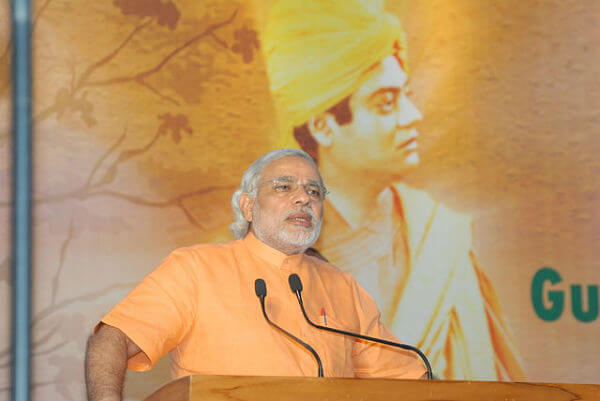
Siddhartha Deb writes: Vivekananda was a remarkable, complex figure, introducing his distinct, modernized version of yoga and neo-Hinduism to the United States. But if his legacy in the West was to be yoga, in India it would morph — helped, no doubt by his early death at 39 — into a muscular Hindu nationalism centered around the idea that Hindus needed to become more aggressive in challenging both Islam and the West. He became a symbol of the Hindu warrior monk who had gone into the West to conquer it for Hinduism, an idea embodied loudly by Modi in his own self-presentation, especially in the cross-armed pose and saffron turban he affected. And just as Vivekananda, in this populist version, took the battle to the West, so did Modi when he arrived at Madison Square Garden.
In India, it took an organization and the onset of race-based nationalism in the early twentieth century to give Vivekananda’s vision a more sinister touch and ultimately connect it to Modi. Founded in 1925 in the central Indian city of Nagpur, the Rashtriya Swayamsevak Sangh (RSS), the National Volunteer Organization, took Vivekananda’s ideas of Hindu revival a step further, combining them with racial theories popular in the West and drawing inspiration from the Italian Fascists and the Nazis. M.S. Golwalkar, who became the chief of the RSS in 1940, wrote approvingly of Germany’s “purging the country of the Semitic Races — the Jews,” and urged Hindus to manifest a similar “Race Spirit” with Muslims. After India became independent in 1947, Nathuram Godse, a former member of the RSS, assassinated Gandhi for being too conciliatory toward Muslims and Pakistan. The RSS was banned briefly, but this was a blip in its steady expansion from its base in the Western state of Maharashtra into neighboring Gujarat, Modi’s home state, and beyond.
The RSS was known for its secretive, cultlike tendencies; it kept no written fundraising records, and produced a constitution only in 1949 as a condition for the lifting of its ban. It stayed away from anticolonial politics under the British and maintained a distance from electoral politics in the decades following independence. It focused, instead, on the ideal of an upper-caste Hindu society within an unabashedly upper-caste, patriarchal Hindu nation. It recruited boys between the ages of six and 18, using doctrinaire lectures and a routine of paramilitary drills to mold their Hindu “Race Spirit,” while its adult members were unleashed as shock troops in riots against Muslims. It maintained links with Hindu-right political parties and Congress leaders favorably inclined to its sectarian idea of India, but avoided direct involvement in parliamentary politics, calling itself a social organization rather than a political one.
This was the organization — disciplined, secretive, tainted by its association with Gandhi’s assassination and its role in sectarian riots — that Modi joined in 1958 as an eight-year-old in the provincial Gujarati town of Vadnagar. He was the third of six children, from a family that ran a tea shop at the railway station to supplement its income from pressing and selling cooking oil. Leaving home as a teenager, Modi wandered the country, possibly to escape living with the wife who had been chosen for him in an arranged marriage at an early age—ironically, just the sort of social practice defended by the Hindu right, despite legislative attempts to make marriage and divorce more equitable, especially for Hindu women — and from whom he remains estranged. He returned after a couple of years to the Gujarati city of Ahmedabad, where he briefly ran a tea stall before joining the RSS full-time. Modi soon completed the RSS’s one-month officer-training program and became a pracharak, or organizer.
One can see the attractions of the RSS for a young man like Modi, filled with ambition and intelligence but without much education or opportunity. Its warrior-monk structure would offer upward mobility and power even as its cultish ideology stoked a sense of humiliation about the place of India in the world, and of Hindus within India. [Continue reading…]
Zalmay Khalilzad writes: It’s time for some serious dialogue with Iran about Iraq. The chaos in Baghdad, culminating in the temporary occupation of the parliament by followers of Shiite Islamist cleric Muqtada al-Sadr, is undermining the war against the Islamic State, weakening Iraq’s economy, and accelerating the country’s disintegration. Without cooperation between the United States, Iran and Iraq’s top Shiite cleric, Ayatollah Sistani, the crisis could very well lead to the collapse of the entire political system set up in Iraq during the temporary U.S. occupation. And that in turn could open the door to permanent occupation by the Islamic State and other violent anti-U.S. terrorist organizations.
To prevent this Washington needs Tehran’s help. And Iran should be as motivated to seek stability as much as Washington because currently it is losing favor in Iraq; the Shiite Islamist political parties that have dominated the government — with Iranian backing—have lost the confidence of most Iraqis. These groups had little support among Sunnis from the outset and now their standing has weakened among the Kurds and fellow Shiites also. For over nine months, young Iraqis have organized mass demonstrations, protesting the government’s economic mismanagement and its failure to provide security, governance and services. In their calls for reform, the protesters are demanding answers on where the country’s billions in oil revenues have gone.
Fearing that both secular groups might gain at their expense, intense rivalries have erupted among the entrenched Shiite Islamist parties. Ayatollah Sistani, the most revered Shiite cleric in the country — who had previously supported Haider al-Abadi’s appointment as prime minister — has publicly sided with the young protesters in their demand for reform. Sistani has echoed their calls for progress on combating corruption and improving services, and his withdrawal of support for Abadi has given Muqtada al-Sadr an opening to take up the mantle of reform. By attacking his Shiite rivals — notably Islamic Supreme Council of Iraq leader Ammar-al Hakim, former Prime Minister Nouri al-Maliki, and militias such as the Badr Corps that back them—Sadr is seeking to wrest control of the reform movement from secularists. [Continue reading…]
Krishnadev Calamur writes: The man who went from being described as a “pest” to “the most dangerous man in Iraq” is back — though Moqtada al-Sadr and his supporters are likely to say he never went anywhere in the first place. The Shia cleric’s supporters stormed Baghdad’s supposedly secure Green Zone on Saturday and took over Parliament, demanding improved public services and an end to corruption. They left Sunday, on Sadr’s orders, after ISIS attacked an Iraqi city. Their departure avoided further destabilizing the predominantly Shia government of Prime Minister Haider al-Abadi, but the protests not only raised questions about whether the government can stand, it also showed that Iraq’s turmoil has sources beyond Sunni-Shia sectarian divisions.
The roots of Iraq’s current parliamentary crisis lie in the quota system set up in 2003, after the fall of Saddam Hussein’s regime, which guarantees some minimal level of representation to each major ethno-sectarian faction. The idea was such a system would prevent any one of Iraq’s various ethnic factions from dominating the others. Iraq is majority Shia, but has a significant Sunni minority, as well as a large number of Kurds and others. Under Saddam, the Sunnis dominated government and many Shiites and others complained of discrimination. The new system was designed to curb such divisions, but, as Ibrahim al-Marashi, an assistant professor at California State University, San Marcos, wrote on Al Jazeera, “the quota system … empowers politicians based solely on their ethno-sectarian background.”
What that system fostered is chronic corruption. Indeed, the country is ranked 161 out of 168 in Transparency International’s admittedly flawed corruption index even as it wrestles with ethnic and sectarian divisions, as well as a challenge from the Islamic State. Low oil prices have not helped. Revenues from the sector were supposed to rebuild Iraq after years of war that followed international sanctions imposed during Saddam’s rule, but now, with oil prices near multiyear lows, salaries have gone unpaid and Iraq’s problems seem magnified. Emma Sky, a former civilian adviser to the U.S. military in Iraq, wrote in Politico: “The greatest threat to Iraq thus comes not from the Islamic State but from broken politics, catastrophic corruption, and mismanagement.” It is these circumstances that have resulted in massive anti-government protests and calls from Sadr for more, and presumably more honest, technocrats in Iraq’s government. [Continue reading…]
The New York Times reports: Insurgent shelling hit a maternity hospital in the government-held section of the Syrian city of Aleppo on Tuesday, according to state media and footage from the scene, underscoring what rights groups are calling a growing disregard for the rules of war.
It was the sixth assault on a medical facility in the divided city in less than a week and the first to have caused casualties on the government-controlled side. At least three women were reported killed and 17 people wounded, including children.
On Wednesday, warplanes destroyed a pediatric hospital and a clinic on the rebel-held side of the city, leaving dozens of people dead, including medical workers, women and children.
That attack, believed to have been carried out by the Syrian government despite its denials, came as intensifying airstrikes and rebel shelling shattered what remained of a fragile truce that had prevailed for a few months. The violence of the past week has plunged Aleppo back into all-out war, killing scores of people, mainly civilians.
The strikes on hospitals and clinics have incited a new wave of outrage from international humanitarian organizations, which called for an end to the attacks and emphasized that, if deliberate, they constitute war crimes. The United Nations Security Council condemned the attacks in a resolution on Tuesday that passed unanimously. [Continue reading…]
The Guardian reports: The British government’s claim that Saudi Arabia’s bombing campaign in Yemen has not breached international humanitarian law is “deeply disappointing” and contributes to an “anything goes” attitude from the opposing sides in the conflict, the international development select committee has said.
The finding comes as a rebuke to the foreign secretary, Philip Hammond, who made the assessment despite a UN-sponsored report and many charities presenting evidence to the contrary. The Conservative-dominated committee said the Saudi inquiry into the Yemen campaign, supported by the Foreign Office, was inadequate and called for an independent inquiry.
“It is deeply disappointing that the UK government does not accept that breaches of international humanitarian law have taken place in Yemen,” the committee said in a report. “The failure to hold parties to the conflict to account for their actions appears to have contributed to an ‘anything goes’ attitude by both sides to this conflict.” [Continue reading…]
John Hilary writes: Today’s shock leak of the text of the Transatlantic Trade and Investment Partnership (TTIP) marks the beginning of the end for the hated EU-US trade deal, and a key moment in the Brexit debate. The unelected negotiators have kept the talks going until now by means of a fanatical level of secrecy, with threats of criminal prosecution for anyone divulging the treaty’s contents.
Now, for the first time, the people of Europe can see for themselves what the European Commission has been doing under cover of darkness – and it is not pretty.
The leaked TTIP documents, published by Greenpeace this morning, run to 248 pages and cover 13 of the 17 chapters where the final agreement has begun to take shape. The texts include highly controversial subjects such as EU food safety standards, already known to be at risk from TTIP, as well as details of specific threats such as the US plan to end Europe’s ban on genetically modified foods.
The documents show that US corporations will be granted unprecedented powers over any new public health or safety regulations to be introduced in future. If any European government does dare to bring in laws to raise social or environmental standards, TTIP will grant US investors the right to sue for loss of profits in their own corporate court system that is unavailable to domestic firms, governments or anyone else. [Continue reading…]
The Guardian reports: Doubts about the controversial EU-US trade pact are mounting after the French president threatened to block the deal.
François Hollande said on Tuesday he would reject the Transatlantic Trade and Investment Partnership “at this stage” because France was opposed to unregulated free trade.
Earlier, France’s lead trade negotiator had warned that a halt in TTIP talks “is the most probable option”. Matthias Fekl, the minister responsible for representing France in TTIP talks, blamed Washington for the impasse. He said Europe had offered a lot but had received little in return. He added: “There cannot be an agreement without France and much less against France.”
All 28 EU member states and the European parliament will have to ratify TTIP before it comes into force. But that day seems further away than ever, with talks bogged down after 13 rounds of negotiations spread over nearly three years. [Continue reading…]
Jason Coppola reports: As the start of 2016 shatters last year’s record as the hottest year on record, the Oceti Sakowin (Seven Council Fires of the Great Sioux Nation) once again find themselves on the front lines of the battle against the fossil fuel industry.
Members of the Standing Rock Sioux Tribe have established a Spirit Camp at the mouth of the Cannonball River in North Dakota as a means of bringing attention and awareness to a proposed pipeline and act as an enduring symbol of resistance against its construction.
The Dakota Access Pipeline (DAPL) is set to cut through several US states, delivering hundreds of thousands of barrels of crude oil from the Bakken and Three Forks oil fields in North Dakota to Patoka, Illinois.
The Dallas-based Energy Transfer Partners pipeline will cross the Ogallala Aquifer — a million-year-old shallow water table spanning eight US states, which provides fresh water for drinking and agriculture — while twice crossing the Missouri River and running alongside the Standing Rock Indian Reservation.
A spill could contaminate the Ogallala Aquifer, one of the worlds largest, which is already in crisis and under threat of running dry in the coming decades. [Continue reading…]
Robert Mackey writes: At first glance, the heated argument two members of the British Labour Party conducted in front of reporters’ iPhones on Thursday, sparked by accusations that one of their colleagues posted anti-Semitic comments on Facebook, seems like a story of interest mainly to political junkies in London.
Watch this. Extraordinary. John Mann MP: You're a disgusting Nazi apologist, Livingstone'. pic.twitter.com/1wlbA1BmND
When the debate is unpacked, however, it becomes clear that what’s at stake is something much broader: whether critics of Israel, who question its government’s policies or its right to exist as a Jewish state, are engaged in a form of coded anti-Semitism. That matters because attempts to disqualify all critics of Israel as racists are widespread across the globe.
In the United States, for instance, supporters of a movement to boycott Israel until it grants Palestinians full civil rights have recently been condemned as anti-Semites by Hillary Clinton; last month, the University of California adopted a policy on discrimination that implies anti-Semitism is behind opposition to Zionism, the political ideology asserting that the Jewish people have a right to a nation-state in historic Palestine.
But how did this issue come to dominate the political debate in Britain, a week before important local elections? [Continue reading…]
Jamie Stern-Weiner writes: Norman Finkelstein is no stranger to controversy. The American Jewish scholar is one of the world’s leading experts on the Israel-Palestine conflict and the political legacy of the Nazi holocaust. Apart from his parents, every member of Finkelstein’s family, on both sides, was exterminated in the Nazi holocaust. His 2000 book The Holocaust Industry, which was serialised in the Guardian, became an international best-seller and touched off a firestorm of debate. But Finkelstein’s most recent political intervention came about by accident.
Last month, Naz Shah MP became one of the most high-profile cases to date in the ‘antisemitism’ scandal still shaking the Labour leadership. Shah was suspended from the Labour party for, among other things, reposting an image on Facebook that was alleged to be antisemitic. The image depicted a map of the United States with Israel superimposed, and suggested resolving the Israel-Palestine conflict by relocating Israel into the United States. It has been reported that Shah got the image from Finkelstein’s website. I spoke with Finkelstein about why he posted the image, and what he thinks of allegations that the Labour party has a ‘Jewish problem’.
Did you create the controversial image that Naz Shah reposted?
I’m not adept enough with computers to compose any image. But I did post the map on my website in 2014. An email correspondent must have sent it. It was, and still is, funny. Were it not for the current political context, nobody would have noticed Shah’s reposting of it either. Otherwise, you’d have to be humourless. These sorts of jokes are a commonplace in the U.S. So, we have this joke: Why doesn’t Israel become the 51st state? Answer: Because then, it would only have two senators. As crazy as the discourse on Israel is in America, at least we still have a sense of humour. It’s inconceivable that any politician in the U.S. would be crucified for posting such a map.
Frankly, I find that obscene. It’s doubtful these Holocaust-mongers have a clue what the deportations were, or of the horrors that attended them. I remember my late mother describing her deportation. She was in the Warsaw Ghetto. The survivors of the Ghetto Uprising, about 30,000 Jews, were deported to Maijdanek concentration camp. They were herded into railroad cars. My mother was sitting in the railroad car next to a woman who had her child. And the woman – I know it will shock you – the woman suffocated her infant child to death in front of my mother. She suffocated her child, rather than take her to where they were going. That’s what it meant to be deported. To compare that to someone posting a light-hearted, innocuous cartoon making a little joke about how Israel is in thrall to the U.S., or vice versa…it’s sick. What are they doing? Don’t they have any respect for the dead? All these desiccated Labour apparatchiks, dragging the Nazi holocaust through the mud for the sake of their petty jostling for power and position. Have they no shame? [Continue reading…]
On November 30, 2011, the U.S. Ambassador to Belgium, Howard Gutman, spoke to a conference of lawyers organized by the European Jewish Union. His remarks have some renewed relevance now as Britain’s Labour Party is suffering multiple accusations that it harbors antisemites.
Gutman said:
There is and has long been some amount of anti-Semitism, of hatred and violence against Jews, from a small sector of the population who hate others who may be different or perceived to be different, largely for the sake of hating. Those anti-Semites are people who hate not only Jews, but Muslims, gays, gypsies, and likely any who can be described as minorities or different. That hatred is of course pernicious and it must be combated. We can never take our eye off it or just dismiss it as fringe elements or the work of crazy people, because we have seen in the past how it can foment and grow. And it is that hatred that lawyers like you can work vigilantly to expose, combat and punish, maybe in conjunction with existing human rights groups.
I have not personally seen much of that hatred in Europe, though it rears its ugly head from time to time. I do not have any basis to think it is growing in any sense. But of course, we can never take our eye off of it, and you particularly as lawyers can help with that process.
So in some sense, that is the easy part of the analysis.
Let’s turn to the harder and more complex part.
What I do see as growing, as gaining much more attention in the newspapers and among politicians and communities, is a different phenomena. It is the phenomena that led Jacques Brotchi to quit his position on the university committee a couple of months ago and that led to the massive attention last week when the Jewish female student was beaten up. It is the problem within Europe of tension, hatred and sometimes even violence between some members of Muslim communities or Arab immigrant groups and Jews. It is a tension and perhaps hatred largely born of and reflecting the tension between Israel, the Palestinian Territories and neighboring Arab states in the Middle East over the continuing Israeli-Palestinian problem.
It too is a serious problem. It too must be discussed and solutions explored. No Jewish student – and no Muslim student or student of any heritage or religion – should ever feel intimidated on a University campus for their heritage or religion leading to academic leaders quitting in protest. No high school or grammar school Jewish student – and no Muslim high school or grammar school student or student of any heritage or religion – should be beaten up over their heritage or religion.
But this second problem is in my opinion different in many respects than the classic bigotry – hatred against those who are different and against minorities generally — the type of anti-Semitism that I discussed above. It is more complex and requiring much more thought and analysis. This second form of what is labeled “growing anti-Semitism” produces strange phenomena and results.
Thus for example, I have been received well by Belgians everywhere in this country. I always get polite applause and sometimes more.
But the longest and loudest ovation I have ever received in Belgium came from the high school with one of the largest percentages of students of Arab heritage. It was in Molenbeek. It consisted of an audience dominated by girls with head scarves and boys named Mohammed, standing and cheering boisterously for a Jewish American, who belongs to two schuls and whose father was a Holocaust survivor. Let me just share a minute or two with you of a video clip from that visit.
These kids were not anti-Semitic as I have ever thought of the term. And I get a similar reaction as I engage with imans, at Iftars, and with Muslims communities throughout Belgium.
And yet, I know and I hear at the same time that the cheering occurs for this Jew, that within that same school and audience at Molenbeek, among those at the same Iftars, and throughout the Muslim communities that I visit, and indeed throughout Europe, there is significant anger and resentment and, yes, perhaps sometimes hatred and indeed sometimes and all too growing intimidation and violence directed at Jews generally as a result of the continuing tensions between Israel and the Palestinian territories and other Arab neighbors in the Middle East.
This is a complex problem indeed. It requires its own analysis and solutions. And the analysis I submit is not served simply by lumping the problem with past instances of anti-Jewish beliefs and actions or those that exist today among minority haters under a uniform banner of “anti-Semitism.”
Confronting those on your own side is not easy, but it is sometimes necessary. For the last few days I have been pilloried as an establishment lackey, a stooge of the Israeli government, a rightwing careerist and a sell-out. Why? Because I condemned what Jeremy Corbyn rightly described as Ken Livingstone’s “unacceptable” comments, backed the leadership’s suspension of the former London mayor, and supported their commendable decision to launch an inquiry into antisemitism. I do not turn a blind eye to allegations of antisemitism because they involve my own political tribe. The vast majority of leftwing activists I know are violently opposed to antisemitism, but the left can have no complacency when it comes to the menace of racism.
Racism is not an issue of point-scoring to me. It is deadly serious. I do not look at Goldsmith’s poisonous campaign and feel any pleasure, any excitement that its bigotry can be used for political advantage. I am left deeply frightened by it. Frightened because the Tories wouldn’t be doing it unless focus groups and polling suggests it works. Frightened because it’s happening in 2016. Frightened because of the hurt it is causing to Muslims, the damage it is inflicting to community cohesion, and that a horrible lesson is being taught about what happens when a Muslim stands for prominent public office – which will undoubtedly only aid recruitment efforts by extremists. [Continue reading…]
Robert Mackey writes: Stop me if you’ve heard this one: An outsider politician who owes his station in life to the hundreds of millions he inherited from his father is running a failing campaign for office based on stoking fear of Muslims.
The word “failing” — as in 20 points down in the polls days before the election — is a clue that we are speaking about someone other than Donald Trump.
In this case, the politician’s name is Zac Goldsmith, and he is the millionaire scion of a prominent British family. He was thought of, until recently, as a mild-mannered Conservative member of Parliament, known mainly for his environmentalism and his sister’s friendship with the late Princess Diana.
For the past two months, however, he has generated waves of disgust and, polls suggest, not much sympathy, by pursuing a mayoral campaign filled with racially divisive innuendo about the supposed danger of electing his Labour Party rival, Sadiq Khan, a son of Pakistani Muslim immigrants.
The heavier the defeat for #NastyZac on Thursday, the longer it will be before the Tories dare to run a vile, racist campaign again. Vote!
Things reached something of a crescendo over the weekend, when Goldsmith — advised by a political consultant whose website boasts that he was “described by Newt Gingrich as the U.K.’s own ‘Lee Atwater’” — published a dog-whistle appeal to voters in the Mail on Sunday, a right-wing tabloid, that implied Khan, a moderate member of Parliament, would somehow fail to defend the British capital from Islamist terrorists. [Continue reading…]
This website or its third-party tools use cookies, which are necessary to its functioning. By closing this banner, you agree to the use of cookies.