



Alisa Opar writes: The British philosopher Derek Parfit espoused a severely reductionist view of personal identity in his seminal book, Reasons and Persons: It does not exist, at least not in the way we usually consider it. We humans, Parfit argued, are not a consistent identity moving through time, but a chain of successive selves, each tangentially linked to, and yet distinct from, the previous and subsequent ones. The boy who begins to smoke despite knowing that he may suffer from the habit decades later should not be judged harshly: “This boy does not identify with his future self,” Parfit wrote. “His attitude towards this future self is in some ways like his attitude to other people.”
Parfit’s view was controversial even among philosophers. But psychologists are beginning to understand that it may accurately describe our attitudes towards our own decision-making: It turns out that we see our future selves as strangers. Though we will inevitably share their fates, the people we will become in a decade, quarter century, or more, are unknown to us. This impedes our ability to make good choices on their—which of course is our own—behalf. That bright, shiny New Year’s resolution? If you feel perfectly justified in breaking it, it may be because it feels like it was a promise someone else made.
“It’s kind of a weird notion,” says Hal Hershfield, an assistant professor at New York University’s Stern School of Business. “On a psychological and emotional level we really consider that future self as if it’s another person.”
Using fMRI, Hershfield and colleagues studied brain activity changes when people imagine their future and consider their present. They homed in on two areas of the brain called the medial prefrontal cortex and the rostral anterior cingulate cortex, which are more active when a subject thinks about himself than when he thinks of someone else. They found these same areas were more strongly activated when subjects thought of themselves today, than of themselves in the future. Their future self “felt” like somebody else. In fact, their neural activity when they described themselves in a decade was similar to that when they described Matt Damon or Natalie Portman. [Continue reading…]
Richard Dawkins seems to think that religious beliefs qualify as the root of all evil, but the latest research seems to lend weight to the words in the Bible: “the love of money is the root of all evil.”
Pacific Standard: It’s one of life’s less-charming little ironies: having money makes people less sensitive to others’ needs. That was the conclusion of a groundbreaking 2006 study, which found the mere thought of cash puts us in a mindset of self-sufficiency, in which we “prefer to be free of dependency and dependents.”
Ah, but researcher Kathleen Vohs’ experiments were conducted in a lab. Would such a depressing dynamic be found in a real-world setting?
Recently published research from France finds the answer is: sadly, yes. Researchers Nicolas Guéguen and Céline Jacob report that, in two experiments conducted near an ATM machine, “handling money several seconds earlier was associated with a decrease in helping behavior.”
Their study, published in the Journal of Socio-Economics, looks at the behavior of people in their 30s and 40s who were “walking alone in a pedestrian street” in a medium-sized French city. Half of them “were approached after using an automatic teller machine, and thus having touched money.” The others walked by the ATM without using it.
The first experiment featured 50 men and 50 women. All were asked by a female member of the research team if they would take a short survey about children and authority.
Sixty-two percent of those who had not used the ATM agreed to take the time to complete the survey. In contrast, only 34 percent of those who had just handled money agreed to the request. [Continue reading…]
Dr. Slava Gerovitch writes: If two statisticians were to lose each other in an infinite forest, the first thing they would do is get drunk. That way, they would walk more or less randomly, which would give them the best chance of finding each other. However, the statisticians should stay sober if they want to pick mushrooms. Stumbling around drunk and without purpose would reduce the area of exploration, and make it more likely that the seekers would return to the same spot, where the mushrooms are already gone.
Such considerations belong to the statistical theory of “random walk” or “drunkard’s walk,” in which the future depends only on the present and not the past. Today, random walk is used to model share prices, molecular diffusion, neural activity, and population dynamics, among other processes. It is also thought to describe how “genetic drift” can result in a particular gene—say, for blue eye color—becoming prevalent in a population. Ironically, this theory, which ignores the past, has a rather rich history of its own. It is one of the many intellectual innovations dreamed up by Andrei Kolmogorov, a mathematician of startling breadth and ability who revolutionized the role of the unlikely in mathematics, while carefully negotiating the shifting probabilities of political and academic life in Soviet Russia.
As a young man, Kolmogorov was nourished by the intellectual ferment of post-revolutionary Moscow, where literary experimentation, the artistic avant-garde, and radical new scientific ideas were in the air. In the early 1920s, as a 17-year-old history student, he presented a paper to a group of his peers at Moscow University, offering an unconventional statistical analysis of the lives of medieval Russians. It found, for example, that the tax levied on villages was usually a whole number, while taxes on individual households were often expressed as fractions. The paper concluded, controversially for the time, that taxes were imposed on whole villages and then split among the households, rather than imposed on households and accumulated by village. “You have found only one proof,” was his professor’s acid observation. “That is not enough for a historian. You need at least five proofs.” At that moment, Kolmogorov decided to change his concentration to mathematics, where one proof would suffice. [Continue reading…]
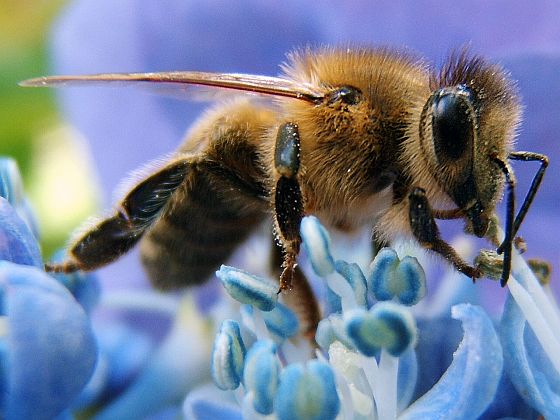
Queensland Brain Institute: QBI scientists at The University of Queensland have found that honeybees use the pattern of polarised light in the sky invisible to humans to direct one another to a honey source.
The study, conducted in Professor Mandyam Srinivasan’s laboratory at the Queensland Brain Institute, a member of the Australian Research Council Centre of Excellence in Vision Science (ACEVS), demonstrated that bees navigate to and from honey sources by reading the pattern of polarised light in the sky.
“The bees tell each other where the nectar is by converting their polarised ‘light map’ into dance movements,” Professor Srinivasan said.
“The more we find out how honeybees make their way around the landscape, the more awed we feel at the elegant way they solve very complicated problems of navigation that would floor most people – and then communicate them to other bees,” he said.
The discovery shines new light on the astonishing navigational and communication skills of an insect with a brain the size of a pinhead.
The researchers allowed bees to fly down a tunnel to a sugar source, shining only polarised light from above, either aligned with the tunnel or at right angles to the tunnel.
They then filmed what the bees ‘told’ their peers, by waggling their bodies when they got back to the hive.
“It is well known that bees steer by the sun, adjusting their compass as it moves across the sky, and then convert that information into instructions for other bees by waggling their body to signal the direction of the honey,” Professor Srinivasan said.
“Other laboratories have shown from studying their eyes that bees can see a pattern of polarised light in the sky even when the sun isn’t shining: the big question was could they translate the navigational information it provides into their waggle dance.”
The researchers conclude that even when the sun is not shining, bees can tell one another where to find food by reading and dancing to their polarised sky map.
In addition to revealing how bees perform their remarkable tasks, Professor Srinivasan says it also adds to our understanding of some of the most basic machinery of the brain itself.
Professor Srinivasan’s team conjectures that flight under polarised illumination activates discrete populations of cells in the insect’s brain.
When the polarised light was aligned with the tunnel, one pair of ‘place cells’ – neurons important for spatial navigation – became activated, whereas when the light was oriented across the tunnel a different pair of place cells was activated.
The researchers suggest that depending on which set of cells is activated, the bee can work out if the food source lies in a direction toward or opposite the direction of the sun, or in a direction ninety degrees to the left or right of it.
The study, “Honeybee navigation: critically examining the role of polarization compass”, is published in the 6 January 2014 issue of the Philosophical Transactions of the Royal Society B.

Moheb Costandi writes: Home is more than a place on a map. It evokes a particular set of feelings, and a sense of safety and belonging. Location, memories, and emotions are intertwined within those walls. Over the past few decades, this sentiment has gained solid scientific grounding. And earlier this year, researchers identified some of the cells that help encode our multifaceted homes in the human brain.
In the early 1970s, neuroscientist John O’Keefe of University College London and his colleagues began to uncover the brain mechanisms responsible for navigating space. They monitored the electrical activity of neurons within a part of the brain called the hippocampus. As the animals moved around an enclosure with electrodes implanted in their hippocampus, specific neurons fired in response to particular locations. These neurons, which came to be known as place cells, each had a unique “place field” where it fired: For example, neuron A might be active when the rat was in the far right corner, near the edge of the enclosure, while neuron B fired when the rat was in the opposite corner.
Since then, further experiments have shown that the hippocampus contains at least two other types of brain cells involved in navigation. Grid cells fire periodically as an animal traverses a space, and head direction cells fire when the animal faces a certain direction. Together, place cells, grid cells, and head direction cells form the brain’s GPS, mapping the space around an animal and its location within it.
Neuroscientists assumed that these three types of cells in the hippocampus are how we humans, too, navigate our surroundings. But solid evidence of these cell types came only recently, when a research team implanted electrodes into the brains of epilepsy patients being evaluated before surgery. They measured the activity of neurons in the hippocampus while the patients navigated a computer-generated environment, and found that some of the cells fired at regular intervals, as grid cells in rodents did. The authors of the study, published last August, conclude that the mechanisms of spatial navigation in mice and humans are likely the same. [Continue reading…]
Tom Chatfield writes: Massive, inconceivable numbers are commonplace in conversations about computers. The exabyte, a one followed by 18 zeroes worth of bits; the petaflop, one quadrillion calculations performed in a single second. Beneath the surface of our lives churns an ocean of information, from whose depths answers and optimisations ascend like munificent kraken.
This is the much-hyped realm of “big data”: unprecedented quantities of information generated at unprecedented speed, in unprecedented variety.
From particle physics to predictive search and aggregated social media sentiments, we reap its benefits across a broadening gamut of fields. We agonise about over-sharing while the numbers themselves tick upwards. Mostly, though, we fail to address a handful of questions more fundamental even than privacy. What are machines good at; what are they less good at; and when are their answers worse than useless?
Consider cats. As commentators like the American psychologist Gary Marcus have noted, it’s extremely difficult to teach a computer to recognise cats. And that’s not for want of trying. Back in the summer of 2012, Google fed 10 million feline-featuring images (there’s no shortage online) into a massively powerful custom-built system. The hope was that the alchemy of big data would do for images what it has already done for machine translation: that an algorithm could learn from a sufficient number of examples to approximate accurate solutions to the question “what is that?”
Sadly, cats proved trickier than words. Although the system did develop a rough measure of “cattiness”, it struggled with variations in size, positioning, setting and complexity. Once expanded to encompass 20,000 potential categories of object, the identification process managed just 15.8% accuracy: a huge improvement on previous efforts, but hardly a new digital dawn. [Continue reading…]