



Jared Diamond: In Guns, Germs, and Steel, I set out to explain why, after the end of the last Ice Age, the most powerful and technologically advanced societies developed first in the Fertile Crescent and spread from there to Europe and North America. In Collapse, I asked why many societies disintegrated or vanished while others avoided that fate, and what lessons those varying outcomes hold for us today.
Since publication of Collapse, I have been attempting to understand the revolutionary changes in human societies and social relations brought about by the emergence of state government, after seven million years of simpler forms of organization. The differences are so profound, and we take state government as so completely natural, that I couldn’t even pose the differences as questions until I had experienced them first-hand through living in New Guinea, a window on our past.
I first went to New Guinea 41 years ago to study birds and to have adventures. I knew intellectually that New Guineans constituted most of the world’s last remaining “primitive” peoples, who until a few decades ago still used stone tools, little clothing, and no writing. That was what the whole world used to be like until 7,000 years ago, a mere blink of an eye in the history of the human species. Only in a couple of other parts of the world besides New Guinea did our original long-prevailing “primitive” ways survive into the 20th century.
Stone tools, little clothing, and no writing proved to be only the least of the differences between our past and our present. There were other differences that I noticed within my first year in New Guinea: murderous hostility towards any stranger, marriageable young people having no role in choosing their spouse, lack of awareness of the existence of an outside world, and routine multi-lingualism from childhood.
But there were also more profound features, which took me a long time even to notice, because they are so at odds with modem experience that neither New Guineans nor I could even articulate them. Each of us took some aspects of our lifestyle for granted and couldn’t conceive of an alternative. Those other New Guinea features included the non-existence of “friendship” (associating with someone just because you like them), a much greater awareness of rare hazards, war as an omnipresent reality, morality in a world without judicial recourse, and a vital role of very old people.
I’ve encountered myself some features of our primitive lifestyle among Inuits, Amazonian Indians, and Aboriginal Australians. Others have described such features among Kalahari Bushmen, African Pygmies, Ainus, California Indians, and other peoples. Of course, all these peoples differ from each other. New Guinea’s 1,000 tribes themselves are diverse: they constitute 1,000 radically different experiments in constructing a human society. But they all share (or shared) some basic features that used to characterize all human societies until the rise of state societies with laws and government, beginning around 5,500 years ago in the Fertile Crescent and now established over the entire world.
I am once again treating a huge question about human societies, and in using methods of long-term comparative history. In this case I am placing much heavier weight on one area of the world, New Guinea. Yes, I include other parts of the world: I’ve already been gathering material on the Mongols, Cherokees, Zulus, and many others. But New Guinea will play a central role, as the standard of comparison. That’s as it should be, because New Guinea’s 1,000 languages make up one 6th of all surviving languages, and because New Guinea contained by far the largest number of people and tribes still living under pre-state conditions in modem times.
The other difference is that my studies of New Guinea are based much more heavily on my personal experiences and observations, and less on publications by others. Many of my experiences in New Guinea have been intense — a sudden encounter at night with a wild man, the prolonged agony of a nearly-fatal boat accident, one broken little stick in the forest warning us that nomads might be about to catch us as trespassers … Those stories carry a bigger message than mere exciting adventures that have shaped my outlook. They give us a first-hand picture of the human past as it has been for millions of years — a past that has almost vanished within our lifetimes, and that no one will ever be able to experience again.
I’ve gone from wrestling with difficult abstract questions about the structure of societies—about their rise from agricultural origins in Guns, Germs, and Steel, and about their decline or maintenance in Collapse. The abstractness of those questions forced me to work hard to put human faces on them. The New Guinea work is more passionate, personal, and from the heart.
In conversation with John Brockman at Edge, Diamond recounts some of the stories from his new book, The World Until Yesterday.

Happy New Year!
Maywa Montenegro and Terry Glavin write: This past January [2008], at the St. Innocent Russian Orthodox Cathedral in Anchorage, Alaska, friends and relatives gathered to bid their last farewell to Marie Smith Jones, a beloved matriarch of her community. At 89 years old, she was the last fluent speaker of the Eyak language. In May 2007 a cavalry of the Janjaweed — the notorious Sudanese militia responsible for the ongoing genocide of the indigenous people of Darfur — made its way across the border into neighboring Chad. They were hunting for 1.5 tons of confiscated ivory, worth nearly $1.5 million, locked in a storeroom in Zakouma National Park. Around the same time, a wave of mysterious frog disappearances that had been confounding herpetologists worldwide spread to the US Pacific Northwest. It was soon discovered that Batrachochytrium dendrobatidis, a deadly fungus native to southern Africa, had found its way via such routes as the overseas trade in frog’s legs to Central America, South America, Australia, and now the United States. One year later, food riots broke out across the island nation of Haiti, leaving at least five people dead; as food prices soared, similar violence erupted in Mexico, Bangladesh, Egypt, Cameroon, Ivory Coast, Senegal and Ethiopia.
All these seemingly disconnected events are the symptoms, you could say, of a global epidemic of sameness. It has no precise parameters, but wherever its shadow falls, it leaves the landscape monochromatic, monocultural, and homogeneous. Even before we’ve been able to take stock of the enormous diversity that today exists — from undescribed microbes to undocumented tongues — this epidemic carries away an entire human language every two weeks, destroys a domesticated food-crop variety every six hours, and kills off an entire species every few minutes. The fallout isn’t merely an assault to our aesthetic or even ethical values: As cultures and languages vanish, along with them go vast and ancient storehouses of accumulated knowledge. And as species disappear, along with them go not just valuable genetic resources, but critical links in complex ecological webs.
Experts have long recognized the perils of biological and cultural extinctions. But they’ve only just begun to see them as different facets of the same phenomenon, and to tease out the myriad ways in which social and natural systems interact. Catalyzed in part by the urgency that climate change has brought to all matters environmental, two progressive movements, incubating already for decades, have recently emerged into fuller view. Joining natural and social scientists from a wide range of disciplines and policy arenas, these initiatives are today working to connect the dots between ethnosphere and biosphere in a way that is rapidly leaving behind old unilateral approaches to conservation. Efforts to stanch extinctions of linguistic, cultural, and biological life have yielded a “biocultural” perspective that integrates the three. Efforts to understand the value of diversity in a complex systems framework have matured into a science of “resilience.” On parallel paths, though with different emphases, different lexicons, and only slightly overlapping clouds of experts, these emergent paradigms have created space for a fresh struggle with the tough questions: What kinds of diversity must we consider, and how do we measure them on local, regional, and global scales? Can diversity be buffered against the streamlining pressures of economic growth? How much diversity is enough? From a recent biocultural diversity symposium in New York City to the first ever global discussion of resilience in Stockholm, these burgeoning movements are joining biologist with anthropologist, scientist with storyteller, in building a new framework to describe how, why, and what to sustain.
The biological diversity crisis is often called the “Sixth Extinction” because an event of this magnitude has occurred only five times in the history of life on Earth. The last was at the end of the Cretaceous period, when the dinosaurs disappeared. In the past couple hundred years, humans have increased species extinction rates by as much as 10,000 times the background rates that have been typical over Earth’s history. This is a crash that, within the scientific community, is causing a slow panic and a wide belief that the dangers of biodiversity loss are woefully underestimated by most everyone outside of science. Yet even those who grasp extinction’s severity haven’t made much of a noticeable contribution to its containment. On May 16 the Zoological Society of London released a report suggesting that since contemporary environmentalism emerged with the declaration of the first Earth Day in 1970, close to one-third of all the wild species on Earth have disappeared. Language conservationists have fared no better: Of the world’s roughly 6,800 languages, fully half — though some experts say closer to 90 percent — are expected to disappear before the end of the century.
Our collective failure to recognize and impede this rampant winnowing of diversity can in part be blamed on the sheer rapidity with which it has advanced. Since only 1900, the human population has increased by a factor of four, water use by a factor of nine, carbon dioxide emissions by 17, marine-fish catch by 35, and industrial output by 40. It’s this expanding human footprint, and the global commerce on which it depends, that unifies the stories of Marie Smith Jones, the Janjaweed horsemen, the disappearing frogs, and the food riots. The transnational flow of people and products, media and information, crops and commodities has never in the history of the planet been so heavy or so fast. [Continue reading…]

Paul Kingsnorth writes: Etymology can be interesting. Scythe, originally rendered sithe, is an Old English word, indicating that the tool has been in use in these islands for at least a thousand years. But archaeology pushes that date much further out; Roman scythes have been found with blades nearly two meters long. Basic, curved cutting tools for use on grass date back at least ten thousand years, to the dawn of agriculture and thus to the dawn of civilizations. Like the tool, the word, too, has older origins. The Proto-Indo-European root of scythe is the word sek, meaning to cut, or to divide. Sek is also the root word of sickle, saw, schism, sex, and science.
I’VE RECENTLY BEEN reading the collected writings of Theodore Kaczynski. I’m worried that it may change my life. Some books do that, from time to time, and this is beginning to shape up as one of them.
It’s not that Kaczynski, who is a fierce, uncompromising critic of the techno-industrial system, is saying anything I haven’t heard before. I’ve heard it all before, many times. By his own admission, his arguments are not new. But the clarity with which he makes them, and his refusal to obfuscate, are refreshing. I seem to be at a point in my life where I am open to hearing this again. I don’t know quite why.
Here are the four premises with which he begins the book:
- Technological progress is carrying us to inevitable disaster.
- Only the collapse of modern technological civilization can avert disaster.
- The political left is technological society’s first line of defense against revolution.
- What is needed is a new revolutionary movement, dedicated to the elimination of technological society.
Kaczynski’s prose is sparse, and his arguments logical and unsentimental, as you might expect from a former mathematics professor with a degree from Harvard. I have a tendency toward sentimentality around these issues, so I appreciate his discipline. I’m about a third of the way through the book at the moment, and the way that the four arguments are being filled out is worryingly convincing. Maybe it’s what scientists call “confirmation bias,” but I’m finding it hard to muster good counterarguments to any of them, even the last. I say “worryingly” because I do not want to end up agreeing with Kaczynski. There are two reasons for this.
Firstly, if I do end up agreeing with him — and with other such critics I have been exploring recently, such as Jacques Ellul and D. H. Lawrence and C. S. Lewis and Ivan Illich — I am going to have to change my life in quite profound ways. Not just in the ways I’ve already changed it (getting rid of my telly, not owning a credit card, avoiding smartphones and e-readers and sat-navs, growing at least some of my own food, learning practical skills, fleeing the city, etc.), but properly, deeply. I am still embedded, at least partly because I can’t work out where to jump, or what to land on, or whether you can ever get away by jumping, or simply because I’m frightened to close my eyes and walk over the edge.
I’m writing this on a laptop computer, by the way. It has a broadband connection and all sorts of fancy capabilities I have never tried or wanted to use. I mainly use it for typing. You might think this makes me a hypocrite, and you might be right, but there is a more interesting observation you could make. This, says Kaczynski, is where we all find ourselves, until and unless we choose to break out. In his own case, he explains, he had to go through a personal psychological collapse as a young man before he could escape what he saw as his chains. He explained this in a letter in 2003:
I knew what I wanted: To go and live in some wild place. But I didn’t know how to do so. . . . I did not know even one person who would have understood why I wanted to do such a thing. So, deep in my heart, I felt convinced that I would never be able to escape from civilization. Because I found modern life absolutely unacceptable, I grew increasingly hopeless until, at the age of 24, I arrived at a kind of crisis: I felt so miserable that I didn’t care whether I lived or died. But when I reached that point a sudden change took place: I realized that if I didn’t care whether I lived or died, then I didn’t need to fear the consequences of anything I might do. Therefore I could do anything I wanted. I was free!
At the beginning of the 1970s, Kaczynski moved to a small cabin in the woods of Montana where he worked to live a self-sufficient life, without electricity, hunting and fishing and growing his own food. He lived that way for twenty-five years, trying, initially at least, to escape from civilization. But it didn’t take him long to learn that such an escape, if it were ever possible, is not possible now. More cabins were built in his woods, roads were enlarged, loggers buzzed through his forests. More planes passed overhead every year. One day, in August 1983, Kaczynski set out hiking toward his favorite wild place:
The best place, to me, was the largest remnant of this plateau that dates from the Tertiary age. It’s kind of rolling country, not flat, and when you get to the edge of it you find these ravines that cut very steeply in to cliff-like drop-offs and there was even a waterfall there. . . . That summer there were too many people around my cabin so I decided I needed some peace. I went back to the plateau and when I got there I found they had put a road right through the middle of it. . . . You just can’t imagine how upset I was. It was from that point on I decided that, rather than trying to acquire further wilderness skills, I would work on getting back at the system. Revenge.
I can identify with pretty much every word of this, including, sometimes, the last one. This is the other reason that I do not want to end up being convinced by Kaczynski’s position. Ted Kaczynski was known to the FBI as the Unabomber during the seventeen years in which he sent parcel bombs from his shack to those he deemed responsible for the promotion of the technological society he despises. In those two decades he killed three people and injured twenty-four others. His targets lost eyes and fingers and sometimes their lives. He nearly brought down an airplane. Unlike many other critics of the technosphere, who are busy churning out books and doing the lecture circuit and updating their anarcho-primitivist websites, Kaczynski wasn’t just theorizing about being a revolutionary. He meant it.
BACK TO THE SCYTHE. It’s an ancient piece of technology; tried and tested, improved and honed, literally and metaphorically, over centuries. It’s what the green thinkers of the 1970s used to call an “appropriate technology” — a phrase that I would love to see resurrected — and what the unjustly neglected philosopher Ivan Illich called a “tool for conviviality.” Illich’s critique of technology, like Kaczynski’s, was really a critique of power. Advanced technologies, he explained, created dependency; they took tools and processes out of the hands of individuals and put them into the metaphorical hands of organizations. The result was often “modernized poverty,” in which human individuals became the equivalent of parts in a machine rather than the owners and users of a tool. In exchange for flashing lights and throbbing engines, they lost the things that should be most valuable to a human individual: Autonomy. Freedom. Control.
Illich’s critique did not, of course, just apply to technology. It applied more widely to social and economic life. A few years back I wrote a book called Real England, which was also about conviviality, as it turned out. In particular, it was about how human-scale, vernacular ways of life in my home country were disappearing, victims of the march of the machine. Small shops were crushed by supermarkets, family farms pushed out of business by the global agricultural market, ancient orchards rooted up for housing developments, pubs shut down by developers and state interference. What the book turned out to be about, again, was autonomy and control: about the need for people to be in control of their tools and places rather than to remain cogs in the machine.
Critics of that book called it nostalgic and conservative, as they do with all books like it. They confused a desire for human-scale autonomy, and for the independent character, quirkiness, mess, and creativity that usually results from it, with a desire to retreat to some imagined “golden age.” It’s a familiar criticism, and a lazy and boring one. Nowadays, when I’m faced with digs like this, I like to quote E. F. Schumacher, who replied to the accusation that he was a “crank” by saying, “A crank is a very elegant device. It’s small, it’s strong, it’s lightweight, energy efficient, and it makes revolutions.” [Continue reading…]

Wade Davis: “If human beings are the agents of cultural destruction, we can also be and must be the facilitators of cultural survival.”
This is an interview which the Austrian psychiatrist, Holocaust survivor, and author of Man’s Search for Meaning, Viktor Frankl, gave in South Africa in 1985.
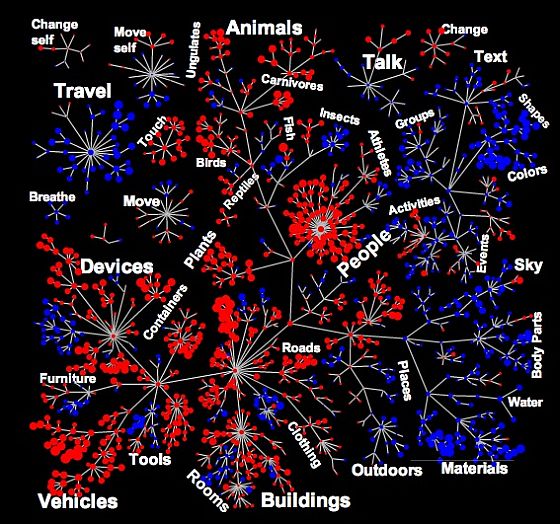
ExtremeTech: If not for our brains, our eyes wouldn’t be able to process anything. Considering how much time we spend with our eyes open, our brains are constantly dealing with an influx of visual data. The brain needs to store that data somewhere, and thanks to scientists over at the University of California, Berkeley, we now have our first map of not only where the brain puts all that information, but how our grey matter organizes it.
The study (PDF), led by neuroscience doctoral student Alexander Huth, had five participants watch two hours of movie trailers that contained over 1,700 categories of actions and objects. During that time, their brain activity was recorded using functional Magnetic Resonance Imaging (fMRI), measuring blood flow in various spots in the brain. Using linear regression, the scientists were then able to analyze the collected data, and subsequently build a model showing how all of those actions and objects fit into around 30,000 locations within the cortex.
After that point the researchers translated the model to a visual form. Using principal component analysis – a mathematical procedure used to provide a synopsis for a large amount of data — the scientists were able to visualize those 1,700 categories and how they related to one another, creating the chart shown to the right.
The map is made [of] “semantic neighborhoods,” which are essentially just categories of things that the brain finds similar to each other. The researchers found that, for instance, the brain organizes the categories of “humans” and “animals” in a related manner, whereas “eyeball” and “car” are stored in completely different areas of the brain. Along with finding out how the brain organizes different categories of objects, the researchers also found out that different people’s brains organize things in similar ways. [Continue reading…]
The graphic above is not a representation of a neural network. It’s simply a visual representation of the WordNet semantic network from which the 1,700 categories used in this research were derived.

A Mayan elder explains in more detail how the Mayan cyclical calendars worked.
It’s always worth being reminded that the real Americans inhabited this continent long before the Europeans arrived.
Tim Padgett writes: I once took a Classics professor friend of mine, a real Hellenophile, to the majestic Maya ruins of Palenque in southern Mexico. I wanted him to see why the Maya, thanks to their advanced astronomy, mathematics and cosmology, are considered the Greeks of the New World. As we entered the Palace there, my friend stopped, surprised, and said, “Corbel arches!” That’s the kind of precocious architecture you find at famous ancient Greek sites like Mycenae — and seeing it at Palenque made him acknowledge that maybe the Greeks could be considered the Maya of the Old World.
Today, Dec. 21, we’re all standing under those Corbel arches, celebrating one of civilization’s more sublime accomplishments, the Maya calendar. The 2012 winter solstice marks the end of a 5,125-year creation cycle and the hopeful start of another — and not the apocalyptic end that so many wing nuts rave about. (That comes next month, when our wing nuts in Washington send us over the fiscal cliff.) Understandably, this Maya milestone is a source of Latin American and especially Mexican pride. As teacher Jaime Escalante tells the Mexican-American kids he turns into calculus wizards in the 1988 film Stand and Deliver: “Did you know that neither the Greeks nor the Romans were capable of using the concept of zero? It was your ancestors, the Mayas, who first contemplated it…True story.”
But, unfortunately, most Americans ignore that record and focus on the doomsday nonsense that a crowd of pseudo-scholars has tied to the Maya calculations. It’s part and parcel of the western world’s condescending approach to pre-Columbian society—typified by the popular canard that if the Maya did rival the Greeks in any arena, then space aliens must have shown them how. It also reflects the maddening American disregard, if not disdain, for Mexico and Latin America, which persists even today as Escalante’s now grown-up Chicano students and the rest of the Latino community prove their political clout. So since today is all about new beginnings — and since Mexico itself is endeavoring a fresh start right now — we also ought to consider an overhaul of the tiresomely arrogant and indifferent way we look at the world south of the border. [Continue reading…]
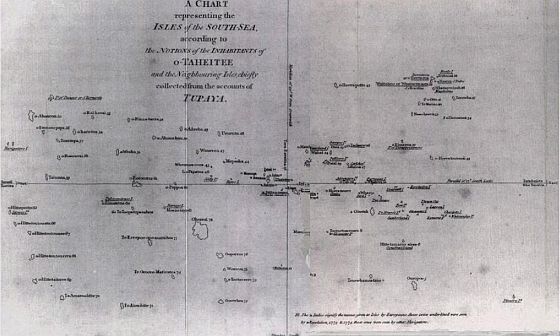
Map of the South Pacific made by the Polynesian navigator, Tupaia.
National Geographic: In the winter of 1769, the British explorer Captain James Cook, early into his first voyage across the Pacific, received from a Polynesian priest named Tupaia an astonishing gift — a map, the first that any European had ever encountered showing all the major islands of the South Pacific. Some accounts say Tupaia sketched the map on paper; others that he described it in words. What’s certain is that this map instantly gave Cook a far more complete picture of the South Pacific than any other European possessed. It showed every major island group in an area some 3,000 miles across, from the Marquesas west to Fiji. It matched what Cook had already seen, and showed much he hadn’t.
Cook had granted Tupaia a berth on the Endeavour in Tahiti. Soon after that, the Polynesian wowed the crew by navigating to an island unknown to Cook, some 300 miles south, without ever consulting compass, chart, clock, or sextant. In the weeks that followed, as he helped guide the Endeavour from one archipelago to another, Tupaia amazed the sailors by pointing on request, at any time, day or night, cloudy or clear, precisely toward Tahiti.
Cook, uniquely among European explorers, understood what Tupaia’s feats meant. The islanders scattered across the South Pacific were one people, who long ago, probably before Britain was Britain, had explored, settled, and mapped this vast ocean without any of the navigational tools that Cook found essential—and had carried the map solely in their heads ever since.
Two centuries later a global network of geneticists analyzing DNA bread-crumb trails of modern human migration would prove Cook right: Tupaia’s ancestors had colonized the Pacific 2,300 years before. Their improbable migration across the Pacific continued a long eastward march that had begun in Africa 70,000 to 50,000 years earlier. Cook’s journey, meanwhile, continued a westward movement started by his own ancestors, who had left Africa around the same time Tupaia’s ancestors had. In meeting each other, Cook and Tupaia closed the circle, completing a journey their forebears had begun together, so many millennia before. [Continue reading…]
