



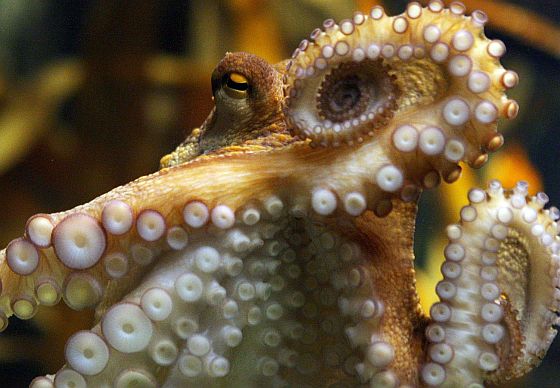
Sy Montgomery: “Meeting an octopus,” writes [professor of philosophy, Peter] Godfrey-Smith, “is like meeting an intelligent alien.” Their intelligence sometimes even involves changing colors and shapes. One video online shows a mimic octopus alternately morphing into a flatfish, several sea snakes, and a lionfish by changing color, altering the texture of its skin, and shifting the position of its body. Another video shows an octopus materializing from a clump of algae. Its skin exactly matches the algae from which it seems to bloom — until it swims away.
For its color palette, the octopus uses three layers of three different types of cells near the skin’s surface. The deepest layer passively reflects background light. The topmost may contain the colors yellow, red, brown, and black. The middle layer shows an array of glittering blues, greens, and golds. But how does an octopus decide what animal to mimic, what colors to turn? Scientists have no idea, especially given that octopuses are likely colorblind.
But new evidence suggests a breathtaking possibility. Woods Hole Marine Biological Laboratory and University of Washington researchers found that the skin of the cuttlefish Sepia officinalis, a color-changing cousin of octopuses, contains gene sequences usually expressed only in the light-sensing retina of the eye. In other words, cephalopods — octopuses, cuttlefish, and squid — may be able to see with their skin.
The American philosopher Thomas Nagel once wrote a famous paper titled “What Is It Like to Be a Bat?” Bats can see with sound. Like dolphins, they can locate their prey using echoes. Nagel concluded it was impossible to know what it’s like to be a bat. And a bat is a fellow mammal like us — not someone who tastes with its suckers, sees with its skin, and whose severed arms can wander about, each with a mind of its own. Nevertheless, there are researchers still working diligently to understand what it’s like to be an octopus.
Jennifer Mather spent most of her time in Bermuda floating facedown on the surface of the water at the edge of the sea. Breathing through a snorkel, she was watching Octopus vulgaris — the common octopus. Although indeed common (they are found in tropical and temperate waters worldwide), at the time of her study in the mid-1980s, “nobody knew what they were doing.”
In a relay with other students from six-thirty in the morning till six-thirty at night, Mather worked to find out. Sometimes she’d see an octopus hunting. A hunting expedition could take five minutes or three hours. The octopus would capture something, inject it with venom, and carry it home to eat. “Home,” Mather found, is where octopuses spend most of their time. A home, or den, which an octopus may occupy only a few days before switching to a new one, is a place where the shell-less octopus can safely hide: a hole in a rock, a discarded shell, or a cubbyhole in a sunken ship. One species, the Pacific red octopus, particularly likes to den in stubby, brown, glass beer bottles.
One octopus Mather was watching had just returned home and was cleaning the front of the den with its arms. Then, suddenly, it left the den, crawled a meter away, picked up one particular rock and placed the rock in front of the den. Two minutes later, the octopus ventured forth to select a second rock. Then it chose a third. Attaching suckers to all the rocks, the octopus carried the load home, slid through the den opening, and carefully arranged the three objects in front. Then it went to sleep. What the octopus was thinking seemed obvious: “Three rocks are enough. Good night!”
The scene has stayed with Mather. The octopus “must have had some concept,” she said, “of what it wanted to make itself feel safe enough to go to sleep.” And the octopus knew how to get what it wanted: by employing foresight, planning — and perhaps even tool use. Mather is the lead author of Octopus: The Ocean’s Intelligent Invertebrate, which includes observations of octopuses who dismantle Lego sets and open screw-top jars. Coauthor Roland Anderson reports that octopuses even learned to open the childproof caps on Extra Strength Tylenol pill bottles — a feat that eludes many humans with university degrees.
In another experiment, Anderson gave octopuses plastic pill bottles painted different shades and with different textures to see which evoked more interest. Usually each octopus would grasp a bottle to see if it were edible and then cast it off. But to his astonishment, Anderson saw one of the octopuses doing something striking: she was blowing carefully modulated jets of water from her funnel to send the bottle to the other end of her aquarium, where the water flow sent it back to her. She repeated the action twenty times. By the eighteenth time, Anderson was already on the phone with Mather with the news: “She’s bouncing the ball!”
This octopus wasn’t the only one to use the bottle as a toy. Another octopus in the study also shot water at the bottle, sending it back and forth across the water’s surface, rather than circling the tank. Anderson’s observations were reported in the Journal of Comparative Psychology. “This fit all the criteria for play behavior,” said Anderson. “Only intelligent animals play — animals like crows and chimps, dogs and humans.” [Continue reading…]

To see a world in a grain of sand
And a heaven in a wild flower,
Hold infinity in the palm of your hand,
And eternity in an hour.
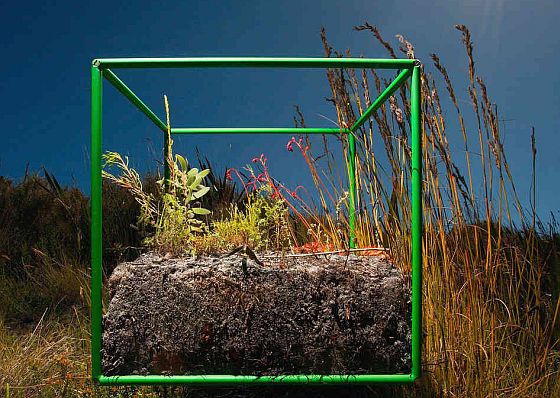
Thus William Blake’s Auguries of Innocence begins. The same insight — that in the smallest things we can discover the significance of life — has now been revealed (though not as poetically expressed) by a photographer who scoured the world examining life circumscribed by a cubic foot.
John Vidal writes: Long live the creepy crawlies, the bugs, the tiny wigglers and wrigglers, the minuscule parasites and nematodes, the mites and oribatids and all the myriad life forms that buzz, crawl and throb below our feet. Most have barely been given a second thought by science, but biologists now think that these mostly named creatures make up the beating heart of the biosphere and that the fate of all life may depend on the wellbeing of their fragile worlds.
Thanks to photographer David Liittschwager, we now have a visual inkling of what exactly lives high in the cloud forest canopy, below our feet in the parks, in the sediments of rivers and on coral reefs. Liittschwager, primarily a portrait photographer, had the idea of taking a one-cubic-foot metal frame and recording what moved through this habitat over the course of a day and night. He then made portraits of the life that could be seen with the naked eye.
What was found even in fairly nondescript places was wondrous. When the metal frame was dropped in the Duck river in Tennessee, it recorded 32 fish species, and nearly 100 others in the day. “Dig a few handfuls of sediment from the bottom and the river’s significance begins to reveal itself. Half of what you hold in your hands is sand and gravel, and the rest is live species – mussels, snails, juvenile crayfish, the larvae of stoneflies and dragonflies. It seems possible that the driving force of planetary life is actually very small and that its intricacies are lost on most of us,” author Alan Huffman remarks in an essay accompanying the pictures.
A whole, unknown world was found when the cube was suspended from the branch of a tree in Costa Rica’s rainforest. This time, 145 species – birds, mammals, mosses, bromeliads and epiphytes – were recorded. “This is the last biotic frontier, the missing pieces of the phenomenal jigsaw puzzle that is the tropical rainforest. How forest canopy populations become established, grow and disperse to other sites remains wholly unknown,” said canopy researcher Nalini Nadkarni.
The cubic foot was dropped on Temae coral reef near Tahiti in the Pacific. There, 600 individual animals and plants more than a millimetre in size – some living permanently in the space, others swimming or floating through – were recorded. “And this is not counting the many thousands of smaller creatures that floated by each hour. Wrasses, sea slugs, a baby octopus, shrimp, worms and crabs as small as the letters on the page were all recorded,” reported author Elizabeth Kolbert.
Jasper Slingsby, a researcher at the South Africa environmental observational network, recorded life in a cubic foot of Table mountain national park in South Africa. “In the course of 24 hours, the one cubic foot of mountain fynbos that we sampled revealed almost 30 plant species and roughly 70 invertebrates. But being stationary the cube could not capture what is arguably the most amazing component of fynbos diversity – how much it changes from location to location. If we picked the cube up and walked 10ft we could get as much as 50% difference in plant species we encountered. [Continue reading…]
NPR’s Robert Krulwich describes a Liittschwager-like experiment that his colleague, commentator and science writer Craig Childs, conducted in a cornfield in Iowa.
There were no bees. The air, the ground, seemed vacant. He found one ant “so small you couldn’t pin it to a specimen board.” A little later, crawling to a different row, he found one mushroom, “the size of an apple seed.” Then, later, a cobweb spider eating a crane fly (only one). A single red mite “the size of a dust mote hurrying across the barren earth,” some grasshoppers, and that’s it. Though he crawled and crawled, he found nothing else.
“It felt like another planet entirely,” he said, a world denuded.
Yet, 100 years ago, these same fields, these prairies, were home to 300 species of plants, 60 mammals, 300 birds, hundreds and hundreds of insects. This soil was the richest, the loamiest in the state. And now, in these patches, there is almost literally nothing but one kind of living thing. We’ve erased everything else.

Immortality has always struck me as a terrible idea — the most extreme expression of self-infatuation. Out with the old and in with the new seems like a universal law and a good one. It turns out, however, that that’s not always the case.
Nathaniel Rich writes: After more than 4,000 years — almost since the dawn of recorded time, when Utnapishtim told Gilgamesh that the secret to immortality lay in a coral found on the ocean floor — man finally discovered eternal life in 1988. He found it, in fact, on the ocean floor. The discovery was made unwittingly by Christian Sommer, a German marine-biology student in his early 20s. He was spending the summer in Rapallo, a small city on the Italian Riviera, where exactly one century earlier Friedrich Nietzsche conceived “Thus Spoke Zarathustra”: “Everything goes, everything comes back; eternally rolls the wheel of being. Everything dies, everything blossoms again. . . .”
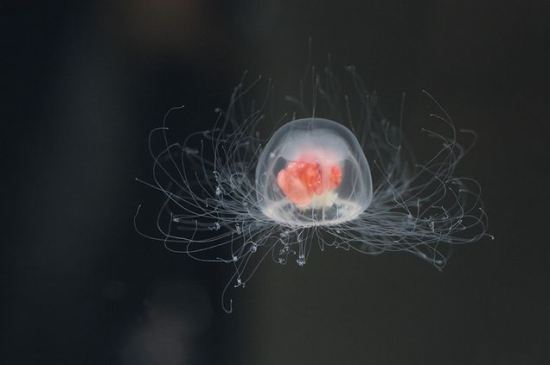
Sommer was conducting research on hydrozoans, small invertebrates that, depending on their stage in the life cycle, resemble either a jellyfish or a soft coral. Every morning, Sommer went snorkeling in the turquoise water off the cliffs of Portofino. He scanned the ocean floor for hydrozoans, gathering them with plankton nets. Among the hundreds of organisms he collected was a tiny, relatively obscure species known to biologists as Turritopsis dohrnii. Today it is more commonly known as the immortal jellyfish.
Sommer kept his hydrozoans in petri dishes and observed their reproduction habits. After several days he noticed that his Turritopsis dohrnii was behaving in a very peculiar manner, for which he could hypothesize no earthly explanation. Plainly speaking, it refused to die. It appeared to age in reverse, growing younger and younger until it reached its earliest stage of development, at which point it began its life cycle anew.
Sommer was baffled by this development but didn’t immediately grasp its significance. (It was nearly a decade before the word “immortal” was first used to describe the species.) But several biologists in Genoa, fascinated by Sommer’s finding, continued to study the species, and in 1996 they published a paper called “Reversing the Life Cycle.” The scientists described how the species — at any stage of its development — could transform itself back to a polyp, the organism’s earliest stage of life, “thus escaping death and achieving potential immortality.” This finding appeared to debunk the most fundamental law of the natural world — you are born, and then you die.
One of the paper’s authors, Ferdinando Boero, likened the Turritopsis to a butterfly that, instead of dying, turns back into a caterpillar. Another metaphor is a chicken that transforms into an egg, which gives birth to another chicken. The anthropomorphic analogy is that of an old man who grows younger and younger until he is again a fetus. For this reason Turritopsis dohrnii is often referred to as the Benjamin Button jellyfish.
Yet the publication of “Reversing the Life Cycle” barely registered outside the academic world. You might expect that, having learned of the existence of immortal life, man would dedicate colossal resources to learning how the immortal jellyfish performs its trick. You might expect that biotech multinationals would vie to copyright its genome; that a vast coalition of research scientists would seek to determine the mechanisms by which its cells aged in reverse; that pharmaceutical firms would try to appropriate its lessons for the purposes of human medicine; that governments would broker international accords to govern the future use of rejuvenating technology. But none of this happened. [Continue reading…]
