



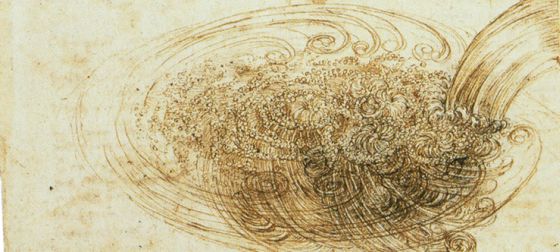
Philip Ball writes: When the German physicist Arnold Sommerfeld assigned his most brilliant student a subject for his doctoral thesis in 1923, he admitted that “I would not have proposed a topic of this difficulty to any of my other pupils.” Those others included such geniuses as Wolfgang Pauli and Hans Bethe, yet for Sommerfeld the only one who was up to the challenge of this subject was Werner Heisenberg.
Heisenberg went on to be a key founder of quantum theory and was awarded the 1932 Nobel Prize in physics. He developed one of the first mathematical descriptions of this new and revolutionary discipline, discovered the uncertainty principle, and together with Niels Bohr engineered the “Copenhagen interpretation” of quantum theory, to which many physicists still adhere today.
The subject of Heisenberg’s doctoral dissertation, however, wasn’t quantum physics. It was harder than that. The 59-page calculation that he submitted to the faculty of the University of Munich in 1923 was titled “On the stability and turbulence of fluid flow.”
Sommerfeld had been contacted by the Isar Company of Munich, which was contracted to prevent the Isar River from flooding by building up its banks. The company wanted to know at what point the river flow changed from being smooth (the technical term is “laminar”) to being turbulent, beset with eddies. That question requires some understanding of what turbulence is. Heisenberg’s work on the problem was impressive—he solved the mathematical equations of flow at the point of the laminar-to-turbulent change—and it stimulated ideas for decades afterward. But he didn’t really crack it—he couldn’t construct a comprehensive theory of turbulence.
Heisenberg was not given to modesty, but it seems he had no illusions about his achievements here. One popular story goes that he once said, “When I meet God, I am going to ask him two questions. Why relativity? And why turbulence? I really believe he will have an answer for the first.”
It is probably an apocryphal tale. The same remark has been attributed to at least one other person: The British mathematician and expert on fluid flow, Horace Lamb, is said to have hoped that God might enlighten him on quantum electrodynamics and turbulence, saying that “about the former I am rather optimistic.”
You get the point: turbulence, a ubiquitous and eminently practical problem in the real world, is frighteningly hard to understand. [Continue reading…]

Nautilus: Neil Shubin has been going backward his whole life. “I teach anatomy but I want to understand why things look the way they do,” says the paleontologist and professor of organismal biology and anatomy at the University of Chicago. “And to understand the fundamental questions you have to go ever deeper into history. So I have gone backward from humans to fish to planets.”
Shubin, 53, is referring to his two books, Your Inner Fish and The Universe Within, which detail the atoms and molecules, genes and cells, sculpted by evolution into the common bonds of life. In 2004, on Ellesmere Island in the Arctic, Shubin discovered one of the key links in animal evolution, the fish known as Tiktaalik, that, he writes, “was specialized for a rather extraordinary function: it was capable of doing push-ups.”
Shubin and his team learned from Tiktaalik fossils that the big fish with the flat head had a shoulder, elbow, and wrist composed of the same bones in a human’s upper arm, forearm, and wrist. Tiktaalik used those bones to navigate shallow streams and ponds “and even to flop around on the mudflats along the banks.” Here was the creature from the lagoon that revealed how animals evolved from fish to us. [Continue reading…]
Zakir Hussain with John McLaughlin, Jan Garbarek & Hariprasad Chaurasia
Harvard Business Review: Researchers have confronted us in recent years with example after example of how we humans get things wrong when it comes to making decisions. We misunderstand probability, we’re myopic, we pay attention to the wrong things, and we just generally mess up. This popular triumph of the “heuristics and biases” literature pioneered by psychologists Daniel Kahneman and Amos Tversky has made us aware of flaws that economics long glossed over, and led to interesting innovations in retirement planning and government policy.
It is not, however, the only lens through which to view decision-making. Psychologist Gerd Gigerenzer has spent his career focusing on the ways in which we get things right, or could at least learn to. In Gigerenzer’s view, using heuristics, rules of thumb, and other shortcuts often leads to better decisions than the models of “rational” decision-making developed by mathematicians and statisticians.
Gerd Gigerenzer: Gut feelings are tools for an uncertain world. They’re not caprice. They are not a sixth sense or God’s voice. They are based on lots of experience, an unconscious form of intelligence.
I’ve worked with large companies and asked decision makers how often they base an important professional decision on that gut feeling. In the companies I’ve worked with, which are large international companies, about 50% of all decisions are at the end a gut decision.
But the same managers would never admit this in public. There’s fear of being made responsible if something goes wrong, so they have developed a few strategies to deal with this fear. One is to find reasons after the fact. A top manager may have a gut feeling, but then he asks an employee to find facts the next two weeks, and thereafter the decision is presented as a fact-based, big-data-based decision. That’s a waste of time, intelligence, and money. The more expensive version is to hire a consulting company, which will provide a 200-page document to justify the gut feeling. And then there is the most expensive version, namely defensive decision making. Here, a manager feels he should go with option A, but if something goes wrong, he can’t explain it, so that’s not good. So he recommends option B, something of a secondary or third-class choice. Defensive decision-making hurts the company and protects the decision maker. In the studies I’ve done with large companies, it happens in about a third to half of all important decisions. You can imagine how much these companies lose.
HBR: But there is a move in business towards using data more intelligently. There’s exploding amounts of it in certain industries, and definitely in the pages of HBR, it’s all about Gee, how do I automate more of these decisions?
GG: That’s a good strategy if you have a business in a very stable world. Big data has a long tradition in astronomy. For thousands of years, people have collected amazing data, and the heavenly bodies up there are fairly stable, relative to our short time of lives. But if you deal with an uncertain world, big data will provide an illusion of certainty. For instance, in Risk Savvy I’ve analyzed the predictions of the top investment banks worldwide on exchange rates. If you look at that, then you know that big data fails. In an uncertain world you need something else. Good intuitions, smart heuristics. [Continue reading…]