Author Archives: Paul Woodward

Why Iran’s opposition movement muddles nuclear talks

Why Iran’s opposition movement muddles nuclear talks

After more than five months of going it alone, Iran’s opposition Green Movement is reaching out to the United States for help. Via public and private channels, the Obama Administration has received several appeals in recent weeks to take a stronger stand against human-rights abuses in Iran, avoid military action and impose more aggressive and rapid-fire sanctions against the Revolutionary Guards and its vast business interests.

The opposition’s outreach comes as the Administration weighs the next move in its diplomatic effort to resolve the nuclear standoff with Iran. Tehran has effectively rebuffed a confidence-building deal that would ship out the bulk of Iran’s enriched-uranium stockpile to be converted into fuel rods for a medical-research reactor — which would also have added about a year to the time frame within which Iran could weaponize nuclear material. The deal would have offered more time for longer-term diplomatic negotiations. As a result, President Obama has begun trying to rally international support for a new round of sanctions. (See pictures of people around the world protesting Iran’s election.)

Washington has struggled since the disputed June 12 presidential election to figure out how to engage the regime without undermining the opposition. Now it has begun to hear answers from the Green Movement itself. [continued…]


Watch CBS News Videos Online

Iran’s death penalty is seen as a political tactic

A flurry of executions and death sentences in Iran has raised concern that the government is using judicially sanctioned killing to intimidate the political opposition and quell pockets of ethnic unrest around the nation, human rights groups and Iran experts said.

In Iran, where there is precedent for executions to surge in the wake of a crisis, human rights groups said there was mounting evidence that the trend had emerged in response to the political tumult that followed the June presidential election. This month, a fifth person connected to the protests was sentenced to death.

In at least one instance, a Kurdish activist was hanged after the government added a new charge, raising concerns that cases with political overtones were drawing more serious penalties.

In the short period between the disputed June election and the inauguration of President Mahmoud Ahmadinejad in August, 115 people were executed, according to statistics compiled by human rights groups from Iranian news agencies. Though the executions mostly involved violent criminals and drug dealers, the number and pace of the killings appeared to be sending a message to the opposition, said human rights groups and Iran experts. [continued…]

Facebooktwittermail

Iraq report: Secret papers reveal Blair’s blunders and concealment

Iraq report: Secret papers reveal Blair’s blunders and concealment

On the eve of the Chilcot inquiry into Britain’s involvement in the 2003 invasion and its aftermath, The Sunday Telegraph has obtained hundreds of pages of secret Government reports on “lessons learnt” which shed new light on “significant shortcomings” at all levels.

They include full transcripts of extraordinarily frank classified interviews in which British Army commanders vent their frustration and anger with ministers and Whitehall officials.

The reports disclose that:

Tony Blair, the former prime minister, misled MPs and the public throughout 2002 when he claimed that Britain’s objective was “disarmament, not regime change” and that there had been no planning for military action. In fact, British military planning for a full invasion and regime change began in February 2002.

The need to conceal this from Parliament and all but “very small numbers” of officials “constrained” the planning process. The result was a “rushed”operation “lacking in coherence and resources” which caused “significant risk” to troops and “critical failure” in the post-war period.

Operations were so under-resourced that some troops went into action with only five bullets each. Others had to deploy to war on civilian airlines, taking their equipment as hand luggage. Some troops had weapons confiscated by airport security.

Commanders reported that the Army’s main radio system “tended to drop out at around noon each day because of the heat”. One described the supply chain as “absolutely appalling”, saying: “I know for a fact that there was one container full of skis in the desert.” [continued…]

Facebooktwittermail

Gideon Levy on Israel’s addiction

Gideon Levy on Israel’s addiction

Gaza militant groups agree to stop firing rockets into Israel

Hamas has won an agreement from other militant groups in Gaza to halt rocket fire into Israel for the first time in almost a year, asboth sides indicated progress on a deal to release a captured Israeli soldier.

The agreement, announced , appears to be an attempt by the Palestinian Islamist movement to prevent another descent into fighting at a time when reconstruction has barely begun almost 12 months after the devastating conflict with Israel.

It also reflected more progress in secretly mediated talks to release Gilad Shalit, the soldier captured more than three years ago, in exchange for the return of hundreds of Palestinian prisoners. [continued…]

Gaza water unfit for human consumption: Palestinians

Water in the Gaza Strip is so salty that it is unfit for human consumption, a Palestinian official in charge of water supplies inside the besieged coastal territory said on Saturday.

“The water is no longer fit for human consumption, with analysis and international studies showing that just 10 percent of water in the Gaza Strip is usable… threatening the lives of Palestinians,” Munzir Shiblak warned.

He called in a statement for “the necessary measures to be taken to end the problem of salinity in Gaza water supplies, a problem that is getting worse.” [continued…]

Obama must deal with important questions of the Mideast conflict

For 41 years, Washington turned a blind eye. It protested a bit, scolded a bit, and mostly made do with periodically stating that its policy has not changed – it still opposes settlements in the territories and does not recognize the annexation of East Jerusalem or the Golan Heights. Suddenly, it gave us a resounding slap, but one of the frustrating kind that misses the cheek and flies through empty air. Because the American demand that we freeze construction in the settlements, that “strong message” containing a threat, has become a personal duel between Prime Minister Benjamin Netanyahu and U.S. President Barack Obama, in place of a clear policy presented by the latter.

Obama will win, of course. He can set a meeting with Netanyahu late at night, not answer the prime minister’s phone calls, warn him from the Great Wall of China and even order his officials to give Israel’s requests the cold shoulder. Obama already has managed to garner international support for his demand that Israel freeze settlement construction, even in Jerusalem, and American public opinion is on his side. If Obama wants to undermine Israel’s trust in the United States, or to prove to Netanyahu who is stronger, he does not have to work hard.

The American demand is proper, even if it is very late and unusually aggressive. However, its lack of context is infuriating. Freezing settlements is not a policy. Its entire purpose is to give Mahmoud Abbas, the resigning Palestinian Authority president, a reason to get back to negotiations. But negotiations cannot be a final goal, just as freezing settlements cannot be considered the ultimate achievement. What then? Is Abbas doomed to be a constant negotiator in endless negotiations? Does Washington have a plan for continuing negotiations? Continue reading

Facebooktwittermail

US pours millions into anti-Taliban militias in Afghanistan

US pours millions into anti-Taliban militias in Afghanistan

U.S. special forces are supporting anti-Taliban militias in at least 14 areas of Afghanistan as part of a secretive programme that experts warn could fuel long-term instability in the country.

The Community Defence Initiative (CDI) is enthusiastically backed by Stanley McChrystal, the US general commanding Nato forces in Afghanistan, but details about the programme have been held back from non-US alliance members who are likely to strongly protest.

The attempt to create what one official described as “pockets of tribal resistance” to the Taliban involves US special forces embedding themselves with armed groups and even disgruntled insurgents who are then given training and support.

In return for stabilising their local area the militia helps to win development aid for their local communities, although they will not receive arms, a US official said.

Special forces will be able to access money from a US military fund to pay for the projects. The hope is that the militias supplement the Nato and Afghan forces fighting the Taliban. But the prospect of re-empowering militias after billions of international dollars were spent after the US-led invasion in 2001 to disarm illegally armed groups alarms many experts. [continued…]

Obama’s Afghanistan dilemma

The sum we are already spending annually on Afghanistan is greater than its gross domestic product. Are there nonmilitary ways we could deploy that sum which would advance our goals as efficaciously? Would even forty thousand additional troops suffice for anything resembling the ambitious nation-building program that General Stanley McChrystal, the top military commander in Afghanistan, has proposed? (Counterinsurgency theory suggests that it would take more than ten times that many; would forty—or ten, or twenty—thousand be only a first installment?) Any counterinsurgency campaign, we’re told, requires a very long commitment. Is the voluntary association of democracies called NATO, organized to deter war more than to wage it, capable of sustaining a twenty or thirty years’ war? For that matter, does the United States—a decentralized populist democracy struggling with economic decline and political gridlock—have that capacity? And what about Pakistan?

The President has come under heavy criticism for taking the time to ponder the imponderables. “The urgent necessity,” a respected Washington columnist wrote the other day, “is to make a decision—whether or not it is right.” Really? Does the columnist suppose that a country unable to find the patience for weeks (even months) of thinking could summon the stamina for years (even decades) of killing and dying? What Obama seems to have discovered is that this is no longer the war that began eight years ago. That war was an act of retribution and prevention. But now who are we punishing? What are we preventing? The old narrative is broken. [continued…]

Militants could be invited to Afghan “Jirga”

Afghan President Hamid Karzai could invite militants to attend a “Loya Jirga,” or grand council meeting, aiming to seek peace and reconciliation with the Taliban, a spokesman said on Sunday.

The plans signal a more public effort to engage with militants during Karzai’s second term as leader, measures that Washington has encouraged in its counter-insurgency strategy.

Afghanistan’s constitution recognizes the Loya Jirga — Pashtu for grand assembly — as “the highest manifestation of the will of the people of Afghanistan.” [continued…]

Escaping Taliban may widen war as Pakistan pays cost

Taliban fleeing a Pakistani offensive are regrouping in the country’s northwest, threatening to spread and prolong a conflict that has strained the nation’s economy and may hamper efforts to attract foreign investment.

While Pakistan says its month-old offensive in South Waziristan has destroyed the largest Taliban sanctuary, some militants are falling back to Orakzai, a mountain region less than 16 kilometers (10 miles) south of Peshawar, the capital of North West Frontier Province, said Talat Masood, an independent military analyst in Islamabad.

Rising violence in the region last year prompted London- based Tullow Oil Plc to give up operational control of drilling operations near Orakzai. A wider conflict may make it harder to attract companies like Mol Nyrt., Hungary’s largest oil refiner, which this month started natural gas production in the province. [continued…]

Facebooktwittermail

Survey of Pakistan’s young predicts ‘disaster’ if their needs aren’t addressed

Survey of Pakistan’s young predicts ‘disaster’ if their needs aren’t addressed

Pakistan will face a “demographic disaster” if it does not address the needs of its young generation, the largest in the country’s history, whose views reflect a deep disillusionment with government and democracy, according to a report released here on Saturday.

The report, commissioned by the British Council and conducted by the Nielsen research company, drew a picture of a deeply frustrated young generation that feels abandoned by its government and despondent about its future.

An overwhelming majority of young Pakistanis say their country is headed in the wrong direction, the report said, and only 1 in 10 has confidence in the government. Most see themselves as Muslim first and Pakistani second, and they are now entering a work force in which the lion’s share cannot find jobs, a potentially volatile situation if the government cannot address its concerns.

“This is a real wake-up call for the international community,” said David Steven, a fellow at the Center for International Cooperation at New York University, who was an adviser on the report. “You could get rapid social and economic change. But the other route will lead to a nightmare that would unfold over 20 to 30 years.” [continued…]

Facebooktwittermail

Kahane tribute may damage peace talks

Kahane tribute may damage peace talks

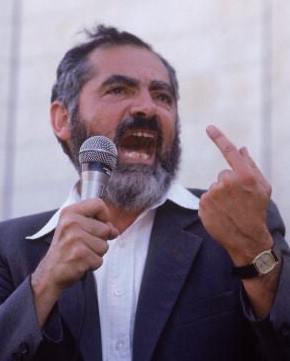
A plan by right-wing legislators in Israel to commemorate the anniversary this month of the death of Meir Kahane, whose banned anti-Arab movement is classified as a terrorist organisation, risks further damaging the prospects for talks between Israel and the Palestinians, US officials have warned.

A move to stage the commemoration in Israel’s parliament, the Knesset, is being led by Michael Ben-Ari, who was elected this year and is the first self-declared former member of Kahane’s party, Kach, to become a legislator since the movement was banned 15 years ago.

The US Embassy, in Tel Aviv, has sent a series of e-mails to Reuven Rivlin, the parliamentary speaker, asking that he intervene to block the event.

According to US officials, pressure is being exerted on behalf of George Mitchell, the US president Barack Obama’s envoy to the region, who is concerned that it will add to his troubles as Israeli and Palestinian leaders clash over a possible move by the Palestinians to issue a unilateral declaration of statehood.

Some Israeli legislators have warned that Mr Ben-Ari and his supporters are gaining a stronger foothold in parliament, in an indication of the country’s increasing lurch rightwards.

“Ben-Ari and the advisers he has brought with him are unabashed representatives for Kach and Kahane’s ideas,” said Ahmed Tibi, an Arab legislator and the deputy speaker. “What we have is in effect a terrorist cell in the parliament.” [continued…]

Editor’s Comment — Beyond the fact that Rabbi Meir Kahane was bad for Israel’s international image and that he fomented hostility between Jews and Palestinians, Kahane no doubt antagonized moderate Zionists by unmasking the contradictions implicit in the notion of a Jewish democratic state.

The following videos contain a CBS 60 Minutes report on Kahane from 1984. (The second part of the report is followed by a song eulogizing Kahane. Whoever put this on YouTube is clearly a shameless Kahanist.)

Kahane was describing the “demographic threat” facing Israel well before that phrase and that concept was lent a veneer of political respectability by becoming the fact that, for Zionists, makes the realization of a two-state solution an imperative.

Interestingly, back in 1984, an American journalist — Mike Wallace — had no problem asserting on national television that Israel’s claim to be democratic would require accepting the possibility that Palestinians might at some point become the majority.

Wallace, in the setup for the interview clip says: “Kahane asks his Jewish opponents how they would react to an Arab majority in Israel?”

Rabbi Meir Kahane: In theory, do they [the Palestinians] have a right to be the majority? Yes or no? They [Kahane’s opponents] can’t answer that. They cannot answer that question.

Wallace: If Israel is a democratic state, then obviously they [the Palestinians] obviously do [have a right to be in the majority].

Kahane: Right. But if it’s a Zionist state then obviously they don’t.

Wallace: But you’re the one who finds it impossible to accept both Zionism and democracy in the same state.

Kahane: Anyone does, because Zionism — the very definition of it is: the creation of a Jewish state — and in fact, Israel is defined in its declaration of independence as the “Jewish” state. You think that that makes Arabs feel happy. You think that Arabs rush into the streets on Independence Day in Israel to celebrate their defeat.

I think that only liberals have such contempt for Arabs that they believe you can buy an Arab’s national pride by raising his living standards. Not by bread alone does an Arab live.

Because I respect the Arab, I want to throw him out.

Later in the 60 Minutes report, Kahane is shown outside city of Umm al-Fahm, the second largest Palestinian city within Israel, saying in reference to some of its residents who are protesting his presence: “I want to make it clear to those dogs that are standing there, there is no such thing as an Arab village in the state of Israel.”

Facebooktwittermail

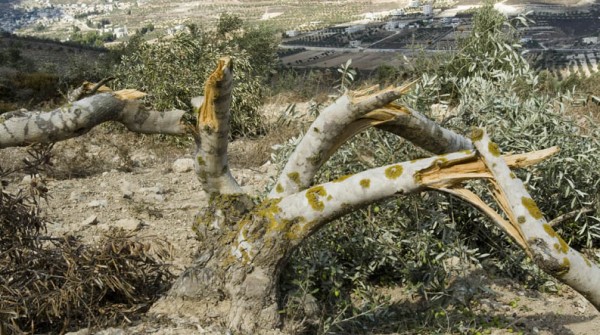
Mourning uprooted olive trees in West Bank villages

Mourning uprooted olive trees in West Bank villages

The old tractor sputtered up the hill, its engine seemingly about to expire, but its big wheels bumping across the rocky terrain. We stood in the back, swaying wildly, holding on for dear life. On the hilltop loomed the big antenna of the settlement of Yitzhar, whose houses lay on the other side of the hill. The very knowledge of their presence inspired dread. It was a glorious sunny day, the spectacular valley sprawling below. The houses of the Palestinian village of Burin lie in this valley, which lies between two hills: on one stands Yitzhar; on the other, Har Bracha, outside Nablus.

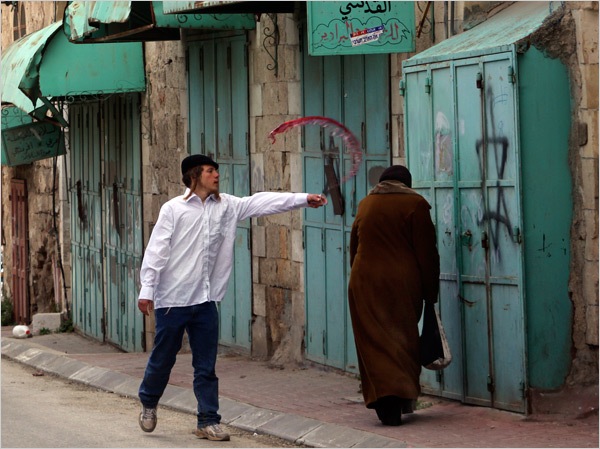
Burin is caught between a rock and hard place, between Har Bracha and Yitzhar. We have visited Burin often, most recently after settlers burned down some of its homes. Settlers once stole a horse from a villager, torched fields, demolished a home in the village and uprooted olive trees. We have frequently documented the uprooting of olive trees: Less than a month ago, in this space, we told the story of the beautiful vineyard belonging to the agriculture teacher Mohammed Abu Awad from the village of Mureir, whose 300 trees were felled by intruders – probably from the illegal outpost of Adei Ad – using buzz saws. Continue reading

Facebooktwittermail

J Street seeks to undermine BDS

J Street seeks to undermine BDS

We’ve been following J Street’s attempts to counteract the growing BDS movement. First there was its aborted release of a public letter criticizing the Toronto Declaration. Then there was the workshop at its student conference called “Reckoning with the Radical Left on Campus: Alternatives to Boycotts and Divestments.” The workshop didn’t go quite as planned either as many students who attended actually offered their support for divestment campaigns targeting the Israeli occupation. You would think these two initial missteps would lead J Street to reconsider which way the wind is blowing. Nope.

J Street is now working to undermine the National Campus Boycott, Divestment, Sanctions Conference that will be held this weekend at Hampshire College. The conference is being called to build “a coordinated national BDS campaign,” and J Street seems to feel threatened by this. Yesterday the organization sent the following email out to its student wing: [continued…]

Editor’s Comment — Strip a J Street statement of all its marketing filler and its use of slogans as a substitute for argumentation and you end up with nothing much at all.

In this case though, there is one important piece of news: “[The] Boycott, Divestment, and Sanctions (BDS) movement against Israel movement… is spreading like wild fire on campuses across the country…”

This is a major grassroots movement but J Street has the hubris and naivety to imagine it can co-opt and steer in the “right” direction. In the process J Street is increasingly coming to look like nothing more than the liberal wing of the Israel lobby.

Facebooktwittermail

For the Palestinians, all roads now lead to the UN

For the Palestinians, all roads now lead to the UN

It is hard to take seriously the threat by the Palestinian president Mahmoud Abbas to declare a Palestinian state in the West Bank and Gaza and demand recognition by the UN Security Council.

The cool response from the US and the European Union made clear that no such recognition would be forthcoming; and, as Hamas asked, what is the point of unilaterally declaring a state while those territories remain ultimately under Israeli control? Yasser Arafat already did that, in 1988.

Mr Abbas, of course, is a desperate man, because the strategy on which he has staked his political career – negotiating a two-state solution to the conflict with Israel under US auspices – is dead. The Obama administration was the last, best hope of the Palestinians for a change of course by America to deliver a credible peace. Mr Obama has been a massive disappointment, lacking either the will or the ability to compel Israel to do anything it doesn’t want to. [continued…]

‘Fatah officials warn of third Palestinian intifada’

atah had made a strategic decision to declare a third intifada against Israel, movement officials told Nazereth-based newspaper Hadith Anas, citing the failed peace talks as the reason for their resolution.

The newspaper report quoted Fatah Central Committee members as saying that the movement wished to implement a decision made during its sixth convention, which assembled last August in the West Bank city of Bethlehem.

One of the movement’s top officials interviewed by Hadith Anas said the third intifada will have a widespread popular base, adding, however, that unlike the previous popular struggle against Israel, which was sparked in September 2000, the movement will not endorse an armed struggle or the use of firearms. Continue reading

Facebooktwittermail

Hasan had intensified contact with cleric

Hasan had intensified contact with cleric

In the months before the deadly shootings at Fort Hood, Army Maj. Nidal M. Hasan intensified his communications with a radical Yemeni American cleric and began to discuss surreptitious financial transfers and other steps that could translate his thoughts into action, according to two sources briefed on a collection of secret e-mails between the two.

The e-mails were obtained by an FBI-led task force in San Diego between late last year and June but were not forwarded to the military, according to government and congressional sources. Some were sent to the FBI’s Washington field office, triggering an assessment into whether they raised national security concerns, but those intercepted later were not, the sources said.

Hasan’s contacts with extremist imam Anwar al-Aulaqi began as religious queries but took on a more specific and concrete tone before he moved to Texas, where he allegedly unleashed the Nov. 5 attack that killed 13 people and wounded nearly three dozen, said the sources who were briefed on the e-mails, speaking on the condition of anonymity because the case is sensitive and unfolding. One of those sources said the two discussed in “cryptic and coded exchanges” the transfer of money overseas in ways that would not attract law enforcement attention. [continued…]

Editor’s Comment — Finally, the real “terrorism” smoking gun: the money trail!

Problem is, in this case the trail seems to have been heading in the wrong direction: Hasan was sending the money — not receiving it. His choice for questionable donations is certainly not going to count in his favor but neither is it going to provide particularly compelling evidence of intent.

Facebooktwittermail

Three key lessons from Obama’s China tour

Three key lessons from Obama’s China tour

Russia may be engaged in a geopolitical chess game with the U.S. aimed at recovering from the demise of its great power status, but China is different. It pushes back against U.S. initiatives only when those are deemed inimical to its national interests. Iran is a good example. Beijing’s heavy investment in and reliance on Iran’s energy sector make it extremely averse to serious sanctions or strategies that create political turmoil in Tehran. While insisting on compliance with the non-proliferation regime, Beijing does not believe Iran represents an imminent nuclear weapons threat. And its response to North Korea going nuclear suggests that a nuclear armed Iran is something it could live with.

Obama went to China arguing that its emergence as a major power gives it greater responsibility, as a partner to the U.S., in helping run the world and tackle such global challenges as climate change and Iran. Indeed, there was a collective shudder in Europe’s corridors of power at the idea of global leadership being concentrated in a “G2” partnership between Washington and Beijing. They needn’t have worried. China’s response to Obama could be read as: “Running the world is your gig, we’re focused on running our own country, and ensuring security in our immediate neighborhood. We want harmonious relations with you, but don’t expect us to do anything that we deem harmful to our national interests.” That means no serious sanctions against Iran, regardless of what deals are struck between Washington and Moscow, because China’s national interests require growing Iran’s energy exports. [continued…]

Facebooktwittermail

Cleric wields religion to challenge Iran’s theocracy

Cleric wields religion to challenge Iran’s theocracy

For years, Grand Ayatollah Hossein Ali Montazeri criticized Iran’s supreme leader and argued that the country was not the Islamic democracy it claimed to be, but his words seemed to fall on deaf ears. Now many Iranians, including some former government leaders, are listening.

Ayatollah Montazeri has emerged as the spiritual leader of the opposition, an adversary the state has been unable to silence or jail because of his religious credentials and seminal role in the founding of the republic.

He is widely regarded as the most knowledgeable religious scholar in Iran and once expected to become the country’s supreme leader until a falling-out with Ayatollah Ruhollah Khomeini, the leader of the 1979 revolution and Iran’s supreme leader until his death in 1989.

Now, as the Iranian government has cracked down to suppress the protests that erupted after the presidential election in June and devastated the reform movement, Ayatollah Montazeri uses religion to attack the government’s legitimacy.

“We have many intellectuals who criticize this regime from the democratic point of view,” said Mehdi Khalaji, a former seminary student in Qum and now a senior fellow at the Washington Institute for Near East Policy. “He criticizes this regime purely from a religious point of view, and this is very hurtful. The regime wants to say, ‘If I am not democratic enough that doesn’t matter, I am Islamic.’

“He says it is not an Islamic government.” [continued…]

Facebooktwittermail

Israel: Apartheid and beyond

Beyond compare

While South Africa was explicit about the goal of apartheid policies, Israel engages in discursive subterfuge so that the intent and effects of their policies must be seen on the ground to be fully comprehended. Shulamit Aloni, the former Israeli minister of education, relates an episode at a bypass road built for settlers in the West Bank:

On one occasion I witnessed such an encounter between a driver and a soldier who was taking down the details before confiscating the vehicle and sending its owner away. ‘Why?’ I asked the soldier. ‘It’s an order—this is a Jews-only road,’ he replied. I inquired as to where was the sign indicating this fact and instructing [other] drivers not to use it. His answer was nothing short of amazing. ‘It is his responsibility to know it, and besides, what do you want us to do, put up a sign here and let some anti-Semitic reporter or journalist take a photo so that can show the world apartheid exists here?’

Part of the appeal of the apartheid comparison is that apartheid is a recognized name for an ideology and practice of separation. There is no similar name for what Israel has done. Neither the pre-state Zionist movement nor the state of Israel has ever spelled out an official policy of discrimination against the Palestinians, and Israel did not institute discriminatory practices in one fell swoop. Instead, it has worked in a piecemeal fashion to constrain Palestinian rights and access to resources. In other words, separation in the Occupied Territories has been a process whose legal contours are harder to discern and whose name has yet to circulate abroad.

A corollary assumption underlying the comparison is that Israeli practices cannot be condemned as discriminatory in and of themselves. They cannot stand on their own, partly because they are difficult to understand unless they are seen up close. Most people understand that Zionism, as an ideology and a project, calls for Jewish communal security, and due to centuries of pogroms and the Holocaust, this project commands considerable sympathy. But many people do not understand that Zionism, as put into practice, calls for an exclusivist state that leads to policies characteristic of apartheid, as defined by the UN.

Zionism retains a significant body of supporters in the West, particularly among Jews and evangelical Christians, but also the public at large. For numerous historical, cultural and political reasons, the American public in particular “stands with Israel,” a fact demonstrated by poll after poll and not lost on successive US administrations. Israel and its backers work constantly to cement this support, in part by equating criticism of Israel, the “Jewish state,” with anti-Semitism. Thus, drawing attention to the parallels between Israel’s occupation and apartheid has been one way to turn the tables, framing the occupation (and not criticism of Israel) as inherently racist. But the introduction of race into the conversation heats it up to the boiling point: As the Jews of Europe suffered from persecution and genocidal racism, and Jews comprised a large percentage of the white Americans who put their bodies on the line for civil rights, equating the practices of Zionism with racism is, for many, inconceivable. Rational debate shuts down.

It may be time to develop a new language. “Apartheid” cannot thoroughly explain Zionist ideology or Israeli practices. It can simply offer broad points of comparison, a framing in an already powerful concept. Yet the Afrikaans term does have a Hebrew counterpart in the term hafrada, meaning separation from and putting distance between oneself and others, in this case, the Palestinians. In Hebrew, the wall is often referred to as the “hafrada barrier.” [continued…]

Editor’s Comment — I seriously doubt whether any effort to develop new language can ever work. We don’t need new terms — we need to bring about a shift in the way existing terms are used.

Apartheid was a system that Africaners believed in and legally institutionalized. The campaign against apartheid was an effort to delegitimize an idea that held legitimacy in the minds of its proponents. And that seems to be the key: people give names to the things they believe in. Efforts in “discursive subterfuge” are efforts to avoid naming that which needs to be denied.

The concept of hafrada has arisen (from what I understand) in an effort to legitimize a policy of separation, yet that policy carries with it the notion that this separation comes out of a security imperative rather than an ideological conviction. It amounts to saying: We don’t want separation but the Palestinians made us do it.

The implication is that Israelis are good Western pluralists who are not racists and who would happily co-exist with their neighbors if only their neighbors could forsake their violent tendencies.

Julie Peteet says: “Perhaps the Hebrew hafrada can one day become a rallying cry as powerful as “apartheid” was in its day.”

To my mind the much more likely candidate is Zionism.

Although this is a word that is a long way from completely losing mainstream legitimacy, it has over the decades acquired increasingly negative connotations. It is a word that seems to have entered a netherworld. Self-described Zionists tend to be right-wing. Liberal Zionists either refrain from unabashedly calling themselves Zionists or they strongly emphasize the “liberal” qualification. Yet Zionism, of whatever political stripe, has at its core the notion of Jewish sovereignty in a Jewish homeland.

What does that mean? The clearest expression that I have recently heard comes from Rabi Toba Spitzer, an American Jew who in a promotional video for J Street underlined this as one of Israel’s core attributes: “[Israel is] the one place in the world where Jews are in charge.”

Whatever Israel’s future — whether its international boundaries can be agreed upon and whether a Palestinian state can be created — the continuation of Israel’s existence as a Jewish state depends on this: that it remains a state where Jews are in charge.

This, it seems to me, reveals the unvarnished nature of Zionism and exposes Israel’s hollow claim to be democratic.

Democracy is government by the demos — the people — and it allows no distinction between the multitude of groups whose amalgamation constitutes “the people”.

Jewish democracy, built on the fantasy of “a land with no people for a people with no land”, has in its practice used “democracy” as a salve to its liberal conscience, yet in the conflict between its Jewish identity and its democratic identity, democracy has consistently lost.

Israel’s enemy within: A rising militancy from the Jewish settlements

The terrorist walked up the quiet alleyway, police say, and went down nine steps and found himself hidden from view in the stone vestibule outside the famous Holocaust survivor’s apartment.

More than a half century ago the Nazis hadn’t been able to kill Ze’ev Sternhell, who would live to become Israel’s foremost expert on fascism and a long-time peace activist. But the terrorist who was now on his door step, whom police allege was a fellow Israeli from the militant settlement movement, was determined to succeed in just that. He attached the bomb, hidden inside a plant, to the doorknob and left.

Sternhell was inside the apartment in West Jerusalem. It was Sept. 25, 2008 and he and his wife had returned from a vacation in Paris the previous day. The hallway leading to the front door was still clogged up with their bags. It was late, a few minutes after midnight, and just like he does every night, Sternhell went to close the metal gate at the entrance of the vestibule that is meant to keep unwelcome guests from breaking and entering. The obstruction in his hallway forced Sternhell to turn sideways, the right side of his body facing outside, as he opened the door to the apartment.

There was a huge noise and something pushed him back. He saw the flash of an explosive. His right leg and thigh stung with pain and began to bleed. He was rushed to hospital in an ambulance. Doctors told him later that if he had not been sideways to the blast, his abdomen would likely have been pierced by the bomb’s shrapnel. He could have died.

Police who came to the scene found leaflets scattered nearby. The fliers offered a reward of $300,000 to anyone who killed a member of Peace Now, Israel’s best known peace movement. “The State of Israel has become our enemy,” the fliers said. Police officers immediately went to guard the home of Peace Now’s most-prominent figure, general secretary Yariv Oppenheimer.

I interviewed Sternhell in his home this January. The police had made no arrests back then, but Sternhell was convinced that fellow Jews had tried to kill him. “This,” said the 73-year-old, whose mother and sister were killed by the Nazis when he was 7 years old, “was an act of pure Jewish terror.” [continued…]

Rights groups: Israeli ambulance rules discriminate

Human rights groups are calling on the Israeli government to cancel instructions preventing ambulances from entering Palestinian neighborhoods in East Jerusalem without a police escort.

According Adalah, The Legal Center for Arab Minority Rights in Israel, Magen David Adom (MDA) ambulances “must wait in a Jewish neighborhood adjacent to the Palestinian neighborhood and may not enter it to transfer the injured or the sick person to the hospital until a police escort arrives, even in life threatening situations.”

In many cases, patients face long delays in receiving treatment, and must be transferred by their own family’s cars, risking complications or increased severity of illness, the rights advocates say.

In a news release on Thursday, Adalah said the procedures “violate the first rule in the work of emergency crews, which is to provide medical aid as soon as possible, and the state’s obligation to ensure the life and physical well-being of each person under its authority.” [continued…]

Facebooktwittermail

U.S. talks tougher on dealing with Iran

U.S. talks tougher on dealing with Iran

The international spokesman for Iran’s main opposition movement called for President Barack Obama to increase his public support for Iranian democrats and significantly intensify financial pressure on Tehran’s elite military unit, the Iranian Revolutionary Guard Corps.

Mohsen Makhmalbaf, during an unofficial visit to Washington, also said Thursday that Iranian opposition leaders supported U.S. efforts to use diplomacy to contain the nuclear ambitions of President Mahmoud Ahmadinejad’s government.

Mr. Makhmalbaf’s remarks came just hours after President Obama expressed growing doubt Thursday during the final day of his Asian tour about his administration’s ability to engage Mr. Ahmadinejad’s government on the nuclear issue.

Mr. Obama emphasized in Seoul that the window for diplomacy was closing and that the U.S. and its allies would begin developing a new set of sanctions against Iran.

“Iran has taken weeks now and has not shown its willingness to say yes to this proposal…and so as a consequence we have begun discussions with our international partners about the importance of having consequences,” Mr. Obama said at a joint news conference with South Korean President Lee Myung-bak.

Mr. Makhmalbaf, who was the campaign spokesman for Iranian presidential challenger Mir Hossein Mousavi, said he believes the current Iranian leadership is incapable of cutting a deal with the West, because the nuclear program is now fundamental to its political survival.

“If they agree not to pursue a nuclear bomb and start negotiations, they will lose their supporters,” Mr. Makhmalbaf said at a lunch hosted by the Carnegie Endowment for International Peace. “Definitely dialogue is better than war. … But can you continue your dialogue without any results?” [continued…]

Editor’s Comment — Well, if you want to use the Israeli-Palestinian conflict as a measure, Washington’s interest in promoting dialogue without results apparently knows no limit.

Facebooktwittermail

To succeed in Afghanistan, we must fail

To succeed in Afghanistan, we must fail

… what is depressing about the situation in Afghanistan is not that it has suddenly gotten much worse but that it steadily fails to get better. By the time U.S. forces left Vietnam, the South Vietnamese army had at least proved itself capable of holding ground against its enemy, albeit with massive U.S. air support. In Afghanistan, by contrast, district after district in the country’s troubled south is falling, in effect, under Taliban control. Meanwhile, in the Western nations with troops here, public support for the war is waning.

Would 40,000 more troops turn this around? They would buy time, provided the time is well used. But the real currency of counterinsurgency is not military strength but durability. A person will be more eager to be friends with a neighbor who will still be around in 20 years to repay any favor or grudge. The Taliban offers this. The U.S. does not. The Afghan government might.

The struggle in Afghanistan is all about Afghans sizing each other up; foreigners are mainly just bystanders. [continued…]

Afghanistan is not making Americans safer

In the light of several incidents or alleged plots that have been in the news in recent months — the Fort Hood shootings and the break-up of a terrorist ring in Colorado — it is appropriate to be re-examine the terrorist threat to the U.S. homeland, and how the debate over troop levels in Afghanistan might affect it.

The most important patterns in international terrorism, with particular reference to threats to the U.S. homeland, in the eight years since the 9/11 attacks can be summarized in two trends pointing in different directions. The first is that the group that accomplished 9/11, al Qaeda, is — although still a threat — less capable of pulling off something of that magnitude than it was in 2001. This is possible in large part because of a variety of measures that the outrage of the American public made politically possible in a way that was not possible before 9/11. These include enhanced defensive security measures at home as well as expanded offensive efforts overseas that have eroded al Qaeda’s organizational infrastructure.

The other major pattern or trend is that the broader violent jihadist movement of which al Qaeda is a part is probably at least as large and strong as it was eight years ago. Here again, some of our own actions have been major contributors. The war in Iraq was one such action. It provided a jihadists’ training ground and networking opportunity similar to what the war against the Soviets in Afghanistan had provided two decades earlier. And in the words of the U.S. intelligence community, the war in Iraq became a cause célèbre for radical Islamists. [continued…]

Facebooktwittermail

Iraq sentences Sunni leader to death

Iraq sentences Sunni leader to death

A leader of a Sunni Awakening Council was sentenced to death for kidnapping and murder on Thursday, setting off charges that the Shiite-dominated Iraqi government was trying to weaken the Sunni movement, which is credited with much of the reduction of sectarian violence here since 2006.

The Sunni leader, Adil al-Mashhadani, who led the Awakening militia in the impoverished Fadhil neighborhood of Baghdad, was arrested in March on charges of terrorism. His arrest set off 24 hours of fighting between Awakening members and American and Iraqi security forces, after which the government dissolved the Fadhil council.

A spokesman for the Justice Ministry, Abdul-Sattar Bayrkdar, provided no further details about the crime.

The Awakening Councils, also known as the Sons of Iraq, are local groups, including former insurgents and Baathists, who turned against the insurgency and received pay, first from the Americans and now from the Iraqis. Under their agreement with the government, they have tacit amnesty for past acts of sectarian violence but not for crimes like murder. [continued…]

Facebooktwittermail

CIA detainees again an issue in Lithuania

CIA detainees again an issue in Lithuania

Twice in the past three years, the Lithuanian Parliament investigated reports that the CIA secretly imprisoned al-Qaeda leaders in this Baltic country. Both times, legislators concluded that there was no evidence.

Now the Parliament is investigating a third time, and it is looking a little harder. Fresh reports of covert CIA flights carrying prisoners from Afghanistan to Lithuania, as well as the revelation that U.S. contractors built a high-security complex at the edge of a forest near Vilnius, have added to the suspicions.

Many Lithuanian officials said they remain unconvinced that their country’s secret services allowed the CIA to detain international terrorists. A few legislators blame Russia and other outside interests for inventing the allegations in an attempt to besmirch Lithuania’s reputation.

But increasingly, after years of issuing denials, Lithuania’s leaders are no longer ruling out the possibility that the CIA operated a secret prison in this northern European country of 3.5 million people, and that its government will have to deal with the fallout. [continued…]

Facebooktwittermail

Obama’s word — a fire that has turned to ashes

Little behind Obama’s tough Mideast talk: analysts

The Obama administration is hardening its tone against Israel, but analysts warned Wednesday the tough talk was mere bluster hiding the lack of a viable plan to revive the Middle East peace process.

“You’ve had three ‘no’s’ to an American president in his first year,” Aaron David Miller, who has served as advisor on Middle East peacemaking to previous US administrations, told AFP.

President Barack Obama is now “faced with the default position, which is words,” said Miller from the Woodrow Wilson International Center for Scholars.

“And the louder they shout, the more there is a paradox. The tougher the words are, the weaker we look.” [continued…]

Editor’s Comment — In an interview with Barbara Walters on Tuesday, Sarah Palin said: “I don’t think that the Obama administration has any right to tell Israel that the Jewish settlements cannot expand.”

Americans for Peace Now quickly shot back: “Gov. Palin may not be aware of it, but every American president in the past 40 years — Republican and Democrat alike — has opposed West Bank settlements. They have done so because settlement expansion is bad for American national security interests and because they have cared about Israel’s well-being.”

It’s curious at this juncture that anyone would think the best way to press the argument against settlements is by citing the consistency of Washington’s opposition — opposition that for 40 years has proved to be utterly ineffectual.

To consistently oppose settlement growth while settlements relentlessly expand suggests that Washington is either convinced that it possesses no leverage, or, that its opposition is disingenuous.

Early on, the Obama administration signaled to Israel that it would distinguish itself from its predecessor by saying what it meant: there would be no contradiction between its public and private declarations.

What Obama now needs to grasp is that the greatest asset he held when he came into office — the power of his word — is a fire that has largely turned to ashes.

There may be a few embers in there, but the only way to rebuild the fire is for the president to show the world what he can do. We no longer have any interest in what he has to say.

Israel building Jewish homes with one hand, destroying Arab homes with the other

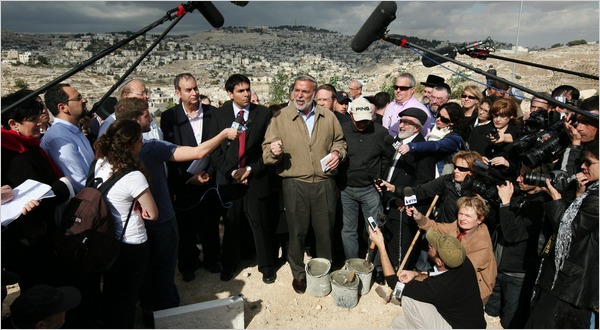
The World Likud movement held a cornerstone-laying ceremony yesterday for the expansion of the neighborhood of Nof Zion, despite – or possibly because of – American pressure against building in East Jerusalem. The Jewish settlement is in the middle of the Arab village of Jabal Mukkaber. Meanwhile, the Jerusalem municipality razed two Palestinian homes in East Jerusalem yesterday.

The plan is to add to Nof Zion 105 new apartments to the 90 ones that are already there, most of which are already occupied. The neighborhood is considered “prestigious,” but the developers ran into trouble a few years ago after they failed to sell the apartments to Jews from overseas. About a year ago the developers changed their marketing strategy to target the local national-religious market – and the apartments began selling quickly. The developers expect the same for the new part of the neighborhood.

The World Likud’s announcement of the ceremony said the neighborhood was near Jabal Mukkaber, “bounded by terraces and with olive trees and grapevines.”

In fact, however, Nof Zion is in the middle of the village, near Palestinian homes. In September Haaretz reported that the family of the late actor-comedian Shaike Ophir criticized the municipality’s decision to name a street in Nof Zion after him.

A group of American Jews interested in buying apartments in Nof Zion attended yesterday’s ceremony. New York State Assemblyman Dov Hikind, who is considered a staunch supporter of the settlers, headed the group. Continue reading

Facebooktwittermail